ISSN(Online): 2320-9801
ISSN (Print): 2320-9798
I
nternational
J
ournal of
I
nnovative
R
esearch in
C
omputer
and
C
ommunication
E
ngineering
(An ISO 3297: 2007 Certified Organization)
Vol. 4, Issue 8, August 2016
Design and Implementation of Driver
Drowsiness and Alcohol Intoxication Detection
Using Raspberry PI
Pandurang N. Kathar1, Prof. D.L.Bhuyar2
P.G Student Dept. of E&TC, CSMSS College of Engineering, Aurangabad (MS), India1
Assistant Professor, Dept. of E&TC, CSMSS College of Engineering, Aurangabad (MS), India2
ABSTRACT: Drowsiness and drunken driving causes the road accidents. This paper proposes a real time detection of driver’s drowsiness as well as alcohol intoxication and subsequently alerting them. The main aim of this proposed system is to reduce the number of accidents due to driver’s Drowsiness and alcohol intake to increase the transportation safety. This proposed system contains 8-megapixels digital USB camera, Raspberry-pi loaded with Raspbian-OS, Alcohol sensor (MQ-3) is used to detect the intake of alcohol in percentage if the intoxication matching fails GSM get triggered on and transmits warming message. The Raspberry-pi system board is serially interfaced with Arduino Uno. GSM, Bluetooth, relay circuitry and buzzers are interfaced with Arduino Uno. This will perform some task like the alarm notification and switching off the car power source.
KEYWORDS: Drowsiness detection, Alcohol intoxication, Raspberry pi, Arduino UNO, OpenCv, and GSM. I. INTRODUCTION
ISSN(Online): 2320-9801
ISSN (Print): 2320-9798
I
nternational
J
ournal of
I
nnovative
R
esearch in
C
omputer
and
C
ommunication
E
ngineering
(An ISO 3297: 2007 Certified Organization)
Vol. 4, Issue 8, August 2016
II. RELATED WORK
Different approaches for detection of driver drowsiness and alcohol intoxication detection are presented below:
In “A Real Time Embedded System Application for Driver Drowsiness and Alcoholic Intoxication Detection”[1], This work on the real time detection of car driver drowsiness and alcoholic intoxication. This detects large numbers of road accidents which takes place due to fatigue or alcohol drinking of driver. Computer vision and alcohol gas sensor application is combined to an embedded system to achieve this goal. This system consist of Drowsiness detection, alcoholic intoxication, Raspberry pi, Arduino UNO, Open CV and Embedded System.
In [2], Design of ARM based face Recognition system using Open CV library”, the authors have implemented a system using ARM 7 based microcontroller and opencv based machine. This is interfaced to USB camera for continuous images are captured and these images are processed with help of Opencv and compared with existing database.If the current images are matching with any of the existing images the system generates commandto the output unit to perform the location identification using GPS and forward the necessary information about the identified person using GSM/GPRS to concern authorities.
In”Computer Vision System for Driver Fatigue Detection”,[3] in this system can actively monitors driver vigilance level and alert the driver for any insecure driving condition. In that drowsiness detection of driver is based on viola jones algorithm for face and eyes detection. System is developed using video camera, Raspberry Pi hardware, and open source computer vision library (OpenCV) and Microsoft visual studio.
In “Tracking Eye State for Fatigue Detection”[4] the author focuses on eye states tracking. Images are capturedusing a camera and used for tracking as input of the proposed method.In first step weuse color space for drivers’ face detection and crop the face frombackground. In the next step, we estimate the area of the eyes andcrop image from this region. Then top and bottom coordinates of theeyes are located using retrench the face pixels from this area andcanny operator for edge detection. In the last step we count thenumber of white and black pixels and compare the distance betweenthese coordinates for recognition of the driver’s fatigue.
In [8]”Advance Vehicle Control and Safety System Using Face Detection”, the design is based on computer vision and embedded system application principles. System work is acombination of face detection, eye region detection and eye closing rate detection in real time environment. The proposed system is realized with a digital camera supported by embedded system board Raspberry Pi loaded with Raspian-OS and Python-IDLE with OpenCV installed. Also different vehicle control functions like center locking and unlocking, opening and closing of windows, bonnets etc. can be controlled by using Android mobilephone.
In, ,”Driver Behavior Analysis Using Non-Invasive sensors” [9], developed system uses an ARM7(LPC2129) controller as the main control unit and CAN bus within a car. ARM7 is used to obtain high performance. Use of CAN makes high-speed communication in control networks and also helps sharing of data between all nodes which results in enhancing their collaborative work. With the help of this system we can detect ECG, eye blink and alcohol Detection.
ISSN(Online): 2320-9801
ISSN (Print): 2320-9798
I
nternational
J
ournal of
I
nnovative
R
esearch in
C
omputer
and
C
ommunication
E
ngineering
(An ISO 3297: 2007 Certified Organization)
Vol. 4, Issue 8, August 2016
III. METHODOLOGY
In this section results are obtained using software and hardware platforms to achieving the objective of driver drowsiness detection and alcoholic intoxication. Besides eye and head movements, another visual cue that can potentially capture one’s level of drowsiness is his/her eyes and faces detection analysis. Making a real time application with computer vision is very effective and efficient challenging task that needs processing powerful system. OpenCV is open source software, which is used for creating computer vision. OpenCV is available in C, C++, and Python and Java programming languages extension. Raspberry controller small sized ARM 11 open source controller with the GPU provides up to 1.5Gpixels of graphics processing and processing700 MHz It can be over clocked maximum 1500MHz Raspberry-pi can work with Raspbian operating system, which is a light weight Linux. Raspbian OS is loaded with programming software and OpenCV. It supports interfacing of various low level and high level peripherals including USB camera and GPIO’s. In case of driver is in sleepy or finding fatigue, the message will be sent by using GSM and buzzer will be turned on till the GSM positive message from car owner.. Fig. 1 shows the basic block diagram of the proposed system. Haar Feature based Cascade Classifier technique, it is a machine learning based approach where a cascade function is trained from a lot of positive and negative images, and this positive image is used for detecting face region and eye region the update of region of interest ROI. Open CV is packed with a trainer as well as detector. The open CV is used for creating user defined object classifier. The object classifier that has been created is stored in.xml file extension classifier can be used in the later stages of programming. Also in this paper we use canny operator edge detection for recognize exact coordinate of eyes region. On the other hand of the system arduino is used for detection of the alcohol consumption by the person, alcohol gas sensor or breathalyzer MQ-3 is interfaced. Arduino will detect samples of the person who is driving drunk or not. Based on the output from arduino, an alarm will be turned on and the car’s ignition power source can be cut down through a relay to stop the car or preventing the driver to start the car. If driver is in over limit drunk then the message will be sent by using GSM and buzzer will be turned on till the GSM positive message from car owner.
ISSN(Online): 2320-9801
ISSN (Print): 2320-9798
I
nternational
J
ournal of
I
nnovative
R
esearch in
C
omputer
and
C
ommunication
E
ngineering
(An ISO 3297: 2007 Certified Organization)
Vol. 4, Issue 8, August 2016
IV. SYSTEM HARDWARE AND SOFTWARE CONFIGURATION
A. SOFTWARE CONFIGURATION
In this proposed system there are some necessary software tools required for the system includes Raspbian operating system, Python IDLE, Open CV, computer vision software extension for python with Haar cascade classifier and object detection ,Canny edge detector and Arduino IDE programming for alcohol sensors and corresponding outputs and AT commands use for GSM modem for messaging purpose.
B. HARDWARE MODULES
i)
RASPBERRY PI BOARDRaspberry Pi (represented in Figure.2) is a credit card sized single-board computer. Generation 2 Model B also has 4 USB ports, 1 GB RAM, USB camera interface and 1HDMI interface and 40 GPIO allows us to control and interact with real world.
Fig.2. Raspberry pi2 model B.
We implemented system using raspberry pi2 Model B. IT has a Broadcom BCM2836 system on chip which includes an ARM1176JZF-S 900 MHz processor, Video Core IV GPU, and an SD card. The GPU is capable of Blu-ray quality playback, using H.264 at 40MBits/s. It has a fast 3D core accessed using the supplied Open GL ES2.0 and Open VG libraries. The chip specifically provides HDMI and there is no VGA support. The foundation provides Debian and Arch Linux ARM distributions and also Python as the main programming language, with the support for BBC BASIC, C and Perl.
ii)Arduino UNO development board
In Arduino Uno(represented in Figure.3),"Uno" means one in Italian and is named to mark the upcoming release of Arduino 1.0 version. The Arduino Uno is a microcontroller board based on the ATmega328. It has 14 digital input/output pins (of which 6 can be used as PWM outputs), 6 analog inputs, a 16 MHz crystal oscillator, a USB connection, a power jack, an ICSP header, and a reset button. It contains everything needed to support the microcontroller; simply connect it to a computer with a USB cable or power it with a AC-to-DC adapter or battery to get started. The Uno differs from all preceding boards in that it does not use the FTDI USB-to-serial driver chip. Instead, it features the Atmega8U2 programmed as a USB-to-serial converter.
ISSN(Online): 2320-9801
ISSN (Print): 2320-9798
I
nternational
J
ournal of
I
nnovative
R
esearch in
C
omputer
and
C
ommunication
E
ngineering
(An ISO 3297: 2007 Certified Organization)
Vol. 4, Issue 8, August 2016
iii)
CAMERA INTERFACEThe USB camera module (shown in the Figure 4)used in this project . The camera plugs directly into the USB connector on the Raspberry Pi. It's able to deliver clear 8MP resolution image, or 1080p HD video recording at 30fps. This USB camera which has no infrared filter making it perfect for taking infrared photographs or photographing objects in low light (twilight) conditions.
Fig.4 USB camera
iv)
GSM Modem (SIM900)In this system GSM is used, operating frequency of GSM lies in between 900MHz and 1.8GHz bands. One of the most leading digital systems is GSM. GSM uses narrow band Time Division Multiple Access (TDMA). Of all time GSM becomes the world's fastest growing communications technology. It is the leading global mobile standard. GSM is an open, digital cellular technology, which is used for transmitting both data services and mobile voice .The GSM is able to support data transfer speeds of up to 9.6 kbps. It also allows the transmission of basic data services such as SMS.
Fig.5 GSM Modem (SIM900)
v)
ALCOHOL SENSOR (MQ-3)The alcohol sensor will detect the alcohol depends on human breath i.e. if the driver has consumed alcohol, it will be identified by his breath, and the sensor will display on the LCD regularly. The sensor is placed in front of the driver.
ISSN(Online): 2320-9801
ISSN (Print): 2320-9798
I
nternational
J
ournal of
I
nnovative
R
esearch in
C
omputer
and
C
ommunication
E
ngineering
(An ISO 3297: 2007 Certified Organization)
Vol. 4, Issue 8, August 2016
(milligrams per liter). These are also known as Breathalyzer or breathe content (BrAC).we can determine the driver consumed alcohol or not by the percent of BAC in blood of driver.
MQ BrAC values can be converted to BAC.0.1% BAC = 1000 mg/L
VI.EXPERIMENTAL RESULT
This proposed system is still in research level also integrated into few higher end cars for measuring accuracy of the proposed system and algorithm .The USB camera connected to Raspberry pi is loaded using Raspbian O.S and Python with Open CV installed in SD card.The detection program can detect image of driver using camera, face region with green rectangle, red colour rectangle are the region of interest that shows the open eye region, this get the update to Arduino UNO to every frame of detection.
Fig.7 Detection of face, open eye region.
In other part of the program eyes of the person are closed hence this close eyes red frame of rectangle detected by a system. If the closed eyes frame detect more than 5 frames in a program at that instant warning alarm through buzzer is generated. In other condition if closed eyes frames is more than threshold value of 10 frames settled for transmitting high voltage value to Raspberry Pi is serially interface with Arduino UNO and this sending message through GSM Modem.
Fig.8 Detection of face, Closed Eyes region.
ISSN(Online): 2320-9801
ISSN (Print): 2320-9798
I
nternational
J
ournal of
I
nnovative
R
esearch in
C
omputer
and
C
ommunication
E
ngineering
(An ISO 3297: 2007 Certified Organization)
Vol. 4, Issue 8, August 2016
In the other hand to detect the Alcoholic Intoxication of the driver, An alcohol gas sensor (MQ3) work as a breathalyzer for calculate alcohol intake of a driver. The testing and Observation of MQ-3 Alcohol sensor is based on the Arduino UNO programming. At the time of testing of MQ-3 Alcohol sensor there are different voltages level/samples at output. The sensor continuously variation in the range of between 0-1023, because there is 10bit ADC output. In this system is the alcoholic Intoxication is displayed in the percentage, for that purpose we program as per our condition that voltage samples is converted into percentage using Mapping Concept. If the input of alcohol is 0% to 60% at that time output is in the form of a buzzer Indication to the Driver. If the input of alcohol is Above 70% at that time GSM modem activate through Arduino UNO and send message to car owner at same time switch off the Ignition of the car through relay switch to prevent drunk driving.
The system begins to operate when the alcohol sensor detected BAC level from the driver. Then it will send the signal to Arduino UNO for further process which will involve the LCD display, alarm and ignition system. BAC level detected by alcohol sensor is based on gas or alcohol concentration in ppm (parts per million). This system is tested by Whisky alcoholic drinks / After shave lotion as the input to the experiment. The alcohol sensor can sense an alcohol from human breath from 0 ppm until 1000 ppm.In this system is the alcoholic Intoxication is displayed in the percentage, for that purpose we program as per our condition that voltage samples is converted into percentage using Mapping Concept.The result is categorized into four conditions of the driver with different value(in percentage) of BAC level which are intoxication, slightly drunk ,drunkennessand over limite drunk.
Table 1 shows the achieved result. Table 1: Result achieved in different level of drunkenness in ppm For first condition, LCD will display “intoxication” when the alcohol sensor detected BAC level from 0% to 20%.This condition showed that the driver is free from alcohol and there is no alarm sound from the buzzer is activated. While the ignition system is enable means the driver is conscious and can drive the vehicle on the road safely. The next condition is slightly drunk with 21% to 40% drunkenness level. This means the driver has drunk with a little amount of alcohol, but need to be assisted during the driving on the road. The buzzer is activated to alert the driver and the people in vicinity that the driver is slightly drunk.The third condition drunkenness level with 41% to60% . This means the driver has drunk with a little strong amount of alcohol, but need to be assisted during the driving on the road. The buzzer is activated to alert the driver and the people in vicinity that the driver is slightly drunk. In the last condition, the ignition system is deactivated as the level of BAC is too high. The driver is totally unconscious and not safe for driving. Figure 6 show the corresponding value of BAC in ppm to the alcohol sensor output voltage. Ultimately, this system help to prevent the driver to drive in risky situation and will avoid accident occur on the road
Output Level Of Drunkenness
0% -20% 21%-40% 41%-60% 61%-99%
LCD Display “Intoxication” “Slightly
Drunk” “Drunkenness”
“Over limit drunk”
Buzzer
Indication OFF OFF ON ON Ignition
System Enable Enable Enable Disable Message Send
by GSM NO No NO YES
Table 1: Result achieved in different level of drunkenness in ppm
ISSN(Online): 2320-9801
ISSN (Print): 2320-9798
I
nternational
J
ournal of
I
nnovative
R
esearch in
C
omputer
and
C
ommunication
E
ngineering
(An ISO 3297: 2007 Certified Organization)
Vol. 4, Issue 8, August 2016
No.of Samples
Operting Voltage of
MQ-3 Sensor
ALCOHOL SENSOR MQ-3 OUTPUT SAMPLES IN PPM
0%-10%
11%-20%
21%-30%
31%-40%
56%-60%
Above 60% Red
Line
Sky
Blue Green Yellow Blue Black
1 0 v 0 0 0 0 0 0
2 0.5 v 0 22 82 76 163 213
3 1 v 30 30 98 102 332 312
4 1.5 v 35 98 193 196 556 619
5 2 v 52 115 223 234 623 782
6 2.5 v 66 135 283 294 762 886
7 3 v 79 142 297 315 782 889
8 3.5 v 91 147 297 317 784 889
9 4 v 93 148 297 317 785 889
10 4.5 v 98 150 297 319 790 893
11 5 v 98 155 299 319 792 894
Table 2: shows Output voltages for the MQ-3 alcohol sensor circuit
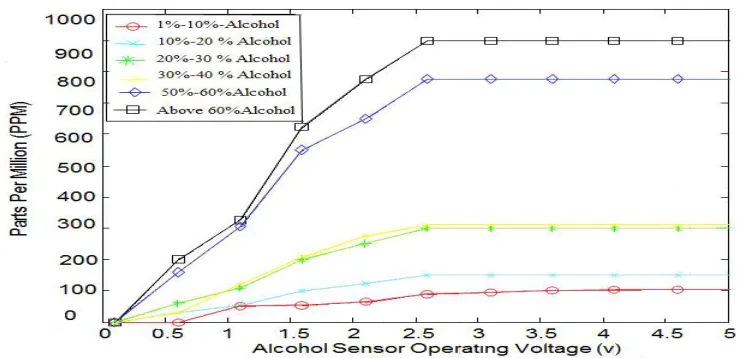
In graph shows different types of output voltages for alcohol detection in ppm with the help of above readings for different alcohol content samples, here the response of different samples is parts per million (PPM) Vs Alcohol sensor Operating voltages in Volt shown in graph.1
Graph 1: Response of ppm (In Percentage) via alcohol sensor output voltages values
VII. CONCLUSION
ISSN(Online): 2320-9801
ISSN (Print): 2320-9798
I
nternational
J
ournal of
I
nnovative
R
esearch in
C
omputer
and
C
ommunication
E
ngineering
(An ISO 3297: 2007 Certified Organization)
Vol. 4, Issue 8, August 2016
notification message with help of GSM modules. The system works well even in case of drivers wearing spectacles and under low light conditions also. Development of software algorithm is completed which is partially tested and found successfully working.
REFERENCES
1. DwipjoySarkar and AtanuChowdhury, “A Real Time Embedded System Application for Driver Drowsiness and Alcoholic Intoxication Detection”, International Journal of Engineering Trends and Technology (IJETT), Volume 10, Number 9, pp. 461-465,2014
2. T.D Prasanthi,K.Rajasekhar,T.V.Janardhanarao,and B.V.V.satyanarayana,”Design of ARM based face Recognition system using Open CV library”, International Journal of Advanced Research in Computer & Technology(IJARCET),Volume 01,Issue-9, pp-233-240, 2012
3. Varsha.E.dahiphale and Prof.sathyanarayanaR,”Computer Vision System for Driver Fatigue Detection”, International Journal of Advanced Rsearch in Electronics and communication Engineering(IJARECE), volume 04,Issue-9, pp-2331-2334,2015
4. Saeid.fazli and Parisa .Esfehani,”Tracking Eye State for Fatigue Detection”, International Conference on advanced in Computer and Electrical Engineering (ICACEE’2012), 2012
5. Lorraine Saju, ChristeenaJestine, FarhanaYasmin, and Surekha Mariam Varghese, “Drowsiness Detection System for Drivers using Haartraining and Template Matching”, International Journal of Engineering Applied Sciences and Technology, Vol. 1, Issue 6, pp. 106-110, 2016.
6. DhavalPimplaskar,Dr.M.S.Nagmode,AtulBorkar,”Real Time Eye Blinking Detection and Tracking Using OpenCV”,International Journal of Engineering Research and Application,Vol.03,Issue 05, PP-1780-1787,2013
7. Naveen M. and Sudarvizhi S., “Finger Vein Recognition Based Driver Authentication and Alertness System Using GSM”, International Journal of Research in Engineering & Advanced Technology (IJREAT), Volume 3, Issue 1, pp.211-216,2015
8. SrinivasuBatchu and S. Praveen Kumar, “Driver Drowsiness Detection to Reduce the Major Road Accidents in Automotive Vehicles”, International Research Journal of Engineering and Technology (IRJET), Volume 02, Issue 01, pp. 345-349,2015
9. L.Nikitha,J.Kiranmai,B.Vidhyalakshmi,”Driver Behaviour Analysis Using Non-Invasive sensors”, International Journal of Advance in Engineering and Science(IJATES),Volume 03,Issue 01,pp 707-714,2015
10. Prof.Saurabh Thakur, ShekharDure, AjinkyaKhutwad,”Advance Vehicle Control and Safety System Using Face Detection”, International Journal of Advance Research In Science And Engineering (IJARSE),Vol.No.4,Issue 05,pp.141-146,2015
11. AshutoshU.Jadhav and N.M.Wagdarikar,”Intelligent Vehicle System for Driver Assistance”, International Journal of Advance Research In Electrical, Electronics And Instrumentation Engineering(IJAREEIE),Vol.No.4,Issue 07,pp.6616-6623,2015
12. Element14 website. Raspberry-Pi Technical Data Sheet [online].Available: http://www.element14.com/community/docs/DOC-65470/l/raspberry-pi-technical-data-sheet
13. Arduino.cc. ArduinoUno Overview [online].Available http://arduino.cc/en/Main/arduinoBoardUno.
14. OpenCV website. Installation in Linux [online]. Available:http://docs.opencv.org/doc/tutorials/introduction/linux_install/linux_inst all.html 15. Hanwei Electronics Co., Ltd. TECHNICAL DATA MQ-3 GAS SENSOR [online]. Available: http://www.hwsensor.com
16. Python website. Python versions [online]. Available :https://www.python.org/download
BIOGRAPHY
Pandurang N. Kathar did his Bachelors of Engineering in Electronics & Telecommunication from Shreeyash College of Engineering & Technology, Aurangabad in year 2013.Currently pursuing Master of Engineering in Electronics & Telecommunication from CSMSS Chh.Shahu college of Engineering, Aurangabad (M.S).