AUZANI BIN JIDIN
INDUCTION MACHINES
AUZANI BIN JIDIN
A thesis submitted in fulfilment of the requirements for the award of the degree of Doctor of Philosophy (Electrical Engineering)
Faculty of Electrical Engineering Universiti Teknologi Malaysia
ACKNOWLEDGEMENT
I would like to express my deep gratitude to my supervisor Associate Prof. Dr. Nik Rumzi Bin Nik Idris for his invaluable suggestions, guidance and consistent support towards the completion of this thesis. Special thank to my co supervisors Prof. Ir. Dr. Halim Mohd. Yatim and Prof. Malik Elbuluk for valuable guidance and generous encouragement throughout the project duration.
I would like to thank the many people who have contributed to this thesis. In particular, to the members of academic and technical staff of the Energy Conversion Department (ENCON), Universiti Teknologi Malaysia for the cooperation and technical help.
I also wish to express my gratitude to the Universiti Teknikal Malaysia Melaka (UTeM) and the Ministry of Higher Education for providing the sponsorship to undertake this study.
ABSTRACT
ABSTRAK
TABLE OF CONTENTS
CHAPTER TITLE PAGE
DECLARATION DEDICATION
ACKNOWLEDGEMENTS ABSTRACT
ABSTRAK
TABLE OF CONTENTS LIST OF TABLES LIST OF FIGURES
LIST OF SYMBOLS AND ABBREVIATIONS LIST OF APPENDICES
ii iii iv v vi vii xii xiii xxiii xxvi
1 INTRODUCTION 1
1.1 A Look Back on Development of Vector Control Induction Machine Drives
1.2 Direct Torque Control of Induction Machines 1.2.1 The Control Structure of Basic DTC 1.2.2 Improvements of DTC Performance 1.2.3 The Popularity Versus The Complexity of
DTC-SVM based induction machines 1.3 Thesis Objectives and Contributions
1.4 Methodology of Research 1.5 Organisation of the Thesis
2 OVERVIEW OF CONVENTIONAL DIRECT
TORQUE CONTROL OF INDUCTION MACHINES
16
2.1 Introduction
2.2 Mathematical Model of Induction Machine 2.2.1 Complex Space Vector Equations 2.2.2 d-q Axis Equations
2.3 Basic Principles of Direct Torque Control 2.3.1 3-Phase Voltage Source Inverter Space
Vectors
2.3.2 Direct Flux Control 2.3.3 Direct Torque Control
2.3.4 De-coupled Control of Torque and Flux in DTC-hysteresis based Induction Machine 2.3.5 Estimations of stator flux and electromagnetic
torque
2.4 Major Problems in Hysteresis-Based DTC 2.4.1 Variable inverter switching frequency 2.4.2 High Torque Ripple
2.4.3 The Need of High Speed Processor 2.5 Chapter Conclusions
16 16 18 20 22 22 24 28 34 35 37 37 38 39 42
3 ENLARGING SWITCHING FREQUENCY TO MINIMIZE TORQUE RIPPLE UTILIZING A
CONSTANT FREQUENCY TORQUE CONTROLLER 43
3.1 Introduction
3.2 DTC with Constant Frequency Torque Controller 3.3 Design Procedure of Constant Frequency Torque
Controller in DTC 3.4 Experimental Set-up 3.5 Experimental Results 3.6 Chapter Conclusions
4 AN OPTIMIZED SWITCHING STRATEGY FOR QUICK TORQUE DYNAMIC CONTROL
58
4.1 Introduction
4.2 Dynamic Torque Control in the Hysteresis-Based DTC
4.3 Effect of Selecting Different Voltage Vectors on Torque Dynamic Performance in the Hysteresis-Based DTC
4.4 The Proposed Torque Dynamic Control
4.4.1 An Optimized Voltage Vector for Quick Torque Dynamic Control
4.4.2 The Proposed Control Structure 4.5 Simulation and Experimental Results
4.5.1 Simulation of the Proposed Torque Dynamic Control
4.5.2 Experimental Set-up
4.5.3 Improved Torque Dynamic Control for Hysteresis-based DTC
4.5.4 Improved Torque Dynamic Control for Constant Switching Frequency-based DTC 4.5.5 Behavior of Motor Currents during Torque
Dynamic Condition 4.6 Chapter Conclusions
58 59 59 63 63 66 68 69 73 74 80 83 85
5 A WIDE-SPEED HIGH TORQUE CAPABILITY UTILIZING OVERMODULATION STRATEGY FOR DIRECT TORQUE CONTROL OF INDUCTION MACHINES
86
5.1 Introduction
5.2 Torque Capability in DTC
5.3 Improved Torque Capability with the Proposed Overmodulation Strategy
5.3.1 Extending the Stator Voltage Operation to
86 87 90
Six-Step Mode
5.3.2 Extending the Limit of Stator Flux Angular Frequency
5.3.3 Flux Weakening with Six-Step Mode 5.4 The Proposed Hybrid DTC Scheme
5.4.1 Hexagonal Flux Control in the Proposed Hybrid Scheme
5.4.2 Definition of Dynamic Condition 5.5 Simulation and Experimental Results
5.5.1 Simulation of the Proposed Overmodulation and Flux Weakening Strategy in the Hybrid DTC Scheme
5.5.2 Experimental Set-up mproved Torque
Capability for Constant Switching Frequency-based DTC
5.5.3 Improved Torque Capability for Hysteresis-based DTC
5.5.4 Improved Torque Capability for Constant Switching Frequency-based DTC
5.6 Chapter Conclusions
93 93 95 96 102 104 104 110 112 117 121
6 DESCRIPTION OF THE EXPERIMENTAL SET-UP 122 6.1 Introduction
6.2 DS1102 Controller Board
6.3 Altera Field Programmable Gate Array – APEX20KE 6.4 Gate Drivers and 3-Phase Voltage Source Inverter
(VSI)
6.5 Induction Machines 6.6 Chapter Conclusions
122 124 129 132 135 137
7 CONCLUSION AND FUTURE WORK 138 7.1 Conclusions
7.2 Future Work
REFERENCES Appendices A-G
LIST OF TABLES
TABLE NO. TITLE PAGE
2.1 Voltage vectors selection table as proposed in [13] 35
3.1 Induction machine parameters 51
3.2 PI controllers gains and crossover frequency 52
4.1 DTC-Hysteresis based system and induction machine parameters
73
5.1 DTC-Hysteresis Based/Hybrid Systems and Induction Machine Parameters
111
6.1 Induction machine parameters 136
LIST OF FIGURES
FIGURE NO. TITLE PAGE
1.1 Control structure of basic DTC-hysteresis based induction machine
4
1.2 Variations of modified reference voltage vectors which is applied during dynamic overmodulation mode
7
1.3 A general block diagram of generation of switching in DTC-SVM
10
2.1 Cross-section of a single pole-pair three-phase machine
17
2.2 A space vector x in the three-phase symmetric system (based on (2.1))
19
2.3 Schematic diagram of Voltage Source Inverter (VSI) 23
2.4 Voltage space vectors of a 3-phase inverter with the corresponded switching states
24
2.5 Control of flux magnitude using a 2-level hysteresis comparator
25
and the flux error status for the two-level hysteresis flux comparator
2.7 Definition of six sectors of the stator flux plane 27
2.8 Two possible active voltages are switched for each sector to control the stator flux within its hysteresis band
27
2.9 The variation of δsr with application of (a) active voltage vector, (b) zero or radial voltage vector, (c) reverse voltage vector
29
2.10 The application of voltage vectors in controlling the δsr
as well as the output torque for 4-quadrant operation
31
2.11 Control of torque using a 3-level hysteresis comparator 33
2.12 Typical waveforms of the torque, the torque error and the torque error status for the three-level hysteresis torque comparator
33
2.13 A de-coupled control structure of DTC-hysteresis based induction machine
34
2.14 The waveforms of output torque sampled at DT in the hysteresis comparator for (a) low speed, (b) middle speed and (c) high speed
39
2.15 Experimental results of control of output torque utilizing three-level hysteresis comparator (in
hysteresis based-DTC). (a) Hysteresis band = 2HBTe, sampling time=2DT, (b) hysteresis band = HBTe,
sampling time=2DT and (c) Hysteresis band = HBTe, sampling time=DT
3.1 Constant frequency torque controller (CFTC) 45
3.2 Typical waveforms of the constant frequency torque controller
45
3.3 Generated upper triangular waveform using DSP (sampled at DT µs)
46
3.4 Averaged and linearized torque loop (as proposed in [32])
49
3.5 Generated upper triangular waveforms sampled at 55
µs. (a) DTC-CSF1, (b) DTC-CSF2 and (c) DTC-CSF3
51
3.6 Bode plot of loop gain with PI controller for (a) DTC-CSF1, (b) DTC-CSF2 and (c) DTC-CSF3
52
3.7 Experimental results of phase current frequency spectrum and output torque for the basic DTC, DTC-CSF1, DTC-CSF2 and DTC-CSF3 at the speed about (a) 20 rad/s (b) 30 rad/s and (c) 55 rad/s
54
3.8 Experimental results for step response of torque in (a) DTC-hysteresis based, (b) DTC-CSF1, (c) DTC-CSF2 and (d) DTC-CSF3. (1) is output torque, (2) is reference torque, (3) is torque error, (4) is output of PI controller, (5) is upper triangular waveform, (6) is torque error status. (x-axis or time scale: 2 ms/div.)
3.9 The zoomed image (zoomed area indicated by '↔’) of the waveforms of upper triangular and output of PI controller for (a) DTC-CSF1, (b) DTC-CSF2 and (c) DTC-CSF3, corresponds the results obtained in Figure 3.8 (b),(c) and (d). (Time scale: 1 ms/div.)
56
3.10 Experimental results of output torque, motor speed and d-axis flux component for a square-wave speed
reference for (a) the basic DTC and (b) DTC-CSF2 based induction machine drives
57
4.1 The selection of two possible active voltage vectors in controlling the flux in Sector III
60
4.2 Space vectors of the applied voltage, the stator flux and the rotor flux
61
4.3 Inconsistent torque slope due to selection of different voltage vectors
62
4.4 Effects of selecting different switching modes under torque dynamic conditions (a) when the stator flux is about to enter sector h, (b) when the stator flux is at the middle of sector h
64
4.5 Comparison of the load angle, ∆δsr for three different modes of switching under torque dynamic conditions (a) when the stator flux is about to enter sector h (b) when the stator flux is at the middle of sector h
65
4.6 Structure of DTC-hysteresis based induction machine with the proposed modification of flux error status
4.7 The proposed digital outputs in modified flux error status correspond to the optimized voltage vectors for every subsector in each sector
68
4.8 Simulink blocks of the DTC drive with the proposed block of modification of flux error status
70
4.9 Identification of flux sector and determination of the appropriate flux error status in the block of
modification of flux error status
71
4.10 Generation of reference torque from 1.5 Nm to 9 Nm at a specific flux positions (i.e. case1 at the middle Sector II or case2 at the boundary Sector I and II)
72
4.11 Experimental Set-up (DTC with torque control loop) 74
4.12 Comparison by simulation and experimental of dynamic torque performance between (a) DTC1 and (b) DTC2, when a dynamic torque control occurs as the stator flux position at αh=π/24 rad.
76
4.13 Comparison by simulation and experimental of dynamic torque performance between (a) DTC1 and (b) DTC2, when a dynamic torque control occurs as the stator flux position at αh=π/6 rad. (at the middle of Sector II)
77
4.14 Comparison of stator flux locus obtained in (a) DTC1 and (b) DTC2 (for one complete flux wave cycle) when a dynamic torque condition occurs at αh=π/24 rad.
4.15 Comparison of stator flux locus obtained in (a) DTC1 and (b) DTC2 (for one complete flux wave cycle) when a dynamic torque condition occurs at αh=π/6 rad.
79
4.16 Structure of DTC-constant switching frequency (DTC-CSF) based induction machine with the proposed modification of flux error status block
80
4.17 Comparison by experimental of dynamic torque performance for (a) DTC1, (b) DTC2 and (c) DTC-CSF2 when a dynamic torque control occurs as the stator flux position at αh=π/24 rad.. (1) is stator flux (Wb), (2) is flux error status, (3) is output torque (Nm) and (4) is torque error status
81
4.18 Comparison by experimental of dynamic torque performance for (a) DTC1, (b) DTC2 and (c) DTC-CSF2 when a dynamic torque control occurs as the stator flux position at αh=π/6 rad.. (1) is stator flux (Wb), (2) is flux error status, (3) is output torque (Nm) and (4) is torque error status
82
4.19 The behavior of motor currents since the flux magnitude suddenly distorted due to the proposed switching strategy as the dynamic torque occurs at
αh=π/24 rad. and αh=π/6 rad. The dynamic torque control is applied at three different speed operations for (a) at around 100 rpm (b) at around 300 rpm (c) at around 540 rpm
84
5.1 Phasor diagrams of vectors of stator voltage, ohmic voltage drop and back-emf for (a) low speed operation and (b) base speed operation
5.2 The mapping of the voltage vector and the stator flux trajectories
92
5.3 The comparison of the performances of stator voltage and torque capability for (a) DTC without the
proposed overmodulation and (b) DTC with the proposed overmodulation (Time scale: 162.5 ms/div.)
92
5.4 More rapid motor acceleration achieved with the proposed overmodulation and flux weakening strategy when a step change of reference speed is applied at time t1
95
5.5 The structure of hybrid DTC of induction motor drive with the proposed block of ‘modification of flux error status’
97
5.6 Ideal case of hexagonal flux control based on Ψs- 98
5.7 Effect of ohmic voltage drop on the trajectory of stator flux vector. (a) stator flux locus (b) phasor diagram of (5.3)
100
5.8 Flux keeps the increase as it enters to subsector ii until it reaches to the point c. (i.e. path b-c) with the Ψs,mod- = 0
101
5.9 State diagram of finite state machine that establishes the modified flux error status (Ψs,mod-) for proper hexagonal flux locus operation
101
5.10 The selection of flux error status in the block of modification of flux error status. (a) Original flux
error status Ψs+ for circular locus (b) Modified flux error status Ψs,mod- for hexagonal locus
5.11 Block diagram of a PI speed controller and flux weakening algorithm
103
5.12 Simulink blocks of the DTC drive with the proposed block of modification of flux error status and the block of a PI speed controller and a flux weakening
algorithm
107
5.13 Identification of flux sector and determination of the appropriate flux error status Ψs,mod- (based on Figure 5.9), in the block of modification of flux error status
108
5.14 Generation of references of torque and stator flux from a PI speed controller and flux weakening algorithm
109
5.15 Experimental Set-up (DTC with speed control loop) 110
5.16 Comparison of capability of torque obtained in (a) DTC-HYS1 and (b) DTC-HYS3 (Time scale: 400ms/div.)
113
5.17 Comparison of torque control as the speed reaches its target for (a) DTC-HYS2 and (b) DTC-HYS3 (Time scale: 400ms/div.)
115
5.18 Stator flux locus correspond to the results obtained in Figures 5.16 and 5.17 for (a) DTC-HYS1, (b) DTC-HYS2 and (c) DTC-HYS3
5.19 Comparison performances of torque capability, current wave shape and torque ripple in (a) DTC-HYS1, (b) DTC-HYS3, (c) DSC and (d) DTC-CSF2
119
5.20 Comparison by experimentation of torque capability in flux weakening region obtained in (a) DTC-HYS1, (b) DTC-HYS3 and (c) DTC-CSF2 (Time scale:
400ms/div.)
120
5.21 Comparison of torque dynamic performance in a flux weakening region, obtained in (a) DTC-HYS1, (b) DTC-HYS3 and (c) DTC-CSF2 (which is corresponded to the results obtained in Figure 5.20) (Time scale: 40ms/div.)
121
6.1 Complete drive system (a) picture of the experiment set-up, (b) functional block diagram of the experiment set-up
123
6.2 Identifying sectors of the stator flux (a) definition of
Ψsq,1, (b) determining sector based on threshold values, i.e. 0 and Ψsq,1
125
6.3 Identifying sectors of the stator flux (a) definition of
Ψsq,1, (b) determining sector using Ψsq,1
127
6.4 Altera FPGA (APEX20KE) 129
6.5 Block diagram of voltage vectors selection table and blanking time generation
131
6.6 Block diagram of blanking time generation for a single leg (i.e. phase a)
6.7 Timing diagram of blanking time generation for a single leg (i.e. phase a)
132
6.8 Schematic of the gate driver circuit 133
6.9 Schematic of the IGBT module with the capacitor Snubbers
134
6.10 Gate drivers and VSI 134
6.11 A coupling between induction machine (right) and DC machine (left)
LIST OF SYMBOLS AND ABBREVIATIONS
AC - Alternating Current ADC - Analog to digital converter
B - Viscous friction
CFTC - Constant Frequency Torque Controller
Cupper - Upper triangular carrier
Clower - Lower triangular carrier
Cp-p - Peak to peak value of the triangular carrier
d,q - Direct and quadrature axis of the stationary reference frame dΨs, qΨs - Direct and quadrature axis of the estimated stator flux
reference frame
DAC - Digital to analog converter
DC - Direct Current
DSP - Digital Signal Processor DTC - Direct Torque Control DSC - Direct Self Control emf - Electromotive force fc - Carrier frequency fsw - Switching frequency FOC - Field Oriented Control
FPGA - Field Programmable Gate Array I.E - Incremental Encoder
I.M - Induction Machine
isg, irg - Stator and rotor current space vectors in general reference
frame
is, ir - Stator and rotor current space vectors in stationary reference
frame
reference frame
isd, isq - d and q components of the stator current in stationary
reference frame
J - Moment of inertia
kp - Proportional gain of the PI controller for CFTC
kpw - Proportional gain of the PI controller for speed controller ki - Integral gain of the PI controller for CFTC
kpw - Integral gain of the PI controller for speed controller
Lm - Mutual inductance
Ls - Stator self-inductance Lr - Rotor self-inductance P - Number of pole pairs PI - Proportional - Integral p.p.r - Pulse per revolution PWM - Pulse Width Modulation Rs, Rr - Stator and rotor resistance r.m.s - Root mean squared SVM - Space Vector Modulation Sa, Sb, Sc - Switching states of phase a, b, c Te - Electromagnetic torque
Te,rated - Torque rated
Te,ref - Reference torque
TPI - Output of PI controller for the CFTC
Tstat Torque error status
ttri - Period of Cupper or Clower THD - Total Harmonic Distortion VDC - DC link voltage
vsg - Stator voltage space vector in general reference frame
vs - Stator voltage space vector in stationary reference frame
vsd, vsq - d and q components of the stator voltage in stationary
reference frame
VHDL - VHSIC hardware description language VSI - Voltage Source Inverter
θr - Angle with respect to rotor axis
θs - Angle with respect to stator axis
δsr - Difference angle between stator flux linkage and rotor flux linkage
Ψs g
, Ψr g
- Stator and rotor flux linkage space vectors in general reference frame
Ψs, Ψr - Stator and rotor flux linkage space vectors in stationary
reference frame
Ψs - Estimated stator flux linkage
Ψsd, Ψsq - d and q components of stator flux in stationary reference frame
ΨsdΨs, ΨsqΨs - d and q components of stator flux in stator flux reference frame
ωr - Rotor electrical speed in rad./s
ωe - Steady state synchronous frequency in rad./s ωm - Rotor mechanical speed in rad./s
ωslip - Steady state slip frequency in rad./s
σ - Total flux leakage factor
LIST OF APPENDICES
APPENDIX TITLE PAGE
A Derivation of torque and flux equations 151
B Derivation of torque rate equation 153
C Derivation of the relationship between the angle δsr and the slip angular frequency
156
D Simulation of DTC 158
E DSP source code listings 164
F VHDL code 178
CHAPTER 1
INTRODUCTION
1.1 A Look Back on Development of Vector Control Induction Machine Drives
In the past decades, DC machines have been used extensively in many applications due to its simplicity and offers high performance torque control. Their mechanical commutation action forms the torque and flux components that are always orthogonal, which allows high performance control achieved under optimal conditions. Despite their excellent performance and simple control structure, the construction using the mechanical commutator and brush cause some limitations. For examples, they require regular maintenance and cannot be operated in the dirty or explosive environment, their speed is limited and they are expensive. Unlike DC machines, the induction machines are robust, require less maintenance, cheaper and able to operate at higher speed. The induction machines became popular and gradually replacing DC machine drives in many industrial applications as the Field Oriented Control (FOC) introduced by F. Blachke in 1970’s can produce comparable performance to that obtained in DC machines [1]. Moreover, their popularity is also assisted by the rapid development in power semiconductor devices and the
quantities. The rotating reference frame refers to the rotating space vector quantity which can be either rotor flux or stator flux. The one which is based on rotor flux (referred as Rotor Flux Oriented Control (RFOC)) is sensitive to the parameter variations, and also it requires the knowledge of rotor speed. The improvements of the FOC performance were reported in many technical papers; these include the areas of robust control [3-5], improved flux estimator [6-9] and sensorless speed control [10-12].
1.2 Direct Torque Control of Induction Machines
Over the past years, Direct Torque Control (DTC) scheme for induction motor drives [13] has received enormous attention in industrial motor drive
applications. It was also used as the main platform for the ABB inverter technology, and the first DTC drive was marketed by ABB in 1996 [14-15]. Its popularity increases since it offers a faster instantaneous dynamic control and its control
structure is simpler compared to the field-oriented control (FOC) scheme [13, 16-17]. In DTC, the torque and flux are controlled independently, in which their demands are satisfied simultaneously using optimum voltage vectors. Unlike the FOC drives, where the torque and flux are controlled corresponded to their producing current components (i.e. d and q axis components of stator current) which requires frame transformer, knowledge of machine parameters and current regulated Pulse Width Modulation (PWM).
1.2.1 The Structure of Basic DTC
3-level and 2-3-level hysteresis comparators, respectively. To satisfy the torque and flux demands, the appropriate voltage vector for a particular flux sector should be chosen, either to increase torque or to reduce torque and at the same time either to increase stator flux or to decrease stator flux; based on torque error status, flux error status and flux orientation. In fact, high performance control in DTC drive with proper selection of voltage vectors can be established if the flux as well as torque is estimated accurately. A combination of the voltage model and the current model using a first-order lag network was implemented in [13] to obtain a proper flux estimator for entire speed range operations. The use of the current model is superior in estimating the flux at very low speed operations, but it requires the knowledge of motor speed, which in turns requires an observer or a speed sensor from the motor shaft. On the other hand, the implementation of the voltage model provides better flux estimation for high speed operations and requires only stator resistance and terminal quantities (i.e. stator voltages and stator currents), which leads to the robust control of DTC. However, the digital implementation of this model utilizing
microprocessor or digital signal processor introduces some problems, i.e. the integration drift and initial condition problems [18-20].
In hysteresis-based DTC, the switching frequency of VSI is totally
1.2.2 Improvements of DTC Performance
Since DTC was first introduced in 1986 [13], several variations to its original structure (which referred to as DTC hysteresis-based) were proposed to improve the performance of DTC of induction machines. Noticeably, most researches in last
decades aimed to overcomethe inherent disadvantages of hysteresis-based DTC
schemes, such as variable switching frequency and high torque ripple. In addition, some recent researches interested to facilitate the DTC to be operated in
overmodulation mode that will improve the dynamic performance and the power output of DTC of induction machines. To relate the study of this thesis, some reviews on improvements of DTC are concentrated into three following research areas:
Torque Ripple Reduction or/and Constant Switching Frequency
Basically, the output torque ripple can be reduced by reducing the band width of hysteresis comparator to the appropriate value. The selection of the appropriate
Figure 1.1 Control structure of basic DTC-hysteresis based induction machine Switching
table +
IM Sa, Sb, Sc
sector -
Te,ref
+ - Ψs,ref
Te Ψs
Voltage source inverter
(VSI)
Stator flux and electromagnetic torque estimators (i.e. only using the voltage model)
band width is based on the worst operating conditions [24]. This will ensure the switching frequency of switching devices do not exceed its limit (or thermal restriction). It is also desirable to use a high speed processor to keep the ripple within the band, in such a way the discrete hysteresis controller will perform like the analog one.
Instead of decreasing the hysteresis band and using a high speed processor, the ripple can be minimized by injecting high-frequency triangular waveforms to the errors of torque and flux [25]. This method is called dithering technique, which is simple and effective to minimize the torque ripple even performing DTC at limited sampling frequency. However, it still produces unpredictable switching frequency since the torque and flux slopes which are related to the switching frequency, do vary with operating conditions [23, 26].
Several methods had been proposed to provide a constant switching frequency as well as reduced output torque ripple [22, 27-38]. In [27], a constant switching frequency is established in the hysteresis-based DTC by adjusting the band width of the hysteresis comparators according to the changes in operating conditions. The adjustable of band width is based on a PI controller and a pulse counter, for each comparator. This, consequently, increases the complexity of the DTC drive.
Moreover, this technique does not guarantee reduction of torque ripple as it is
approach to solve the problems is using the space vector modulation [28, 31, 33-35]. In this approach, the switching period is subdivided into three or more states, to synthesize the desired voltage vector in order to produce the minimum torque ripple.
Recently, predictive control strategy to DTC has gain considerable amount of attention particularly due to its ability to reduce the torque ripple and switching frequency [36-39]. In particular model predictive control (MPC) which was applied in [38] and [36] uses the hysteresis comparators but with the switching table replaced with online optimization algorithm.
Fast Torque Dynamic Control through Dynamic Overmodulation Strategy
Without the need to use any extra hardware, the torque dynamic performance can be improved by fully utilizing the available DC link voltage through
overmodulation. To perform the DTC under the overmodulation mode, it is
preferable to use the Space Vector Modulation (SVM) [28, 40-44] rather than other techniques (for example, [45-46] use the triangular carrier based). This is because, the SVM is more flexible to be adopted for advanced motor control where only a single reference voltage vector vs,ref is employed to define the mode of
overmodulation.
During large torque demand, it is inevitable that the reference voltage vs,ref
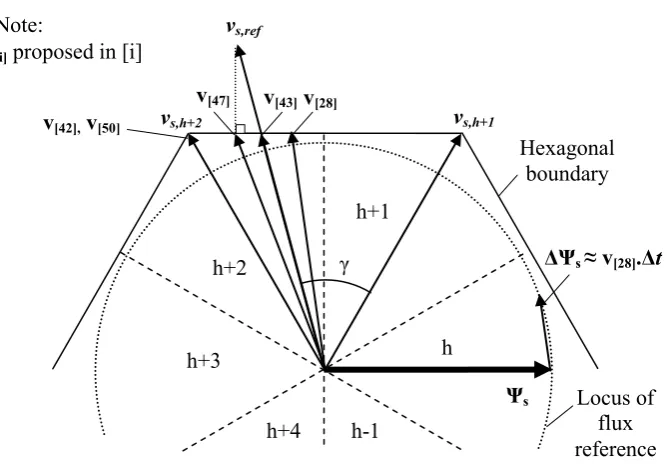
exceeds the voltage vector limits enclosed by the hexagonal boundary. Under this condition, the SVM has to be operated in what is termed as dynamic overmodulation mode. The voltage reference vector vs,ref has to be modified such that it will lie on
the hexagonal boundary.
vs,ref, which is beyond the hexagonal boundary of the voltage vectors. Note that, voltage vector components are not drawn to scale. It can be seen that (from Figure 1.2), [42] and [50] switched only single voltage vector which is vs,h+2 during dynamic overmodulation. This single selection of vector shows the occurrence of a six-step operation that produces the fastest dynamic torque control as will be discussed later in Chapter 4. While the other methods result in slower dynamic torque response since two active states are alternately switched during the dynamic condition. For example, [28] used two active states utilizing dead-beat control in order to maintain the magnitude of stator flux under control for any condition. Later, [43] was proposed to simplify the complexity control structure in [28], (where it does not provide a dead beat control of the magnitude flux as a transient torque encountered) and hence results in a faster dynamic torque control. In this way, the modified voltage vector, v[43] has the same angle, γ as the original reference voltage, vs,ref but
with a modified magnitude. In [47], the reference voltage, vs,ref was modified to v[47] such that the error between the magnitude of v[47] and vs,refis minimized. This means the modified voltage vector, v[47] should be closest to the original reference vector
vs,ref by ensuring that a line joining the vs,ref and v[47] is orthogonal to the hexagon boundary. h Ψs h+1 h+2 h+3
h+4 h-1
vs,h+1 vs,h+2 v[28] v[43] vs,ref v[47]
γ ΔΨs ≈ v[28].Δt
Hexagonal boundary Locus of flux reference *Note:
v[i] proposed in [i]
v[42], v[50]
Enhanced Torque Capability using Flux Weakening or/and Overmodulation Strategy
A wide-speed high torque capability is a very important feature in many electric motor drive applications. In automotive applications, it is usually referred to as a high ‘Constant Power Speed Range’ (CPSR). The availability of wide range of speed operations with the maximum capability of torque is of main concern,
especially for the road electric vehicles where multiple gears have to be avoided.
In practice, a flux weakening strategy is normally used to extend the motor speed operations beyond the base speed and to enhance the capability of torque. Several papers were published [42, 50-63] proposing the solution of achieving maximum torque capability in field weakening region. The common approach adopted is to estimate the optimal flux level of the motor based on the maximum values of inverter voltage and inverter current. Typically, the algorithms require frame transformer, knowledge of machine parameters and space-vector modulator. For examples, [53] used Field Oriented Control-Space Vector Modulation (FOC-SVM) while [63] used Direct Torque Control-Space Vector Modulation (DTC-SVM), and they consider voltage and current limit conditions to compute the
controllable currents (in stator flux reference frame) in achieving the appropriate flux level in field weakening region. Besides that, some papers had been reported to provide a robust field weakening strategy so that any variations of machine
parameters used in calculating the optimal flux can be compensated [55, 59, 61-62].
1.2.3 The Popularity Versus The Complexity of DTC-SVM based induction machines
The most popular variation of DTC of induction motor drives is the one that is based on space vector modulation (SVM), which normally referred to as DTC-SVM [28, 33, 40, 42, 64-66]. As mentioned previously, the advantages provided by this scheme not only solve the inherent problems in hysteresis-based DTC but also facilitate the DTC performs under overmodulation region. Moreover, the study of the SVM itself in the area of overmodulation strategy improvement for 3-phase VSI was reported by many researchers [41, 46-47, 49, 66-73]. All these evidences show that the implementation of SVM to operate under overmodulation region is well established, and widely adopted for advanced motor control.
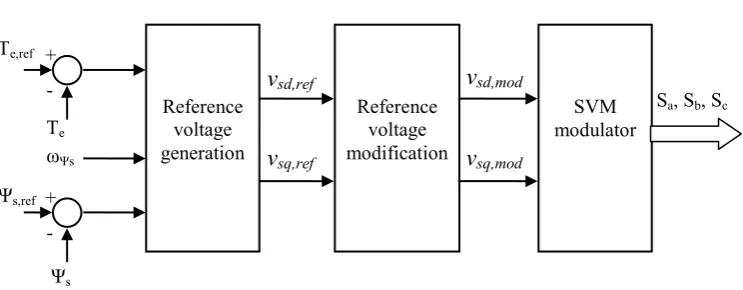
The major difference between DTC hysteresis-based and DTC-SVM is the way the stator voltage is generated. In DTC hysteresis-based the applied stator voltage depends on voltage vectors, which are selected from a look-up table. The selections are based on the requirement of the torque and flux demand obtained from the hysteresis comparators. On the other hand, in DTC-SVM, a stator voltage reference is calculated or generated within a sampling period, which is then
synthesized using the space vector modulator. The stator voltage reference vector is calculated based on the requirement of torque and flux demands. Due to the regular sampling in SVM, the DTC-SVM produces constant switching frequency as opposed to the variable switching frequency in hysteresis-based DTC however, at the expense of more complex implementation.
DTC-SVM becomes complicated as the reference voltage needs to modify whenever it passes outside the hexagon (due to the physical constraint of inverter as the vs,ref defines mode of overmodulation), particularly during a large torque demand. Some modified reference voltages as mentioned previously are shown in Figure 1.2. Figure 1.3 shows a general block diagram of generation of switching in DTC-SVM, which contains three main components and the functional of the two of them are as mentioned above.
Ultimately, all of the proposed methods [28, 33, 40, 42-43, 64-65, 74-77] complicate the basic control structure of DTC drive systems as originally proposed in [13].
1.3 Thesis Objectives and Contributions
The objective of this thesis is to study, implement and improve the performance of the DTC of induction machines. Despite the improvements, the proposed methods also aim to preserve the simple control structure of DTC drive. The thesis proposes a simple, yet significant, method of overmodulation strategy employed in the DTC-hysteresis based induction machine to improve torque
dynamic control and to enhance torque capability for a wide speed range operation. Figure 1.3 A general block diagram of generation of switching in DTC-SVM
SVM modulator +
- Te,ref
Ψs,ref
Te
Ψs
+ -
Reference voltage generation ωΨs
Reference voltage modification
vsd,ref
vsq,ref
vsd,mod
vsq,mod
The thesis also shows that the proposed methods can be implemented using a constant switching controller [32] (which has a similar control structure with the hysteresis-based DTC), in order to give extra advantages of providing a constant switching frequency and reduced torque ripple. While doing the research, the thesis makes the following contributions:
It shows the reduction of torque ripple in [32] can be further reduced by enlarging the constant frequency of triangular carriers. This is achieved without the need of reducing the sampling period which is useful for the DSP or microprocessor with a limited sampling frequency.
It analyses the effect of different voltage vectors selection on the performance of torque dynamic control in DTC induction machine drive. Although the hysteresis-based DTC is well established to give a high performance torque control, there is still room to further improve the performance based on the observation of the analysis.
It introduces a modification block of flux error status in the hysteresis-based DTC drive which is responsible to perform dynamic overmodulation. This technique is very simple, yet it gives the fastest torque dynamic control. The introduced block can also be implemented in [32] to verify the improvements.
It justifies the extension of constant torque region and hence improvement of torque capability can be obtained by controlling the locus of flux into
hexagonal shape. With this method, the stator voltage in the DTC drives (i.e. in [32] and hysteresis-based DTC) can be transformed with a smooth
transition from PWM to the six-step mode.
performed in DTC during the steady state (that produces lower current’s THD) and hexagonal flux locus as performed in Direct Self Control (DSC) when dynamic condition encountered (that gives superior dynamic
performance). The feasibility of the proposed method is verified using the hysteresis-based DTC and the scheme proposed by [32].
It improves dynamic performances in flux weakening region. With the proposed overmodulation strategy, the fastest torque dynamic control and higher torque capability are achieved with the complete six-step voltage.
It introduces a step reduction of reference flux to ensure proper torque control when a motor speed reaches its target in a flux weakening region. This is to avoid an inappropriate level of reference flux (i.e. too high flux level) as the hexagonal flux changes to the circular.
It develops a simulation and experimental set-up to verify the proposed improvements on the DTC drive. The simulation is based on Matlab and Simulink program from Mathworks inc.. The experimental set-up consists of a DS1102 DSP controller board as the main processor and APEX20KE Altera FPGA. The combined controller board is implemented so that the sampling period of the DSP can be minimized by distributing some of the tasks to the FPGA.
1.4 Methodology of Research
strategies, constant switching frequency and reduced torque ripple strategy was also carried out.
The development of the overmodulation strategy for the hysteresis-based DTC is based on the modification of flux error status on the stator flux plane. To achieve the fastest torque dynamic control, the most optimized voltage vector is switched and held. The selection of the voltage is determined by the modified flux error status. To enhance torque capability, the proposed overmodulation and flux weakening strategies are utilized in the hybrid DTC scheme. This scheme performs the control of flux in dual mode operations. This is established using the introduced block named as ‘block of Modification of Flux Error Status’. The improvements using the proposed methods also can be achieved with the extra advantages, i.e. reduced torque ripple and constant switching frequency using the scheme proposed by [32].
Once the algorithm for the overmodulation and field weakening was developed, it had to be applied to the DTC drive and simulated using large signal model. The Matlab/SIMULINK simulation package was used for this purpose.
1.5 Organisation of the Thesis
The rest of the thesis is organised as follows:
Chapter 2 describes the mathematical modeling of induction machine and the basic principle of DTC of induction machines. The inherent problems in discrete
implementation of hysteresis-based DTC such as variable switching frequency, high torque ripple and the need of high speed processor are also discussed.
Chapter 3 suggests to use the simple method proposed by [32] to perform a constant switching frequency and to reduce output torque ripple, instead of using the common approach that is SVM. A quick guide to design or to obtain a proper controller of the Constant Frequency Torque Controller (CFTC) is presented. Further improvement in reducing the torque ripple can be achieved by extending the triangular carrier
frequency to its maximum (which is equal to one-quarter of the maximum sampling frequency achieved by the DSP).
Chapter 4 proposes a simple dynamic overmodulation to achieve the fastest torque dynamic control. The effect of selecting two possible voltage vectors on the torque dynamic performance is analyzed. Based on the observation, the most optimized voltage vector is identified, and it is used to produce the fastest torque dynamic response. Simulation and experimental results are presented to show the
effectiveness of the proposed method. Experimental results on the proposed method implemented in [32] is also presented.
the conventional DTC scheme to verify the feasibility of the proposedmethod, are presented. Experimental results on the proposed method implemented in [32] is also presented.
Chapter 6 describes the experimental set-up used in the thesis. Details information of each hardware component and the implementation of the tasks are given.