© 2015, IRJET.NET- All Rights Reserved
Page 608
IMMINENT COLLISION DETECTION FOR AUTOMOTIVES USING
SENSOR SYSTEM
P.DURGASARANYA
1, K.VENKATESH
21
PG Student, Department of ECE, Siddharth Institute of Engineering & Technology, A.P., India
2
Assistant Professor, Department of ECE, Siddharth Institute of Engineering & Technology, A.P., India
---***---Abstract -
This paper focuses on the use of infraredand ultrasonic sensors for imminent collision detection in cars. The infrared sensors are used to measure the distance from another vehicle in close proximity, to estimate relative position of the vehicle from the measurements. The ultrasonic sensor is also used to measure the distance of the vehicle. The use of both ultrasonic sensor and infrared sensors in order to measure small intervehicular distance of the automotives. While the ultrasonic sensors do not work at very small intervehicle distance and have low refresh rates, their use during short initial time duration leads to a reliable estimator. A playback is used to warn the vehicle after measuring the distances from the sensors. The results show that planar position and orientation can be accurately estimated for a range of relative motions at different oblique angles.
Key Words:
crash prediction, infrared sensors,ultrasonic sensors, playback,etc…..
1. INTRODUCTION
The work in this paper is motivated by the need to develop an inexpensive sensor system for an automobile that can predict an imminent collision with another vehicle, just before the collision occurs. The prediction needs to occur at least 100 ms before the collision, so that there is adequate time to initiate active passenger protection measures to protect the occupants of the vehicle during the crash. Examples of simple occupant protection measures that can be initiated based on the prediction include retightening of seat belts and gentler inflation of air bags. In addition, active crash space enhancement systems such as active bumpers and rapid active seat back control can be utilized.
It should be noted that active occupant protection measures involve considerable cost, discomfort, and even a small risk to the occupants. For example, deployment of air bags is an expensive action resulting in considerable cost. Likewise, rapid seatback motion control
during driving can be significant annoyance and a danger to the driver, if triggered unnecessarily. Therefore, these measures can be initiated only if the collision prediction system is highly reliable. A false prediction of collision has highly unacceptable costs.
Traditionally, radar and laser systems have been used on cars for adaptive cruise control and collision avoidance These sensors typically work at intervehicle spacing greater than 1 m. They do not work at very small intervehicle spacing and further have a very narrow field of view at small distances. Collision prediction based on sensing at large distances is unreliable. For example, even if the relative longitudinal velocity between two vehicles in the same lane is very high, one of the two vehicles could make a lane change resulting in no collision. An imminent collision can be reliably predicted enough to inflate air bags only when the distance between vehicles is very small and when it is clear that the collision cannot be avoided under any circumstances. Radar and laser sensors are not useful for such small distance measurements. A radar or a laser sensor can cost well over $1000. Hence, it is also inconceivable that a number of radar and laser sensors be distributed all around the car in order to predict all the possible types of collisions that can occur. It should be noted that camera-based image processing systems suffer from some of the same narrow field of view problems for small distances between vehicles.
© 2015, IRJET.NET- All Rights Reserved
Page 609
An Infrared (IR) sensor is used to detect obstacles in frontof the robot or to differentiate between colors depending on the configuration of the sensor. An IR sensor consists of an emitter, detector and associated circuitry. The circuit required to make an IR sensor consists of two parts; the emitter circuit and the receiver circuit.
The emitter is simply an IR LED (Light Emitting Diode) and the detector is simply an IR photodiode which is sensitive to IR light of the same wavelength as that emitted by the IR LED. When IR light falls on the photodiode, its resistance and correspondingly, its output voltage, change in proportion to the magnitude of the IR light received. This is the underlying principle of working of the IR sensor. A custom-designed ultrasonic system is also used, which consists of one transmitter and one receivers, and measures not only the distance to the objects but also the orientation of the object. This system is described in detail in later sections.
2. EXISTING METHOD
Traditionally, radar and laser systems have been used on cars for adaptive cruise control and collision avoidance. These sensors typically work at intervehicle spacing greater than 1 m. They do not work at very small intervehicle spacing and further have a very narrow field of view at small distance. Collision prediction based on sensing at large distances is unreliable. For example, even if the relative longitudinal velocity between two vehicles in the same lane is very high, one of the two vehicles could make a lane change resulting in no collision.
An imminent collision can be reliably predicted enough to inflate air bags only when the distance between vehicles is very small and when it is clear that the collision cannot be avoided under any circumstances. Radar and laser predict all the possible types of collisions that can occur. It should be noted that camera-based image processing systems suffer from some of the same narrow field of view problems for small distances between vehicles.
3. PROPOSED METHOD
This project is about advanced technologies in cars for making it more intelligent and interactive for avoiding accidents on roads. In this project we are using IR sensors and ultrasonic sensors.
The IR sensors are used to measure the distance from another vehicle in close proximity, to estimate relative position, velocity, and orientation of the vehicle from the activated the controller will give warning sounds by using playback. Also it stops the vehicle by using motor.
4. WORKING METHOD
For 1-D motion, in which the vehicle is moving directly toward or away from the sensors However, an impact due to collision can occur at any location around the car body. In fact, side impact and oblique collisions at rural intersections are a significant source of fatalities [13]. It is therefore necessary to be able to estimate not only the relative position but also the orientation of the colliding vehicle anywhere in the 2-D plane.
The infrared sensors and ultrasonic sensors which are used to measure the distance of the vehicles. Infrared sensor is used to measure the distance which is very near to the vehicle . This principle is used in intrusion detection, object detection (measure the presence of an object in the sensor’s FOV), barcode decoding, and surface feature detection (detecting features painted, taped, or otherwise marked onto the floor), wall tracking (detecting distance from the wall), etc.
It can also be used to scan a defined area; the transmitter emits a beam of light into the scan zone, the reflected light is used to detect a change in the reflected light thereby scanning the desired zone Infrared radiation is the portion of electromagnetic spectrum having wavelengths longer than visible light wavelengths, but smaller than microwaves, i.e., the region roughly from 0.75µm to 1000 µm is the infrared region. Infrared waves are invisible to human eyes. The wavelength region of 0.75µm to 3 µm is called near infrared, the region from 3 µm to 6 µm is called mid infrared and the region higher than 6 µm is called far infrared.
Fig1: IR sensor with transmitter and receiver
© 2015, IRJET.NET- All Rights Reserved
Page 610
Fig 2: distance vs analogy output voltageLine formula is:
1 / (d + k) = a ⋅ ADC + b ---(1)
d - distance in cm
k - constant (from datasheet) ADC - ADC value
a,b - variables (we need to compute them from our line)
Now we can get distance formula
d = (1 / (a ⋅ ADC + b)) – k--- (2)
We can use that, but it is better to work with integrals than floats, so we change this formula into:
d = (1 / a) / (ADC + b / a) – k--- (3)
final formula looks like that:
d = (6787 / (ADC - 3)) – 4--- (4)
4.1. ULTRASONIC SENSOR FOR OBJECT DETECTION
The developed sonar measurement system includes one
Fig 3: ultrasonic sensor with transmitter and receiver.
Transmitter, i.e., T, and one receivers, i.e., R arranged in the order shown in. This configuration of the transmitter and the receivers makes it possible to measure the orientation of the target and its velocity.
As the distance to an object is determined by measuring the time of flight and not by the intensity of the sound, ultrasonic sensors are excellent at suppressing background interference.
Ultrasonic sensors can see through dust-laden air and ink mists. Even thin deposits on the sensor membrane do not impair its function.
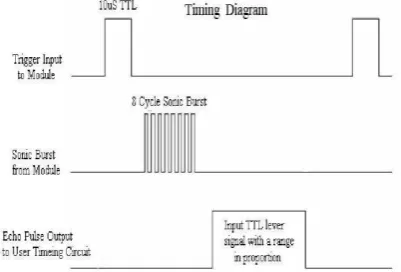
The Timing diagram is shown below. You only need to supply a short 10uS pulse to the trigger input to start the ranging, and then the module will send out an 8 cycle burst of ultrasound at 40 kHz and raise its echo. The Echo is a distance object that is pulse width and the range in proportion .You can calculate the range through the time interval between sending trigger signal and receiving echo signal. Formula: uS / 58 = centimeters or uS / 148 =inch; or: the range = high level time * velocity (340M/S) / 2; we suggest to use over 60ms measurement cycle, in order to prevent trigger signal to the echo signal.
The
Fig 4: timing diagram for ultrasonic sensor
The outputs of the IR sensor and sonar sensor are sampled at 2KHz and given to 10 bit adc in ARM 7microcontroller.In this NXP2148 is used which is a low power consumption 32 bit microcontroller. The sensor system measures the distances and given to the microcontroller .
HC-SRO4 ultrasonic sensor is used here this popular ultrasonic distance sensor provides stable and accurate distance measurements from 2cm to 450cm. It has a focus of less than 15 degrees and an accuracy of about 2mm.
© 2015, IRJET.NET- All Rights Reserved
Page 611
Fig 5: Two-dimensional position estimation and theparameters to be estimated.
At point A an IR sensor is placed in the host vehicle at left side of the car and the ultrasonic sensor at the front of the approaching vehicle . The IR sensor detects the objects and measures the distance between the vehicles in both X-axis and Y-X-axis .The approaching vehicle where the sensor placed in front also measures the distance of the vehicle in two dimensional. where r is the distance measured along the direction of motion. However, if θ is not constant or if the colliding vehicle is moving toward the sensors at an offset (meaning that its center line does not pass through the center of the IR sensor), the preceding approach cannot be adopted.
Hence, to fully identify and classify a crash in 2-D motion, we need to estimate xA , yA , v, θ, and ω, as shown in
Fig. , where xA and yA are the position of point A with respect to the coordinate frame attached to the approaching car, v is the longitudinal velocity of the approaching car along its x-axis, θ is the orientation of the approaching car relative to the host car (in other words, it is the angle between the x-axis of the coor- dinate frame attached to the approaching car and the X -axis of the coordinate frame at point A), and ω is the rotational velocity of the approaching car.
5. FINAL RESULT OF THE PROPOSED SYSTEM
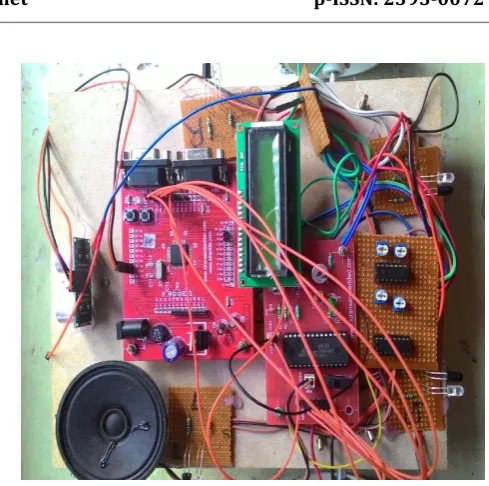
This output from the sensors are given to the microcontroller and an LCD is used to display the results i.e., left detected objects, right detected objects, backside by using the IR sensors, at the front side we are using the ultrasonic sensors which gives the distances.And also a playback which is recorded with warnings based on the results from the sensor are recorded previously are playback whenever we get appropriate signals from the sensors in order to warn or inform to the driver in the vehicle. When the vehicles are very close to the host vehicle and imminent collision may happen the motors of the vehicle is going to stop.
Fig 6: collision prediction using sensor system
6. CONCLUSION
This paper has focused on the development of a novel and unique automotive sensor system for the measurement of relative position and orientation of another vehicle in close proximity. The sensor system is based on the use of Infrared sensors, which measure magnetic field.
A system based on the use of multiple infrared sensors and a custom-designed ultrasonic sensor system together to estimate vehicle parameters, position, and orientation. The use of the combined sensors results in a reliable system that performs well without the knowledge of vehicle- specific magnetic field parameters. Test results with a wheeled laboratory test rig consisting of a door and tests with a full- scale passenger sedan were presented. The experimental results in this paper confirm that the developed sensor system is viable and that it is feasible to adaptively estimate vehicle position and orientation even without knowledge of vehicle-dependent parameters.
REFERENCES
[1] J. G. Buechele and G. A. Cazzell, “Automotive bumper active energy absorption system,” U.S. Patent 6 836 717, Dec. 28, 2004.
© 2015, IRJET.NET- All Rights Reserved
Page 612
[3] L. Jakobsson, B. Lund ell, H. Norin, and I.Isaksson-Hellman, “WHIPS— Volvo’s whiplash protection study,” Accid. Anal. Prev., vol. 32, no. 2, pp. 307–319, Mar. 2000.
[4] R. Mobus and U. Kolbe, “Multi-target multi-object tracking, sensorfusion of radar and infrared,” in Proc. IEEE Intell. Veh. Symp., 2004, pp. 732–737.
[5] S. Matzka and R. Altendorfer, “A comparison of track-to-track fusion algorithms for automotive sensor fusion,” in Proc. IEEE Int. Conf. MFIIntell. Syst., 2008, pp. 189–194.
[6] G. R. Widmann, M. Daniels, L. Hamilton, L. Humm, B. Riley, J. K. Schiffmann, D. E. Schnelker, and W. H. Wishon, “Comparison of lidar-based and radar-based adaptive cruise control systems,” presented at the SAE World Congr., Detroit, MI, USA, 2000, 2000-01-0345.
[7] I. Moon, K. Yi, D. Caveney, and J. K. Hedrick (2005, Sep.). A multi-target tracking algorithm for application to adaptive cruise control. J. Mech. Sci.
Technol. [Online]. 19(9), pp. 1742–1752. Available: http://dx.doi.org/10.1007/BF02984186
[8] D. Caveney, B. Feldman, and J. K. Hedrick, “Comprehensive framework for multisensor multitarget tracking in the adaptive cruise control environ- ment,” in Proc. 6th Int. Symp. AVEC, 2002, pp. 697–702.
[9] G. Fu, P. Corradi, A. Menciassi, and P. Dario, “An integrated triangulation laser scanner for obstacle detection of miniature mobile robots in indoor environment,” IEEE/ASME Trans. Mechatronics, vol. 16, no. 4, pp. 778–783, Aug. 2011.
[10] M. J. Caruso and L. S. Withanawasam, “Vehicle detection and compass applications using AMR magnetic sensors,” in Proc. Sensors Expo, 1999, pp. 477–489.
[11] S. Taghvaeeyan and R. Rajamani, “Use of vehicle magnetic signaturesfor position estimation,” Appl. Phys. Lett., vol. 99, no. 13, pp. 134101-1–134101-3, Sep. 2011.
[12] S. Taghvaeeyan and R. Rajamani, “Two-dimensional sensor system for automotive crash prediction,” in Proc. ASME DSCC, Fort Lauderdale, FL, USA, 2012, pp. 681–688.
[13] Fatality Analysis Reporting System. [Online]. Available: www.nhtsa.gov/ FARS
[14] H. Knoepfel, Magnetic Fields : A Comprehensive Theoretical Treatise forPractical Use. Hoboken, NJ, USA: Wiley, 2000, 1931.
[15] Y. Bar-Shalom, Estimation With Applications to Tracking and Navigation.Hoboken, NJ, USA: Wiley, 2001.
[16] D. Simon, Optimal State Estimation : Kalman, infinity, and Nonlinear Approaches. Hoboken, NJ, USA: Wiley, 2006, 1960.
[17] S. Julier, J. Uhlmann, and H. F. Durrant-Whyte, “A new method for the nonlinear transformation of means and covariances in filters and estima- tors,” IEEE Trans. Autom. Control, vol. 45, no. 3, pp. 477–482, Mar. 2000.
[18] T. Lefebvre, H. Bruyninckx, and J. De Schuller, “Comment on ‘A new method for the nonlinear transformation of means and covariances in filters and estimators’ [with authors’ reply],” IEEE Trans. Autom. Control, vol. 47, no. 8, pp. 1406–1409, Aug. 2002.
BIOGRAPHIES
P.Durgasaranya pursuing Mtech Embedded systems in Siddharth Institute of Engineering and Technology, Puttur. She received Bachelor Degree in Department
of Electronics and
Communication Engineering from Audisankara institute of technology, gudur.