An annotation scheme for citation function
Simone Teufel
Advaith Siddharthan
Dan Tidhar
Natural Language and Information Processing Group
Computer Laboratory
Cambridge University, CB3 0FD, UK
{
Simone.Teufel,Advaith.Siddharthan,Dan.Tidhar
}
@cl.cam.ac.uk
Abstract
We study the interplay of the discourse struc-ture of a scientific argument with formal ci-tations. One subproblem of this is to clas-sify academic citations in scientific articles ac-cording to their rhetorical function, e.g., as a rival approach, as a part of the solution, or as a flawed approach that justifies the cur-rent research. Here, we introduce our anno-tation scheme with 12 categories, and present an agreement study.
1 Scientific writing, discourse structure
and citations
In recent years, there has been increasing interest in applying natural language processing technologies to scientific literature. The overwhelmingly large num-ber of papers published in fields like biology, genetics and chemistry each year means that researchers need tools for information access (extraction, retrieval, sum-marization, question answering etc). There is also in-creased interest in automatic citation indexing, e.g., the highly successful search tools Google Scholar and CiteSeer (Giles et al., 1998).1 This general interest in
improving access to scientific articles fits well with re-search on discourse structure, as knowledge about the overall structure and goal of papers can guide better in-formation access.
Shum (1998) argues that experienced researchers are often interested in relations between articles. They need to know if a certain article criticises another and what the criticism is, or if the current work is based on that prior work. This type of information is hard to come by with current search technology. Neither the author’s abstract, nor raw citation counts help users in assessing the relation between articles. And even though CiteSeer shows a text snippet around the phys-ical location for searchers to peruse, there is no guar-antee that the text snippet provides enough information for the searcher to infer the relation. In fact, studies from our annotated corpus (Teufel, 1999), show that 69% of the 600 sentences stating contrast with other work and 21% of the 246 sentences stating research continuation with other work do not contain the cor-responding citation; the citation is found in preceding
1CiteSeer automatically citation-indexes all scientific ar-ticles reached by a web-crawler, making them available to searchers via authors or keywords in the title.
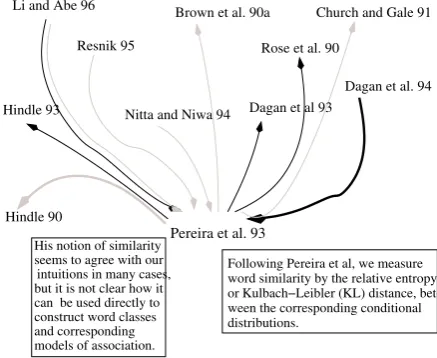
Nitta and Niwa 94 Resnik 95
Brown et al. 90a
Rose et al. 90
Church and Gale 91
Dagan et al. 94 Li and Abe 96
Hindle 93
Hindle 90
Dagan et al 93
Pereira et al. 93
Following Pereira et al, we measure word similarity by the relative entropy or Kulbach−Leibler (KL) distance, bet− ween the corresponding conditional distributions.
His notion of similarity seems to agree with our intuitions in many cases, but it is not clear how it can be used directly to construct word classes and corresponding models of association.
Figure 1: A rhetorical citation map
sentences (i.e., the sentence expressing the contrast or continuation would be outside the CiteSeer snippet). We present here an approach which uses the classifica-tion of citaclassifica-tions to help provide relaclassifica-tional informaclassifica-tion across papers.
Citations play a central role in the process of writing a paper. Swales (1990) argues that scientific writing follows a general rhetorical argumentation structure: researchers must justify that their paper makes a con-tribution to the knowledge in their discipline. Several argumentation steps are required to make this justifica-tion work, e.g., the statement of their specific goal in the paper (Myers, 1992). Importantly, the authors also must relate their current work to previous research, and acknowledge previous knowledge claims; this is done with a formal citation, and with language connecting the citation to the argument, e.g., statements of usage of other people’s approaches (often near textual segments in the paper where these approaches are described), and statements of contrast with them (particularly in the discussion or related work sections). We argue that the automatic recognition of citation function is interest-ing for two reasons: a) it serves to build better citation indexers and b) in the long run, it will help constrain interpretations of the overall argumentative structure of a scientific paper.
Being able to interpret the rhetorical status of a tation at a glance would add considerable value to ci-tation indexes, as shown in Fig. 1. Here differences and similarities are shown between the example paper (Pereira et al., 1993) and the papers it cites, as well as
the papers that cite it. Contrastivelinks are shown in grey – links to rival papers and papers the current pa-per contrasts itself to. Continuativelinks are shown in black – links to papers that are taken as starting point of the current research, or as part of the methodology of the current paper. The most important textual sentence about each citation could be extracted and displayed. For instance, we see which aspect ofHindle (1990)the
Pereira et al.paper criticises, and in which wayPereira et al.’s work was used byDagan et al.(1994).
We present an annotation scheme for citations, based on empirical work in content citation analysis, which fits into this general framework of scientific argument structure. It consists of 12 categories, which allow us to mark the relationships of the current paper with the cited work. Each citation is labelled with exactly one category. The following top-level four-way distinction applies:
• Weakness: Authors point out a weakness in cited work
• Contrast: Authors make contrast/comparison with cited work (4 categories)
• Positive: Authors agree with/make use of/show compatibility or similarity with cited work (6 cat-egories), and
• Neutral: Function of citation is either neutral, or weakly signalled, or different from the three func-tions stated above.
We first turn to the point of how to classify citation function in a robust way. Later in this paper, we will report results for a human annotation experiment with three annotators.
2 Annotation schemes for citations
In the field of library sciences (more specifically, the field of Content Citation Analysis), the use of informa-tion from citainforma-tions above and beyond simple citainforma-tion counting has received considerable attention. Biblio-metric measures assesses the quality of a researcher’s output, in a purely quantitative manner, by counting how many papers cite a given paper (White, 2004; Luukkonen, 1992) or by more sophisticated measures like the h-index (Hirsch, 2005). But not all citations are alike. Researchers in content citation analysis have long stated that the classification of motivations is a central element in understanding the relevance of the paper in the field. Bonzi (1982), for example, points out thatnegationalcitations, while pointing to the fact that a given work has beennoticedin a field, do not mean that that work isreceived well, and Ziman (1968) states that many citations are done out of “politeness” (to-wards powerful rival approaches), “policy” (by name-dropping and argument by authority) or “piety” (to-wards one’s friends, collaborators and superiors). Re-searchers also often follow the custom of citing some
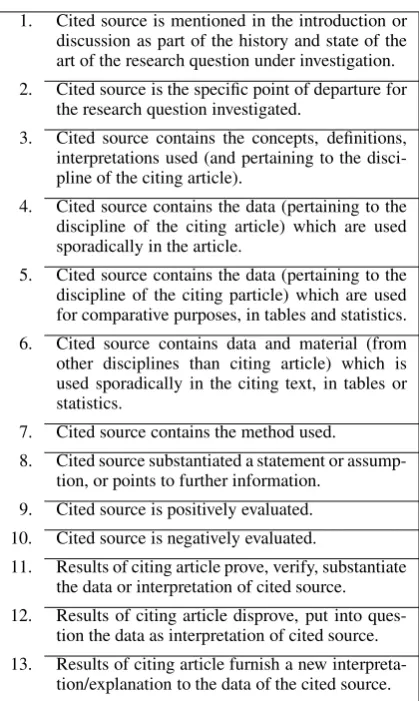
1. Cited source is mentioned in the introduction or discussion as part of the history and state of the art of the research question under investigation. 2. Cited source is the specific point of departure for
the research question investigated.
3. Cited source contains the concepts, definitions, interpretations used (and pertaining to the disci-pline of the citing article).
4. Cited source contains the data (pertaining to the discipline of the citing article) which are used sporadically in the article.
5. Cited source contains the data (pertaining to the discipline of the citing particle) which are used for comparative purposes, in tables and statistics. 6. Cited source contains data and material (from other disciplines than citing article) which is used sporadically in the citing text, in tables or statistics.
7. Cited source contains the method used.
8. Cited source substantiated a statement or assump-tion, or points to further information.
9. Cited source is positively evaluated. 10. Cited source is negatively evaluated.
11. Results of citing article prove, verify, substantiate the data or interpretation of cited source. 12. Results of citing article disprove, put into
ques-tion the data as interpretaques-tion of cited source. 13. Results of citing article furnish a new
interpreta-tion/explanation to the data of the cited source.
Figure 2: Spiegel-R¨using’s (1977) Categories for Cita-tion MotivaCita-tions
particular early, basic paper, which gives the founda-tion of their current subject (“paying homage to pio-neers”). Many classification schemes for citation func-tions have been developed (Weinstock, 1971; Swales, 1990; Oppenheim and Renn, 1978; Frost, 1979; Chu-bin and Moitra, 1975), inter alia. Based on such an-notation schemes and hand-analyzed data, different in-fluences on citation behaviour can be determined, but annotation in this field is usually done manually on small samples of text by the author, and not confirmed by reliability studies. As one of the earliest such stud-ies, Moravcsik and Murugesan (1975) divide citations in running text into four dimensions: conceptual or operational use (i.e., use of theory vs. use of techni-cal method); evolutionary or juxtapositional (i.e., own work is based on the cited work vs. own work is an al-ternative to it); organic or perfunctory (i.e., work is cru-cially needed for understanding of citing article or just a general acknowledgement); and finally confirmative vs. negational (i.e., is the correctness of the findings disputed?). They found, for example, that 40% of the citations were perfunctory, which casts further doubt on the citation-counting approach.
rel-evant to our work concentrates on relating textual spans to authors’ descriptions of other work. For example, in O’Connor’s (1982) experiment,citing statements(one or more sentences referring to other researchers’ work) were identified manually. The main problem encoun-tered in that work is the fact that many instances of cita-tion context are linguistically unmarked. Our data con-firms this: articles often contain large segments, par-ticularly in the central parts, which describe other peo-ple’s research in a fairly neutral way. We would thus expect many citations to be neutral (i.e., not to carry any function relating to the argumentation per se).
Many of the distinctions typically made in content citation analysis are immaterial to the task considered here as they are too sociologically orientated, and can thus be difficult to operationalise without deep knowl-edge of the field and its participants (Swales, 1986). In particular, citations for general reference (background material, homage to pioneers) are not part of our an-alytic interest here, and so are citations “in passing”, which are only marginally related to the argumentation of the overall paper (Ziman, 1968).
Spiegel-R¨using’s (1977) scheme (Fig. 2) is an exam-ple of a scheme which is easier to operationalise than most. In her scheme, more than one category can apply to a citation; for instance positive and negative evalu-ation (category 9 and 10) can be cross-classified with other categories. Out of 2309 citations examined, 80% substantiated statements (category 8), 6% discussed history or state of the art of the research area (cate-gory 1) and 5% cited comparative data (cate(cate-gory 5).
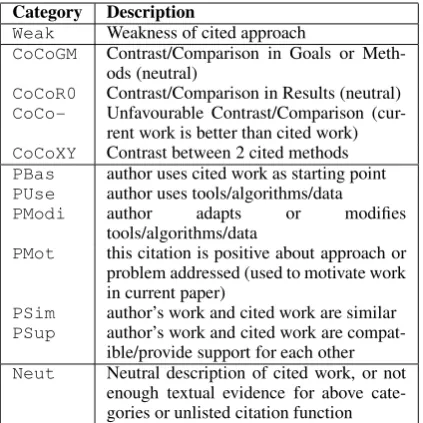
Category Description
Weak Weakness of cited approach
CoCoGM Contrast/Comparison in Goals or Meth-ods (neutral)
CoCoR0 Contrast/Comparison in Results (neutral)
CoCo- Unfavourable Contrast/Comparison (cur-rent work is better than cited work)
CoCoXY Contrast between 2 cited methods
PBas author uses cited work as starting point
PUse author uses tools/algorithms/data
PModi author adapts or modifies
tools/algorithms/data
PMot this citation is positive about approach or problem addressed (used to motivate work in current paper)
PSim author’s work and cited work are similar
PSup author’s work and cited work are compat-ible/provide support for each other
Neut Neutral description of cited work, or not enough textual evidence for above cate-gories or unlisted citation function
Figure 3: Our annotation scheme for citation function
Our scheme (given in Fig. 3) is an adaptation of the scheme in Fig. 2, which we arrived at after an analysis of a corpus of scientific articles in computational lin-guistics. We tried to redefine the categories such that they should be reasonably reliably annotatable; at the same time, they should be informative for the
appli-cation we have in mind. A third criterion is that they should have some (theoretical) relation to the particu-lar discourse structure we work with (Teufel, 1999).
Our categories are as follows: One category (Weak) is reserved for weakness of previous research, if it is ad-dressed by the authors (cf. Spiegel-R¨using’s categories 10, 12, possibly 13). The next three categories describe comparisons or contrasts between own and other work (cf. Spiegel-R¨using’s category 5). The difference tween them concerns whether the comparison is be-tween methods/goals (CoCoGM) or results (CoCoR0). These two categories are for comparisons without ex-plicit value judgements. We use a different category (CoCo-) when the authors claim their approach is bet-ter than the cited work.
Our interest in differences and similarities between approaches stems from one possible application we have in mind (the rhetorical citation search tool). We do not only consider differences stated between the cur-rent work and other work, but we also mark citations if they are explicitly compared and contrasted with other work (not the current paper). This is expressed in cat-egoryCoCoXY. It is a category not typically consid-ered in the literature, but it is related to the other con-trastive categories, and useful to us because we think it can be exploited for search of differences and rival approaches.
The next set of categories we propose concerns pos-itive sentiment expressed towards a citation, or a state-ment that the other work is actively used in the cur-rent work (which is the ultimate praise). Like Spiegel-R¨using, we are interested in use of data and methods (her categories 4, 5, 6, 7), but we cluster different us-ages together and instead differentiate unchanged use (PUse) from use with adaptations (PModi). Work which is stated as the explicit starting point or intellec-tual ancestry is marked with our categoryPBas(her category 2). If a claim in the literature is used to strengthen the authors’ argument, this is expressed in her category 8, and vice versa, category 11. We col-lapse these two in our categoryPSup. We use two categories she does not have definitions for, namely similarity of (aspect of) approach to other approach (PSim), and motivation of approach used or problem addressed (PMot). We found evidence for prototypi-cal use of these citation functions in our texts. How-ever, we found little evidence for her categories 12 or 13 (disproval or new interpretation of claims in cited literature), and we decided against a “state-of-the-art” category (her category 1), which would have been in conflict with ourPMotdefinition in many cases.
Citation function is hard to annotate because it in principle requires interpretation of author intentions (what could the author’s intention have been in choos-ing a certain citation?). Typical results of earlier cita-tion funccita-tion studies are that the sociological aspect of citing is not to be underestimated. One of our most fun-damental ideas for annotation is to only mark explicitly signalled citation functions. Our guidelines explicitly state that a general linguistic phrase such as “better” or “used by us” must be present, in order to increase objectivity in finding citation function. Annotators are encouraged to point to textual evidence they have for assigning a particular function (and are asked to type the source of this evidence into the annotation tool for each citation). Categories are defined in terms of cer-tain objective types of statements (e.g., there are 7 cases forPMot). Annotators can use general text interpreta-tion principles when assigning the categories, but are not allowed to use in-depth knowledge of the field or of the authors.
There are other problematic aspects of the annota-tion. Some concern the fact that authors do not al-ways state their purpose clearly. For instance, several earlier studies found that negational citations are rare (Moravcsik and Murugesan, 1975; Spiegel-R¨using, 1977); MacRoberts and MacRoberts (1984) argue that the reason for this is that they are potentially politically dangerous, and that the authors go through lengths to diffuse the impact of negative references, hiding a neg-ative point behind insincere praise, or diffusing the thrust of criticism with perfunctory remarks. In our data we found ample evidence of this effect, illustrated by the following example:
Hidden Markov Models (HMMs) (Huang et al. 1990)offer a powerful statistical ap-proach to this problem, though it is unclear how they could be used to recognise the units of interest to phonologists.(9410022, S-24)2
It is also sometimes extremely hard to distinguish usage of a method from statements of similarity be-tween a method and the own method. This happens in cases where authors do not want to admit they are using somebody else’s method:
The same test was used inAbney and Light (1999). (0008020, S-151)
Unification of indices proceeds in the same manner as unification of all other typed feature structures(Carpenter 1992).
(0008023, S-87)
In this case, our annotators had to choose between categoriesPSimandPUse.
It can also be hard to distinguish between continu-ation of somebody’s research (i.e., taking somebody’s
2In all corpus examples, numbers in brackets correspond to the official Cmp lg archive number, “S-” numbers to sen-tence numbers according to our preprocessing.
research as starting point, as intellectual ancestry, i.e.
PBas) and simply using it (PUse). In principle, one would hope that annotation of all usage/positive cate-gories (starting withP), if clustered together, should re-sult in higher agreement (as they are similar, and as the resulting scheme has fewer distinctions). We would ex-pect this to be the case in general, but as always, cases exist where a conflict between a contrast (CoCo) and a change to a method (PModi) occur:
In contrast to McCarthy, Kay and Kiraz,
we combine the three components into a sin-gle projection. (0006044, S-182) The markable units in our scheme are a) all full cita-tions (as recognized by our automatic citation proces-sor on our corpus), and b) all names of authors of cited papers anywhere in running text outside of a formal citation context (i.e., without date). Our citation pro-cessor recognizes these latter names after parsing the citation list an marks them up. This is unusual in com-parison to other citation indexers, but we believe these names function as important referents comparable in importance to formal citations. In principle, one could go even further as there are many other linguistic ex-pressions by which the authors could refer to other peo-ple’s work: pronouns, abbreviations such as “Mueller and Sag (1990), henceforth M & S”, and names of ap-proaches or theories which are associated with partic-ular authors. If we could mark all of these up auto-matically (which is not technically possible), annota-tion would become less difficult to decide, but techni-cal difficulty prevent us from recognizing these other cases automatically. As a result, in these contexts it is impossible to annotate citation function directly on the referent, which sometimes causes problems. Because this means that annotators have to consider non-local context, one markable may have different competing contexts with different potential citation functions, and problems about which context is “stronger” may oc-cur. We have rules that context is to be constrained to the paragraph boundary, but for some categories paper-wide information is required (e.g., forPMot, we need to know that a praised approach is used by the authors, information which may not be local in the paragraph).
Appendix A gives unambiguous example cases where the citation function can be decided on the ba-sis of the sentence alone, but Fig. 4 shows a more typ-ical example where more context is required to inter-pret the function. The evaluation of the citation Hin-dle (1990)is contrastive; the evaluative statement is found 4 sentences after the sentence containing the ci-tation3. It consists of a positive statement (agreement
with authors’ view), followed by a weakness, under-lined, which is the chosen category. This is marked on the nearest markable (Hindle, 3 sentences after the ci-tation).
S-5 Hindle (1990)/Neut proposed dealing with the sparseness problem by estimating the likelihood of un-seen events from that of “similar” events that have been seen.
S-6For instance, one may estimate the likelihood of a particular direct object for a verb from the likelihoods of that direct object for similar verbs.
S-7 This requires a reasonable definition of verb simi-larity and a simisimi-larity estimation method.
S-8 In Hindle/Weak ’s proposal, words are similar if we have strong statistical evidence that they tend to participate in the same events.
S-9 Hisnotion of similarity seems to agree with our in-tuitions in many cases, but it is not clear how it can be used directly to construct word classes and correspond-ing models of association. (9408011)
Figure 4: Annotation example: influence of context
A naive view on this annotation scheme could con-sider the first two sets of categories in our scheme as “negative” and the third set of categories “positive”. There is indeed a sentiment aspect to the interpretation of citations, due to the fact that authors need to make a point in their paper and thus have a stance towards their citations. But this is not the whole story: many of our “positive” categories are more concerned with different ways in which the cited work is useful to the current work (which aspect of it is used, e.g., just a definition or the entire solution?), and many of the con-trastive statements have no negative connotation at all and simply state a (value-free) difference between ap-proaches. However, if one looks at the distribution of positive and negative adjectives around citations, one notices a (non-trivial) connection between our task and sentiment classification.
There are written guidelines of 25 pages, which in-struct the annotators to only assign one category per citation, and to skim-read the paper before annotation. The guidelines provide a decision tree and give deci-sion aids in systematically ambiguous cases, but sub-jective judgement of the annotators is nevertheless nec-essary to assign a single tag in an unseen context. We implemented an annotation tool based on XML/XSLT technology, which allows us to use any web browser to interactively assign one of the 12 tags (presented as a pull-down list) to each citation.
3 Data
The data we used came from the CmpLg (Computation and Language archive; 320 conference articles in com-putational linguistics). The articles are in XML format. Headlines, titles, authors and reference list items are automatically marked up with the corresponding tags. Reference lists are parsed, and cited authors’ names are identified. Our citation parser then applies regu-lar patterns and finds citations and other occurrences of the names of cited authors (without a date) in running text and marks them up. Self-citations are detected by
overlap of citing and cited authors. The citation pro-cessor developped in our group (Ritchie et al., 2006) achieves high accuracy for this task (96% of citations recognized, provided the reference list was error-free). On average, our papers contain 26.8 citation instances in running text4.
4 Human Annotation: results
In order to machine learn citation function, we are in the process of creating a corpus of scientific arti-cles with human annotated citations, according to the scheme discussed before. Here we report preliminary results with that scheme, with three annotators who are developers of the scheme.
In our experiment, the annotators independently an-notated 26 conference articles with this scheme, on the basis of guidelines which were frozen once annotation started5. The data used for the experiment contained a
total of 120,000 running words and 548 citations. The relative frequency of each category observed in the annotation is listed in Fig. 5. As expected, the dis-tribution is very skewed, with more than 60% of the citations of categoryNeut.6 What is interesting is the
relatively high frequency of usage categories (PUse,
PModi, PBas) with a total of 18.9%. There is
a relatively low frequency of clearly negative cita-tions (Weak, CoCoR-, total of 4.1%), whereas the neutral–contrastive categories (CoCoGM, CoCoR0,
CoCoXY) are slightly more frequent at 7.6%. This
is in concordance with earlier annotation experiments (Moravcsik and Murugesan, 1975; Spiegel-R¨using, 1977).
We reached an inter-annotator agreement of K=.72 (n=12;N=548;k=3)7. This is comparable to aggreement
on other discourse annotation tasks such as dialogue act parsing and Argumentative Zoning (Teufel et al., 1999). We consider the agreement quite good, consid-ering the number of categories and the difficulties (e.g., non-local dependencies) of the task.
The annotators are obviously still disagreeing on some categories. We were wondering to what de-gree the fine granularity of the scheme is a prob-lem. When we collapsed the obvious similar cat-egories (all P categories into one category, and all CoCo categories into another) to give four top level categories (Weak, Positive, Contrast,
Neutral), this only raised kappa to 0.76. This
4As opposed to reference list items, which are fewer. 5The development of the scheme was done with 40+ dif-ferent articles.
6Spiegel-R¨using found that out of 2309 citations she ex-amined, 80% substantiated statements.
7Following Carletta (1996), we measure agreement in Kappa, which follows the formulaK = P(A)−P(E)1−P(E) where
Neut PUse CoCoGM PSim Weak CoCoXY PMot PModi PBas PSup CoCo- CoCoR0
62.7% 15.8% 3.9% 3.8% 3.1% 2.9% 2.2% 1.6% 1.5% 1.1% 1.0% 0.8%
Figure 5: Distribution of the categories
Weak CoCo- CoCoGM CoCoR0 CoCoXY PUse PBas PModi PMot PSim PSup Neut
Weak 5 3
CoCo- 1 3
CoCoGM 23 3
CoCoR0 4
CoCoXY 1
PUse 86 6 2 1 12
PBas 3 2
PModi 3
PMot 13 4
PSim 3 20 5
PSup 1 2 1
Neut 6 10 6 4 17 1 6 4 287
Figure 6: Confusion matrix between two annotators
points to the fact that most of our annotators disagreed about whether to assign a more informative category orNeut, the neutral fall-back category. Unfortunately, Kappa is only partially sensitive to such specialised dis-agreements. While it will reward agreement with in-frequent categories more than agreement with in-frequent categories, it nevertheless does not allow us to weight disagreements we care less about (Neutvs more in-formative category) less than disagreements we do care a lot about (informative categories which are mutually exclusive, such asWeakandPSim).
Fig. 6 shows a confusion matrix between the two an-notators who agreed most with each other. This again points to the fact that a large proportion of the confu-sion involves an informative category andNeut. The issue with Neut andWeak is a point at hand: au-thors seem to often (deliberately or not) mask their in-tended citation function with seemingly neutral state-ments. Many statements of weakness of other ap-proaches were stated in such caged terms that our anno-tators disagreed about whether the signals given were “explicit” enough.
While our focus is not sentiment analysis, it is pos-sible to conflate our 12 categories into three: positive,
weaknessandneutralby the following mapping:
Old Categories New Category Weak, CoCo- Negative PMot, PUse, PBas, PModi, PSim, PSup Positive
CoCoGM, CoCoR0, CoCoXY, Neut Neutral
Thus negative contrasts and weaknesses are grouped
into Negative, while neutral contrasts are grouped
intoNeutral. All the positive classes are conflated intoPositive. This resulted in kappa=0.75 for three annotators.
Fig. 7 shows the confusion matrix between two an-notators for this sentiment classification. Fig. 7 is par-ticularly instructive, because it shows that annotators
Weakness Positive Neutral
Weakness 9 1 12
Positive 140 13
Neutral 4 30 339
Figure 7: Confusion matrix between two annotators; categories collapsed to reflect sentiment
have only one case of confusion between positive and negative references to cited work. The vast majority of disagreements reflects genuine ambiguity as to whether the authors were trying to stay neutral or express a sen-timent.
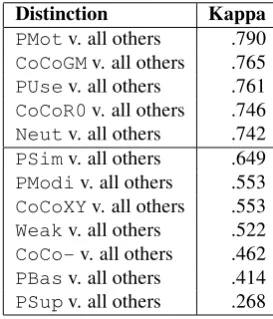
Distinction Kappa PMotv. all others .790
CoCoGMv. all others .765
PUsev. all others .761
CoCoR0v. all others .746
Neutv. all others .742
PSimv. all others .649
PModiv. all others .553
CoCoXYv. all others .553
Weakv. all others .522
CoCo-v. all others .462
PBasv. all others .414
PSupv. all others .268
Figure 8: Distinctiveness of categories
informa-tive categories, four are defined at least as well as the overall distinction (i.e. above the line in Fig. 8:PMot,
PUse, CoCoGMandCoCoR0. This is encouraging,
as the application of citation maps is almost entirely centered around usage and contrast. However, the se-mantics of some categories are less well-understood by our annotators: in particularPSup(where the difficulty lies in what an annotator understands as “mutual sup-port” of two theories), and (unfortunately)PBas. The problem withPBasis that its distinction fromPUseis based on subjective judgement of whether the authors
usea part of somebody’s previous work, orbase selves entirely on this previous work (i.e., see them-selves as following in the same intellectual framework). Another problem concerns the low distinctivity for the clearly negative categoriesCoCo-andWeak. This is in line with MacRoberts and MacRoberts’ hypothesis that criticism is often hedged and not clearly lexically signalled, which makes it more difficult to reliably an-notate such citations.
5 Conclusion
We have described a new task: human annotation of citation function, a phenomenon which we believe to be closely related to the overall discourse structure of scientific articles. Our annotation scheme concentrates on contrast, weaknesses of other work, similarities be-tween work and usage of other work. One of its prin-ciples is the fact that relations are only to be marked if they are explicitly signalled. Here, we report positive results in terms of interannotator agreement.
Future work on the annotation scheme will concen-trate on improving guidelines for currently suboptimal categories, and on measuring intra-annotator agree-ment and inter-annotator agreeagree-ment with naive annota-tors. We are also currently investigating how well our scheme will work on text from a different discipline, namely chemistry. Work on applying machine learning techniques for automatic citation classification is cur-rently underway (Teufel et al., 2006); the agreement of one annotator and the system is currently K=.57, leaving plenty of room for improvement in comparison with the human annotation results presented here.
6 Acknowledgements
This work was funded by the EPSRC projects CITRAZ (GR/S27832/01, “Rhetorical Citation Maps and Domain-independent Argumentative Zoning”) and SCIBORG (EP/C010035/1, “Extracting the Science from Scientific Publications”).
References
Susan Bonzi. 1982. Characteristics of a literature as predic-tors of relatedness between cited and citing works. JASIS, 33(4):208–216.
Jean Carletta. 1996. Assessing agreement on classification
tasks: The kappa statistic. Computational Linguistics, 22(2):249–254.
Daryl E. Chubin and S. D. Moitra. 1975. Content analysis of references: Adjunct or alternative to citation counting? Social Studies of Science, 5(4):423–441.
Carolyn O. Frost. 1979. The use of citations in literary re-search: A preliminary classification of citation functions. Library Quarterly, 49:405.
C. Lee Giles, Kurt D. Bollacker, and Steve Lawrence. 1998. Citeseer: An automatic citation indexing system. In Pro-ceedings of the Third ACM Conference on Digital Li-braries, pages 89–98.
Jorge E. Hirsch. 2005. An index to quantify an individ-ual’s scientific research output. Proceedings of the Na-tional Academy of Sciences of the United Stated of Amer-ica (PNAS), 102(46).
Terttu Luukkonen. 1992. Is scientists’ publishing behaviour reward-seeking? Scientometrics, 24:297–319.
Michael H. MacRoberts and Barbara R. MacRoberts. 1984. The negational reference: Or the art of dissembling. So-cial Studies of Science, 14:91–94.
Michael J. Moravcsik and Poovanalingan Murugesan. 1975. Some results on the function and quality of citations. So-cial Studies of Science, 5:88–91.
Greg Myers. 1992. In this paper we report...—speech acts and scientific facts. Journal of Pragmatics, 17(4):295– 313.
John O’Connor. 1982. Citing statements: Computer recogni-tion and use to improve retrieval. Information Processing and Management, 18(3):125–131.
Charles Oppenheim and Susan P. Renn. 1978. Highly cited old papers and the reasons why they continue to be cited. JASIS, 29:226–230.
Anna Ritchie, Simone Teufel, and Steven Robertson. 2006. Creating a test collection for citation-based IR experi-ments. InProceedings of HLT-06.
Simon Buckingham Shum. 1998. Evolving the web for sci-entific knowledge: First steps towards an “HCI knowledge web”.Interfaces, British HCI Group Magazine, 39:16–21. Ina Spiegel-R¨using. 1977. Bibliometric and content
analy-sis.Social Studies of Science, 7:97–113.
John Swales. 1986. Citation analysis and discourse analysis. Applied Linguistics, 7(1):39–56.
John Swales, 1990. Genre Analysis: English in Academic and Research Settings. Chapter 7: Research articles in En-glish, pages 110–176. Cambridge University Press, Cam-bridge, UK.
Simone Teufel, Jean Carletta, and Marc Moens. 1999. An annotation scheme for discourse-level argumentation in re-search articles. InProceedings of the Ninth Meeting of the European Chapter of the Association for Computational Linguistics (EACL-99), pages 110–117.
Simone Teufel, Advaith Siddharthan, and Dan Tidhar. 2006. Automatic classification of citation function. In Proceed-ings of EMNLP-06.
Simone Teufel. 1999. Argumentative Zoning: Information Extraction from Scientific Text. Ph.D. thesis, School of Cognitive Science, University of Edinburgh, UK. Melvin Weinstock. 1971. Citation indexes. InEncyclopedia
of Library and Information Science, volume 5, pages 16– 40. Dekker, New York, NY.
Howard D. White. 2004. Citation analysis and discourse analysis revisited.Applied Linguistics, 25(1):89–116. John M. Ziman. 1968. Public Knowledge: An Essay
A Annotation examples
Weak However,Koskenniemihimself understood that his initial implementation had signif-icant limitations in handling non-concatenative morphotactic processes.
(0006044, S-4)
CoCoGM The goals of the two papers are slightly different:Moore’s approach is designed to reduce the total grammar size (i.e., the sum of the lengths of the productions), while our approach minimizes the number of productions.
(0008021, S-22)
CoCoR0 This is similar to results in the literature(Ramshaw and Marcus 1995).
(0008022, S-147)
CoCo- For the Penn Treebank, Ratnaparkhi (1996)reports an accuracy of 96.6% using the
Maximum Entropy approach, our much simpler and therefore faster HMM approach
delivers 96.7%. (0003055, S-156)
CoCoXY Unlike previous approaches(Ellison 1994, Walther 1996), Karttunen’s approach
is encoded entirely in the finite state calculus, with no extra-logical procedures for counting constraint violations. (0006038, S-5)
PBas Our starting point is the work described inFerro et al. (1999), which used a fairly
small training set. (0008004, S-11)
PUse In our application, we tried out the Learning Vector Quantization (LVQ)(Kohonen et
al. 1996). (0003060, S-105)
PModi In our experiments, we have used a conjugate-gradient optimization program adapted
from the one presented inPress et al. (0008028, S-72)
PMot It has also been shown that the combined accuracy of an ensemble of multiple clas-sifiers is often significantly greater than that of any of the individual clasclas-sifiers that make up the ensemble (e.g.,Dietterich (1997)). (0005006, S-9)
PSim Our system is closely related to those proposed in Resnik (1997)and Abney and
Light (1999). (0008020, S-24)
PSup In all experiments the SVM Light system outperformed other learning algorithms, which confirms Yang and Liu’s(1999)results for SVMs fed with Reuters data.
(0003060, S-141)