Deep Grammars in a Tree Labeling Approach to
Syntax-based Statistical Machine Translation
Mark Hopkins
Department of Linguistics University of Potsdam, Germany
Jonas Kuhn
Department of Linguistics University of Potsdam, Germany
Abstract
In this paper, we propose a new syntax-based machine translation (MT) approach based on reducing the MT task to a tree-labeling task, which is further decom-posed into a sequence of simple decisions for which discriminative classifiers can be trained. The approach is very flexible and we believe that it is particularly well-suited for exploiting the linguistic knowledge en-coded in deep grammars whenever possi-ble, while at the same time taking advantage of data-based techniques that have proven a powerful basis for MT, as recent advances in statistical MT show.
A full system using the Lexical-Functional Grammar (LFG) parsing system XLE and the grammars from the Parallel Grammar development project (ParGram; (Butt et al., 2002)) has been implemented, and we present preliminary results on English-to-German translation with a tree-labeling sys-tem trained on a small subsection of the Eu-roparl corpus.
1 Motivation
Machine translation (MT) is probably the oldest ap-plication of what we call deep linguistic processing techniques today. But from its inception, there have been alternative considerations of approaching the task with data-based statistical techniques (cf. War-ren Weaver’s well-known memo from 1949). Only with fairly recent advances in computer technology have researchers been able to build effective statis-tical MT prototypes, but in the last few years, the statistical approach has received enormous research interest and made significant progress.
The most successful statistical MT paradigm has been, for a while now, the so-call phrase-based MT approach (Och and Ney, 2003). In this paradigm, sentences are translated from a source language to a target language through the repeated substitution of contiguous word sequences (“phrases”) from the source language for word sequences in the target language. Training of the phrase translation model builds on top of a standard statistical word alignment over the training corpus of parallel text (Brown et al., 1993) for identifying corresponding word blocks, assuming no further linguistic analysis of the source or target language. In decoding, i.e. the application of the acquired translation model to unseen source sentences, these systems then typically rely on n-gram language models and simple statistical reorder-ing models to shuffle the phrases into an order that is coherent in the target language.
An obvious advantage of statistical MT ap-proaches is that they can adopt (often very id-iomatic) translations of mid- to high-frequency con-structions without requiring any language-pair spe-cific engineering work. At the same time it is clear that a linguistics-free approach is limited in what it can ultimately achieve: only linguistically in-formed systems can detect certain generalizations from lower-frequency constructions in the data and successfully apply them in a similar but different lin-guistic context. Hence, the idea of “hybrid” MT, ex-ploiting both linguistic and statistical information is fairly old. Here we will not consider classical, rule-based systems with some added data-rule-based resource acquisition (although they may be among the best candidates for high-quality special-purpose transla-tion – but adaptransla-tion to new language pairs and sub-languages is very costly for these systems). The other form of hybridization – a statistical MT model that is based on a deeper analysis of the syntactic
structure of a sentence – has also long been iden-tified as a desirable objective in principle (consider (Wu, 1997; Yamada and Knight, 2001)). However, attempts to retrofit syntactic information into the phrase-based paradigm have not met with enormous success (Koehn et al., 2003; Och et al., 2003)1, and purely phrase-based MT systems continue to outper-form these syntax/phrase-based hybrids.
In this work, we try to make a fresh start with syntax-based statistical MT, discarding the phrase-based paradigm and designing a MT system from the ground up, using syntax as our central guid-ing star – besides the word alignment over a par-allel corpus. Our approach is compatible with and can benefit substantially from rich linguistic rep-resentations obtained from deep grammars like the ParGram LFGs. Nevertheless, contrary to classi-cal interlingual or deep transfer-based systems, the generative stochastic model that drives our system is grounded only in the cross-language word align-ment and a surface-based phrase structure tree for the source language and will thus degrade grace-fully on input with parsing issues – which we sus-pect is an important feature for making the overall system competitive with the highly general phrase-based MT approach.
Preliminary evaluation of our nascent system in-dicates that this new approach might well have the potential to finally realize some of the promises of syntax in statistical MT.
2 General Task
We want to build a system that can learn to translate sentences from a source language to a destination language. The general set-up is simple.
Firstly, we have a training corpus of paired sen-tences f and e, where target sentence e is a gold standard translation of source sentence f. These sentence pairs are annotated with auxiliary informa-tion, which can include word alignments and syntac-tic information. We refer to these annotated sentence pairs as complete translation objects.
Secondly, we have an evaluation corpus of source sentences. These sentences are annotated with a sub-set of the auxiliary information used to annotate the
1
[image:2.612.366.492.54.221.2](Chiang, 2005) also reports that with his hierarchical gen-eralization of the phrase-based approach, the addition of parser information doesn’t lead to any improvements.
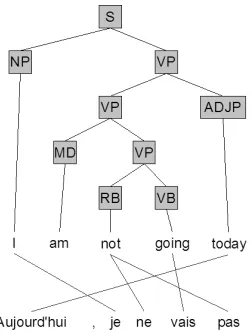
Figure 1: Example translation object.
training corpus. We refer to these partially annotated source sentences as partial translation objects.
The task at hand: use the training corpus to learn a procedure, through which we can successfully in-duce a complete translation object from a partial translation object. This is what we will define as translation.
3 Specific Task Addressed by this Paper
Before going on to actually describe a translation procedure (and how to induce it), we need to spec-ify our prior assumptions about how the translation objects will be annotated. For this paper, we want to exploit the syntax information that we can gain from an LFG-parser, hence we will assume the following annotations:
(1) In the training and evaluation corpora, the source sentences will be parsed with the XLE-parser. The attribute-value information from LFG’s f-structure is restructured so it is indexed by (c-structure) tree nodes; thus a tree node can bear mul-tiple labels for various pieces of morphological, syn-tactic and semantic information.
(2) In the training corpus, the source and target sentence of every translation object will be aligned using GIZA++ (http://www.fjoch.com/).
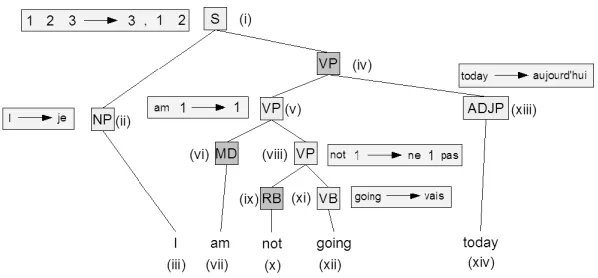
Figure 2: GHKM tree equivalent of example translation object. The light gray nodes are rule nodes of the GHKM tree.
4 Syntax MT as Tree Labeling
It is not immediately clear how one would learn a process to map a parsed source sentence into an aligned tree-string pair. To facilitate matters, we will map complete translation objects to an alternate representation. In (Galley et al., 2003), the authors give a semantics to aligned tree-string pairs by asso-ciating each with an annotated parse tree (hereafter called a GHKM tree) representing a specific theory about how the source sentence was translated into the destination sentence.
In Figure 1, we show an example translation ob-ject and in Figure 2, we show its associated GHKM tree. The GHKM tree is simply the parse tree f of the translation object, annotated with rules (hereafter referred to as GHKM rules). We will not describe in depth the mapping process from translation object to GHKM tree. Suffice it to say that the alignment in-duces a set of intuitive translation rules. Essentially, a rule like: “not 1→ne 1 pas” (see Figure 2) means: if we see the word “not” in English, followed by a phrase already translated into French, then translate the entire thing as the word “ne” + the translated phrase + the word “pas.” A parse tree node gets la-beled with one of these rules if, roughly speaking, its span is still contiguous when projected (via the alignment) into the target language.
The advantage of using the GHKM interpretation of a complete translation object is that our transla-tion task becomes simpler. Now, to induce a com-plete translation object from a partial translation ob-ject (parse tree), all we need to do is label the nodes of the tree with appropriate rules. We have reduced
the vaguely defined task of translation to the con-crete task of tree labeling.
5 The Generative Process
At the most basic level, we could design a naive gen-erative process that takes a parse tree and then makes a series of decisions, one for each node, about what rule (if any) that node should be assigned. How-ever it is a bit unreasonable to expect to learn such a decision without breaking it down somewhat, as there are an enormous number of rules that could po-tentially be used to label any given parse tree node. So let’s break this task down into simpler decisions. Ideally, we would like to devise a generative process consisting of decisions between a small number of possibilities (ideally binary decisions).
We will begin by deciding, for each node, whether or not it will be annotated with a rule. This is clearly a binary decision. Once a generative process has made this decision for each node, we get a conve-nient byproduct. As seen in Figure 3, the LHS of each rule is already determined. Hence after this se-quence of binary decisions, half of our task is al-ready completed.
tem-Figure 3: Partial GHKM tree, after rule nodes have been identified (light gray). Notice that once we identify the rule node, the rule left-hand sides are already determined.
plate ofh“ne”, x1,“pas”iish“ne”, X,“pas”iand the
template ofhx3,“,”, x1, x2i ishX,“,”, Xi, where X
represents the empty slots.
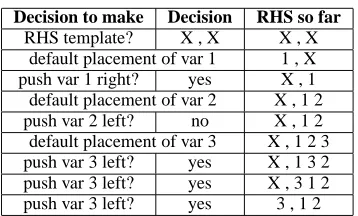
Once the template is chosen, it simply needs to be filled with the variables from the LHS. To do so, we process the LHS variables, one by one. By default, they are placed to the right of the previously placed variable (the first variable is placed in the first slot). We repeatedly offer the option to push the variable to the right until the option is declined or it is no longer possible to push it further right. If the vari-able was not pushed right at all, we repeatedly offer the option to push the variable to the left until the option is declined or it is no longer possible to push it further left. Figure 4 shows this generative story in action for the rule RHShx3,“,”, x1, x2i.
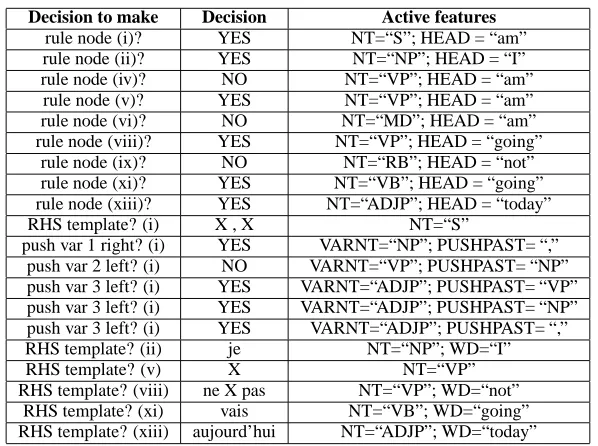
These are all of the decisions we need to make in order to label a parse tree with GHKM rules. A trace of this generative process for the GHKM tree of Figure 2 is shown in Figure 5. Notice that, aside from the template decisions, all of the decisions are binary (i.e. feasible to learn discriminatively). Even the template decisions are not terribly large-domain, if we maintain a separate feature-conditional dis-tribution for each LHS template. For instance, if the LHS template ish“not”, Xi, then RHS template
h“ne”, X,“pas”i and a few other select candidates should bear most of the probability mass.
5.1 Training
Having established this generative story, training is straightforward. As a first step, we can convert each complete translation object of our training corpus to the trace of its generative story (as in Figure 5).
Decision to make Decision RHS so far
[image:4.612.187.484.52.181.2]RHS template? X , X X , X default placement of var 1 1 , X push var 1 right? yes X , 1 default placement of var 2 X , 1 2 push var 2 left? no X , 1 2 default placement of var 3 X , 1 2 3 push var 3 left? yes X , 1 3 2 push var 3 left? yes X , 3 1 2 push var 3 left? yes 3 , 1 2
Figure 4: Trace of the generative story for the right-hand side of a GHKM rule.
These decisions can be annotated with whatever fea-ture information we might deem helpful. Then we simply divide up these feature vectors by decision type (for instance, rule node decisions, template de-cisions, etc.) and train a separate discriminative clas-sifier for each decision type from the feature vectors. This method is quite flexible, in that it allows us to use any generic off-the-shelf classification software to train our system. We prefer learners that produce distributions (rather than hard classifiers) as output, but this is not required.
5.2 Exploiting deep linguistic information
[image:4.612.338.517.235.343.2]the ParGram LFG grammar and applying probabilis-tic disambiguation (Riezler et al., 2002) to obtain a single analysis (i.e., a c-structure [phrase struc-ture tree] and an f-strucstruc-ture [an associated attribute-value matrix with morphosyntactic feature informa-tion and a shallow semantic interpretainforma-tion]) for each sentence. A fall-back mechanism integrated in the parser/grammar ensures that even for sentences that do not receive a full parse, substrings are deeply parsed and can often be treated successfully.
We convert the c-structure/f-structure represen-tation that is based on XLE’s sophisticated word-internal analysis into a plain phrase structure tree representation based on the original tokens in the source language string. The morphosyntactic fea-ture information from f-strucfea-ture is copied as addi-tional labeling information to the relevant GHKM tree nodes, and the f-structural dependency relation among linguistic units is translated into a relation among corresponding GHKM tree nodes. The rela-tional information is then used to systematically ex-tend the learning feature set for the tree-node based classifiers.
In future experiments, we also plan to exploit lin-guistic knowledge about the target language by fac-torizing the generation of target language words into separate generation of lemmas and the various mor-phosyntactic features. In decoding, a morphological generator will be used to generate a string of surface words.
5.3 Decoding
Because we have purposely refused to make any Markov assumptions in our model, decoding cannot be accomplished in polynomial time. Our hypothe-sis is that it is better to find a suboptimal solution of a high-quality model than the optimal solution of a poorer model. We decode through a simple search through the space of assignments to our generative process.
This is, potentially, a very large and intractible search space. However, if most assignment deci-sions can be made with relative confidence (i.e. the classifiers we have trained make fairly certain deci-sions), then the great majority of search nodes have values which are inferior to those of the best so-lutions. The standard search technique of depth-first branch-and-bound search takes advantage of
search spaces with this particular characteristic by first finding greedy good-quality solutions and using their values to optimally prune a significant portion of the search space. Depth-first branch-and-bound search has the following advantage: it finds a good (suboptimal) solution in linear time and continually improves on this solution until it finds the optimal. Thus it can be run either as an optimal decoder or as a heuristic decoder, since we can interrupt its execu-tion at any time to get the best soluexecu-tion found so far. Additionally, it takes only linear space to run.
6 Preliminary results
In this section, we present some preliminary results for an English-to-German translation system based on the ideas outlined in this paper.
Our data was a subset of the Europarl corpus consisting of sentences of lengths ranging from 8 to 17 words. Our training corpus contained 50000 sentences and our test corpus contained 300 sen-tences. We also had a small number of reserved sentences for development. The English sentences were parsed with XLE, using the English ParGram LFG grammar, and the sentences were word-aligned with GIZA++. We used the WEKA machine learn-ing package (Witten and Frank, 2005) to train the distributions (specifically, we used model trees).
For comparison, we also trained and evaluated the phrase-based MT system Pharaoh (Koehn, 2005) on this limited corpus, using Pharaoh’s default pa-rameters. In a different set of MT-as-Tree-Labeling experiments, we used a standard treebank parser trained on the PennTreebank Wall Street Journal section. Even with this parser, which produces less detailed information than XLE, the results are com-petitive when assessed with quantitative measures: Pharaoh achieved a BLEU score of 11.17 on the test set, whereas our system achieved a BLEU score of 11.52. What is notable here is not the scores them-selves (low due to the size of the training corpus). However our system managed to perform compara-bly with Pharaoh in a very early stage of its devel-opment, with rudimentary features and without the benefit of an n-gram language model.
Decision to make Decision Active features
rule node (i)? YES NT=“S”; HEAD = “am” rule node (ii)? YES NT=“NP”; HEAD = “I” rule node (iv)? NO NT=“VP”; HEAD = “am”
rule node (v)? YES NT=“VP”; HEAD = “am” rule node (vi)? NO NT=“MD”; HEAD = “am” rule node (viii)? YES NT=“VP”; HEAD = “going”
rule node (ix)? NO NT=“RB”; HEAD = “not” rule node (xi)? YES NT=“VB”; HEAD = “going” rule node (xiii)? YES NT=“ADJP”; HEAD = “today” RHS template? (i) X , X NT=“S”
push var 1 right? (i) YES VARNT=“NP”; PUSHPAST= “,” push var 2 left? (i) NO VARNT=“VP”; PUSHPAST= “NP” push var 3 left? (i) YES VARNT=“ADJP”; PUSHPAST= “VP” push var 3 left? (i) YES VARNT=“ADJP”; PUSHPAST= “NP” push var 3 left? (i) YES VARNT=“ADJP”; PUSHPAST= “,” RHS template? (ii) je NT=“NP”; WD=“I” RHS template? (v) X NT=“VP” RHS template? (viii) ne X pas NT=“VP”; WD=“not”
[image:6.612.157.456.52.275.2]RHS template? (xi) vais NT=“VB”; WD=“going” RHS template? (xiii) aujourd’hui NT=“ADJP”; WD=“today”
Figure 5: Trace of a top-down generative story for the GHKM tree in Figure 2.
evaluation, let’s take a closer look at the sentences produced by our system, to gain some insight as to its current strengths and weaknesses.
Starting with the English sentence (1) (note that all data is lowercase), our system produces (2).
(1) i agree with the spirit of those amendments .
(2) ich I stimme vote die the.FEM geist spirit.MASC dieser these ¨anderungsantr¨age change-proposals zu to . .
The GHKM tree is depicted in Figure 6. The key feature of this translation is how the English phrase “agree with” is translated as the German “stimme ... zu” construction. Such a feat is difficult to pro-duce consistently with a purely phrase-based sys-tem, as phrases of arbitrary length can be placed be-tween the words “stimme” and “zu”, as we can see happening in this particular example. By contrast, Pharaoh opts for the following (somewhat less de-sirable) translation: (3) ich I stimme vote mit with dem the.MASC geist spirit.MASC dieser these ¨anderungsantr¨age change-proposals . .
A weakness in our system is also evident here. The German noun “Geist” is masculine, thus our system uses the wrong article (a problem that
Pharaoh, with its embedded n-gram language model, does not encounter).
In general, it seems that our system is superior to Pharaoh at figuring out the proper way to arrange the words of the output sentence, and inferior to Pharaoh at finding what the actual translation of those words should be.
Consider the English sentence (4). Here we have an example of a modal verb with an embedded in-finitival VP. In German, infinite verbs should go at the end of the sentence, and this is achieved by our system (translating “shall” as “werden”, and “sub-mit” as “vorlegen”), as is seen in (5).
(4) ) we shall submit a proposal along these lines before the end of this year .
(5) wir we werden will eine a.FEM vorschlag proposal.MASC in in dieser these haushaltslinien budget-lines vor before die the.FEM ende end.NEUT dieser this.FEM jahres year.NEUT vorlegen submit . .
Pharaoh does not manage this (translating “sub-mit” as “unterbreiten” and placing it mid-sentence).
(6) werden will wir we unterbreiten submit eine a vorschlag proposal in in dieser these haushaltslinien budget-lines vor before ende end dieser this.FEM jahr year.NEUT . .
sev-Figure 6: GHKM tree output for a test sentence.
eral agreement mistakes and (like Pharaoh) doesn’t get the translation of “along these lines” right.
In Figure 7, we show sample translations by the three systems under discussion for the first five sen-tences in our evaluation set. For the LFG-based ap-proach, we can at this point present only results for a version trained on 10% of the sentence pairs. This explains why more source words are left untrans-lated. But note that despite the small training set, the word ordering results are clearly superior for this system: the syntax-driven rules place the untrans-lated English words in the correct position in terms of German syntax.
The translations with Pharaoh contain relatively few agreement mistakes (note that it exploits a lan-guage model of German trained on a much larger corpus). The phrase-based approach does however skip words and make positioning mistakes some of which are so serious (like in the last sentence) that they make the result hard to understand.
7 Discussion
In describing this pilot project, we have attempted to give a “big picture” view of the essential ideas behind our system. To avoid obscuring the presen-tation, we have avoided many of the implementation details, in particular our choice of features. There are exactly four types of decisions that we need to train: (1) whether a parse tree node should be a rule
node, (2) the RHS template of a rule, (3) whether a rule variable should be pushed left, and (4) whether a rule variable should be pushed right. For each of these decisions, there are a number of possible features that suggest themselves. For instance, re-call that in German, embedded infinitival verbs get placed at the end of the sentence or clause. So when the system is considering whether to push a rule’s noun phrase to the left, past an existing verb, it would be useful for it to consider (as a feature) whether that verb is the first or second verb of its clause and what the morphological form of the verb is.
Even in these early stages of development, the MT-as-Tree-Labeling system shows promise in us-ing syntactic information flexibly and effectively for MT. Our preliminary comparison indicates that us-ing deep syntactic analysis leads to improved trans-lation behavior. We hope to develop the system into a competitive alternative to phrase-based ap-proaches.
References
P.F. Brown, S. A. Della Pietra, V. J. Della Pietra, and R. L. Mer-cer. 1993. The mathematics of statistical machine trans-lation: Parameter estimation. Computational Linguistics,
19(2):263–311.
[image:7.612.70.471.53.251.2]gram-source we believe that this is a fundamental element . professional translation wir denken , dass dies ein grundlegender aspekt ist .
PHARAOH(50k) wir halten dies f¨ur
:::eine::::::::::::grundlegende element . TL-WSJ(50k) wir glauben , dass
:::::
diesen ist ein grundlegendes element .
TL-LFG(5k) wir meinen , dass dies
:::eine::::::::::::grundlegende element ist .
source it is true that lisbon is a programme for ten years . professional translation nun ist lissabon ein programm f¨ur zehn jahre .
PHARAOH(50k) es ist richtig , dass lissabon ist
:::
eine programm f¨ur zehn
:::::
jahren .
TL-WSJ(50k) es ist richtig , dass lissabon ist
:::
eine programm f¨ur zehn
:::::
jahren .
TL-LFG(5k) es ist true , dass lisbon
:::
eine programm f¨ur zehn
:::::
jahren ist . source i completely agree with each of these points .
professional translation ich bin mit jeder einzelnen dieser aussagen voll und ganz einverstanden .
PHARAOH(50k) ich ... v¨ollig einverstanden mit jedem dieser punkte .
TL-WSJ(50k) ich bin v¨ollig mit
::::jedes:::::diese fragen einer meinung . TL-LFG(5k) ich agree completely mit
::::jeder dieser punkte .
source however , i would like to add one point . professional translation aber ich m¨ochte gern einen punkt hinzuf¨ugen .
PHARAOH(50k) allerdings m¨ochte ich noch eines sagen .
TL-WSJ(50k) ich m¨ochte jedoch an noch einen punkt hinzuf¨ugen .
TL-LFG(5k) allerdings m¨ochte ich einen punkt add .
source this is undoubtedly a point which warrants attention .
professional translation ohne jeden zweifel ist dies ein punkt , der aufmerksamkeit verdient .
PHARAOH(50k) das ist sicherlich
:::
eine punkt .... rechtfertigt das aufmerksamkeit .
TL-WSJ(50k) das ist ohne zweifel
[image:8.612.122.493.53.328.2]::::eine punkt ,::die warrants beachtung . TL-LFG(5k) das ist undoubtedly .... sache , die attention warrants .
Figure 7: Sample translations by (1) thePHARAOHsystem, (2) our system with a treebank parser (TL-WSJ), (3) our system with the XLE parser (TL-LFG). (1) and (2) were trained on 50,000 sentence pairs, (3) just
on (3) sentence pairs. Error coding:
::::::wrong:::::::::::::::morphological:::::form, incorrectly positioned word, untranslated source word, missed word: ...., extra word.
mar project. In Proceedings of COLING-2002 Workshop on
Grammar Engineering and Evaluation, pages 1–7.
David Chiang. 2005. A hierarchical phrase-based model for statistical machine translation. In Proceedings of ACL, pages 263–270.
Michel Galley, Mark Hopkins, Kevin Knight, and Daniel Marcu. 2003. What’s in a translation rule? In Proc. NAACL.
Philipp Koehn, Franz Josef Och, and Daniel Marcu. 2003. Sta-tistical phrase-based translation. In Proceedings of the
Hu-man Language Technology Conference 2003 (HLT-NAACL 2003), Edmonton, Canada.
Philipp Koehn. 2002. Europarl: A multilingual corpus for eval-uation of machine translation. Ms., University of Southern California.
Philipp Koehn. 2005. Pharaoh: a beam search decoder for phrase-based statistical machine translation models. In
Pro-ceedings of the Sixth Conference of the Association for Ma-chine Translation in the Americas, pages 115–124.
Franz Josef Och and Hermann Ney. 2003. A systematic com-parison of various statistical alignment models.
Computa-tional Linguistics, 29(1):19–51.
F. J. Och, D. Gildea, S. Khudanpur, A. Sarkar, K. Yamada, A. Fraser, S. Kumar, L. Shen, D. Smith, K. Eng, Viren
Jain, Z.Jin, and D. Radev. 2003. Syntax for statistical ma-chine translation. Technical report, Center for Language and Speech Processing, Johns Hopkins University, Baltimore. Summer Workshop Final Report.
Stefan Riezler, Dick Crouch, Ron Kaplan, Tracy King, John Maxwell, and Mark Johnson. 2002. Parsing the Wall Street Journal using a Lexical-Functional Grammar and discrim-inative estimation techniques. In Proceedings of the 40th
Annual Meeting of the Association for Computational Lin-guistics (ACL’02), Pennsylvania, Philadelphia.
Ian H. Witten and Eibe Frank. 2005. Data Mining: Practical
machine learning tools and techniques. Morgan Kaufmann.
Dekai Wu. 1997. Stochastic inversion transduction grammars and bilingual parsing of parallel corpora. Computational Linguistics, 23(3):377–403.
Kenji Yamada and Kevin Knight. 2001. A syntax-based statis-tical translation model. In Proceedings of the 39th Annual
Meeting of the Association for Computational Linguistics,