1306 | P a g e
Pre-Encoded Multipliers Based on Non-Redundant
Radix-8 Signed-Digit Encoding
B.Sunny Manohar
Assistant Professor, Dhruva Institute of Engineering & Technology
ABSTRACT
In this paper, we introduce an architecture of pre-encoded multipliers for Digital Signal Processing applications based on off-line encoding of coefficients. To this extend, the Non-Redundant radix-8 Signed-Digit (NR8SD) encoding technique, which uses the digit values f 1; 0; +1; +2g or f 2; 1; 0; +1g, is proposed leading to a multiplier design with less complex partial products implementation. Extensive experimental analysis verifies that the proposed pre-encoded NR8SD multipliers, including the coefficients memory, are more area and power efficient than the conventional Modified Booth scheme.
Index Terms: Multiplying circuits, Modified Booth encoding, Pre-Encoded multipliers, VLSI
implementation
I. INTRODUCTION
MULTIMEDIA and Digital Signal Processing (DSP) applications (e.g., Fast Fourier Transform (FFT),
audio/video CoDecs) carry out a large number of multiplications with coefficients that do not change during the
execution of the application. Since the multiplier is a basic component for implementing computationally
intensive applications, its architecture seriously affects their performance. Constant coefficients can be encoded
to contain the least non-zero digits using the Canonic Signed Digit (CSD) representation [1]. CSD multipliers
com-prise the fewest non-zero partial products, which in turn decreases their switching activity. However, the
CSD encoding involves serious limitations. Folding technique [2], which reduces silicon area by
time-multiplexing many operations into single functional units, e.g., adders, multipliers, is not feasible as the
CSD-based multipliers are hard-wired to specific coef-ficients. In [3], a CSD-CSD-based programmable multiplier design
was proposed for groups of pre-determined coefficients that share certain features. The size of ROM used to
store the groups of coefficients is sig-nificantly reduced as well as the area and power consumption of the
circuit. However, this multiplier design lacks flexibility since the partial products gen-eration unit is designed
specifically for a group of coefficients and cannot be reused for another group. Also, this method cannot be
easily extended to large groups of pre-determined coefficients attaining at the same time high efficiency.
Modified Booth (MB) encoding [4]–[7] tackles the aforementioned limitations and reduces to half thenumber of
partial products resulting to reduced area, critical delay and power consumption. However, a dedicated encoding
circuit is required and the partial products generation is more complex. In [8], Kim et al. proposed a technique
similar to [3], for designing efficient MB multipliers for groups of pre-determined coefficients with the same
limitations described in the previous paragraph.
In [9], [10], multipliers included in butterfly units of FFT processors use standard coefficients stored in ROMs.
In audio [11], [12] and video [13], [14] CoDecs, fixed coefficients stored in memory, are used as multiplication
1307 | P a g e
on the MB encoding and store the MB encoded coefficients (i.e., 3 bits per digit) into a ROM. Using thistechnique [15]–[17], the encoding circuit of the MB multiplier is omitted. We refer to this design as pre-encoded
MB multiplier. Then, we explore a Non-Redundant radix-8 Signed-Digit (NR8SD) encoding scheme extending
the serial encoding techniques of [6], [18]. The proposed NR8SD encoding scheme uses one of the following
sets of digit values: f 1; 0; +1; +2g or f 2; 1; 0; +1g. In or-der to cover the dynamic range of the 2’s complement
form, all digits of the proposed representation are en-coded according to NR8SD except the most significant one
that is MB encoded. Using the proposed encoding formula, we pre-encode the standard coefficients and store
them into a ROM in a condensed form (i.e., 2 bits per digit). Compared to the pre-encoded MB multiplier in
which the encoded coefficients need 3 bits per digit, the proposed NR8SD scheme reduces the memory size.
Also, compared to the MB form, which uses five digit values f 2; 1; 0; +1; +2g, the proposed NR8SD encoding
uses four digit values. Thus, the NR8SD-based pre-encoded multipliers in-clude a less complex partial products
generation cir-cuit. We explore the efficiency of the aforementioned pre-encoded multipliers taking into account
the size of the coefficients’ ROM.
II. MODIFIED BOOTH ALGORITHM
Modified Booth (MB) is a redundant radix-4 encoding technique [6], [7]. Considering the multiplication of the
1308 | P a g e
where b 1 = 0. Each MB digit is represented by the bits s, one and two (Table 1). The bit s shows if the digit isnegative (s=1) or positive (s=0). One shows if the absolute value of a digit equals 1 (one=1) or not (one=0). Two
shows if the absolute value of a digit equals 2 (two=1) or not (two=0). Using these bits, we calculate the MB
digits bMBj as follows:
III. NON-REDUNDANT RADIX-8 SIGNED-DIGIT ALGORITHM
In this section, we present the Non-Redundant radix-4 Signed-Digit (NR8SD) encoding technique. As in MB
form, the number of partial products is reduced to half. When encoding the 2’s complement number B,
1309 | P a g e
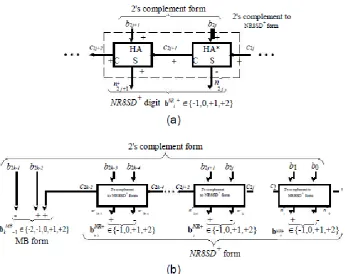
Fig. 2. Block Diagram of the NR8SD+ Encoding Scheme at the (a) Digit and (b) Word Level.
digits bNRj take one of four values: f 2; 1; 0; +1g or bNRj+ 2 f 1; 0; +1; +2g at the NR8SD or NR8SD+ algorithm, respectively. Only four different values are used and not five as in MB algorithm, which leads to 0 j k
2. As we need to cover the dynamic range of the 2’s complement form, the most significant digit is MB encoded
(i.e., bMBk1 2 f 2; 1; 0; +1; +2g).
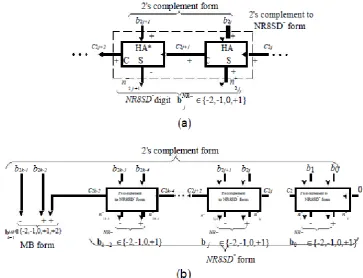
The NR8SD and NR8SD+ encoding algorithms are illustrated in detail in Fig. 1 and 2, respectively.
NR8SD Algorithm
Step 1: Consider the initial values j = 0 and c0=0. Step 2: Calculate the carry c2j+1 and the sum n+2j of a Half
Adder (HA) with inputs b2j and c2j (Fig. 1a).
c2j+1 = b2j ^ c2j; n+2j = b2j c2j:
Step 3: Calculate the positively signed carry c2j+2 (+) and the negatively signed sum n2j+1 (-) of a Half Adder*
1315 | P a g e
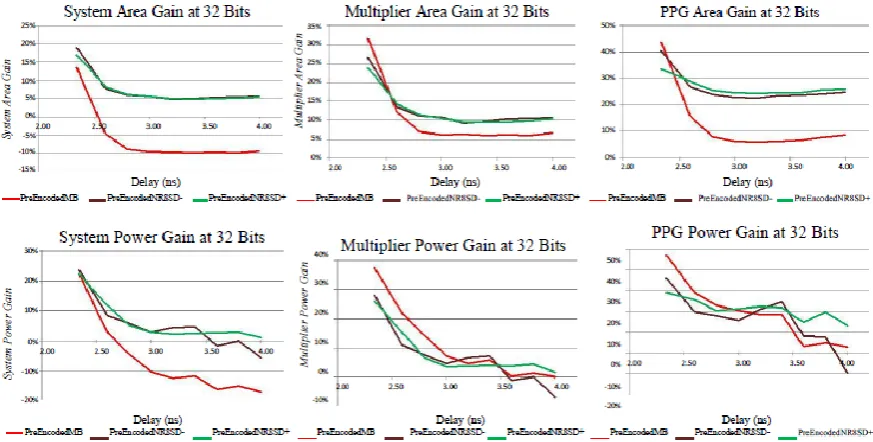
Fig. 10. Area / Power Gains of the Pre-Encoded Designs Over the Conventional MB Scheme at
1316 | P a g e
VI. CONCLUSION
In this paper, new designs of pre-encoded multi-pliers are explored by off-line encoding the stan-dard
coefficients and storing them in system mem-ory. We propose encoding these coefficients in the
Non-Redundant radix-8 Signed-Digit (NR8SD) form. The proposed pre-encoded NR8SD multiplier designs are more
area and power efficient compared to the conventional and pre-encoded MB designs. Extensive experimental
analysis verifies the gains of the pro-posed pre-encoded NR8SD multipliers in terms of area complexity and
power consumption compared to the conventional MB multiplier.
REFERENCES
[1] G. W. Reitwiesner, ―Binary arithmetic,‖ Advances in Computers, vol. 1, pp. 231–308, 1960.
[2] K. K. Parhi, VLSI Digital Signal Processing Systems: Design and Implementation. John Wiley & Sons,
2007.
[3] K. Yong-Eun, C. Kyung-Ju, J.-G. Chung, and X. Huang, ―Csd-based programmable multiplier design for
predetermined coefficient groups,‖ IEICE Trans. Fundam. Electron. Commun. Comput. Sci., vol. 93, no. 1, pp. 324–326, 2010.
[4] O. Macsorley, ―High-speed arithmetic in binary computers,‖ Proc. IRE, vol. 49, no. 1, pp. 67–91, Jan. 1961.
[5] W.-C. Yeh and C.-W. Jen, ―High-speed booth encoded parallel multiplier design,‖ IEEE Trans. Comput., vol. 49, no. 7, pp. 692– 701, Jul. 2000.
[6] Z. Huang, ―High-level optimization techniques for low-power multiplier design,‖ Ph.D. dissertation, Department of Com-puter Science, University of California, Los Angeles, CA, 2003.
1317 | P a g e
[8] Y.-E. Kim, K.-J. Cho, and J.-G. Chung, ―Low power small area modified booth multiplier design forpredetermined coeffi-cients,‖ IEICE Trans. Fundam. Electron. Commun. Comput. Sci., vol. E90-A, no. 3, pp. 694–697, Mar. 2007.
[9] C. Wang, W.-S. Gan, C. C. Jong, and J. Luo, ―A low-cost 256-point fft processor for portable speech and
audio appli-cations,‖ in Int. Symp. on Integrated Circuits (ISIC 2007), Sep. 2007, pp. 81–84.
[10] A. Jacobson, D. Truong, and B. Baas, ―The design of a recon-figurable continuous-flow mixed-radix fft
processor,‖ in IEEE Int. Symp. on Circuits and Syst. (ISCAS 2009), May 2009, pp. 1133–1136.
[11] Y. T. Han, J. S. Koh, and S. H. Kwon, ―Synthesis filter for mpeg-2 audio decoder,‖ Patent US 5 812 979, Sep., 1998.
[12] M. Kolluru, ―Audio decoder core constants rom optimization,‖ Patent US 6 108 633, Aug., 2000. [13] H.-Y. Lin, Y.-C. Chao, C.-H. Chen, B.-D. Liu, and J.-F. Yang, ―Combined 2-d transform and
quantization architectures for h.264 video coders,‖ in IEEE Int. Symp. on Circuits and Syst. (ISCAS 2005), vol. 2, May 2005, pp. 1802–1805.
[14] G. Pastuszak, ―A high-performance architecture of the double-mode binary coder for h.264.avc,‖ IEEE Trans. Circuits Syst. Video Technol., vol. 18, no. 7, pp. 949–960, Jul. 2008.
[15] J. Park, K. Muhammad, and K. Roy, ―High-performance fir filter design based on sharing
multiplication,‖ IEEE Trans. Very Large Scale Integr. (VLSI) Syst., vol. 11, no. 2, pp. 244–253, Apr. 2003.
[16] K.-S. Chong, B.-H. Gwee, and J. S. Chang, ―A 16-channel low-power nonuniform spaced filter bank core
for digital hearing aids,‖ IEEE Trans. Circuits Syst. II, Exp. Briefs, vol. 53, no. 9,pp. 853–857, Sep. 2006. [17] B. Paul, S. Fujita, and M. Okajima, ―Rom-based logic (rbl) design: A low-power 16 bit multiplier,‖ IEEE
J. Solid-State Circuits, vol. 44, no. 11, pp. 2935–2942, Nov. 2009.
[18] M. D. Ercegovac and T. Lang, ―Multiplication,‖ in Digital Arithmetic. San Francisco: Morgan Kaufmann, 2004, pp. 181– 245.
[19] N. Weste and D. Harris, CMOS VLSI Design: A Circuits and Systems Perspective, 4th ed. USA:
Addison-Wesley Publishing Company, 2010.