(will be inserted by the editor)
Variants of Differential and Linear Cryptanalysis
Mehak Khurana · Meena Kumari
Received: date / Accepted: date
Abstract Block cipher is in vogue due to its require-ment for integrity, confidentiality and authentication. Differential and Linear cryptanalysis are the basic tech-niques on block cipher and till today many cryptana-lytic attacks are developed based on these. Each variant of these have different methods to find distinguisher and based on the distinguisher, the method to recover key. This paper illustrates the steps to find distinguisher and steps to recover key of all variants of differential and lin-ear attacks developed till today. This is advantageous to cryptanalyst and cryptographer to apply various at-tacks simultaneously on any crypto algorithm.
Keywords Boomerang ·Differential Cryptanalysis · Higher Order · Impossible · Integral· Linear crypt-analysis ·Rectangle ·Related Key ·Truncated· Zero Correlation
1 Introduction
Block cipher is one of the cryptographic techniques which are used for integrity, confidentiality and authentica-tion mechanism. Designing a cipher which is secure and immune to all present day attacks is a challenging task. Cryptanalyst has to find statistical and algebraic technique based on mathematical weakness in design with the aim to recover the secret key. Cryptanalytic method consists of analyzing mathematical properties of encryption algorithms with the aim to find the dis-tinguishers which distinguishes the output distribution
ITM University Gurgaon, India
E-mail: [email protected]
ITM University Gurgaon, India
E-mail: [email protected]
of cryptographic algorithms from uniform distribution. Based on this property one finds the distinguisher which distinguishes it from randomness and exploits this to find the key. Attack is said to be theoretically success-ful if cryptanalyst breaks the cipher with less key com-plexity than exhaustive search. It may not be practi-cally feasible to break with lesser key complexity than exhaustive search. But lesser key complexity than brute force attack shows that the cipher design has some flaws or weakness which can be exploited in future with ad-vent of new attacks.
There are various types of cryptanalytic attacks; based on the attackers access such as ciphertext only attack, known plaintext attack or attacker access to encryption system to generate chosen plaintext and its ciphertext or decryption process to generate plaintexts of chosen ciphertexts. The success of attack can be measured us-ing number of plaintext-ciphertext pairs or operations required to recover secret key or partial key. When for the attack the number of operations required is less than 2n where n is size of secret key, the cipher is said to be broken.
Bi-ham, Alex Biryukov, and Adi Shamir used impossible differential to break IDEA and Skipjack block ciphers [6] by exploiting differentials that never occurs. In 1999 Boomerang attack was developed by Wagner [7] which states, attack is possible even if no differentials with high or low probability is present for whole cipher. This attack was modified and named as Rectangle attack [8] in 2001. Related Key attack can be combined with other variants of differential cryptanalysis where knowledge of difference in keys may allow to attack more number of rounds [9].
Linear cryptanalysis was developed by Matsui [10] in 1993 to exploit linear approximation with high proba-bility i.e. greater than 12. Zero correlation is a variant of linear cryptanalysis developed by Bogdanov and Rij-men [11] which tries to construct atleast one non trivial linear hull with no linear trail i.e. with correlation C ex-actly zero. This attack is countermeasure of impossible differential attack.
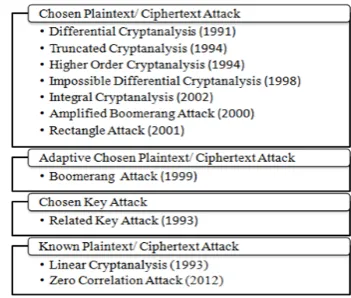
To attack a cipher using integral, impossible or zero correlation attack details of S-Box is not required as it is independent of the choice of S-Box. Choosing another S-Box for a cipher will result in almost same cryptan-alytic results. Fig. 1 illustrates the different types of attacks developed till today.
Fig. 1 Types of Cryptanalytic Attacks
Differential and Linear cryptanalysis or its variants have been applied on almost all the block ciphers developed till today. The fig. 2 shows various differential and lin-ear based attacks which are developed and their com-binations. Block cipher which is resistant to one attack can be attacked by its variants or some combinations of variants. To ease the process of applying these attacks to check resistance to present day cryptanalytic attacks, the simplified steps of each attack are described in next sections.
Fig. 2 Variants of Cryptanalysis
The basic differential cryptanalytic technique is explained in section II and the steps to find distinguisher and steps to recover key for each variant of differential crypt-analysis is explained in section 3. In section 4 linear cryptanalysis is illustrated and the steps to find dis-tinguisher and steps to recover key for the latest vari-ant of linear cryptanalysis is explained in section 5. We conclude in section 6 by describing unification of these attacks and how this work is advantageous to the crypt-analyst.
2 Differential Cryptanalysis
In differential cryptanalysis, one attacks by exploiting the fact that for some fixed plaintext difference∆P = P ⊕P0, certain differences in the ciphertext ∆C =
C⊕C0 appear more often than one would expect for secured design and this high probability of occurrence is used to find secret key, whereP andP0are two plain-texts andC andC0 are corresponding ciphertexts. To apply differential cryptanalysis, one needs to find the high probability of differentials in each S-Box used in block cipher based on Substitution Permutation Net-work (SPN) and then find products of high probabilities of differential of S-boxes which lead the given plaintext difference ∆P = P ⊕P0 to the ciphertext difference ∆C = C ⊕C0. So in order to determine the differ-ential characteristic, Difference distribution tables are constructed for each S-Box for input difference∆Xand output difference ∆Y. Due to the weakness in S-Box (nxm), we may get high probabilities of difference pair (∆X, ∆Y) instead of 1
Once the differential characteristic for second last round with a suitably large enough probability pD is
discov-ered, it is easy to attack cipher to recover some bits of last round subkey by ex-oring all the possible combina-tions of all influenced nonzero difference bits TPS (Tar-get Partial Subkeys) entering last round with the ci-phertext and running one round backwards through S-boxes. The number of chosen plaintext-ciphertext pairs required for attack will be 1/pD.
Differential cryptanalysis is divided into two steps: i) Finding the Distinguisher and ii) Steps for Key Recov-ery.
i) Finding the Distinguisher
1. Difference distribution table is constructed for each S-Box (nxm) which contains the number of occur-rences of corresponding output difference ∆Y for each given input difference ∆X.
2. Find the probability of the each value of input out-put difference by dividing it by 2n (number of input
bits)
3. Mark S-box difference pairs from round to round so that the nonzero output difference bits from one round correspond to the nonzero input difference bits of the next round with highest probability. There-fore traversing the active S-Box (i.e. non-zero dif-ferential with high probability) difference pair from first round till second last round of the cipher. The highest probabilities of input output pairs of active S-boxes are multiplied, to get the differential proba-bilitypD till second last round of the cipher [10].
4. So the differential probabilitypDis the distinguisher
During the cryptanalysis process, many pairs of plain-texts for which∆P will be encrypted. With high prob-ability, the differential characteristic∆Cwill occur. We term such pairs for (∆P, ∆C) as right pairs. Plaintext difference pairs for which the characteristic does not oc-cur are referred to as wrong pairs.
ii) Steps for Key Recovery
1. Generate N plaintext/ciphertext pairs with given ∆P.
2. If kr(TPS) is l−bit. There are 2l possibilities. For
each TPS value (say TPS*) do the following i Set count=0
ii For each Ciphertext(i) for i = 1toN do the partial decryption
(a) Ciphertext(i)⊕T P S∗
(b) Run backward through S-boxes to obtain bits into the last round
(c) Check the input difference to the final round determined by partial decryption is the same
as expected from the differ-ential characteristic
(d) If same, increment count The partial subkey value with largest count is con-sidered for each TPS*
3. Obtain a table of partial subkey values and corre-spondingprob=count/N.
4. If probability (prob) as calculated in step 3 is equal topD(as expected)⇒Correct TPS is determined
For fast implementation, discard those wrong cipher-text pairs of which zeros do not appear in appropriate subblock of the ciphertext difference.
3 Variants Of Differential Cryptanalysis
In this section variants of differential cryptanalysis are described by illustrating the steps to formulate the dis-tinguisher and steps to recover key.
3.1 Truncated Differential Cryptanalysis
In case of differential cryptanalysis, one exploits the probability of fixed plaintext difference of two plain-texts that produces the predicted Ciphertext difference of the respective ciphertexts, but in case of truncated differential, instead of getting the exact differential in plaintext and Ciphertext, one exploits the probability of subset of plaintext differences and subset of predicted Ciphertext differences [12]. Wherever the value in the difference is not as predicted in Differential cryptanaly-sis we denote by0?0 (don’t care), So the predicted prob-ability of truncated differential increases the number of plaintext and Ciphertext pairs to be counted in the dis-tinguisher, which in turn increases the probability of recovering the key [13]. The attack is as follows: i)Finding the Distinguisher
1. Let∆Pα be the subset of non trivial difference∆P
of two inputs to encryption function f :GF(2n)→ GF(2n) upto r rounds, for which only fraction of
output difference∆Ci.e.∆Cδ occurs afterrrounds.
The truncated differentials∆Pα→∆Cδ
2. LetTbe a table of size 2nwhich is initialized to zero
for all entries.
3. For all possible value of inputx, x∈GF(2n), com-pute the table T by putting 1 at position f(x)⊕ f(x⊕∆Pα), which gives truncated output∆Cδ
cor-responding truncated input∆Pα, i.e.T[f(x) +f(x+
∆Pα)] = 1. Therefore all possible output
ii)Steps for Key Recovery
In order to recover last round keykr, if we get truncated
differentials and tableT values of functionf ofrround 1. Generate N pair of plaintext P, P0 and their
corre-sponding ciphertextC, C0 respectively.
2. For all possible value of the last round keykr, do the
following:
i Decrypt one round backwards C, C0 us-ing kr, and obtain the intermediate
ci-phertextsM, M0
3. For all possible value of the second last round key, kr−1 do the following:
i Calculatet1=f(M+kr−1), t2=f(M0+ kr−1)
ii IfT[t1+t2+M+M0]>0, then pair of keyskr−1 andkr are right keys. Here,
we are measuring if the truncated differ-ential was seen.
4. By repeating the attackNnumber of times only one unique pair of keyskr−1 andkr, the right key will
be suggested. Then output the values of kr−1 and
kr.
5. Output the subkeys for last and second last round kr andkr−1 respectively.
3.2 Impossible Differential Cryptanalysis
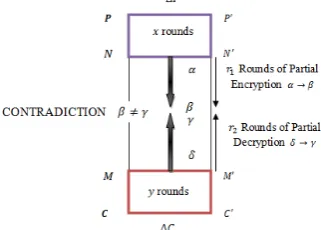
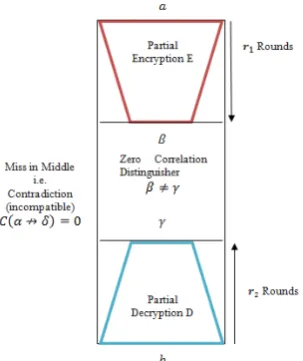
Biham et.al. in 1998 developed variant of a truncated differential cryptanalysis called impossible differential cryptanalysis [14][15][16] by formulating distinguisher based on the fact that certain differentials never occur (i.e. the differentials with zero probability). It can be applied to the cipher, whose non-linear round function is bijective. To apply impossible differential attack, we need to find impossible differential pair (α9δ) which can be used as distinguisher the differential αcan be ∆P the difference of two plaintextP andP0 or it can be the difference of two inputsN andN0 after encryp-tion ofxrounds ofP andP0 and the differential δcan be ∆C the difference of two ciphertext C and C0 or it can be the difference of two outputs M and M0 af-ter decryption ofy rounds ofC andC0. The difference α after r1+r2 rounds produces the output difference δ. An impossible differential with miss in middle tech-nique works as a distinguisher to rule out the incorrect keys, where miss in middle technique uses combination of two differentials both of which hold with probabil-ity one and do not meet in middle i.e. for r1 rounds of partial encryption αbecomes β and for partial de-cryption ofr2roundsδbecomesγ(see Fig 3). Ifβ6=γ the difference α9δafter r1+r2rounds of encryption is impossible because α → β 6= γ ← δ and (α, δ) is
called impossible differential pair. We eliminate or dis-card keys for which impossible differential characteristic β6=γ holds for the subkey of that key.
Fig. 3 Miss in Middle
i)Finding the Distinguisher
To obtain impossible differentials (α9δ)
1. Obtain the input differential α=N ⊕N0, encrypt N, N0 by r1 rounds to obtain differential β of the outputs i.e.P r(α→β) = 1
2. For the differential δ = M ⊕M0, decrypt M, M0 byr2 rounds to obtain values with differentialγ i.e. P r(δ→γ) = 1.
3. Ifβ6=γ thenα9δ is impossible
4. Repeat above 4 steps for different values (α, δ) to ob-tain a setIDi.e.ID= (α1, δ1),(α2, δ2), . . . ,(αn, δn).
ii)Filtering and Key Elimination
For each key, obtain subkey afterxrounds andyrounds. Do the following to rule out the invalid subkeys 1. For input-output pairs (N, M) and (N0, M0). Check
N⊕N0 =αandM ⊕M0=δi.e. (α, δ)∈ID
2. Find the differentialβ of the values after encrypting N and N0 byr1 round
3. Find differentialγof the value after decryptingM, M0
byr2 rounds
4. Checkβ6=γthen subkey is invalid.
5. Rejecting the invalid keys, the total key space is re-duced.
3.3 Integral Cryptanalysis
Cryptanaly-sis[17]. Block ciphers which uses bijective components are prone to integral cryptanalysis. The integral is de-fined as R
R = P
B∈RB, where B =b1, b2. . . , bn is a
state vector where eachbi∈GF(2n).Ris a multiset of
state vectors. In integral 0n0 represents the number of
words in the plaintext and ciphertext, for example in AES the state vector is of 16 words each of 8 bits. In this attack, attacker tries to predict the values in the inte-gral after certain number of rounds of encryption. The following properties can be observed in output of cipher rounds which play an important role to construct ba-sic model of integral distinguisher to distinguish several rounds of block cipher from random permutation. (a) All ith words are equal i.e. b
i = c for all B ∈ R,
denoted by symbol0C0 Wherec∈GF(2n), are some
fixed values (constants). (b) Allithwords are differentb
i:B∈R=GF(2n),
de-noted by symbol 0A0.
(c) Allithwords sum to certain value predicted in ad-vance L
B∈Rbi = c0, denoted by symbol 0S0
(bal-anced) Where c0 ∈ GF(2n), are some fixed values
(constants)
(d) The sum of words that cannot be predicted i.e. no information can be derived are denoted by symbol ‘?0
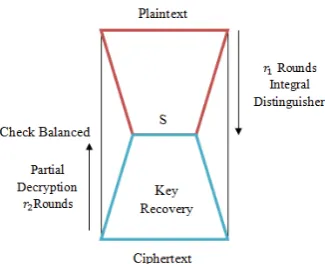
Fig. 4 Integral Attack
i) Finding the Distinguisher
1. Choose an input multisetRwhich consists of 2n
cho-sen plaintexts which have above property such that plaintext with some certain words being Aand rest of the words beingC. e.g.P = (CCCC;CCCC), P0= (ACCC;CCCC).
2. Encrypt the multiset, after a few rounds r1 of en-cryption check if all the sum (usually exclusive-or) at some word is zero (balanced) i.e. some bytes of output will have state 0S0 (balanced) with proba-bility one which works as a distinguisher that can distinguish few rounds of cipher from random per-mutation, see fig. 4.
3. Thus by changing the position of0A0 in chosen plain-text we can obtain different distinguisher.
ii) Steps for Key Recovery
1. Obtain all the possible combination of subkey kr
(TPS).
2. Do the partial decryptions (forr2 rounds) upto the output of integral distinguisher.
3. If decryption gives exclusive-or sum of the states as zeroi.e. balanced, store that subkey.
Otherwise, repeat the steps for other possible sub-keys.
4. Repeat step 1-3 number of times for all multiset, subkey with maximum count is the correct subkey.
3.4 Higher Order Differential Cryptanalysis
Knudsen introduced higher order differential cryptanal-ysis based on the concept of higher order derivative pro-posed by Lai [18] that are applicable to those ciphers that can be expressed by multivariable Boolean func-tions with low degree [19].
The derivative of function f : GF(2n) → GF(2m) at the point a is ∆af(x) = f(x+a)−f(x) where a ∈
GF(2n). Forithderivative offat the point (a
1, a2, .., ai)∈
GF(2n) is defined as∆(i)
a1,...,aif(x) =∆ai(∆
(i−1)
a1,...,ai−1)f(x),
where∆(ai−1)
1,. . . ,ai−1f(x) is the (i−1)
thderivative off at
(a1, a2, . . . , ai−1), the 0thderivative offis defined to be f(x) itself, alsodeg(∆af(x))6deg(f(x))−1. For any
x∈GF(2n), letL[a1, . . . , ai] be the list of all 2ipossible
combinations ofa1, . . . , ai [20]. Then ∆
(i)
a1,. . . ,aif(x) =
L
v∈L[a1,. . . ,.ai]f(x⊕v) If ai is linearly independent
of (a1, . . . , ai −1), then ∆
(i)
a1,. . . ,aif(x) = 0. In
iter-ated block cipher of block sizenandrrounds, Attack is possible, when we know the total degree deg(f) of the output of the (r−1)th round. To attack (r−1)
rounds of cipher, we find the order of (r−1) rounds for which derivative∆a1,a2,. . . ,ar−1f(x) =c(constant)∀x∈
GF(2n) i.e. independent of round keysk
1, k2, . . . , kr−1. The steps to find the order are given in[21]. The attack is based on the property that the dth derivative of a
multivariate polynomialsf with degreedis a constant and (d+ 1)thderivative is zero.
i)Finding the Distinguisher
1. Randomly choose a plaintextP ∈GF(2n)
2. Encrypt plaintextsP⊕v,∀v∈L[a1, . . . , ai] to obtain
their corresponding ciphertextscv.
3. ComputeL
v∈L[a1,. . . ,ai]f(x⊕v)
4. IfL
v∈L[a1,. . . ,ai]f(x⊕v) =c(constant)∀x∈GF(2 n),
for (r−1) round with any round keysk1, k2, . . . , kr−1.This will work as a distinguisher to recover the key.
1. Generate N plaintext randomly. For each plaintext P, do the following
2. For all the possible combination of last round in-fluenced bits kr(TPS), if kr is l-bits, there are 2l
possibilities for eachkrvalue, for each value of TPS
(say TPS*) Do the following
i Decrypt all ciphertextscv one round
backwards using TPS* ii The value of TPS* for which
L
v∈L[a1,. . . ,ai]f
−1
kr (cv) becomes
constant∀v∈L[a1, . . . , ai], store that
TPS* value in a tableT and reject TPS* if
L
v∈L[a1,. . . ,ai]f
−1
kr cv,∀v∈L[a1, . . . , ai]
is not constant.
3. Repeat the step 2 for N plaintexts and the key in the table T with highest probability is the correct last round key. Output that keykr.
Higher order cryptanalysis can be applied to maximum 5 feistel rounds of cipher i.e. cannot defeat ciphers with large or more than 6 rounds.
3.5 Boomerang Differential Attack
In 1999, Boomerang was developed by Wagner which states that even if there is no differential with either high or low probability for whole cipher, it may still be vulnerable to Boomerang attack. It is an adaptive cho-sen plaintext/Ciphertext attack in which attacker finds two short differentials with high probabilities instead of one whole differential with low probability.
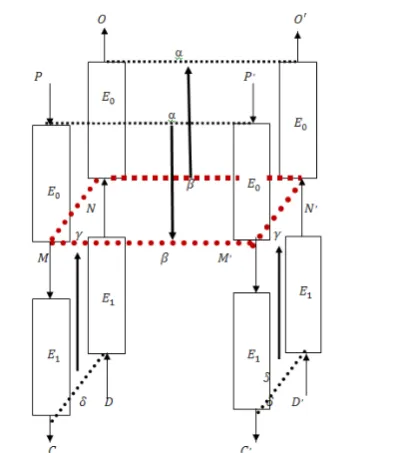
The block cipher encryptionE: (0,1)nX(0,1)k = (0,1)n is decomposed into two halvesE =E0◦E1 where E0 represents first half andE1represents second half. Dif-ferential characteristic for E0 is α → β with proba-bility p and for E1−1 the differential characteristic is δ→γwith probabilityq. In boomerang attack, to find all plaintexts sharing a desired difference that depends on the choice of the differential is the distinguisher [22]. i) Finding the Distinguisher
1. The attacker randomly chooses two plaintextsP, P0 and computesα=P0⊕P
2. Encrypt P and P0 by E0 to obtain middle cipher-text M =E0(P) and M0 =E0(P0) and further en-crypt forE1 to obtain ciphertextC=E1(M), C0 = E1(M0).
3. Obtain new ciphertextsD, D0from ciphertextsC, C0 with differenceδi.e.D=C⊕δandD0=C0⊕δsuch that when we decrypt C, C0 by E−1
1 and D, D0 by E1−1we get the differenceγi.e.E1−1(C)⊕E1−1(D) = E1−1(C0)⊕E1−1(D0) =γ
Fig. 5 Structure of Boomerang Attack
4. Decrypt these CiphertextDandD0forE1−1partially to getN, N0and further decrypt it forE0−1to getO andO0 i.e.O=E0−1(N) andO0=E0−1(N0). 5. Finally for each pair (O, O0) check whether O and
O0 differ by same differential α i.e. O⊕O0 =α. If this condition is satisfied, it means it has formed a right quartet (P, P0, O, O0). If so, store the quartet. 6. Repeat these steps with other set of plaintext to find
other pairs that form right quartets and store it in a table (Boomerang distinguisher).
ii) Steps of Key Recovery
1. From set of boomerang distinguisher, for each ob-tained right quartets (P, P0, O, O0)
2. Find all possible values for nonzero influenced dif-ference bits entering last round (TPS).
3. For all the possible values TPS (kr) i.e. if kr is
l-bits, there are 2l possibilities for each kr value, Do
the following
i Set count=0
ii Encrypt (P, P0, O, O0) and obtain the cor-responding ciphertext quartet (C, C0, D, D0) respectively
iii Then do the one round partial decryp-tiondk under key kr
(a) C = dkr(C), C
0
= dkr(C
0)
andD=dkr(D), D
0
=dkr(D0)
(c) If difference is same in both the pairs then increment the count
4. Value of TPS which has maximum count for right quartet is correct TPS and output that value.
3.6 Rectangle Attack
Boomerang uses adaptive chosen plaintext/ciphertext due to which many of the ciphers that were developed through the years cannot be attacked by boomerang distinguishers and key recovery attack cannot be ap-plied, which led to the development of its chosen plain-text variant called amplified attack [23]. This was later modified and named as rectangle attack. The Rectangle attack is divided into two steps: 1) Finding the distin-guisher 2) Key Recovery (same as Boomerang) [24] i) Finding the Distinguisher
1. The attacker randomly chooses two plaintext pairs (P, P0),(O, O0) with same differenceαsuch thatα= P0⊕P andα=O0⊕O.
2. Encrypt (P, P0) and (O, O0) to obtain middle cipher-texts i.e. M = E0(P) and M0 =E0(P0) and N = E0(O) and N0 = E0(O0), we are interested in the cases whereM⊕M0=β, N⊕N0=β andM⊕N = γ, which leads toM0⊕N0 = (M⊕β)⊕(N⊕β) =γ.
3. We receive two pairs (M⊕N andM0⊕N0) each with the differenceγ. When encrypting (M, M0),(N, N0) by E1, i.e. C = E1(M), C0 = E1(M0) and D = E1(N), D0 = E1(N0) then in some of the cases γ becomes δ. And we look for those cases where both difference become C⊕D=δ andC0⊕D0=δafter
E1. The quartet satisfying these differential require-ments forms a right quartet.
4. Repeat these steps to find the pairs that form right quartets (P, P0, O, O0) and save it in a table (distin-guisher).
ii) Steps of Key Recovery
1. From set of distinguisher, for each obtained right quartet (P, P0, O, O0)
2. Find all possible values for nonzero influenced dif-ference bits entering last round (TPS).
3. For all the possible values TPS (kr) i.e. if kr is
l-bits, there are 2l possibilities for each kr value, Do
the following for each right quartet, i Set count=0
ii Do the partial decryption by one round. iii Check the input difference by partial decryption
is the same as expected from the differential characteristic.
iv If same, increment count for that TPS.
4. TPS which has maximum count value for right quar-tet that is correct and output that value.
3.7 Related Key Attack
In key schedule algorithm of block cipher, if the re-lations between pairs of keys in different rounds exist then all the subkeys can be shifted one round backward and a new set of subkeys can be obtained, these key re-lations can be used to attack the block ciphers. The attack where keys are unknown, but relation is known to the attacker is called chosen key attacks. The attacks are not dependent on number of rounds of a cipher [25]. The Chosen Key Attacks
Several plaintexts are encrypted by these related keys. After encryption the corresponding ciphertexts are ob-tained under these related keys which have some rela-tion between them, this relarela-tion is used by attacker to find both the keys. Chosen Key attack can be further divided into
•Chosen Key Known Plaintext Attack •Chosen Key Chosen Plaintext Attack
In chosen key known plaintext attack, attacker exploits only relation between the keys and in chosen key chosen plaintext attack, the relation between keys and plain-text are exploited by the attacker. The process of re-covering the keys is almost same in both cases. i) Steps for Key Recovery
1. The attacker chooses such a plaintext pair P and P∗such that right half ofP equals the left ofP∗i.e. PR=PL∗.
2. P is encrypted with keyK and result of encryption ofP is obtained before next round which may be the same asP∗encrypted with keyK∗ after first round. 3. For plaintextsP andP∗corresponding ciphertextC
andC∗is obtained after encryption after all rounds and if these ciphertexts satisfies the relation CL =
C∗
R, then it has high probability to find expected pair
(by birthday paradox).
4. If attacker find such pairs thenP, P∗, C, C∗andK, K∗ can be used to recover secret key bits with less trails than brute force attack.
For chosen plaintext attack 2n4 Chosen plaintexts are
required and for known plaintext attack 2n2 known
plain-texts are required.
4 Linear Cryptanalysis
from probability 12 wherepLis the probability of
hold-ing the linear expression. The higher the magnitude of the bias|pL−12|, poorer the randomization ability of the
0 cipher and weak is the system, so with fewer known plaintext this attack can be applied. IfPL >12
expres-sionXi1⊕Xi2⊕Xi3. . .⊕Xiu⊕Yi1⊕Yi2⊕Yi3. . .⊕Yv= 0
between uinput bits and v output bits of second last round is called linear approximation and if pL < 12 it
is called affine approximation. Distinguisher for the at-tack is the bias probability of holding the linear atat-tack of plaintext bits and the second last round of cipher; following are the steps to find distinguisher of SPN ci-pher withrrounds.
i) Finding the Distinguisher
1. Generate the linear approximation table of order 2nx2mfor each S-Box of sizenxmby
i Form a table for eachnxmS-Box where the elements of the table represent the number coincides between linear relation a.x=a1x1⊕a2x2⊕. . . ⊕anxn of input
and the linear relationb.y=b1y1⊕b2y2⊕ . . .⊕bmymof the output wherea, b
rep-resentsnandmbit numbers respectively for 0≤a≤2n−1 and 0≤b≤2m−1. In a table the binary value of a1a2a3. . . an
(a1the MSB) represents row no, the bi-nary value of b1b2b3. . . bm(b1 the MSB) represents column no.
ii Calculate the coincidence probabilitypL
by dividing the elements of linear ap-proximation table by 2n(number of
in-put bits).
iii Calculate the bias probability e for each high coincidence probability pL of each
S-Box for each round by using formula ε=|pL−12|.
2. Mark the linear trail for the whole cipher by con-sidering those elements of S-Boxes with highest bias probability e in each round till second last round. 3. Calculate the expected bias probability pD of
hold-ing the linear expression between input and the last round cipher by using pilling up lemma, considering all S-Boxes as independent. For each round function the linear expression which hold with high coinci-dence probability and calculate bias probability by subtracting from 12 and combine this linear expres-sion with next round linear expresexpres-sion with high-est coincidence probability and go on calculatingεi
for each round and at last probability of pD(x1 ⊕ x2⊕. . . ⊕xn = 0) = 12 + 2k−1Qi=1tokεi where
ε1,2. . . k= 2k−1Qi=1tokε.
ii) Steps to Recover Key
1. GenerateN plaintext/ciphertext pairs
2. If TPS isl-bit. There are 2lpossibilities
3. For each TPS value (say TPS*) do the following i Set count=0
ii For each ciphertext(i) fori= 1 toN do the partial decryption
(a) ciphertext(i)⊕TPS*
(b) Run backward through S-boxes to obtain bits into the last round
(c) XOR the Bits of plaintext (i) with XOR of the bits obtained in step (b)
(d) If expression in (c) is zero (e) Increment count
iii |Bias|=|count–N2|
4. Obtain a Table of partial subkey values and corre-sponding|Bias|
5. If|Bias|= 0⇒IncorrectT P S
If|Bias| ≈Expectedvalue⇒CorrectT P S
5 Variants Of Linear Cryptanalysis 5.1 Zero Correlation Linear Cryptanalysis
Zero correlation linear cryptanalysis was proposed by Bogdanov and Rijmen for an iterative block cipher is a counterpart of impossible differential cryptanalysis. This attack exploits the linear approximationa→b of the cryptographic functionf of the cipher ofr rounds whereaandbare input sum and output sum selection pattern. The probability p= P rx
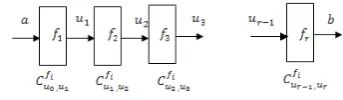
(ax=bf(x)) for lin-ear approximation a→b over all inputx is exactly 12 which amounts to correlationCzero becauseC= 2p−1 witha6= 0, b6= 0. The linear approximationa→b for an iterative block cipher from fixed input a to fixed outputbis called a Linear Hull which contains all pos-sible sequences of linear approximation. These set of sequences are called Linear Trails [26]. See fig 5, where fiis the function ofithround andui’s are intermediate
values.
Fig. 6 Linear Trail
According to pilling up lemma, the total correlation contribution CU over a cipher of a linear trail U is a
round and calculated by doing product of these correla-tion for all rounds and is defined asCU =Q
r i=1C
fi ui−1,ui,
whereCfi
ui−1,uiis correlation for each intermediate value ui−1 → ui. For a linear hull a → b, total correlation
over a cipher is computed by summing the correlation contributionCU of all its possible linear trailsU.
C= X
U=u0=a,u1,u2,. . . ,ur=b
CU
To construct zero correlation (C= 0) linear hull, input aand outputb is selected in such a way that no linear trail exists with non-zero correlation contribution CU
i.e. if correlation contribution CU = 0 for each linear
trail, then correlation over the entire iterative cipher is exactly zero, C = 0 and it is denoted by a 9 b. For correlation contribution to be zero CU = 0 for
each trail, construct each trail with at least one inter-mediate Cfi
ui−1,ui linear approximationui−1 →ui over
the rounds to be zero since the product of all corre-lation values with intermediate zero correcorre-lation value will result in zero correlation C=0 for this linear hull. IfCfi
ui−1,ui = 0 for a linear trailU, the pair of selection
pattern ui−1 and ui for a trail is called incompatible.
If even one zero correlation linear hull (distinguisher) exists, the cipher can be attacked.
Fig. 7 Zero correlation Linear Cryptanalysis Structure
The basic steps for constructing an attack on ciphers are
i)Finding the Distinguisher
1. Choose plaintext and ciphertext pairs with fixed un-known key K.
2. Construct linear distinguisher with correlation zero C(a 9 b) = 0 by using miss in middle technique.
This can be done by encrypting fixed inputato ob-tain output β for r1 rounds of cipher, decrypting fixed outputbto obtainγ forr2 rounds of cipher. 3. Obtain the partial trails with non zero correlation
contribution. If both the partial trails do not match in middleβ6=γ, this contradiction ensures the cor-relation zero thereforer1+r2rounds must be a zero-correlation linear hull i.e.C= 0. Thus correlation of linear hull is exactly zero and linear distinguisher (a, b) is obtained.
ii) Steps to Recover Key
1. Obtain all the possible combination of subkey kr
(TPS) to compute encryption and decryption. 2. For each possible subkey, partially encrypt each
plain-text (for r1 rounds) and partial decrypt each ci-phertext (forr2 rounds) upto the input and output boundaries of the distinguisher (zero correlation lin-ear approximation boundaries)
3. Evaluate the correlation for partial encryption de-cryption of all linear approximations for each possi-ble subkey by counting number of timesax⊕bf(x) = 0
4. If the correlationC is 0, the subkey guess is correct We evaluate the correlation for distinct linear hulls to reduce the error probability.
6 Conclusion
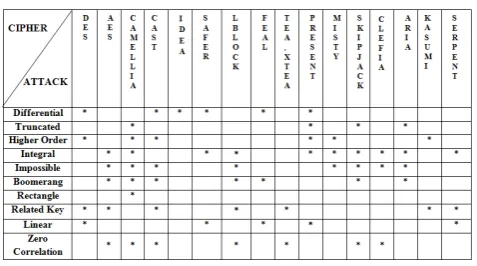
Cryptographers as well as cryptanalysts all over the world have been applying the latest attacks to already published or newly designed crypto algorithm. To de-sign a highly secure block ciphers which are immune to the present day attacks, one needs to analyze the possibility of any weakness in the design which can be exploited by all the variants of differential and linear attacks. The steps described in this paper, to find the distinguisher and to recover the key of each cryptana-lytic attack will be of great help to cryptanalyst. With the advent of High Performance Computing(HPC) and Distributed computing, these attacks will make crypt-analysis efficient. All the attacks described in this paper can be applied on SPN, feistel and generalized feistel structure with the additional condition that the round function should be bijective for impossible, integral and zero correlation. The following Table 1 consolidates the ciphers which have been attacked by variants of linear and differential cryptanalysis till today.
corre-Table 1 List of Attacks and ciphers
lation attack which is a variant of linear cryptanalysis will also help to check the weakness in the design. Our futurist work is to apply these attacks on various algo-rithms and to do comparison on basis of time and data complexity.
References
1. E. Biham, A. Shamir, “Differential Cryptanalysis of DES-like Cryptosystems,” Journal of Cryptology, Vols.4, no.1, pp. 3-72 (1991).
2. E. Biham, A. Shamir, Differential Cryptanalysis of the Data Encryption Standard, Springer Verlag (1993). 3. E. Biham, ”New Types of Cryptanalytic Attacks Using
Related Keys,” Journal of Cryptology, vol. 7, no. No. 4, p. 229–246, Springer-Verlag (1994).
4. L. Knudsen, ”Truncated and higher order differentials,” in In B.Preneel,editor, FSE, LNCS 1008, pp.196-211, Springer-verlag (1995).
5. L. Knudsen, D. Wagner, “Integral Cryptanalysis (Ex-tended Abstract),” in FSE 2002, LNCS 2365, pp. 112–127, Springer-Verlag (2002).
6. E. Biham, A. Biryukov, A. Shamir, “Cryptanalysis of Skipjack Reduced to 31 Rounds using Impossible Differ-entials,” in Advances in Cryptology: EUROCRYPT’99 LNCS 1592, pp. 12-23, Springer Verlag (1999).
7. D. Wagner, ”The Boomerang Attack,” in Fast Soft-ware Encryption, FSE’99 (L. R.Knudsen, ed.) Springer-Verlag, vol. 1636 of Lecture Notes in Computer Science, p. 156–170 (1999).
8. E. Biham, O. Dunkelman, N. Keller, ”The Rectan-gle Attack - Rectangling the Serpent,” EUROCRYPT 2001 LNCS,, vol. 2045, pp. 340-357, Springer, Heidelberg (2001).
9. E. Biham, O. Dunkelman, N. Keller, ”Related-Key Boomerang and Rectangle Attacks.,” EUROCRYPT 2005, LNCS, vol. 3494, pp. 507-525, Springer, Heidelberg, (2005).
10. Howard M. Heys, A Tutorial on Linear and Differential Cryptanalysis.
11. A. Bogdanov, V. Rijmen, “Zero Correlation Linear Cryptanalysis of Block Ciphers,” IACR Eprint Archive Report 2011/123, March (2011).
12. C. Swenson, Modern Cryptanalysis: Techniques and Ad-vanced Code Breaking, Indianapolis: Wiley Publishing (2008).
13. Lars R. Knudsen, Matthew J.B. Robshaw, The Block Ci-pher Companion, Springer-Verlag (2011).
14. Y. Liu, D. Gu, Z. Liu, Wei Li, “Impossible Differential At-tacks on Reduced Round LBlock,” in ISPEC 2012, LNCS 7232, pp. 97–108, 2012, Springer-Verlag Berlin Heidel-berg (2012).
15. C. Boura, M. Naya-Plasencia, V. Suder, “Scrutinizing and Improving Impossible Differential Attacks: Appli-cations to CLEFIA, Camellia, LBlock and Simon” Asi-acrypt 2014, LNCS Volume 8873, 2014, pp 179-199, Springer-Verlg (2014).
16. R. Li1, B. Sun1 and C. Li, ”Impossible Dif-ferential Cryptanalysis of SPN Ciphers,” https://eprint.iacr.org/2010/307.pdf (2010).
17. Y. Yeom, “Integral Cryptanalysis and Higher Order Dif-ferential Attack,” in Trends in Mathematics, Information Center for Mathematical Sciences, Volume 8, Number 1, June, Pages 101-118 (2005).
18. M. Duan, X. Lai, ”Higher Order Differential Cryptanal-ysis Framework and its Applications,” in International Conference on Information Science and Technology, Nan-jing, Jiangsu, China, March 26-28, (2011).
19. M. Duan, X. Lai, Mohan Yang, X. Sun, B. Zhu, “Dis-tinguishing Properties of Higher Order Derivatives of Boolean Functions,” in IEEE Transactions on Informa-tion Theory, Jul (2010).
20. A. Canteaut, M.Videau, “Degree of Composition of Highly Nonlinear Functions and Applications to Higher Order Differential Cryptanalysis,” in L.R. Knudsen (Ed.): EUROCRYPT 2002, LNCS 2332, pp. 518–533, 2002, Springer-Verlag (2002).
21. Francois-Xavier Standaert, Gilles Piret, Jean-Jacques Quisquater, “Cryptananlysis of Block Ciphers: A Survey,” UCL, Groupe Crypto, http://www.dice.ucl.ac.be/crypto/, Belgium (2003). 22. E. Biham, O. Dunkelman, N. Keller, ”New Results and
boomerang and rectangle attack,” in Proceeding of Fast Software Encryption, LNCS 2365, pp 1-16 Springer verlag (2002).
23. J. Kelsey, T. Kohno, B. Schneier, Amplified Boomerang Attacks Against Reduced-Round MARS and Serpent, New York : FSE 2000, pp. 75–93, Springer-Verlag (2000). 24. E. Fleischmann, M. Gorski, S. Lucks, ”Attack-ing Reduced Rounds of the ARIA Block Cipher,” https://eprint.iacr.org/2009/334.pdf, Germany (2009). 25. E. Biham, “New Types of Cryptanalytic Attacks Using
Related Keys,” Journal of Cryptology, , vol. 7, no. No. 4, p. 229–246, Springer-Verlag (1994).