Secure Reversible Image Data Hiding Over Encrypted
Domain via Key Modulation
Pabbu Buchaiah & Mr.K.Anjaneyulu
[1]
M tech
PGScholar,
Department of Electronics and Communication Engineering,
Madhira Institute of Technology & Sciences – Jntuh, KODAD.
Email id: -
[email protected]
[2]
(
Assistant professor&HOD
),
Department of Electronics and Communication Engineering, Madhira
Institute of Technology & Sciences–Jntuh, KODAD.
Email id
:-
[email protected]
ABSTRACT
This paper proposes a novel reversible picture information concealing plan over encoded area. Information inserting is accomplished through an open key balance system, in which access to the mystery encryption key isn't required. At the decoder side, an effective two-class SVM classifier is intended to recognize scrambled and non encoded picture patches, enabling us to mutually translate the installed message and the first picture flag. Contrasted and the best in class strategies, the proposed approach gives higher inserting limit and can consummately remake the first picture and also the implanted message. Broad exploratory outcomes are given to approve the prevalent execution of our plan.
Record Terms—Feature extraction, reversible picture information concealing (RIDH), flag handling over scrambled area, SVM.
I. INTRODUCTION
Reversible picture information concealing (RIDH) is an extraordinary class of information concealing method, which guarantees idealize reproduction of the cover picture upon the extraction of the inserted message. The reversibility makes such a picture information concealing methodology especially appealing in the basic situations, e.g., military and remote detecting, therapeutic picture sharing, law crime scene investigation, and copyright verification, where high loyalty of the reproduced cover picture is required. Most of the current RIDH calculations are planned over the plaintext space, to be specific, the message bits are installed into the first decoded pictures pack certain picture highlights, to clear space for message implanting.
Image data hiding in the scenario of secure remote sensing.
In any case, the implanting limit of this sort of technique is somewhat restricted and the caused twisting on the watermarked picture is extreme. Histogram moving based system, at first planned by another class of approach accomplishing better installing execution through moving of the histogram of some picture highlights. The most recent contract extension based plans and the enhanced forecast blunder development based procedures were appeared to have the capacity to offer the cutting edge capacity– contortion execution.
1. It is along these lines much wanted if secure information stowing away could be accomplished without an extra mystery information concealing key shared between the base station and the server farm. Additionally, we acknowledge straightforward inserting calculation as the base station is generally compelled by constrained registering abilities as well as power. At long last, the server farm, which has plentiful registering assets, extricates the implanted message and recuperates the first picture utilizing the encryption key K . In this paper, we propose a scrambled area RIDH plot by particularly taking the previously mentioned plan inclinations into thought.
entwined, our proposed procedure has a place with the classification of non detachable RIDH arrangements.
2 .Compared with the best in class techniques, the proposed approach gives higher inserting limit and can accomplish culminate recreation of the first picture and the installed message bits. Broad exploratory outcomes on 100 test pictures approve the predominant execution of our plan.
2. LITERATURE SURVEY
J. TIAN REVERSILE DATA EMBEDDING
USING A DIFFERENCE
EXAPNSION:-Reversible information installing has drawn loads of intrigue as of late. Being reversible, the first computerized substance can be totally reestablished. In this paper, we exhibit a novel reversible information implanting technique for computerized pictures. We investigate the excess in advanced pictures to accomplish high inserting limit, and keep the mutilation low.
In this paper, we have displayed a basic and proficient reversible date-implanting technique for computerized pictures. We investigated the repetition in the advanced substance to accomplish reversibility. Both the payload limit confine and the visual nature of inserted pictures are among the best in the writing.
Z. NI, Y. Q. SHI, N. ANSARI, AND W. SU
REVERSIBLE DATA HIDING:-A novel
reversible information concealing calculation, which can recoup the first picture with no bending from the stamped picture after the shrouded information have been removed, is exhibited in this paper. This calculation uses the zero or the base purposes of the histogram of a picture and somewhat adjusts the pixel grayscale qualities to implant information into the picture. It can install a greater number of information than a considerable lot of the current reversible information concealing calculations. It is demonstrated systematically and indicated tentatively that the pinnacle motion to-commotion proportion (PSNR) of the stamped picture produced by this technique versus the first picture is ensured to be over 48 dB. This lower bound of PSNR is considerably higher than that of every reversible datum concealing procedures detailed in the writing. The computational many-sided quality of our proposed method is low and the execution time is short. The calculation has been effectively connected to an extensive variety of pictures, including normally utilized pictures,
medicinal pictures, surface pictures, aeronautical pictures and the greater part of the 1096 pictures in Corel Draw database. Test results and execution examination with other reversible information concealing plans are introduced to exhibit the legitimacy of the proposed calculation.
D. COLTUC AND J. M. CHASSERY VERY FATS WATER MARKING BY REVERSIBLE
CONTRAST MAPPING:-Reversible complexity
mapping (RCM) is a straightforward number change that applies to sets of pixels. For a few sets of pixels, RCM is invertible, regardless of whether the minimum huge bits (LSBs) of the changed pixels are lost. The information space possessed by the LSBs is reasonable for information stowing away. The installed data bit-rates of the proposed spatial area reversible watermarking plan are near the most elevated piece rates detailed up until this point. The plan does not require extra information pressure, and, as far as numerical multifaceted nature, it has all the earmarks of being the least intricacy one proposed up to now. A quick query table execution is proposed. Heartiness against editing can be guaranteed too.
X. LI. B. YANG, AND T. ZENG, EFFICIENT REVERSIBLE WATER MARKING BASED ON
ADAPTIVE PREDICTION-ERROR
EXPANSION AND PIXEL SELECTION:-As of
now, the exploration for reversible watermarking centers on the diminishing of picture twisting. Going for this issue, this paper introduces a change strategy to bring down the installing bending in view of the expectation mistake extension (PE) method. Initially, the outrageous learning machine (ELM) with great speculation capacity is used to improve the forecast exactness for picture pixel esteem amid the watermarking inserting, and the lower expectation mistake brings about the diminishment of picture twisting. Also, a streamlining activity for reinforcing the execution of ELM is taken to additionally reduce the inserting mutilation. With two prevalent indicators, that is, middle edge locator (MED) indicator and slope balanced indicator (GAP), the exploratory outcomes for the traditional pictures and Kodak picture set demonstrate that the proposed plot accomplishes change for the bringing down of picture contortion contrasted and the established PE conspire proposed by Thodi et al. what's more, beats the change strategy displayed by Cultic and other existing methodologies.
MULTILEVEL HISTOGRAM MODIFICATION
AND SEQUENTIAL RECOVER:-This paper
proposes a reversible information concealing technique for characteristic pictures. Because of the likeness of neighbor pixels' qualities, most contrasts between sets of contiguous pixels are equivalent or near zero. In this work, a histogram is built in view of these distinction measurements. In the information inserting stage, a multilevel histogram adjustment instrument is utilized. As more pinnacle focuses are utilized for mystery bits balance, the concealing limit is upgraded contrasted and those ordinary strategies in view of maybe a couple level histogram adjustment. Additionally, as the distinctions concentricity around zero is enhanced, the bends on the host picture presented by mystery content inserting is moderated. In the information extraction and picture recuperation organize, the installing level rather than the pinnacle focuses and zero focuses is utilized. In like manner the subsidiary data is substantially littler than in those strategies for the kind. A successive recuperation system is abused for every pixel is remade with the guide of its beforehand recouped neighbor. Test results and correlations with different strategies exhibit our technique's viability and unrivaled execution.
3. CONTRAST ENHANCEMENT AND
REVERSIBLE DATAHIDING
Supra Threshold Contrast Sensitivity:-In this segment, we determine the condition that aides the affectability of the human eye to splendor contrasts at various forces. Complexity recognition has been examined in vision discernment writing for a considerable length of time [Valois and Valois 1990]. Limit differentiates affectability capacities (CSF) de-fine the base complexity required to identify a sinusoidal grinding of a specific mean and spatial recurrence. These are bow formed plots with crest affectability at around 5-6 cycles/degree and the recurrence for crest affectability diminishes as mean splendor diminishes.
So far we have discussed edge CSF. In any case, the vast majority of our ordinary vision is at supra limit (above edge) levels. As of late there has been an extensive number of works to ponder the difference separation affectability of individuals for supra edge vision. Of this, we are especially intrigued by the investigation of complexity increases with regards to our difference upgrade application. [Whittle 1986] presents a standout amongst the most far reaching
thinks about toward this path. This demonstrates for supra edge differentiates C, differentiate segregation limit takes after the Weber law, i.e.
Where τ is a steady. These shows for noticeable difference improvement, higher complexity designs require higher differentiation increases. This structures the backbone of our complexity improvement strategy.
Utilizing the above, we infer a basic condition for differentiate upgrade of pictures. We characterize the neighborhood difference of the picture to be corresponding to the nearby angle of the picture. As it were,
Where I(x,y) is the picture, C is the difference and λ is the consistent of proportionality. Condition 1 shows that to accomplish the same saw increment conversely over a picture, bigger angles must be extended more than littler inclinations. Indeed, the extending ought to be performed in such a mold, to the point that the difference augmentation is relative to the underlying angle. In this way,
Where I 0(x, y) is the differentiation upgraded picture. Utilizing the above realities, we express the complexity improvement of a picture I(x,y) by a solitary parameter τ as
THE METHOD FOR GRAY SENSITIVTY:-We represent the neighborhood differentiate improvement issue as an enhancement issue. We plan a scalar enhancement work got from Equation 2 that catches the general difference of a picture, and try to expand it subject to the limitation portrayed by Equation 4. Moreover, we likewise compel the shading scope of the yield picture to keep away from over or under immersion ancient rarities.
REVERSIBILE DATA HIDING:-Most mixed
media information installing strategies change, and henceforth misshape, the host motion so as to embed the extra data. Frequently, this inserting twisting is little, yet irreversible, i.e. it can't be expelled to recoup the first host flag. In numerous applications, the loss of host flag constancy isn't restrictive as long as unique and adjusted signs are perceptually equal. Be that as it may, in various areas -, for example, military, legitimate and therapeutic imaging-albeit some implanting twisting is acceptable, lasting loss of flag loyalty is unwanted. This features the requirement for Reversible (Lossless) Data Embedding methods. These procedures, similar to their lossey partners, embed data bits by altering the host flag, in this way initiate an installing twisting. In any case, they additionally empower the evacuation of such bends and the correct lossless-rebuilding of the first host motion after extraction of implanted data.
4. RELATED WORK
Some current endeavors were made on implanting message bits into the scrambled pictures. Punch et al. utilized a basic substitution strategy to embed extra bits into AES scrambled pictures. Nearby standard deviation (LSD) was enter administration challenges in the cloud have been completely contemplated in inverse to the non distinct plans, there is another compose called detachable RIDH approaches, in which the information extraction and picture unscrambling can be independently done. at that point abused at the decoder side to reproduce the first picture. Zhang planned a technique to insert extra message bits into stream figure encoded pictures by flipping three LSBs of half of the pixels in a square. The information extraction can be performed by using the neighborhood smoothness inborn to regular pictures. This strategy was later enhanced by Hong et al through a side match system.
As nearby smoothness does not generally hold for characteristic pictures, information extraction
mistakes can be seen in the high-action areas. Moreover, Zhang proposed a distinct RIDH strategy with the end goal that the assurance extents of information concealing key and encryption key are effortlessly isolated. Zhang et al. broadened the lossless pressure based RIDH way to deal with the encoded area, to be specific, misfortune pack half of the fourth LSBs of the scrambled picture by means of LDPC code to make space for information covering up. As the source coding with side data at the decoder requires a criticism channel, this plan would confront extreme difficulties in numerous pragmatic situations, e.g., secure remote detecting, where the input channel could be expensive.
Schematic of data hiding over encrypted domain.
5. PROPOSED RIDH SCHEME OVER
ENCRYPTED DOMAIN
Rather than considering devoted encryption calculations custom fitted to the situation of encoded area information concealing, we here adhere to the traditional stream figure connected in the standard arrangement. That is, the figure content is created by bitwise XO Ring the plaintext with the key stream. If not generally determined, the broadly utilized stream figure AES in the CTR mode (AES-CTR) is accepted.
1) Stream figure utilized as a part of the standard configuration (e.g., AES-CTR) is as yet a standout amongst the most prominent and solid encryption instruments, because of its provable security and high programming/equipment execution productivity. It may not be simple, or even infeasible, to induce clients to receive new encryption calculations that have not been completely assessed.
Where f and [[f]] mean the first and the scrambled pictures, individually. Here, K signifies the key stream produced utilizing the mystery encryption key K . In this paper, without loss of simplification, every one of the pictures are thought to be 8 bits. All through this paper, we utilize [[x]] to speak to the scrambled rendition of x. obviously, the first picture can be gotten by playing out the accompanying decoding capacity:
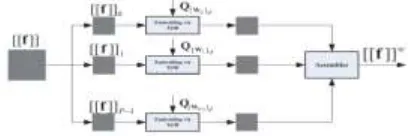
As said before, the scrambled picture [[f]] now fills in as the cover to oblige message to be covered up. We first gap [[f]] into a progression of non covering hinders [[f]]i's of size M × N, where I is the piece list. Each piece is intended to convey n bits of message. Giving the quantity of squares inside the picture a chance to be B, the implanting limit of our proposed plot progresses toward becoming n • B bits. To empower effective installing, we propose to utilize S = 2n paired open keys Q0, Q1,..., QS−1, every one of which is of length L = M × N × 8 bits. All Q j 's, for 0 ≤ j ≤ S − 1, are made openly available, which infers that even the aggressor knows them. These open keys are preselected preceding the message installing, as per a basis of expanding the base Hamming separation among all keys. The calculation created by MacDonald can be utilized to this end.Note that all general society keys are incorporated with the information hider and the beneficiary when the entire framework is set up, and consequently, it isn't important to transmit them amid the information installing stage. Additionally, for settled S and L, Hamming demonstrated that an upper bound on the base Hamming separation can be given as takes after. In the first place, decide two numbers m1 and m2 by m1
Where L i = (L!/i!(L − i)!). It can be demonstrated that both m1 and m2 are exceptional. At that point, the base Hamming separation among all Q js fulfills
The schematic graph of the proposed message installing calculation over encoded area is appeared in Fig. 2. In this paper, we don't think about the instance of installing numerous watermarks for one single piece, implying that each square is prepared once at most. For straightforwardness, we accept that the quantity of message bits to be inserted is n • A, where A ≤ B and B is the quantity of squares inside the picture.
The means for playing out the message inserting are outlined as takes after.
Stage 1: Initialize piece list I = 1.
Stage 2: Extract n bits of message to be installed, signified by Wi.
Stage 3: Find general society key Q[Wi]d related with Wi, where the record [Wi]d is the decimal portrayal of Wi . For example, when n = 3 and Wi = 010, the comparing open key is Q2.
Stage 4: Embed the length-n message bits Wi into the ith square by means of
Stage 5: Increment I = I + 1 and rehash Steps 2– 4 until the point when all the message bits are embedded. The watermark length parameter A should be transmitted alone with the implanted message bits. There are numerous approaches to take care of this issue.
6. FEATURE SELECTION FOR
DISCRIMINATING ENCRYPTED AND
NONENCRYPTED
initially apply uniform scalar quantization to every pixel of the square
Where f and fˆ mean the first and the quantized pixel esteems, individually. Surely, fˆ falls into the range [0, M N − 1]. The entropy pointer H in view of quantized examples is then given by
Where p( j) is the observational likelihood of j in the quantized piece. As a solitary first-arrange entropy amount may not be adequate to cover all the fundamental qualities of a piece, we recommend enlarging the component vector by presenting another component, i.e., the SD characterized by
Where f( j) is the jth pixel in the square and μ = (1/M N) j f( j) is the example mean over every one of the examples in the piece. By including this element component, we can enhance the arrangement execution as the information thickness can be better reflected.
Illustration of the neighbors of f( j).
where f( jne), f( je), f( jse), and f( js) speak to the neighbors in the 45° (upper east), 0° (east), −45° (southeast), and −90° (south) headings, with respect to f( j), as appeared in Fig. 3. Upon the assurance of the component vector ρ, we prepare a two-class SVM classifier with RBF (Gaussian) bit [29] taking the for
The 0-class and 1-class relate to the decoded and encoded picture pieces, separately. Here, the preparation picture set comprises of 100 pictures of size 512×512, with a wide assortment of attributes including normal scenes, counterfeit pictures, manufactured pictures, and literary pictures. The disconnected prepared SVM classifier will be utilized to segregate the scrambled and non encoded picture fixes during the time spent information extraction and picture decoding.
7. JOINT DATA EXTRACTION AND
IMAGE DECRYPTION
The decoder in the server farm has the unscrambling key K and endeavors to recuperate both the installed message and the first picture at the same time from [[f]]w, which is thought to be splendidly gotten with no contortions. Note that this supposition is made in all the current RIDH techniques. Because of the exchangeable property of XOR tasks, the decoder first XORs [[f]]w with the encryption key stream K and gets
The subsequent fw is then parceled into a progression of non covering hinders fiw's of size M × N, like the task directed at the implanting stage. From (6), we have
which would show basic data. As will turn out to be clear right away, alternate outcomes relate to randomized squares, which can be recognized from the first organized fi. All the more particularly,
The disconnected prepared SVM classifier will be utilized to segregate the encoded and non scrambled picture fixes during the time spent information extraction and picture unscrambling
As said before, one of the above S applicants must be fi, while the others can be composed in the frame
Where t = [Wi]d. The outcome f(t) I = Enc(fi, Q[Wi]d ⊕ Qt) compares to a scrambled form of fi with identical key stream being Q[Wi]d ⊕ Qt. Note that all people in general keys Q j 's, for 0 ≤ j ≤ S − 1, are intended to
Where [ j]2 signifies the length-n twofold portrayal of j and n = log2 S. For instance, if n = 3 and j = 7, at that point [ j]2 = 111. After deciding Wi , the first picture piece can be effortlessly recuperated by The disconnected prepared SVM classifier will be utilized to segregate the scrambled and non encoded picture fixes during the time spent information extraction and picture unscrambling.
Illustration of the error correction mechanism based on image self similarity.
1) Type I Error: fi( j) = fi, while r j = 1.
2) Type II Error: fi( j) = fi, while r j = 0.
8. SECURITY ANALYSIS
As indicated by the setting of the assault, the assailant may approach diverse measures of data. Obviously, the assailant at any rate can access to watermarked flag, to be specific, [[f]] w. In a few events, the inserted message or the cover flag can likewise be accessible to the aggressor Therefore, the security level of the scrambled space RIDH plan ought to be evaluated for various settings. Like the issue of assessing the security for encryption natives, Care et al. characterized three kinds of assaults.
Schematic of the data extraction.
Hypothesis 1: Assuming that the encryption plot (Enc, Dec) is secure as far as message, at that point our RIDH framework is secure under WOA assault. Portray of the Proof: Upon getting the watermarked and encoded picture [[f]]w, we can at present parcel it into non covering pieces of size M × N. For each square, we can produce S unraveling competitors in a comparative mold as (14)
{fiw ⊕ Q0, fiw ⊕ Q1, . . . , fiw ⊕ QS−1} is the message encoded by Ki, because of the property of message portrayed in (21). Consequently,
In this area, we tentatively assess the installing execution of our proposed encoded space RIDH plot. The test set is made out of 100 pictures of size 512 × 512 with different attributes, including common pictures, engineered pictures, and very finished pictures. All the test pictures can be downloaded from, the test set is not the same as the preparation set used to infer the two-class SVM classifier.
9. EXPERIMENTAL RESULTS
Image for fine-grained comparison
barbara512
lean new
boat
Grass (D9)
Jet new
Man
peppers
baboon512
10. CONCLUSION
In this paper, we plan a safe RIDH plot worked over the encoded area. We propose an open key tweak instrument, which enables us to install the information by means of basic XOR tasks, without the need of getting to the mystery encryption key. At the decoder side, we propose to utilize an effective two-class SVM classifier to segregate encoded and non scrambled picture patches, empowering us to mutually decipher the installed message and the first picture flag impeccably. We have additionally performed broad analyses to approve the unrivaled implanting execution of our proposed RIDH strategy over encoded space.
11.
REFERENCES
1. M. U. Celik, G. Sharma, A. M. Tekalp, and E. Saber, "Lossless summed up LSB information installing," IEEE Trans. Picture Process., vol. 14, no. 2, pp. 253– 266, Feb. 2005.
2. Z. Ni, Y.- Q. Shi, N. Ansari, and W. Su, "Reversible information concealing," IEEE Trans. Circuits Syst. Video Technol., vol. 16, no. 3, pp. 354– 362, Mar. 2006.
3. X. Li, W. Zhang, X. Gui, and B. Yang, "A novel reversible information concealing plan in view of two-dimensional contrast histogram alteration," IEEE Trans. Inf. Crime scene investigation Security, vol. 8, no. 7, pp. 1091– 1100, Jul. 2013.
4. C. Qin, C.- C. Chang, Y.- H. Huang, and L.- T. Liao, "An inpaintingassisted reversible steganographic plot utilizing a histogram moving component," IEEE Trans. Circuits Syst. Video Technol., vol. 23, no. 7, pp. 1109– 1118, Jul. 2013.
5. W.- L. Tai, C.- M. Yeh, and C.- C. Chang, "Reversible information stowing away in view of
histogram adjustment of pixel contrasts," IEEE Trans. Circuits Syst. Video Technol., vol. 19, no. 6, pp. 906– 910, Jun. 2009.
6. J. Tian, "Reversible information inserting utilizing a distinction development," IEEE Trans. Circuits Syst. Video Technol., vol. 13, no. 8, pp. 890– 896, Aug. 2003.
7. Y. Hu, H.- K. Lee, and J. Li, "DE-based reversible information covering up with enhanced flood area delineate," Trans. Circuits Syst. Video Technol., vol. 19, no. 2, pp. 250– 260, Feb. 2009.
8. X. Li, B. Yang, and T. Zeng, "Proficient reversible watermarking in view of versatile expectation blunder extension and pixel determination," IEEE Trans. Picture Process., vol. 20, no. 12, pp. 3524– 3533, Dec. 2011.
9. X. Zhang, "Reversible information stowing away with ideal esteem exchange," IEEE Trans. Mixed media, vol. 15, no. 2, pp. 316– 325, Feb. 2013.
10. T. Bianchi, A. Piva, and M. Barni, "On the execution of the discrete Fourier change in the encoded space," IEEE Trans. Inf. Crime scene investigation Security, vol. 4, no. 1, pp. 86– 97, Mar. 2009.
11. T. Bianchi, A. Piva, and M. Barni, "Composite flag portrayal for quick and capacity productive preparing of encoded signals," IEEE Trans. Inf. Legal sciences Security, vol. 5, no. 1, pp. 180– 187, Mar. 2010.
12. M. Barni, P. Failla, R. Lazzeretti, A. Sadeghi, and T. Schneider, "Security saving ECG arrangement with spreading programs and neural systems," IEEE Trans. Inf. Crime scene investigation Security, vol. 6, no. 2, pp. 452– 468, Jun. 2011.
13. Z. Erkin, T. Veugen, T. Toft, and R. Lagendijk, "Creating private suggestions productively utilizing homomorphic encryption and information pressing," IEEE Trans. Inf. Legal sciences Security, vol. 7, no. 3, pp. 1053– 1066, Jun. 2012.
15. X. Zhang, "Distinct reversible information stowing away in encoded picture," IEEE Trans. Inf. Crime scene investigation Security, vol. 7, no. 2, pp. 826– 832, Apr. 2012.
16. W. Puech, M. Chaumont, and O. Strauss, "A reversible information concealing technique for scrambled pictures," Proc. SPIE, vol. 6819, pp. 1– 9, Feb. 2008.
17. X. Zhang, "Reversible information covering up in scrambled picture," IEEE Signal Process. Lett., vol. 18, no. 4, pp. 255– 258, Apr. 2011.
18. W. Hong, T.- S. Chen, and H.- Y. Wu, "An enhanced reversible information covering up in scrambled pictures utilizing side match," IEEE Signal Process. Lett., vol. 19, no. 4, pp. 199– 202, Apr. 2012.
19. X. Zhang, Z. Qian, G. Feng, and Y. Ren, "Proficient reversible information stowing away in scrambled pictures," J. Vis. Commun. Picture Represent., vol. 25, no. 2, pp. 322– 328, Feb. 2014.
20. K. Mama, W. Zhang, X. Zhao, N. Yu, and F. Li, "Reversible information covering up in scrambled pictures by saving room before encryption," IEEE Trans. Inf. Crime scene investigation Security, vol. 8, no. 3, pp. 553– 562, Mar. 2013.
21. Z. Qian, X. Zhang, and S. Wang, "Reversible information covering up in scrambled JPEG bitstream," IEEE Trans. Sight and sound, vol. 16, no. 5, pp. 1486– 1491, Aug. 2014.
22. X. Zhang and Z. J. Wang, "Spread range picture information covering up in the scrambled discrete cosine change coefficients," J. Electron. Imag., vol. 22, no. 4, p. 043029, Dec. 2013.
23. W. Zhang, K. Mama, and N. Yu, "Reversibility enhanced information covering up in scrambled pictures," Signal Process., vol. 94, no. 1, pp. 118– 127, Jan. 2014.
[24] W. Zhang, K. Mama, and N. Yu, "Reversibility enhanced information covering up in scrambled pictures," Signal Process., vol. 94, no. 1, pp. 118– 127, Jan. 2014.
[25] B. Yang, C. Busch, and X. Niu, "Joint reversible information covering up and picture encryption," Proc. SPIE, vol. 7541, pp. 1– 10, Jan. 2010.
AUTHOR’S PROFILE
Mr.K.ANJANEYULU, received
the Master Of Technology degree in ECE from the MADHIRA INSTITUTE OF TECHNOLOGY & SCIENCES - JNTUH, he received the Bachelor Of Technology degree from SRR-Karepally, JNTUH. He is currently working as assistant professor & HOD of the ECE with Madhira Institute of Technology And Sciences, kodad. His interest subjects are Signals and Systems, EDC, Analog Electronics, PTSP & Etc
Pabbu buchaiah no: