A Computationally Efficient Mel-Filter
Bank VAD Algorithm for Distributed
Speech Recognition Systems
Damjan Vlaj
Institute of Electronics, Faculty of Electrical Engineering and Computer Science, University of Maribor, Smetanova 17, 2000 Maribor, Slovenia
Email:[email protected]
Bojan Kotnik
Institute of Electronics, Faculty of Electrical Engineering and Computer Science, University of Maribor, Smetanova 17, 2000 Maribor, Slovenia
Email:[email protected]
Bogomir Horvat
Institute of Electronics, Faculty of Electrical Engineering and Computer Science, University of Maribor, Smetanova 17, 2000 Maribor, Slovenia
Email:[email protected]
Zdravko Kaˇciˇc
Institute of Electronics, Faculty of Electrical Engineering and Computer Science, University of Maribor, Smetanova 17, 2000 Maribor, Slovenia
Email:[email protected]
Received 18 March 2004; Revised 23 September 2004; Recommended for Publication by Douglas O’Shaughnessy
This paper presents a novel computationally efficient voice activity detection (VAD) algorithm and emphasizes the importance of such algorithms in distributed speech recognition (DSR) systems. When using VAD algorithms in telecommunication systems, the required capacity of the speech transmission channel can be reduced if only the speech parts of the signal are transmitted. A similar objective can be adopted in DSR systems, where the nonspeech parameters are not sent over the transmission channel. A novel approach is proposed for VAD decisions based on mel-filter bank (MFB) outputs with the so-called Hangover criterion. Comparative tests are presented between the presented MFB VAD algorithm and three VAD algorithms used in the G.729, G.723.1, and DSR (advanced front-end) Standards. These tests were made on the Aurora 2 database, with different signal-to-noise (SNRs) ratios. In the speech recognition tests, the proposed MFB VAD outperformed all the three VAD algorithms used in the standards by 14.19% relative (G.723.1 VAD), by 12.84% relative (G.729 VAD), and by 4.17% relative (DSR VAD) in all SNRs.
Keywords and phrases:voice activity detection, distributed speech recognition, telecommunication systems.
1. INTRODUCTION
Voice activity detection (VAD) is an algorithm that is able to distinguish speech from noise and is an integral part of a variety of speech communication systems, such as speech recognition, speech coding, hands-free telephony, and audio conferencing. An effective VAD algorithm plays an impor-tant role in telecommunication systems, especially in auto-matic speech recognition (ASR) systems. This paper presents the use and the importance of VAD algorithms in ASR sys-tems. ASR systems can work under various noisy conditions (e.g., in a restaurant, a train station, etc.). An input signal
sounds occurring at the beginning or the end of the utter-ances [1].
The majority of existing algorithms that try to distinguish between speech and noise perform decisions based on frames of various frame and shift length. The input signal is divided into overlapping frames where the signal is supposed to be stationary within one frame. The VAD algorithm makes con-stantly a decision, if the certain frame of the windowed input signal contains noise only or there is also presence of speech. The output decision of the VAD can be 1 (the frame of the input signal contains speech or noisy speech) or 0 (the frame of the input signal contains noise only).
VAD is very important in speech communication and telecommunication systems. VAD and two other algorithms, discontinuous transmission (DTX) and comfort noise gen-erator (CNG) [2,3], are used in telecommunication systems to reduce transmission rate during the silent periods of the input signal. When DTX is in operation, the transmitter is switched offif no speech is present. This increases the sys-tem capacity by reducing the cochannel interface and also reduces the transmitter power consumption (an important consideration for mobile phones). During a typical conver-sation, each speaker talks for less than 40% of the time, and it has been estimated that DTX with VAD decision could ap-proximately double the transmission channels capacity [4]. At the same time, VAD sorts out the frames without speech, so the noise suppressor can use this information to estimate noise statistics. A similar objective can be used in distributed speech recognition (DSR) system, where the nonspeech pa-rameters are not sent over the transmission channel. This work proposes a novel procedure for a VAD algorithm based on mel-filter bank (MFB) outputs.
A lot of existing VAD algorithms use features that depend on energy computation. Some algorithms use a combination of zero-crossing rate and energy [5], and the others a dis-tance measure of the cepstral features [6]. More complex al-gorithms use more than one feature to detect speech. One of these is described in [7] where the entropy for the low-, high-, and full-frequency bands is calculated. Entropy-based VAD is also presented in [8]. A statistical-model-based VAD [9,10] is also one of the algorithms used for VAD. The new DSR Standard (advanced front end) [11] uses two VAD algo-rithms. Both are shortly presented inSection 3.3.
In the following section, we give short descriptions of the DSR system. Section 3 presents four VAD algorithms: three VAD algorithms used in the G.729, G.723.1, and DSR (advanced front-end) Standards and a novel approach to VAD decisions based on the MFB outputs with the so-called Hangover criterion. We conducted comparative tests between the proposed VAD (MFB VAD) algorithm and the three VAD algorithms used in the G.729, G.723.1, and DSR (advanced front-end) Standards.Section 4presents the tests, which were made on the Aurora 2 database [12] us-ing different SNRs to ascertain how robust the tested VAD algorithms are to the background noise, and to perform comparative analysis. In the same section, we present the speech recognition performance results using a frame drop-ping strategy, when different VAD algorithms were used.
The results are presented in Section 5 and discussed in Section 6. Conclusions are given inSection 7.
2. DSR SYSTEM
The use of data processing in modern telecommunication technologies such as speech recognition has been increasing in recent years. The growth of speech and Internet technol-ogy, and speech recognition over IP networks [13] has made the field of speech recognition research more extensive. Data processing is now being deployed in the area of increased mobile telephony, where people want to be able to access information while they are on the move. This also applies in the mobile wireless world [14]. To access these data ser-vices, small portable multimodal devices (e.g., personal dig-ital assistant (PDA), personal navigator) will be used, which require improved user interfaces using speech input [15]. Since 1995, several researches have been made in the field of DSR systems [14,16]. The DSR system involves many di-versified technologies including ASR, network data transmis-sion bandwidth and protocol, data comprestransmis-sion, distributed computing, and others [16].
Whereas centralized servers are able to share the com-putational burden between different users and, therefore, support an easy development of the provided technologies and services, mobile voice networks, however, can degrade the speech recognition performance obtained from central recognizers. This is due to low bit rate coding and speech transmission errors. The idea of a DSR system is to elimi-nate the impact of the transmission channel on the transmit-ted speech by using an error-protectransmit-ted data channel to send a parameterized speech representation which is suitable for speech recognition. The DSR system works in the following way (Figure 1): the recognizer’s front end, which is located in the terminal, is connected over the wireless data channel to a remote back-end server. The feature parameter extraction of the spoken speech is performed on the terminal. This is called the “front end” of the speech recognition system. The features are then compressed and transmitted to a remote “back-end” recognizer over a data channel together with er-ror protection and correction data (cyclic redundancy check (CRC)). In this way, both channel invariability and minimal impact of the transmission channel on recognition perfor-mance are achieved [14].
Terminal DSR front end
Figure1: Block diagram of the DSR system.
The feature extraction algorithms that operate in DSR are expected to produce a speech feature representation invari-ant to noisy environments and SNRs if the equivalent utter-ance is spoken under each of these different conditions. Fur-thermore, they are expected to operate in real-time and with the lowest possible computational costs.
3. VAD ALGORITHMS
In the next four sections, the three VAD algorithms used in the Standards G.729, G.723.1, and DSR (advanced front end) are briefly described and the proposed MFB-output-based VAD algorithm is presented. All the described algorithms are frame-based. The VAD algorithm makes a voice activity de-cision every 10 milliseconds using the G.729, DSR (advanced front end), and proposed MFB VAD. When using the G.723.1 VAD algorithm, the decision is made every 30 milliseconds. The frame decision is divided into three decision frames for the G.723.1 VAD algorithm with the same information. In this way, the algorithms can be easily compared.
3.1. G.729 VAD algorithm
The basic parameters for the VAD algorithm used for the G.729 Standard are full- and low-band frame energy, a set of line spectral frequencies and the frame zero-crossing rate [2]. In the first stage, all four parametric features are extracted from the input signal. If the frame number is less than 32, an initialization stage for the long-term averages takes place, and the VAD decision is set to 1 if the frame energy from the linear predictive coding (LPC) analysis is above 15 dB. Other-wise, the VAD decision is forced to 0. At the next stage, a set of difference parameters are calculated. This set is generated as a difference measure between the current frame parameters and the running averages of the background noise charac-teristics. Four different measures are calculated: spectral dis-tortion, energy difference, low-band energy difference, and zero-crossing difference. The initial VAD decision is made at the next stage, using multiboundary decision regions in the space of four difference measures [2]. The running averages have to be updated only in the presence of background noise. An adaptive threshold is tested, and the update takes place only if the threshold criterion is met.
3.2. G.723.1 VAD algorithm
Energy measure is the basic parameter for the VAD algorithm used for the G.723.1 Standard [3]. The energy of the inverse filtered signal is compared with the threshold. Speech is in-dicated whenever the threshold is exceeded. The threshold is computed using a two-step procedure. Firstly, the noise level is updated based on its previous value and the energy of the filtered signal. Secondly, the threshold is computed from the noise level via a logarithmic approximation [3]. A Hangover of six frames is added only in the case of speech bursts (VAD decision is 1) larger or equal to two frames [3].
3.3. DSR (advanced front-end) VAD algorithm
The DSR Standard (advanced front end) [11] uses two VAD algorithms. The first one is used for noise estimation and is based on energy computation. The second one is used for nonspeech frame dropping and has two stages: the first is a frame-based detection stage consisting of three measure-ments, and the second is the decision stage in which mea-surements are analyzed for speech likelihood. The final de-cision from the second stage is applied retrospectively to the earliest frame in the buffer [11]. The second VAD algorithm was used as a comparative test in this paper.
3.4. Proposed MFB VAD algorithm
The proposed MFB VAD algorithm is based on MFB outputs. The VAD algorithm is designed to be used in speech recogni-tion systems. MFB outputs, which are part of the feature ex-traction module, were used to reduce unnecessary computa-tional costs for VAD decision. The described VAD algorithm classifies framemas speechσ[m] = 1 (speech mixed with noise) or nonspeech σ[m] = 0 (noise only) by comparing the SNR of the current frame to the threshold. The SNR of the current frame corresponds to the difference between the short-term and the long-term spectral energy estimates. The long-term estimate is updated when the VAD decides that the current frame corresponds to the noise only and the MFB output of the current frame is used as a short-term estimate. In the first step, an estimate of the MFB outputs’ short-term energyEest[m] is calculated for the first ten frames as
Eest[m]=
whereN=23 represents the number of channels (MFB out-puts) and fbank[m,i] is theith MFB output of themth frame. The estimates of short-term energyEest[m] are used to define the weighting factorqof the input signal:
60
Figure2: Optimal definition of the weighting factorq.
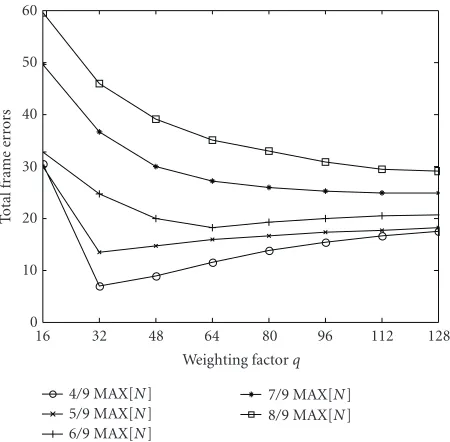
where MAX[N] represents the logarithmic sum of the MFB outputs’ maximum possible values in the frequency spec-trum. The different values for the weighting factor q were defined by considering the fact that the lower q was more suitable for the higher SNRs and vice versa. The interdepen-dence between the total frame errors and weighting factorq can be seen onFigure 2. When studying the weighting factor q, we obtained the best results for the clean signal whenqwas set to 32. For a very noisy signal (SNR= −5 dB), the best re-sults were achieved whenqwas set to 128. Ifqwas the same as for the clean signal, the frame detection for a very noisy signal would be incorrect, as the majority of frames which include speech would be recognized as noise. The values of the short-term energy estimatesEest[m] are calculated for the first ten frames (1) and for every frame m when the VAD algorithm classifies it as nonspeech (σ[m] =0). By chang-ing the short-term energy estimatesEest[m], the weighting factorqchanges, respectively (see (2)). The weighting factor is therefore adjusted to various values of SNRs. The values of the short-term energy estimates Eest[m] in the logarith-mic domain were between four ninths of the maximum value for the silent part of the clean signal and eight ninths of the maximum value for the silent part of the noisy signal (SNR = −5 dB). We defined the limits for optimal definition of the weighting factorqin (2) based on this and the former facts. For themth frame, the MAX[N] is calculated as the maximum possible value of thekth bin of the frequency spectrum in themth frame. The maximum possible value of
the frequency spectrum is 2Q/2, whereQrepresents the reso-lution of the input signal quantization. In our case, the quan-tization resolution is 16. The calculation of the channels’ cen-tre frequencies (cbink for the kth channel) is described in more detail in [17]. The full-frequency band is divided into N channels equidistant in the mel-frequency domain. Each channel has a triangular-shaped frequency window. Consec-utive channels are half overlapping.
We can now calculate the weighted short-term MFB out-put energyEf[m] for each frame, which is used in the VAD
whereN = 23 represents a number of channels (MFB out-puts) and fbank[m,i] the MFB output of theith MBF output andmth frame. The weighting factor q is used to increase the slope of theEf[m] function in the logarithmic domain. The constantwis set to 1000 and is used to change the shape of the logarithmic function. The influence of the constantw in the logarithmic domain is presented inFigure 3.Figure 3a shows that we can reduce the total frame errors with the con-stantw, especially for the clean condition. The constantwis set to 1000, which gives us optimal attenuation for the sum of MFB outputs (4) against all otherwconstants, which are also presented inFigure 3b. The attenuation of the MFB outputs is too big for the bigger constant, wand the attenuation is too small for the lower constantw. There is no improvement in the reduction of the level of frame errors. If we choose too big or too small a constantw, the average of the total frame errors will increase. The analysis of the constantwshows that the chosen constant gave us the best results (Figure 3a). The short-term MFB bank output energy of the current frame Ef[m] is used in the update of the long-term mean energy
24
Figure3: (a) The influence of the constantwon the total number of frame errors and (b) influence of the constantwon the sum of the MFB outputs in the logarithmic domain (x=ΣN
i=1 fbank[m,i]).
after initial calculations on the first frame to determine the short-term spectral energyEf[m] and the long-term mean spectral energy Em[m]. Figure 5 shows a flowchart of the proposed MFB output-based VAD algorithm. It should be noted here, that before the VAD processing of the input sig-nal is started, the frame countersHangoverandSpeechFrame, as well as the long-term mean spectral energy Em[m−1], are initialized to 0. The constant EnergyRatio is set to op-timal value 4.5 (see Figure 4a). The constants EnergyUp-date andEnergyRatio were set together. Between both val-ues, the long-term mean energyEm[m] is updated and the frame is declared as speech. When the difference is smaller than 4.5, only the long-term mean energyEm[m] is updated (Ef[m]−Em[m−1]<4.5) and when the difference is bigger
than 20, the frame is declared as speech without long-term mean energyEm[m] update (Ef[m]−Em[m−1]>20). VAD also uses the so-called Hangover criterion with theHangover
factor, which prevents a misclassification of weak fricatives to noise at the end of the speech segments. Seven consecutive frames (experimentally defined—seeFigure 4d) at the end of
19
Figure4: Definition of theEnergyRatio,EnergyUpdate, EnergyRe-duction, andHangoverconstants to achieve lower total frame errors.
at least a four-frame-long speech segment are also declared as speech. If the speech segment is shorter than four frames then the Hangover criterion is unused. When the Hangover criterion is used, the seven consecutive frames at the end of the speech segment are also declared as speech when the conditions shown in the flowchart in Figure 5 are fulfilled (Hangoveris set to 6). The Hangover criterion for the VAD decision was also used in [3,11].
4. DESCRIPTION OF THE EXPERIMENTAL FRAMEWORK
Framem−1 Framem
Start Framem
Increment SpeechFrame
Yes
Ef[m]−Em[m−1]>EnergyRatio No
Hangover=6
Yes SpeechFrame>3
No
SpeechFrame=0
Decrement Hangover
No
Hangover=0
Framemis speech (σ[m]=1)
Framemis speech (σ[m]=1)
Framemis noise (σ[m]=0)
Yes
Framem+ 1
Figure5: Flowchart of the MFB VAD.
4.1. Aurora 2 database
The concept of the Aurora 2 framework and experiments in-cludes two training modes that are defined as training on clean data only, and as training on clean and noisy (mul-ticondition) data. Owing to the fact that training on clean data only enables speech modeling without any noise dis-tortions, such models are expected to be the best for repre-senting all the available speech information. The weakness of these models is that they contain no information about possible distortions. This, however, is an advantage of multi-condition training, where distorted speech signals are taken as training data.
For training on clean data, 8440 utterances were chosen, which contained the recordings of 55 male and 55 female adults. These signals were filtered using the G.712 character-istics [18] with no noise added. The same 8440 utterances were used for multicondition training. They were divided into 20 subsets, each of which included 422 utterances. There were several utterances from all the available speakers in each subset. The 20 subsets represented 4 different noise scenarios at 5 different SNRs. The noises were a suburban train, bab-ble, a car, and an exhibition hall noise. The SNRs were 20 dB, 15 dB, 10 dB, 5 dB, and the clean condition. How the SNR was calculated is described in more detail in [12]. Speech and noise were filtered using the frequency response of the G.712 characteristic before mixing them with a noisy speech signal.
Three different test sets were defined [12]. Four subsets with 1001 utterances in each were obtained by splitting 4004 utterances from 52 male and 52 female speakers. The record-ings of all speakers were present in each subset. Individual noise signals at SNRs of 20 dB, 15 dB, 10 dB, 5 dB, 0 dB, and −5 dB were added and the clean case without adding noise was taken as the seventh condition. Speech and noise were, once again, filtered using the G.712 characteristic before ad-dition.
The first test set was called test set A. In this test set, there are four noises, a suburban train, babble, a car, and an exhi-bition hall, were added to the 4 subsets. So, the set consisted of 28,028 utterances. There was a high match of training and test data, owing to the fact that this test set contained the same noises as used for the multicondition training.
The second test set was called test set B. This test was cre-ated in the same way, the only difference was that four dif-ferent noises were used, which were a restaurant, a street, an airport, and a train station. In this case, a mismatch between training and test data also existed for multicondition train-ing. This influenced the recognition accuracy when consid-ering different noises other than those used for training.
Input speech
ADC y[n] Offcom Framing y[m,n] PE W FFT Y[m,k] MF fbank [m,i]
LOG fln [m,i]
DCT C[m,j] logE E[m]
MFB/DSR (advanced front end)
G.729/G.723.1 MFCC+E
Frame dropping
Feature compression
Bit-stream formatting framing To transmission channel
Figure6: Block diagram of mel-cepstral DSR front-end Standard [17] with additionally integrated VAD decision and frame dropping strat-egy. (Sample indexn, Frequency bin indexk, and Cepstral coefficients indexj). (ADC: analog-to-digital conversion; Offcom: offset compen-sation; PE: preemphasis; logE: energy measure computation; W: windowing; FFT: Fast Fourier transform (only magnitude components); LOG: nonlinear transformation; DCT: discrete cosine transform; and MFCC+E: Mel-frequency cepstral coefficients and energy.)
the SNRs of 20 dB, 15 dB, 10 dB, 5 dB, 0 dB, and −5 dB. MIRS can be explained as a frequency characteristic that simulates the behavior of a telecommunication terminal, which meets the official requirements for the terminal input frequency response as specified, for example, in the ETSI-SMG (ETSI Special Mobile Group) Technical Specification [19]. The street and suburban train were used as added noise signals. The purpose of this set is to show the in-fluence on recognition performance when a different fre-quency characteristic is present at the input of the recog-nizer.
4.2. Development of the frame-based reference for the VAD algorithm
The procedure for the frame-based reference for the VAD al-gorithm was carried out on 4004 clean speech data record-ings, which were used in the test sets of the Aurora 2 database. The reference for the VAD algorithm was based on connected-digit speech recognition performed by the ence recognizer used in the Aurora 2 framework. The refer-ence recognizer was based on Hidden Markov Models Toolkit (HTK) software [20]. The digits were modeled as whole word Hidden Markov Models (HMMs) with 16 emitting states per word with simple left-to-right models without skip-over states and 3 Gaussian mixtures per state. Two pause models were defined. The first one, called sil, consisted of 3 emit-ting states. The second pause model, called sp, was used to model pauses between words and consisted of a single emit-ting state, which was tied to the middle state of the first pause model. Six Gaussian mixtures for each state were used for the pause models.
Realignment of the training data was used to set the time boundaries of the speech utterances to create a frame-based
reference for the VAD decision. The decision as to whether the frame contains a speech or silent part of the signal was set for every 10 milliseconds. The frame-based reference VAD al-gorithm was set in such a way that the result was best for the speech recognition process using the following procedure. If the input signal was recognized as speech within the time boundaries, the reference frames were set to 1. When the input signal was recognized as silence, the reference frames were set to 0. Comparative tests were made between the pro-posed MFB VAD algorithm and the three VAD algorithms used in the G.729, G.723.1, and DSR (advanced front-end) Standards. All tested VAD algorithms were compared to the frame-based reference for VAD algorithm. The results are shown inSection 5.
4.3. Speech recognition experiments
Table1: Percentage of frame errors obtained by the G.729 VAD algorithm.
FEC MSC NDS OVER Total
Clean 4.52 7.47 0.42 0.43 12.84 SNR 20 0.44 4.73 13.83 5.53 24.53 SNR 15 0.30 5.28 14.42 6.13 26.13 SNR 10 0.31 6.27 14.43 6.37 27.38 SNR 5 0.35 7.75 14.43 6.60 29.13 SNR 0 0.43 10.72 14.39 6.69 32.23 SNR−5 0.60 13.53 14.40 6.68 35.21
Table2: Percentage of frame errors obtained by the G.723.1 VAD algorithm.
FEC MSC NDS OVER Total
Clean 4.67 0.35 5.25 9.18 19.45 SNR 20 3.88 0.51 7.73 9.19 21.31 SNR 15 2.43 0.51 10.18 10.17 23.29 SNR 10 0.78 0.30 12.57 10.79 24.44 SNR 5 0.10 0.08 13.27 12.85 26.30 SNR 0 0.00 0.02 13.38 13.16 26.56 SNR−5 0.00 0.00 13.38 13.20 28.58
5. RESULTS
5.1. Results on tested VAD algorithms
The tests based on frame errors were made on an MFB VAD algorithm and three VAD algorithms that are used in G.729, G.723.1, and DSR (advanced front-end) Standards. The statistics were obtained on [4] and are presented in Ta-bles1,2,3, and4as follows:
(i) clipping rate at the front of the speech segment (FEC), (ii) clipping in the middle of the speech segment (MSC), (iii) noise detected as speech in the silent region (NDS), (iv) quantity of time during which the output of the tested
VAD is on, after the reference VAD has switched off (OVER),
(v) total number of all the frame errors (Total).
We have also analyzed if word clipping (WC) occurred, but none of the tested VAD algorithms performed this kind of error.
5.2. Speech recognition results
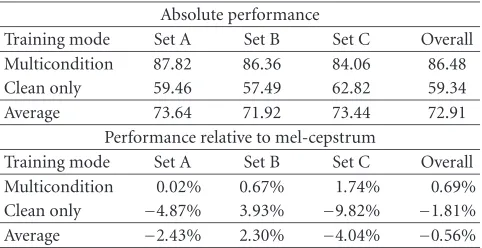
The speech recognition experiments were carried out on the Aurora 2 database with clean and multicondition training on all three subsets. Tables5,6,7, and8 present the absolute performances of the algorithms indicated inFigure 6(G.729, G.723.1, DSR (advanced front-end) and MFB VAD algo-rithms) and relative performance to the mel-cepstral DSR front-end Standard [17].
6. DISCUSSION
The frame dropping strategy used for the ASR shows that speech recognition performance can be improved, without
Table3: Percentage of frame errors obtained by the DSR (advanced front-end) VAD algorithm.
FEC MSC NDS OVER Total
Clean 0.00 0.00 7.57 11.00 18.57 SNR 20 0.36 0.03 4.54 10.40 15.33 SNR 15 0.55 0.06 4.41 10.23 15.25 SNR 10 0.81 0.18 4.06 9.84 14.89 SNR 5 1.14 0.38 3.97 9.44 14.93 SNR 0 1.59 1.64 3.98 8.82 16.03 SNR−5 3.03 7.23 3.98 7.35 21.59
Table4: Percentage of frame errors obtained by the MFB VAD al-gorithm.
FEC MSC NDS OVER Total
Clean 3.28 1.83 0.58 1.23 6.92 SNR 20 1.88 3.28 5.96 4.27 15.39 SNR 15 1.86 4.45 6.78 4.61 17.70 SNR 10 1.83 5.94 7.47 4.88 20.12 SNR 5 1.86 7.23 8.13 5.53 22.75 SNR 0 1.94 9.94 8.32 5.96 26.16 SNR−5 2.36 14.26 8.52 5.95 31.09
Table5: Speech recognition performance by the G.729 VAD algo-rithm.
Absolute performance
Training mode Set A Set B Set C Overall Multicondition 85.95 84.25 80.31 84.14 Clean only 67.68 66.88 67.34 67.29 Average 76.81 75.57 73.82 75.72
Performance relative to mel-cepstrum
Training mode Set A Set B Set C Overall Multicondition −15.31% −14.69% −21.38% −16.51% Clean only 16.39% 25.15% 3.35% 18.09% Average 0.54% 5.23% −8.93% 0.79%
Table6: Speech recognition performance by the G.723.1 VAD al-gorithm.
Absolute performance
Training mode Set A Set B Set C Overall Multicondition 87.82 86.36 84.06 86.48 Clean only 59.46 57.49 62.82 59.34 Average 73.64 71.92 73.44 72.91
Performance relative to mel-cepstrum
Training mode Set A Set B Set C Overall Multicondition 0.02% 0.67% 1.74% 0.69% Clean only −4.87% 3.93% −9.82% −1.81% Average −2.43% 2.30% −4.04% −0.56%
speech segment (MSC inTable 4) as under the clean training condition. In this case, it is better to use a frame attenua-tion strategy [23,24]. However, this strategy does not have the two advantages mentioned in the case of frame dropping strategy [21,22]. Speech recognition performance by multi-condition training can be improved if the errors in clipping at the front of the speech (FEC) and clipping in the middle of the speech (MSC) are as few as possible. In this case, the HMMs can be trained well enough.
When compared to the VAD G.729 and G.723.1 Stan-dards, the total number of frame errors is always smaller in the case of MFB VAD (Tables1,2, and4). The only exception is the G.723.1 Standard, where the total number of frame errors is smaller when the SNR is −5 dB, because FEC and MSC frame errors are zero. When we compare MFB VAD al-gorithm (Table 4) to DSR (advanced front-end) VAD algo-rithm (Table 3), the percentage of Total errors is almost al-ways smaller by the DSR VAD algorithm. But, as we can see from Tables7and8, the speech recognition accuracy is bet-ter by MFB VAD algorithm if we compare overall average and overall speech recognition by clean condition training mode. The reason for this is the smaller number of inserted words when computing speech recognition accuracy. From this, we can conclude that the higher NDS and OVER frame errors increase the number of inserted words and reduce the speech recognition accuracy. The same conclusion can be set for the G.729 and G.723.1 VAD algorithms (Tables1,2,5, and6).
Table7: Speech recognition performance by the DSR (advanced front-end) VAD algorithm.
Absolute performance
Training mode Set A Set B Set C Overall Multicondition 87.79 87.16 84.32 86.84 Clean only 66.87 65.90 65.88 66.29 Average 77.33 76.53 75.10 76.57
Performance relative to mel-cepstrum
Training mode Set A Set B Set C Overall Multicondition −0.17% 6.45% 3.37% 3.34% Clean only 14.31% 22.95% −0.77% 15.58% Average 7.07% 14.70% 1.30% 9.46%
Table8: Speech recognition performance by the MFB VAD algo-rithm.
Absolute performance
Training mode Set A Set B Set C Overall Multicondition 87.64 87.26 81.62 86.28 Clean only 71.89 72.96 66.65 71.27 Average 79.76 80.11 74.13 78.77
Performance relative to mel-cepstrum
Training mode Set A Set B Set C Overall Multicondition −1.48% 7.17% −13.30% −0.80% Clean only 27.28% 38.90% 1.50% 28.06% Average 12.90% 23.03% −5.90% 13.63%
We can conclude from the results obtained for the G.723.1 VAD, that the VAD used for this standard is very effective for the SNRs 5 dB, 0 dB, and−5 dB. This is due to the fact that this VAD does not properly distinguish between noise and speech. On the contrary, it considers the whole in-formation as speech, therefore the FEC and MSC frame error rates are decreasing when the SNR is being reduced. If we use a VAD algorithm for noise estimation when the decision is set at 0, it is very important that VAD also works well at low SNRs. Additional proof that almost all frames are declared as speech is given inTable 6. We can see that the performance of the ASR with VAD used in the G.723.1 Standard relative to the mel-cepstral DSR front-end Standard (Figure 6) stays al-most the same whether the G.723.1 VAD and frame dropping strategy are used or not (Table 6).
Table9: The amount of time needed for VAD computation in one frame.
VAD Computational costs Relative to the MFB VAD
G.729 78µs 0.527
G.723.1 935µs 6.317
DSR 96µs 0.648
MFB 148µs 1
MFB∗ 0.59µs 0.004
∗In this case, we assume that the MFB outputs are known, as they
are used for the ASR process.
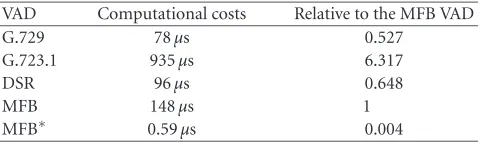
A lower computational cost is another advantage of MFB VAD in respect to VAD algorithms used in the standards. The computational costs were calculated with the amount of time needed for VAD computation in one frame. The amount of time needed for one frame is presented inTable 9. The tests were made on an HP-UX B2000 workstation. The amount of time was defined as the average computation over the mil-lion frames for all tested VAD algorithms.Table 9shows that the amount of time needed for algorithm computation of the proposed MFB VAD is significantly lower than the ones for G.729, G.723.1, and DSR (advanced front-end) if it is as-sumed that we already have information about MFB outputs. It should also be noticed that the amount of time needed for VAD used in the G.723.1 Standard should be divided by three, because VAD decisions are made every 30 millisec-onds, the MFB, DSR (advanced front-end), and G.729 VAD decisions are made every 10 milliseconds.
The use of a VAD algorithm together with frame drop-ping strategy is important at the back end of the DSR system, because the speech recognizer does not need to deal with noisy frames and the result is faster and more accurate ASR (Table 8). At the font end of the DSR system, where the pro-cessing power and memory available are limited, a reduction in computational costs using the MFB VAD is also welcome.
7. CONCLUSIONS
A novel approach for a VAD algorithm was presented based on MFB outputs with the so-called Hangover criterion. Comparative tests were made between the proposed MFB VAD algorithm and the three VAD algorithms used in the G.729, G.723.1, and DSR (advanced front-end) Standards. The results show that the total number of frame errors is higher for G.729 and G.723.1 VAD algorithms compared to MFB VAD algorithm. The total number of frame errors ob-tained by the DSR (advanced front-end) is lower than the one obtained by MFB VAD algorithm, however, the results of speech recognition performance with frame dropping strat-egy show better results with MFB VAD algorithm especially when clean only training mode is used. The computational costs of the MFB VAD are significantly lower than the costs when the standardized VAD algorithms are used (Table 9), especially when MFB feature extraction is used in speech recognition. This advantage is important at the front-end of the DSR system, where the processing power and memory available are limited.
REFERENCES
[1] J. C. Junqua and J. P. Haton, “Dealing with noisy speech and channel distortions,” inRobustness in Automatic Speech Recog-nition: Fundamentals and Applications, chapter 5, pp. 155– 189, Kluwer Academic Publishers, Norwell, Mass, USA, 1996. [2] ITU, “Coding of speech at 8 kbit/s using conjugate struc-ture algebraiccode-excited linear-prediction (CS-ACELP) An-nex B: A silence compression scheme,” ITU Recommendation G.729, 1996.
[3] ITU, “Dual rate speech coder for multimedia communica-tions transmitting at 5.3 and 6.3 kbit/s. Annex A: Silence com-pression scheme,” ITU Recommendation G.723.1, 1996. [4] D. K. Freeman, G. Cosier, C. B. Southcott, and I. Boyd, “The
voice activity detector for the Pan-European digital cellular mobile telephone service,” inProc. IEEE Int. Conf. Acoustics, Speech, Signal Processing (ICASSP ’89), vol. 1, pp. 369–372, Glasgow, UK, May 1989.
[5] B. Kotnik, Z. Kacic, and B. Horvat, “A multiconditional ro-bust front-end feature extraction with a noise reduction pro-cedure based on improved spectral subtraction algorithm,” in Proc. 7th European Conference on Speech Communication and Technology (ISCA EUROSPEECH ’01), pp. 197–200, Aalborg, Denmark, September 2001.
[6] J. Haigh and J. S. Mason, “A voice activity detector based on cepstral analysis,” inProc. 3rd European Conference on Speech Communication and Technology (ISCA EUROSPEECH ’93), pp. 1103–1106, Berlin, Germany, September 1993.
[7] S. McClellan and J. D. Gibson, “Variable-rate CELP based on subband flatness,”IEEE Trans. Speech Audio Processing, vol. 5, no. 2, pp. 120–130, 1997.
[8] P. Renevey and A. Drygajlo, “Entropy based voice activity detection in very noisy conditions,” inProc. European Con-ference on Speech Communication and Technology (ISCA EU-ROSPEECH ’01), pp. 1887–1890, Aalborg, Denmark, Septem-ber 2001.
[9] J. Sohn, N. S. Kim, and W. Sung, “A statistical model-based voice activity detection,” IEEE Signal Processing Lett., vol. 6, no. 1, pp. 1–3, 1999.
[10] J. Stadermann, V. Stahl, and G. Rose, “Voice activity detec-tion in noisy environments,” inProc. European Conference on Speech Communication and Technology (ISCA EUROSPEECH ’01), pp. 1851–1854, Aalborg, Denmark, September 2001. [11] ETSI, “Speech processing, transmission and quality aspects
(STQ), distributed speech recognition, advanced front-end feature extraction algorithm, compression algorithm,” ES 202 050 v1.1.1, 2002.
[12] H.-G. Hirsch and D. Pearce, “The AURORA experimental framework for the performance evaluations of speech recog-nition systems under noisy conditions,” inProc. Automatic Speech Recognition: Challenges for the Next Millennium (ISCA ITRW ASR ’00), pp. 181–188, Paris, France, September 2000. [13] B. Milner and S. Semnani, “Robust speech recognition over
IP networks,” inProc. IEEE Int. Conf. Acoustics, Speech, Sig-nal Processing (ICASSP ’00), vol. 3, pp. 1791–1794, Istanbul, Turkey, June 2000.
[14] D. Pearce, “Enabling new speech driven services for mobile devices: an overview of the ETSI standards activities for dis-tributed speech recognition front-ends,” inProc. Applied Voice Input/Output Society Conference (AVIOS ’00), San Jose, Calif, USA, May 2000.
[16] W. Zhang, L. He, Y. Chow, R. Yang, and Y. Su, “The study on distributed speech recognition system,” in Proc. IEEE Int. Conf. Acoustics, Speech, Signal Processing (ICASSP ’00), vol. 3, pp. 1431–1434, Istanbul, Turkey, June 2000.
[17] ETSI, “Speech processing, transmission and quality as-pects (STQ), distributed speech recognition, front-end fea-ture extraction algorithm, compression algorithm,” ES 201 108 v1.1.1, 2000.
[18] ITU, “Transmission performance characteristics of pulse code modulation channels,” ITU Recommendation G.712, 1996. [19] ETSI-SMG, “European digital cellular telecommunication
system (phase 1)—transmission planning aspects for the speech service in GSM PLMN system,” TSGSM03.50, 3.4.0, 1994.
[20] S. Young, D. Kershaw, J. Odell, D. Ollason, V. Valtchev, and P. Woodland,The HTK Book (Version 3.0), Microsoft Corpo-ration, Redmond, Wash, USA, 2000.
[21] B. Andrassy, D. Vlaj, and C. Beaugeant, “Recognition perfor-mance of the siemens front-end with and without frame drop-ping on the aurora 2 database,” inProc. 7th European Con-ference on Speech Communication and Technology (ISCA EU-ROSPEECH ’01), pp. 193–196, Aalborg, Denmark, September 2001.
[22] C. Benitez, L. Burget, B. Chen, et al., “Robust ASR front-end using spectral-based and discriminant features: experiments on the Aurora tasks,” inProc. 7th European Conference on Speech Communication and Technology (ISCA EUROSPEECH ’01), pp. 429–432, Aalborg, Denmark, September 2001. [23] B. Kotnik, D. Vlaj, and B. Horvat, “Efficient noise robust
fea-ture extraction algorithms for distributed speech recognition (DSR) systems,” International Journal of Speech Technology, vol. 6, no. 3, pp. 205–219, 2003.
[24] B. Kotnik, D. Vlaj, Z. Kaˇciˇc, and B. Horvat, “Robust MFCC feature extraction algorithm using efficient additive and con-volutional noise reduction procedures,” inProc. International Conf. on Spoken Language Processing (ICSLP ’02), pp. 445– 448, Denver, Colo, USA, September 2002.
Damjan Vlajgraduated from the Faculty of
Electrical Engineering and Computer Sci-ence, University of Maribor, in 1998. From April 1998 to October 2000, he worked at the Research and Studies Center, University of Maribor. Since October 2000, he has been employed at the Faculty of Electrical Engi-neering and Computer Science, University of Maribor. He has been a postgraduate stu-dent in the same faculty since October 1999.
His research interests lie in the areas of robust speech recognition in the environment of fix and mobile telephony.
Bojan Kotnikreceived the Diploma degree
from the University of Maribor in 2000. Since November 2000, he has been a post-graduate student and a young researcher at the Faculty of Electrical Engineering and Computer Science, University of Maribor. His research interests are in the areas of feature extraction, feature postprocessing, speech enhancement, and robust speech recognition.
Bogomir Horvatgraduated from the
Fac-ulty of Electrical Engineering, University of Ljubljana, in 1963. He received the M.S. de-gree in 1975 and the Ph.D. dede-gree in 1983 from the same faculty. He is currently em-ployed in the Faculty of Electrical Engineer-ing and Computer Science, University of Maribor, as a Full Professor, where he is the Head of the Institute of Electronics and Telecommunications and the Head of the
Laboratory for Digital and Information Systems. His research in-terests include computer communications, man-machine commu-nication, and system verification and validation.
Zdravko Kaˇciˇcgraduated from the Faculty