R E S E A R C H
Open Access
An improved scheme based on
log-likelihood-ratio for lattice reduction-aided
MIMO detection
Yunchao Song, Chen Liu
*and Feng Lu
Abstract
Lattice reduction (LR)-aided detectors have been shown great potentials in wireless communications for their low complexity and low bit-error-rate (BER) performance. The LR algorithms use the unimodular transformation to improve the orthogonality of the channel matrix. However, the LR algorithms only utilize the channel state information (CSI) and do not take account for the received signal, which is also important information in enhancing the performance of the detectors. In this paper, we make a readjustment of the received signal in the LR domain and propose a new scheme which is based on the log-likelihood-ratio (LLR) criterion to improve the LR-aided detectors. The motivation of using the LLR criterion is that it utilizes both the received signal and the CSI, so that it can provide exact pairwise error probabilities (PEPs) of the symbols. Then, in the proposed scheme, we design the LLR-based transformation algorithm (TA) which uses the unimodular transformation to minimize the PEPs of the symbols by the LLR criterion. Note that the PEPs of the symbols affect the error propagation in the vertical Bell Laboratories Layered Space-Time (VBLAST) detector, and decreasing the PEPs can reduce the error propagation in the VBLAST detectors; thus, our LLR-based TA-aided VBLAST detectors will exhibit better BER performance than the previous LR-aided VBLAST detectors. Both the BER performance and the computational complexity are demonstrated through the simulation results.
Keywords: Lattice reduction, Log-likelihood-ratio criterion, VBLAST detector, Pairwise error probability
1 Introduction
The multiple-input multiple-output (MIMO) technology plays an important role in increasing the spectral effi-ciency of wireless communications by allowing for spatial multiplexing [1]. However, with the increase of the num-ber of antennas, the complexity of the hardware and the signal processing at both the transmitters and the receivers are increased [2]. At the receiver side, design-ing reliable and efficient detectors has become a critical challenge of the MIMO systems. The maximum likeli-hood detectors (MLD) [3–5] which are the performance-optimal detectors suffer from exponential complexity in terms of the number of the transmitted signal, and they are not practical when the number of the transmitted sig-nal becomes large. The linear detectors (LD) [6], including the zero forcing (ZF) and the minimum mean square error
*Correspondence: [email protected]
School of Electronic Science and Engineering, Nanjing University of Posts and Telecommunications, 210003 Nanjing, China
(MMSE) LDs, can provide polynomial complexity. How-ever, the bit-error-rate (BER) performance of the LDs is far inferior to the MLD. To improve the BER performance of the LDs, the decision feedback equalization, which uti-lizes the successive interference cancelation (SIC) scheme, can cancel the interference between different antennas and exhibit better BER performance than the LDs. To further improve the BER performance, the well-known vertical Bell Laboratories Layered Space-Time (VBLAST) detector [7–10], using both the SIC scheme and the order-ing process, can provide excellent performance, while the error propagation is a critical problem in the VBLAST detector. Some other non-linear detectors were proposed to reduce the gap between the LDs and the MLD. The likelihood ascent search [11] and reactive tabu search [12] can provide well BER performance for low-order mod-ulations, however exhibit performance degradation for higher-order quadrature amplitude modulation (QAM). The layered tabu search [13] was proposed to further improve the BER performance for higher-order QAM.
However, this algorithm brings large complexity when the constellation size is large.
Recently, an efficient scheme called lattice reduction [14–18] has been shown great potential in MIMO detec-tions. The lattice reduction (LR) algorithm attempts to change the orthogonality of the channel matrix, as the orthogonality of the channel matrix largely affects the per-formance of the MIMO system [15]. As the well-known LR algorithm, Lenstra, Lenstra, and Lovasz (LLL) algo-rithm has firstly been considered for LR-aided detection [16]. It allows suboptimum detectors, such as the LDs and the VLBAST detectors, to exploit all the available diversity [16], while it has polynomial complexity. Many LR algo-rithms have been developed to improve the performance of the LLL algorithm. The LR algorithm improving the minimum Euclidean distance of the LR-aided LDs, which can improve the BER performance of the LR-aided LDs, is proposed in [17]. Element-based lattice reduction (ELR) algorithm [15], a low complexity LR algorithm, was pro-posed to reduce the diagonal elements of the noise covari-ance matrix. The ELR-aided detectors show better BER performance than other LR-aided detectors, especially for large MIMO systems [15]. An improved ELR algo-rithm [18] is proposed to enhance the BER performance of the ELR algorithm; however, it brings large complexity increase. As it needs to solve a closest vector problem by the sphere decoding method [4, 5], which requires expo-nential complexity, it will be complexity expensive and impractical when the number of the transmitted signal becomes moderate and large. Moreover, [19, 20] proposed some efficient ways to reduce the complexity of the LR algorithm.
As shown above, the previous LR algorithms aim to use unimodular transformation to change the orthogo-nality of the channel matrix, such that the gap between the suboptimal detectors and the MLD is reduced. How-ever, these LR algorithms do not take the received signal into consideration. In fact, the received signal is impor-tant information in the MIMO detection. It can partially reflect the received noise and is also useful in enhanc-ing the BER performance of the LR-aided detectors. In this paper, we make a readjustment of the received sig-nal in the LR domain and propose a scheme to improve the LR-aided detectors. The proposed scheme is based on a new criterion called the log-likelihood-ratio (LLR) criterion, which utilizes both the received signal and the channel state information (CSI). Then, by the LLR crite-rion, we propose our LLR-based transformation algorithm (TA) which targets to use the unimodular transforma-tion to minimize the pairwise error probabilities (PEPs) of the symbols, while these PEPs are deduced exactly in this paper by the information of the CSI and the received sig-nal. We show that the PEPs affect the error propagation of the VBLAST detector, and decreasing the PEPs can reduce
the error propagation and enhance the BER performance of the VBLAST detector. In our proposed algorithm, a standard LR algorithm such as LLL or ELR algorithm is performed as the initial stage, where the LLL and the ELR algorithm is the classical LR algorithms as shown above, then an algorithm decreasing the PEPs of the symbols is shown. The simulation results validate that our LLR-based TA-aided VBLAST detectors can provide substantial BER performance gain over the pervious LR-aided VBLAST detectors, while only moderate computational complexity is increased.
Notation: (·)T is the transpose of (·), and (·)† is the pseudo-inverse of(·). We writeAi,jfor the entry in theith row andjth column of the matrixA,aifor theith entry in
a.ai andai denote for theith row and theith column of the matrixA, respectively.
2 Preliminary
2.1 System model
Consider a MIMO system withNt transmitted antennas andNrreceived antennas as
rc=Hcsc+wc, (1)
whererc ∈CNr is the received signal,Hc ∈CNr×Ntis the
channel matrix. The entries ofHcare represented as inde-pendent and identically distributed variables drawn from CN0,N1
t
.sc ∈ CNt is the transmitted signal
indepen-dent and iindepen-dentically drawn from the MQAM constella-tion, whereMis the constellation size, and the covariance matrix ofscisσs2cI.wc∈CNr is a zero-mean white Gaussian
random vector with covariance matrixσ2I. Moreover, the number of the transmitted signal is assumed to be less than or equal to the number of the received signal.
Note that (1) is equivalent to the real input-output model [14]
r=H s+w, (2)
where
r=
R(rc)T,I(rc)T T
,
s=
R(sc)T,I(sc)T
T
,
w=R(wc)T,I(wc)TT,
and
H=
R(Hc) −I(Hc)
I(Hc) R(Hc)
.
We knowr ∈ RK,w ∈ RK,s ∈ RN, andH ∈ RK×N, whereK=2NrandN=2Nt.
2.2 The LR-aided detectors
gap of the BER performance between the suboptimal detectors (e.g., the LDs and the VBLAST detectors) and the MLD is mainly due to the orthogonality [15]. It has been shown that the more orthogonal the channel matrix is, the smaller the gap between the suboptimal detectors and the MLD will be. The LR technique is one technique that can change the orthogonality of the channel matrix and reduce the gap between the suboptimal detectors and the MLD.
As shown above, the orthogonality of the channel matrix is crucial to the MIMO detection. The previous LR algorithms aim to find a unimodular transformation
¯
H=HT[14], whereTis a unimodular matrix (i.e., all the entries ofTare integers, and the determinant ofTis±1), such thatH¯ is more orthogonal. In our paper, we aim to find a unimodular transformationH¯ = HTto minimize the PEPs of the symbols.
The LR-aided detectors and our TA-aided detectors in ZF criterion based onH¯ are performed as follows [14, 15]. Note
r=HTT−1s+w= ¯Hs¯+w, (3)
where H¯ = HT, and ¯s = T−1s. To make (3) be more easily analyzed, we transform the domain of the detected symbol be consecutive integers as follows [15]. We apply scaling and shifting ons, i.e.,(s−1N×1) /2 where1N×1∈
RN×1 is the matrix with entries 1, and the constellation
set is transferred to consecutive integer sets. Then, set-tingx=T−1(s−1N×1) /2, the set of the element ofxis
consecutive integer set too, and we have ¯
s=T−1s=2x+T−11N×1. (4)
Then substituting (4) into (3), (3) can be written as
y= ¯Hx+n, (5)
wherey=r− ¯HT−11N×1 /2,n=w/2, whose variance
isσn2=σ2/8. Considering (5), the channel matrix is more orthogonal than the channel matrix in (2), and the domain of the elements inxis consecutive integer set. Wubben and Seethaler [21] shows that it is complicated to consider the domain ofx, and with no prior knowledge ofx, the element ofxis assumed to be drawn from the integer set
Zwith equal probability.
Considering (5), the suboptimal MIMO detectors such as the LDs or the VBLAST detectors can be used to obtain the estimationxˆofx. Once we get the estimation ofx, and from (4), the estimation of¯scan be calculated as [15]
ˆ¯
s=2xˆ+T−11N×1. (6)
As s = Tsˆ, then we can obtain the estimation sˆ by quantizingTˆ¯sto the constellation set as
ˆ
s=QTsˆ¯, (7)
whereQ(·)denotes componentwise quantization.
As the detectors in the MMSE criterion can provide bet-ter performance than the detectors in ZF cribet-terion, here we describe the and our TA-aided detectors in the MMSE criterion. For the MMSE detectors [15], we only need to replace the channel matrixHand the signalrin the ZF criterion by the extended matrix
HMMSE=
H 1
ρI
,rMMSE=
r 0
, (8)
whereρ2= σs2c
σ2,σs2c, andσ2are defined above.
3 The LLR-based transformation algorithm
In this section, we will describe our LLR-based TA in both the ZF and the MMSE criterion. Our LLR-based TA uti-lizes both the CSI information and the received signal and aims to find a unimodular transformation H¯ = HTto minimize the PEPs of the detected symbol in the VBLAST detectors, while minimizing the PEPs is helpful to enhance the BER performance of the VBLAST detectors.
3.1 LLR criterion for our transformation algorithm
Considering (5), in the first step of the ZF VBLAST detec-tor, we should multiply (5) by the equalization matrix
¯
H†=T−1H†, where(·)†is the pseudo-inverse operation, then we have
¯
y=x+ ¯n, (9)
wherey¯ = T−1H†yandn¯ = T−1H†n¯. Then, the covari-ance matrixCofn¯will be
C = σn2T−1H†
T−1H†
T
= σ2
nT−1
HTH
−1
T−1 T. (10)
Considering thelth component of (9), we have
¯
yl=xl+ ¯nl, (11)
where y¯l, xl, and n¯l denote thelth component of y¯, x, andn¯, respectively. From (10), it is easy to know that the variance of the noisen¯l,l=1,· · ·,Nisσn¯2l =Cl,l.
Asxlis drawn from the setZ, then it is easy to know that
z∈Z
P(xl=z|¯yl)=1. (12)
Denote
l,z(C,y¯)=ln
Pxl= ˆxl|¯yl P(xl=z|¯yl)
(13)
as the pairwise LLR [22], wherezis a component in the set ofxl(i.e.,Z), andxˆlis the estimation of the componentxl. If we want to detect the componentxl in the first step of the ZF VBLAST detector, thenxl will be detected as the component in the set ofxl that is closest toy¯, i.e.,xˆl =
¯ yl
Then from (12), (13), the PEP of the componentxl, can
As shown in Section 2, each symbol is transmitted with equal probability. Then from [9], (13) can be written as
l,z(C,y¯)=ln
Then from (16), (15) can be simplified as
l,z(C,y¯) = ln
Substituting (17) into (14), we can get the PEPs of the symbolsxl,l=1, 2,· · ·,N.
Considering (14), it is complicated to analyze the sum-mation in the denominator, as the sumsum-mation has infin-ity terms. Actually, similar with [23], we can simplify the summation by only considering the dominant terms. Note that, the term exp−l,z(C,y¯) in the summa-tion decreases exponentially with(¯yl−z)2. So it can be known that, whenzis chosen to be close toy¯l, the terms exp−l,z(C,y¯) will be the dominant terms. SetDl as the set whose components are theBintegers closest toy¯l, then the PEPs can be approximated as
Pxl= ˆxl|¯yl ≈1−
In fact, decreasing the PEPs is not beneficial to the orthogonality of the channel matrix, and the proposed LLR-based algorithm which aims to decrease the PEPs in (18) will not help to enhance the BER performance of the LR-aided ZF LD. However, for the VBLAST detector, we find that the PEPs directly affect the error probability of the first detected symbol in the VBLAST detector. Note that the error probability of the first detected symbol in the VBLAST detector is a key factor affecting the error
propagation of the VBLAST detector, which is impor-tant to the BER performance of the VBLAST detector. Decreasing the PEPs will help to reduce the error propa-gation, and the BER performance of the VBLAST detector will be enhanced.
As minimizing the PEPs can improve the BER perfor-mance of the VBLAST detector, our target is to design a unimodular matrix such that the PEPs will be minimized. The problem can be formulated as follows.
As the largest PEP will result in symbol error with large probability, we target to minimize the largest PEP at first, i.e., we find a unimodular matrixTsuch that
min
Note the solution in (19) is not unique, and there may exist many solutions in the problem (19). Secondly, we tar-get to find a unimodular matrix to minimize the second largest PEP, which is also crucial to the BER performance, while keeping the largest PEP unchanged. Then, we can further minimize the third largest PEP, the forth one, and so on. This process continues until all the PEPs cannot be decreased.
Then, above process shows the LLR criterion for the ZF VBLAST detectors. Now, we propose the LLR criterion for the MMSE VBLAST detectors. For (5), [18] shows that in the first step of MMSE VBLAST detector, and by some manipulation, we have
¯
yMMSE=x+ ¯nMMSE, (20)
wherey¯MMSE =T−1(HMMSE)†y,n¯MMSEis the noise, and its covariance matrix is
CMMSE=σn2T−1
Comparing (20) with (9), the formulation in ZF and MMSE criterions are similar; then, the LLR criterion in MMSE case can be derived in the similar process as the LLR criterion in the ZF case, and we omit the process here.
3.2 The description of the LLR-based transformation algorithm
ensure performance improvement for problems of differ-ent dimensions and differdiffer-ent modulations. Moreover, it can alleviate the computational complexity.
In fact, the solution to minimize the PEPs in the second stage cannot be obtained straightforward, and finding the global optimal solution is computationally expensive. So, we develop one iterative algorithm to find the solution as follows. The iterative algorithm is suboptimal.
Before we give our proposed algorithm, we define the row-addition operationwhich will be used in each itera-tion in the second stage of our algorithm.
Definition (row-addition operation): LetUk,idenote the N ×N matrix with a one at the (k,i)th entry and zero elsewhere. Then, a row-addition operation on the matrix
T−1is defined as
T−1←λk,iUk,i+I T−1, (22)
whereλk,iis an integer andλk,iis called the step length. From (22), we know after the row-addition operation, the matrixT−1can be obtained by updating thekth row ofT−1as
tk←tk+λk,iti, (23)
where tk, ti(i = k) is the kth and the ith row of T−1, respectively, while other rows of the matrixT−1remain unchanged.
Moreover, if a row-addition operation is performed as (22), it is easy to verify thatTwill be updated as
T←Tλk,iUk,i+I −1. (24)
Note that
λk,iUk,i+I−1= −λk,iUk,i+I. (25) Then, the unimodular matrixTand the channel matrix ¯
H(i.e.,HT) will be updated as
T←T−λk,iUk,i+I ,
¯
H← ¯H−λk,iUk,i+I ,
and similar with (23), they can be obtained by updating theith column ofTand theith column ofH¯ as
From the discussion above, after one row-addition oper-ation on the matrixT−1, the matrixTis still unimodular [14]. In each iteration of our algorithm, we use one row-addition operation to update the matrixT−1such that the PEPs of the detected symbols are minimized.
Considering (9), if we perform a row-addition operation on the matrixT−1as (23), then (9) will be updated as defined above. The matrixC¯ can be obtained by updating the matrixCas
ck ←ck+λk,ici, (28)
ck←ck+λk,ici, (29)
andci, ci denotes for theith row and theith column of
C, respectively. From above, the varianceC¯j,jof the noise ˜
nj,j=kremain unchanged, and the variance of the noise ˜
Considering (26), we know that the pairwise LLR l,z(C,y¯),l = k remain unchanged, while the pair-operation as defined above.
From Section 2, each symbol ofx˜k is transmitted with equal probability; then from [9], we have
k,z
Substituting (33) into (32), we can get
k,z
For (35), we only consider the dominant terms in the summation, which is similar with (18); then the PEP above can be written as
Pi
whereD˜kis the set whose components are theBintegers closest toxˆ˜k.
Our target is to minimize the PEPs in each itera-tion, such that we can obtain the minimum PEPs of the detected symbols. To minimize the PEP in (36), the parameterλk,iin (36) should satisfy that
λ∗k,i = arg min
However, the problem in (37) is complicated, and it is hard to obtain the exact solution. Now, we propose the fixed step length (FSL) method to solve it, which means the step lengthλi,kis constrained to be a constantc(i.e., get two values, and by comparing the two values, we can obtain the solution in (38). Now, a problem is that how to choose the constant c. In fact, the constantc should not be too large. As shown above, a standard LR algo-rithm is used in the first stage of our algoalgo-rithm. While these LR algorithms aim to find a unimodular matrix such that the channel matrix is more orthogonal. However, in the second stage, the row-addition operation will destroy the orthogonality formed in the initial stage, and a large cwill seriously destroy the orthogonality of the matrixH¯. Then, it will be hard to decrease the PEP if the constant cis large. The above process describes the detail of one iteration given the pair(k,i).
Now, we will describe our LLR-based algorithm. We perform the LLL or the ELR algorithm in the initial stage, and we can get (9).
Then, we use (14) to find the largest PEPPxk= ˆxk|¯yk at first. Using the method above, and for each pair
(k,i)(i = k), we can get Pi est one is smaller than the largest PEP, use it to update Pxk = ˆxk|¯yk , and go on to decrease the largest PEP. Otherwise, begin to decrease the second largest PEP. If the second largest PEP can be decreased, update it, then return to decrease the largest PEP, and go on with the above process until the second largest PEP cannot be decreased. Then, we can further decrease the third largest
PEP, the forth one, and so on. This process continues until no PEP can be decreased.
The whole process is described in Table 1.
The above process shows the LLR-based TA in ZF crite-rion. Now, we briefly discuss the LLR-based TA in MMSE criterion. As shown above, to obtain the LLR criterion in MMSE criterion, we need to replace the matrix Hand
r in the LLR criterion in ZF criterion by the extended matrixHMMSEandrMMSE. So replacingHandrin Table 1
by HMMSEandrMMSE, we can get the LLR-based TA in
MMSE criterion.
4 The simulation and the analysis
In this section, we validate the performance of our LLR-based TA-aided VBLAST detectors through the computer simulations in different MIMO systems. As shown in Section 2, we simulate the figures in the uncoded systems. The channel is a Rayleigh fading channel. The entries of H are modeled as independent and identically dis-tributed complex Gaussian variables with zero mean and
1
N variance. The elements of the transmitted signal are drawn from theMQAM constellation. The signal to noise ratio (SNR) is defined as the average received energy per information bit divided byσ2[15, 17]. Our LLL-LLR and
Table 1The description of the LLR-based TA in ZF criterion
Input: real matrixH,rand the parametercandK. Output: unimodular real matrixT.
Perform standard LR algorithm such as LLL or ELR onHand generate the reduced basisH¯and unimodular matrixT;
Using (14) to get the PEP of each component, and setj=1;
ELR-LLR TAs use the LLL and the ELR as the initial stage, and we setB=3. We compare the performance of the LLL-LLR and ELR-LLR-aided VBLAST detectors with the LLL [16] and the ELR-aided LDs [15] and VBLAST detectors.
4.1 The BER comparison of the VBLAST detector with SNR ordering
In this subsection, the VBLAST detector we used is shown in [8]. It is the classical VBLAST detector whose ordering process is based on the SNR. In Figs. 1, 2, 3, 4, 5 and 6, we use this kind of VBLAST detector, and it is represented as “VB1.”
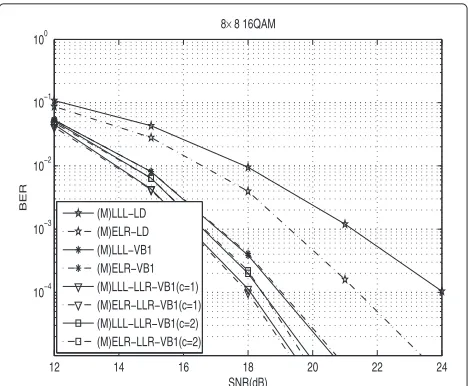
Figures 1 and 2 compare the BER performance of our ELR-LLR- and LLL-LLR-aided VBLAST detectors for dif-ferent constant c with the previous LR-aided detectors in the 8×8 system with 16QAM modulation. The con-stant cis set to be 1 and 2. Figure 1 simulates the BER performance of these detectors in ZF criterion, while Fig. 2 simulates the BER performance in the MMSE criterion. The two figures show that all the VBLAST detectors have better BER performance than the previous LR-aided LDs, and the LLL-LLR- and the ELR-LLR-aided VBLAST detectors can provide significant BER perfor-mance gain over the LLL- and the ELR-aided VBLAST detectors, respectively, in both the ZF and the MMSE criterion. The two figures also show that our ELR-LLR-and LLL-LLR-aided VBLAST detectors for c = 1 out-perform the detectors for c = 2. This is because with the increase of c, the orthogonality of H¯ formed in the initial stage will be destroyed more seriously, and it will be harder to obtain small PEPs, which will result in worse BER performance of the VBLAST detectors. From these figures, we can find that the proposed
12 14 16 18 20 22 24
10−4 10−3 10−2 10−1 100
SNR(dB)
BER
8× 8 16QAM
(Z)LLL−LD (Z)ELR−LD (Z)LLL−VB1 (Z)ELR−VB1 (Z)LLL−LLR−VB1(c=1) (Z)ELR−LLR−VB1(c=1) (Z)LLL−LLR−VB1(c=2) (Z)ELR−LLR−VB1(c=2)
Fig. 1The comparison of the BER of different ZF detectors in 8×8 system with 16QAM
12 14 16 18 20 22 24
10−4 10−3 10−2 10−1 100
SNR(dB)
BER
8× 8 16QAM
(M)LLL−LD (M)ELR−LD (M)LLL−VB1 (M)ELR−VB1 (M)LLL−LLR−VB1(c=1) (M)ELR−LLR−VB1(c=1) (M)LLL−LLR−VB1(c=2) (M)ELR−LLR−VB1(c=2)
Fig. 2The comparison of the BER of different MMSE detectors in 8×8 system with 16QAM
LLL-LLR- (c = 1) and the ELR-LLR-aided (c = 1) VBLAST detectors achieve about 1 dB gain over the LLL-and the ELR-aided VBLAST detectors at BER= 10−5,
respectively.
As shown above, the smaller the constantcis, the bet-ter the BER performance of our proposed detector will be. When the constantcis set to be 1, the BER performance of our detector will be the best. In the following, the constant cis set to be 1.
Figures 3 and 4 compare the BER performance of our ELR-LLR- and LLL-LLR-aided VBLAST detectors with the LR-aided LDs and VBLAST detectors in 8×8 system with 4QAM modulation. Figures 5 and 6 compare the BER performance of these detectors in 6×6 system with
9 10 11 12 13 14 15 16 17
10−5 10−4 10−3 10−2 10−1 100
SNR(dB)
BER
8×8 4QAM
(Z)LLL−LD (Z)ELR−LD (Z)LLL−VB1 (Z)ELR−VB1 (Z)LLL−LLR−VB1 (Z)ELR−LLR−VB1
7 8 9 10 11 12 13 14 15 10−5
10−4 10−3 10−2 10−1
SNR(dB)
BER
8×8 4QAM
(M)LLL−LD (M)ELR−LD (M)LLL−VB1 (M)ELR−VB1 (M)LLL−LLR−VB1 (M)ELR−LLR−VB1
Fig. 4The comparison of the BER of different MMSE detectors in 8×8 system with 4QAM
4QAM modulation. Figures 3 and 5 compare the BER per-formance of different ZF detectors, while Figs. 4 and 6 compare the BER performance of different MMSE detec-tors. From these figures, we find that our LLR-based TA-aided VBLAST detectors still provide substantial BER performance gain than the previous LR-aided VBLAST detectors in different MIMO systems.
4.2 The BER comparison of the VBLAST detector with LLR ordering
In [9, 10], an efficient VBLAST detector whose ordering process is based on the LLR is proposed. It shows better BER performance than the VBLAST detector whose ordering process is based on the SNR, while it will bring
7 8 9 10 11 12 13 14 15
10−4 10−3 10−2 10−1 100
SNR(dB)
BER
6×6 4QAM
(Z)LLL−LD (Z)ELR−LD (Z)LLL−VB1 (Z)ELR−VB1 (Z)LLL−LLR−VB1 (Z)ELR−LLR−VB1
Fig. 5The comparison of the BER of different ZF detectors in 6×6 system with 4QAM
7 8 9 10 11 12 13 14 15
10−5 10−4 10−3 10−2 10−1
SNR(dB)
BER
6×6 4QAM
(M)LLL−LD (M)ELR−LD (M)LLL−VB1 (M)ELR−VB1 (M)LLL−LLR−VB1 (M)ELR−LLR−VB1
Fig. 6The comparison of the BER of different MMSE detectors in 6×6 system with 4QAM
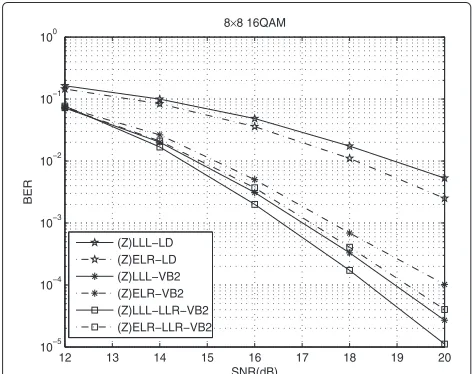
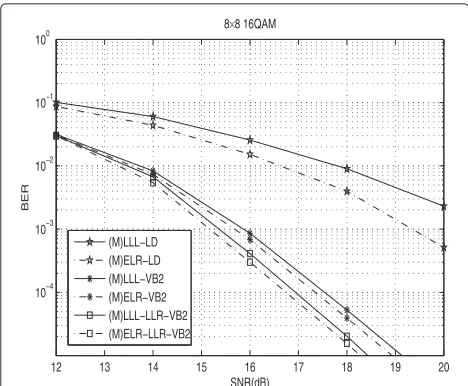
complexity increase. It aims at minimizing the PEP in each stage of the VBLAST detector, where the PEP is calculated as Eq. (14) as shown in Section 3. In this sub-section, the VBLAST detector in [9, 10] is utilized, and it is represented as “VB2” in Figs. 7 and 8.
Figures 7 and 8 compare the BER performance of dif-ferent detectors in 8×8 system with 16QAM modula-tion. Figure 7 compares the BER performance of different ZF detectors, while Fig. 8 compares the BER perfor-mance of different MMSE detectors. From these figures, we also find that our LLR-based TA-aided VBLAST detector can provide BER performance gain than the previous LR-aided VBLAST detectors in different MIMO systems.
12 13 14 15 16 17 18 19 20
10−5 10−4 10−3 10−2 10−1 100
SNR(dB)
BER
8×8 16QAM
(Z)LLL−LD (Z)ELR−LD (Z)LLL−VB2 (Z)ELR−VB2 (Z)LLL−LLR−VB2 (Z)ELR−LLR−VB2
12 13 14 15 16 17 18 19 20 10−4
10−3 10−2 10−1 100
SNR(dB)
BER
8×8 16QAM
(M)LLL−LD (M)ELR−LD (M)LLL−VB2 (M)ELR−VB2 (M)LLL−LLR−VB2 (M)ELR−LLR−VB2
Fig. 8The comparison of the BER of different MMSE detectors in 8×8 system with 16QAM
4.3 The simulation results of the complexity
As the LLL (ELR) is used as the initial stage of our algo-rithm, then the computational complexity of our LLL-LLR (ELR-LLR) will be larger than that of the LLL (ELR) algo-rithm. It is validated by Figs. 9 and 10. Figure 9 shows the empirical CDFs of the total number of arithmetic opera-tions for different algorithms in ZF criterion with 8×8 16QAM system at 20 dB, while the comparison of the complexity of these algorithms in MMSE criterion with 8×8 16QAM system at 20 dB is shown in Fig. 10. The comparison in other MIMO systems is similar with the comparison in 8× 8 16QAM system, and we omit the figure. As we know, the complexity of the ELR and LLL algorithms is polynomial in the MIMO system, and the polynomial complexity is acceptable in the MIMO system.
0 1 2 3 4 5 6 7 8 9 10
x 104 0
0.1 0.2 0.3 0.4 0.5 0.6 0.7 0.8 0.9 1
Number of floating point operations (flops)
Empirical cumulative distribution function (CDF)
(Z)LLL (Z)LLL−LLR(c=1) (Z)LLL−LLR(c=2) (Z)ELR (Z)ELR−LLR(c=1) (Z)ELR−LLR(c=2)
Fig. 9CDFs of the number of floating point operations for different algorithms in ZF criterion (Nr=Nt=8, SNR = 20 dB)
From the simulation results, we find that the complexity of our ELR-LLR and LLL-LLR is no more than twice the complexity of the ELR and LLL algorithm, respectively. Then, the complexity of our algorithm is also polyno-mial, and the complexity of ELR-LLR and LLL-LLR has the same order as the complexity of ELR and LLL, respec-tively, which means the complexity of our algorithm is acceptable in the MIMO system. Then, we know that the complexity increase is moderate and acceptable in the MIMO system. Moreover, Figs. 9 and 10 also show that the computational complexity of our algorithm forc = 1 is larger than that forc=2. As is shown above, it is easier to obtain small PEPs for smallc, which means the number of updates will be larger, and the computational complexity will also be larger.
5 Conclusions
In this paper, we made a readjustment of the received signal in the LR domain and proposed a new scheme to improve the LR algorithm. Unlike the LR algorithm which utilized the unimodular transformation to change the orthogonality of the channel matrix, the proposed scheme targeted to use the unimodular transformation to decrease the PEPs of the symbols, while the PEPs affected the error propagation in the VBLAST detectors. In our designed TA, the standard algorithm such as the LLL or the ELR algorithm was used as the initial stage. Then, a new algorithm was shown to decrease the PEPs of the detected symbols in the VBLAST detector. The simu-lations showed that our LLR-based TA-aided VBLAST detectors substantially improved the BER performance of the LLL- and the ELR-aided VBLAST detectors, while it only brought moderate increase in the computational complexity.
0 1 2 3 4 5 6 7 8 9 10
x 104 0
0.1 0.2 0.3 0.4 0.5 0.6 0.7 0.8 0.9 1
Number of floating point operations (flops)
Empirical cumulative distribution function (CDF)
(M)LLL (M)LLL−LLR(c=1) (M)LLL−LLR(c=2) (M)ELR (M)ELR−LLR(c=1) (M)ELR−LLR(c=2)
Competing interests
The authors declare that they have no competing interests.
Acknowledgements
This work is supported by the Natural Science Foundation of Jiangsu Province of China under Grant BK21030874, and the Natural Science Foundation of China under Grants 61372126 and 61302101.
Received: 12 July 2015 Accepted: 13 January 2016
References
1. S Jarmyr, B Ottersten, EA Jorswieck, Statistical framework for optimization in the multi-user MIMO uplink with ZF-DFE. IEEE Trans. Signal process. 62(10), 2730–2745 (2014)
2. F Rusek, D Persson, BK Lau, EG Larsson, TL Marzetta, O Edfors, F Tufvesson, Opportunities and challenges with very large arrays. IEEE Signal Process. Mag.30(1), 40–60 (2013)
3. B Hassibi, H Vikalo, On sphere decoding algorithm I: Expected complexity. IEEE Trans. Signal Process.53(8), 2806–2818 (2005)
4. B Hassibi, H Vikalo, On the sphere-decoding algorithm II.Generalizations, second-order statistics, and applications to communications. IEEE Trans. Signal Process.53(8), 2819–2834 (2005)
5. J Jalden, B Ottersten, On the complexity of sphere decoding in digital communications. IEEE Trans. Signal Process.53(4), 1474–1484 (2005) 6. Y Jiang, MK Varanasi, J Li, Performance analysis of ZF and MMSE equalizers
for MIMO systems: an in-depth study of the high SNR regime. IEEE Trans. Inf. Theory.57(4), 2008–2026 (2011)
7. PW Wolniansky, GJ Foschini, GD Golden, RA Valenzuela, inProc. URSI International Symposium on Signals, Systems, and Electronics (ISSSE). V-BLAST: An Architecture for Realizing Very High Data Rates Over the Rich-Scattering Wireless Channel (IEEE, Pisa, 1998), pp. 295–300 8. Y Shang, XG Xia, On fast recursive algorithms for V-BLAST with optimal
ordered SIC detection. IEEE Trans. Wireless commun.8(6), 2860–2865 (2009)
9. SW Kim, KP Kim, Log-likelihood-ratio-based detection ordering in V-BLAST. IEEE Trans. Commun.54(2), 302–307 (2006)
10. J He, G Gu, Z Wu, MMSE interference suppression in MIMO frequency selective and time-varying fading channels. IEEE Trans. Signal Process. 56(8), 3638–3651 (2008)
11. KV Vardhan, SK Mohammed, A Chockalingam, B Sundar Rajan, A low-complexity detector for large MIMO systems and multicarrier CDMA systems. IEEE J. Sel. Areas Commun.26(3), 473–485 (2008)
12. BS Rajan, SK Mohammed, A Chockalingam, N Srinidhi, inProc. IEEE Int. Symp. Info. Theory (ISIT). Low-Complexity Near-ML Decoding of Large Non-Orthogonal STBCs Using Reactive Tabu Search (IEEE, Seoul, 2009), pp. 1993–1997
13. N Srinidhi, T Datta, A Chockalingam, BS Rajan, Layered tabu search algorithm for large-MIMO detection and a lower bound on ML performance. IEEE Trans. Commun.59(1), 2955–2963 (2011) 14. D Wubben, D Seethaler, J Jalden, G Matz, Lattice reduction. IEEE Signal
Process. Mag.30(1), 70–91 (2011)
15. Q Zhou, X Ma, Element-based lattice reduction algorithms for large MIMO detection. IEEE J. Sel. Areas Commun.31(2), 274–286 (2013)
16. H Yao, GW Wornell, inProc. IEEE Global Tele. Conf. (GLOBECOM). Lattice-Reduction-Aided Detectors for MIMO Communication Systems (IEEE, Taipei, 2002), pp. 424–428
17. CE Chen, WH Sheen, A new lattice reduction algorithm for LR-Aided MIMO linear detection. IEEE Trans. Wireless commun.10(8), 2417–2422 (2011) 18. Q Zhou, X Ma, Improved Element-Based lattice reduction algorithms for
wireless communications. IEEE Trans. Wireless commun.12(9), 4414–4421 (2013)
19. K Zhao, Y Li, H Jiang, S Du, inProc. IEEE 23rd Symposim on Personal, Indoor and Mobile Radio Commun. (PIMRC). A Low Complexity Fast Lattice Reduction Algorithm for MIMO Detection (IEEE, Sydney, 2012), pp. 1612–1616
20. W Zhang, S Qiao, Y Wei, A diagonal lattice reduction algorithm for MIMO detection. IEEE signal process. letter.19(5), 311–314 (2012)
21. D Wubben, D Seethaler, inProc. Asilomar Conf. Signals, Systems and Computers. On the Performance of Lattice Reduction Schemes for MIMO Data Detection (IEEE, Pacific Grove, 2007), pp. 1534–1538
22. D Tse, P Viswanath,Fundamentals of Wireless Communication. (Cambridge University Press, Cambridge, UK, 2005)
23. SR Kim, I Lee, inProc. IEEE Int. Conf. Commun. (ICC). Optimal Detection Ordering for V-BLAST (IEEE, Glasgow, 2007), pp. 5288–5293
Submit your manuscript to a
journal and benefi t from:
7Convenient online submission
7Rigorous peer review
7Immediate publication on acceptance
7Open access: articles freely available online
7High visibility within the fi eld
7Retaining the copyright to your article