
Face Recognition Based on DCT and RBF
Neural Network
Sapna Tyagi
M.Tech (Computer Science and Engineering), Inderprastha Engineering College, Uttar Pradesh Technical University,
Lucknow, India
ABSTRACT: In this paper, several approaches to face recognition have been incorporated. The system consists of a database of a set of facial patterns for each individual. The characteristic features called „eigenfaces‟ are extracted from the stored images using which the system is trained for subsequent recognition of new images. We first use k-means clustering, to cluster the similar images of database. Second, Principal Component Analysis (PCA) is applied to the cluster images for dimensionality reduction. The performance of PCA-based face recognition techniques is based on various parameters such as distance classifier, selecting the number of eigenfaces. And then Discrete-Cosine transform (DCT), DCT works by separating images into parts of differing frequencies. During a step, less important frequencies are discarded only the most important frequencies are used for image retrieval. After the extraction of feature vectors, automated face recognition system requires correct classification of input facial image. The system with higher classification accuracy has less error rate in recognition. Various classifiers are used like Bayesian, nearest neighbour classifiers, neural networks are used for classification purpose. For recognition of faces with good accuracy neural networks is used.Neural networks have been widely applied in pattern recognition for the reason that neural networks-based classifiers can incorporate both statistical and structural information and achieve betterperformance than the simple minimum distance classifiers.
In this paper, several distance based classifiers are applied to classify „eigenfaces‟ extracted from the stored images after being clustered by k-means clustering. Eigen faces are extracted from the images after the holistic application of discrete cosine transformation (DCT). The classification accuracy obtained from distance based classifiers is also compared with simple feed forward neural network and RBFNN.
KEYWORDS: Face Recognition, DCT, k-means clustering, PCA, RBF neural network
I. INTRODUCTION
As a check to the risks posed by fraudulent use of identity documents, a lot of biometric technologies are emerging. These are:
face recognition Voice recognition Iris recognition
Fingerprint recognition and gait recognition
Since last decade, due to high rate of crime and fraud in the world, it is becoming increasingly important to have a non-intrusive monitoring system that allows recognition of people with high accuracy. Automated face identification system is possesses one of the important feature non-intrusiveness. An automated face recognition system is a computer-based system that attempt to identify an individual or verify a person‟s claimed identify using face of an individual.
In face recognition system there is a database consist of face images of individuals, for recognizing a face image it go through several processes. Due to high dimension of input facial data, data dimensionality reduction technique is normally applied to improve the performance of recognition system. Principle Component Analysis (PCA) based, Linear Discriminant Analysis (LDA) are few popular classical approaches used in last 20 years literature. A classical method belonging to appearance based algorithms for face recognition uses Principle Component Analysis (PCA) for dimensionality reduction is Eigenfaces. The scheme is based on an information theory approach that decompose face images into a small set of characteristic feature of images called eigenfaces, which may be thought of as the principle components of the initial training set of face images. When the database of eigenfaces is constructed, any face in this database can be exactly represented with the combination of these eigenfaces. In combination of these eigenfaces, the multipliers of them are called the feature vectors of the input face. PCA constructs the face space without using face class information. For face recognition, PCA is used for representing patterns, while for classification purpose discriminative features are required. A closely related method Fisherfaces approach based on the Linear Discriminant Analysis (LDA) was proposed by Kim and Kittler. LDA like PCA projects face images to new space. But unlike PCA, in LDA class information is used to maximize the between class scatter and minimize within class scatter.
One of the most widely used techniques is JPEG compression technique for lossy image compression centers on the discrete cosine transformation (DCT). The DCT works by separating images into part of differing frequencies. The less important frequencies are discarded; hence the term uses “lossy”, only the most important frequency that remain are used to retrieve the image in the decompression process. Therefore, the technique achieves good performance in reducing the dimensionality of data at a reasonable computational complexity/time. DCT has several advantages over the PCA and LDA. First, the DCT is data independent. Second, the DCT can be implemented, using a fast algorithm. Polynomial coefficients are derived from the 2D-DCT coefficients from the spatially neighboring blocks. DCT coefficients contain three bands, namely low frequency, middle frequency and high frequency. The information in these different bands can be used to extract meaningful information. Low frequency coefficients are related to illumination variation and smooth regions. High frequency coefficients represent noise and detailed information of edge. The basic structure of image is represented by the middle frequency coefficient. Removal of DC element enables the reconstructed facial image to be robust to lighting changes and removal of high-frequency DCT coefficients to be robust against scaling variations. After the extraction of feature vectors, automated face recognition system requires correct classification of input facial image. The system with higher classification accuracy has less error rate in recognition. Various classifiers are used like nearest neighbour classifiers, Bayesian and neural networks are used for classification purpose. For recognition of faces with good accuracy with neural networks, good generalization capability is achieved by tuning the neural network architecture according to the extracted features. The advantage of using the neural networks for face recognition is that the networks can be trained to capture more knowledge about the variation of face patterns.
II. RELATED WORK
This review examines some of the current literature in the area of autonomous face recognition. Face recognition research over the past several years falls into two categories:
Features based
Holistic approach (or whole face).
Face recognition using features was first attempted by L. D. Harmon in the early 1970s. He extracted features from profiles to identify the faces. His features were defined as the distance from the tip of the nose to the mouth, the distance from the nose to the chin, the distance from the eyes to the nose and other similar measurements. In addition to Hannon's method, other types of face recognition using feature involves segmenting a face and then extracting features from the segments. Whatever the method, face recognition using features continues today with researchers all over the world.
The second category of face recognition is the holistic approach. Research in face recognition has moved towards a holistic point of view with researchers at the Massachusetts Institute of Technology (M1T), the University of California San Diego (UCSD) and AFIT The holistic approach still involves extracting features, but the features, which are extracted using some type of principal component analysis, are now taken from the entire face image, not just segments or profiles. This research is based on the holistic approach and it is what will be discussed in the following sections.
2.1. Recent Approaches to Face Recognition
Face recognition has been an active research area over last 30 years. This research spans several disciplines such as image processing, pattern recognition, computer vision, and neural networks. It has been studied by scientists from different areas of psychophysical sciences and those from different areas of computer sciences. Engineers studying on machine recognition of human faces deal with the computational aspects of face recognition. Face recognition has applications mainly in the fields of biometrics, access control, law enforcement, and security and surveillance systems.
2.2. Human Face Recognition
When building artificial face recognition systems, scientists try to understand the architecture of human face recognition system. Focusing on the methodology of human face recognition system may be useful to understand the basic system. However, the human face recognition system utilizes more than that of the machine recognition system which is just 2-D data. The human face recognition system uses some data obtained from some or all of the senses; visual, auditory, tactile, etc. All these data is used either individually or collectively for storage and remembering of faces. In many cases, the surroundings also play an important role in human face recognition system. It is hard for a machine recognition system to handle so much data and their combinations. However, it is also hard for a human to remember many faces due to storage limitations. For a human face recognition system the important feature is its parallel processing capacity.
2.3. Machine Recognition of Faces
Although studies on human face recognition were expected to be a reference on machine recognition of faces, research on machine recognition of faces has developed independent of studies on human face recognition. Chellappa et al. (1995) posited that, during 1970‟s, typical pattern classification techniques, which use measurements between features in faces or face profiles, were used. During the 1980‟s, work on face recognition remained nearly stable. Since the early 1990‟s, research interest on machine recognition of faces has grown tremendously. The reasons may be;
- An increase in emphasis on civilian/commercial research projects,
- The studies on neural network classifiers with emphasis on real-time computation and adaptation, - The availability of real time hardware,
- The growing need for surveillance applications.
the whole face region. In this approach, as in the previous approach, the pattern classifiers are applied to classify the image after extracting the features.
One of the methods to extract features in a holistic system is applying statistical methods such as Principal Component Analysis (PCA) to the whole image. PCA can also be applied to a face image locally; in that case the approach is not holistic.
2.4. Neural Network based Approaches
Artificial Neural Network (ANN) is a powerful tool for pattern recognition problems. The use of neural networks (NN) in faces has addressed several problems: gender classification, face recognition and classification of facial expressions. One of the earliest demonstrations of NN for face recalls application which was reported in Kohonen's associative map. Using a small set of face images, accurate recall was reported even when input image is very noisy or when portions of the images are missing. In face recognition applications, the RBF neural networks are regarded as a mapping from the feature hyperspace to the classes. Therefore, the number of inputs of RBF neural networks is determined by the dimension of input vectors. The number of outputs is equal to the class number. The hidden neurons are very crucial to the RBF neural networks, which represent the subset of the input data.
III. METHODOLOGY
3.1. CLUSTERING
3.1.1. Principle and methods
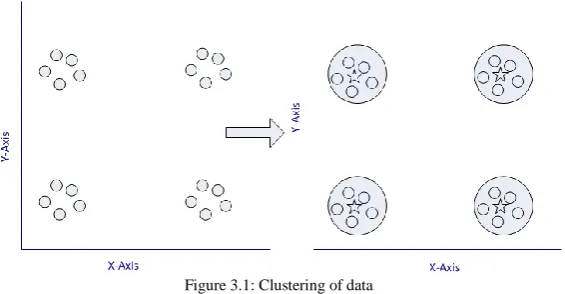
Clustering aims at storing similar or close objects into similar groups in a way that the degree of association between two objects is maximal if they belong to the same group and minimal otherwise, to identify such clusters in an unsupervised manner. Figure illustrates to identify four clusters and its centers into which the input data is divided.Two well-known methods of clustering are:-
Partitioned clustering Hierarchical clustering
In Partition clustering, algorithms find all the clusters simultaneously as a partition of the data and do not impose any sort of hierarchy. In many practical scenarios, there is an inherent hierarchy. The clusters have sub-classes within them, and these subclasses might have their own subclasses. Such classifications are hierarchical and they can be partitioned properly by hierarchical clustering. In partition clustering, the dataset is divided into clusters, such that each cluster has at least one data point and each data point has one cluster. The well-known partitioned algorithm is k-means.
Figure 3.1: Clustering of data
3.1.3. K-means Clustering
K-means clustering is a method for finding clusters and cluster centers in a set of unlabeled data. The k-means algorithm partitions a set of n objects into k clusters so that the resulting intracluster similarity is high but the intercluster similarity is low. Cluster similarity is measured with respect to the mean of the objects in the cluster. Similarity Measure Similarity is expressed in terms of a distance function. Two closely related vectors have a small distance and a large similarity. It is important to keep the similarity measure simple since the algorithm repeatedly calculates the similarity of each pixel to the mean of each cluster.
3.1.3.1. k-means Algorithm :-Mirkin (2005) defines K-means in four steps:
1. Initial setting Define the value of K and the tentative centroids c1, c2,….,ck. In the conventional K-means, the initial
centroids are usually randomly chosen entities. As per the value of K, this is a difficult question. Its value may come from any expert knowledge relating to the data or from experiments at different values.
2. Cluster update
Assign the N entities to their respective centroid, ck= (ckv) , using the minimum distance rule.
3. Stop condition The most common stop condition is to check for changes to the clusters in step 2: should there be
none, the clustering task is assumed to be finished and the generated partitions S={ S1, S2, ….,Sk} are final. Other
possible stop conditions are limiting the number of iterations or pre-setting a threshold for the objective function. 4. Centroids update
For each cluster, move its centroid to its cluster‟s centre of gravity. This way, each will represent the general properties of its cluster. When using the squared Euclidian distance, this can be achieved by simply moving the centroids to the means of their clusters.
The k-means algorithm is a very popular algorithm for data clustering, since it is very simple to implement, it is fast, and it is fairly easy to understand. Originally developed for and applied to the task of vector quantization, k-means has been used in a wide assortment of applications.
3.2. PRINCIPLE COMPONENT ANALYSIS (PCA)
Principal component analysis (PCA) was invented in 1901 by Karl Pearson. It is a linear transformation based on statistical technique. It is used to decrease the dimension of the data or to reduce the correlation between them. It is a way of identifying patterns present in data, and expressing the data in such a way that their similarities and differences are highlight.
Since patterns present in data can be hard to find in data of high dimension, where it can-not be represented graphically, PCA is a powerful tool for face recognition which is multidimensional.
The purpose of PCA is to reduce the large dimension of data space to a smaller intrinsic dimension of feature vector (independent variable), which are used to describe the data cost effectively. The first principal component is the linear combination of the original dimension along which the variance is maximum. The second principal component is the linear combination of the original dimension along which the variance is maximum and which is orthogonal to the first principal component. The nth principal component is the linear combination with highest variance, subject to being orthogonal to n-1 principal component.
The major advantage of PCA is using it in eigenface approach which helps in reducing the size of the database for recognition of a test images. The images are stored as their feature vectors in the database which are found out projecting each and every trained image to the set of Eigen faces obtained. PCA is applied on Eigen face approach to reduce the dimensionality of a large data set.
3.3. DISCRETE COSINE TRANSFORM (DCT)
The mathematical theory of linear transforms plays a very important role in the signal and image processing area. The y generate a set of coefficients from which it is possible to restore the original samples of the signal. In many situations, a mathematical operation – generally known as a transform – is applied to a signal that is being processed, converting it to the frequency domain. With the signal in the frequency domain, it is processed and, finally, converted back to the original domain. A mathematical transform has an important property: when applied to a signal, i.e., they have the ability to generate decorrelated coefficients, concentrating most of the signal‟s energy in a reduced number of coefficients.
frequency domain by applying the direct DCT transform and it is possible to convert back the transformed signal to the original domain by applying the inverse DCT transform. After the original signal has been transformed, its DCT coefficients reflect the importance of the frequencies that are present in it. The very first coefficient refers to the signal‟s lowest frequency, known as the DC-coefficient, and usually carries the majority of the relevant (the most representative) information from the original signal. The last coefficient refers to the signal‟s higher frequencies. These higher frequencies generally represent more detailed or fine information of signal and probably have been caused by noise. The rest of the coefficients (those between the first and the last coefficients) carry different information levels of the original signal.
In the image processing field, it is interesting to use a two-dimensional DCT (2D-DCT), because images are intrinsically two-dimensional elements. The standard JPEG, for example, establishes the use a 2D-DCT at the decorrelation step.
In the JPEG image compression standard, original images are initially partitioned into rectangular non overlapping blocks (8X8 blocks) and then the DCT is performed independently on the subimage blocks. In our proposed system, we simply apply the DCT on the entire face image. If the DCT is only applied to the subimage independently, some relationship information between subimages cannot be obtained. However, we can obtain all frequency components of a face image by applying the DCT on the entire face image. In addition, some low-frequency components are only related to the illumination variations which can be discarded.
For an image, we have a DCT coefficient matrix covering all the spatial frequency components of the image. The DCT coefficients with large magnitude are mainly located in the upper-left corner of the DCT matrix. Accordingly, as illustrated in Fig. 2, we scan the DCT coefficient matrix in a zig-zag manner starting from the upper-left corner and subsequently convert it to a one-dimensional (1-D) vector.
The main features of the DCT which make it attractive for face recognition are:
1. Data compression (energy compaction) property, commonly used in image/video compression, and 2. Efficient computation, due to its relationship to the Fourier transform.
Figure3.3 Scheme of scanning two-dimensional (2-D) DCT coefficients to a 1-D vector
3.4. NEURAL NETWORKS
An artificial neural network is a non-linear and adaptive mathematical module inspired by the working of a human brain. It consists of simple neuron elements operating in parallel and communicating with each other through weighted interconnections.
3.4.1. Model of neuron
the amplitude of the output of the neuron. An acceptable range of output is usually between 0 and 1, or -1 and 1 depending on the transfer function selected. Figure shows a typical model of an artificial neuron.
Radial Basis Function Networks (RBFN)
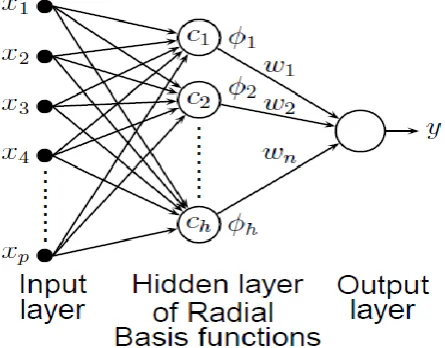
RBNF consists of 3 layers an input layer a hidden layer an output layer.
The hidden units provide a set of functions that constitute an arbitrary basis for the input patterns. Hidden units are known as radial centers and represented by the vectors c1; c2; _ _ _ ; ch transformation from input space to hidden unit space is nonlinear whereas transformation from hidden unit space to output space is linear dimension of each center for a p input network is p X 1
Figure 4.5: Radial Basis Function Network
The radial basis function in the hidden layer produces a significant non-zero response only when the input falls within a small localized region of the input space. Each hidden unit has its own receptive fieldin input space.
An input vector xi which lies in the receptive field for centercj , would activate cj and by proper choice of weights the target output is obtained. The output is given as
Different radial functions are given as follows:-
Here,
Learning in RBFN
Training of RBFN requires optimal selection of the parameters vectors ci and wi, i = 1; _ _ _ h. Both layers are optimized using different techniques and in different time scales.
Following techniques are used to update the weights and centers of a RBFN. Pseudo-Inverse Technique (Off line)
Gradient Descent Learning (On line) Hybrid Learning (On line)
Specific Procedures of Methodology
The steps required for face recognition are as follows: 1. Select a database that contains faces.
2. Segment out potential faces with the K-means algorithm. 3. Create an array of flags indicating face or not-face.
4. Create a matrix of principal components of the potential faces. 5. Train the neural network classifier with the PCA matrix.
IV. EXPERIMENTALANALYSISANDRESULTS
Data Collection
AT&T face database is used for tests. In this database there are 10 different images of each of 40 distinct subjects. Separate directories were merged into one folder. The subjects were sitting at approximately the same distance from the camera.Each image is indexed 1 to 10 for the 10 images per person. In all, a total of 400 images make up the database for this thesis. For the purposes of recognition and testing the performance of the algorithm, the dataset is divided into two: the training set and testing set.
The recognition rates, with different number of eigenfaces and hidden layer neurons in neural network system are implemented. It is found that for the whole database, 7 training images per person. The eigenface method is very sensitive and the mismatches occur for the images.
Face Recognition Algorithm
This algorithm shows the processes involved when a new image is to be recognized. At the recognition stage:
Step 1. The eigenfaces, the image index along with the projected image are loaded into the computer system.
Step 2. The image to be tested is allowed to go through the feature extraction process in order to get its feature vector. Step 3. This feature vector of the test image is then compared with the projected images of the training set in the database.
Step 4. The Euclidean distance between this tested image and the projected image in the database is then calculated. Step 5. The smallest Euclidean distance that corresponds to an image in the training set is assumed to be a match. It is selected along with its index.
Step 6. If the index of the test projected image and the projected image of the training set happens to be the same, then there is a valid match. Otherwise, it failed the test of success.
This process is repeated for the rest of the images to be tested.
Algorithm Performance
To calculate the accuracy rate during the testing stage, each image in the testing set is compared into the eigenface of the training set and the index of the image with the smallest
In this thesis, an accuracy rate of 98.333% was achieved with an error margin of 1.667%.
Outcomes of MATLAB Code
Total elapsed time taken to load Dataset is 7.503672 seconds. On normalizing, the Dataset have zero mean and 0.081888 seconds elapsed time. Time taken by PCA is 0.832715 seconds.
Performing Clustering...
Table 4.1 k-means clustering
Running Iteration [1/20]: Error = 1009577.047074 Running Iteration [2/20]: Error = 999399.538115 Running Iteration [3/20]: Error = 994903.112865 Running Iteration [4/20]: Error = 994361.288368 Running Iteration [5/20]: Error = 1004353.055393 Running Iteration [6/20]: Error = 995063.470136 Running Iteration [7/20]: Error = 998033.442055 Running Iteration [8/20]: Error = 999663.224915 Running Iteration [9/20]: Error = 999559.555106 Running Iteration [10/20] Error = 996944.314702 Running Iteration [11/20] Error = 995029.424720 Running Iteration [12/20]: Error = 995599.217286 Running Iteration [13/20]: Error = 995126.246564 Running Iteration [14/20]: Error = 993799.384652 Running Iteration [15/20]: Error = 995167.070226 Running Iteration [16/20]: Error = 995200.958630 Running Iteration [17/20]: Error = 999357.879958 Running Iteration [18/20]: Error = 994300.513283 Running Iteration [19/20]: Error = 995023.324973 Running Iteration [20/20]: Error = 996431.209552
Clustering Performed.
Elapsed time is 30.221332 seconds.
Trying PCA with Clustering...
Test Set Accuracy: 90.000000 Elapsed time is 0.137252 seconds. Trying PCA without Clustering...
Test Set Accuracy: 93.333333 Elapsed time is 0.166153 seconds. Trying Neural Network...
Normalizing Reduced Matrix... Reduced Matrix Normalized. Elapsed time is 0.069527 seconds.
Training RBF Neural Network...
RBF Neural Network Trained. Elapsed time is 0.881614 seconds.
Finding Test Set Accuracy...
Test Set Accuracy: 98.333333 Elapsed time is 0.005119 seconds. Iteration 1 | Cost: 1.033330e+001
V. CONCLUSION
In this thesis we implemented the face recognition method using k-means clustering, Principal Component Analysis (PCA) and RBF neural network approach. The system successfully recognized the human faces and worked better in different conditions of face orientation up to a tolerable limit. We used these algorithms to construct efficient face recognition method with a high recognition rate. Proposed method consists of three parts:- Firstly, we propose a clustering algorithm to prevent training samples with large variations from being clustered in the same class. This process guarantees optimal projection direction. Secondly, dimension reduction using PCA that main features that are important for representing face images are extracted. Thirdly, the RBF neural network for classification. Simulation results on three benchmark face databases show that our system achieves high training and recognition speed, as well as high recognition rate. More importantly, it is insensitive to illumination variations. Experimental results show a high recognition rate equal to 98.333% which demonstrated an improvement in comparison with previous methods. The new face recognition algorithm can be used in many applications such as security methods.
REFERENCES
[1] AT&T Laboratories, Cambridge, UK, “The ORL Database of Faces” (Now At&T “The Database of Faces”), Available [Online]: http://www.cl.cam.ac.uk/research/dtg/attarchive/pub/data/att_faces.zip [November, 16, 2008], 1994.
[2]. Simon Haykin, “Neural Networks: a comprehensive foundation,” Prentice-Hall, Inc., Upper Saddle River, New Jersey (1999).
[3]. Zhang Xiaozheng, GaoYongsheng, “Face recognition across pose: A review”, Pattern Recognition, Vol. 42, No. 11, pp: 2876 – 2896, 2009.
[4]. T.K.Kim,J.Kittler, “Design and fusion of pose-invariant face-identification experts”, IEEETransactions on Circuits Syst. Video Technol. , Vol.
16, No. 9, pp: 1096–1106, 2006.
[5]. ZIAD M. HAFED AND MARTIN D. LEVINE,” Face Recognition Using the Discrete Cosine Transform”, International Journal of Computer
Vision 43(3), 167–188, 2001.
[6]. MengJooEr,Weilong Chen, and Shiqian Wu,” High-Speed Face Recognition Based on Discrete Cosine Transform and RBF Neural Networks”
IEEE TRANSACTIONS ON NEURAL NETWORKS, VOL. 16, NO. 3, MAY 2005.
[7]. RabiaJafri and Hamid R. Arabnia,”A Survey of Face Recognition Techniques”,Journal of Information Processing Systems, Vol.5, No.2, June
2009.
[8]. FatmaZohraChelali, Amar Djeradi ,”Face Recognition System using Discrete Cosine Transform Combined with MLP and RBF Neural
Networks”, International Journal of Mobile Computing and Multimedia Communications, Vol.4, No.4, December 2012.
BIOGRAPHY
![Table 4.1 k-means clustering Running Iteration [1/20]: Error = 1009577.047074 Running Iteration [2/20]: Error = 999399.538115](https://thumb-us.123doks.com/thumbv2/123dok_us/1467453.1179790/9.595.52.535.254.499/table-clustering-running-iteration-error-running-iteration-error.webp)
