ISSN(Online): 2320-9801
ISSN (Print): 2320-9798
I
nternational
J
ournal of
I
nnovative
R
esearch in
C
omputer
and
C
ommunication
E
ngineering
(An ISO 3297: 2007 Certified Organization)
Vol. 3, Issue 3, March 2015
Pixel Steganalysis – A Novel Approach in Image
Steganography Using F5 Algorithm
Prabhu Kumar
1,, Nikhil Tirpathi
, 2, G.Michael
3UG Student, Dept. of CSE, Bharath University, Chennai, India1,2
Assistant professor, Dept. of CSE,Bharath University, Chennai, India3
ABSTRACT
:
The Faugère F5 algorithm first calculates the Gröbner basis of a pair of generator polynomials of the ideal. And it uses to reduce the sizes of initial matrices of created messages which had to be embedded in image steganography. The stenographical systems are weak against statistically and visually weak which offers only a relatively small capacity of stenographic message but the newly developed f5 algorithm help to embedded messages in images large capacity of steganography. It implement matrix encoding and permutation straddling to embedded message with large capacity and reduces the embedded-image.KEYWORDS: F5 algorithm, Permutation straddling, Matrix encoding, Image steganography, JPEG encoder.
I.INTRODUCTION
II. LITERATURE SURVEY
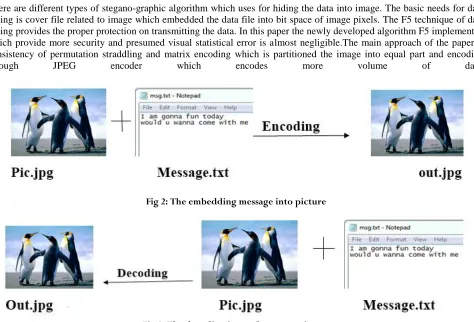
There are different types of stegano-graphic algorithm which uses for hiding the data into image. The basic needs for data hiding is cover file related to image which embedded the data file into bit space of image pixels. The F5 technique of data hiding provides the proper protection on transmitting the data. In this paper the newly developed algorithm F5 implemented which provide more security and presumed visual statistical error is almost negligible.The main approach of the paper is consistency of permutation straddling and matrix encoding which is partitioned the image into equal part and encoding
through JPEG encoder which encodes more volume of data.
ISSN(Online): 2320-9801
ISSN (Print): 2320-9798
I
nternational
J
ournal of
I
nnovative
R
esearch in
C
omputer
and
C
ommunication
E
ngineering
(An ISO 3297: 2007 Certified Organization)
Vol. 3, Issue 3, March 2015
III.EXISTING SYSTEM
[2]
The main concept which was used in recent project was compared with original file as file weight age and color variations of pixels. The main purpose of Cryptography techniques is latent communication to hide the existence of a message from a third party, but it’s too Complex to embedded and Extract the message from stego-data. LSBs of the elements pointed by the determined locations are used for embedding and extraction and it doesn’t opposes permutation straddling and matrix encoding which secured not more enough.Before embedding and extraction data, a location finds the method which determines a sequence of locations that point to elements in the cover stego-object. A commonly used strategy for Steganography techniques is to embed the message by slightly distorting the cover-object into the target stego-Object Reducing distortion is a crucial issue.
IV.PROPOSED SYSTEM
The proposed method is driven by an algorithm that works as follows: Every character in the input secret message is encoded using newly generated strong number generator which indexed that points to a random character in the Pangram sentence, and an offset index that denotes the total number of bit character which has to be arrange with an pair of 8bit, 16bit, 24bit index and the first occurrence of the character being encoded in the embedded message. The maximum allowable length of the sentence which is going to be embedded in jpg image is 512 characters. Using hash function the random generated number could be arranged in multiple of bit but if not arranged in sequences of multiple of bit the remaindered number of bit could be added in last arranged bit of generated number which secured more the remained bit which doesn’t give space to be statistically and visually attacks.
The primeprogression of the proposed method is that it employs two mediums, instead of one, that complement each other to deliver the secret data, making the covert data so robust against stego-attacks.
V. MODULE DESCRIPTION
1.JPEG file encoding format
[1]
The file format defined by the Joint Photographic Experts Group (JPEG) stores image data in lossy compressed form as quantized frequency coefficients.it expressed losing some quality and reducing the actual frequency of each pixel in order to its easily to identify and convert into BMP which could be recognized by algorithm to be JPEG encoder this algorithm which encodes the image to JPEG afterpartitioning the images into 8X8 pixel nevertheless, It refers to a standards organization, a secure techniques of file compression, and sometimes a changing the jpeg file format from .gif, .jpg, .etc. First, the JPEG compressor cuts the uncompressed bitmap image into parts of 8 by 8 pixels by blocking the image partition of any extension of image format. The discrete cosine transformation (DCT) which expresses a finite sequences of pixel point in image in terms of sum of cosine function oscillating at different frequency of image position, transfers 8 × 8 brightness values into 8 × 8 frequency coefficients (real numbers) and After DCT, the quantization suitably rounds the
frequency coefficients to integers in the range −2048 . . . 2047.it compressed 8 x 8 pixel wise and remained pixels of image
could return to algorithm procedure of compressing technique through an DCT.
Fig 4: The procedure of jpeg compressor through Huffman coding.
2. Permutation straddling
The straddling mechanism used with F5 shuffles all coefficients using a permutation first. Then, F5 arranged the bits of pixel of image into the permuted sequentially. The shrinkage does not change the number of coefficients. The permutation depends on a key derived from a password. F5 delivers the stegano-graphically changed coefficients in its original sequence to the Huffman coding algorithm. With the correct key, the receiver is capable to repeat the permutation.
VI. RESULT
ISSN(Online): 2320-9801
ISSN (Print): 2320-9798
I
nternational
J
ournal of
I
nnovative
R
esearch in
C
omputer
and
C
ommunication
E
ngineering
(An ISO 3297: 2007 Certified Organization)
Vol. 3, Issue 3, March 2015
Fig 6: The decoding output of stego-image into image and message
VII.CONCLUSION
In this study of F5 algorithm most of the effort is done to get a better imperceptibility, increasing capacity, increasing security without losing stego-image quality and most important concept which has been studied is
like the reducing the embedded image size which does not get lose the image resolution as well as Hash function is used to generate a pattern, which is random selection of edge pixels, for more security and better stego-image quality.
REFERENCES
1. .LinjieGuo, Jiangqun Ni “Uniform Embedding for Efficient JPEG Steganography” IEEE TRANSACTIONS ON INFORMATION FORENSICS AND SECURITY, VOL. 9, NO. 5, MAY 2014
2. Ravinder Reddy Ch1 RojaRamani A2 “The Process of Encoding and Decoding of Image Steganography using LSB Algorithm” IJCSET Vol 2, Issue 11, November 2012
3.Morkel 1, J.H.P. Eloff 2, M.S. Olivier 3 “An overview of image steganography” University of Pretoria, 0002, Pretoria, South Africa
4. Kritika Singla1, and Sumeet Kaur2 “Hash based approach for secure image steganography using canny edge detection method” IJCSC Vol 3. No 1. JAN 2012
5. Jessica Fridrich1, Miroslav Goljan1, Dorin Hogea2 “Steganalysis of JPEG Images: Breaking the F5 Algorithm” NY13902-6000, USA.
6.BhagyashriRahangdale , “Hash Based Least Significant Bit Technique For Video Steganography”,IJERA,VOL 4, JAN 2014, INDIA
BIOGRAPHY
Mr. Prabhu Kumar has been with Dept. of CSE, Bharath University, India since 2011.His research interests includes Steganography, Cryptography and Data hiding. He had been with St. Xavier’s college, Ranchi, India whither awarded as
G Michael has been with Bharath University, India since 2004.he having more than 10 years experienced in assistance ship. He received the ME degree from Annamalai University, India, BE degree from Rajaa’s Engineering college, India and perusing PHD from Bharath university, India. His research interest include digital data hiding, Steganography, Cloud computing, information assurance. He has authored and co-authored more than 22 papers. He awarded asinnovative research faculty from the Bharath University, India.