Proceedings of the 13th Linguistic Annotation Workshop, pages 56–64 56
The Materials Science Procedural Text Corpus: Annotating Materials
Synthesis Procedures with Shallow Semantic Structures
Sheshera Mysore1∗ Zach Jensen2∗ Edward Kim2 Kevin Huang2
Haw-Shiuan Chang1 Emma Strubell1 Jeffrey Flanigan1
Andrew McCallum1 Elsa Olivetti2 1College of Information and Computer Sciences
University of Massachusetts Amherst
{smysore, hschang, strubell, jflanigan, mccallum}@cs.umass.edu
2Department of Materials Science and Engineering
Massachusetts Institute of Technology
{zjensen, edwardk, kjhuang, elsao}@mit.edu
Abstract
Materials science literature contains millions of materials synthesis procedures described in unstructured natural language text. Large-scale analysis of these synthesis procedures would facilitate deeper scientific understand-ing of materials synthesis and enable auto-mated synthesis planning. Such analysis re-quires extracting structured representations of synthesis procedures from the raw text as a first step. To facilitate the training and evalu-ation of synthesis extraction models, we intro-duce a dataset of 230 synthesis procedures an-notated by domain experts with labeled graphs that express the semantics of the synthesis sen-tences. The nodes in this graph are synthe-sis operations and their typed arguments, and labeled edges specify relations between the nodes. We describe this new resource in detail and highlight some specific challenges to an-notating scientific text with shallow semantic structure. We make the corpus available to the community to promote further research and de-velopment of scientific information extraction systems.
1 Introduction
Systematically reducing the time and effort re-quired to synthesize novel materials remains one of the grand challenges in materials science. Mas-sive knowledge bases which tabulate known chem-ical reactions fororganicchemistry (Lawson et al.,
2014) have accelerated data-driven synthesis plan-ning and related analyses (Segler et al.,2018;Coley et al.,2017). Automated synthesis planning for or-ganic molecules has recently achieved human-level
∗
Equal contribution
Figure 1: Example synthesis procedure text from a ma-terials journal article (Dong et al.,2009). Bold red in-dicates the operations (prein-dicates) involved in the syn-thesis;bold blackindicates arguments; underlines de-marcate entity boundaries.
planning performance using massive organic re-action knowledge bases as training data (Segler et al.,2018). There are, however, currently no com-prehensive knowledge bases which systematically document the methods by whichinorganic materi-als are synthesized (Kim et al.,2017a,b). Despite efforts to standardize the reporting of chemical and materials science data (Murray-Rust and Rzepa,
1999), inorganic materials synthesis procedures continue to reside as natural language descriptions in the text of journal articles. Figure1presents an example of such a synthesis procedure. To achieve similar success for inorganic synthesis as has been achieved for organic materials, we must develop new techniques for automatically extracting struc-tured representations of materials synthesis proce-dures from the unstructured narrative in scientific papers (Kim et al.,2017b).
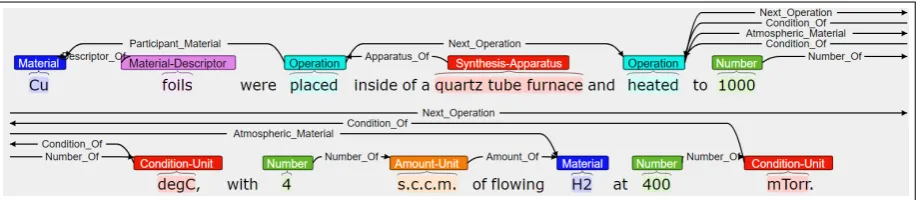
Figure 2: An example annotated sentence. Shallow semantic structures generally consist of verbal predicates and arguments of these predicates as nodes and labeled edges between predicate and argument nodes, example. Heated(Condition of: degC,Atmospheric Material: H2,Condition of: mTorr). We also label relations between argument entities and non-predicate entities, for example. Descriptor of(Cu, foils) and relations between predi-cates, for example.Next Operation(placed, heated).
machine learning models for automatic extraction of materials syntheses from text, in this work we present a new dataset of synthesis procedures anno-tated with semantic structure by domain experts in materials science. We annotate each step in a syn-thesis with a structured frame-semantic representa-tion, with all the steps in a synthesis making up a Directed Acyclic Graph (DAG). The types of nodes in the graph include synthesis operations (i.e. predi-cates), and the materials, conditions, apparatus and other entities participating in each synthesis step. Labeled edges represent relationships between en-tities, for exampleCondition oforNext Operation. Our dataset consists of 230 synthesis procedures annotated with these structures. An example sen-tence level annotation is given in Fig.2. We make the corpus available to the community to promote further research and development of scientific in-formation extraction systems for procedural text.1
2 Description of the Annotated Dataset
Here we describe the manner in which synthe-sis procedures were chosen for annotation (§2.1), present a description of the structures we an-notate (§2.2), summarize key statistics of the dataset (§2.3), highlight specific annotation deci-sions (§2.4) and present inter-annotator agreements (§2.5). All annotations were performed by three materials scientists using the BRAT2 annotation tool (Stenetorp et al.,2012).
2.1 Selecting Synthesis Procedures for Annotation
The 230 synthesis procedures annotated were se-lected from our database of 2.5 million publications
1
Public dataset:https://bit.ly/2WLCbyh
2http://brat.nlplab.org/
describing materials synthesis. The database was built from agreements with major scientific publi-cation companies. Synthesis procedure text were obtained by first parsing the HTML text of the full publications, then automatically identifying candi-date synthesis paragraphs using a trained classifier. This paragraph classifier was trained on a set of manually labeled paragraph examples and has a F1 score of 90.2 on a held out test set.3 The paragraphs selected by the classifier were manually verified as containing complete, valid materials synthesis procedures by domain experts. While a given syn-thesis procedure is most often a single paragraph, there are cases where it spans multiple paragraphs, we consider all the paragraphs to be a single syn-thesis procedure. All the semantic structures were then manually annotated in these selected synthesis procedures. Fig1depicts an example paragraph containing a synthesis procedure. In selecting a synthesis procedure for annotation, a small number of valid synthesis procedures (∼20%) are ignored; this is done for the synthesis procedures which are not amenable to annotation from a sentence-level frame-semantic view of synthesis steps, or ones in which most entities in the synthesis do not agree with our definitions of operations and argument entities (see §2.4for further discussion).
2.2 Structures Annotated
An annotated graph consists of nodes denoting the participants of synthesis steps and edges denoting relationships between the participants in the syn-thesis. Operation nodes define the main structure of the graph and the arguments for each operation include different materials, conditions and
appara-3The labeled data for this classifier is
Entity type Count
Material 4843
Number 4095
Operation 3786
Amount-Unit 1659
Condition-Unit 1621 Material-Descriptor 1430
Condition-Misc 535
Synthesis-Apparatus 490 Nonrecipe-Material 475
Brand 348
(a)
Recipe-target,Solvent-material,
Operation-argument Atmospheric-material,Recipe-precursor, relations Participant-material,Apparatus-of
Condition-of
Non-operation entity Descriptor-of,Number-of,Amount-of, relations Apparatus-attr-of,Brand-of,Coref-of, Operation-Operation
Next-operation relations
[image:3.595.100.509.73.207.2](b)
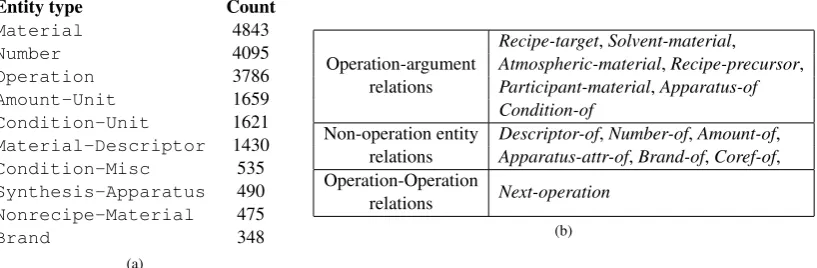
Table 1: Entity types and relation labels annotated in our dataset. The table (a) depicts the 10 most frequent of the 21 entity types defined in our dataset, and the table (b) highlights the 14 relation labels among entities possible in our dataset.
tus. For annotating the text describing a synthesis procedure, we define a set of span-level labels that identify the operations and typed arguments in the text, i.e. the nodes of the graph. We also define a set of relationships between text spans, which label the edges of the synthesis graph. We detail these two kinds of labels next.
Span-level Labels: Each span is a sequence of tokens or characters which form one entity men-tion (for example. “quartz tube furnace”). Entity mentions are associated withentity types which specify a category/kind for the entity mention. Our dataset defines a total of 21 entity types, with the least frequent entity type occuring 32 times. The 10 most frequent entity types defined for our dataset are listed in Table1a. We describe a notable subset of the entity types in more detail below alongside examples of their occurrence in text. In examples, the text underlined is the span to be annotated.
Material: Materials that are used in the syn-thesis of the target. For example: Cr2O3, Strontium carbonate, BaTiO3, Li2CO3, Water, Ethanol.
Nonrecipe-Material: Chemically specified materials that are not used in the synthesis of the synthesis target. For example: “BaTiO3 powder (Ba/Ti=0.999)”, “Li2CO3was used as the Li source”, “Si/Al ratio was 5”.
Operation: Discrete actions physically per-formed by the researcher or discrete process steps taken to synthesize the target.
Material-Descriptor: Describes a mate-rial’s structure, shape, form, type, role, etc. and must be directly or nearly adjacent to the material it describes. Does not include
amounts, concentrations, or purities of mate-rials. For example: CaCu3Ti4O12compound, Copper ion, GaAs nanowires, Anatase TiO2, Deionized water.
Meta: A canonical name to specify a par-ticular overall synthesis method used for synthesis. For example: “Graphite oxide was prepared by oxidation of graphite powder according to the modified Hummers’ method”. “Bi2S3 nanorods with orthorhombic structure were prepared through the hydrothermal method”. “Graphene oxide (GO) was prepared from graphite powder by the Staudenmaier method.”
Amount-Unit: These describe absolute amounts, concentrations, purities, ratios, flow rates and so on. For example: mg, mL, M, %.
Condition-Unit: These describe the units of measurement for intangible conditions under which operations are performed. For ex: °C, K, sec, RPM, mW.
Condition-Misc: Qualitative descriptions of conditions. For example: Room temperature, Dropwise, Naturally, Vacuum.
Synthesis-Apparatus: Equipment used to perform an operation involved in the synthe-sis.
Characterization-Apparatus: Equip-ment used to characterize a materials prop-erties.
re-0
Number of sentences in synthesis procedure. 0
10
Sentence count
20 40 60 80
20 30 40 50 60
(a) Sentences per synthesis document.
0
Number of tokens in sentence.
0 50
Sentence count
20 40 60 80 100 120 140 100
150 200 250
[image:4.595.112.511.74.238.2](b) Tokens per sentence.
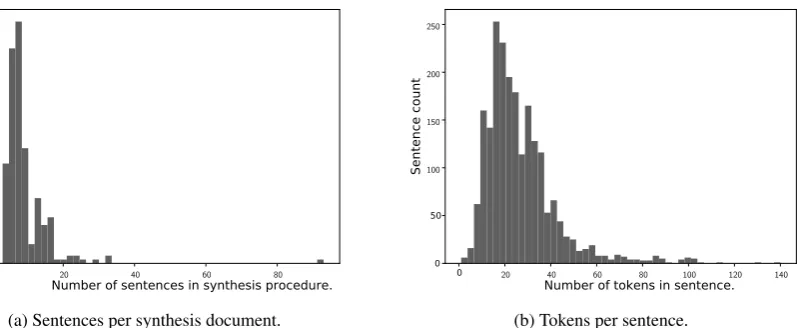
Figure 3: Sentences count statistics of the corpus; On average a synthesis procedure contains 9 sentences, each of which contain 26 tokens on average.
lationships between argument mentions, and the
Next-Operationrelation describes relationships be-tween operations so as to step towards annotating full recipe graphs. The different relation labels we define are tabulated in Table1b, a subset of these are defined below:
Recipe-target: Indicates a material assigned to an operation which is the target of the synthesis procedure.
Participant-material: A material that is part of a particular synthesis step.
Recipe-precursor: Indicates a material which is the source of an element for the target material used in a specific synthesis operation.
Apparatus-of: Denotes an apparatus to be used in a synthesis operation.
Condition-of: Denotes a reaction condition for a synthesis operation.
Coref-of: Intended to capture coreferent mentions of entities presented by abbreviations, text in parenthesis and so on. For example: “Air (O2/N2 mixture gases)” and “He were sup-plied to the porous support side . . . ”. “Air” is coreferent with O2and N2.
Amount-of: Links a number entity to the corre-sponding unit of measurement.
Next-operation: A relation intended to denote the true synthesis order of the synthesis steps; the relation is also intended to implicitly denote the flow of intermediate materials in the syn-thesis. However, in this first release of the data, as a placeholder for future annotations,
Next-Operation is used simply used to indi-cate the next operation in text order rather than
in true synthesis order.
We refer readers to our annotation guidelines for definitions of the complete set of entity type and relation labels in the dataset.
2.3 Dataset Statistics
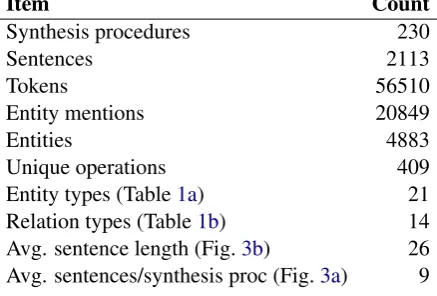
Some key statistics of the dataset such as number of documents, tokens, entities and unique opera-tions are listed in Table2and Fig.3. In reporting these statistics we perform tokenization and sen-tence segmentation using the ChemDataExtractor package (Swain and Cole,2016).4
2.4 Annotation Decisions
Next we highlight specific points of contention in creating the current set of annotations.
What constitutes an operation?: While our definition of the Operation entity type speci-fies only actions performed by a lab researcher to be valid operations, there are cases where our anno-tations diverge from this definition. This happens in the following cases:
• Cases where an operation isn’t explicitly per-formed by the researcher. For example: “After this, the autoclave wascooledto room tem-perature naturally”.
• Cases with nested verb structures. For example: “white precipitate which was
harvestedbycentrifugation. . . ”.
In the current set of annotations, we allow experts to decide when a particular candidate operation
4https://pypi.org/project/
Item Count
Synthesis procedures 230
Sentences 2113
Tokens 56510
Entity mentions 20849
Entities 4883
Unique operations 409
[image:5.595.75.294.67.215.2]Entity types (Table1a) 21 Relation types (Table1b) 14 Avg. sentence length (Fig.3b) 26 Avg. sentences/synthesis proc (Fig.3a) 9
Table 2: Various dataset statistics. Additional details provided in referred figures. To determine unique op-erations,Operationentity mentions are lemmatized with the WordNet lemmatizer and the unique lemmas are counted.
should be considered valid and when it can be omitted. As our inter-annotator agreements will demonstrate, experts tend to agree often on what should be considered an operation. The question of what constitutes an operation is analogous to the notion of what constitutes an “event” in the broader NLP literature as highlighted byMostafazadeh et al.
(2016).
Argument state and argument re-use: Anno-tation of semantic structures often allow for ar-gument spans to have multiple parents (Surdeanu et al.,2008;Banarescu et al.,2013;Oepen et al.,
2015). For example in Figure2, the material “Cu” could be considered an argument of the operations “placed” and “heated”. Allowing for arguments to have multiple parents however runs into com-plications when the operation causes the state of a material to change (incidentally, this is not the case in the example we highlight above). When a materials state changes due to a specific operation, considering the same text span to be the argument of a different operation would not be chemically valid. For example, in the sentence:
After that, the mixed solution was aged at 60 degC for 48 h, followed by heating at 900 degC for 2 h with a heating rate of 5 degC min-1 in an N2 atmosphere.
“solution” is labeled as Participant-material for “aged”, but it isnt considered aParticipant-material
to “heating” since aging caused it to be a different material. Similarly, in:
1.6632 g lithium acetate was dissolved into 26 mL of ethanol-water mixture
(12:1 in volume) and slowly dropped into the above suspension.
“lithium acetate” is only labeled as Participant-material for “dissolved” and not for “dropped” whose sole argument is “suspension”. This clearly highlights an instance of a material entirely absent from the text being the true argument of an op-eration. Therefore the current set of annotations does not allow for arguments to have multiple par-ents. Further, the tracking of state itself is also complicated by the difficulty in being able to write down precise states at a meaningful level of gran-ularity for all possible materials, this is further complicated by the ambiguity presented by under-specified materials in synthesis text, for example in the sentence:
With the indraught of ozone, black solid appeared gradually and the clear solution turned into black slurry finally.
Most of the entities, “black solid”, “clear solution” and “black slurry” are chemically under-specified, with precise specification even unnecessary for de-scribing the synthesis procedure.
Relations across sentences: Often, in synthe-sis procedures, a given synthesynthe-sis step is described across multiple sentences. In these cases it would be meaningful to allow for relationships between operation-argument entities which are in different sentences. For the sake of simplicity and to stick more closely to a sentence level shallow semantic annotation, our current iteration of the annotations has avoided this annotation, however a very small number of instances of cross-sentence relations do exist (<1%of all relations in the dataset). Exam-ples of this type are as follows:
First, sulfuric acid and nitric acid were mixed well by stirring 15 min in an ice bath, and then graphite powder was dispersed into the solution. After 15 min, potassium chlorate was added into the system - very slowly to prevent strong reaction during the oxidation process.
Oxygen with 20 sccm flow rate and argon with 40 sccm flow rate were used as the sputtering gas. Growth temperature was 400 degC and the RF power was 90 W.
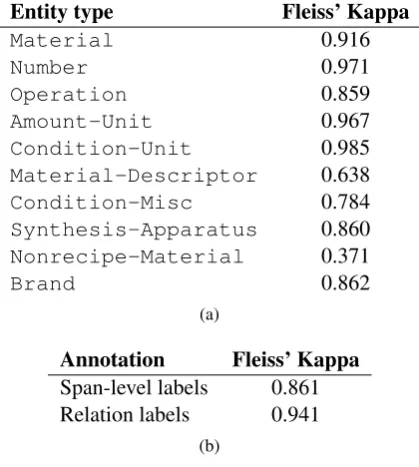
Entity type Fleiss’ Kappa
Material 0.916
Number 0.971
Operation 0.859
Amount-Unit 0.967
Condition-Unit 0.985
Material-Descriptor 0.638
Condition-Misc 0.784
Synthesis-Apparatus 0.860
Nonrecipe-Material 0.371
Brand 0.862
(a)
Annotation Fleiss’ Kappa Span-level labels 0.861 Relation labels 0.941
[image:6.595.76.286.63.297.2](b)
Table 3: Annotator agreements in our dataset. The table (a) depicts the percent agreements on 10 most frequent of the 21 entity types defined in our dataset, and the table (b) denotes overall agreements on the different annotations in our dataset.
both are annotated withCondition Of relations to “used”. Annotations of this kind were created when annotators deemed such an annotation absolutely necessary. Synthesis procedures which required an-notation primarily of cross-sentence relations were ignored.
2.5 Inter-annotator Agreement
Next we report a host of inter-annotator agreements for the different levels of semantic annotation in our dataset. The agreements we report are based on a collection of 5 synthesis procedures which were annotated separately by all three expert annotators. All the numbers we report are Fleiss’ Kappa scores for the 3 expert annotators.
Span-level Labels: Agreements on span level labels correspond to the agreement on entity type labels assigned to individual tokens. We ob-serve the overall agreement on the token level labels to be 0.861. A break down of this agree-ment by the entity type is presented in Table
3a. As this indicates, there seems to be high agreement on labels which have clear defini-tions; namely. Number, Amount-Unit. La-bels which by definition are a lot more ambigu-ous, however, have a lower agreement. The two entity typesMaterial-Descriptorand
Nonrecipe-Material see the lowest
agree-ments. We believe these to be inherently more subjective entity types. In the case of
Material-Descriptorit is often that some annotators may consider the descriptor and the ad-jacent material to beMaterialin its own right, for example: “Deionized Water” may be consid-ered as a material in its own right or ”deionized” may be considered to be a descriptor. In the case of Nonrecipe-Material, a similarly harder decision needs to be made by the annotator, since these are materials which aren’t involved in the synthesis but are still mentioned in the text for completeness information. Often it is up to the interpretation of the annotator to decide whether a material is indeed involved in the synthesis leading to the low agreement on this entity type.
Relation Labels:Agreement on relation labels were computed for the set of cases where a pair of annotators agreed on the token level annotations, this happens 66% of the time in our repeated an-notations. For a pair of entities, if both annotators indicate the same relation type the annotators are considered to be in agreement. For relation labels we observe a agreement score of 0.941. Since we only consider cases where the token labels are in agreement, we believe that it is likely that when an-notators agree on the token level annotations they also tend to agree on the relation level labels.
3 Related Work
proto-col text, with semantic structures and to facilitate training supervised models for the extraction of these structures (Kulkarni et al.,2018). Kulkarni et al. make use of an altered version of the EXACT2 ontology, created for the annotation of biomedi-cal procedural text (Soldatova et al.,2014). The dataset presented here can be viewed to fit within the theme of sentence level semantics for procedu-ral text, specifically tailored to materials science synthesis.
Materials Science & Chemistry: Prior work in the materials science community have shown that manual extraction and subsequent text mining can be an effective approach to analysis of synthe-sis routes for specific compounds and classes of materials (Raccuglia et al.,2016;Ghadbeigi et al.,
2015); these approaches however have been lim-ited by scale due to the manual extraction step. There has also been strong a consensus that com-prehensively extracting the knowledge contained within written inorganic materials syntheses is a key step towards reducing the overall discovery and development time for novel materials (Butler et al.,
2018). We believe that the dataset we release fills an important gap in the existing work on extraction of inorganic materials synthesis procedures, by al-lowing exploration into extraction at a scale not attempted before. Parallel with this work, work by
Kim et al.(2018) andTamari et al.(2019) adopt the dataset released here to aid extraction of structured representations from synthesis procedures and with Kim et al. presenting early experiments in synthesis planning from extracted synthesis.
The focus of existing datasets and resources in the materials science community, has been on ma-terials structures and properties knowledge bases (Jain et al.,2013), rather than reactions and synthe-sis. In pursuit of more scalable methods for mate-rials synthesis data extraction,Young et al.(2018) have made use of automated methods for extracting specific categories of materials synthesis parame-ters, while Mysore et al. (2017) and Kim et al.
(2017a) have both presented preliminary method-ological explorations for automated extraction of elements of a synthesis graph from materials sci-ence literature. However, these lines of work have not presented general purpose annotated data with which to train information extraction models for extraction of structured synthesis representations at scale, the focus of this work.
4 Conclusion and Future Directions
In this work we present a shallow semantic parsing dataset consisting of 230 synthesis procedures. The dataset was annotated by domain experts in materi-als science. We materi-also highlight specific difficulties in the annotation process and present agreement metrics on the different levels of our annotation. We believe the dataset will enable the development of robust supervised entity tagging models and is suitable for evaluating models trained to extract shallow semantic structures. This is evidenced by the adoption of the dataset by work contemporane-ous with this work (Kim et al.,2018;Tamari et al.,
2019).
Future work in the development of this dataset could involve methods for the scaling up of the annotation process, perhaps by adapting the guide-lines to enable annotation by non-experts at some stages of the annotation process. Further, we also plan to quantitatively establish the limits of our annotation schema for the kinds of information it isn’t able to capture. We also plan to add additional layers of annotation, including: co-reference rela-tions between synthesis steps, states of argument entities, and linking annotated entities to entries in materials science knowledge bases such as The Materials Project.5
5 Acknowledgements
The authors would like to acknowledge fund-ing from the National Science Foundation Award 1534340/1534341 DMREF and support from the Office of Naval Research (ONR) under Contract No. N00014-16-1-2432. Early work was collab-orative under the Dept. of Energys Basic Energy Science Program through the Materials Project un-der Grant No. EDCBEE.
References
Omri Abend and Ari Rappoport. 2017. The state of the art in semantic representation. InACL.
Laura Banarescu, Claire Bonial, Shu Cai, Madalina Georgescu, Kira Griffitt, Ulf Hermjakob, Kevin Knight, Philipp Koehn, Martha Palmer, and Nathan Schneider. 2013. Abstract meaning representation for sembanking. InProceedings of the 7th Linguis-tic Annotation Workshop and Interoperability with Discourse.
Keith T Butler, Daniel W Davies, Hugh Cartwright, Olexandr Isayev, and Aron Walsh. 2018. Machine learning for molecular and materials science. Na-ture.
Connor W Coley, Regina Barzilay, Tommi S Jaakkola, William H Green, and Klavs F Jensen. 2017. Pre-diction of organic reaction outcomes using machine learning.ACS central science.
George R Doddington, Alexis Mitchell, Mark A Przy-bocki, Lance A Ramshaw, Stephanie Strassel, and Ralph M Weischedel. 2004. The automatic content extraction (ace) program-tasks, data, and evaluation. InLREC.
Yuming Dong, Hongxiao Yang, Kun He, Shaoqing Song, and Aimin Zhang. 2009. β-mno 2 nanowires: a novel ozonation catalyst for water treatment. Ap-plied Catalysis B: Environmental.
Charles J Fillmore and Collin Baker. 2010. A frames approach to semantic analysis. InThe Oxford hand-book of linguistic analysis.
Sahil Garg, Aram Galstyan, Ulf Hermjakob, and Daniel Marcu. 2016. Extracting biomolecular inter-actions using semantic parsing of biomedical text. In Thirtieth AAAI Conference on Artificial Intelli-gence.
Leila Ghadbeigi, Jaye K Harada, Bethany R Lettiere, and Taylor D Sparks. 2015. Performance and re-source considerations of li-ion battery electrode ma-terials. Energy & Environmental Science.
Anubhav Jain, Shyue Ping Ong, Geoffroy Hautier, Wei Chen, William Davidson Richards, Stephen Dacek, Shreyas Cholia, Dan Gunter, David Skinner, Ger-brand Ceder, et al. 2013. Commentary: The mate-rials project: A matemate-rials genome approach to accel-erating materials innovation. Apl Materials.
Edward Kim, Kevin Huang, Adam Saunders, An-drew McCallum, Gerbrand Ceder, and Elsa Olivetti. 2017a. Materials synthesis insights from scientific literature via text extraction and machine learning. Chemistry of Materials.
Edward Kim, Kevin Huang, Alex Tomala, Sara Matthews, Emma Strubell, Adam Saunders, Andrew McCallum, and Elsa Olivetti. 2017b. Machine-learned and codified synthesis parameters of oxide materials.Scientific Data.
Edward Kim, Zach Jensen, Alexander van Grootel, Kevin Huang, Matthew Staib, Sheshera Mysore, Haw-Shiuan Chang, Emma Strubell, Andrew Mc-Callum, Stefanie Jegelka, et al. 2018. Inorganic ma-terials synthesis planning with literature-trained neu-ral networks. arXiv preprint arXiv:1901.00032.
J-D Kim, Tomoko Ohta, Yuka Tateisi, and Junichi Tsu-jii. 2003. Genia corpusa semantically annotated cor-pus for bio-textmining. Bioinformatics.
Chaitanya Kulkarni, Wei Xu, Alan Ritter, and Raghu Machiraju. 2018. An annotated corpus for machine reading of instructions in wet lab protocols. NAACL.
Alexander J Lawson, J¨urgen Swienty-Busch, Thibault G´eoui, and David Evans. 2014. The making of reaxystowards unobstructed access to relevant chem-istry information. InThe Future of the History of Chemical Information.
Shinsuke Mori, Hirokuni Maeta, Yoko Yamakata, and Tetsuro Sasada. 2014. Flow graph corpus from recipe texts. InLREC, pages 2370–2377.
Nasrin Mostafazadeh, Alyson Grealish, Nathanael Chambers, James Allen, and Lucy Vanderwende. 2016. Caters: Causal and temporal relation scheme for semantic annotation of event structures. In Pro-ceedings of the Fourth Workshop on Events, pages 51–61.
Peter Murray-Rust and Henry S Rzepa. 1999. Chem-ical markup, xml, and the worldwide web. 1. basic principles. Journal of Chemical Information and Computer Sciences.
Sheshera Mysore, Edward Kim, Emma Strubell, Ao Liu, Haw-Shiuan Chang, Srikrishna Kompella, Kevin Huang, Andrew McCallum, and Elsa Olivetti. 2017. Automatically extracting action graphs from materials science synthesis procedures. Workshop on Machine Learning for Molecules and Materials at NIPS.
Stephan Oepen, Marco Kuhlmann, Yusuke Miyao, Daniel Zeman, Silvie Cinkov´a, Dan Flickinger, Jan Hajic, and Zdenka Ureˇsov´a. 2015. Semeval 2015 task 18: Broad-coverage semantic dependency pars-ing.SemEval-2015, page 915.
Martha Palmer, Paul Kingsbury, and Daniel Gildea. 2005. The Proposition Bank: An Annotated Corpus of Semantic Roles. Computational Linguistics.
Paul Raccuglia, Katherine C Elbert, Philip DF Adler, Casey Falk, Malia B Wenny, Aurelio Mollo, Matthias Zeller, Sorelle A Friedler, Joshua Schrier, and Alexander J Norquist. 2016. Machine-learning-assisted materials discovery using failed experi-ments. Nature.
Marwin HS Segler, Mike Preuss, and Mark P Waller. 2018. Planning chemical syntheses with deep neural networks and symbolic ai.Nature.
Larisa N Soldatova, Daniel Nadis, Ross D King, Piyali S Basu, Emma Haddi, V´eronique Bauml´e, Nigel J Saunders, Wolfgang Marwan, and Brian B Rudkin. 2014. Exact2: the semantics of biomedical protocols. BMC bioinformatics.
Mihai Surdeanu, Richard Johansson, Adam Meyers, Llu´ıs M`arquez, and Joakim Nivre. 2008. The conll-2008 shared task on joint parsing of syntactic and se-mantic dependencies. InProceedings of the Twelfth Conference on Computational Natural Language Learning, pages 159–177. Association for Compu-tational Linguistics.
Matthew C Swain and Jacqueline M Cole. 2016. Chem-dataextractor: a toolkit for automated extraction of chemical information from the scientific litera-ture. Journal of chemical information and modeling, 56(10):1894–1904.
Ronen Tamari, Hiroyuki Shindo, Dafna Shahaf, and Yuji Matsumoto. 2019. Playing by the book: An in-teractive game approach for action graph extraction from text. In Workshop on Extracting Structured Knowledge from Scientific Publications at NAACL 2019.