A Context-Aware Topic Model for Statistical Machine Translation
Jinsong Su1, Deyi Xiong2∗, Yang Liu3, Xianpei Han4, Hongyu Lin1,Junfeng Yao1,Min Zhang2
Xiamen University, Xiamen, China1
Soochow University, Suzhou, China2
Tsinghua University, Beijing, China3
Institute of Software, Chinese Academy of Sciences, Beijing, China4 {jssu, hylin, yao0010}@xmu.edu.cn
{dyxiong, minzhang}@suda.edu.cn [email protected]
Abstract
Lexical selection is crucial for statistical ma-chine translation. Previous studies separately exploit sentence-level contexts and document-level topics for lexical selection, neglecting their correlations. In this paper, we propose a context-aware topic model for lexical selec-tion, which not only models local contexts and global topics but also captures their correla-tions. The model uses target-side translations as hidden variables to connect document top-ics and source-side local contextual words. In order to learn hidden variables and distribu-tions from data, we introduce a Gibbs sam-pling algorithm for statistical estimation and inference. A new translation probability based on distributions learned by the model is inte-grated into a translation system for lexical se-lection. Experiment results on NIST Chinese-English test sets demonstrate that 1) our model significantly outperforms previous lexical se-lection methods and 2) modeling correlations between local words and global topics can fur-ther improve translation quality.
1 Introduction
Lexical selection is a very important task in statis-tical machine translation (SMT). Given a sentence in the source language, lexical selection statistically predicts translations for source words, based on vari-ous translation knowledge. Most conventional SMT systems (Koehn et al., 2003; Galley et al., 2006; Chiang, 2007) exploit very limited context informa-tion contained in bilingual rules for lexical selecinforma-tion.
∗Corresponding author.
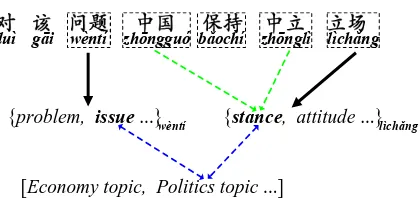
{stance, attitude ...}lìchǎng duì gāi wèntí zhōngguó bǎochí zhōnglì lìchǎng
[image:1.595.315.525.275.374.2][Economy topic, Politics topic ...] {problem, issue ...}wèntí
Figure 1: A Chinese-English translation example to il-lustrate the effect of local contexts and global topics as well as their correlations on lexical selection. Each black line indicates a set of translation candidates for a Chinese content word (within a dotted box). Green lines point to translations that are favored by local contexts while blue lines show bidirectional associations between global top-ics and their consistent target-side translations.
Previous studies that explore richer information for lexical selection can be divided into two categories: 1) incorporating sentence-level contexts (Chan et al., 2007; Carpuat and Wu, 2007; Hasan et al., 2008; Mauser et al., 2009; He et al., 2008; Shen et al., 2009) or 2) integrating document-level topics (Xi-ao et al., 2011; Ture et al., 2012; Xi(Xi-ao et al., 2012; Eidelman et al., 2012; Hewavitharana et al., 2013; Xiong et al., 2013; Hasler et al., 2014a; Hasler et al., 2014b) into SMT. The methods in these two strands have shown their effectiveness on lexical selection.
in-to “stance”, they will also indicate that the in-topic of the document where the example sentence oc-curs is aboutpolitics. The politicstopic can be fur-ther used to enable the decoder to select a correc-t correc-translacorrec-tion “issue” for anocorrec-ther source word “¯ K/w`entˇi”, which is consistent with this topic. On the other hand, if we know that this document main-ly focuses on the politics topic, the candiate trans-lation “stance” will be more compatible with the context of “á|/l`ıchˇang” than the candiate
transla-tion “attitude”. This is because neighboring source-side words “¥I/zh¯ongu´o” and “¥á/zh¯ongl`ı” of-ten occur in documents that are about international politics. We believe that such correlations between local contextual words and global topics can be used to further improve lexical selection.
In this paper, we propose a unified framework to jointly model local contexts, global topics as well as their correlations for lexical selection. Specifically,
• First, we present a context-aware topic mod-el (CATM) to exploit the features mentioned above for lexical selection in SMT. To the best of our knowledge, this is the first work to joint-ly model both local and global contexts for lex-ical selection in a topic model.
• Second, we present a Gibbs sampling algorith-m to learn various distributions that are related to topics and translations from data. The trans-lation probabilities derived from our model are integrated into SMT to allow collective lexical selection with both local and global informtion.
We validate the effectiveness of our model on a state-of-the-art phrase-based translation system. Ex-periment results on the NIST Chinese-English trans-lation task show that our model significantly outper-forms previous lexical selection methods.
2 Context-Aware Topic Model
In this section, we describe basic assumptions and elaborate the proposed context-aware topic model.
2.1 Basic Assumptions
In CATM, we assume that each source documentd consists of two types of words: topical wordswhich are related to topics of the document andcontextual
words which affect translation selections of topical words.
As topics of a document are usually represented by content words in it, we choose source-sidenouns, verbs,adjectivesandadverbsas topical words. For contextual words, we use all words in a source sen-tence as contextual words. We assume that they are generated by target-side translations of other words than themselves. Note that a source word may be both topical and contextual. For each topical word, we identify its candidate translations from training corpus according to word alignments between the source and target language. We allow a target trans-lation to be a phrase of length no more than 3 words. We refer to these translations of source topical word-s aword-s target-side topical items, which can be either words or phrases. In the example shown in Figure 1, all source words within dotted boxes are topical words. Topical word “á|/l`ıchˇang” is supposed to
be translated into a target-side topical item “stance”, which is collectively suggested by neighboring con-textual words “ ¥I/zh¯onggu´o”, “¥á/zh¯ongl`ı” and the topic of the corresponding document.
In our model, all target-side topical items in a doc-ument are generated according to the following two assumptions:
• Topic consistency assumption: All target-side topical items in a document should be consis-tent with the topic distribution of the document. For example, the translations “issue”, “stance” tend to occur in documents aboutpoliticstopic. • Context compatibility assumption: For a top-ical word, its translation (i.e., the counter-part target-side topical item) should be com-patible with its neighboring contextual word-s. For instance, the translation “stance” of “á|/l`ıchˇang” is closely related to
contextu-al words “¥I/zh¯ongu´o” and “¥á/zh¯ongl`ı”. 2.2 Model
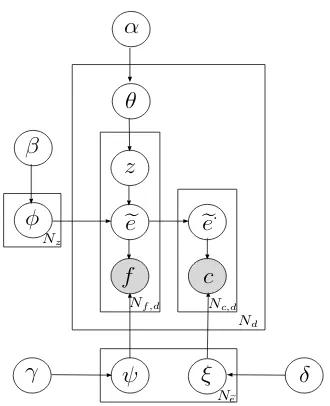
The graphical representation of CATM, which visu-alizes the generative process of training data D, is shown in Figure 2. Notations of CATM are present-ed in Table 1. In CATM, each document dcan be generated in the following three steps1:
re-Symbol Meaning
α hyperparameter forθ β hyperparameter forφ γ hyperparameter forψ δ hyperparameter forξ
f topical word c contextual word ˜
e target-side topical item ˜
e0 a sampled target-side topical item used to
generate a source-side contextual word
θ the topic distribution of document
φ the distribution of a topic over target-sidetopical items ψ the translation probability distribution of atarget-side topical item over source-side topical
words
ξ the generation probability distribution of atarget-side topical item over source-side contextual words
Nz topic number Nd document number
[image:3.595.336.501.93.296.2]Nf the number of topical words Nc the number of contextual words N˜e the number of target-side topical items Nf,d the number of topical words ind Nc,d the number of contextual words ind
Table 1: Notations in CATM.
1. Sample a topic distributionθd∼Dir(α).
2. For each positionithat corresponds to a topical wordfiin the document:
(a) Sample a topiczi∼Mult(θd).
(b) Conditioned on the topic zi, sample a target-side topical item˜ei∼Mult(φzi). (c) Conditioned on the target-side
topi-cal item e˜i, sample the topical word fi∼Mult(ψ˜ei).
3. For each positionjthat corresponds to a contex-tual wordcj in the document:
(a) Collect all target-side topical items˜es that are translations of neighboring topical words within a window centered at cj (window sizews).
(b) Randomly sample an item from ˜es, ˜
e0
j∼Unif(˜es).
(c) Conditioned on the sampled target-side topical item e˜0
j, sample the contextual wordcj∼Mult(ξ˜e0
j).
To better illustrate CATM, let us revisit the example in Figure 1. We describe how CATM generates
top-spectively.
Nd Nc,d Nf,d
Nee
α
θ
z
e
e ee′
f c
ψ
γ ξ δ
Nz
β
ϕ
Figure 2: Graphical representation of our model.
ical words “¯K/w`ent´ı”, “á|/l`ıchˇang”, and
con-textual word “¥á/zh¯ongl`ı” in the following steps: Step 1: The model generates a topic dis-tribution for the corresponding document as {economy0.25, politics0.75}.
Step 2: Based on the topic distribution, we choose “economy” and “politics” as topic assign-ments for “¯K/w`ent´ı” and “á|/l`ıchˇang”
respec-tively; Then, according to the distributions of the t-wo topics over target-side topical items, we generate target-side topical items “issue” and “stance”; Final-ly, according to the translation probability distribu-tions of these two topical items over source-side top-ical words, we generate source-side toptop-ical words “¯K/w`ent´ı” and “á|/l`ıchˇang” for them
respec-tively.
Step 3: For the contextual word “¥á/zh¯ongl`ı”, we first collect target-side topical items of its neigh-boring topical words such as “¯K/w`ent´ı”, “ ±/bˇaoch´ı” and “á|/l`ıchˇang” to form a
target-side topical item set {“issue”,“keep”, “stance”}, from which we randomly sample one item “stance”. Next, according to the generation probability dis-tribution of “stance” over source contextual words, we finally generate the source contextual word “¥
á/zh¯ongl`ı”.
Ad-ditionally, each source contextual word is derived from a target-side topical item given its generation probability distribution. This makes selected target translations also compatible with source-side local contextual words. In this way, global topics, topical words, local contextual words and target-side topi-cal items are highly correlated in CATM that exactly captures such correlations for lexical selection.
3 Parameter Estimation and Inference
We propose a Gibbs sampling algorithm to learn var-ious distributions described in the prevvar-ious section. Details of the learning and inference process are p-resented in this section.
3.1 The Probability of Training Corpus
According to CATM, the total probability of train-ing dataD given hyperparametersα, β, γ andδ is computed as follows:
P(D;α, β, γ, δ) =Q
d P(fd,cd;α, β, γ, δ) =Q
d P
˜ed
P(˜ed|α, β)P(fd|˜ed, γ)P(cd|˜ed, δ)
=RφP(φ|β)RψP(ψ|γ)Q d
P
˜
ed
P(fd|˜ed, ψ)
×RξP(ξ|δ)P
˜
e0 d
P(˜e0
d|˜ed)p(cd|˜e0d, ξ)
×RθP(θ|α)P(˜ed|θ, φ)dθdξdψdφ (1) wherefdand˜eddenote the sets of topical words and their target-side topical item assignments in docu-ment d, cd and˜e0d are the sets of contextual word-s and their target-word-side topical item aword-sword-signmentword-s in documentd.
3.2 Parameter Estimation via Gibbs Sampling
The joint distribution in Eq. (1) is intractable to compute because of coupled hyperparameters and hidden variables. Following Han et al, (2012), we adapt the well-known Gibbs sampling algorith-m (Griffiths and Steyvers, 2004) to our algorith-model. We compute the joint posterior distribution of hidden variables, denoted byP(z,˜e,˜e0|D), and then use this distribution to 1) estimateθ,φ,ψandξ, and 2) pre-dict translations and topics of all documents inD.
Specifically, we derive the joint posterior distribu-tion from Eq. (1) as:
P(z,˜e,˜e0|D)∝P(z)P(˜e|z)P(f|˜e)P(˜e0|˜e)P(c|˜e0) (2)
Based on the equation above, we construct a Markov chain that converges toP(z,˜e,˜e0|D), where each s-tate is an assignment of a hidden variable (includ-ing topic assignment to a topical word, target-side topical item assignment to a source topical or con-textual word.). Then, we sequentially sample each assignment according to the following three condi-tional assignment distributions:
1. P(zi = z|z−i,˜e,˜e0,D): topic assignment dis-tribution of a topical word givenz−ithat denotes all topic assignments butzi,˜eand˜e0 that are target-side topical item assignments. It is updated as follows:
P(zi =z|z−i,˜e,˜e0,D)∝ CDZ
(−i)dz +α CDZ
(−i)d∗+Nzα
× C ZE˜
(−i)z˜e+β CZE˜
(−i)z∗+N˜eβ
(3)
where the topic assignment to a topical word is de-termined by the probability that this topic appears in document d(the 1st term) and the probability that the selected iteme˜occurs in this topic (the2nd ter-m).
2.P(˜ei = ˜e|z,˜e−i,˜e0,D): target-side topical item assignment distribution of a source topical word giv-en the currgiv-ent topic assignmgiv-ents z, the current item assignments of all other topical words˜e−i, and the current item assignments of contextual words˜e0. It is updated as follows:
P(˜ei = ˜e|z,˜e−i,˜e0,D)∝ CZE˜
(−i)z˜e+β CZE˜
(−i)z∗+Ne˜β
× C
˜
EF
(−i)˜ef +γ CEF˜
(−i)˜e∗+Nfγ
×(C WE˜
(−i)w˜e+ 1 CWE˜
(−i)w˜e
)CWE˜0
we˜ (4)
3. P(˜e0
i = ˜e|z,˜e,˜e0−i,D): target-side topical item assignment distribution for a contextual word given the current topic assignmentsz, the current item as-signments of topical words ˜e, and the current item assignments of all other contextual words˜e0−i. It is updated as follows:
P(˜e0i = ˜e|z,˜e,˜e0−i,D)∝ CWE˜
we˜
CWE˜ w∗
× C
˜
EC
(−i)˜ec+δ CEC˜
(−i)˜e∗+Ncδ
(5)
where the target-side topical item assignment used to generate a contextual word is determined by the probability of this item being assigned to generate contextual words within a surface window of size ws (the1st term) and the probability that contextu-al words occur in the context of this item (the 2nd term).
In all above formulas,CDZ
dz is the number of times that topic zhas been assigned for all topical words in documentd,CDZ
d∗ =
P
zCdzDZ is the topic number in document d, andCZE˜
ze˜ , CefEF˜˜ , CwW˜eE˜, CwWe˜E˜0 and
CEC˜
˜
ec have similar explanations. Based on the above marginal distributions, we iteratively update all as-signments of corpusDuntil the constructed Markov chain converges. Model parameters are estimated using these final assignments.
3.3 Inference on Unseen Documents
For a new document, we first predict its topics and target-side topical items using the incremental Gibb-s Gibb-sampling algorithm deGibb-scribed in (Kataria et al., 2011). In this algorithm, we iteratively update top-ic assignments and translation assignments of an unseen document following the same process de-scribed in Section 3.2, but with estimated model pa-rameters.
Once we obtain these assignments, we estimate lexical translation probabilities based on the sam-pled counts of target-side topical items. Formal-ly, for the position i in the document correspond-ing to the content word f, we collect the sampled count that translation e˜ generates f, denoted by Csam(˜e, f). This count can be normalized to form a new translation probability in the following way:
p(˜e|f) = CCsam(˜e, f) +k
sam+k·Ne,f˜ (6)
where Csam is the total number of samples during inference andN˜e,fis the number of candidate trans-lations off. Here we applyadd-ksmoothing to re-fine this translation probability, wherekis a tunable global smoothing constant. Under the framework of log-linear model (Och and Ney, 2002), we use this translation probability as a new feature to improve lexical selection in SMT.
4 Experiments
In order to examine the effectiveness of our mod-el, we carried out several groups of experiments on Chinese-to-English translation.
4.1 Setup
Our bilingual training corpus is from the FBIS pus and the Hansards part of LDC2004T07 cor-pus (1M parallel sentences,54.6Kdocuments, with 25.2M Chinese words and 29M English words). We first usedZPartoolkit2 and Stanford toolkit3 to preprocess (i.e., word segmenting, PoS tagging) the Chinese and English parts of training corpus, and then word-aligned them using GIZA++ (Och and Ney, 2003) with the option “grow-diag-final-and”. We chose the NIST evaluation set of MT05 as the development set, and the sets of MT06/MT08 as test sets. On average, these three sets contain17.2,13.9 and 14.1 content words per sentence, respectively. We trained a 5-gram language model on the Xinhua portion of Gigaword corpus using theSRILM Toolk-it (Stolcke, 2002).
Our baseline system is a state-of-the-art SMT sys-tem, which adapts bracketing transduction gram-mars (Wu, 1997) to phrasal translation and equip-s itequip-self with a maximum entropy baequip-sed reordering model (MEBTG) (Xiong et al., 2006). We used the toolkit4 developed by Zhang (2004) to train the re-ordering model with the following parameters: it-eration numberiter=200and Gaussian priorg=1.0. During decoding, we set the ttable-limit as20, the stack-size as 100. The translation quality is eval-uated by case-insensitive BLEU-4 (Papineni et al., 2002) metric. Finally, we conducted paired boot-strap sampling(Koehn, 2004) to test the significance in BLEU score differences.
2http://people.sutd.edu.sg/∼yue zhang/doc/index.html 3http://nlp.stanford.edu/software
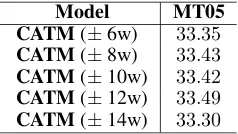
Model MT05 CATM(±6w) 33.35 CATM(±8w) 33.43 CATM(±10w) 33.42 CATM(±12w) 33.49 CATM(±14w) 33.30
Table 2: Experiment results on the development set using different window sizesws.
To train CATM, we set the topic number Nz as 25.5 For hyperparametersαandβ, we empirically set α=50/Nz andβ=0.1, as implemented in (Grif-fiths and Steyvers, 2004). Following Han et al. (2012), we setγ andδ as1.0/Nf and2000/Nc, re-spectively. During the training process, we ran400 iterations of the Gibbs sampling algorithm. For doc-uments to be translated, we first ran300rounds in a burn-instep to let the probability distributions con-verge, and then ran1500rounds where we collected independent samples every 5 rounds. The longest training time of CATM is less than four days on our server using 4GB RAM and one core of 3.2GHz CPU. As for the smoothing constant k in Eq. (6), we set its values to0.5according to the performance on the development set in additional experiments.
4.2 Impact of Window Sizews
Our first group of experiments were conducted on the development set to investigate the impact of the window sizews. We gradually varied window size from6to14with an increment of2.
Experiment results are shown in Table 2. We achieve the best performance when ws=12. This suggests that a ?12-word window context is suf-ficient for predicting target-side translations for am-biguous source-side topical words. We therefore set ws=12for all experiments thereafter.
4.3 Overall Performance
In the second group of experiments, in addition to the conventional MEBTG system, we also compared CATM with the following two models:
Word Sense Disambiguation Model (WSDM) (Chan et al., 2007). This model improves lexical s-election in SMT by exploiting local contexts. For
5We try different topic numbers from25to100with an in-crement of25each time. We find thatNz=25produces a slight-ly better performance than other values on the development set.
each content word, we construct a MaxEnt-based classifier incorporating local collocation and sur-rounding word features, which are also adopted by Chan et al. (2007). For each candidate translation ˜
e of topical word f, we use WSDM to estimate the context-specific translation probability P(˜e|f), which is used as a new feature in SMT system.
Topic-specific Lexicon Translation Model (TLTM) (Zhao and Xing, 2007). This model focuses on the utilization of document-level context. We adapted it to estimate a lexicon translation probability as follows:
p(f|˜e, d)∝p(˜e|f, d)·p(f|d) =P
z p(˜e|f, z)·p(f|z)·p(z|d) (7) where p(˜e|f, z) is the lexical translation probabil-ity conditioned on topic z, which can be calculat-ed according to the principle of maximal likelihood, p(f|z)is the generation probability of wordf from topicz, andp(z|d)denotes the posterior topic distri-bution of documentd.
Note that our CATM is proposed for lexical se-lection on content words. To show the strong effec-tiveness of our model, we also compared it against the full-fledged variants of the above-mentioned two models that are built for all source words. We refer to them asWSDM (All) andTLTM (All), respec-tively.
Table 3 displays BLEU scores of different lexical selection models. All models outperform the base-line. Although we only use CATM to predict trans-lations for content words, CATM achieves an aver-age BLEU score of26.77on the two test sets, which is higher than that of the baseline by 1.18 BLEU points. This improvement is statistically significant atp<0.01. Furthermore, we also find that our model performs better than WSDM and TLTM with signif-icant improvements. Finally, even if WSDM (All) and TLTM (all) are built for all source words, they are still no better than than CATM that selects de-sirable translations for content words. These exper-iment results strongly demonstrate the advantage of CATM over previous lexical selection models.
5 Analysis
contex-Model Local Context Global Topic MT06 MT08 Avg Baseline × × 29.66↓↓ 21.52↓↓ 25.59
WSDM √ × 30.62↓ 22.05↓↓ 26.34
WSDM (All) √ × 30.92 22.27 26.60
TLTM × √ 30.27↓↓ 21.70↓↓ 25.99
TLTM (All) × √ 30.33↓↓ 21.58↓↓ 25.96
[image:7.595.127.473.96.179.2]CATM √ √ 30.97 22.56 26.77
Table 3: Experiment results on the test sets. Avg= average BLEU scores.WSDM (All)andTLTM (All)are models built for all source words.↓: significantly worse than CATM (p<0.05),↓↓: significantly worse than CATM (p<0.01)
.
tual words or global topics, we take a deep look in-to in-topics, in-topical items and contextual words learned by CATM and empirically analyze the effect of mod-eling correlations between local contextual words and global topics on lexical selection.
5.1 Outputs of CATM
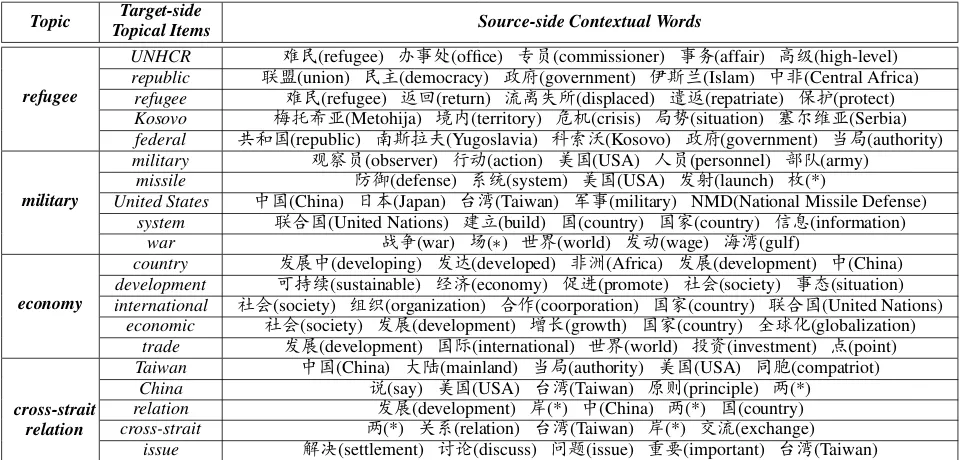
We present some examples of topics learned by CATM in Table 4. We also list five target-side topi-cal items with the highest probabilities for each top-ic, and the most probable five contextual words for each target-side topical item. These examples clear-ly show that target-side topical items tightclear-ly connect global topics and local contextual words by captur-ing their correlations.
5.2 Effect of Correlation Modeling
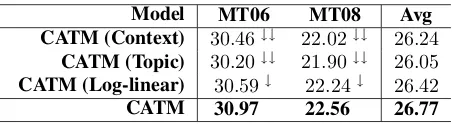
Compared to previous lexical selection models, CATM jointly models both local contextual words and global topics. Such a joint modeling also en-ables CATM to capture their inner correlations at the model level. In order to examine the effect of corre-lation modeling on lexical selection, we compared CATM with its three variants: CATM (Contex-t)that only uses local context information. We de-termined target-side topical items for content words in this variant by setting the probability distribution that a topic generates a target-side topical item to be uniform; CATM (Topic)that explores only glob-al topic information. We identified target-side topi-cal items for content words in the model by setting ws as 0, i.e., no local contextual words being used at all. CATM (Log-linear) is the combination of the above-mentioned two variants ( and ) in a log-linear manner, which does not capture corre-lations between local contextual words and global topics at the model level.
Model MT06 MT08 Avg CATM (Context) 30.46↓↓ 22.02↓↓ 26.24
CATM (Topic) 30.20↓↓ 21.90↓↓ 26.05
CATM (Log-linear) 30.59↓ 22.24↓ 26.42
CATM 30.97 22.56 26.77
Table 5: Experiment results on the test sets. CATM (Log-linear) is the combination of CATM (Context) and CATM (Topic) in a log-linear manner.
Results in Table 5 show that CATM performs sig-nificantlly better than both CATM (Topic) and CAT-M (Context). Even compared with CATCAT-M (Log-linear), CATM still achieves a significant improve-ment of0.35BLEU points (p<0.05). This validates the effectiveness of capturing correlations for lexical selection at the model level.
6 Related Work
Our work is partially inspired by (Han and Sun, 2012), where an entity-topic model is presented for entity linking. We successfully adapt this work to lexical selection in SMT. The related work mainly includes the following two strands.
[image:7.595.306.532.239.302.2]Topic Topical ItemsTarget-side Source-side Contextual Words
refugee
UNHCR J¬(refugee) •¯?(office) ; (commissioner) ¯Ö(affair) p?(high-level) republic é†(union) ¬Ì(democracy) ?(government) žd=(Islam) ¥š(Central Africa)
refugee J¬(refugee) ˆ£(return) 6l”¤(displaced) eˆ(repatriate) o(protect)
Kosovo r÷Fæ(Metohija) ¸S(territory) ˆÅ(crisis) Û³(situation) l ‘æ(Serbia)
federal ÚI(republic) Hd.Å(Yugoslavia) ‰¢»(Kosovo) ?(government) Û(authority)
military
military * (observer) 1Ä(action) {I(USA) < (personnel) Üè(army)
missile “”(defense) XÚ(system) {I(USA) u (launch) q(*)
United States ¥I(China) F (Japan) (Taiwan) ¯(military) NMD(National Missile Defense)
system éÜI(United Nations) ïá(build) I(country) I[(country) &E(information)
war Ô (war) |(∗) -.(world) uÄ(wage) ° (gulf)
economy
country uÐ¥(developing) uˆ(developed) š³(Africa) uÐ(development) ¥(China)
development Œ±Y(sustainable) ²L(economy) r?(promote) ¬(society) ¯ (situation)
international ¬(society) |„(organization) ÜŠ(coorporation) I[(country) éÜI(United Nations) economic ¬(society) uÐ(development) O•(growth) I[(country) ¥z(globalization)
trade uÐ(development) IS(international) -.(world) Ý](investment) :(point)
cross-strait relation
Taiwan ¥I(China) Œº(mainland) Û(authority) {I(USA) Óœ(compatriot) China `(say) {I(USA) (Taiwan) K(principle) ü(*)
relation uÐ(development) W(*) ¥(China) ü(*) I(country) cross-strait ü(*) 'X(relation) (Taiwan) W(*) 6(exchange)
[image:8.595.63.546.96.326.2]issue )û(settlement) ?Ø(discuss) ¯K(issue) -‡(important) (Taiwan) Table 4: Examples of topics, topical items and contextual words learned by CATM withNz=25 andWs=12. Chinese words that do not have direct English translations are denoted with ”*”. Here “q” and “|” are Chinese quantifiers
formissileandwar, respectively; “ü” and “W” together meanscross-starit.
the document-level translation consistency. Ture et al. (2012) soften this consistency constraint by in-tegrating three counting features into decoder. Also relevant is the work of Xiong et al.(2013), who use three different models to capture lexical cohesion for document-level SMT.
(2)SMT with Topic Models. In this strand, Zhao and Xing (2006, 2007) first present a bilingual top-ical admixture formalism for word alignment in SMT. Tam et al. (2007) and Ruiz et al. (2012) apply topic model into language model adaptation. Su et al. (2012) conduct translation model adaptation with monolingual topic information. Gong et al. (2010) and Xiao et al. (2012) introduce topic-based similar-ity models to improve SMT system. Axelrod et al. (2012) build topic-specific translation models from the TED corpus and select topic-relevant data from the UN corpus to improve coverage. Eidelman et al. (2012) incorporate topic-specific lexical weights in-to translation model. Hewavitharana et al. (2013) propose an incremental topic based translation mod-el adaptation approach that satisfies the causality constraint imposed by spoken conversations. Hasler et al. (2014) present a new bilingual variant of LDA to compute topic-adapted, probabilistic phrase trans-lation features. They also use a topic model to learn
latent distributional representations of different con-text levels of a phrase pair (Hasler et al., 2014b).
In the studies mentioned above, those by Zhao and Xing (2006), Zhao and Xing (2007), Hasler et al. (2014a), and Hasler et al. (2014b) are most relat-ed to our work. However, they all perform dynam-ic translation model adaptation with topdynam-ic models. Significantly different from them, we propose a new topic model that exploits both local contextual word-s and global topicword-s for lexical word-selection. To the beword-st of our knowledge, this is first attempt to capture cor-relations between local words and global topics for better lexical selection at the model level.
7 Conclusion and Future Work
This paper has presented a novel context-aware topic model for lexical selection in SMT. Jointly modeling local contexts, global topics and their correlations in a unified framework, our model provides an effec-tive way to capture context information at differen-t levels for bedifferen-tdifferen-ter lexical selecdifferen-tion in SMT. Experi-ment results not only demonstrate the effectiveness of the proposed topic model, but also show that lex-ical selection benefits from correlation modeling.
improve our model with monolingual corpora.
Acknowledgments
The authors were supported by National Natural Sci-ence Foundation of China (Grant Nos 61303082 and 61403269), Natural Science Foundation of Jiang-su Province (Grant No. BK20140355), National 863 program of China (No. 2015AA011808), Re-search Fund for the Doctoral Program of Higher Education of China (No. 20120121120046), the Special and Major Subject Project of the Industri-al Science and Technology in Fujian Province 2013 (Grant No. 2013HZ0004-1), and 2014 Key Project of Anhui Science and Technology Bureau (Grant No. 1301021018). We also thank the anonymous reviewers for their insightful comments.
References
Amittai Axelrod, Xiaodong He, Li Deng, Alex Acero, and Mei-Yuh Hwang. 2012. New methods and eval-uation experiments on translating TED talks in the I-WSLT benchmark. In Proc. of ICASSP 2012, pages 4945-4648.
Rafael E. Banchs and Marta R. Costa-jussa`. 2011. A Semantic Feature for Statistical Machine Translation. InProc. of SSSST-5 2011, pages 126-134.
David M. Blei. 2003. Latent Dirichlet Allocation. Jour-nal of Machine Learning, pages 993-1022.
Marine Carpuat and Dekai Wu. 2007. Improving Statis-tical Machine Translation Using Word Sense Disam-biguation. InProc. of EMNLP 2007, pages 61-72. Yee Seng Chan, Hwee Tou Ng, and David Chiang. 2007.
Word Sense Disambiguation Improves Statistical Ma-chine Translation. InProc. of ACL 2007, pages 33-40. David Chiang. 2007. Hierarchical Phrase-Based
Trans-lation.Computational Linguistics, pages 201-228. Jonathan H. Clark, Chris Dyer, Alon Lavie, and Noah A.
Smith. 2011. Better Hypothesis Testing for Statis-tical Machine Translation: Controlling for Optimizer Instability. InProc. of ACL 2011, short papers, pages 176-181.
George Doddington. 2002. Translation Quality Using N-gram Cooccurrence Statistics. InProc. of HLT 2002, 138-145.
Vladimir Eidelman, Jordan Boyd-Graber, and Philip Resnik. 2012. Topic Models for Dynamic Transla-tion Model AdaptaTransla-tion. InProc. of ACL 2012, Short Papers, pages 115-119.
Michel Galley, Jonathan Graehl, Kevin Knight, Daniel Marcu, Steve DeNeefe, Wei Wang, and Ignacio Thay-er. 2006. Scalable Inference and Training of Context-Rich Syntactic Translation Models. InProc. of ACL 2006, pages 961-968.
Zhengxian Gong and Guodong Zhou. 2010. Improve SMT with Source-side Topic-Document Distributions. InProc. of SUMMIT 2010.
Thomas L. Griffiths and Mark Steyvers. 2004. Finding Scientific Topics. InProc. of the National Academy of Sciences 2004.
Xianpei Han and Le Sun. 2012. An Entity-Topic Model for Entity Linking. InProc. of EMNLP 2012, pages 105-115.
Sasˇa Hasan, Juri Ganitkevitch, Hermann Ney, and Jesu´s Andre´s-Ferrer 2008. Triplet Lexicon Models for S-tatistical Machine Translation. In Proc. of EMNLP 2008, pages 372-381.
Eva Hasler, Phil Blunsom, Philipp Koehn, and Bar-ry Haddow. 2014. Dynamic Topic Adaptation for Phrase-based MT. InProc. of EACL 2014, pages 328-337.
Eva Hasler, Phil Blunsom, Philipp Koehn, and Barry Haddow. 2014. Dynamic Topic Adaptation for SMT using Distributional Profiles. InProc. of WMT 2014, pages 445-456.
Zhongjun He, Qun Liu, and Shouxun Lin. 2008. Improv-ing Statistical Machine Translation usImprov-ing Lexicalized Rule Selection. InProc. of COLING 2008, pages 321-328.
Sanjika Hewavitharana, Dennis Mehay, Sankara-narayanan Ananthakrishnan, and Prem Natarajan. 2013. Incremental Topic-based TM Adaptation for Conversational SLT. In Proc. of ACL 2013, Short Papers, pages 697-701.
Saurabh S. Kataria, Krishnan S. Kumar, and Rajeev Ras-togi. 2011. Entity Disambiguation with Hierarchical Topic Models. InProc. of KDD 2011, pages 1037-1045.
Philipp Koehn, Franz Josef Och, and Daniel Marcu. 2003. Statistical Phrase-based Translation. InProc. of NAACL-HLT 2003, pages 127-133.
Philipp Koehn. 2004. Statistical Significance Tests for Machine Translation Evaluation. InProc. of EMNLP 2004, pages 388-395.
Qun Liu, Zhongjun He, Yang Liu, and Shouxun Lin. 2008. Maximum Entropy based Rule Selection Model for Syntax-based Statistical Machine Translation. In Proc. of EMNLP 2008, pages 89-97.
Franz Joseph Och and Hermann Ney. 2002. Discrimi-native Training and Maximum Entropy Models for S-tatistical Machine Translation. InProc. of ACL 2002, pages 295-302.
Franz Joseph Och and Hermann Ney. 2003. A Systemat-ic Comparison of Various StatistSystemat-ical Alignment Mod-els. Computational Linguistics, 2003(29), pages 19-51.
Franz Josef Och. 2003. Minimum Error Rate Training in Statistical Machine Translation. InProc. of ACL 2003, pages 160-167.
Franz Joseph Och and Hermann Ney. 2004. The Align-ment Template Approach to Statistical Machine Trans-lation. Computational Linguistics, 2004(30), pages 417-449.
Kishore Papineni, Salim Roukos, Todd Ward, and Wei-Jing Zhu. 2007. BLEU: A Method for Automatic Evaluation of Machine Translation. InProc. of ACL 2002, pages 311-318.
Nick Ruiz and Marcello Federico. 2012. Topic Adapta-tion for Lecture TranslaAdapta-tion through Bilingual Latent Semantic Models. InProc. of the Sixth Workshop on Statistical Machine Translation, pages 294-302. Libin Shen, Jinxi Xu, Bing Zhang, Spyros Matsoukas,
and Ralph Weischedel. 2009. Effective Use of Lin-guistic and Contextual Information for Statistical Ma-chine Translation. In Proc. of EMNLP 2009, pages 72-80.
Andreas Stolcke. 2002. Srilm - An Extensible Language Modeling Toolkit. InProc. of ICSLP 2002, pages 901-904.
Jinsong Su, Hua Wu, Haifeng Wang, Yidong Chen, Xi-aodong Shi, Huailin Dong, and Qun Liu. 2012. lation Model Adaptation for Statistical Machine Trans-lation with Monolingual Topic Information. InProc. of ACL 2012, pages 459-468.
Yik-Cheung Tam, Ian R. Lane, and Tanja Schultz. 2007. Bilingual LSA-based adaptation for statistical machine translation. Machine Translation, 21(4), pages 187-207.
Ferhan Ture, DouglasW. Oard, and Philip Resnik. 2012. Encouraging Consistent Translation Choices. InProc. of NAACL-HLT 2012, pages 417-426.
Dekai Wu. 1997. Stochastic inversion transduction grammars and bilingual parsing of parallel corpora. Computational Linguistics, 23(3):377-403.
Tong Xiao, Jingbo Zhu, Shujie Yao, and Hao Zhang. 2011. Document-level Consistency Verification in Machine Translation. InProc. of MT SUMMIT 2011, pages 131-138.
Xinyan Xiao, Deyi Xiong, Min Zhang, Qun Liu, and Shouxun Lin. 2012. A Topic Similarity Model for Hi-erarchical Phrase-based Translation. InProc. of ACL 2012, pages 750-758.
Deyi Xiong, Qun Liu, and Shouxun Lin. 2006. Maxi-mum Entropy Based Phrase Reordering Model for S-tatistical Machine Translation. InProc. of ACL 2006, pages 521-528.
Deyi Xiong, Guosheng Ben, Min Zhang, Yajuan Lu¨, and Qun Liu. 2013. Modeling Lexical Cohesion for Document-Level Machine Translation. InProc. of IJ-CAI 2013, pages 2183-2189.
Deyi Xiong and Min Zhang. 2014. A Sense-Based Translation Model for Statistical Machine Translation. InProc. of ACL 2014, pages 1459-1469.
Bing Zhao and Eric P.Xing. 2006. BiTAM: Bilingual Topic AdMixture Models for Word Alignment. In Proc. of ACL/COLING 2006, pages 969-976.