VALIDATION OF STABILITY INDICATING RP-HPLC METHOD
ANALYSIS FOR ASSAY OF AMISULPRIDE IN INJECTION
Ashlesha P. Bhagat*, Sonali S. Mahaparale and Reshma S. Kore
Dr. D. Y. Patil College of Pharmacy, Akurdi, Pune, Maharashtra, India.
ABSTRACT
A simple and precise method was developed for the assay of
Amisulpride from injection formulation. The solvent system and
wavelength were optimized in order to maximize the sensitivity of the
proposed method; Amisulpride shows the maximum absorbance at 280
nm. The separation was achieved on RP-HPLC Isocratic system
equipped with HPLC Agilent 1200 series. The mobile phase was
prepared with buffer pH 4.5: Acetonitrile: Methanol in the ratio of
75:20:5 O-phosphoric acid used for the pH adjustment (pH-4.5). The
method was validated for accuracy, precision, linearity, specificity,
stressed studies, robustness, etc. Linearity was observed in the
concentration range of 70-130 % and gave mean correlation coefficient 0.999. The developed
RP-HPLC method was found to be accurate, precise and was successful applied to a
pharmaceutical injection formulation for qualitative estimation of Amisulpride.
KEYWORDS: Amisulpride, RP-HPLC, Force degradation, method validation.
1. INTRODUCTION
RP-HPLC involves the separation of compound. Good resolution that can be achieved under
a wide range of chromatographic conditions. Chromatographic selectivity can be manipulated
through changes in mobile phase characteristics and other important factors.
Amisulpride is an antipsychotic medication used to treat schizophrenia. It is also used to treat
dysthymia. It is usually classed with the atypical antipsychotics Chemically it is a
benzamide and like totally different benzamide antipsychoti cs, such as sulpiride, it is
associated with a high risk of elevating blood levels of the lactation internal secretion,
gonadotropic hormone (thereby doubtless inflicting the absence of the oscillation, breast
Volume 8, Issue 11, 1164-1174. Research Article ISSN 2277– 7105
Article Received on 12 August 2019,
Revised on 01 Sept. 2019, Accepted on 22 Sept. 2019,
DOI: 10.20959/wjpr201911-15925
*Corresponding Author Ashlesha P. Bhagat
Dr. D. Y. Patil College of
Pharmacy, Akurdi, Pune,
enlargement, even in males, breast milk secretion not associated with breastfeeding,
impaired fertility, impotence, breast pain, etc.), and a low risk, relative to the typical
antipsychotics, of causing movement disorders. It has conjointly been found to be with
modesty more practical in treating psychosis than the standard antipsychotics.
Amisulpride is believed to figure by reducing signalling via the monoamine
neurotransmitter D2 receptor.
Chemical Structure of Amisulpride
Figure 1: Amisulpride.
2. MATERIALS AND METHODS
2.1. Materials
Amisulpride, Active Pharmaceutical Ingredient (API) and working standard was supplied by
Alkem Laboratories (Taloja, Navi Mumbai). Injection of Amisulpride as a sample for
respected study was provided by the same firm.
2.2. Chemicals and Reagents
1) Potassium Dihydrogen Phosphate : AR grade or equivalent.
2) Water : HPLC grade or equivalent
3) Methanol : HPLC grade or equivalent
4) Acetonitrile : HPLC grade or equivalent
5) Orthophosphoric acid : AR grade or equivalent
6) Sodium Hydroxide : AR grade or equivalent
2.3. Apparatus and Equipment
1) HPLC equipped with pump, injector and UV Detector, Make: Agilent 1200 Series
2) Analytical Balance: Make: Mettler Toledo
3) Hot air oven: Make: Thermolab
4) Photostability Chamber: Make: Newtronic
6) Sonicator: Spectra lab, UCB 300D
2.4. Chromatographic conditions
Chromatographic separation was performed on a reverse phase Peerless basic C18 shield. The
mobile phase was a mixture of buffer pH 4.5: Acetonitrile: Methanol (75:20:5 % (v/v)).
Column : Peerless basic, 150mm x 4.6mm, 5µm (C18 or
equivalent)
Flow rate 1.5 ml /minute
Wavelength 280 nm
Injection volume 20µl
Column Temperature 30°C
Sample Compartment Temperature 25°C
Run Time 5 minutes
Retention Time 2.7 minutes of Ivabradine HCl
a. Preparation of standard solution
Accurately about 25 mg of Amisulpride standard was weighed and transferred into 100 ml
volumetric flask. About 70 ml of mobile phase was added, and then solution was sonicated to
dissolve, then cooled at room temp and diluted up to the mark with mobile phase.
Further 5 ml of this solution was diluted to 100 ml with mobile phase.
b. Analysis of Marketed Formulation
Transfer 5ml of sample containing the equivalent of about 12.5mg of Amisulpride into a 100
ml volumetric flask. Add 70 ml of mobile phase sonicate for 5 minutes with intermittent
shaking and make up the volume to 100 ml with mobile phase. Further dilute 5ml of this
solution to 50 ml with mobile phase. Filter through 0.45µ PVDF filter/0.45µ nylon filter#.
3. METHOD VALIDATION
The method was validated for linearity, accuracy, precision, Specificity, robustness, filter
paper study, solution stability and forced degradation study.
3.1. Accuracy
Placebo was spiked with the known amount of Amisulpride at 70%, 100% and 130% of test
concentration as Amisulpride injection (2.5mg Amisulpride per ml). The amount of
Amisulpride was quantified as per the test method. The percentage recovery was calculated
3.2. Precision
The instrument precision was evaluated by determining the absorbance of the standard
solution six times repeatedly. The results are reported in terms of relative standard deviation
for the same. The intra-and inter-day variation for the determination was carried out in
triplicate for the standard solution.
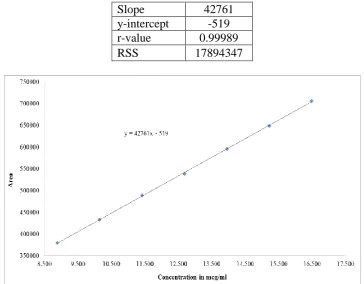
3.3. Linearity
Linearity for Amisulpride performed in the range of 8.877mcg/ml to 16.486 mcg/ml (about
70% to 130%) test concentration. A graph was plotted with concentration (in mcg/ml) on
x-axis and peak areas on y-x-axis. Slope, y-intercept, correlation coefficient (r-value) and residual
sum of squares (RSS) were determined from the obtained results.
3.4. Specificity
Blank (mobile phase), Placebo, standard and sample solution were injected into the HPLC
system. There was no interference from the blank and placebo at the retention time of
Amisulpride peak. Peak purity data reveals that Amisulpride peak was homogeneous and
there were no co-eluting peaks at the retention time of Amisulpride peak.
3.5. Stability in analytical solution
Stability of Amisulpride peak in analytical solution was verified by analyzing the standard
solutions and sample solutions, initially and also at different time intervals as mentioned
below by storing in sample compartment of HPLC instrument at 25°C. Calculated the %
assay for standard solution and sample solutions.
3.6. Filter paper selection study
Selection of filter paper was evaluated by preparing the assay preparation in triplicate as per
test method. Filtered the test solution through 0.45µm PVDF filter and 0.45µm Nylon filter
analysed the samples against centrifuged a portion of sample solution. The % assay of
Amisulpride was calculated and compared the results with method precision results.
3.7. Robustness
Robustness of the method was verified by deliberately varying the following instrumental
conditions.
a. By changing the temperature by 5°C
c. By changing the organic content in mobile phase by 2% absolute.
3.8. Forced Degradation
Forced degradation study was carried out by treating the sample under the following
conditions along with control sample.
Degradation Conditions Condition Detail
Thermal 60° C for 24 Hrs.
UV 254 nm for 48 Hrs.
Acid 5 mL 0.1 N HCl for 24 Hrs.
Alkali 5 mL 0.1 N NaOH for 24 Hrs.
Oxidation 5 mL 0.3% H2O2 for 24 Hrs.
3.9. System Suitability
1. %Relative standard deviation for five replicate injections of Standard preparation should
be not more than 2.
2. Tailing factor for Amisulpride peak should not be more than 2.0.
1. RESULT AND DISCUSSION
The method given here was found to be highly specific and linear according to the results.
The peaks of the active ingredients and other additives as well as the degradation products
were separated out by the HPLC method. Therefore, HPLC method is highly specific and
stability indicating for degradation products of the dosage form and formulation excipients.
The method can be applied for routine analysis of Amisulpride in liquid dosage form.
Developed HPLC method was found to be stability indicating and very specific for
estimation of Amisulpride in presence of other degradation products and various excipients
used in solid dosage form. Complete validation studies for the method proved it to be
specific, linear, robust and reproducible.
4.1. System Suitability
System Suitability was daily performed during the entire validation to ensure the suitability
of method.
The system suitability and system precision results of developed HPLC method, are given in
Table 3: System suitability and System Precision.
Retention Time (Mean ± SEM)
Theoretical Plates (n)
Asymmetry/Tailing (T)
2.462 5829 1.2
4.2. Linearity
Characteristics of the method from Standard calibration curve:
Slope 42761
y-intercept -519
r-value 0.99989
RSS 17894347
4.3. Specificity
The data demonstrate that there is no interference of blank, known impurity and placebo at
retention time of Amisulpride.
Peak Purity in HPLC method.
Sample type Peak name Retention Time Purity match
Control Sample Amisulpride 2.464 999.993
Standard Amisulpride 2.465 -
4.4. Stability indicating nature of the Developed Method-Forced degradation
Placebo preparation of Amisulpride, Amisulpride API, and samples i.e., injection of
Amisulpride were exposed to various stress conditions showed the peak purity as that of the
normal condition. The degradation study clearly indicated that Amisulpride degrades in
Sr.
No. Condition
% Assay
% Degradation
Purity Match / Purity factor
1 Untreated Sample* 102.36 - -
2 Acid Treated sample 100.51 1.81 999.993
3 Base Treated sample 100.26 2.05 999.993
4 Peroxide Treated sample 99.92 2.38 999.992
5 Heat Treated sample 100.03 2.28 999.993
6 UV-Visible Treated sample 90.97 11.13 999.991
4.5. Method Precision
The method precision was obtained by determining the assay by preparing six-sample
preparation. The low value of standard deviation i.e., >2 proved the method to be very precise
and accurate.
SR No % Assay
1 101.96
2 102.05
3 103.12
4 100.76
5 103.51
6 102.78
Mean 102.36
SD 0.989
% RSD 0.97
4.6. Intermediate Precision
Ruggedness of methodology(the tactic, the strategy) was verified by analysing the six
samples of same batch that was used for methodology preciseness as per take a look at
method by completely different analyst mistreatment different instrument and different
column on different day. The % relative standard deviation (%RSD) for % assay of the six
samples should not be more than 2 and the overall % RSD should not be more than 2. The
results are tabulated in table.
Sample No. % Assay
Analyst-I Analyst-II
1 101.96 102.42
2 102.05 103.37
3 103.12 105.22
4 100.76 102.75
5 103.51 104.24
6 102.78 106.99
Over all Mean 103.26
Over all SD 1.635
Over all %RSD 1.58
4.7. Method Recovery
To determine the reliability and accuracy of the method recovery studies were carried out In
triplicate at 70%, 100% and 130% of target concentration. Results of accuracy study are
found to be within the range of 98% to 102% and RSD < 1%.
Level no. (Spike level in %)
Mean
(%) SD % RSD
Level – 1
(70%) 98.47 0.155 0.16
Level – 2
(100%) 99.17 0.294 0.30
Level – 3
(130%) 99.53 0.246 0.25
Over all
99.06 mean Over all
0.511 SD Over all %
0.52 RSD
4.8. Method Robustness
Robustness of the method was determined by small deliberate changes in some Important
chromatographic conditions like flow rate, organic phase ratio, buffer pH and column oven
temperature. Even when these changes content of the drug failed to have an effect on
adversely. The low values of relative standard deviation indicating that the HPLC method is
robust for this particular parameter.
Sr. No. Method Precision Minus Flow Plus Flow Minus Temp. Plus Temp. Minus Org. Content Plus Org. Content Minus pH Plus pH
1 101.96 102.37 102.43 102.57 102.55 100.82 100.74 100.98 100.92
2 102.05 103.50 103.77 103.24 103.29 101.22 101.14 100.96 100.97
3 103.12 103.90 104.03 104.14 104.10 102.80 102.77 102.68 102.72
4 100.76
5 103.51
6 102.78
Over all Mean 102.66 102.71 102.68 102.68 102.11 102.09 102.09 102.09
Over all SD 0.984 1.034 0.997 0.994 1.013 1.032 1.012 1.022
Where,
Sr. No Experiment (Actual Value)
1 Method Precision data
2 Minus flow (1.35ml)
3 Plus flow (1.65ml)
4 Minus temperature (25°C)
5 Plus Temperature (35°C)
6 Minus organic content (– 2 % absolute)
7 Plus organic content (+ 2% absolute)
8 Minus pH (4.3)
9 Plus pH (4.7)
4.9. Solution Stability
Standard and sample solutions in HPLC method were evaluated at room temperature for 16
Hours. The solutions were analysed after 4, 6, 8, 10, 12, 14, 16, 18, 20, 22 and 24 Hours the
relative standard deviation was found to be below 2.0% in both the methods. It proves the
Solution stability of standard and sample solution is at room temperature. The results of
solution stability HPLC method are shown in Table.
Solution stability for standard solution.
Time in hours % Assay Difference
Initial 100.55 -
1 100.58 0.03
4 100.61 0.06
6 100.66 0.11
8 100.81 0.26
10 100.90 0.35
12 100.93 0.38
14 100.86 0.31
16 100.88 0.33
18 100.87 0.32
20 101.10 0.55
22 100.99 0.44
24 101.16 0.61
Solution stability for sample solution.
Time in hours % Assay Difference
Initial 101.93 -
1 101.98 0.05
4 102.13 0.20
6 102.17 0.24
14 102.50 0.57
16 102.51 0.58
18 102.44 0.51
20 102.63 0.70
22 102.53 0.60
24 102.81 0.88
4.10. Assay
The developed and validated method was successfully applied for the estimation of
Amisulpride in injection dosage form. The assay results were about 98-100%. The mean
retention time was about 2.46. The results of assay by using this method indicate that the
method is specific for the analysis of Amisulpride without interference from the excipients
used to prepare and formulate these injections.
2. CONCLUSION
The above developed method is suitable for determination of Amisulpride in injection. The
method was found to be highly sensitive, precise, and accurate for determination of
Amisulpride in pharmaceutical dosage form. These methods are quite useful and reasonably
satisfy all the standards. Therefore, these methods can be used for routine analysis of
Amisulpride in pharmaceutical dosage form i.e., injection form. More over the HPLC method
has also proved to be stability indicating because it can separate degradation peaks from the
main peaks and accurately quantifies it in the stability samples.
ACKNOWLEDGEMENT
All authors are thankful to Alkem Laboratories, Taloja, Navi Mumbai, Maharashtra, India for
providing reference standards and all facilities to complete this research work.
REFERENCES
1. Ravisankar P, Devala Rao G. (2015): Novel RP-HPLC method for the determination of
Amisulpride in pure and pharmaceutical formulations, Journal of Chemical and
Pharmaceutical Research, 7(6): 815-824.
2. Manoja K.M.L, Gurupadayya B.M, Srujana S, Raaga Leena V (2012): Development and
validation of stability indicating RP-HPLC method for amisulpride in bulk and
pharmaceutical dosage form, Indian Drugs, 49(4): 43-49.
3. Devadasu Ch., Ravisankar P, Validated RP-HPLC method for microgram determination
of amisulpride in pure and pharmaceutical formulations, International Journal of Research
4. Mogili R., Kanala K., Challa B.R., Chandu B.R., Bannoth C.K. (2011): Development and
validation of Amisulpride in human plasma by HPLC coupled with Tandam Mass
Spectrometry and its application to a Pharmacokinetic Study. Sci Pharm, 79(3): 583-599.
5. Humaira S., Dey A., Raju S.A, Sanaullah S. (2008): Development and validation of
spectrophotometric method for determination of amisulpride in pharmaceutical dosage
forms, International Journal of Chemical Science, 6(1): 437-440.
6. ICH Q1A (R2) (2003) Stability Testing of New Drug Substances and Products.
International Conference on Harmonisation, IFPMA, Geneva.
7. ICH Q1B (1996) Stability Testing of New Drug Substances and Products. International
Conference on Harmonisation, IFPMA, Geneva.
8. ICH Q2B (2005) Stability Testing of New Drug Substances and Products. International