Abstract— We analyze each U.S. Equity sector’s risk contribution ΔVaR, the difference between the Value-at-Risk of a sector and the Value-at-Risk of the system (S&P 500 Index), by using vine Copula-based ARMA-GARCH (1, 1) modeling. Vine copula modeling not only has the advantage of extending to higher dimensions easily, but also provides a more flexible measure to capture an asymmetric dependence among assets. We investigate systemic risk in 10 S&P 500 sector indices in the U.S. stock market by forecasting one-day ahead Copula VaR and Copula ΔVaR during the 2008 financial subprime crisis. Our evidence reveals vine Copula-based ARMA-GARCH (1, 1) is the appropriate model to forecast and analyze systemic risk.
Index Terms—Copula, Time Series, GARCH, Systemic Risk, VaR
I. INTRODUCTION
he definition of systemic risk from the Report to G20 Finance Ministers and Governors agreed upon among the International Monetary Fund (IMF), Bank for International Settlements (BIS) and Financial Stability Board (FSB) [3] that is “(i) caused by an impairment of all or parts of the financial system and (ii) has the potential to have serious negative consequences for the real economy”. Furthermore,
“G-20 members consider an institution, market or instrument as systemic if its failure or malfunction causes widespread distress, either as a direct impact or as a trigger for broader contagion.” A common factor in the various definitions of systemic risk is that a trigger event causes a chain of bad economic consequences, referred to as a “domino effect”. Given the definition of systemic risk quoted above, measuring systemic risk is done by estimating the probability of failure of an institute that is the cause of distress for the financial system. Therefore, we only consider the ∆CoVaR methodology proposed by Adrian and Brunnermeier [1], the difference between the VaR that the institution adds to the entire system conditional on the distress of a particular institution and the unconditional VaR of the financial system.
Because CoVaR method does not take the dependence structure of variables into account, not only did Girardi and Ergun [7] modify the CoVaR methodology by using the dynamic conditional correlation GARCH, but Hakwa [8] and Hakwa et al. [9] also modified the CoVaR methodology based on bivariate copula modeling. We extend their concepts and present vine Copula-based ARMA-GARCH (1, 1) VaR
Kuan-Heng Chen is the Ph.D. candidate with the Department of Financial Engineering at Stevens Institute of Technology, Hoboken, NJ 07030 USA (phone: 201-744-3166; e-mail: [email protected]).
Khaldoun Khashanah is the director with the Department of Financial Engineering at Stevens Institute of Technology, Hoboken, NJ 07030 USA. (e-mail: [email protected]).
measure into a high dimensional analysis in systemic risk. Sklar [21] introduced the copula, which describes the dependence structure between variables. Patton [16] defined the conditional version of Sklar’s theorem, which extends the copula applications to the time series analysis. In addition, Joe [11] was the first research to introduce a construction of multivariate distribution based on pair-copula construction (PCC), while Aas et al. [13] were the first to recognize that the pair-copula construction (PCC) principal can be used with arbitrary pair-copulas, referred to as the graphical structure of R-vines. Furthermore, Dissmann et al. [6] developed an automated algorithm of jointly searching for an appropriate R-vines tree structures, the pair-copula families and their parameters. Accordingly, a high dimensional joint distribution can be decomposed to bivariate and conditional bivariate copulas arranged together according to the graphical structure of a regular vine. Besides, Rockinger and Jondeau [17] was the first to introduce the copula-based GARCH modeling. Afterwards, Huang et al. [10] estimated the portfolio’s VaR by using the copula-based GARCH model, and Lee and Long [14] concluded that copula-based GARCH models outperform the dynamic conditional correlation model, the varying correlation model and the BEKK model. Moreover, Reboredo and Ugolini [18] measured CoVaR in European sovereign debts based on Gaussian and Student’s t copula-based TGARCH model.
In this paper, we present an application of the estimation of systemic risk in terms of the Copula ΔVaR/ΔES by using vine Copula-based ARMA-GARCH (1, 1) model, and it provides the important conclusion that it is a real-time and efficient tool to analyze systemic risk.
This paper has four sections. The first section briefly introduces existing research regarding systemic risk. The second section describes the definition of the Copula ΔVaR/ΔES, and outlines the methodology of vine Copula-based GARCH (1, 1) modeling. The third section describes the data and explains the empirical results of Copula ΔVaR/ΔES. The fourth section concludes our findings.
II. METHODOLOGY
A. Risk Methodology
The definition of Value-at-Risk (VaR) is that the maximum loss at most is (1 − 𝛼) probability over a pre-set horizon [19]. People usually determines 𝛼 as 95%, 99%, or 99.9% to
Measuring Systemic Risk: Vine
Copula-GARCH Model
Kuan-Heng Chen and Khaldoun Khashanah
be their confidence level. Adrian and Brunnermeier [1] defined ∆CoVaR as the difference between the VaR if the institution is added to the system conditional on the distress of a particular institution and the unconditional VaR of the system. In our paper, we modified the concept of CoVaR [1] [8] [9]. We use the Copula-based ARMA-GARCH (1, 1) methodology to obtain the VaR from each sector, named Copula VaR. We denote Δ𝑉𝑎𝑅1−𝛼𝑖→𝑗 , the sector 𝑖′𝑠 risk contribution to the system 𝑗 (S&P 500 index) at the confidence level 𝛼, by
𝐶𝑜𝑝𝑢𝑙𝑎 Δ𝑉𝑎𝑅1−𝛼𝑖→𝑗 = 𝐶𝑜𝑝𝑢𝑙𝑎 𝑉𝑎𝑅1−𝛼𝑖 − 𝐶𝑜𝑝𝑢𝑙𝑎 𝑉𝑎𝑅 1−𝛼 𝑗
The positive Δ𝑉𝑎𝑅1−𝛼𝑖→𝑗 presents the sector is the risk receiver from the system, while the negative Δ𝑉𝑎𝑅1−𝛼𝑖→𝑗 interprets the sector is the risk provider to the system. In addition, the methodology can be easily extended from VaR to expected shortfall (ES).
B. Univariate ARMA-GARCH Model
Engle is the first researcher to introduce the ARCH model, which deals with the volatility clustering, usually referred to as conditional heteroskedasticity. Bollerslev [4] extended the ARCH model to the generalized ARCH (GARCH) model. We employ ARMA (p, q)-GARCH (1, 1) with the Student’s
t distributed innovations for the marginal to account for the time-varying volatility, and ARMA (p, q)-GARCH (1, 1) with Student’s t distributed innovation can then be written as
𝑟𝑡= 𝜇𝑡+ ∑ 𝜑𝑖𝑟𝑡−𝑖
𝑝
𝑖=1
+ ∑ 𝜃𝑗𝜖𝑡−𝑗
𝑞
𝑗=1
+ 𝜖𝑡,
𝜖𝑡= 𝜎𝑡𝑧𝑡,
𝜎𝑡2= 𝛾
𝑡+ 𝛼𝑡𝜎𝑡−12 + 𝛽𝑡𝜖𝑡−12
where 𝑟𝑡 is the log return, 𝜇𝑡 is the drift term, 𝜖𝑡 is the error
term, and the innovation term 𝑧𝑡 is Student’s t distribution
with ν>2 degrees of freedom.
In addition, an overwhelming feature of Copula-based ARMA-GARCH model is the ease with which the correlated random variables can be flexible and easily estimated.
C. Sklar’s theory
Sklar’s Theorem [21] states that given random variables 𝑋1, 𝑋2, … , 𝑋𝑛 with continuous distribution functions 𝐹1, 𝐹2, … , 𝐹𝑛 and joint distribution function 𝐻, and
there exists a unique copula 𝐶 such that for all 𝑥 = (𝑥1, 𝑥2, … , 𝑥𝑛) ∈ 𝑅𝑛
𝐻(𝑥) = 𝐶(𝐹1(𝑥1), 𝐹2(𝑥2), … , 𝐹𝑛(𝑥𝑛))
If the joint distribution function is 𝑛-times differentiable, then taking the nth cross-partial derivative of the equation:
𝑓(𝑥1, 𝑥2, … , 𝑥𝑛) =
𝜕𝑛
𝜕𝑥1… 𝜕𝑥𝑛
𝐻(𝑥)
= 𝜕
𝑛
𝜕𝑢1… 𝜕𝑢𝑛
𝐶(𝐹1(𝑥1), … , 𝐹𝑛(𝑥𝑛)) ∏ 𝑓𝑖(𝑥𝑖) 𝑛
𝑖=1
= 𝑐(𝐹1(𝑥1), … , 𝐹𝑛(𝑥𝑛)) ∏ 𝑓𝑖(𝑥𝑖) 𝑛
𝑖=1
where 𝑢𝑖 is the probability integral transform of 𝑥𝑖.
For the purpose of estimating the VaR or ES based on time series data, Patton [16] defined the conditional version of Sklar’s theorem. Let 𝐹1,𝑡 and 𝐹2,𝑡 be the continuous conditional distriubtions of 𝑋1|ℱ𝑡−1 and 𝑋2|ℱ𝑡−1, given the
conditioning set ℱ𝑡−1, and let 𝐻𝑡 be the joint conditional
bivariate distribution of (𝑋1, 𝑋2|ℱ𝑡−1). Then, there exists a unique conditional copula 𝐶𝑡 such that
𝐻𝑡(𝑥1, 𝑥2|ℱ𝑡−1) = 𝐶𝑡(𝐹1,𝑡(𝑥1|ℱ𝑡−1), 𝐹2,𝑡(𝑥2|ℱ𝑡−1)|ℱ𝑡−1)
D. Parametric Copulas
Joe [12] and Nelsen [15] gave comprehensive copula definitions for each family.
(1) The bivariate Gaussian copula is defined as: 𝐶(𝑢1, 𝑢2; 𝜌) = 𝛷𝜌(𝛷−1(𝑢
1), 𝛷−1(𝑢2))
where 𝛷𝜌 is the bivariate joint normal distribution with linear
correlation coefficient 𝜌 and 𝛷 is the standard normal marginal distribution.
(2) The bivariate student’s t copula is defined by the following:
𝐶(𝑢1, 𝑢2; 𝜌, 𝜈) = 𝑡𝜌,𝜈(𝑡𝜈−1(𝑢1), 𝑡𝜈−1(𝑢2))
where 𝜌 is the linear correlation coefficient and 𝜈 is the degree of freedom.
(3) The Clayton generator is given by 𝜑(𝑢) = 𝑢−𝜃− 1, its
copula is defined by
𝐶(𝑢1, 𝑢2; 𝜃) = (𝑢1−𝜃+ 𝑢2−𝜃− 1)− 1
𝜃, with 𝜃 ∈ (0, ∞)
(4) The Gumbel generator is given by 𝜑(𝑢) = (− 𝑙𝑛 𝑢)𝜃,
and the bivariate Gumbel copula is given by 𝐶(𝑢1, 𝑢2; 𝜃) = exp (−[(− 𝑙𝑛 𝑢1)𝜃+ (− 𝑙𝑛 𝑢
2)𝜃] 1
𝜃) , with 𝜃
∈ [1, ∞)
(5) The Frank generator is given by 𝜑(𝑢) = 𝑙𝑛(𝑒−𝜃𝑢−1
𝑒−𝜃−1), and
the bivariate Frank copula is defined by 𝐶(𝑢1, 𝑢2; 𝜃) = −1
𝜃𝑙𝑜𝑔 (1 +
(𝑒−𝜃𝑢1− 1)(𝑒−𝜃𝑢2− 1)
𝑒−𝜃− 1 ),
with 𝜃 ∈ (−∞, 0) ∪ (0, ∞)
(6) The Joe generator is 𝜑(𝑢) = 𝑢−𝜃− 1, and the Joe
copula is given by
𝐶(𝑢1, 𝑢2) = 1 − (𝑢̅̅̅1𝜃+ 𝑢̅̅̅2𝜃− 𝑢̅̅̅1𝜃𝑢̅̅̅2𝜃)1𝜃,
with 𝜃 ∈ [1, ∞)
(7) The BB1 (Clayton-Gumbel) copula is given by 𝐶(𝑢1, 𝑢2; 𝜃, 𝛿) = (1 + [(𝑢1−𝜃− 1)𝛿+ (𝑢
2−𝜃− 1)𝛿] 1 𝛿)−1𝜃,
with 𝜃 ∈ (0, ∞) ∩ 𝛿 ∈ [1, ∞) (8) The BB6 (Joe-Gumbel) copula is
𝐶(𝑢1, 𝑢2; 𝜃, 𝛿) = 1 − (1
− exp {−[(−𝑙𝑜 𝑔(1 − 𝑢̅̅̅1𝜃))𝛿
+ (− 𝑙𝑜𝑔( 1 − 𝑢̅̅̅2𝜃))𝛿]1𝛿})𝜃1,
with 𝜃 ∈ [1, ∞) ∩ 𝛿 ∈ [1, ∞) (9) The BB7 (Joe-Clayton) copula is given by
𝐶(𝑢1, 𝑢2; 𝜃, 𝛿) = 1 − (1 − [(1 − 𝑢̅̅̅1𝜃)−𝛿+ (1 − 𝑢̅̅̅2𝜃)−𝛿
− 1]−1𝛿)1𝜃,
with 𝜃 ∈ [1, ∞) ∩ 𝛿 ∈ [0, ∞) (10)The BB8 (Frank-Joe) copula is
𝐶(𝑢1, 𝑢2; 𝜃, 𝛿) =1
𝛿(1 − [1 − 1
1 − (1 − 𝛿)𝜃(1
− (1 − 𝛿𝑢1)𝜃) (1 − (1 − 𝛿𝑢 2)𝜃)]
1 𝜃),
with 𝜃 ∈ [1, ∞) ∩ 𝛿 ∈ (0,1]
E. Vine Copulas
Vine copula method allows a joint distribution to be built from bivariate and conditional bivariate copulas arranged together according to the graphical structure of a regular vine, which is a more flexible measure to capture the dependence structure among assets. It is well known that any multivariate density function can be decomposed as
𝑓(𝑥1, … , 𝑥𝑛) = 𝑓(𝑥1) ∙ 𝑓(𝑥2|𝑥1) ∙ 𝑓(𝑥3|𝑥1, 𝑥2) ∙∙∙
𝑓(𝑥𝑛|𝑥1, … , 𝑥𝑛−1)
Moreover, the conditional densities can be written as copula functions. For instance, the first and second conditional density can be decomposed as
𝑓(𝑥2|𝑥1) = 𝑐1,2(𝐹1(𝑥1), 𝐹2(𝑥2)) ∙ 𝑓2(𝑥2),
𝑓(𝑥3|𝑥1, 𝑥2) = 𝑐2,3|1(𝐹2|1(𝑥2|𝑥1), 𝐹3|1(𝑥3|𝑥1)) ∙ 𝑓3(𝑥3|𝑥1)
= 𝑐2,3|1(𝐹2|1(𝑥2|𝑥1), 𝐹3|1(𝑥3|𝑥1))
∙ 𝑐1,3(𝐹1(𝑥1), 𝐹3(𝑥3)) ∙ 𝑓3(𝑥3)
After rearranging the terms, the three dimensional joint density can be written as
𝑓(𝑥1, 𝑥2, 𝑥3) = 𝑐2,3|1(𝐹2|1(𝑥2|𝑥1), 𝐹3|1(𝑥3|𝑥1))
∙ 𝑐1,2(𝐹1(𝑥1), 𝐹2(𝑥2))
∙ 𝑐1,3(𝐹1(𝑥1), 𝐹3(𝑥3)) ∙ 𝑓1(𝑥1) ∙ 𝑓2(𝑥2)
∙ 𝑓3(𝑥3)
Bedford and Cooke [2] introduced canonical vine copulas, in which one variable plays a pivotal role. The summary of vine copulas is given by Kurowicka and Joe [13]. The general 𝑛-dimensional canonical vine copula can be written as 𝑐(𝑥1, … , 𝑥𝑛)
= ∏ ∏ 𝑐𝑖,𝑖+𝑗|1,… ,𝑖−1(𝐹(𝑥𝑖|𝑥1, … , 𝑥𝑖−1), 𝐹(𝑥𝑖+𝑗|𝑥1, … , 𝑥𝑖−1)) 𝑛−𝑖
𝑗=1 𝑛−1
𝑖=1
Similarly, D-vines are also constructed by choosing a specific order for the variables. The general 𝑛-dimensional D-vine copula can be written as
𝑐(𝑥1, … , 𝑥𝑛)
= ∏ ∏ 𝑐𝑗,𝑗+𝑖|𝑗+1,… ,𝑗+𝑖−1(𝐹(𝑥𝑗|𝑥𝑗+1, … , 𝑥𝑗+𝑖−1), 𝐹(𝑥𝑗+𝑖|𝑥𝑗+1, … , 𝑥𝑗+𝑖−1)) 𝑛−𝑖
𝑗=1 𝑛−1 𝑖=1
Dissmann et al. [6] proposed that the automated algorithm involves searching for an appropriate R-vine tree structure, the pair-copula families, and the parameter values of the chosen pair-copula families, which is summarized in Table 1.
TABLEI
SEQUENTIAL METHOD TO SELECT AN R-VINE MODEL HE COEFFICIENTS OF TAIL DEPENDENCY
Algorithm. Sequential method to select an R-Vine model 1. Calculate the empirical Kendall’s tau for all
possible variable pairs.
2. Select the tree that maximizes the sum of absolute values of Kendall’s taus.
3. Select a copula for each pair and fit the corresponding parameters.
4. Transform the observations using the copula and parameters from Step 3. To obtain the transformed values.
5. Use transformed observations to calculate empirical Kendall’s taus for all possible pairs. 6. Proceed with Step 2. Repeat until the R-Vine is
fully specified.
F. Tail dependence
Tail dependence looks at the concordance and discordance in the tail, or extreme values of 𝑢1 and 𝑢2. It
concentrates on the upper and lower quadrant tails of the joint distribution function. Given two random variables 𝑢1~𝐹1 and
𝑢2~𝐹2 with copula 𝐶, the coefficients of tail dependency are
given by [5] [12] [15] 𝜆𝐿≡ lim
𝑢→0+𝑃[𝐹1(𝑢1) < 𝑢|𝐹2(𝑢2) < 𝑢] = lim𝑢→0+
𝐶(𝑢, 𝑢) 𝑢 , 𝜆𝑈≡ lim𝑢→1−𝑃[𝐹1(𝑢1) > 𝑢|𝐹2(𝑢2) > 𝑢]
= lim
𝑢→1−
1 − 2𝑢 + 𝐶(𝑢, 𝑢) 1 − 𝑢
where 𝐶 is said to have lower (upper) tail dependency 𝑖𝑓𝑓 𝜆𝐿≠ 0 (𝜆𝑈≠ 0) . The interpretation of the tail
dependency is that it measures the probability of two random variables both taking extreme values shown as table 2 [5] [12] [15].
TABLEII
THE COEFFICIENTS OF TAIL DEPENDENCY
Family Lower tail dependence Upper tail dependence
Gaussian * *
Student's t 2𝑡𝜈+1(−√𝜈 + 1√
1 − 𝜃
1 + 𝜃) 2𝑡𝜈+1(−√𝜈 + 1√ 1 − 𝜃 1 + 𝜃)
Clayton 2−𝜃1 *
Gumbel * 2 − 21𝜃
Frank * *
Joe * 2 − 21𝜃
BB1
(Clayton-Gumbel) 2−𝜃𝛿1 2 − 2
1 𝛿
BB6
(Joe-Gumbel) * 2 − 2𝜃𝛿1
BB7
(Joe-Clayton) 2−1𝛿 2 − 2
1 𝜃
BB8
(Frank-Joe) * 2 − 2
1 𝜃 𝑖𝑓 𝛿
= 1, 𝑜𝑡ℎ𝑒𝑟𝑤𝑖𝑠𝑒 0
Note: * represents that there is no tail dependency.
G. Estimation method
Generally, the two-step separation procedure is called the inference functions for the margin method (IFM) [12]. It implies that the joint log-likelihood is simply the sum of univariate log-likelihoods and the copula log-likelihood shown is as below.
log 𝑓(𝑥) = ∑ 𝑙𝑜𝑔𝑓𝑖(𝑥𝑖) + 𝑙𝑜𝑔𝑐(𝐹1(𝑥1), … , 𝐹𝑛(𝑥𝑛)) 𝑛
𝑖=1
Therefore, it is convenient to use this two-step procedure to estimate the parameters by maximum log-likelihood, where marginal distributions and copulas are estimated separately.
III. DATA AND EMPIRICAL FINDINGS A. Data Representation
observations) and the out-of-sample forecast validation period is from January 1, 2008 to June 5, 2009 (360 observations). The summary statistics of these indices is listed in table 3 as well as the statistical hypothesis testing. The results of Jarque-Bera (J-B) test reject the distributions of returns are normality, and the results of LM test show that indices’ returns present conditional heteroscedasticity. In addition, we assign the identify numbers to each sector.
TABLEIII
THE SUMMARY STATISTICS OF THE IN-SAMPLE AND STATISTICAL HYPOTHESIS TESTINGS
ID Sector Mean Sigma Skew Kurt J-B test LM test min / Max
1 S5FINL Index Financials 0.041% 1.41% 0.0725 6.0779 1 1 -8.04%/8.39%
2 S5INFT Index Technology 0.044% 1.99% 0.1825 6.7752 1 1 -10.01%/16.08%
3
S5COND Index Consumer Discretionary
0.030
% 1.24% -0.1470 8.2310 1 1 -10.33%/8.47%
4 S5ENRS Index Energy 0.055% 1.39% -0.0889 4.648 1 1 -7.21%/7.94%
5 S5HLTH Index Health Care 0.043% 1.21% -0.1798 7.0971 1 1 -9.17%/7.66%
6 S5INDU Index Industrials 0.039% 1.18% -0.2272 7.4103 1 1 -9.60%/7.21%
7 S5UTIL Index Utilities 0.023% 1.12% -0.4085 9.6084 1 1 -9.00%/8.48%
8 S5CONS Index Consumer Staples
0.033
% 0.97% -0.2326 9.9050 1 1 -9.30%/7.59%
9 S5MATR Index Materials 0.029% 1.31% 0.0356 5.9286 1 1 -9.12%/6.98%
10 TelecommunicaS5TELS Index tion Services
0.016
% 1.44% -0.1004 6.6741 1 1 -10.32%/8.03%
11 S&P 500 Index 0.036% 1.07% -0.1355 6.4383 1 1 -7.11%/5.57%
B. Results for the marginal models
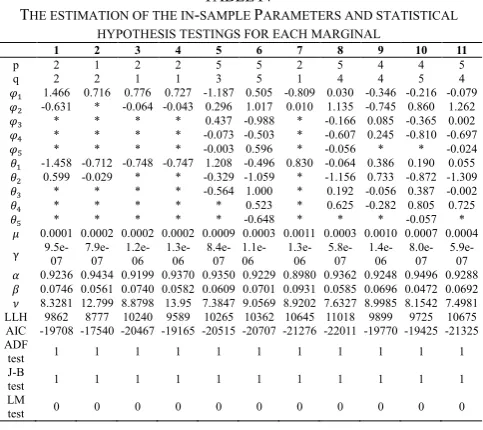
We estimate the parameters of p and q by minimizing Akaike information criterion (AIC) values for possible values ranging from zero to five. Table 4 lists the parameters which are estimated by minimum AIC values, and the statistical hypothesis testing for the unit-root based on Augmented Dickey-Fuller (ADF) test. Meanwhile, the statistical hypothesis testings for residuals are based on the Jarque-Bera (J-B) test and the LM test. The result shows that the values of 1 in ADF test rejects the null hypothesis of a unit root in a univariate time series. The result shows that using the Student’s t innovation distribution for the error term is appropriately fitted to the return data because the degree of freedom is usually smaller than 15 and the result of Jarque-Bera test rejects the null hypothesis of normality. Although the parameter β is usually larger than 0.9, which indicates the conditional volatility is time-dependent, using GARCH (1, 1) model is appropriate because the result of the LM test shows no conditional heteroscedasticity in residuals.
TABLEIV
THE ESTIMATION OF THE IN-SAMPLE PARAMETERS AND STATISTICAL HYPOTHESIS TESTINGS FOR EACH MARGINAL
1 2 3 4 5 6 7 8 9 10 11
p 2 1 2 2 5 5 2 5 4 4 5
q 2 2 1 1 3 5 1 4 4 5 4
𝜑1 1.466 0.716 0.776 0.727 -1.187 0.505 -0.809 0.030 -0.346 -0.216 -0.079
𝜑2 -0.631 * -0.064 -0.043 0.296 1.017 0.010 1.135 -0.745 0.860 1.262
𝜑3 * * * * 0.437 -0.988 * -0.166 0.085 -0.365 0.002
𝜑4 * * * * -0.073 -0.503 * -0.607 0.245 -0.810 -0.697
𝜑5 * * * * -0.003 0.596 * -0.056 * * -0.024
𝜃1 -1.458 -0.712 -0.748 -0.747 1.208 -0.496 0.830 -0.064 0.386 0.190 0.055
𝜃2 0.599 -0.029 * * -0.329 -1.059 * -1.156 0.733 -0.872 -1.309
𝜃3 * * * * -0.564 1.000 * 0.192 -0.056 0.387 -0.002
𝜃4 * * * * * 0.523 * 0.625 -0.282 0.805 0.725
𝜃5 * * * * * -0.648 * * * -0.057 *
𝜇 0.0001 0.0002 0.0002 0.0002 0.0009 0.0003 0.0011 0.0003 0.0010 0.0007 0.0004
γ 9.5e-07 7.9e-07 1.2e-06 1.3e-06 8.4e-07 1.1e-06 1.3e-06 5.8e-07 1.4e-06 8.0e-07 5.9e-07 𝛼 0.9236 0.9434 0.9199 0.9370 0.9350 0.9229 0.8980 0.9362 0.9248 0.9496 0.9288
𝛽 0.0746 0.0561 0.0740 0.0582 0.0609 0.0701 0.0931 0.0585 0.0696 0.0472 0.0692
𝜈 8.3281 12.799 8.8798 13.95 7.3847 9.0569 8.9202 7.6327 8.9985 8.1542 7.4981 LLH 9862 8777 10240 9589 10265 10362 10645 11018 9899 9725 10675 AIC -19708 -17540 -20467 -19165 -20515 -20707 -21276 -22011 -19770 -19425 -21325 ADF
test 1 1 1 1 1 1 1 1 1 1 1
J-B
test 1 1 1 1 1 1 1 1 1 1 1
LM
test 0 0 0 0 0 0 0 0 0 0 0
C. Results for the copula models
After the estimation of each marginal, we consider the set of standardized residuals from the ARMA-GARCH (1, 1) model and transform them to the set of uniform variables. Table 5 provides the correlation matrix of the transformed residuals and the result of the Kolmogorov-Smirnov (KS) test. The result of the Kolmogorov-Smirnov test is 0, and it fails to reject the null hypothesis that the distribution of transformed residuals is different from the uniform distribution at the 5% significance level.
TABLEV
THE PEARSON CORRELATION MATRIX AND KOLMOGOROV-SMIRNOV (KS) TEST FROM THE IN-SAMPLE DATA
ID /
Correlation 1 2 3 4 5 6 7 8 9 10 11
1 1 0.5571 0.7549 0.4038 0.5928 0.7836 0.4678 0.5911 0.6099 0.5626 0.8564 2 0.5571 1 0.6483 0.2574 0.3833 0.6529 0.2455 0.2849 0.4191 0.5132 0.8089 3 0.7549 0.6483 1 0.3974 0.5692 0.8167 0.3997 0.5564 0.6474 0.5786 0.8699 4 0.4038 0.2574 0.3974 1 0.3945 0.4631 0.4699 0.3987 0.5007 0.3306 0.5255 5 0.5928 0.3833 0.5692 0.3945 1 0.6056 0.4011 0.6595 0.4448 0.437 0.6954 6 0.7836 0.6529 0.8167 0.4631 0.6056 1 0.4579 0.6008 0.7216 0.5716 0.8934 7 0.4678 0.2455 0.3997 0.4699 0.4011 0.4579 1 0.433 0.4022 0.3785 0.5048 8 0.5911 0.2849 0.5564 0.3987 0.6595 0.6008 0.433 1 0.5085 0.4254 0.6388 9 0.6099 0.4191 0.6474 0.5007 0.4448 0.7216 0.4022 0.5085 1 0.422 0.6771 10 0.5626 0.5132 0.5786 0.3306 0.437 0.5716 0.3785 0.4254 0.422 1 0.6902 11 0.8564 0.8089 0.8699 0.5255 0.6954 0.8934 0.5048 0.6388 0.6771 0.6902 1
KS test 0 0 0 0 0 0 0 0 0 0 0
Due to our benchmark using the Student’s t copula, the parameters are the correlation matrix shown in table 5 and the degree of freedom 8.0748. Table 6 shows that using vine copula-based model has a better performance than using the Student’s t copula-based model based on AIC values, and the evidence supports that vine copula-based model is an appropriate method to apply to high-dimensional modeling.
TABLEVI
THE ESTIMATION FOR THE COPULA MODELS FROM THE IN-SAMPLE DATA Number of parameters Log-likelihood AIC
t copula 56 17102 -34092
Vine copula 99 17211.33 -34225
[image:4.595.307.549.57.272.2] [image:4.595.302.552.426.550.2]VineCopula library in R [20].
D. Results for the Copula VaR/ES and Copula 𝛥𝑉𝑎𝑅/ 𝛥𝐸𝑆
[image:5.595.309.545.50.333.2]We empirically examine which sector dominates more risk contributions on systemic risk with 10000 Monte Carlo simulations in each time interval using vine Copula-based ARMA-GARCH (1, 1) modeling. The results of Copula VaR are not surprising and are shown in figure 1. As seen in figure 2 and figure 3 below, we realize that the financial sector caused more risk distribution during the subprime crisis from 2008 to 2009, while the consumer staples sector is the major risk receiver. The results present that this measure is a simplified and efficient methodology to analyze systemic risk.
[image:5.595.55.285.243.459.2]Fig. 1. The one-day ahead Copula VaR for each sector index
Fig. 2. The one-day ahead Copula ∆VaR
Fig. 3. The one-day ahead Copula ∆ES
IV. CONCLUSION
The evidence in our paper shows that not only that vine Copula-based ARMA-GARCH (1, 1) has a better performance than the Student’s t copula-based ARMA-GARCH (1, 1) based on AIC values, but also that vine Copula-based ARMA-GARCH (1, 1) is a useful and efficient way to estimate systemic risk by using sector indices. In addition, using vine Copula-based ARMA-GARCH (1, 1) model to forecast one-day ahead Copula VaR and Copula ∆VaR, we develop a real-time and flexible resolution without lagging financial accounting data. Moreover, the ∆VaR/∆ES provides the information of the risk contribution from each sectors. This approach is very general and can be tailored to any underlying country and financial market easily. In further research, we would like to investigate copula-based modeling in systemic risk in different financial market.
REFERENCES
[1] Adrian, Tobias, and Markus K. Brunnermeier. CoVaR. No. w17454. National Bureau of Economic Research, 2011.
[2] Bedford, Tim, and Roger M. Cooke. "Vines: A new graphical model for dependent random variables." Annals of Statistics (2002): 1031-1068.
[3] Board, Financial Stability. "International Monetary Fund and Bank for International Settlements (2009)." Guidance to Assess the Systemic Importance of Financial Institutions, Markets and Instruments: Initial Considerations.(Background Paper. Report to the G-20 Finance Ministers and Central Bank Governors (October)).
[4] Bollerslev, Tim. "Generalized autoregressive conditional heteroskedasticity."Journal of econometrics 31, no. 3 (1986): 307-327.
[5] Cherubini, Umberto, Elisa Luciano, and Walter Vecchiato. Copula methods in finance. John Wiley & Sons, 2004.
[6] Dissmann, Jeffrey, Eike Christian Brechmann, Claudia Czado, and Dorota Kurowicka. "Selecting and estimating regular vine copulae and application to financial returns." Computational Statistics & Data Analysis 59 (2013): 52-69.
[7] Girardi, Giulio, and A. Tolga Ergün. "Systemic risk measurement: Multivariate GARCH estimation of CoVaR." Journal of Banking & Finance 37, no. 8 (2013): 3169-3180.
[8] Hakwa, Brice. "Measuring the marginal systemic risk contribution using copula." Available at SSRN 1934894 (2011).
01/01/09 -0.2
0 0.2
time 1. Financial Sector
01/01/09 -0.2
0 0.2
time 2. IT Sector
01/01/09 -0.2
0 0.2
time 3. Consumer Sector
01/01/09 -0.2
0 0.2
time 4. Energy Sector
01/01/09 -0.2
0 0.2
time 5. Health Care Sector
01/01/09 -0.2
0 0.2
time 6. Industrial Sector
01/01/09 -0.2
0 0.2
time 7. Utilities Sector
01/01/09 -0.2
0 0.2
time 8. Consumer Staples Sector
01/01/09 -0.2
0 0.2
time 9. Materials Sector
01/01/09 -0.2
0 0.2
time 10. Telecomm Sector
VaR (1-95%) based on Vine-Copula ARMA-GARCH
01/01/09 -0.2
0 0.2
time 11. S&P 500 Index
Empirical Returns Vine-Copula ARMA-GARCH
04/01/08 07/01/08 10/01/08 01/01/09 04/01/09
-0.1 -0.05 0 0.05 0.1 Time
Copula VaR(1-95%) based on Vine-Copula ARMA-GARCH
1. Financial 2. IT 3. Energy 4. Consumer Staples
04/01/08 07/01/08 10/01/08 01/01/09 04/01/09
0 20 40 60 80
100 VIX Index
Time
04/01/08 07/01/08 10/01/08 01/01/09 04/01/09
600 800 1000 1200 1400
1600 S&P500 Index
Time 1
2 4
3
04/01/08 07/01/08 10/01/08 01/01/09 04/01/09
-0.15 -0.1 -0.05 0 0.05 Time
Copula ES(1-95%) based on Vine-Copulas ARMA-GARCH
1. Financial 2. IT 3. Energy 4. Consumer Staples
04/01/08 07/01/08 10/01/08 01/01/09 04/01/09
0 20 40 60 80
100 VIX Index
Time
04/01/08 07/01/08 10/01/08 01/01/09 04/01/09
600 800 1000 1200 1400
1600 S&P500 Index
Time
2 3 4
[image:5.595.49.555.244.775.2][9] Hakwa, Brice, Manfred Jäger-Ambrożewicz, and Barbara Rüdiger. "Measuring and Analysing Marginal Systemic Risk Contribution using CoVaR: A Copula Approach." arXiv preprint arXiv:1210.4713 (2012).
[10] Huang, Jen-Jsung, Kuo-Jung Lee, Hueimei Liang, and Wei-Fu Lin. "Estimating value at risk of portfolio by conditional copula-GARCH method." Insurance: Mathematics and economics 45, no. 3 (2009): 315-324.
[11] Joe, Harry. "Families of m-variate distributions with given margins and m (m-1)/2 bivariate dependence parameters." Lecture Notes-Monograph Series(1996): 120-141.
[12] Joe, Harry. Multivariate models and multivariate dependence concepts. CRC Press, 1997.
[13] Kurowicka, D., and H. Joe. "Dependence Modeling-Handbook on Vine Copulae." (2011).
[14] Lee, Tae-Hwy, and Xiangdong Long. "Copula-based multivariate GARCH model with uncorrelated dependent errors." Journal of Econometrics 150, no. 2 (2009): 207-218.
[15] Nelsen, Roger B. An introduction to copulas. Vol. 139. Springer Science & Business Media, 1999.
[16] Patton, Andrew John. "Applications of copula theory in financial econometrics." PhD diss., University of California, San Diego, 2002.
[17] Rockinger, Michael, and Eric Jondeau. "Conditional dependency of financial series: an application of copulas." (2001).
[18] Reboredo, Juan C., and Andrea Ugolini. "A vine-copula conditional value-at-risk approach to systemic sovereign debt risk for the financial sector." The North American Journal of Economics and Finance 32 (2015): 98-123.
[19] Riskmetrics: technical document. Morgan Guaranty Trust Company of New York, 1996.
[20] Schepsmeier, Ulf, Jakob Stoeber, Eike Christian Brechmann, and Benedikt Graeler. "VineCopula: statistical inference of vine copulas, 2012." URL http://CRAN. R-project. org/package= VineCopula. R package version: 1-1.