Block-Turbo Codes
Bee Leong Yeap, Tong Hooi Liew, J. Hámorský, and Lajos Hanzo, Senior Member, IEEE
Abstract—Turbo equalizers have been shown to be successful in mitigating the effects of inter-symbol interference introduced by partial response modems and by dispersive channels for code rates of 1 2. In this contribution, we compara-tively studied the performance of a range of binary phase-shift keying turbo equalizers employing block-turbo codes, namely Bose–Chaudhuri–Hocquenghen turbo codes, convolutional codes, and convolutional turbo codes having high code rates, such as
= 3 4 and = 5 6, over a dispersive five-path Gaussian
channel and an equally weighted symbol-spaced five-path Rayleigh fading channel. These turbo equalization schemes were combined with an iterative channel estimation scheme in order to characterize a realistic scenario. The simulation results demon-strated that the turbo-equalized system using convolutional turbo codes was the most robust system for all code rates investigated.
Index Terms—Bose–Chaudhuri–Hocquenghen codes, convo-lutional codes, iterative decoding, iterative equalization, joint equalization and decoding, turbo codes, turbo decoding, turbo equalization.
I. INTRODUCTION
T
URBO equalization (TEQ) [1] was proposed by Douillardet al. in 1995 for a rate convolutional-coded binary phase-shift keying (BPSK) system. Specifically, Douillard et al. demonstrated that the turbo equalizer was capable of mitigating the effects of inter-symbol interference (ISI), provided that the channel impulse response (CIR) was known. Here the performance improvements were obtained by performing the channel equalization and channel decoding iteratively. Gertsman and Lodge [2] then showed that the turbo principle can compensate for the performance degradations due to imperfect CIR estimation. Different iteration termination criteria [3], such as cross-entropy minimization [4], were also investigated in order to minimize the number of iterations carried out by the turbo equalizer. A turbo equalization scheme was proposed by Bauch and Franz [5] for the global system for mobile communications (GSM) where different approaches of overcoming the dispersion of the so-called a priori information due to the interburst interleaving scheme were investigated. Re-search into combined convolutional turbo coding [6],
Manuscript received September 23, 1999; revised August 2, 2000 and June 7, 2001; accepted July 18, 2001. The editor coordinating the review of this paper and approving it for publication is D. L. Goeckel. This work was supported in part by the Commission of European Community and in part by the Engineering and Physical Sciences Research Council (EPSRC), U.K.
The authors are with the Department of Electronics and Computer Science, University of Southampton, Southampton, U.K. (e-mail: [email protected]; [email protected]).
Publisher Item Identifier S 1536-1276(02)02928-8.
[7] and iterative channel equalization has also been conducted by Raphaeli and Zarai [8]. Their results showed that for BPSK systems transmitting over nonrecursive channels the turbo equalizer using turbo codes outperformed the turbo equalizer utilizing convolutional codes. In the context of recursive channels, such as precoded magnetic storage media [9], the same trend was observed in the “floor” region of the bit-error rate (BER) curve. However, in the “cliff” region, the opposite trend was observed, where the turbo equalizer employing convolutional codes outperformed the turbo equalizer using turbo codes.
With the ever increasing demand for bandwidth, current systems aim to increase the spectral efficiency by invoking high-rate codes. This has been the motivation for research into block-turbo codes, which have been shown by Hagenauer
et al. [10] to outperform convolutional turbo codes using
punctured high-rate convolutional component codes, when the coding rate is higher than . It was also observed that a rate block turbo code using BPSK over the nondispersive Gaussian channel can operate within 0.27 dB of the Shannon limit [11]. Another method of generating high-rate turbo codes have been proposed by Açikel and Ryan [12], whereby a rate turbo code consisting of two
convolutional codes is punctured. These high-rate turbo codes have been shown to perform better than the turbo codes pro-posed by Hagenauer et al. [10]. The puncturing patterns were optimized for transmission over the nondispersive additive white Gaussian noise (AWGN) channel.
In this contribution, our objective is to investigate the perfor-mance of BPSK turbo equalizers employing different classes of high-rate codes, namely and convolutional codes, convolutional turbo codes, and block—turbo codes. This is because known turbo equalization results have only been pre-sented for turbo equalizers using convolutional codes and con-volutional turbo codes for code rates of and
[1], [8]. Specifically, Bose–Chaudhuri–Hocquengham (BCH) codes [13], [14] are used as the component codes of the BT codec. Since BCH codes can be constructed with parameters and , which represent the number of coded bits and data bits, respectively, we will use the notation BCH . The nota-tions convolutional coded (CC), convolutional turbo (CT), and block-turbo (BT), will also be used to represent the CC system, the convolutional turbo coded scheme, and the BCH turbo coded system, respectively.
The organization of this paper is as follows. In Section II, the model of the investigated systems is described. Subsequently, an
Fig. 1. A coded BPSK system employing a turbo equalizer at the receiver.
overview of turbo equalization [27] is presented in Section III. Section IV discusses the relative complexity of the turbo equal-izers, while Section V presents the simulation parameters. The performance of the systems is demonstrated in Section VI and, finally, we conclude in Section VII.
II. SYSTEMOVERVIEW
In our investigations, we have considered a coded BPSK system employing turbo equalization [27] at the receiver, as illustrated in Fig. 1. At the transmitter, the source bits are encoded in order to yield the coded bits . Three classes of codecs are investigated, namely convolutional codecs, the convolutional turbo codecs, and the BCH turbo codecs for code
rates of , , and . Subsequently, the
coded bits are channel-interleaved and passed to the modulator, which produces the modulated signal , transmitted in bursts.
The transmission burst structure used in this system is the Frames Mode A1 (FMA1) nonspread burst as specified in the Pan-European FRAMES proposal [15]. It consists of a 27-symbol training sequence, which separates two 72-symbol data sequences. At each end of the transmission burst, there are three tail symbols. The signal is transmitted over the channel characterized by the CIR and further corrupted by the zero-mean complex white Gaussian noise , having a variance of , where is the single-sided noise power spectral density at the receiver, yielding the received signal . Here, we utilized a dispersive five-path Gaussian channel, written as
(1)
and a five-path, symbol-spaced fading channel of equal CIR weights
(2)
where is a complex variable possessing Rayleigh fading sta-tistics and obeys a normalized Doppler frequency of 1.5 10 . The resultant received signal is:
(3)
where denotes convolution.
At the receiver, the CIR is estimated using an iterative CIR estimation technique [16], [17]. In the first turbo equalization iteration, the CIR is estimated using the least mean square (LMS) algorithm [18] and the training sequence mentioned previously. The initial step-size of the LMS algorithm is set
to 0.05. Subsequently, the CIR estimate is then utilized by the soft-in/soft-out (SISO) [19] equalizer, which generates soft de-cisions in the form of the logarithmic probability ratios known as log-likelihood ratios (LLR). These soft decisions are passed to the channel decoder, which computes the reliability infor-mation referred to as a posteriori inforinfor-mation, corresponding to the coded bits. At the next iteration, in addition to using the training sequences for reestimating the CIR, the soft estimates of the entire transmission burst’s symbols derived from the
a posteriori information of the SISO decoder are employed.
Here, a smaller step-size of 0.01 is utilized in the LMS algo-rithm. The decoder’s a posteriori information is transformed from the ratio of probability values into soft estimates of the modulated symbols by computing the statistical average of the transmitted symbol probabilities [20]. This CIR estimation process is repeated for each turbo equalization iteration.
Although there exists a wide range of low complexity SISO [19] algorithms, we have chosen the logarithmic-maximum a
posteriori (Log-MAP) algorithm [21], [22] for the SISO channel
equalizer and channel decoder, since the Log-MAP algorithm achieves optimal performance, despite having reduced compu-tational complexity compared with the original maximum a
pos-teriori (MAP) algorithm [23].
III. OVERVIEW OFTURBOEQUALIZATION
Before proceeding with the overview of turbo equalization, let us first define the terms a priori, a posteriori, and extrinsic information. The a priori information associated with a bit is the information known before equalization or decoding com-mences, and originates from a source other than the received information or the code constraints. Next, the extrinsic informa-tion associated with a bit is defined as the informainforma-tion provided by the equalizer or decoder based on the received sequence and on the a priori information of all other bits with the exception of the received and a priori information explicitly related to that particular bit. Finally, the a posteriori information associated with a bit is the reliability information that the SISO algorithm provides taking into account all available sources of informa-tion about the particular bit.
Fig. 2. Structure of original turbo equalizer introduced by Douillard et al. [1].
of the decoder, i.e., the a priori information accruing from the previous iteration must be removed, in order to yield the com-bined channel and extrinsic information. This also minimizes the correlation between the a priori information supplied by the decoder and the a posteriori information generated by the equal-izer. The removal of the a priori information is necessary, in order to prevent the decoder from “reprocessing” its own infor-mation, which would result in the so-called “positive feedback” phenomenon, overwhelming the decoder’s current reliability es-timation of the coded bits, i.e., the extrinsic information.
The combined channel and extrinsic information is channel-deinterleaved and directed to the SISO decoder, as depicted in Fig. 2. Subsequently, the SISO decoder computes the a
pos-teriori probability of the coded bits. Note that in contrast to
turbo decoding, the SISO decoder of the turbo equalizer not only produces the a posteriori probability of the source bits, but also those of all channel coded bits. The deinterleaved channel and extrinsic information is then removed from the a posteriori information provided by the decoder in Fig. 2 before channel interleaving, in order to yield the extrinsic information. This is to prevent the channel equalizer from receiving information based on its own decisions, which was generated in the previous turbo equalization iteration. The interleaved extrinsic tion computed is then employed as the a priori input informa-tion of the equalizer in the next channel equalizainforma-tion process. This constitutes the first turbo equalization iteration. The iter-ative process is repeated, until the required termination criteria are met [3]. At this stage, the a posteriori information of the source bits, which has been generated by the decoder is utilized to estimate the transmitted bits. Further discussions on turbo equalization/detection can be found in [1], [2], [8], and [24].
IV. COMPLEXITY OF THETURBOEQUALIZERS(TEQ)
This section presents the complexity of the TEQ utilized by the investigated systems. In order to simplify the complexity analysis of these systems, the complexity of the channel en-coder, modulator, interleaver, and deinterleaver has been as-sumed to be negligible. Therefore, the complexity of the turbo equalizer is dependent only on the complexity of the equalizer, the decoder, and the number of turbo equalization iterations per-formed.
In order to determine the complexity of the turbo equalizer, the complexity of the equalizer and decoder is added and sub-sequently multiplied by the number of turbo equalization iter-ations. Therefore, we must adopt the same measure of
com-plexity for both the equalizer and decoder, which in this paper is the number of associated trellis transitions per information bit. Since the complexity of the equalizer is dependent on the number of trellis transitions per coded bit, it must be normal-ized to become the number of transitions per information bit. This is achieved by multiplying the number of equalizer transi-tions per coded bit with the reciprocal of the code rate employed. For a BPSK equalizer, the number of transitions per coded bit depends on the number of trellis states and the number of trellis branches leaving each trellis state, as expressed below
no. of transitions per coded bit no. of states no. of branches
(4)
where is the duration of the channel memory. Consequently, the number of trellis transitions per information data bit which is also proportional to the complexity of the equalizer, can be expressed as
no. of transitions per coded bit Code rate
Code rate (5)
Let us now consider the complexity of the decoder. As men-tioned above, the complexity of the decoder is dependent on the number of transitions considered for decoding each information data bit. Hence, for the convolutional decoder, the complexity
incurred is
no. of states no. of branches
(6)
since the convolutional code is a binary code which has two branches leaving each state.
For the convolutional turbo code, the complexity is a factor of two higher than that of the convolutional code , since the turbo decoder consists of two convolutional decoders. Therefore, the complexity of the convolutional turbo code is written as
no. of states no. of branches
(7)
states is given as [25]
no. of States
.
(8)
Therefore, in order to determine the number of transitions com-puted for each information bit, the total number of transitions in the trellis must be calculated and subsequently divided by the total number of information bits. With the aid of the equations given below
(9)
(10)
we can determine the number of transitions for each of the three decoding trellis segments. Starting with the segment where
, we note that the total number of states is , which from (9) is equal to . Therefore, the total number of transitions is . Using (8), the total number of states in segment is . However, since the trellis begins to con-verge back to the all-zero state for , the total number of transitions in this segment is . Finally, by using (10), the total number of transitions for the segment,
where , is . By
summing the number of transitions for each of the three trellis segments, we obtain the total number of transitions for the entire decoding trellis. Hence, the number of transitions per informa-tion bit which is also our measure of the complexity for BCH
turbo codes, becomes
Total no. of transitions
(11)
As in the case of the convolutional turbo codes in (7), a multi-plicative factor of two was applied, since there are two compo-nent BCH decoders in the turbo decoder.
Having determined the complexity of the equalizer and de-coder as a function of the number of transitions per information bit, the complexity of the turbo equalizer can be expressed as
Decoder complexity
no. of TEQ iterations (12)
Using (6), (7), (11), and (12), the complexity of the turbo equalizers was evaluated and summarized in Table I.
V. SIMULATIONPARAMETERS
In this contribution, BPSK modulation is employed in all the examined systems. The first system described is a convo-lutional-coded scheme, denoted by CC. A rate , con-straint length , nonrecursive convolutional code was used with octal generator polynomials and . In
TABLE I
TABLE OFTURBOEQUALIZERCOMPLEXITY OF THECC, CT,AND
BT SYSTEMS FORCODERATES OFR 1=2, R 3=4, ANDR 5=6. THECHANNELMEMORYLFORBOTH
THEFIVE-PATHGAUSSIANCHANNEL ANDFIVE-PATH
RAYLEIGHFADINGCHANNEL ISEQUAL TOFOUR
TABLE II
PUNCTURINGPATTERN[26] APPLIED TO THECODEDBITS OF THE
R = 1=2 CONVOLUTIONALCODE INORDER TOOBTAINCODE
RATESR = 3=4ANDR = 5=6 CONVOLUTIONALCODES
TABLE III
REGULARPUNCTURINGPATTERNUSED INORDER TOOBTAIN THE
R = 1=2, R = 3=4,ANDR = 5=6 CONVOLUTIONALTURBO
CODES. THETERMSC1ANDC2 REPRESENT THEPARITYBITS OFR = 1=2 CONVOLUTIONALCODES OF THEFIRST AND
SECONDCONSTITUENTCODES, RESPECTIVELY
order to obtain and rate convolutional codes, we have employed the puncturing pattern used by Yasuda et al., which is specified in Table II.
For the convolutional turbo-coded system, represented by CT, we have used the rate , convolutional constituent codes employing the feedback generator polynomial of and feedforward polynomial of . A constraint length of
in order to obtain , , and rate convolu-tional turbo codes. Note that the puncturing patterns employed in these systems have been determined experimentally. For proce-dures ondesigning optimum high-rateturbocodes via puncturing, the interested reader is referred to [12].
Finally, for the BCH turbo-coded system which we denoted by BT, three different constituent BCH codes were used, namely the BCH(15,11) code, the BCH(31,26) code, and the BCH(63,57) code in order to obtain the code rates of
, , and , respectively. No
puncturing is required for this class of turbo codes.
We used a random channel interleaver, which was employed in the original turbo equalizer proposed by Douillard et al. [1], for all three turbo equalization systems and the interleaver size was set to approximately 20 000 bits. Similarly, random turbo coding interleavers were used in the turbo equalizers employing BCH turbo codes and convolutional turbo codes. Note that the same random interleaver mapping rules were used throughout the simulation. The detailed channel and turbo coding interleaver sizes are specified in Table IV. The number of turbo equalization iterations performed is specified in Table I. Here, the required number of iterations was determined experimentally and it was defined as the number of iterations, beyond which yielded no significant iteration gains. A total of 5 10 bits were transmitted for each signal-to-noise ratio (SNR) value in our investigations.
Our comparative study was conducted both over a five-path Gaussian channel, which is given in (1) and an equally-weighted five-path Rayleigh fading channel, as shown in (2), using a nor-malized Doppler frequency of . Note that for a fixed information rate, the channel ISI pattern will vary for dif-ferent code rates. Therefore, in order to achieve a fair comparison, the performance of the turbo equalizer must be compared for a par-ticular code rate, but not between different code rates.
As mentioned in Section II, we have employed the iterative CIR estimation technique proposed in [16]. Our simulations demonstrated that the performance of the turbo equalizer using the iterative CIR estimator was virtually the same as that of the turbo equalizer possessing perfect CIR knowledge after performing the critical number of turbo equalization iterations. Therefore, in our contribution the simulation results obtained using the iterative CIR estimator also closely represent the performance of the turbo equalizer possessing perfect CIR knowledge.
VI. RESULTS ANDDISCUSSION
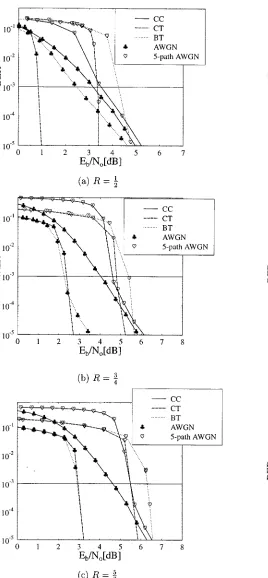
In this section, we compared the turbo equalization perfor-mance of the CC, CT, and BT systems investigated. We com-mence by comparing the turbo equalization performance of the CT, BT, and CC systems for code rates of , , and over the five-path Gaussian channel, followed by the five-path Rayleigh fading channel results in (1) and (2), re-spectively. We have compared the performance of these schemes at the target BER of 10 , noting that a similar preference order has been observed at the BERs of 10 and 10 for the various schemes. We also note that the performance of the coded sys-tems recorded for transmission over the nondispersive AWGN channel was included in both Figs. 3 and 4 for comparison.
A. Five-Path Gaussian Channel
Fig. 3(a) shows the turbo equalization performance of the BT system, the CT system, and the CC system over the five-path Gaussian channel shown in (1). At , we observed that the performance of
the CT system was comparable to the CC
system. Both of these systems outperformed the
BT system by approximately 1.0 dB at . The same comparison was performed for BPSK turbo equalizers in Fig. 3(b). We observed that the performance of the
CT scheme was again comparable to the CC system, while achieving a gain of 0.7 dB over the BT system at . Fig. 3(c) shows the turbo equalization
perfor-mance of the BT system, the CT scheme,
and that of the CC system. For this code rate, we ob-served that the CT system achieved a gain of 0.8 dB
over the BT system at and was
com-parable to the CC system. The results demonstrated that at high code rates and for transmission over the dispersive Gaussian channel of (1) turbo equalizers using convolutional turbo codes and convolutional codes required similar values in order to achieve a BER of 10 . It was also observed that both of these systems achieved gains of 0.7 dB–1.0 dB, when compared with the BT schemes.
B. Equally Weighted Five-Path Rayleigh Fading Channel
Fig. 3. Comparing the turbo equalization performance of the CC system, the CT scheme, and the BT system for code ratesR = 1=2, R = 3=4, and R =
5=6 over the five-path Gaussian channel of (1).
channel shown in (2). As shown in Fig. 4(a), the CT system achieved a gain of 1.6 dB and 1.9 dB, when compared
with the BT system and the CC system
at . For a code rate of , we observed
[image:6.612.321.532.65.642.2]in Fig. 4(b) that the BT system and the CT scheme required a similar value in order to achieve . Relative
Fig. 4. Comparing the turbo equalization performance of the CC system, the CT scheme, and the BT system for code ratesR = 1=2, R = 3=4, and R =
5=6 over the five-path Rayleigh fading channel of Fig. 2.
to the BT system and the CT scheme, the CC system exhibited
an loss of 1.4 dB at . The same
com-CT systems were comparable to the performance of the
and BT systems.
In the five-path Gaussian channel, the performance of the high-code-rate CT system was comparable to the CC system and outperformed the BT scheme at . For the five-path Rayleigh fading channel scenario, the performance of the CT system is better, than that of the other systems of similar code rate. However, for higher code rates, its perfor-mance is similar to that of the BT system at . Still, the CT system is favored as it is computationally less complex than the BT scheme (see Table I).
It was also observed in Fig. 4(a)–(c) that the CC turbo equalizer systems required only three turbo equalization iterations over the five-path Rayleigh fading channel for all code rates. Furthermore, the CC schemes were seen to perform poorly over the Rayleigh fading channel. For example, for a
code rate of and at , a loss of 1.5 dB
was observed, when compared with the turbo-equalized CT system. A reason for this marginal improvement of the CC scheme through iterative equalization and decoding is that the CC system’s performance is already close to the optimum, i.e., only 1.1 dB from the decoding performance over the nondispersive Gaussian channel, after three iterations.
It was also observed that the performance of the turbo-equal-ized CC systems transmitting over the dispersive Gaussian and Rayleigh fading channels of (1) and (2), respectively, approach the nondispersive AWGN performance. This trend was also seen for the turbo-coded CT and BT schemes transmitting over the dispersive Rayleigh fading channel. However, over the dispersive Gaussian channel the performance of the high-rate CT and BT coded turbo-equalized systems was approximately 2.5 dB–3.0 dB poorer than their corresponding AWGN perfor-mance. It is worth noting that the gap between the nondispersive AWGN channel performance and the turbo-equalized CT per-formance curve of the five-path dispersive Gaussian channel is due to the fact that the turbo equalizer is required to operate and to converge under extremely low SNR conditions. In this low-SNR region, the powerful turbo decoder used over the nondispersive AWGN channel is capable of providing a good performance, whereas the turbo equalizer is unable to converge when communicating over the five-path dispersive Gaussian channel resulting in the above-mentioned 2.5 dB–3.0 dB performance gap. In contrast to turbo codes, convolutional codes exhibit an inferior performance, hence, they require a higher operating SNR over nondispersive Gaussian channels and in this higher SNR region the turbo equalizer exhibits better convergence properties. This is why the performance gap between the CC nondispersive AWGN channel scenario and the turbo-equalized dispersive five-path Gaussian channel scenario appears more narrow, than for the corresponding turbo-coded scenario.1
1The authors wish to thank the reviewer for the above observation.
rates of , and . Our comparative
study of the turbo equalizers showed that for the five-path Gaussian channel of (1) and at high code rates of
and , the convolutional turbo coded system CT yielded better performance, when compared with the BCH turbo coded BT system and gave comparable performance to the convolutional-coded system CC at . Further-more, this performance was obtained by the CT scheme at the lowest complexity as compared with that of the BT and CC systems. Over the equally-weighted symbol-spaced five-path Rayleigh fading channel of Fig. 2, the CT system was again the best, achieving better performance than the CC system. When compared with the BT schemes, the rate CT system outperformed the BT system, while the rate and CT systems were comparable to the
performance of the and BT systems.
It was also observed that the CC turbo equalizer system performed poorly and required only three turbo equalization iterations, whereas the turbo-coded turbo equalizer schemes needed six to eight iterations. This was because after three iterations the performance of the CC system was already close to the decoding results over the nondispersive Gaussian channel. On the whole, the turbo-equalized CT system was the most robust scheme, giving better or comparable performance for all code rates investigated. Furthermore, the CT system incurs moderate computational complexity compared with the other schemes, hence, it constitutes the best choice in most turbo equalizer applications.
ACKNOWLEDGMENT
We are also grateful for the insightful and constructive com-ments of the reviewers.
REFERENCES
[1] C. Douillard, A. Picart, M. Jézéquel, P. Didier, C. Berrou, and A. Glavieux, “Iterative correction of intersymbol interference: Turbo-equalization,” Eur. Trans. Commun., vol. 6, pp. 507–511, Sept.–Oct. 1995.
[2] M. J. Gertsman and J. L. Lodge, “Symbol-by-symbol MAP demodula-tion of CPM and PSK signals on Rayleigh flat-fading channels,” IEEE
Trans. Commun., vol. 45, pp. 788–799, July 1997.
[3] G. Bauch, H. Khorram, and J. Hagenauer, “Iterative equalization and decoding in mobile communications systems,” in Proc. the European
Personal Mobile Communications Conf., Bonn, Germany, Sept. 30–Oct.
2 1997, pp. 301–312.
[4] M. Moher, “Decoding via cross-entropy minimization,” in Proc. IEEE
Global Telecommunications Conf. 1993, Houston, TX, Nov. 29 –Dec. 2
1993, pp. 809–813.
[5] G. Bauch and V. Franz, “Iterative equalization and decoding for the GSM-system,” in Proc. IEEE 48th Vehicular Technology Conf., Ottawa, Canada, May 18–21, 1998, pp. 2262–2266.
[6] C. Berrou, A. Glavieux, and P. Thitimajshima, “Near Shannon limit error-correcting coding and decoding: Turbo codes,” in Proc. Int.
Conf. Communications, Geneva, Switzerland, May 23–26, 1993, pp.
1064–1070.
[8] D. Raphaeli and Y. Zarai, “Combined turbo equalization and turbo de-coding,” in Proc. Global Telecommunications Conf. 1997, Phoenix, AZ, Nov. 3–8, 1997, pp. 639–641.
[9] T. Souvignier, A. Friedman, M.Öberg, R. E. S. P. H. Siegel, and J. Wolf, “Turbo decoding for pr4: Parallel versus serial concatenation,” in Proc.
Int. Conf. Communications 1999, Vancouver, Canada, June 6–10, 1999,
pp. 1638–1642.
[10] J. Hagenauer, E. Offer, and L. Papke, “Iterative decoding of binary block and convolutional codes,” IEEE Trans. Inform. Theory, vol. 42, pp. 429–445, Mar. 1996.
[11] H. Nickl, J. Hagenauer, and F. Burkett, “Approaching Shannon’s ca-pacity limit by 0.27 dB using simple hamming codes,” IEEE Commun.
Lett., vol. 1, pp. 130–132, Sept. 1997.
[12] Ö. F. Açikel and W. E. Ryan, “Punctured turbo-codes for BPSK/QPSK channels,” IEEE Trans. Commun., vol. 47, pp. 1315–1323, Sept. 1999. [13] A. Hocquenghem, “Codes correcteurs d’erreurs,” Chiffres (Paris), vol.
2, pp. 147–156, Sept. 1959.
[14] R. C. Bose and D. K. Ray-Chaudhuri, “On a class of error-correcting binary group codes,” Inf. Control, vol. 3, pp. 68–79, Mar. 1960. [15] A. Klein, R. Pirhonen, J. Sköld, and R. Suoranta, “FRAMES multiple
access model—Wideband TDMA with and without spreading,” in Proc.
IEEE Int. Symp. Personal, Indoor, and Mobile Radio Communications 1997, Helsinki, Finland, Sept. 1–4, 1997, pp. 37–41.
[16] C. H. Wong, B. L. Yeap, and L. Hanzo, “Wideband burst-by-burst adap-tive modulation with turbo equalization and iteraadap-tive channel estima-tion,” in Proc. IEEE Vehicular Technology Conf. 2000, Tokyo, Japan, May 15–18, 2000, pp. 2044–2048.
[17] M. Sandell, C. Luschi, P. Strauch, and R. Yan, “Iterative channel estima-tion using soft decision feedback,” in Proc. Global Telecommunicaestima-tions
Conf. 1998, Sydney, Australia, Nov. 8–12, 1998, pp. 3728–3733.
[18] S. Haykin, Adaptive Filter Theory. Englewood Cliffs, NJ: Prentice-Hall, 1996.
[19] S. Benedetto, D. Divsalar, G. Montorsi, and F. Pollara, “A soft-input soft-output APP module for iterative decoding of concatenated codes,”
IEEE Commun. Lett., vol. 1, pp. 22–24, Jan. 1997.
[20] A. Glavieux, C. Laot, and J. Labat, “Turbo equalization over a frequency selective channel,” in Proc. Int. Symp. Turbo Codes, and Related Topics, Brest, France, Sept. 3–5, 1997, pp. 96–102.
[21] P. Robertson, E. Villebrun, and P. Hoeher, “A comparison of optimal and sub-optimal MAP decoding algorithms operating in the log domain,” in
Proc. Int. Conf. Communications, Seattle, WA, June 18–22, 1995, pp.
1009–1013.
[22] P. Robertson, P. Hoeher, and E. Villebrun, “Optimal and sub-optimal maximum a posteriori algorithms suitable for turbo decoding,” Eur.
Trans. Telecommun., vol. 8, pp. 119–125, Mar./Apr. 1997.
[23] L. R. Bahl, J. Cocke, F. Jelinek, and J. Raviv, “Optimal decoding of linear codes for minimizing symbol error rate,” IEEE Trans. Inform. Theory, pp. 284–287, Mar. 1974.
[24] S. Benedetto, D. Divsalar, G. Montorsi, and F. Pollara, “Serial concate-nation of interleaved codes: Performance analysis, design, and itera-tive decoding,” IEEE Trans. Inform. Theory, vol. 44, pp. 909–926, May 1998.
[25] J. Wolf, “Efficient maximum likelihood decoding of linear block codes using a trellis,” IEEE Trans. Inform. Theory, vol. 24, pp. 76–80, Jan. 1978.
[26] Y. Yasuda, K. Kashiki, and Y. Hirata, “High-rate punctured convolu-tional codes for soft decision Viterbi decoding,” IEEE Trans. Commun., vol. COM-32, pp. 315–319, Mar. 1984.
[27] L. Hanzo, T. H.. Liew, and B. L. Yeap, Turbo-Coding,
Turbo-Equaliza-tion and Space–Time Coding. New York: Wiley, 2002.
Bee Leong Yeap received the B.Eng. (honors)
de-gree in electronics engineering from the University of Southampton, U.K., in 1996. In 2000, he received the Ph.D. degree.
Since then, he has been continuing his research as a Postdoctoral Research Fellow at the University of Southampton. His research interests include turbo coding, turbo equalization, adaptive modulation, and space–time coding.
Tong Hooi Liew received the B.Eng. degree in
electronics engineering from the University of Southampton, U.K. He also received the Ph.D. degree.
Currently, he is continuing his research as a Post-doctoral Research Fellow. His current research inter-ests include coding and modulation for wireless chan-nels, space–time coding, adaptive transceivers, etc. He has published his research results widely.
J. Hámorský, photograph and biography not available at the time of
publica-tion.
Lajos Hanzo (SM’92) received the B.Eng. degree in
electronics, in 1976, and received the Ph.D. degree, in 1983.
He has held various research and academic posts in Hungary, Germany, and the U.K. during his 25-year career in telecommunications. Since 1986, he has been with the Department of Electronics and Computer Science, University of Southampton, U.K., and has been a Consultant to Multiple Access Communications Ltd., U.K. Currently, he holds the Chair in Telecommunications. He has co-authored eight books on mobile radio communications, published about 400 research papers, organized and chaired conference sessions, presented overview lectures, and was awarded a number of distinctions. Currently, he is managing a research team, working on research projects in the field of wireless multimedia communications under the auspices of the Engineering and Physical Sciences Research Council (EPSRC) U.K., European IST Programme, and Mobile Virtual Center of Excellence (VCE). He provides industrial training courses

![Fig. 2.Structure of original turbo equalizer introduced by Douillard et al. [1].](https://thumb-us.123doks.com/thumbv2/123dok_us/1028536.618172/3.612.132.465.63.166/fig-structure-original-turbo-equalizer-introduced-douillard-et.webp)