Subtree Extractive Summarization via Submodular Maximization
Hajime Morita
Tokyo Institute of Technology, Japan [email protected]
Hiroya Takamura
Tokyo Institute of Technology, Japan [email protected]
Ryohei Sasano
Tokyo Institute of Technology, Japan [email protected]
Manabu Okumura
Tokyo Institute of Technology, Japan [email protected]
Abstract
This study proposes a text summarization model that simultaneously performs sen-tence extraction and compression. We translate the text summarization task into a problem of extracting a set of depen-dency subtrees in the document cluster. We also encode obligatory case constraints as must-link dependency constraints in or-der to guarantee the readability of the gen-erated summary. In order to handle the subtree extraction problem, we investigate a new class of submodular maximization problem, and a new algorithm that has the approximation ratio 1
2(1−e−1). Our
experiments with the NTCIR ACLIA test collections show that our approach outper-forms a state-of-the-art algorithm.
1 Introduction
Text summarization is often addressed as a task of simultaneously performing sentence extraction and sentence compression (Berg-Kirkpatrick et al., 2011; Martins and Smith, 2009). Joint mod-els of sentence extraction and compression have a great benefit in that they have a large degree of freedom as far as controlling redundancy goes. In contrast, conventional two-stage approaches (Za-jic et al., 2006), which first generate candidate compressed sentences and then use them to gen-erate a summary, have less computational com-plexity than joint models. However, two-stage ap-proaches are suboptimal for text summarization. For example, when we compress sentences first, the compressed sentences may fail to contain im-portant pieces of information due to the length limit imposed on each sentence. On the other
hand, when we extract sentences first, an impor-tant sentence may fail to be selected, simply be-cause it is long. Enumerating a huge number of compressed sentences is also infeasible. Joint models can prune unimportant or redundant de-scriptions without resorting to enumeration.
Meanwhile, submodular maximization has re-cently been applied to the text summarization task, and the methods thereof have performed very well (Lin and Bilmes, 2010; Lin and Bilmes, 2011; Morita et al., 2011). Formalizing summarization as a submodular maximization problem has an im-portant benefit inthat the problem can be solved by using a greedy algorithm with a performance guar-antee.
We therefore decided to formalize the task of si-multaneously performing sentence extraction and compression as a submodular maximization prob-lem. That is, we extract subsentences for mak-ing the summary directly from all available sub-sentences in the documents and not in a stepwise fashion. However, there is a difficulty with such a formalization. In the past, the resulting maxi-mization problem has been often accompanied by thousands of linear constraints representing logi-cal relations between words. The existing greedy algorithm for solving submodular maximization problems cannot work in the presence of such nu-merous constraints although monotone and non-monotone submodular maximization with con-straints other than budget concon-straints have been studied (Lee et al., 2009; Kulik et al., 2009; Gupta et al., 2010). In this study, we avoid this difficulty by reducing the task to one of extracting depen-dency subtrees from sentences in the source doc-uments. The reduction replaces the difficulty of numerous linear constraints with another difficulty wherein two subtrees can share the same word
ken when they are selected from the same sen-tence, and as a result, the cost of the union of the two subtrees is not always the mere sum of their costs. We can overcome this difficulty by tackling a new class of submodular maximization prob-lem: a budgeted monotone nondecreasing sub-modular function maximization with a cost func-tion, where the cost of an extraction unit varies depending on what other extraction units are se-lected. By formalizing the subtree extraction prob-lem as this new maximization probprob-lem, we can treat the constraints regarding the grammaticality of the compressed sentences in a straightforward way and use an arbitrary monotone submodular word score function for words including our word score function (shown later). We also propose a new greedy algorithm that solves this new class of maximization problem with a performance guar-antee1
2(1−e−1).
We evaluated our method on by using it to per-form query-oriented summarization (Tang et al., 2009). Experimental results show that it is supe-rior to state-of-the-art methods.
2 Related Work
Submodularityis formally defined as a property of a set function for a finite universeV. The function f : 2V →Rmaps a subsetS ⊆V to a real value.
If for any S, T ⊆ V, f(S ∪T) +f(S ∩T) ≤
f(S) +f(T), f is calledsubmodular. This defini-tion is equivalent to that of diminishing returns, which is well known in the field of economics: f(S∪ {u})−f(S)≤f(T∪ {u})−f(T),where T ⊆ S ⊆ V and u is an element of V. Di-minishing returns means that the value of an el-ement u remains the same or decreases asS be-comes larger. This property is suitable for sum-marization purposes, because the gain of adding a new sentence to a summary that already contains sufficient information should be small. Therefore, many studies have formalized text summarization as a submodular maximization problem (Lin and Bilmes, 2010; Lin and Bilmes, 2011; Morita et al., 2011). Their approaches, however, have been based on sentence extraction. To our knowledge, there is no study that addresses the joint task of simultaneously performing compression and ex-traction through an approximate submodular max-imization with a performance guarantee.
In the field of constrained maximization prob-lems, Kulik et al. (2009) proposed an algorithm that solves the submodular maximization problem
under multiple linear constraints with a perfor-mance guarantee1−e−1 in polynomial time. Al-though their approach can represent more flexible constraints, we cannot use their algorithm to solve our problem, because their algorithm needs to enu-merate many combinations of elements. Integer linear programming (ILP) formulations can repre-sent such flexible constraints, and they are com-monly used to model text summarization (McDon-ald, 2007). Berg-Kirkpatrick et al. (2011) formu-lated a unified task of sentence extraction and sen-tence compression as an ILP. However, it is hard to solve large-scale ILP problems exactly in a practi-cal amount of time.
3 Budgeted Submodular Maximization with Cost Function
3.1 Problem Definition
Let V be the finite set of all valid subtrees in the source documents, where valid subtrees are defined to be the ones that can be regarded as grammatical sentences. In this paper, we regard subtrees containing the root node of the sentence as valid. Accordingly, V denotes a set of all rooted subtrees in all sentences. A subtree con-tains a set of elements that are units in a de-pendency structure (e.g., morphemes, words or clauses). Let us consider the following problem of budgeted monotone nondecreasing submodu-lar function maximization with a cost function: maxS⊆V {f(S) :c(S)≤L},whereS is a
sum-mary represented as a set of subtrees, c(·) is the cost function for the set of subtrees,Lis our bud-get, and the submodular function f(·) scores the summary quality. The cost function is not always the sum of the costs of the covered subtrees, but depends on the set of the covered elements by the subtrees. Here, we will assume that the generated summary has to be as long as or shorter than the given summary length limit, as measured by the number of characters. This means the cost of a subtree is the integer number of characters it con-tains.
max
S⊆V
{
f(S) :∑
B∈B
c(B∩S)≤L
}
. (1)
For example, if we add a subtree t containing words {wa,wb,wc} to a summary that already
covers words {wa, wb, wd} from the same
sen-tence, the additional cost oftis onlyc({wc})
be-causewaandwbare already covered1.
The problem has two requirements. The first requirement is that the union of valid subtrees is also a valid subtree. The second requirement is that the union of subtrees and a single valid sub-tree have the same score and the same cost if they cover the same elements. We will refer to the sin-gle valid subtree as theequivalent subtree of the union of subtrees. These requirements enable us to represent sentence compression as the extrac-tion of subtrees from a sentence. This is because the requirements guarantee that the extracted sub-trees represent a sentence.
3.2 Greedy Algorithm
We propose Algorithm 1 that solves the maximiza-tion problem (Eq.1). The algorithm is based on ones proposed by Khuller et al. (1999) and Krause et al. (2005). Instead of enumerating all candidate subtrees, we use alocal searchto extract the ele-ment that has the highest gain per cost. In the al-gorithm,Gi indicates a summary set obtained by
adding element si to Gi−1. U means the set of
subtrees that are not extracted. The algorithm it-eratively adds to the current summary the element si that has the largest ratio of the objective
func-tion gain to the addifunc-tional cost, unless adding it violates the budget constraint. We set a parame-terrthat is the scaling factor proposed by Lin and Bilmes (2010). After the loop, the algorithm com-paresGiwith the{s∗}that has the largest value of
the objective function among all subtrees that are under the budget, and it outputs the summary can-didate with the largest value.
Let us analyze the performance guarantee of Al-gorithm 12.
1Each subset B corresponds to a kind of greedoid
con-straint. V implicitly constrains the model such that it can only select valid subtrees from a set of nodes and edges.
2Our performance guarantee is lower than that reported
by Lin and Bilmes (2010). However, their proof is er-roneous. In their proof of Lemma 2, they derive ∀u ∈ S∗\Gi−1,ρu(GCri−1)
u ≤
ρvi(Gi−1)
Cr
vi , for anyi(1 ≤i≤ |G|),
from line 4 of their Algorithm 1, which selects the densest element out of all available elements. However, the inequal-ity does not hold fori, for which elementuselected on line 4 is discarded on line 5 of their algorithm. The performance guarantee of their algorithm is actually the same as ours, since
Algorithm 1 Modified greedy algorithm for budgeted submodular function maximization with a cost function .
1: G0←φ 2: U ←V 3: i←1
4: while U 6=φdo
5: si←arg maxs∈U(cf((GGii−−1∪{1∪{s}s}))−−fc(G(Gi−i−11)))r 6: ifc({si} ∪Gi−1)≤Lthen
7: Gi←Gi−1∪ {si} 8: i←i+ 1
9: end if 10: U ←U\{si} 11: end while
12: s¯←arg maxs∈V,c(s)≤Lf({s}) 13: returnGf = arg maxS∈{{s¯},Gi}f(S)
Theorem 1 For a normalized monotone submod-ular function f(·), Algorithm 1 has a constant
approximation factor when r = 1 as follows:
f(Gf)≥
(
1 2(1−e
−1)
)
f(S∗), (2) where S∗ is the optimal solution and, Gf is the solution obtained by Greedy Algorithm 1.
Proof.See appendix.
3.3 Relation with Discrete Optimization
We argue that our optimization problem can be regarded as an extraction of subtrees rooted at a given node from a directed graph, instead of from a tree. LetD be the set of edges of the directed graph,Fbe a subset ofDthat is a subtree. In the field of combinatorial optimization, a pair (D,F)
is a kind of greedoid:directed branching greedoid
(Schmidt, 1991). A greedoid is a generalization of the matroid concept. However, while matroids are often used to represent constraints on submodular maximization problems (Conforti and Cornu´ejols, 1984; Calinescu et al., 2011), greedoids have not been used for that purpose, in spite of their high representation ability. To our knowledge, this is the first study that gives a constant performance guarantee for the submodular maximization under greedoid (non-matroid) constraints.
the guarantee1 2(1−e−
1)was already proved by Krause and
Guestrin (2005). We show a counterexample. Suppose that V is{e1(density 4:cost 6),e2(density 2:cost 4),e3(density
3:cost 1),e4(density 1:cost 1)}, and cost limitKis10. The
optimal solution isS∗ = {e1, e2}. Their algorithm selects e1,e3,e4in this order. However the algorithm selectse2on
line 4 after selectinge3, and it dropse2on line 5. As a result, e4 selected by the algorithm does not satisfy the inequality
∀u∈S∗\Gi
−1,ρu(CGir−1)
u ≤
ρvi(Gi−1)
4 Joint Model of Extraction and Compression
We will formalize the unified task of sentence compression and extraction as a budgeted mono-tone nondecreasing submodular function maxi-mization with a cost function. In this formaliza-tion, a valid subtree of a sentence represents a candidate of a compressed sentence. We will re-fer to all valid subtrees of a given sentence as a
valid set. A valid set corresponds to all candi-dates of the compression of a sentence. Note that although we use the valid set in the formaliza-tion, we do not have to enumerate all the candi-dates for each sentence. Since, from the require-ments, the union of valid subtrees is also a valid subtree in the valid set, the model can extract one or more subtrees from one sentence, and generate a compressed sentence by merging those subtrees to generate an equivalent subtree. Therefore, the joint model can extract an arbitrarily compressed sentence as a subtree without enumerating all can-didates. The joint model can remove the redundant part as well as the irrelevant part of a sentence, be-cause the model simultaneously extracts and com-presses sentences. We can approximately solve the subtree extraction problem by using Algorithm 1. On line 5 of the algorithm, the subtree extraction is performed as a local search that findsmaximal density subtreesfrom the whole documents. The maximal density subtree is a subtree that has the highest score per cost of subtree. We use a cost function to represent the cost, which indicates the length of word tokens in the subtree.
In this paper, we address the task of summariza-tion of Japanese text by means of sentence com-pression and extraction. In Japanese, syntactic subtrees that contain the root of the dependency tree of the original sentence often make gram-matical sentences. This means that the require-ments mentioned in Section 3.1 that a union of valid subtrees is a valid and equivalent tree is of-ten true for Japanese. The root indicates the pred-icate of a sentence, and it is syntactically modi-fied by other prior words. Some modifying words can be pruned. Therefore, sentence compression can be represented as edge pruning. The linguis-tic units we extract are bunsetsu phrases, which are syntactic chunks often containing a functional word after one or more content words. We will re-fer to bunsetsu phrases asphrasesfor simplicity. Since Japanese syntactic dependency is generally
defined between two phrases, we use the phrases as the nodes of subtrees.
In this joint model, we generate a compressed sentence by extracting an arbitrary subtree from a dependency tree of a sentence. However, not all subtrees are always valid. The sentence generated by a subtree can be unnatural even though the sub-tree contains the root node of the sentence. To avoid generating such ungrammatical sentences, we need to detect and retain the obligatory de-pendency relations in the dede-pendency tree. We address this problem by imposing must-link con-straints if a phrase corresponds to an obligatory case of the main predicate. We merge obligatory phrases with the predicate beforehand so that the merged nodes make a single large node.
Although we focus on Japanese in this pa-per, our approach can be applied to English and other languages if certain conditions are satisfied. First, we need a dependency parser of the lan-guage in order to represent sentence compression as dependency tree pruning. Moreover, although, in Japanese, obligatory cases distinguish which edges of the dependency tree can be pruned or not, we need another technique to distinguish them in other languages. For example we can distinguish obligatory phrases from optional ones by using se-mantic role labeling to detect arguments of predi-cates. The adaptation to other languages is left for future work.
4.1 Objective Function
on word overlaps, we do not score word pairs. The score function issupermodularas a score function of subtree extraction3, because the union of two
subtrees can have extra word pairs that are not in-cluded in either subtree. If the extra pair has a pos-itive score, the score of the union is greater than the sum of the score of the subtrees. This violates the definition of submodularity, and invalidates the performance guarantee of our algorithms.
We designed our objective function by combin-ing this relevance score with a penalty for redun-dancy and too-compressed sentences. Important words that describe the main topic should occur multiple times in a good summary. However, ex-cessive overlap undermines the quality of a sum-mary, as do irrelevant words. Therefore, the scores of overlapping words should be lower than thoseof new words. The behavior can be represented by a submodular objective function that reduces word scores depending on those already included in the summary. Furthermore, a summary consisting of many too-compressed sentences would lack read-ability. We thus gives a positive reward to long sentences. The positive reward leads to a natu-ral summary being generated with fewer sentences and indirectly penalizes too short sentences. Our positive reward for long sentences is represented as
reward(S) =c(S)− |S|, (3)
wherec(S)is the cost of summaryS, and|S|is the number of sentences inS. Since a sentence must contain more than one character, the reward con-sistently gives a positive score, and gives a higher score to a summary that consists of fewer sen-tences.
Let d be the damping rate, countS(w) be the
number of sentences containing word w in sum-maryS,words(S)be the set of words included in summaryS,qsb(w) be the query relevance score of word w, andγ be a parameter that adjusts the rate of sentence compression. Our score function for a summarySis as follows:
f(S) =∑
w∈words(S)
count∑S(w)−1
i=0
qsb(w)di
+γ reward(S).
(4)
An optimization problem with this objective function cannot be regarded as an ILP problem be-cause it contains non-linear terms. It is also
ad-3The score is still submodular for the purpose of sentence
extraction.
vantageous that the submodular maximization can deal with such objective functions. Note that the objective function is such that it can be calculated according to the type of word. Due to the na-ture of the objective function, we can use dynamic programming to effectively search for the subtree with the maximal density.
4.2 Local Search for Maximal Density Subtree
Let us now discuss the local search used on line 5 of Algorithm 1. We will use a fast algorithm to find the maximal density subtree (MDS) of a given sentence for each cost in Algorithm 1.
Consider the objective function Eq. 4, We can ignore the second term of the reward function while looking for the MDS in a sentence because the number of sentences is the same for every MDS in a sentence. That is, the gain function of adding a subtree to a summary can be represented as the sum of gains for words:
g(t) = ∑
w∈t
{gainS(w) +f reqt(w)c(w)γ},
gainS(w) = qsb(w)dcountS(w),
where f reqt(w) is the number of ws in subtree
t, and gainS(w) is the gain of adding the word
w to the summaryS. Our algorithm is based on
dynamic programming, and it selects a subtree that maximizes the gain function per cost.
When the word gain is a constant, the algorithm proposed by Hsieh et al. (2010) can be used to find the MDS. We extended this algorithm to work for submodular word gain functions that are not constant. Note that the gain of a word that oc-curs only once in the sentence, can be treated as a constant. In what follows, we will describe an extended algorithm to find the MDS even if there is word overlap.
For example, let us describe how to obtain the MDS in the case of a binary tree. First let us tackle the case in which the gain is always constant. Let nbe a node in the tree,aandbbe child nodes ofn, c(n)be the cost ofn,mdscabe the MDS rooted at aand have costc.mdsn={mdsc(n)n , . . . , mdsLn}
denotes the set of MDSs for each cost and its root noden. The valid subtrees rooted atncan be ob-tained by taking unions ofn with one or both of t1∈mdsaandt2 ∈mdsb.mdscnis the union that
the sentence root can be found by calculating each mdscnfrom the bottom of the tree to the top.
Next, let us consider the objective function that returns the sum of values of submodular word gain functions. When there is no word overlap within the union, we can obtainmdsc
n in the same
man-ner as for the constant gain. In contrast, if the union includes word overlap, the gain is less than the sum of gains:g(mdsc
n)≤g(n) +g(mdska) +
g(mdscb−k−c(n)), wherekandcare variables. The score reduction can change the order of the gains of the union. That is, it is possible that another union without word overlaps will have a larger gain. Therefore, the algorithm needs to know whether eacht ∈ mdsn has the potential to have
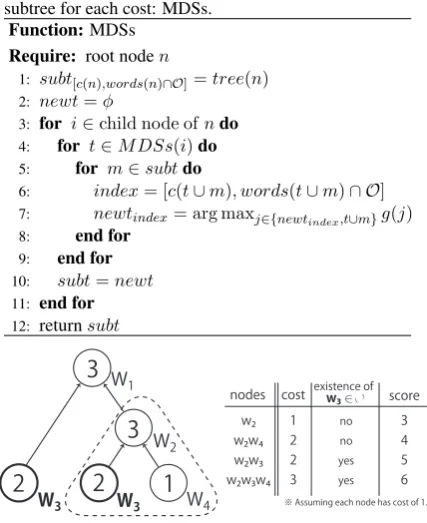
word overlaps with other MDSs. LetObe the set of words that occur twice or more in the sentence on which the local seach focuses. The algorithm stores MDS for eacho⊆ O, as well as each cost. By storing MDS for each o and cost as shown in Fig. 1, the algorithm can find MDS with the largest gain over the combinations of subtrees.
Algorithm 2 shows the procedure. In it,tandm denote subtrees, words(t) returns a set of words in the subtree,g(t)returns the gain oft, tree(n) means a tree consisting of noden, andt∪m de-notes the union of subtrees: t and m. subt in-dicates a set of current maximal density subtrees among the combinations calculated before. newt indicates a set of temporary maximal density sub-trees for the combinations calculated from line 4 to 8. subt[cost,ws]indicates a element ofsubtthat has a cost cost and contains a set of words ws. newt[cost,ws]is defined similarly. Line 1 setssubt
to a set consisting of a subtree that indicates node n itself. The algorithm calculates maximal den-sity subtrees within combinations of the root node n and MDSs rooted at child nodes ofn. Line 3 iteratively adds MDSs rooted at a next child node to the combinations; the algorithm then calculates MDSs newt betweensubt and the MDSs of the child node. The procedure from line 6 to 8 selects a subtree that has a larger gain from the tempo-rary maximal subtree and the union of t and m. The computational complexity of this algorithm is O(N C2)when there is no word overlap within the sentence, where C denotes the cost of the whole sentence, andN denotes the number of nodes in the sentence. The complexity order is the same as that of the algorithm of Hsieh et al. (2010). When we treat word overlaps, we need to count
Algorithm 2 Algorithm for finding maximal density subtree for each cost: MDSs.
Function:MDSs Require: root noden
1: subt[c(n),words(n)∩O]=tree(n)
2: newt=φ
3: for i∈child node ofndo 4: for t∈M DSs(i)do 5: for m∈subtdo
6: index= [c(t∪m), words(t∪m)∩ O] 7: newtindex= arg maxj∈{newtindex,t∪m}g(j)
[image:6.595.311.525.88.350.2]8: end for 9: end for 10: subt=newt 11: end for 12: returnsubt
Figure 1: Maximal density subtree extraction. The right table enumerates the subtrees rooted atw2in
the left tree for all indices. The number in each tree node is the score of the word.
all unions of combinations of the stored MDSs. There are at most (C2|O|) MDSs that the algo-rithm needs to store at each node. Therefore the total computational complexity is O(N C222|O|). Since it is unlikely that a sentence contains many word tokens of one type, the computational cost may not be so large in practical situations.
5 Experimental Settings
We evaluate our method on Japanese QA test collections from 7 ACLIA1 and NTCIR-8 ACLIA2 (Mitamura et al., 200NTCIR-8; Mitamura et al., 2010). The collections contain questions and weighted answer nuggets. Our experimental set-tings followed the setset-tings of (Morita et al., 2011), except for the maximum summary length. We generated summaries consisting of 140 Japanese characters or less, with the question as the query terms. We did this because our aim is to use our method in mobile situations. We used “ACLIA1 test data” to tune the parameters, and evaluated our method on “ACLIA2 test” data.
de-POURPRE Precision Recall F1 F3 Lin and Bilmes (2011) 0.215 0.126 0.201 0.135 0.174 Subtree extraction (SbE) 0.268 0.238 0.213 0.159 0.190
Sentence extraction (NC) 0.278 0.206 0.215 0.139 0.183
Table 1: Results on ACLIA2 test data.
pendency parsing, we used KNP (Kurohashi and Kawahara, 2009b). Since KNP internally has a flag that indicates either an “obligatory case” or an “adjacent case”, we regarded dependency relations flagged by KNP as obligatory in the sentence com-pression. KNP utilizes Kyoto University’s case frames (Kawahara and Kurohashi, 2006) as the re-source for detecting obligatory or adjacent cases.
To evaluate the summaries, we followed the practices of the TAC summarization tasks (Dang, 2008) and NTCIR ACLIA tasks, and computed pyramid-based precision with the allowance pa-rameter, recall, and Fβ (where β is 1 or 3)
scores. The allowance parameter was determined from the average nugget length for each question type of the ACLIA2 collection (Mitamura et al., 2010). Precision and recall are computed from the nuggets that the summary covered along with their weights. One of the authors of this paper man-ually evaluated whether each nugget matched the summary. We also used the automatic evaluation measure, POURPRE (Lin and Demner-Fushman, 2006). POURPRE is based on word matching of reference nuggets and system outputs. We re-garded as stopwords the most frequent 100 words in Mainichi articles from 1991 to 2005 (the doc-ument frequency was used to measure the fre-quency). We also set the threshold of nugget matching as0.5and binarized the nugget match-ing, following the previous study (Mitamura et al., 2010). We tuned the parameters by using POUR-PRE on the development dataset.
Lin and Bilmes (2011) designed a monotone submodular function for query-oriented summa-rization. Their succinct method performed well in DUC from 2004 to 2007. They proposed a positive diversity reward function in order to de-fine a monotone submodular objective function for generating a non-redundant summary. The diver-sity reward gives a smaller gain for a biased sum-mary, because it consists of gains based on three clusters and calculates a square root score with respect to each sentence. The reward also con-tains a score for the similarity of a sentence to the query, for purposes of query-oriented
summa-Recall Length # of nuggets
Subtree extraction 0.213 11,143 100
Reconstructed (RC) 0.228 13,797 108
Table 2: Effect of sentence compression.
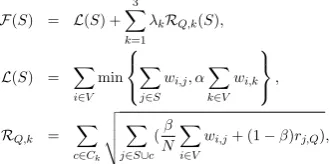
rization. Their objective function also includes a coverage function based on the similaritywi,j
be-tween sentences. In the coverage function min function limits the maximum gain α∑i∈V wi,j,
which is a small fraction α of the similarity be-tween a sentencej and the all source documents. The objective function is the sum of the positive reward R and the coverage function L over the
source documentsV, as follows:
F(S) = L(S) +
3
∑
k=1
λkRQ,k(S),
L(S) = ∑ i∈V
min
∑
j∈S wi,j, α
∑
k∈V wi,k
,
RQ,k = ∑
c∈Ck v u u
t∑
j∈S∪c (β
N ∑
i∈V
wi,j+ (1−β)rj,Q),
whereα,βandλkare parameters, andrj,Q
repre-sents the similarity between sentencej and query Q. We tuned the parameters on the development dataset. Lin and Bilmes (2011) used three clusters Ckwith different granularities, which were
calcu-lated in advance. We set the granularity to (0.2N, 0.15N, 0.05N) according to the settings of them, where N is the number of sentences in a docu-ment.
We also regarded as stopwords “教える(tell),” “知る(know),” “何(what)” and their conjugated forms, which are excessively common in ques-tions. For the query expansion in the baseline, we used Japanese WordNet to obtain synonyms and hypernyms of query terms.
[image:7.595.336.501.354.436.2]6 Results
state-of-the-art baseline are0.135and0.174respectively. Unfortunately, since the document set is small, the difference is not statistically significant. Compar-ing our method with the one without compression, we can see that there are improvements in the F1 and F3 scores of the human evaluation, whereas the POURPRE score of the version of our method without compression is higher than that of our method with compression. The compression im-proved the precision of our method, but slightly decreased the recall.
For the error analyses, we reconstructed the original sentences from which our method ex-tracted the subtrees. Table 2 shows the statistics of the summaries of SbE and reconstructed sum-maries (RC). The original sentences covered108 answer nuggets in total, and 8 of these answer nuggets were dropped by the sentence compres-sion. Comparing the results of SbE and RC, we can see that the sentence compression caused the recall of SbE to be 7% lower than that of RC. However, the drop is relatively small in light of the fact that the sentence compression can discard 19% of the original character length with SbE. This suggests that the compression can efficiently prune words while avoiding pruning informative content.
Since the summary length is short, we can select only two or three sentences for a summary. As Morita et al. (2011) mentioned, answer nuggets overlap each other. The baseline objective func-tion R tends to extract sentences from various
clusters. If the answer nuggets are present in the same cluster, the objective function does not fit the situation. However, our methods (SbE and NC) have a parameterdthat can directly adjust overlap penalty with respect to word importance as well as query relevance. This may help our methods to cover similar answer nuggets. In fact, the develop-ment data resulted in a relatively high parameterd (0.8) for NC compared with0.2for SbE.
7 Conclusions and Future Work
We formalized a query-oriented summarization, which is a task in which one simultaneously per-forms sentence compression and extraction, as a new optimization problem: budgeted monotone nondecreasing submodular function maximization with a cost function. We devised an approximate algorithm to solve the problem in a reasonable computational time and proved that its approxima-tion rate is 1
2(1−e−1). Our approach achieved
an F3-measure of 0.19 on the ACLIA2 Japanese test collection, which is 9.2 % improvement over a state-of-the-art method using a submodular ob-jective function.
Since our algorithm requires that the objective function is the sum of word score functions, our proposed method has a restriction that we cannot use an arbitrary monotone submodular function as the objective function for the summary. Our fu-ture work will improve the local search algorithm to remove this restriction. As mentioned before, we also plan to adapt of our system to other lan-guages.
Appendix
Here, we analyze the performance guarantee of Algorithm 1. We use the following notation.S∗is the optimal solution,cu(S)is the residual cost of
subtreeuwhenSis already covered, andi∗is the last step before the algorithm discards a subtree s∈ S∗or a part of the subtrees. This is because the subtree does not belong to either the approxi-mate solution or the optimal solution. We can re-move the subtrees0 fromV without changing the approximate rate.siis thei-th subtree obtained by
line 5 of Algorithm 1. Gi is the set obtained after
adding subtreesi toGi−1 from the valid set Bi.
Gf is the final solution obtained by Algorithm 1.
f(·) : 2V → Ris a monotone submodular
func-tion.
We assume that there is an equivalent sub-tree with any union of subsub-trees in a valid set B:
∀t1, t2,∃te, te ≡ {t1, t2}. Note that for any
or-der of the set, the cost or profit of the set is fixed: ∑
ui∈S={u1,...,u|S|}cui(Si−1) =c(S).
Lemma 1 ∀X, Y ⊆ V, f(X) ≤ f(Y) +
∑
u∈X\Y ρu(Y),where ρu(S) = f(S ∪ {u}) −
f(S).
The inequality can be derived from the definition
of submodularity. 2
Lemma 2 Fori= 1, . . . , i∗+1, when0≤r≤1,
f(S∗)−f(Gi−1)≤Lr|S∗|
1−r
csi(Gi−1)(f(Gi−1∪{si})−f(Gi−1)), where cu(S)=c(S∪{u})−c(S).
Proof.From line 5 of Algorithm 1, we have
∀u∈S∗\Gi−1, ρu(Gi−1)
cu(Gi−1)r ≤
ρsi(Gi−1)
csi(Gi−1)r
.
∀T ⊆ B,∃b ∈ B, b = union(T), because we have an equivalent tree b ∈ B for each union of trees T in a valid set B. That is, for any set of subtrees, we have an equivalent set of sub-trees, where bi ∈ Bi. Without loss of generality,
we can replace the difference set S∗\Gi−1 with
a setTi0−1 = {b0, . . . , b|T0
i−1|} that does not
con-tain any two elements extracted from the same valid set. Thus when 0 ≤ r ≤ 1 and 0 ≤ i ≤ i∗ + 1, ρs∗\Gi−1(Gi−1)
cS∗\Gi−1(Gi−1)r = ρT0
i−1(Gi−1) cT0
i−1(Gi−1)
r,and
∀bj ∈Ti0−1,
ρbj(Gi−1)
cbj(Gi−1)r ≤
ρsi(Gi−1) csi(Gi−1)r.Thus,
ρT0
i−1(Gi−1) =
∑
u∈Ti0−1ρu(Gi−1) ≤csiρsi((GiGi−−1)1)r∑u∈Ti0
−1cu(Gi−1)
r
≤csiρsi((GiGi−−1)1)r|Ti0−1|
(∑
u∈Ti0−1cu(Gi−1)
|Ti0−1|
)r
≤csiρsi((GiGi−−1)1)r|Ti0−1|1−r
( ∑
u∈Ti0−1cu(φ)
)r
≤csiρsi((GiGi−−1)1)r|S∗|1−rLr,
where the second inequality is from H¨older’s in-equality. The third inequality uses the submodu-larity of the cost function,
cu(Gi−1) =c({u} ∪Gi−1)−c(Gi−1)≤cu(φ)
and the fact that|S∗| ≥ |S∗\Gi−1| ≥ |Ti0−1|, and
∑
u∈T0
i−1cu(φ) =c(T
0
i−1)≤L.
As a result, we have
ρs∗\Gi−1(Gi−1) = ρTi0−1(Gi−1)
≤ ρsi(Gi−1)
csi(Gi−1)r
|S∗|1−rLr.
LetX =S∗ andY =Gi−1. Applying Lemma
1 yields
f(S∗) ≤ f(Gi−1) +ρu∈S∗\Gi−1(Gi−1).
≤ f(Gi−1) +
ρsi(Gi−1)
csi(Gi−1)
|S∗|1−rLr.
The lemma follows as a result.
Lemma 3 For a normalized monotone
submodu-larf(·), fori= 1, . . . , i∗+ 1and0≤r ≤1and
lettingsi be thei-th unit added intoGandGi be the set after addingsi, we have
f(Gi)≥
( 1−
i
∏
k=1
(
1−csk(Gk−1)
r
Lr|S∗|1−r
)) f(S∗).
Proof. This is proved similarly to Lemma 3 of (Krause and Guestrin, 2005) using Lemma 2.
Proof of Theorem 1. This is proved similarly to Theorem 1 of (Krause and Guestrin, 2005) using Lemma 3.
References
Taylor Berg-Kirkpatrick, Dan Gillick, and Dan Klein. 2011. Jointly learning to extract and compress. In
Proceedings of the 49th Annual Meeting of the Asso-ciation for Computational Linguistics: Human Lan-guage Technologies - Volume 1, HLT ’11, pages 481–490, Stroudsburg, PA, USA. Association for Computational Linguistics.
Calinescu Calinescu, Chandra Chekuri, Martin P´al, and Jan Vondr´ak. 2011. Maximizing a monotone
submodular function subject to a matroid constraint.
SIAM Journal on Computing, 40(6):1740–1766. Michele Conforti and G´erard Cornu´ejols. 1984.
Sub-modular set functions, matroids and the greedy al-gorithm: Tight worst-case bounds and some gener-alizations of the rado-edmonds theorem. Discrete Applied Mathematics, 7(3):251 – 274.
Hoa Trang Dang. 2008. Overview of the tac
2008 opinion question answering and summariza-tion tasks. InProceedings of Text Analysis Confer-ence.
Anupam Gupta, Aaron Roth, Grant Schoenebeck, and Kunal Talwar. 2010. Constrained non-monotone submodular maximization: offline and secretary algorithms. In Proceedings of the 6th interna-tional conference on Internet and network eco-nomics, WINE’10, pages 246–257, Berlin, Heidel-berg. Springer-Verlag.
Sun-Yuan Hsieh and Ting-Yu Chou. 2010. The
weight-constrained maximum-density subtree prob-lem and related probprob-lems in trees. The Journal of Supercomputing, 54(3):366–380, December. Daisuke Kawahara and Sadao Kurohashi. 2006. A
fully-lexicalized probabilistic model for japanese syntactic and case structure analysis. InProceedings of the main conference on Human Language Tech-nology Conference of the North American Chap-ter of the Association of Computational Linguistics, HLT-NAACL ’06, pages 176–183, Stroudsburg, PA, USA. Association for Computational Linguistics. Samir Khuller, Anna Moss, and Joseph S. Naor. 1999.
The budgeted maximum coverage problem. Infor-mation Processing Letters, 70(1):39–45.
Andreas Krause and Carlos Guestrin. 2005. A
Ariel Kulik, Hadas Shachnai, and Tami Tamir. 2009. Maximizing submodular set functions subject to multiple linear constraints. In Proceedings of the twentieth Annual ACM-SIAM Symposium on Discrete Algorithms, SODA ’09, pages 545–554, Philadelphia, PA, USA. Society for Industrial and Applied Mathematics.
Sadao Kurohashi and Daisuke Kawahara, 2009a.
Japanese Morphological Analysis System JUMAN 6.0 Users Manual. http://nlp.ist.i. kyoto-u.ac.jp/EN/index.php?JUMAN.
Sadao Kurohashi and Daisuke Kawahara, 2009b. KN parser (Kurohashi-Nagao parser) 3.0 Users Man-ual. http://nlp.ist.i.kyoto-u.ac.jp/ EN/index.php?KNP.
Jon Lee, Vahab S. Mirrokni, Viswanath Nagarajan, and Maxim Sviridenko. 2009. Non-monotone submod-ular maximization under matroid and knapsack con-straints. In Proceedings of the 41st annual ACM symposium on Theory of computing, STOC ’09, pages 323–332, New York, NY, USA. ACM.
Hui Lin and Jeff Bilmes. 2010. Multi-document sum-marization via budgeted maximization of submod-ular functions. InHuman Language Technologies: The 2010 Annual Conference of the North American Chapter of the Association for Computational Lin-guistics, HLT ’10, pages 912–920, Stroudsburg, PA, USA. Association for Computational Linguistics.
Hui Lin and Jeff Bilmes. 2011. A class of submodular functions for document summarization. In Proceed-ings of the 49th Annual Meeting of the Association for Computational Linguistics: Human Language Technologies - Volume 1, HLT ’11, pages 510–520, Stroudsburg, PA, USA. Association for Computa-tional Linguistics.
Jimmy Lin and Dina Demner-Fushman. 2006. Meth-ods for automatically evaluating answers to com-plex questions. Information Retrieval, 9(5):565– 587, November.
Andr´e F. T. Martins and Noah A. Smith. 2009. Sum-marization with a joint model for sentence extraction and compression. InProceedings of the Workshop on Integer Linear Programming for Natural Lan-gauge Processing, ILP ’09, pages 1–9, Stroudsburg, PA, USA. Association for Computational Linguis-tics.
Ryan McDonald. 2007. A study of global inference algorithms in multi-document summarization. In
Proceedings of the 29th European conference on IR research, ECIR’07, pages 557–564, Berlin, Heidel-berg. Springer-Verlag.
Teruko Mitamura, Eric Nyberg, Hideki Shima, Tsuneaki Kato, Tatsunori Mori, Chin-Yew Lin, Rui-hua Song, CRui-huan-Jie Lin, Tetsuya Sakai, Donghong Ji, and Noriko Kando. 2008. Overview of the NTCIR-7 ACLIA Tasks: Advanced Cross-Lingual
Information Access. InProceedings of the 7th NT-CIR Workshop.
Teruko Mitamura, Hideki Shima, Tetsuya Sakai, Noriko Kando, Tatsunori Mori, Koichi Takeda, Chin-Yew Lin, Ruihua Song, Chuan-Jie Lin, and Cheng-Wei Lee. 2010. Overview of the ntcir-8 aclia tasks: Advanced cross-lingual information access. InProceedings of the 8th NTCIR Workshop.
Hajime Morita, Tetsuya Sakai, and Manabu Okumura. 2011. Query snowball: a co-occurrence-based ap-proach to multi-document summarization for ques-tion answering. InProceedings of the 49th Annual Meeting of the Association for Computational Lin-guistics: Human Language Technologies: short pa-pers - Volume 2, HLT ’11, pages 223–229, Strouds-burg, PA, USA. Association for Computational Lin-guistics.
Wolfgang Schmidt. 1991. Greedoids and searches in directed graphs. Discrete Mathmatics, 93(1):75–88, November.
Jie Tang, Limin Yao, and Dewei Chen. 2009. Multi-topic based query-oriented summarization. In Pro-ceedings of 2009 SIAM International Conference Data Mining (SDM’2009), pages 1147–1158.