Graph Based Algorithm for Automatic Domain Segmentation of WordNet
Brijesh Bhatt Subhash Kunnath Pushpak Bhattacharyya Center for Indian Language Technology
Indian Institute of Technology Bombay Mumbai, India
{ brijesh, subhash, pb } @cse.iitb.ac.in
Abstract
We present a graph based algorithm for automatic domain segmentation of Word-net. We pose the problem as a Markov Random Field Classification problem and show how existing graph based algorithms for Image Processing can be used to solve the problem. Our approach is unsuper-vised and can be easily adopted for any language. We conduct our experiments for two domains, health and tourism. We achieve F-Score more than .70 in both do-mains. This work can be useful for many critical problems like word sense disam-biguation, domain specific ontology ex-traction etc.
1 Introduction
Over the years, Wordnet has served as an impor-tant lexical resource for many Natural Language Processing (NLP) applications. Picking up a right sense of a word from the fine grained sense repos-itory of Wordnet is at the heart of many NLP prob-lems. Many researchers have used Wordnet for domain specific applications like word sense dis-ambiguation (Magnini et al., 2002a; Khapra et al., 2010),domain specific taxonomy/ontology ex-traction (Cimiano and Vlker, 2005; Yanna and Zili, 2009) etc. These applications rely on ‘One sense per discourse’ (Gale et al., 1992) hypoth-esis to identify domain specific sense of a word. ‘Dividing Wordnet’s lexical and conceptual space into various domain specific subspace can signif-icantly reduce search space and thus help many domain specific applications’ (Xiaojuan and Fell-baum, 2012).
With the purpose of categorizing Wordnet senses for different domain specific applications, Magnini and Cavagli (2000) constructed a domain hierarchy of 164 domain labels and annotated
Wordnet synsets with one or more label from the hierarchy. The categories were further refined by linking domain labels to subject codes of Dewey Decimal Classification system (Bentivogli et al., 2004). Beginning with Wordnet 2.0, Domain cate-gory pointers were introduced to link domain spe-cific synsets across part of speech. However, the manual determination of a set of domain labels and assigning them to Wordnet synsets is a time consuming task. Also, the senses of words evolves over a period of time and accordingly Wordnet synsets also undergo changes. This makes the static assignment of domain label a costly exer-cise.
With the intention to reduce manual labor of do-main categorization and to facilitate use of Word-net in domain specific applications, there has been efforts to (semi) automatically assign domain la-bels to Wordnet synsets. Most of these efforts rely on Wordnet concept hierarchy and use bel propagation schemes to propagate domain la-bels through the hierarchy. However, the hetero-geneous level of generality poses a key challenge to such approaches. For example, ‘Under Animal (subsumed by Life Form) we find out specific con-cepts, such as Work Animal, Domestic Animal, kept together with general classes such as Chor-date, Fictional Animal, etc.’(Gangemi et al., 2003). Another key challenge in assigning the do-main labels is the quality of dodo-main hierarchy and semantic distance between domain labels (Xiao-juan and Fellbaum, 2012).
In this paper, we present a corpus based ap-proach for automatic domain segmentation of Wordnet. The aim of our work is to provide a gen-eral solution that can be used across languages to construct domain specific conceptualization from Wordnet. The proposed system works in two steps,
conceptualiza-tion from the corpus.
2. The domain specific conceptualization is then disambiguated and linked to Wordnet synsets to generate domain labels.
We pose Wordnet domain segmentation as an image labeling problem and use existing tech-niques in the field of image processing system to solve Wordnet domain labeling problem. The pro-posed method is completely unsupervised and re-quires only Part Of Speech tagged corpus. Hence, it can be easily adopted across languages. Our method also does not require any predefined set of domain category labels, however if such labels are available it can be incorporated into system to generate better labeling.
The remaining of the paper is organized as fol-lows, section 2 describes related work. Section 3 describes the proposed graph based algorithm for Wordnet domain labeling. Section 4 and 5 discuss the experiments and conclusion.
2 Related Work
Two major attempts to categorize Wordnet synsets are Wordnet Domain (Magnini and Cavagli, 2000) and Wordnet Domain Category pointers. In this section we first present a brief overview of these efforts and then describe some efforts to automate the task of domain labeling of Wordnet synsets. We also mention the attempts made for other lan-guages apart from English.
2.1 Wordnet Domain Hierarchy and Domain Category Pointers
Domain categorization of Wordnet synset has been an active area of research for more than a decade now. Magnini and Cavagli (2000) have developed Wordnet Domain Hierarchy (WDH) by annotating Wordnet1.6 using 250 Subject Field Codes (SFC). They used semi-automated approach in which the top level concepts are manually marked with SFC and then the labels are automatically propagated through the hierarchy. Finally, the labeling is again evaluated and refined manually. The seman-tic structure of WDH was further refined by Ben-tivogli et al. (2004).
Starting from Wordnet 2.0, domain category pointers were introduced in the Wordnet. ‘Un-like the original Wordnet Domain, the domain cat-egory pointers use Wordnet synsets as domain la-bels and synsets across part of speech are linked
through domain pointers’ (Xiaojuan and Fell-baum, 2012). However, ‘only 5% of Wordnet 3.0 synsets are linked to 438 domain categories and out of these linked synsets only 30% synsets have same label in both Wordnet Domain and Domain Category’.
2.2 Automated Approaches
Considering the growing size of Wordnet and the amount of efforts required to construct do-main categories, it is apparent to develop semi-automated or semi-automated methods for domain cat-egorization of Wordnets. One of the earlier efforts in this direction was by Buitelaar and Sacaleanu (2001). They extracted domain specific terms us-ing tf*idf measure and then disambiguated these terms using GermaNet synsets. The disambigua-tion was performed based on the assumpdisambigua-tion that the hypernymy and hyponymy terms are more likely to have same domain label. Magnini et al. (2002b) have performed a comparative study of corpus based and ontology based domain annota-tion. They have used frequency of words in the synonym set as a measure to identify domain of a synset.
Gonzalez-Agirre et al. (2012) have proposed a semi-automatic method to align the original Word-net 1.6 based domains to WordWord-net 3.0. They have used domain labels already assigned to some top level synsets and then propagated the domain label across Wordnet hierarchy using UKB algorithm (Agirre and Soroa, 2009). Their approach is based on an assumption that ‘A synset directly related to several synsets labeled with a particular domain (i.e biology) would itself possibly be also related somehow to that domain (i.e. biology)’(Gonzalez-Agirre et al., 2012).
Fukumoto and Suzuki (2011) have adopted a corpus based approach to assign domain labels to Wordnet synsets. They first disambiguate the corpus words with Wordnet senses and then use Markov Random Walk based Page Rank Algo-rithm to rank domain relevance of Wordnet senses. Zhu et al. (2011) have proposed gloss based dis-ambiguation technique for domain assignment to Wordnet synset. They used existing domain labels of Wordnet 3.0 and predicted domains based on words in the gloss of the synsets.
mapping to domain tag Chinese Wordnet.
2.3 Proposed Approach
Like Buitelaar and Sacaleanu (2001), Magnini et al. (2002b) and Fukumoto and Suzuki (2011), we also follow corpus based approach for Wordnet Domain Labeling. Key points of difference among these approaches can be summerized as follows,
1. Both Buitelaar and Sacaleanu (2001) and Magnini et al. (2002b) used word frequency to detect domain specificity of a term. They do not consider the label of neighbor terms to determine the label for a term.
2. Fukumoto and Suzuki (2011) have modeled domain labeling as a Markov Random Walk problem, but they run their algorithm on en-tire Wordnet graph. This is costly in terms of time and space required for the process-ing. In addition to that, Wordnet hypernymy-hyponymy graph may not be a true represen-tative of domain specific conceptualization.
In contrast to the above mentioned approaches, our approach is based on the hypothesis that, ‘Do-main specificity of a term depends on the spatial property of the term’. So it is important to con-struct a domain specific conceptualization to iden-tify domain of a term. The domain for a con-cept/term depends not only on the occurence of the term in the domain but also on the neighbors of the concept/term. Hence, we follow two step process in which first we construct a domain con-ceptualization from the corpus and then we align this conceptualization with Wordnet.
3 Algorithm
The proposed algorithm carves out a domain spe-cific subgraph from the Wordnet. For that, we first construct concept graph from the corpus and then associate concepts with Wordnet senses. Fig-ure 1 shows the overall system architectFig-ure. As shown in the figure 1 after preprocessing, the sim-ilarity graph is constructed from the corpus. Using a graph based algorithm similarity graph is con-verted into domain conceptualization and then it is linked with Wordnet synsets to assign domain la-bels to Wordnet synsets. The detailed description of each component is as follows.
3.1 Preprocessing
The text corpus is first POS tagged using Stanford POS tagger 1 and Morph Analyzer2. Then term
frequency of each term is calculated using weird-ness measure (Ahmad et al., 1999). Context vector for each term is constructed using Point Wise Mu-tual Information (Church and Hanks, 1990) mea-sure. We used a sentence as a boundary to cal-culate context vector. Output of the preprocess-ing step is a list of domain specific terms and their context vector.
3.2 Constructing Document Graph
Using the term list and context vector generated from the preprocessing step, a graph G(V, E) is constructed in which each vi ∈ V is term and
each edge e(vi, vj) is semantic relatedness
be-tween termsvi andvj. Semantic relatedness
be-tween two termsviandvj is calculated by taking
cosine of terms vectors ofvi andvj, as shown in
fig 2.
Figure 2: Cosine Similarity
3.3 Constructing Domain Specific Conceptualization
Algorithm 1Graph Cut Based Energy Minimiza-tion
Input: set of labelsL, undirected graphG(V, E)
where, V is set of random variables, E is penalty cost, f(vl) is cost of assigning label
l ∈Ltov ∈V, A set of initial labeling{(v, l), for allv ∈ V andl ∈L}and Energy Function θ
forviandvj∈V do
Source←vi
Target←vj
Perform Graph Cut Re-assign labels Calculateθ
Repeat untilθis minimized
end for
1
http://nlp.stanford.edu/software/ tagger.shtml
2http://www.sussex.ac.uk/Users/johnca/
Figure 1: System Architecture
This module takes document graphs as an input and constructs a cohesive domain specific concep-tual structure. In order to do this, we need to clas-sify each node in the corpus graph into various do-mains. Assignment of a domain label to a node depends on two parameters,
• Term Cost: This measures how strongly a term belongs to the domain. It is measured by frequency of occurrence of a term within domain. This is formulated as a cost function as shown in equation 1.
tcost=X
i∈V
Ei(Xi) (1)
where,Xi is the label assigned to termiand
Eiis the cost of assigning labelXito nodei.
We use term frequency based measure to cal-culate cost of assigning label to a term. A term should be assigned to a domain in which it occurs more frequently. Hence, hightf in-dicates less cost to assign the term to domain. Thus,
Ei(Xi) = 1−tfi (2)
where,tfiis the term frequency of the termi
in domainX.
• Edge Cost: This measures the cost of assign-ing separate labels to the two adjacent nodes of an edge. This is formulated as a cost func-tion as shown in equafunc-tion 3.
ecost= X
(i,j)∈E
Eij(xi, xj) (3)
where Eij(xi, xj) = cost of assigning
dif-ferent label to neighboring nodes i and j. Eij(xi, xj)is equal to semantic similarity
be-tween nodesxiandxj. Higher the similarity
between nodesxiandxj more is the penalty
to assign different labels toxiandxj.
This can be formulated as an energy minimiza-tion over a Markov Random Field (Kleinberg and Tardos, 2002). Finding optimal solution is equal to minimizing equation 4.
minimzeθ=X
i∈V
Ei(Xi) +
X
(i,j)∈E
Eij(xi, xj)
[image:4.595.318.527.478.651.2](4)
Figure 3: Domain Labeling
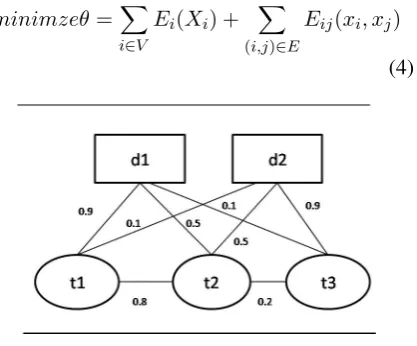
Figure 3 shows an example configuration of the concept graph with three nodest1, t2 andt3 and
two domainsd1andd2. Edges from the nodestito
dj indicates value of cost functionc(p, d)of
equa-tion 2. and edges between nodes ti and tj
andtj. As can be seen in the figure to minimizeθ
of equation 4, nodet1 will be assign to domaind2
and nodet3 will be assign to domaind1. Choice
is to be made fort2, since it has equal cost to be in
d1 ord2. Ift2 is assigned labeld1, then ecostof
equation 2 is 0.8, since label for nodet1andt2will
be different. In the same wayecostwill be 0.2 if t2is assignedd2. So to minimizeθ, Final labeling
ist1andt2are assignedd2andt3is assignedd1.
In other words, to minimize the cost of assign-mentθwe cut the edge (t2,t3). Thus the energy
minimization problem can be solved by perform-ing ‘Min-Cut’ on graph. For two labels the prob-lem is solvable in polynomial time. However, for more than 2 labels, solving this optimization prob-lem is NP hard (Kolmogorov and Zabih, 2002).
In the field of image processing, many prob-lems,e.g. image forground-background detection, image segmentation etc. are formulated as energy minimization in Markov Random Filed. Some of the graph-cut based algorithms to perform the task are,α-expansion,α−β swap (Schmidt and Ala-hari, 2011) andα swap β shrink algorithm . For our experiment we useαswapβshrink algorithm proposed in Schmidt and Alahari (2011). We are briefly describing the basic idea of the algorithms here. Readers are directed to Kolmogorov and Zabih (2002) and Szeliski et al. (2008) for further details.
For more than two labels (domains), a subop-timal solution can be derived by iteratively per-forming graph cut for a pair of labels. This prob-lem is usually solved using iterative descent tech-nique. As shown in algorithm 1, the algorithm start with an initial assignment. In each iteration the algorithm selects a pair of labels and performs the graph cut. Based on the graph cut the labels will be reassigned to the nodes. The energy func-tionθis calculated at the end of each iteration and the value ofθis minimized after every iteration to guarantee the convergence.
3.4 Split-Merge algorithm to Link concept to Wordnet
This module takes domain specific concept graph generated from previous step as an input and as-signs wordnet sense to each term. A term can have more than one sense in the Wordnet and two terms can refer to same Wordnet synset. So the basic approach for the disambiguation is ‘Split for Pol-ysemy and Merge for Synonymy’.
Algorithm 2Link with Wordnet
G(V, E)
V := vertices arranged in breadth first order E := set of edges
|V|:= m|E|:= n
forvi∈V do
create nodev0ifor each sense ofvi
distribute edges across senses
end for
v0:= new sense vertex set; k :=|v0| for i:= 0→kdo
ifEdge setv0i== 0then
deletevi0
end if
for j := 0→kdo
ifEdge setvi0== Edge setv0jthen
mergevi0andv0j
end if end for end for
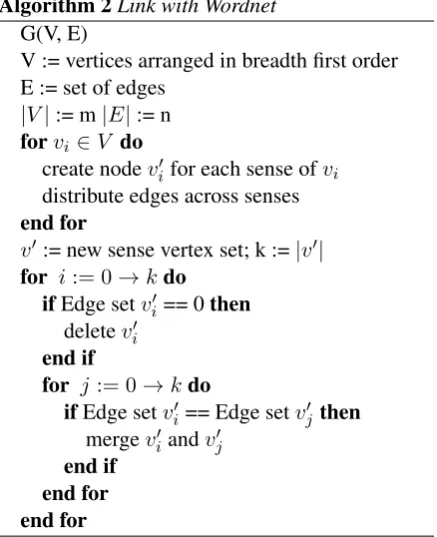
As shown in Algorithm 2, the algorithm iter-ates through the nodes of the concept graph in a breadth first manner. For each vertex in the graph, all possible senses are found from the Wordnet. If a vertex v has n senses then new nodes v1,
v2, ..., vn are created. Then the sense nodes are
linked with each other using Wordnet semantic re-lation, e.g. if two sensessi andsj are
[image:5.595.308.527.67.336.2]hypernym-hyponym in wordnet then and edge is created be-tween them.
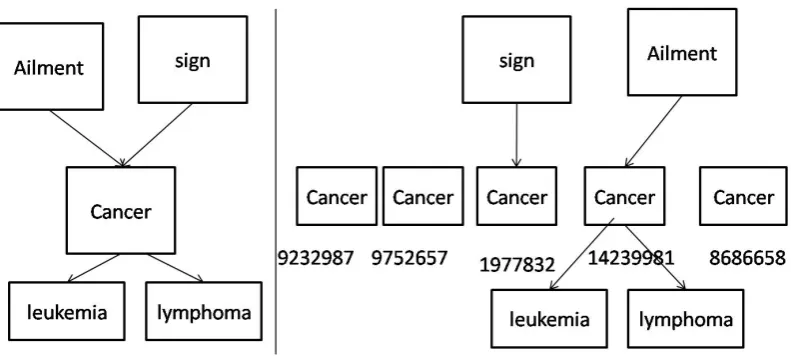
Figure 4 shows an example of vertex split. The left side of the fig. 4 shows concept graph for term node cancer. The term cancerhas five dif-ferent senses. Hence the algorithm creates five nodes for the term, one for each Wordnet sense. Then the edges are distributed across vertices depending upon the participating sense. Node
sign is assigned to sense 1977832, and nodes
leukemia, lymphoma and Ailment are assigned to sense 14239981. Other sense nodes do not have neighbors in the domain. Hence, sense 14239981 becomes winner sense in Health domain and it is tagged in the domain. Right side of the fig. 4 shows resulting wordnet sense graph.
do-Figure 4: Sense Splitting
Health Tourism
#terms 25056 56325
[image:6.595.99.495.161.339.2]#terms after thresholding 4567 5968
Table 1: Corpus Statistics
main tag.
4 Experiments
We have conducted our experiments on publicly available Heath and Tourism Corpus3(Khapra et al., 2010). As shown in Table 1 the total number of unique terms after preprocessing and stop word removal are 25056 in health domain and 56325 in tourism domain. We applied further thresholding and remove low frequency terms (Frequency less than 10) to reduce the size of the graph.
For preprocessing we have used Stanford POS tagger and morpha morph analyzer. We have used Matlab UGM package 4 which is publicly available for researchers. UGM package pro-vides implementation of α-expand, α −β swap
3
http://www.cfilt.iitb.ac.in/wsd/ annotated_corpus
4
http://www.di.ens.fr/˜mschmidt/ Software/alphaBeta.html
Domain Precision Recall F-Score Health 0.69 0.82 0.74 Tourism 0.65 0.80 0.71
Table 2: Precision and Recall of domain labeling
andα-expansion-β-Shrink algorithms. The graph based disambiguation algorithm is written using JGraphT library5.
The overall performance of the system is calcu-lated against manually labeled domain tags. Ta-ble 2 shows overall precision, recall and f-score for both the domains.
As shown in Table 2 the recall value is found to be higher than the precision in both the domains. Reason for high value of recall is the initial labels and high number of edges. Initial labels are as-signed based on the term frequency, then based on the labels of the neighboring nodes, node labels are changed. We observe that in case of two do-mains this leads to add more false positives. In or-der to reduce recall value and increase precision, we need to run experiments for more domains and with higher edge weights.
[image:6.595.307.497.408.453.2]5 Conclusion
We have proposed a novel graph based approach for automatic domain tagging of WordNet synsets. We pose domain labeling as an energy minization problem and show how the existing image label-ing algorithms can be used for the task of Word-Net domain tagging. Our approach is completely unsupervised and can be easily adopted across lan-guages. For our experiments we used term fre-quency based assignment of initial labels, however other existing label can be used to enhance the beling. In future we aim to construct domain la-bels for more domains and compare our system with existing labeling. We are also aiming to test our system for multiple languages.
References
Eneko Agirre and Aitor Soroa. 2009. Personalizing pagerank for word sense disambiguation. In Pro-ceedings of the 12th Conference of the European Chapter of the Association for Computational Lin-guistics, EACL ’09, pages 33–41.
Khurshid Ahmad, Lee Gillam, Lena Tostevin, and Ai Group. 1999. Weirdness indexing for logical document extrapolation and retrieval (wilder). In
The Eighth Text REtrieval Conference.
Luisa Bentivogli, Pamela Forner, Bernardo Magnini, and Emanuele Pianta. 2004. Revising the wordnet domains hierarchy: semantics, coverage and balanc-ing. InProceedings of the Workshop on Multilingual Linguistic Ressources, MLR ’04, pages 101–108.
Paul Buitelaar and Bogdan Sacaleanu. 2001. Rank-ing and selectRank-ing synsets by domain relevance. In
proceedings NAACL wordnet workshop.
Kenneth Ward Church and Patrick Hanks. 1990. Word association norms, mutual information, and lexicog-raphy.Comput. Linguist., 16(1):22–29.
Philipp Cimiano and Johanna Vlker. 2005. Text2onto - a framework for ontology learning and data-driven change discovery. In Proceedings of the 10th In-ternational Conference on Applications of Natural Language to Information Systems (NLDB), volume 3513 of Lecture Notes in Computer Science, pages 227–238.
Fumiyo Fukumoto and Yoshimi Suzuki. 2011. Iden-tification of domain-specific senses in a machine-readable dictionary. InACL (Short Papers), pages 552–557.
William A. Gale, Kenneth W. Church, and David Yarowsky. 1992. One sense per discourse. In Pro-ceedings of the workshop on Speech and Natural Language, HLT ’91, pages 233–237.
Aldo Gangemi, Nicola Guarino, Claudio Masolo, and Alessandro Oltramari. 2003. Sweetening wordnet with dolce. AI Mag., 24(3):13–24.
Aitor Gonzalez-Agirre, Mauro Castillo, and German Rigau. 2012. A proposal for improving wordnet do-mains. InProceedings of Language Resources and Evaluation Conference, pages 3457–3462.
Mitesh M. Khapra, Anup Kulkarni, Saurabh Sohoney, and Pushpak Bhattacharyya. 2010. All words do-main adapted wsd: finding a middle ground between supervision and unsupervision. In Proceedings of the 48th Annual Meeting of the Association for Com-putational Linguistics, ACL ’10, pages 1532–1541.
Jon Kleinberg and ´Eva Tardos. 2002. Approximation algorithms for classification problems with pairwise relationships: metric labeling and markov random fields. J. ACM, 49(5):616–639.
Vladimir Kolmogorov and Ramin Zabih. 2002. What energy functions can be minimized via graph cuts? In Proceedings of the 7th European Conference on Computer Vision-Part III, ECCV ’02, pages 65–81.
Lung-Hao Lee, Yu-Ting Yu, and Chu-Ren Huang. 2009. Chinese wordnet domains: Bootstrapping chinese wordnet with semantic domain labels. In Olivia Kwong, editor,PACLIC, pages 288–296.
Bernardo Magnini and Gabriela Cavagli. 2000. In-tegrating subject field codes into wordnet. pages 1413–1418.
Bernardo Magnini, Giovanni Pezzulo, and Alfio Gliozzo. 2002a. The role of domain information in word sense disambiguation. Natural Language Engineering, 8:359–373.
Bernardo Magnini, Carlo Strapparava, Giovanni Pez-zulo, and Alfio Gliozzo. 2002b. Comparing ontology-based and corpus-based domain annota-tions in wordnet. In First International Global WordNet Conference, Mysore, India.
Mark W. Schmidt and Karteek Alahari. 2011. General-ized fast approximate energy minimization via graph cuts: Alpha-expansion beta-shrink moves. CoRR, abs/1108.5710.
Richard Szeliski, Ramin Zabih, Daniel Scharstein, Olga Veksler, Vladimir Kolmogorov, Aseem Agar-wala, Marshall Tappen, and Carsten Rother. 2008. A comparative study of energy minimization meth-ods for markov random fields with smoothness-based priors. IEEE Trans. Pattern Anal. Mach. In-tell., 30(6):1068–1080.
Wang Yanna and Zhou Zili. 2009. Domain on-tology generation based on wordnet and internet. In Proceedings of the International Conference on Management and Service Science, 2009. MASS ’09, pages 1 –5.