Ship Navigation System Based on Wireless Sensor
https://doi.org/10.3991/ijoe.v14i06.8701
Baofeng Xie!!", Rong Ge Jiangsu Maritime institute, Jiangsu, China
Qinyou Hu
Shanghai Maritime University, Shanghai, China
Abstract—To study the application of wireless sensor in the ship dynamic
positioning system, the distributed fusion function model and structure model of wireless sensor network were set up. Using the DJC model-based SVM pre-diction algorithm, the quadratic optimal performance index in ship dynamic po-sitioning MPC control was solved and the optimal control thrust was obtained. According to the classic cluster routing protocol, a data fusion structure based on residual energy and dormancy scheduling mechanism was proposed. The re-sults showed that the proposed routing protocol based on the residual energy and sleep scheduling mechanism data fusion structure was superior to the Leach protocol. It improved the real-time performance of data transmission. Thus, the network data fusion structure achieves the goal of energy balance. The energy consumption is reduced to a certain extent and the design is reasonable.
Keywords—wireless sensor, ship navigation, model, system
1
Introduction
2
State of the art
There were many researches on ship navigation system and fruitful results were obtained. Perera, L. P. et al. [1] conducted on an experimental setup that consists of a navigation and control platform and a vessel model. They used navigation and control platform to control the vessel model and further divided under two sections: hardware structure and software architecture. Therefore, the physical system was used to con-duct ship maneuvers in autonomous navigation and collision avoidance experiments. Ravichandran, R. and Meena, N [2] explored the ship detection methods with wireless sensor network. They differentiated the ocean and ship generated waves by signal processing and cooperative signal processing techniques and discussed traditional ship detection methods that could monitor a large area but cost more. Deng [3] devel-oped a set of on-line navigation safety monitoring system for liquefied natural gas (LNG) fuelled ship by combining an update Automatic Identification System (AIS) device, some sensors and a software monitoring platform. Perera, L. P. [4] proposed a methodology for overcoming Mamdani-type inference failures on a fuzzy-logic-based decision-making process applied to collision avoidance in ship navigation.
Liu and others [5] designed a stable attitude estimator method through the calibra-tion of IMU's components - accelerometer, gyroscopes and magnetometers. Mean-while, they carried out experiments in simulative ship environment and proved that the proposed scheme could fulfill the demand of pedestrian positioning in nautical situation. Perera and Mo [6] also proposed data analysis techniques to understand marine engine operating regions as a part of the ship energy efficiency management plan (SEEMP) and used Principal Component Analysis (PCA) in the ship energy efficiency management plan (SEEMP) to monitor ship navigation with respect to marine engine operating regions. Zaniewicz, G. et al. [7] discussed the possibilities of external sensors using in mobile navigation system for inland shipping. The analysis of data and sensors availability in this filed was followed with data model definition. Then, they presented various possibilities of integration of spatial data in the system, including typical for GIS, geo-informatic web services approach. Chang and others [8] designed new software-defined wireless network architecture to enable high per-formance in the next generation of ship area networks and proposed a new network architecture, which combines SOTDMA and SDWN advantages to reduce end-to-end transmission delay to achieve high performance in ship area networks. Du, J. L. et al. [9] analyzed the control problem of dynamic positioning for surface ship and com-bined the dynamic surface control technology with the vectorial back-stepping meth-od, based on which, an adaptive robust nonlinear control law of dynamic positioning was proposed. Tomera [10] presented the designs of two observers, which were: the extended Kalman filter and the nonlinear passive observer. Based on the measured values of ship position and heading, the observers estimate the surge, sway and yaw velocities of the ship motion.
distributed fusion function model and structure model of wireless sensor network are set up. The quadratic optimal performance index in ship dynamic positioning MPC control is solved and the optimal control thrust is obtained. As a result, the proposed routing protocol based on the residual energy and sleep scheduling mechanism data fusion structure is superior to the Leach protocol and it has the advantages of effec-tively improving the real-time performance of data transmission.
3
Methodology
In ship dynamic positioning control system, data fusion is adopted. The main pur-pose is to enhance monitoring redundancy and improve data transmission reliability, accuracy and real-time. Fusion information comes from a number of different sensors. The data types, sampling frequency, location and angle of the multi-sensor are differ-ent. It has the characteristics of inaccuracy, incompleteness, unreliability, fuzziness, and reporting conflict. In order to operate the data in real time, a large knowledge base is needed, which makes the data fusion very complicated. The whole data fusion model is divided into functional model and structure model. The function model mainly describes the function of data fusion in the process of data fusion, and the interaction process between the database and the data fusion system. The structure model consists of the hardware and software of the data fusion system, the processing mode of data information, and the human-computer interface of the system and the external environment.
3.1 Functional model
According to the degree of abstraction of the sensed data, it is divided into data level, feature level and decision level. Data level fusion directly integrates raw data collected by the underlying sensors, rather than synthesizing and analyzing all kinds of data before the original prediction data of the sensor is not processed. This is the minimum level of fusion, which can provide as much as possible other field data that cannot be provided by other fusion levels. However, it needs to deal with a large amount of sensor data, so the layer fusion has poor real-time performance, high cost and long processing time. This fusion is carried out in the lowest data fusion layer. Because the information of the original sensor has the characteristics of large amount of data and poor anti-interference ability, data fusion needs a good error correction processing capability.
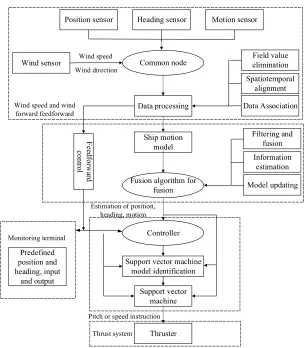
fusion of target characteristics. The state data fusion is used to preprocess the sensor data and verify the data. Then, the main parameters and the related state vectors are estimated. Feature fusion is based on pattern recognition technology, and the feature is processed by correlation. The feature vectors are divided into meaningful combina-tions. Decision level fusion is the result of three level fusions. The layer fusion must start from the actual problem and make full use of the feature extraction results. The final fusion results directly affect the specific level of decision-making. The layer fusion can effectively reflect the different types of information on the various sides of the environment or target. The results of the fusion will not affect the decision result because of the error of individual sensor measurement. Therefore, it has good flexibil-ity, fault tolerance and anti-interference ability. According to the three levels data fusion structure of the multi-sensor, the specific function model of the ship dynamic positioning system can be designed, as shown in Figure 1.
Position sensor Heading sensor Motion sensor
Common node
Data processing
Ship motion model
Fusion algorithm for fusion
Controller
Support vector machine model identification
Support vector machine
Thruster
Wind sensor Field value elimination
Spatiotemporal alignment Data Association
Fe
edforw
ard
cont
rol
Filtering and fusion Information
estimation
Model updating
Predefined position and heading, input
and output
Wind speed Wind direction
Wind speed and wind forward feedforward
Estimation of position, heading, motion
Monitoring terminal
Pitch or speed instruction
Thrust system
3.2 Structural model
The system structure consists of the lowest sensor nodes, transmission networks, converging nodes and management terminals. A number of sensor nodes are distrib-uted in a number of non-adjacent monitoring areas, to form a number of clusters. It guarantees the accuracy of the data and the robustness of the system. The cluster head node is responsible for the fusion of the data transmitted by the sensor nodes. Then, it is transmitted to the aggregation node for decision fusion. The common nodes, espe-cially the nodes on the edge of the network, are responsible for data acquisition and data preprocessing. Each node in the transmission network has strong computing power and storage capacity. In order to ensure the reliable communication between the local converging nodes and the converged nodes, the uninterrupted power supply can be used.
The convergence node and the management terminal are connected through the bus network. The result of decision fusion at the aggregation node is sent to the manage-ment terminal. The data records are stored in the local database. According to the reliability requirements of data, in practical applications, data collected by sensor nodes can be sent to a central database through the client, to provide remote data ser-vices. Each sensor node is equivalent to the traditional network terminal and routing functions in terms of network functions. It also works with other sensor nodes to complete data acquisition, data processing, data storage, fusion and forwarding. Com-pared with the common sensor nodes, the data processing and communication ability of the converged node is strong. It needs to communicate with the external network, such as the connection of the sensor network and the bus transmission network, to achieve the transformation between the search for both protocols. At the same time the terminal is monitored, the task is released, and the collected data is forwarded on the external network.
4
Result Analysis and Discussion
4.1 The application of strong converging node fusion structure in MPC
control
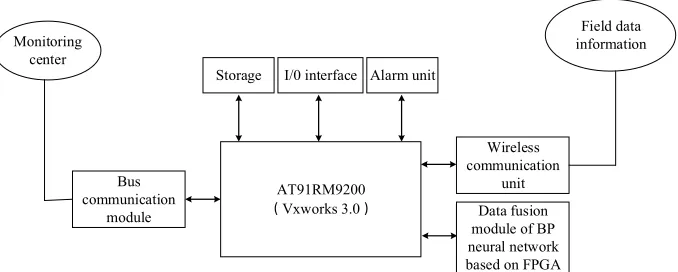
Storage I/0 interface Alarm unit
AT91RM9200 �Vxworks 3.0� Bus
communication module
Wireless communication
unit Data fusion module of BP neural network based on FPGA Monitoring
center
Field data information
Fig. 2. The structure of the convergence node of the ship dynamic positioning system
In the ship dynamic positioning system, MPC (model predictive control) has the function of prediction. Using its robustness to changes in the environment and system parameters, the deviation between the measured and estimated values is corrected before it is produced. Compared with the traditional PID control method, MPC con-trol can better deal with the constraints of the dynamic positioning system. It has strong security and robustness. In addition, the MPC control is used in the constraint processing of the dynamic positioning system. MPC control can be applied to SISO and MIMO systems, linear and nonlinear systems. It is handled by a simple method of constraint. The input and output constraints are included in the expression. At each sampling time, the controller is updated. It has a strong self-adaptive ability.
Most of the control applications need to meet two types of constraints, input (state volume) constraints and output (control) constraints. The input constraint is caused by the actuator physical restriction, that is, the so-called "actuator saturation". The output constraint is caused by security reasons or other operating reasons of the controlled object. The input limit cannot be violated in any case, which is called a hard con-straint. The output constraint can be violated in a certain range, which is called a soft constraint.
Constraints in ship dynamic positioning system can be roughly divided into power consumption constraints (hard input constraints), thruster loads (hard input con-straints), operating areas and work areas (hard and soft output constraints). The thrust linear quadratic optimal control of ship power system transforms the performance measure of thrust distribution into a quadratic function of state variables and control variables. Then, the optimal solution of the quadratic function containing these quad-ratic performance indices is found, and some constraints can be transformed into linear inequality constraints. Therefore, the optimal control of quadratic performance index becomes a dynamic programming problem. There are input and output con-straints in the dynamic positioning system. It includes propulsion restraint, work area, operating area constraints. The operating area is represented by a weighted linear inequality. The work area is represented by a weighted quadratic inequality, that is
, .
val-ues of the A time position and the heading. The inequality constraints mentioned above can be described as .
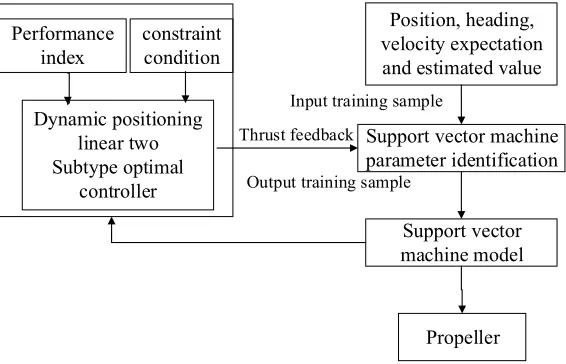
The support vector machine prediction algorithm based on DJC model is used to transform the input sample vector into a high dimensional space. The linear relation-ship between input and output vectors is obtained in high-dimensional space. The optimal regression function is obtained, which corresponds to the nonlinear optimal regression function in low dimensional space. Then, by choosing the appropriate kernel function to replace the inner product of the optimal regression function, a line-ar fit of the nonlineline-ar optimal regression function can be achieved. Through this lineline-ar optimal regression function, the global optimal solution is obtained. Therefore, the SVM can solve the nonlinear problem of quadratic optimal performance index. The parameters of the support vector machine model can be realized through the hard-ware-in-the-loop structure of the FPGA-based BP neural network of sink nodes in the network. In order to reduce the computational load of aggregation nodes, this DJC structure model can disperse the thrust prediction process of MPC controller to some cluster head nodes. The sink node only needs to perform an optimal weighted fusion on the thrust prediction uploaded by the cluster head node. The optimal control thrust result is obtained. The schematic diagram of the support vector MPC controller is shown in Figure 3.
Performance
index constraint condition
Dynamic positioning linear two Subtype optimal
controller
Position, heading, velocity expectation and estimated value
Support vector machine parameter identification
Support vector machine model
Propeller Input training sample
Output training sample Thrust feedback
Fig. 3. The schematic diagram of the support vector MPC controller
The MPC control of support vector machine is simulated. First of all, it is clear that the linear quadratic form control of ship dynamic positioning system is achieved by minimizing the performance index. The linear constant system is given:
(1)
The quadratic performance index function is:
(2)
In the formula, e is the error variable of the state estimation and the expected value. represents the requirements for dynamic performance. Q is a positive sem-idefinite symmetric weighted matrix. represents the requirements for the control of energy. R is a positive definite weighted matrix. For linear time invari-ant systems, according to the linear two order optimal control law, the system can be obtained.
(3)
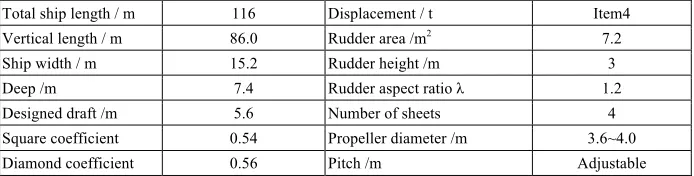
It can be seen from the optimal performance index function that the first integral item is the requirement for the dynamic performance of the system, that is, the trajec-tory and time requirements of the expected state from the initial state. The second item indicates the requirement of the system to control the energy. The elements of the weighted matrix represent the relative importance of the state variables and the components of the control variables. The experimental ship model parameters are as shown in Table 1.
Table 1. Ship model parameters used in simulation experiments
Total ship length / m 116 Displacement / t Item4
Vertical length / m 86.0 Rudder area /m2 7.2
Ship width / m 15.2 Rudder height /m 3
Deep /m 7.4 Rudder aspect ratio ! 1.2
Designed draft /m 5.6 Number of sheets 4
Square coefficient 0.54 Propeller diameter /m 3.6~4.0
Diamond coefficient 0.56 Pitch /m Adjustable
0 2 4 6 8 10 12 14 16 18 20 -10
-5 0 5 10 15
Pr
op
el
ling
f
orc
e(
10
3N)
Time series
The propelling force obtained by the optimal two order type Propelling force predicted by DJC-SVM model
Fig. 4. The prediction error of the lateral control force of the ship
0 2 4 6 8 10 12 14 16 18 20
-10 -8 -6 -4 -2 0 2 4 6 8 10
Pr
op
el
ling
forc
e(
10
3N)
Time series
The propelling force obtained by the optimal two order type Propelling force predicted by DJC-SVM model
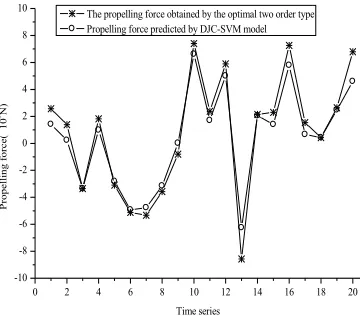
Fig. 5. The prediction error of the longitudinal control force of the ship
As can be seen from Figure 4 and Figure 5, the propulsive force predicted by the DJC-SVM model is basically consistent with the propulsive force obtained from the optimal quadratic calculation. It shows that DJC-SVM model prediction can really solve the nonlinear problem of quadratic optimal performance index. In the DJC-SVM model, the parameter identification based on the pulsating array fusion structure of convergence nodes is further proved. The rationality and validity of the SVM mod-el method are updated in real time.
4.2 Design and analysis of routing protocol for dynamic positioning system based on data fusion
In the ship dynamic positioning system, the basic function of WSN is to collect da-ta in real time, and immediately upload the monitoring information of each sensor node. This will cause the node to start frequently, and the amount of communication and energy will increase. Therefore, it is necessary to adopt a certain data fusion algo-rithm in the network layer routing protocol design and application layer of the sensor network. Based on the residual energy and dormancy scheduling mechanism, the network layer data fusion structure and the network layer data fusion mechanism are adopted. The MAC layer sleep scheduling mechanism is applied to routing layer pro-tocol, which can not only improve the real-time performance of data transmission, but also save energy. When the cluster head is selected, the residual energy of the node is considered, and the equilibrium principle is used to solve the problem of the uneven distribution of nodes in each cluster. The strategy of hierarchical forwarding and de-lay retransmission is adopted to prevent congestion when a large number of data are transmitted. It reduces the delay of data transmission and enhances the real time.
For traditional network layer data fusion mechanism, data centric routing algorithm must be used to identify data and realize data exchange at cross protocol level. The different data types of the same sensor nodes cannot be fused. The agreements of each layer are independent and complete. It lacks mutual transparency. The ability of adap-tive network load is insufficient.
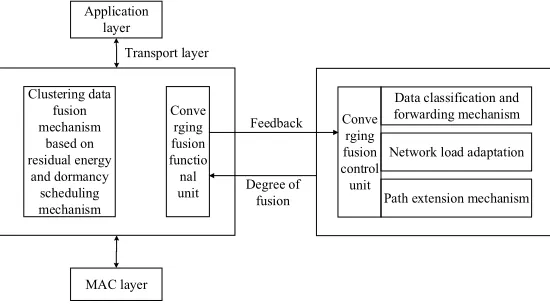
The traditional network layer data fusion mechanism is overly dependent on the application. Aiming at this shortage, the network layer data fusion mechanism inde-pendent of application is designed. It is not concerned with the content of data trans-mission. The core idea is to merge multiple data units based on the next hop address. Data transmission is used to transmit data and extend the path. The MAC layer trans-mission conflict is reduced to achieve the energy saving effect. The data fusion mech-anism independent of the application is shown in Figure 6.
Application layer
MAC layer Clustering data
fusion mechanism
based on residual energy
and dormancy scheduling mechanism
Conve rging fusion functio nal unit
Conve rging fusion control unit
Data classification and forwarding mechanism
Network load adaptation
Path extension mechanism Transport layer
Feedback
Degree of fusion
Convergence and fusion function unit mainly converges the network packet data and cancels the fusion operation. The convergence and fusion control unit is mainly responsible for adjusting the degree of fusion based on the idle state of the link and the state control of the state of the load. The data packet sent by the network layer enters the converging fusion function unit. The next hop address of the same data unit is fused and sent to the MAC layer for transmission. The call time and fusion degree of the fusion functional unit are determined by the fusion control unit. The data up-loaded by the MAC layer is decomposed into the original network layer data unit and transmitted to the network layer, to allow the network layer to reconstruct the routing of each data packet. In converged fusion functional units, a data fusion structure based on residual energy and dormancy scheduling mechanism is used.
The formation of clusters has a great influence on the life cycle and other perfor-mance of the network, so it plays an important role in the network protocol. Aiming at the problem of unstable cluster heads, uneven distribution of cluster heads and uneven distribution of cluster members in most classical clustering protocols in wireless sen-sor networks, the following cluster head selection mechanism is proposed. Based on the minimum network energy, the optimal cluster head formula is:
(4)
The number of the optimal cluster heads is only related to the area a of the wireless sensor network. The number of nodes is N. The communication parameters between the cluster members and the cluster heads are µfs. The data transfer between the clus-ter head and the aggregation node is µmp. The base station coordinate is (r, q). The energy consumed by the cluster head to receive the unit bit data of the member nodes in the cluster is EeRX. The cluster head sends the energy EeTX of the unit bit data to the member nodes in the cluster. Formation process of cluster data fusion based on resid-ual energy dormancy scheduling is shown in Figure 7.
Division area
Cluster head selection
Calculating the value of T (n) of each node according to the optimal cluster head selection formula and the threshold formula
T (n) larger than energy random number
Become the head of the candidate cluster
Broadcasting cluster head information according to the formula of cluster radius
There are other candidate cluster heads within the range of the cluster radius
Comparison of residual energy determinant cluster head
Node joining cluster process
Whether other subclusters are clustered
Wake-up dormancy node
Cluster stabilization process
Next round
Be eliminated
This node is a cluster head
Dormant sub domain node
Wait for all the clusters to complete N
Y
N
Y
N
Y
Fig. 7. Formation process of cluster data fusion based on residual energy dormancy scheduling
The cluster head selection mechanism used in this paper can adjust the energy adaptively. In the new round of cluster formation, the residual energy is an important requirement for the head of the node election cluster. If the energy is sufficient, the node can run for the head of the cluster. Therefore, the average energy of the network and the residual energy factors of the node are considered when choosing the cluster head. The new threshold formula is:
(5)
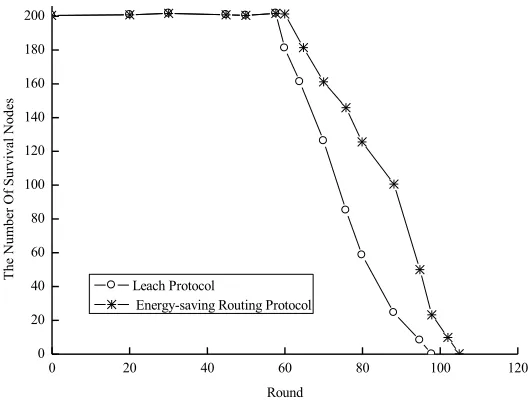
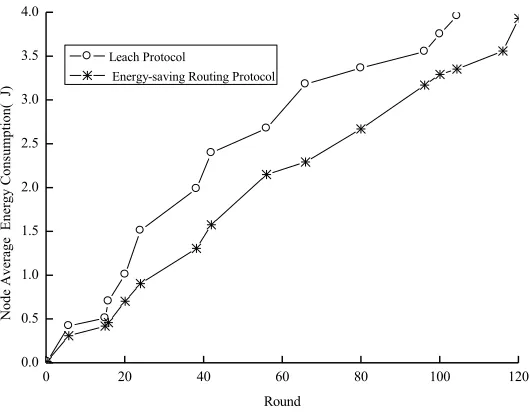
The cluster heads in all subdomains are selected. The cluster head sends a broad-cast notifies the other domain nodes to be cluster heads. The rest of the nodes decide to join the cluster according to the principle of equilibrium and send messages to the cluster head. When a sub domain is formed, if other sub domains have not yet com-pleted the formation of clusters, all nodes in the subdomain will go to sleep and wait for the formation of other sub domain clusters. The innermost subdomains first com-plete the formation of the cluster, and the outer subdomain is finally comcom-pleted. In this way, the problem of the ownership of cluster heads and other nodes in each sector is solved. The following nodes transfer ID, location and residual energy information to their cluster heads. According to the residual energy value of all nodes, the cluster head node obtains the average residual energy Em in the cluster and assigns the con-trol time slot to each node. Two important performance indicators for measuring the network layer data fusion structure of wireless sensor networks are network survival time and average energy consumption. These two performance indicators are simulat-ed. The data fusion structure based on the classical Leach protocol and the data fusion structure based on the residual energy and the dormancy scheduling mechanism pro-posed in this paper are compared.
It is assumed that 200 nodes are randomly distributed in the range of 100x100, and Matlab is used to simulate. The experimental parameter setting is: The initial energy of the node is 4J, and the generation probability of the cluster head is 0.05. The two parameters involved in the principle of equilibrium are: The intensity ratio of the cluster head signal is =1.5. The difference between the number of cluster heads is !=5. Each packet size is 50bit. The energy EeRX and EeTX consumed by each node to receive or send data is 50Ni/bit. The comparison of network lifetime is shown in Fig-ure 8. The comparison of the average energy consumption is shown in FigFig-ure 9.
0 20 40 60 80 100 120
0 20 40 60 80 100 120 140 160 180 200
The N
um
ber
O
f Su
rvi
val
N
od
es
Round Leach Protocol
Energy-saving Routing Protocol
0 20 40 60 80 100 120 0.0
0.5 1.0 1.5 2.0 2.5 3.0 3.5 4.0
N
od
e
A
ver
age
E
ner
gy
C
on
sum
pt
ion
(
J)
Round
Leach Protocol
Energy-saving Routing Protocol
Fig. 9. The comparison of the average energy consumption
From the simulation results in Figure 8 and Figure 9, in terms of network life cycle and average energy consumption, the proposed routing protocol based on the residual energy and sleep scheduling mechanism data fusion structure is superior to the Leach protocol. This shows that the network data fusion structure achieves the goal of ener-gy balance and reduces the enerener-gy consumption to a certain extent. The design is reasonable.
5
Conclusions
The data fusion of network transmission function was applied to the ship dynamic positioning system. According to the classic cluster routing protocol, a data fusion structure based on residual energy and dormancy scheduling mechanism was pro-posed. The data fusion method of common sensor nodes and converging nodes was based on a reasonable and reliable data fusion structure and data transmission mode. At last, the following conclusions are drawn:
(1) The first integral item is the requirement for the dynamic performance of the system, that is, the trajectory and time requirements of the expected state from the initial state.
(2) The proposed routing protocol based on the residual energy and sleep schedul-ing mechanism data fusion structure is superior to the Leach protocol and it improves the real-time performance of data transmission.
6
Reference
[1]Perera, L. P., Ferrari, V., Santos, F. P., Hinostroza, M. A., & Soares, C. G. Experimental evaluations on ship autonomous navigation and collision avoidance by intelligent guid-ance. IEEE Journal of Oceanic Engineering, 2015, vol. 40(2), pp. 374-387. https://doi.org/10.1109/JOE.2014.2304793
[2]Ravichandran, R., & Meena, N. An Instantaneous Power Saving Method in Ship Detection with Wireless Sensor Network. Networking and Communication Engineering, 2014, vol. 6(3, pp. 97-102.
[3]Deng, J. Real-time Navigation Monitoring System Research for LNG-Fuelled Ship in In-land Water. Journal of Maritime Research, 2017, vol. 12(2), pp. 95-102.
[4]Perera, L. P., Carvalho, J. P., & Soares, C. G. Solutions to the failures and limitations of Mamdani fuzzy inference in ship navigation. IEEE Transactions on Vehicular Technology, 2014, vol. 63(4), ppp. 1539-1554.
[5]Liu, K., Xie, Y., Chen, M., & Ma, J., October. Ship-board pedestrian positioning method by integrating Dead Reckoning and Wireless Sensor Networks. In Navigation World Con-gress (IAIN), International Association of Institutes of , 2015, pp. 1-7
[6]Perera, L. P., & Mo, B. Data analysis on marine engine operating regions in relation to ship navigation. Ocean Engineering, 2016, vol. 128, pp. 163-172. https://doi.org/10.1016/ j.oceaneng.2016.10.029
[7]Zaniewicz, G., Kazimierski, W., & Bodus-Olkowska, I, June. Integration of spatial data from external sensors in the mobile navigation system for inland shipping. In Geodetic Congress (Geomatics), Baltic 2016, pp. 165-170.
[8]Chang, S. H., & Mao-Sheng, H. A novel software-defined wireless network architecture to improve ship area network performance. The Journal of Supercomputing, 2017, vol. 73(7), pp. 3149-3160. https://doi.org/10.1007/s11227-016-1930-5
[9]Du, J. L., Yang, Y., Hu, X., & Chen, H. Q. Control law design of dynamic positioning for ship based on dynamic surface control. Journal of Traffic and Transportation Engineering, 2014, vol. 14(5), pp. 36-50.
[10]Tomera, M. Nonlinear observers design for multivariable ship motion control. Polish Maritime Research, 2012, vol. 19, pp. 50-56. https://doi.org/10.2478/v10012-012-0023-5
7
Authors
Baofeng Xie and Rong Ge are with Jiangsu Maritime Institute, Jiangsu, China.
Qinyou Hu is with Shanghai Maritime University, Shanghai, China.