An Improved Mixed Gas Pipeline Multivariable
Decoupling Control Method Based on ADRC
Technology
Zhikun Chen1, 2
1 Electrical Engineering College, Yan Shan University, Hebei Qinhuangdao 063009, China; 2 College of Electrical Engineering, Hebei United University, Hebei Tangshan 063009, China
Email: [email protected]
Yutian Wang1, Ruicheng Zhang2 and Xu Wu2
1 Electrical Engineering College, Yan Shan University, Hebei Qinhuangdao 063009, China; 2 College of Electrical Engineering, Hebei United University, Hebei Tangshan 063009, China
Email: {[email protected], [email protected], [email protected]}
Abstract—According to the serious decoupling, uncertainty,
easily disturbed and nonlinear characters of the gas mixture of butterfly valve string couplets system, an ADRC static decoupling technology and the dynamic decoupling method based on extended state observer (ESO) were proposed. In this method, coupling from other input, parameters time-varying and external disturbances are all regarded as a total disturbance. The total disturbance can be estimated by ESO and feedback to controller, and coupling is achieved. In order to improve response speed of the system, and reduce the computation, this control system use nonlinear tracking-differentiator(TD), ESO and the nonlinear state error feedback control law (NLSEF) uses nonlinear function.Simulation results shows that, in this method, the decoupling is simplified, and the requirement of the model is reduced. The novel method can also ask for less calculation with faster response and better robustness, still with good tracking performance and disturbance rejection capability, the decoupling effect is fine.
Index Terms—gas mixing; active disturbance rejection
control (ADRC); extended state observer (ESO); decoupling
I. INTRODUCTION
For the steel industries, gas compressor stations is a very important units, it is responsible for the iron and steel group and the surrounding cities with mixed gas calorific value and pressure. If the gas compression station stops, all units of the iron and steel group have to stop manufacturing.As the iron and steel production processes and the geographical layout of the business characteristics and complex situation of the production statement, it requires the mixed gas pressure station control system to adapt to the following features:
(1) The variability of the in-put and out-put pressure that under the effect of the upstream user and downstream user change in the amount.
(2) Medium is the gas, and change-process in a long term.
(3) Volatility characteristics of the pipe network. Obviously, we are facing with a mathematical model which is difficult to determine with great delay and nonlinear parts of the complex controlled object.
With the more and more complex, characters as uncertainty, interference, nonlinearity, non-minimum phase, etc, more than one variable is needed to be regulated. And there are several interrelated variables. Traditional single-variable control system designed approach is clearly unable to meet the requirements. In engineering area, bring in the multi-variable decoupling is common. There are two butterfly valves in pipeline blast, coke pipe also have two butterfly valves, by adjusting this four valve, regulation of coke oven gas and blast furnace gas flow ratio, to achieve the ratio of calorific value and pressure regulation.There is serious coupled between the flow control and pressure regulator [1], at the same time the regulation of the four butterfly valves are also interaction, this implies that there is a relative strong coupling in this system. In recent years, along with the development of control theory, a variety of decoupling control method adapt to the times require.
Gas mixing
PV104
PV103
PV102
PV101
Fig 1. Process mixed gas compressor stations
pressure decoupling control loop and the pressure control loop. However, because the two valves series on the blast furnace gas pipes and the two valves series on the coke oven gas pipes are very close, the literature one pointed that: this is a typical strong coupling system.
Because of this,we explore a new control method—— Active Disturbance Rejection Control (ADRC),use this technology in mixed gas pipeline multi-variable system, in order to achieve better control results. ADRC have 3 parts: the tracking differentiator (TD),extended state observer (ESO) and nonlinear state error feedback control law (NLSEF).It is a kind of nonlinear controller that not dependent on the model, it attributed the model uncertainty and unknown external disturbance effects (including the coupling term) to the general disturbance of the system, by the extended state observer (ESO) to real-time estimation and dynamic compensation, there are many advantages, such as high precision, fast response, robustness, usability, etc. Active disturbance rejection control is to adapt the trend of digital control, absorb the results of modern control theory, development and application of nonlinear effects to develop new practical technologies.Therefore, in this paper, used ADRC static decoupling technology and ESO dynamic decoupling techniques, established multi-variable control system of gas mixed, realize the decoupling control of two butterfly valves.
II. PROCESS INTRODUCTION
According to the law of energy conservation, the heat value of mixed gas, such as (1) below.
R3Q3 =R1Q1 +R2Q2 (1)
Symbol subscript l, 2, and 3 were side coke oven gas, blast furnace gas and mixed gas.
Among, R-gas calorific value (KJ /m3), Q—gas flow
(m3/s)
Simplify process of gas mixing compression station shows in figure 1.There are two butterfly valves in blast furnace gas pipeline,coke oven gas pipeline also have two butterfly valves, by adjusting this four valve, regulation of coke oven gas and blast furnace gas flow ratio, to achieve the ratio of calorific value and pressure regulation.The mixture of gas pressurized from the compression machine, compressor stations are generally installed in the inverter, by adjusting the frequency converter to change the speed of pressure machine to adjust the pressure purposes.
The design of four-valve regulating mixed-gas heating value was first proposed by the Japanese Nippon Steel Corporation, at present, the vast majority of gas pressure regulating stations have adopted such a program.
Why the butterfly in country has been developing rapidly, the reason is it has the following advantages:
(1) Simple structure, the installation length is short, easy layout, valve installation is far less than the length of DN, installation length and the nominal diameter ratio of only 0.2~0.1;
(2) Small size, light weight;
(3) Liquidity resistance is small. When the Low-pressure valve fully open, liquidity resistance coefficient <1;
(4) Switch is simple, just turn on a dish plate 90 °. Butterfly valve has many advantages, but there is a drawback: most valve impatience pressure. In high-pressure environment, in order to solve the high high-pressure problem, general with double butterfly valve series pressure points. This is also the reasons why gas compressor stations using butterfly in series design.
Through the butterfly valve to regulate gas flow, gas pressure, gas heating value, the main principle is based on equation (2)
ξ γ P g A
Q= 2 Δ
(2) In equation (2):
Q —volume flow (m3/s
), that is volume of gas flows through the pipe cross-sectional area in per second
A —pipe circulation sectional area(m2) ξ —drag coefficient, dimensionless
g —acceleration of gravity (m s2 )
△P—pressure differential is ) / )(
( 2
2
1 p kgf cm
p − , p1 , p2 respectively is before
and after the pressure of valve. γ —medium severe (kgf m3
)
For simplicity, excluding the impact of the density before and after mixing, obtain equation (3)
Q3 =Q1+Q2 (3)
Symbol subscript l, 2, 3were side coke oven gas, blast furnace gas and mixed gas.
According to (3), because the total flow Q3 of mixed gas is uncontrolled, decision by the users, when a gas flow rate changes, need to change another gas flow to reach the purpose of regulate the mixed gas calorific value.
III. THE MODEL OF THE GAS MIXING BUTTERFLY VALVE GROUP
U
2U
1 g a s o f c o k e o v e nQ
P
2P
1P
0N u m b er tw o b u tte rfly v a lv e N u m b e r o n e
b u tte rfly v a lv e
Fig.2. Pipe system of pressure-flow
G2(s ) G1( s )
Y2(s )
Y1(s )
R2(s )
R1(s )
λ2 2
λ1 2
λ2 1
λ1 1
Fig 3. Gas mixing process control block diagram matrix to decision that how to adjust the two valves of
corresponding valve group in the end.
Due to the high valve and focal valve pressure distribution of the basic ideas are exactly the same, for example by coke oven butterfly group.
In the fig 2, P0 is coke oven gas pressure before the number one butterfly valve. P1 is coke oven gas pressure before the number two butterfly valve. P2 is coke oven gas pressure before the number two butterfly valve. u1, u2 are the opening of number one and number two butterfly valves. Q is the gas flow of coke oven pipeline.
According to the literature10, pressure-flow process can be described as
0 2)
2 1 2 1 2 1 2 1 0
1( ) ( ) (P P
u u u u P P u P P u Q − + = − = −
= (4)
When two circuits are in the open loop, the first amplification factor is
(
0 2)
2 2 1 2 cos 1 2 P P u u u u Q t u − ⎟⎟ ⎠ ⎞ ⎜⎜ ⎝ ⎛ + = ∂ ∂ = (5)
Closed loop pressure, the first amplification factor is
(
0 2)
2 1 2 1 0 cos 1 1 P P u u u P P u Q t p − + = − = ∂ ∂ = (6)
According to the definition of a relative gain
2 1 2 cos 1 cos 1 11 2 2 u u u u Q u Q t P t u + = ∂ ∂ ∂ ∂ = = =
λ (7)
From equation (4) and solve for u1 and u2 into equation (7).can be used pressure to represent the gain
2 0
1 0
11 P P
P P
− − =
λ (8)
can also find the relative gain of the u2 and flow Q
2 0
2 1
12 P P
P P
− − =
λ (9)
If use P1 to describe the pressure-flow system, is
2 1 2 2 0 1 2 2 1 0
1 u u
P u P u u Q P u Q P P + + = + = −
= (10)
Another gain can be determined, solve partial derivative for equation (10), can derived the relative gain of u1, u2 for two channels of the P1.
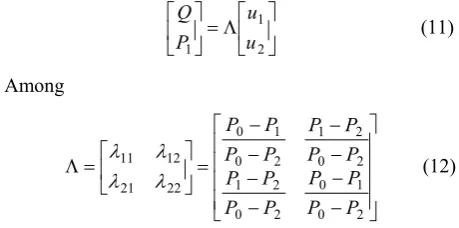
Then, pressure-flow system of input-output relationship can be expressed by relative gain matrix as
⎥ ⎦ ⎤ ⎢ ⎣ ⎡ Λ = ⎥ ⎦ ⎤ ⎢ ⎣ ⎡ 2 1 1 u u P Q (11) Among ⎥ ⎥ ⎥ ⎥ ⎦ ⎤ ⎢ ⎢ ⎢ ⎢ ⎣ ⎡ − − − − − − − − = ⎥ ⎦ ⎤ ⎢ ⎣ ⎡ = Λ 2 0 1 0 2 0 2 1 2 0 2 1 2 0 1 0 22 21 12 11 P P P P P P P P P P P P P P P P λ λ λ λ (12)
If in the system P1close to P2,Λ is very close to the unit matrix, instructions to control the flow with a valve 1, with a valve 2 to control pressure P1 is appropriate. If P1 close to P0, use valve 2 to control flow and with a valve 1 to control pressure P1 is appropriate.if P1close to the midpoint of (P0-P2), adjusting the two valves are the best.
System of coke oven gas pipeline pressure is P0=6.2kPa, P1=5.5kPa, P2=5.0kPa, the gain matrix is
⎥ ⎦ ⎤ ⎢ ⎣ ⎡ = ⎥ ⎦ ⎤ ⎢ ⎣ ⎡ = Λ 58 . 0 42 . 0 42 . 0 58 . 0 22 21 12 11 λ λ λ λ
λi,jvery close to 0.5 shows that there are serious coupling in this system. From equation (11), we could be find the mathematical model of this control system can be expressed as ⎥ ⎦ ⎤ ⎢ ⎣ ⎡ Λ = ⎥ ⎦ ⎤ ⎢ ⎣ ⎡ ) ( ) ( ) ( ) ( ) ( 2 1 2 1 s u s u s G s y s y (13)
Among y1(s)=Q(s) and y2(s)=P(s)
{
( ), ( )}
)(s diagG s G s
1/b0 b0
z23
z22
z21 ESO
TD object y
w
u u0
NLSEF
e2
e1
z12
z11
z
Fig.4. Structure of ADRC
In debugging the process of trial and
error ( ) 1
0 1 s =T sK+
G , in the equation, 2, 1.5 0 =
= T
K
Gas mixing process control block diagram shown in figure 3.
IV. ADRCDECOUPLING CONTROLLER DESIGN FOR BUTTERFLYVALVE SERIES SYSTEM
ADRC have 3 parts, the tracking differentiator (TD), extended state observer (ESO) and nonlinear state error feedback control law (NLSEF).Structure shown in the figure4.
Tracking differentiator (TD) is used to arrange the transition process, fast without overshoot to track the input signal, and has a better differential characteristic. Avoid when the set value mutations, control the amount of violent changes and output overshoot, largely solved the contradiction between of system response speed and overshoot. Precisely because of this the ADRC requirements in high speed applications are subject to certain restrictions.
Extended state observer (ESO) is the core part of ADRC, it can be attributed from the system internal or external factors to the disturbance of the system, through the extended state observer to estimate the system all state variables simultaneously estimate the system's internal and external disturbances and appropriate compensation, in order to achieve the dynamic feedback linearization.
Tracking differential output and extended state observer estimation to take error, and get the system the state variable error. The amount of error into the nonlinear state error feedback control law (NLSEF), after the operation, add from the compensation amount of the extended state observer, the final receive the control amount of charged with object.
Because disturbance rejection controller is based on the time scale of the system to divide objects, when design the controller, do not consider the linear or nonlinear, time-varying or time-invariant of the system, thus simplifying the controller design.
A. ADRC Static Decoupling
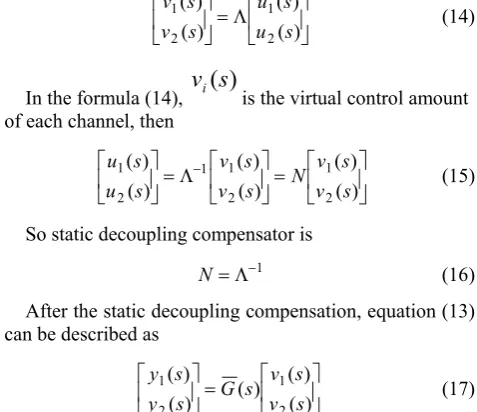
ADRC static decoupling can use conventional controller to achieve. Due to the actual operation process, static coupling matrix Λ is uncertain. Therefore, within the scope of its changes to take a rough estimateΛ ≈ Λ0 ,
approximation error can be attributed to disturbance. Static decoupling compensator used in the decoupling controlled objects, command
⎥
⎦ ⎤ ⎢ ⎣ ⎡ Λ = ⎥ ⎦ ⎤ ⎢ ⎣ ⎡
) (
) ( )
( ) (
2 1
2 1
s u
s u s
v s v
(14)
In the formula (14),
v
i(
s
)
is the virtual control amount of each channel, then⎥
⎦ ⎤ ⎢ ⎣ ⎡ = ⎥ ⎦ ⎤ ⎢ ⎣ ⎡ Λ = ⎥ ⎦ ⎤ ⎢ ⎣
⎡ −
) (
) ( )
( ) ( )
( ) (
2 1
2 1 1
2 1
s v
s v N s v
s v s
u s u
(15)
So static decoupling compensator is
N=Λ−1 (16) After the static decoupling compensation, equation (13) can be described as
⎥
⎦ ⎤ ⎢ ⎣ ⎡ = ⎥ ⎦ ⎤ ⎢ ⎣ ⎡
) (
) ( ) ( ) (
) (
2 1
2 1
s v
s v s G s y
s y
(17)
Visible, ADRC static decoupling technology break through the limit of the conventional decoupled method of matrix inversion, it only need to know a rough estimate of Λ, that is Λ0,and singularity of Λ is not limited. For the
reason of the uncertainty or singular to Λ due to error of approximation, ADRC put it as a new disturbance, then automatically estimated and compensated. As long as the difference between them not very large, you can achieve a good decoupling objective. Therefore, ADRC static decoupling method adapt to wider range, better robustness.
B. ADRC Decoupling Control Design
The ADRC is based on the idea that in order to formulate a robust control strategy. Although the linear model makes it feasible for us to use powerful classical control techniques such as frequency response based analysis and design methods, it also limits our options to linear algorithms and makes us overly dependent on the mathematical model of the plant. Instead of following the traditional design path of modeling and linearizationand then designing a linear controller, the ADRC approach seeks to actively compensate for the unknown dynamics and disturbances in the time domain. Once the external disturbanceis estimated, the control signal is then used to actively compensate for its effect, and then the system becomes a relatively simple control problem. More details of this novel control concept and associated algorithms can be found in [8]-[10].A brief introduction is given below.
DC r2 r1 y2 y1 d2 d1 Plant u2 u1 v2 v1 z21 z11 v01 LESO b01
1/b01 LSEF
LSEF 1/b02
b02
LESO v02
z12 z22
Fig.5 Architecture of ADRC for gas mixing butterfly valve group stochastic noise. In practice, the differential signal
(velocity) is usually obtained by the backward difference of given signal, which is very noisy and limits the overall performance. Han [8] developed a nonlinear tracking-differentiator (TD) to solve this problem effectively. It is described as
(
)
⎪⎩ ⎪ ⎨ ⎧ ⋅ − = − = 0 0 0 1 * 1 0 , ,α δ e fal R r r r e i i i& (18)
R——tracking parameter, δ0——control parameter,
ω1 tracking ω*
The function of fal as following
⎪ ⎩ ⎪ ⎨ ⎧ = −α α δ δ α 1 ) sgn( ) , , ( e e e e fal δ δ ≤ > e e (19)
The extended state observer (ESO) proposed by Prof. Han [8] is a unique nonlinear observer designed to estimate:
εi =z1i−yi (20)
⎩ ⎨ ⎧ − = + − = ) , , ( ) , , ( 2 2 0 1 2 1 δ α β δ α β e fal z v b e fal z z i i i i i i i & & (21)
β01, β02, β03, β04 are observer gains, b0 is normal value of
b.
Because performance of extended state observer has a direct impact on the performance of ADRC is good or bad,ESO parameter selection is critical.System speed links can be approximation reduced to first-order the object, only need to design a second-order extended state observer,then be able to estimate the system state variables, at the same time disturbance compensation,in equation(21),the parameters that need tuning only
α ,δ and β1 ,β2.
Among, parameter α in the range between 0 and 1,parameters of α smaller, non-linear is the better.ESO is stronger ability to adapt for the uncertainty and disturbance of system model, generally
α
often take 0.25, 0.5 or 0.75,here the first takeα = 0.5,parameter δ is the linear interval width of nonlinear function, set the linear range is designed to avoid the error curve slope at the near zero large high-frequency pulse. If δ is too small easily lead to high-frequency pulse, δ is too large, nonlinear feedback will be some extent to degraded a linear feedback. Here take δ = 5.α ,δ determined, in the ESO, tuning parameters to be only β1 and β2 .Because the system dynamic
performance by argument β1 ,β2 a great impact, β1
major impact on the estimated state variables,β2 major
influence on estimate of the disturbance,β1 , β2 ,the
faster, the greater the estimate. For large inertial system, the greater the time constant, the corresponding value of
1
β , β2 should be greater,additional,larger system
disturbances,β1,β2 are larger, however, if β1,β2 is too
large may cause the value of estimate oscillation, so we should be coordinated to adjust parameters β1 andβ2,to
ensure ESO can fast and accurate estimate, and when disturbance compensation, value of estimated will not oscillate at the same time. In this paper, ESO of the parameter selection is first in matlab simulation setting get a set of parameters and then into the actual system after many experiments,β1 and β2 are 90 and 2500.
Once the design of TD and ESO is accomplished, the general error and its change between the reference and the estimated states can be defined as e1, e2 and e3.The
nonlinear proportional derivative (N-PD) law is used to synthesis the preliminary control action, which can be described as ⎪ ⎪ ⎩ ⎪ ⎪ ⎨ ⎧ + = = − = − = ) , , ( ) , ,
( 1 1 1 1
0 3 0 1 3 1 δ α δ
α k fal e
e fal k v z e z r z z r e di i i pi i i i i i i i i i & (22)
In the formula (22), ei is error term, e0i is error rate,
di pi k
k , are the gains of PD controller.
Plus the control action to cancel out the external disturbance, then the total control action of ADRC can be determined as follows
vi =
(
−z2i+v0i)
/b0i (23)The active disturbance rejection decoupling control system is given as figure 5.
V. SIMULATION
are:β01 =90,β02 = 2500 , b0=4/3.NLSEF parameters
are: kp =20,kd =10.5.
A. Tracking Performance:
For the nominal state, two channels each with unit step value were given, the simulation results shown in figure 6. Figure (a) is the response curve of flow channel for a given value of the step change. Curve 1 is the flow curve, curve 2 is pressure curve. Figure (b) is response curve of pressure channel for a given value of the step change. Curve 1 is pressure curve, curve 2 is flow curve. Visible, although the coupling of two valve series system is more serious, but decoupling through decoupling method based on growth hormone two-way adjustment mechanism, when the flow rate Q changes, pressure remained almost unchanged, and the output is no static error, decoupling works well, and vice versa.
(a)Flow set point step change
(b)Pressure set point step change
Fig.6. Responses of gas mixing butterfly valve group
B. Disturbance Rejection Tests:
When t=500s, in the channel and amplitude of 0.5 load disturbance signal. The simulation results shown in figure 7.Figure(a)is response curve of the flow channel plus interference signal, curve 1 is the curves of flow,
curve 2 is curves of the pressure, figure(b)is response curve of the pressure channel plus interference signal.
(a)Changes in flow channel
(b)Pressure channel change Fig.7. Responses of disturbance rejection
Curve 1 is pressure curve, curve 2 is flow curve. Visible, butterfly valve series system has little effect of interference, so it is can negligible.
VI. CONCLUSIONS
In summary, gas mixing is a nonlinear, large time-varying, uncertainty and complex multi-variable coupled production process. Mixed gas pressure calorific value fluctuations are determined by a variety of factors. Most of these factors are unpredictability, appeared frequently, resulting in pressure of mixed gas calorific value volatility, affects the production. Therefore, traditional decoupling method can not meeting the requirements, we can only use intelligent decoupling method.
theory, develop and enriching the classic control “to eliminate errors based on error” spirit and essence, development and application of nonlinear effects, with features as small overshoot, fast response, high control precision, strong anti-disturbance, the algorithm is simple and so on.
This paper use decoupling method based on ADRC to remove gas mixing system coupling. Simulation results shows that the control system is not only has better tracking performance, anti-disturbance ability, the decoupling works well, to solve the gas mixture system valve in series strong coupling, time-varying, confounding factors such as more adverse impact on the system.
ACKNOWLEDGMENTS
This work was supported by the Natural Science Foundation of Hebei Province (grant number: F2009000796).
REFERENCES
[1]. Qin lu. Decoupling and Smith compensator with a mixture of gas heating value control. Control Engineering, 73-75(2002).
[2]. Meng chun, Xia chen. SMAR intelligent regulator and control of mixed gas calorific value. Hebei Metallurgical, 53-55(2002).
[3]. Wu xiao feng, Sun han feng, Wei cheng yong.Automatic control of furnace gas pressure regulator. Metallurgical Automation, 64-65(2002).
[4]. Huang Jimin,Cao Jianmei. Computer-controlled system of gas mixing. Automation and Instrumentation, 28-30(2000). [5]. Ren Hailong, Li Shengyu. Mixture gas pressure and
calorific value of the fuzzy decoupling control. Automation Instrumentation, 65-67 (2004).
[6]. Shao li wei,Liao xiao zhong. ADRC in the voltage-type PWM Rectifier [J]. Beijing University of Technology. (2008).
[7]. Cao Weihua, Wu Min, Hou Shaoyun. Method and application of gas mixture pressurized process intelligent decoupling control. Zhongnan University News,780-785(2006).
[8]. Han Jingqing. ADRC control technology - an estimated uncertainty compensation control technology. Biejing National Defence Industry Press,(2008).
[9]. Wu meng, Zhu xi lin, E shiju,Sun ming ge, Tong shao wei. ADRC controller parameter tuning Method [J]. Beijing University of Technology.(2009).
[10]. Jin yi hui, Fang chong zhi. Process Control [M]. Beijing: Tsinghua University Press, 1995.
[11]. Guo jiang.Intelligent control of blast furnace, coke oven gas pressure and calorific value of mixture. Xinjiang University News: Engineering Edition, 231-235, 2001. [12]. Li SL,Yang X,Yang D. Active disturbance rejection
control for high pointing accuracy and rotation speed. Automatica, 1854-1860, 2009.
[13]. Qing zhang. On active disturbance rejection control: stability analysis and applications in disturbance decoupling control. National University of Singapore, 2003.
[14]. Qiu xiao bo,Dou li hua, Han jing qing, Zhou qi huang. Application of ADRC control used in tanks maneuvering target state estimation [J]; Ordnance Technology, 2009.
[15]. Xu xiang bo,Fang jian cheng. Angular acceleration of the gyro frame-based servo system disturbance observer [J]. Journal of Beijing University of Aeronautics. (2009). [16]. Wu meng,Zhu xi lin,E shi ju,Sun ming ge,Tong shao wei.
ADRC controller parameter tuning Method [J].Beijing University of Technology.(2009).
[17]. J. Timmis and M. Neal. Artificial homeostasis: integrating biologically inspired Computing [EB/OL], www.cs.kent.ac.ulc/pubs/2003/1586Zcontent.pall, Apr.15, 2006.
[18]. B. Liu, K. R. Hao and Y S. Ding . A nonlinear optimized controller based on modulation of testosterone [A]. Proceeding of The Third International Conference on Computational Intelligence, Robotics and Autonomous Systems (CIRAS2005) [C], Singapore, Dec.14-16, 2005. [19]. B.Liu and Y S.Ding.A decoupling control based on the bi
—regulmion principle of growth hormone[A].Proceeding of 2005 ICSC Congress on Computational Intelligence: Methods & Application 2005 (ClMA’05)[C], Istanbul, Turkey, Dec.15-17.2005.
[20]. Bliu, YS. Ding and J. H. Wang. An intelligent controller inspired from neuroendocrine-immune system [A]. Proceeding of 2006 International Conference on Intelligent Systems & Knowledge Engineering (ISKE2006) [C], Shanghai, China, Apr.6-7, 2006.
[21]. WU M,CAO W H,HE C Y.I ntegrated intelligent control of gas mixing-and-pressurization process[J]. IEEE Transactions on Control Systems Technolopogy, 2009, 17(1) :68-77.
[22]. Xia wei xing, Yang xiao tong. Filtering characteristics of the steepest tracking-differentiator based on robust filtering theory. 2010, 17(2).
[23]. D. M. Keenan, J. Licinio and J. D. Veldhuis. A feedback-controlled ensemble model of the stress-responsive hypothalarno-pituitary-adrenal axis [J]. PNAS, 2001, 98(7): 4028—4033.
Zhikun Chen, born in October 1961.
professor, master instructor in control science and engineering. He got M. S. in detection technology and automation devices, Northeastern University, B. S. in metallurgy Chemical Automation Instrumentation, Hebei Institute of Mining and Metallurgy. Mainly engaged in the detection of sensor technology and intelligent control, machine vision and other research, teaching and education management. Has been granted provincial, municipal, hospital the title of outstanding teachers and school teaching achievement First prize.
He has published 40 papers in leading journals such as Chinese Journal of Scientific Instrument, Electronic Measurement Technology, Chongqing University of Posts and Telecommunications, Transducer and Microsystem Technologies etc, has been tagged 4 times by EI. Pro. Chen has co-authored 1 book in Chinese.
institute, Associate Dean of Computer and automatic control in Hebei Polytechnic University.
Yutian Wang, born in October 1952. professor, Doctor
instructor in control science and engineering. Mainly engaged in the detection of sensor technology and intelligent control, machine vision and other research.
Ruicheng Zhang, born in March
1975,Ph.D. associate professor master instructor in control science and engineering.Ph.D.in control theory and control engineering, University of science and technology Beijing, M.S. in process equipment and control engineering, Lanzhou University of techmology, B. S.in process enquipment and control engineering, Hebei University of Science and techmology. Mainly engaged in rolling automation, production intelligent control and robust control and other research. He was awarded the Hebei University of Technology Excellent Teacher third
prize, outstanding graduate design instructor, excellent teacher, excellent script and other honorary titles. In recent years,he guiding students to participate in "Freescale" Cup National University Smart Car race, won the first prize and second prize. He has published 30 papers in leading journals such as Journal of Vibration and Control, Control Theory and Application, transactions of china electro technical society, Journal of University of Science and Technology Beijing etc, which has been tagged 11 times by SCI and EI, and cited 50 times by others. Dr. Zhang has co-authored 1 books in Chinese.
Associate professor Rui-Cheng Zhang currently chaired by the National Natural Science Foundation: Small world artificial neural network model; Ministry of Science and Technology personnel services business operations funded projects: JDC-150 type electronic digital multi-function tape measure ruler; Natural Science Foundation of Hebei Province: ADRC control theory and applied research of vibration control in the rolling mill drive system and other projects.
Xu Wu, born in October 1986, 2005-2009 studied at the