Research Article
a
August
2017
Computer Science and Software Engineering
ISSN: 2277-128X (Volume-7, Issue-8)
An Enhanced LSDBIQ Algorithm for Full Reference Image
Quality Assessment for Multi Distorted Images
Meenu Garg, Amandeep Verma
Punjabi University Regional Centre for IT and Management, Mohali, Punjab, India
DOI:10.23956/ijarcsse/V7I8/0121
Abstract- Image processing is an emerging technology as image is used in various fields like medical and education. Images may corrupt due to the various categories of noises. Image quality reduces because of the image acquisition or transmission. Noise reduction is the main focus to retain the quality of the image. For the removal of this noise, there are various techniques and filters. Before applying further processing on the image, noise should be removed from the image. In this paper we deal with with a practical and effectual IQA model, called LSDBIQ (local standard deviation based image quality). This metric is examined on a well known database MDID (multi distorted image dataset). Exploratory results manifest that this metric perform better than alternative techniques for the assessment of image quality and have very low computational complexity.
Keywords- Canny edge detection, Morphology, Operators
I. INTRODUCTION
Image quality is a characteristic of an image that measures the perceived image degradation (typically, compared to an ideal or perfect image). Imaging systems may introduce some amounts of distortion or artifacts in the signal. Multiple types of distortions get a part of the image. So in order to assess the quality of multiple distorted images it becomes vital to evolve a quality assessment method . In this research an image quality analysis technique i.e. LSDBIQ is applied on multi-distorted images to measure the image quality scores. In the existing researches LSDBIQ technique is applied only on the compressed images to check the quality score of compressed images. In this research a scalable study for the multi-distorted image is done to check the quality of these images.
II. IMAGE QUALITY ASSESSMENTS
IQA methods can be categorized into two sections, namely subjective and objective. The best way for assessing the quality of an image is the subjective quality measurement recommendations given by the ITU [6], which consists of mean opinion score (MOS) from a number of expert observers by looking at image. However, for most applications the MOS method is inconvenient because MOS evaluation is slow and costly, since it employs a group of people in the evaluation process [7].
According to the priority to tackle this problem i.e. the need for people in the evaluation process, an objective approach is required. Such objective quality assessment system has great potential in a wide range of application environments. Usually the objective image quality approaches can be categorized into three groups depending on the availability of the original image. (1) Full reference (FR) methods perform a direct comparison between the image under test and a reference or original image. (2) No reference (NR) metrics, are applied when the original image is unavailable. (3) Reduced reference (RR) metrics lie between FR and NR metrics and are designed to predict image quality with only partial information about the reference image [2].
III. RELATED WORK
The traditional pixel dependent metrics such as MSE( mean square error), SNR(signal to noise ratio), PSNR(peak signal to noise ratio) are under large consideration and effortless. Measures of local standard deviation have been widely used in image processing for texture measures and studies of spatial image structure [1]. Its numerous applications vary from remote sensing, automated inspection and object recognition to content based image retrieval.
To calculate local standard deviation of an image I, a local standard deviation filter (stdfilt) is available in MATLAB software [2]. This tool performs a local standard deviation filter on a raster image, i.e. it calculates the standard deviation within a neighboring area around each grid cell.
Recently, Akshay Gore[1], proposed LSDBIQ an image quality assessment model on jpeg compressed images to calculate the quality of images. After the great success in reducing the computational complexity and minimizing the running time through this model there is great need to apply this metric to other categories of distorted images. Therefore the objective of this research work is to test such a quality assessment metric on multi distorted images, so that their quality can be evaluated effectively and efficiently.
In the multi distorted picture database (MDID) match examination sorting is used as subjective rating strategy to assess picture quality. This strategy enables subjects to have parallel choices on images whose effect in quality can't be effortlessly assessed outwardly. [1]
ISSN(E): 2277-128X, ISSN(P): 2277-6451, DOI: 10.23956/ijarcsse/V7I8/0121, pp. 41-45 order to fulfill this need we have considered the case of multi distorted images, and proposed existing model based on local standard deviation of an image called a LSDBIQ model [1].
All the other existing metrics such as FSIM, SSIM, PSNR, RMSE, MSE overall perform well but require large computational complexity and running time.
This paper is as follows. In section 4 the proposed research that is about the application of LSDBIQ IQA technique on the multi-distorted images. Section 5 gives the experimental results in terms of computational complexity and running time. At last the conclusion are drawn in section 6.
IV. PROPSOED WORK
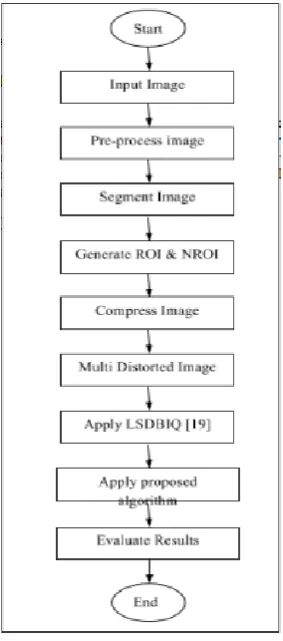
In the proposed research LSDBIQ [19] technique is applied on the multi distorted images to check the quality of images. In the past this technique had been applied on the various compressed images. In the current scenario this technique is to be applied on the multi distorted images so that any distortion may be quantized in case if any distortion had generated in the image. The very first step is to collect the related data. Data may be any digital images or medical images. Next task is to select the region of interest that is the portion of the image which is most important. For Instance in a MRI the portion where the tumor lies is important .The ROI is compressed using lossless or near lossless technique and the non ROI or the remaining part is compressed with any of the lossy methods. LSDBIQ technique is developed by calculating the stdfilt of the reference images and distorted images. This tool performs a local standard deviation filter on a raster image, i.e. it calculates the standard deviation within a neighboring area around each grind cell.
σ =
where σ is standard deviation and N is number of pixels.
The local standard deviation of the reference (Ir) and distorted (Id) images is defined as: Ir = stdfilt(Ir ) Id = stdfilt(Id) with the help of Ir and Id standard deviation maps, we define the local quality map (LQM) between two images Ir and Id as:
LSM = (2*Ir*Id + T) / (I2r + I2d+T)
where T is a small positive constant to stabilize the result and its proposed value is 0.0010. From Eq. (2), if Ir and Id are equal, then LSM will achieve the maximum value 1
We have applied our quality score measurement method to LSM values using standard deviation. The proposed metrics is named as LSDBIQ and is calculated as:
LSDBIQ = ]1/2 where LSM1 is LSM1 =
where N is number of pixels in the image. Values of objective LSDBIQ and human subjective Difference Mean Opinion Scores (DMOS) score also measures distortion, lower the value better will be the image quality.
ISSN(E): 2277-128X, ISSN(P): 2277-6451, DOI: 10.23956/ijarcsse/V7I8/0121, pp. 41-45 In the proposed approach an image is taken as an input. The input image is pre-processed to make it as a multi-distorted image. For multi distortion noise and blurring is added to the image. After multi-distortion of image ROI and NROI is extracted and LSDBIQ technique is applied on it to check the quality score of multi-distorted image. For the dataset testing the MDID data set is used. In this approach the LSDBIQ is applied on the multi-distortion where as in the previous studies this technique is applied on the compressed images.
V. EXPERIMENTAL RESULTS
In this section the results are generated and are validated. Resultant parameters that are used are LSDBIQ coefficient of complexity and running time. Quality Factors are the parameters to quantify the visual nature of a picture. They are used to judge the ease of use of a picture. These measurements portray the distinction in the first and the recreated picture. The outcomes taken from the estimations of these variables helps in the choice of the best picture that suits the necessity. There are vast number of measurements to quantify nature of a Picture .These are pixel dependent metrics Most normal measures are examined underneath:
5.1 Performance Comparison
In this research, MDID data set is chosen to calculate the performance of LSDBIQ algorithm for multi distorted images. The proposed algorithm is applied on 50 images and calculate the coefficient of complexity against RMSE and execution time as described in the following section.
5.2 Computational Complexity
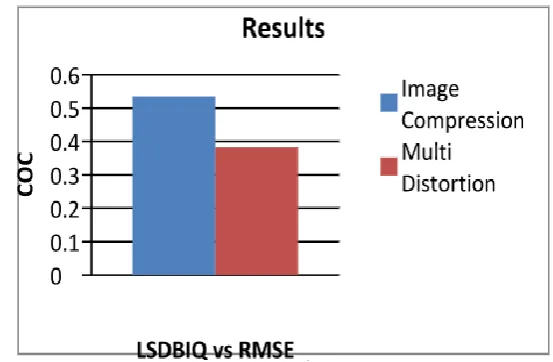
Fig 2: COC for LSDBIQ in image compression and LSDBIQ in multi-distortion
COC:
Coefficient of Complexity may be defined as the computational co mplexity in the LSDBIQ for the compressed and the
multi distorted images. From the fig 2 it is shown that the LSDBIQ is less in case of the multi distorted images as compare to the image compression in the existing research. LSDBIQ is applied on the image compression and generates an average values of approx 0.535 and in case of multi distorted images the average value is 0.382. Therefore by validating the results it may be said that the distortion in case of noisy images is much more than that of the value in distortion in the image compression.
5.3 Execution Time
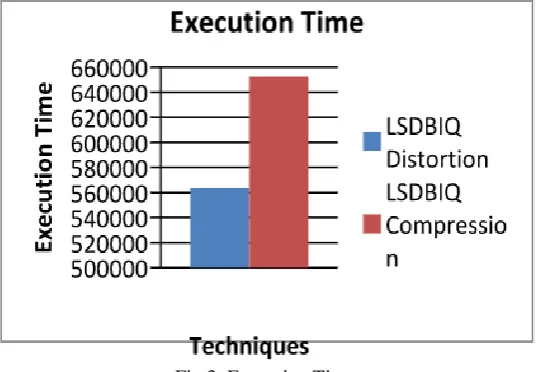
Running Time: Running time or execution time may be defined as the total time taken by the algorithm to perform image operations and to calculate LSDBIQ results in case of proposed approach. As shown in the fig 3 the execution time in the LSDBIQ for distortion is 550000 ns where as in case of LSDBIQ for compression it is 650000ns as shown in the following table 1.
Table 1: Comparison of LSDBIQ in different techniques on basis of different parameters.
Technique Parameter
LSDBIQ in Compression
LSDBIQ in Distortion
Execution Time 563523 652834
ISSN(E): 2277-128X, ISSN(P): 2277-6451, DOI: 10.23956/ijarcsse/V7I8/0121, pp. 41-45
VI. CONCLUSION
In this paper, we deal with multi distorted images and proposed a FR-IQA model based on a local standard deviation in an image. Evaluated results show that the dealt algorithm LSDBIQ results in terms of both accuracy and efficiency. With this computation complexity and running time reduces.
Fig 3: Execution Time
REFERENCES
[1] Akshay Gore, Savita Gupta, “Full reference image quality metrics for JPEG compressed images”, International
Journal of Electronics and Communications, vol: 69, 2015, pp: 604-608
[2] Wen Sun, Fei Zhou, Qingmin Liao, “MDID: A Multiply Distorted Image Database for Image Quality
Assessment”, DOI: http://dx.doi.org/10.1016/j.patcog.2016.07.033
[3] Minakshi Gogoi, Mala Ahmed, “Image Quality Parameter Detection : A Study”, International Journal of
Computer Sci International Journal of Computer Sciences and Engi ences and Engineering, ISSN: 2347-2693, Volume-4, Special Issue-7, Dec 2016, pp: 110-116
[4] Tsung-Jung Liu, Kuan-Hsien Liu, Yuchieh Lin, Weisi Lin, C.-C. Jay Kuo, “A ParaBoost Method to Image Quality Assessment”, IEEE TRANSACTIONS ON NEURAL NETWORKS AND LEARNING SYSTEMS, ISSN: 2162-237X, 2015
[5] Haoyi Liang, Daniel S. Weller, “Comparison-based Image Quality Assessment for Parameter Selection”
[6] Vinayak K Bairagi, Ashok M Sapkal, Department of Electronics Engineering, Sinhgad Academy of
Engineering, " ROI-based DICOM image compression for telemedicine", Vol. 38, Part 1, February 2013, pp. 123–131, Springer [2012]
[7] AmandeepKaur, Monica goyal, Student, Computer Science & Engineering, Guru Kashi University, Talwandi Sabo," A Review: ROI based Image Compression of Medical Images", International Journal of A Advanced Research in Computer Science and Software Engineering [2014]
[8] Wen Sun, Fei Zhou, Qingmin Liao, “MDID: A Multiply Distorted Image Database for Image Quality
Assessment”, DOI: http://dx.doi.org/10.1016/j.patcog.2016.07.033
[9] Vinayak K Bairagi, Ashok M Sapkal, Department of Electronics Engineering, Sinhgad Academy of
Engineering, " ROI-based DICOM image compression for telemedicine", Vol. 38, Part 1, February 2013, pp. 123–131, Springer [2012]
[10] Amandeep Kaur, Monica goyal, Student, Computer Science & Engineering, Guru Kashi University, Talwandi
Sabo," A Review: ROI based Image Compression of Medical Images", International Journal of Advanced Research in Computer Science and Software Engineering [2014]
[11] J.C. Garcia,H.Fuhr,G.Castellanos-Dominguez, “Evaluation of Region-of-Interest coders using perceptual image
quality assessments” ,Elsevier[2013]
[12] PratikChavada ,Narendra Patel,KanuPatel, Department of Computer Engineerin,B.V.M Engineering
College,V.V.Nagar, “Region of Interest Based Image Compression” , International Journal of Advanced Research in Computer Science and Software Engineering [2014]
[13] Peilong Zhao, Jiwen Dong, Lei Wang,Department of Computer Science and technology Shandong,China,
“Image Compression Algorithm Based On Automatic Extracted ROI “, Ieeeexplore [2014]
[14] Kuldip K.Ade,M.V.Raghunadh, Department of Electronics and Communication Engineering National Institute
ISSN(E): 2277-128X, ISSN(P): 2277-6451, DOI: 10.23956/ijarcsse/V7I8/0121, pp. 41-45
[15] Rushabh R.Shah ,Dr. Priyanka Sharma, Institute of Science and Technology for Advanced Studies and Research
Vallabh Vidya Nagar,Gujarat, “Performance analysis of region of interest based compression method for medical images “IEEE [2015]
[16] Sarvarinder Singh,Er. Sarabjit Singh ,Guru Kashi University, Talwandi Sabo, “Review; ROI Based Medical Image Compression using DCT and HAAR Wavelet , International Journal of Advanced Research in Computer Science and Software Engineering [2015]
[17] Loganathan R ,Dr.Y.S.Kumaraswamy, “Performance evalution of image compression for medical image” ,
International Journal of Advanced Research in Computer Science and Software Engineering [2013] Vol. 4
[18] Yogita Sojitra,Prof.Abhishek Katariya,Ms.A.K. Vibhakar,Ms.Poorvi Patel, “Performance analysis of image