Technology (IJRASET)
Optimization And Comparison Of Economic Load
Dispatch Problem With The Proposed Traditional
Technique
Kirti Gupta1,Devendra Dohre2
1,2
MPCT,gwalior,madhya pradesh,india
Abstract-The Economic Dispatch (ED) problem is widely used and constitutes a very important optimization task that must be undertaken on a daily basis in the operation of power systems. Economic dispatch is the short-term determination of the optimal output of a number of electricity generation facilities, to meet the system load, at the lowest possible cost, subject to transmission and operational constraints. So The main goal when dealing with Economic Dispatch tasks is to find the optimal schedule that produces the desired power outputs for all the generating units, and minimizes the total fuel cost, while satisfying some constraints. But another goal associated to the previous one, is to obtain the desired schedule as fast as possible. Generally economic dispatch is solved without accounting to transmission constraints, however, in deregulated power system environment Economic load dispatch (ELD) has the objective of generation allocation to the power generators such that the total fuel cost is minimized and all operating constraints are satisfied. A number of traditional methods are using for solving ED and other power system problems. During the last decade soft computing methods like PSO proposed, Evolutionary Strategy and GA method have been increasingly proposed for complex optimization problems. This paper proposes GAMS technique in which premature convergence is avoided by tuning the parameters for enhanced global and local search. This paper reviews and comparisons the performance of the PSO, GA and Evolutionary algorithm variants with proposed solver The General Algebraic Modeling System GAMS for economic load dispatch on single 40 units standard test system is included for validate the results.
Index Terms: Optimization, Modelling Language, Economic load dispatch, GAMS
I. INTRODUCTION
Technology (IJRASET)
There has been phenomenal growth in mathematical programming techniques and development of computer codes to solve large scale optimization models over the past four to five decades. One of the most popular and flexible languages among these is the General Algebraic Modeling System (GAMS) [13-14].
II. ECONOMIC LOAD DISPATCH PROBLEM FORMULATIONS
The operation of a modern power system has become very complex. It is necessary to maintain frequency and voltage within limits in addition to ensuring reliability of power supply and for maintaining the frequency and voltage within limits it is essential to match the generating of active and reactive power with the load demand. For ensuring reliability of power system it is necessary to put additional generation capacity into the system in the event of outage of generating equipment at some station. Over and above it is also necessary to ensure the cost of electric supply to the minimum. Therefore, the task of load control centre is to keep the exchange of power between various zones and system frequency at desired value. The objective of the economic dispatch problem is to determine the generated powers Pi of units for a total load of PD so that the total fuel cost,
F
T for the N number of generatingunits is minimized subject to the power balance constraint and unit upper and lower operating limits. The objective is
N i i iT F P
MinF
1
)
( (1)
where Fi is the total fuel cost for the ith generator (in $/h) which is defined by,
Fi(Pi) (aiPi2 biPi ci) (2) where
a
i,
b
i and c i are the fuel-cost coefficients of thei
th unit. Two constraints are considered in this problem, i.e., the generation capacity of each generator and the power balance of the entire power system.Static ELD problem can be stated as minimization of eq. (3.1) subject to
A. Power Balance Constraint
01
N i L Di P P
P (3)
B. Unit Operating Limits Constraint
N i
P P
Pimin i imax 1,2,...,
(4)
For a given total real load PD the system loss PL is a function of active power generation at each generating unit. To calculate system
losses, methods based on penalty factors and constant loss formula coefficients or B-coefficients [12] are in use. The latter is adopted in this paper as per which transmission losses are expressed as
C. Minimization Of Transmission Losses
oo i N i oi j ij N j i N i
L P B P B P B
P
1 1 1
(5)
D. Area-Wise Power Balance Constraint
In MAED problem the power balance constraints need to be satisfied for each area. The power balance constraints for area q neglecting losses can be given as
0 1 Nq i Mq j jq Dq
iq P T
P
(6)
for q=1,2……..M (areas). For the qth area , PDq is the load demand , Tjq is the tie- line flows from other areas, Nq are number of
generating units and Mq represents the number of tie-lines connected to the qth area.
E. Unit Ramp-Rate Limit Constraints
When the generator ramp rate limits are considered, the operating limits are modified as follows:
) ,
( )
,
( min max
i o i i i i o i
i P DR P Min P P UR
P
Technology (IJRASET)
The previous operating point of ith generator is oi
P and DRi and URi are the down and up ramp rate limits respectively.
III. PROPOSED TECHNIQUE OF GENERAL ALGEBRAIC MODELING SYSTEM
The General Algebraic Modeling System (GAMS) is specifically designed for modeling linear, nonlinear and mixed integer optimization problems [13]. The system is particularly very advantageous with large, complex problems. GAMS allow the user to concentrate on the modeling problem by making the setup simple. GAMS are especially useful for handling large, complex, one-of-a-kind problems which may require many revisions to establish an accurate model. The user can change the formulation quickly and easily, and can even change from one solver to another. Similarly the use can easily convert from linear to nonlinear optimization option with little trouble [14]. The optimization solver, in GAMS modelling system solves the different problems of linear, nonlinear and mixed integer optimization problems. The basic structure of a mathematical model coded in GAMS has the components: sets, data, variable, equation, model and output the tool kit in GAMS gives algorithms for each category of problem. GAMS also have the unique feature of providing a common language that can make use of a variety of solvers.
A. The General Algebraic Modeling System Tool Kit
The tool kit in GAMS embodies several man-years of research that has gone into developing and fine tuning the algorithms in each category of problems. GAMS also have the unique feature of providing a common language that can make use of a variety of solvers developed by dement research group/companies. GAMS provide powerful solvers for the following classes of optimization problems.
Linear programming (LP) variants of simplex methods and Interior Point methods Non-linear programming (NLP)
Variants of Gradient methods
Linear mixed integer programming (MILP) Non-linear mixed integer programming (MINLP)
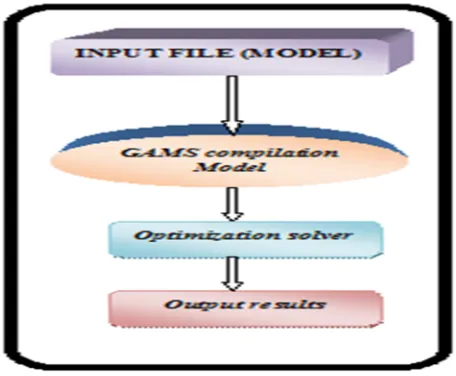
[image:4.612.191.419.464.652.2]GAMS are a modeling system for optimization that provides an interface with a variety of different algorithms. Models are supplied by the user to GAMS in an input file in the form of algebraic equations using a higher level language. GAMS then compile the model and interfaces automatically with a "solver" (i.e., optimization algorithm). The compiled model as well as the solution found by the solver is then reported back to the user through an output file. The simple diagram below illustrates this process show in Fig 1.
Fig 1 optimization solver
Technology (IJRASET)
Models.B. Programmer Features Of GAMS
The model is independent from the solution method, and it can be solved by different solutions methods by only changing the solver efficient handling of mathematical optimization problems.
Simplify model building and solution process. Increase productivity and support maintainable models, Support of decision making process
The translation from the mathematical model to GAMS is almost transparent since GAMS has been built to resemble mathematical programming models.
IV. SIMULATION RESULTS AND DISCUSSION
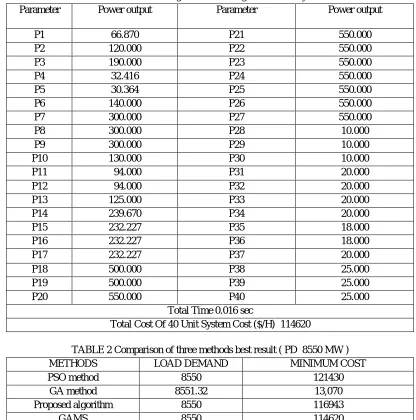
[image:5.612.96.512.291.711.2]The coefficient of fuel cost and maximum and minimum power limits are given in appendix section [15]. The power demand is to be 8550 (MW).The comparisons of best results to GA and PSO with GAMS are shown in table-1.The detailed corresponding to results is shown in table-2.
Table 1 Results using GAMS for 40 generator test system
Parameter Power output Parameter Power output
P1 66.870 P21 550.000
P2 120.000 P22 550.000
P3 190.000 P23 550.000
P4 32.416 P24 550.000
P5 30.364 P25 550.000
P6 140.000 P26 550.000
P7 300.000 P27 550.000
P8 300.000 P28 10.000
P9 300.000 P29 10.000
P10 130.000 P30 10.000
P11 94.000 P31 20.000
P12 94.000 P32 20.000
P13 125.000 P33 20.000
P14 239.670 P34 20.000
P15 232.227 P35 18.000
P16 232.227 P36 18.000
P17 232.227 P37 20.000
P18 500.000 P38 25.000
P19 500.000 P39 25.000
P20 550.000 P40 25.000
Total Time 0.016 sec
Total Cost Of 40 Unit System Cost ($/H) 114620
TABLE 2 Comparison of three methods best result ( PD 8550 MW )
METHODS LOAD DEMAND MINIMUM COST
PSO method 8550 121430
GA method 8551.32 13,070
Proposed algorithm 8550 116943
Technology (IJRASET)
V. CONCLUSION
In this paper, a new approach to solve economic load dispatch problem using GAMS technique method is used. The GAMS technique provides an optimal solution with less computational time. The GAMS technique improves the computational time. The PSO algorithm gives specified load demand with minimum fuel cost and increased power output for each unit. Therefore, in future the GAMS technique will be most important and efficient technique to solve the large optimization problems with lower transmission losses because the GAMS technique is simpler in structure than other methods
REFERENCES
[1] Sunil Kumar Singh *, Lobzang Phunchok **, “Genetic Algorithm A Noble Approach For Economic Load Dispatch” International Journal of Engineering Research and Applications (IJERA), National Conference on Emerging Trends in Engineering & Technology (VNCET-30 Mar’12).
[2] Vijay Kumar, Jagdev Singh, Yaduvir Singh, Sanjay Sood, “Optimal Economic Load Dispatch Using Genetic Algorithms” International Journal of Electrical, Computer, Energetic, Electronic and Communication Engineering Vol:9, No:4, 2015.
[3] Priyanka Sinha, “Particle Swarm Optimization for Solving Economic Load Dispatch Problem” International Journal of Communication and Computer Technologies Volume 01 – No.63 Issue: 07 Aug 201.
[4] Samir SAYAH, Khaled ZEHAR, “Using Evolutionary Computation to Solve the Economic Load Dispatch Problem” Leonardo Journal of Sciences ISSN 1583-0233 Issue 12, January-June 2008.
[5] Janaki Kolli1, K Bhavana2, “Comparative Study to Solution of Economic Load Dispatch - Using Evolutionary Algorithms” International Journal of Emerging Trends in Electrical and Electronics (IJETEE – ISSN: 2320-9569) Vol. 11, Issue. 5, September-2015.
[6] Dr. L.V.Narasimha Rao1, “PSO Technique for Solving the Economic Dispatch Problem Considering the Generator Constraints” International Journal of Advanced Research in Electrical, Electronics and Instrumentation Engineering, Vol. 3, Issue 7, July 2014.
[7] Amita Mahor a,*, Vishnu Prasad b, Saroj Rangnekar a,1, “Economic dispatch using particle swarm optimization: A review” Renewable and Sustainable Energy Reviews 13 (2009) 2134–2141.
[8] M. Anuj Gargeya1, Sai Praneeth Pabba2, “Economic Load Dispatch Using Genetic Algorithm And Pattern Search Methods” International Journal Of Advanced Research In Electrical, Electronics And Instrumentation Engineering Vol. 2, Issue 4, April 2013.
[9] Narottam dutt upadhyay1, Rameshwar singh2, “Soft Computing Technique Based Economic Load Dispatch Using Biogeography-Based Optimization Algorithm” International Journal of Innovative Research in Science, Engineering and Technology, Vol. 3, Issue 8, August 2014.
[10] N. Sinha, R. Chakrabarti, and P. K. Chattopadhyay. "Evolutionary programming techniques for economic load dispatch." IEEE Trans. Evol. vol.7, no. 1, 83–94, Feb 2003.
[11] K. Sudhakara Reddy1, Dr. M. Damodar Reddy2, “Economic Load Dispatch Using Firefly Algorithm” International Journal of Engineering Research and Applications (IJERA),Vol. 2, Issue4, July-August 2012, pp.2325-2330.
[12] Debabrata Chattopadhyay “Application of general algebraic modeling system to power system optimization” IEEE Trans. on Power Systems, vol. 14, No. 1, February, 1999. http://www.gams.com/