This Master’s Thesis is carried out as a part of the education at the University of Agder and is therefore approved as a part of this education.
University of Agder, 2011 Faculty of Engineering and Science
Department of ICT
Solving the Boolean Satisfiability Problem Using
Multilevel Techniques
Sirar Salih Yujie Song
Supervisor
Abstract
There are many complex problems in computer science that occur in knowledge-representation (artificial thinking), artificial learning, Very Large Scale Integration (VLSI) design, security protocols and other areas. These complex problems may be deduced into satisfiability problems where the Boolean Satisfiability Problem (SAT) may be applied. This deduction is made in order to simplify complex problems into a specific propositional logic problem. The SAT problem is the most well-known nondeterministic polynomial time (NP) complete problem in computer science. It is a Boolean expression which is composed of a specific amount of variables (literals), clauses that contain disjunctions of the literals and conjunctions of the clauses. The literals have the logical values TRUE and FALSE, the task is to find a truth assignment that makes the entire expression TRUE. The main goal of the thesis is to solve the SAT problem using a clustering technique - Multilevel - combined first with Tabu Search and combined thereafter with finite Learning Automata. Tabu Search and finite Learning Automata are two very efficient approaches that have been used to solve SAT. Benchmark experiments are conducted in order to disclose whether combining Multilevel with existing solutions to solve SAT will provide better results - than the two mentioned approaches alone - mainly in terms of computational efficiency.
Preface
Imagination is more important than knowledge.-Albert Einstein
This report is the documented result of the master's thesis in the IKT590 (Master's Thesis) course in the master programme at the Faculty of Engineering and Science, Department of ICT at University of Agder in Grimstad, Norway.
The main purpose of the IKT590 course is to allow students to write their master's thesis as a final step of their master programme education at the University of Agder. The work performed by the students in the thesis must be scientific and elements of the work must be new, contributing knowledge. The work is to be presented by a theoretical report that describes the problem and results, along with a poster and an oral presentation at the university.
The project group consists of students Sirar Salih and Yujie Song who attend the Information and Communication Technology master programme, at the University of Agder. The first student has a bachelor degree in computer science from the University of Agder and the second student has a bachelor degree in electrical engineering from the University of Wuhan in Wuhan, China. The work on this thesis and the writing of this report was done at the University of Agder. The supervisor of the thesis is associate professor Noureddine Bouhmala.
Publication
The work conducted in this thesis and some of the experimental results have been included in the paper A Tabu Search Algorithm Combined with Learning Automata for the Satisfiability Problem by N. Bouhmala, O-C. Granmo, Sirar Salih and Yujie Song, to be submitted for publication as a chapter in book.
Acknowledgements
We would like to thank our supervisor, associate professor Noureddine Bouhmala for his continuous support and guiding throughout the thesis period. Especially for his patience, it is safe to say that without his ideas and assistance the thesis would have faced endless difficulties. We would also like to thank our contact at the University of Agder, associate professor Ole-Christoffer Granmo for providing us the opportunity to start and complete this thesis.
Grimstad 25 May 2011 Sirar Salih Yujie Song
Contents
1 Introduction ... 8
1.1 Background ... 8
1.2 Problem and Hypothesis ... 9
1.3 Importance of Topic ... 9
1.4 Motivation ... 10
1.5 Limitations and Key Assumptions ... 10
1.6 Contributions to Research ... 11
1.7 Literature Review ... 11
1.8 Thesis Report Outline ... 12
2 Significant Prior Research... 13
2.1 Solving SAT Using GSAT ... 13
2.2 Solving SAT Using Simulated Annealing ... 14
2.3 Solving SAT Using Adaptive Genetic Algorithms ... 16
2.4 Solving SAT Using Tabu Search ... 17
2.5 Solving SAT Using Finite Learning Automata ... 18
2.6 Others ... 20
3 Research Approach ... 21
3.1 Multilevel Paradigm ... 21
3.2 Combining Multilevel with Tabu Search ... 22
3.3 Combining Multilevel with Finite Learning Automata ... 22
3.4 Tabu Search Implementations ... 22
3.5 Selecting the Best Tabu Search Implementation ... 26
3.6 Learning Automata with Tabu Search Implementation ... 28
3.7 Multilevel Paradigm Implementation ... 30
3.8 Multilevel Tabu Search Implementation ... 31
3.9 Multilevel Learning Automata with Tabu Search Implementation... 32
4 Experimental Results ... 35
4.1 Tabu Search vs. Multilevel Tabu Search ... 35
4.2 Learning Automata with Tabu Search vs. Multilevel Learning Automata with Tabu Search ... 50
5 Discussion ... 65
6 Conclusion and Further Work ... 66
List of Figures
Figure Short description Page
1 The Boolean Satisfiability Problem. 9
2 Tabu list. 17
3 Learning automaton. 18
4 Literals are assigned learning automata. 19
5 The Multilevel clustering technique. 21
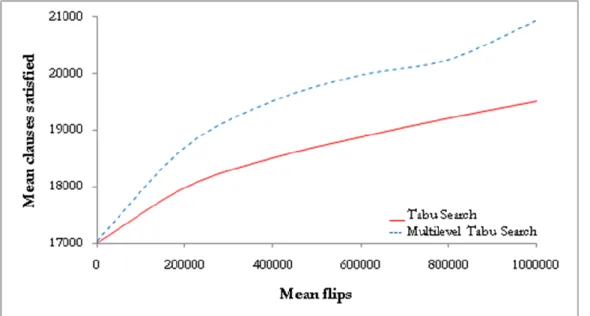
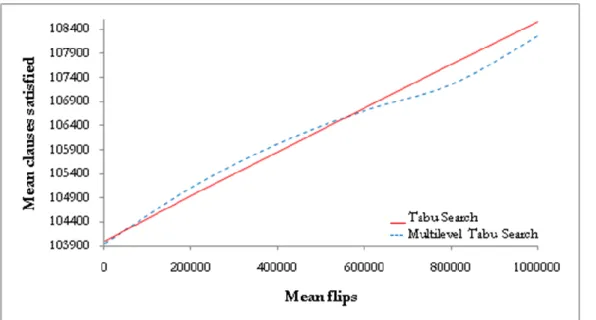
6 Tabu Search vs. Multilevel Tabu Search. SATLIB (Random). 35 7 Tabu Search vs. Multilevel Tabu Search. SATLIB (Random). 36 8 Tabu Search vs. Multilevel Tabu Search. SATLIB (Random). 36 9 Tabu Search vs. Multilevel Tabu Search. SATLIB (Planning). 37 10 Tabu Search vs. Multilevel Tabu Search. SATLIB (Planning). 37 11 Tabu Search vs. Multilevel Tabu Search. SATLIB (Planning). 38 12 Tabu Search vs. Multilevel Tabu Search. SATLIB (Planning). 38 13 Tabu Search vs. Multilevel Tabu Search. SATLIB (Planning). 39 14 Tabu Search vs. Multilevel Tabu Search. SATLIB (Beijing). 40 15 Tabu Search vs. Multilevel Tabu Search. SATLIB (Beijing). 40 16 Tabu Search vs. Multilevel Tabu Search. SATLIB (AIM). 41 17 Tabu Search vs. Multilevel Tabu Search. SATLIB (AIM). 41 18 Tabu Search vs. Multilevel Tabu Search. SATLIB (AIS). 42 19 Tabu Search vs. Multilevel Tabu Search. SATLIB (AIS). 42 20 Tabu Search vs. Multilevel Tabu Search. SATLIB (GCSW). 43 21 Tabu Search vs. Multilevel Tabu Search. SATLIB (GCSW). 43 22 Tabu Search vs. Multilevel Tabu Search. SATLIB (Quasi Groups). 44 23 Tabu Search vs. Multilevel Tabu Search. SATLIB (Quasi Groups). 44
24 Tabu Search vs. Multilevel Tabu Search. Max SAT. 45
25 Tabu Search vs. Multilevel Tabu Search. Max SAT. 45
26 Tabu Search vs. Multilevel Tabu Search. Max SAT. 46
27 Tabu Search vs. Multilevel Tabu Search. Max SAT. 46
28 Tabu Search vs. Multilevel Tabu Search. Max SAT. 47
29 LA with Tabu Search vs. Multilevel LA with Tabu Search. SATLIB (Random). 50 30 LA with Tabu Search vs. Multilevel LA with Tabu Search. SATLIB (Random). 51 31 LA with Tabu Search vs. Multilevel LA with Tabu Search. SATLIB (Random). 51 32 LA with Tabu Search vs. Multilevel LA with Tabu Search. SATLIB (Planning). 52 33 LA with Tabu Search vs. Multilevel LA with Tabu Search. SATLIB (Planning). 52 34 LA with Tabu Search vs. Multilevel LA with Tabu Search. SATLIB (Planning). 53 35 LA with Tabu Search vs. Multilevel LA with Tabu Search. SATLIB (Planning). 53 36 LA with Tabu Search vs. Multilevel LA with Tabu Search. SATLIB (Planning). 54 37 LA with Tabu Search vs. Multilevel LA with Tabu Search. SATLIB (Beijing). 55 38 LA with Tabu Search vs. Multilevel LA with Tabu Search. SATLIB (Beijing). 55 39 LA with Tabu Search vs. Multilevel LA with Tabu Search. SATLIB (AIM). 56 40 LA with Tabu Search vs. Multilevel LA with Tabu Search. SATLIB (AIM). 56 41 LA with Tabu Search vs. Multilevel LA with Tabu Search. SATLIB (AIS). 57 42 LA with Tabu Search vs. Multilevel LA with Tabu Search. SATLIB (AIS). 57 43 LA with Tabu Search vs. Multilevel LA with Tabu Search. SATLIB (GCSW). 58 44 LA with Tabu Search vs. Multilevel LA with Tabu Search. SATLIB (GCSW). 58 45 LA with Tabu Search vs. Multilevel LA with Tabu Search. SATLIB (Quasi Groups). 59 46 LA with Tabu Search vs. Multilevel LA with Tabu Search. SATLIB (Quasi Groups). 59 47 LA with Tabu Search vs. Multilevel LA with Tabu Search. Max SAT. 60 48 LA with Tabu Search vs. Multilevel LA with Tabu Search. Max SAT. 60 49 LA with Tabu Search vs. Multilevel LA with Tabu Search. Max SAT. 61 50 LA with Tabu Search vs. Multilevel LA with Tabu Search. Max SAT. 61 51 LA with Tabu Search vs. Multilevel LA with Tabu Search. Max SAT. 62
List of Tables
Table Short description Page
1 Tabu Search implementations results on SATLIB (Random). 26 2 Tabu Search implementations results on SATLIB (Random). 26 3 Tabu Search implementations results on SATLIB (Random). 26 4 Mean solved, variance and standard deviation for Tabu Search implementations results on
SATLIB (Random). 27
5 Mean solved, variance and standard deviation for Tabu Search implementations results on
SATLIB (Random). 27
6 Mean solved, variance and standard deviation for Tabu Search implementations results on
SATLIB (Random). 27
7 Mean solved, variance and standard deviation for Tabu Search. 48 8 Mean solved, variance and standard deviation for Multilevel Tabu Search. 49 9 Mean solved, variance and standard deviation for LA with Tabu Search. 63 10 Mean solved, variance and standard deviation for Multilevel LA with Tabu Search. 64 11 The mean solution quality and convergence of each algorithm solving the set of SAT instances. 65
1
Introduction
In this chapter the background of the problem is explained in detail. The problem is then stated, the hypothesis, the motivation and the limitations and key assumptions. Finally a literature review is given followed by a short outline of the rest of the thesis report.
1.1
Background
There are many complex problems in computer science that occur in knowledge-representation (artificial thinking), artificial learning, Very Large Scale Integration (VLSI) design, security protocols and other areas. These complex problems may be deduced into satisfiability problems where the Boolean Satisfiability Problem (SAT) may be applied. This deduction is made in order to simplify a complex problem into a specific mathematical problem. Once the deduction is made, one only needs to solve the SAT problem in order to solve the more complex problem. Therefore, efficient ways to solve the SAT problem draw a growing attention in the field of computer science.
One example application is the SAT-based analysis of protocol insecurity problems in [1]. In this paper, A. Armando and L. Compagna from the University of Florence in Italy have managed to represent protocol insecurity problems as SAT, and have built an automatic model-checker for security protocols based on SAT solver algorithms. By doing this, they could use the model-checker to help solve the complex protocol insecurity problems. Similarly, F. Guillaume presented in his paper the SAT representation of MU-calculus over Petri Nets [2]. The model checking problem for Petri Nets has been known to be undecidable for almost fifteen years [3]. Guillaume showed that this undecidability can be represented in SAT, making the problem context much simpler.
The ability to represent a complex problem as a propositional logic problem such as SAT, makes things very easy in terms of solving complexity - since one only needs to satisfy the set of logical values. As a result of this, efficient ways to solve SAT are also important. There has been an increase in the development of SAT solver algorithms. Two notable approaches to solve SAT are Tabu Search and finite Learning Automata, these two approaches have recently been proved to be very efficient. However, there is no boundary on the efficiency aspect and it is believed that the efficiency of the two latter approaches could still be increased. Because the two mentioned approaches use a single level technique, which could be replaced by a multi level that gives a better sampling of the solution space.
1.2
Problem and Hypothesis
The SAT problem is a well-known nondeterministic polynomial time (NP) complete [1] problem in computer science. It is composed of an N amount of literals, clauses that contain disjunctions of the literals and conjunctions of the clauses. The literals can either have the value TRUE or FALSE. To solve the SAT problem, the total set of clauses must give the value TRUE; it is then said that the problem is satisfied. A SAT problem with two literals, two clauses and two literals per clause is shown in figure 1.
Figure 1: The Boolean Satisfiability Problem. After solving SAT, all clauses get the logical value TRUE.
The problem is represented as the following propositional formula:
1
j jm
j
j
j
k
l
k I
l I
C
C
x
x
Where Cj is the disjunction of literals,
m
is the number of clauses,n
is the number of literals andx
i is aliteral, i Є {1, ... n}. Ij, Īj {1, ... n}, Ij ∩ Īj = Ø and
x
i denotes the negation ofx
i. The assignment is satisfiedif the propositional formula
evaluates to TRUE. This formula representation can be found in [3].As the growing need of efficient ways to solve SAT continues, it is in this paper hypothesised that combining the Multilevel technique with existing approaches will drastically increase efficiency of solving SAT. The reason to this is that the Multilevel technique simplifies the problem drastically by clustering literals together. Tabu Search and Finite Learning Automata are two existing approaches (see [13] and [3], respectively) which have been proved to be very efficient methods to solve SAT, therefore these two approaches have been chosen to be combined with the Multilevel technique, in order to prove if combining Multilevel will increase the efficiency to solve SAT or not. This combination will create the Multilevel Tabu Search and Multilevel Learning Automata algorithms.
1.3
Importance of Topic
Many complex problems in computer science can be simplified by representing them in SAT, therefore SAT is very important for helping solve complex problems in computer science and has played a major role. One example application is the SAT-based analysis of protocol insecurity problems in [4]. In this paper, A. Armando and L. Compagna from the University of Florence in Italy have managed to represent protocol
insecurity problems as SAT, and have built an automatic model-checker for security protocols based on SAT solver algorithms. By doing this, they could use the model-checker to help solve the complex protocol insecurity problems. Similarly, F. Guillaume presented in his paper the SAT representation of MU-calculus over Petri Nets [5]. The model checking problem for Petri Nets has been known to be undecidable for almost fifteen years [6]. Guillaume showed that this undecidability can be represented in SAT, making the problem context much simpler.
The ability to represent a complex problem as a propositional logic problem such as SAT, makes things very easy in terms of solving complexity - since one only needs to satisfy the set of logical values. As a result of this, efficient ways to solve SAT are also important. There has been an increase in the development of SAT solver algorithms. Two notable approaches to solve SAT are Tabu Search and finite Learning Automata, these two approaches have been proved to be very efficient. However, there is no boundary on the efficiency aspect and it is believed that the efficiency of the two mentioned approaches could still be increased. Because these two approaches use a single level technique, which could be replaced by a multi level that gives a better sampling of the solution space. Therefore, combining Multilevel technique with these two existing methods may increase the efficiency of using them alone.
If the hypothesis is proved to be true, the research will introduce a new, more efficient way of solving SAT by introducing the Multilevel technique. For example, combining Multilevel with Tabu Search or combining Multilevel with finite Learning Automata will become the new, more efficient way to solve SAT.
1.4
Motivation
If the problem is solved, the research will introduce a new, more efficient way of solving SAT by introducing the Multilevel technique. Adding a new algorithm approach to the collection of solver algorithms is a step further of solving complex problems that can be represented as SAT, and an advancement in the science of SAT.
If however not solved, the work will be used further for research. Continuing the research will no doubt improve the proposed solutions in this thesis.
1.5
Limitations and Key Assumptions
The implementation of our proposed Multilevel Tabu Search and Multilevel Learning Automata algorithms will be done in the C++ programming language. Although Tabu Search and Learning Automata algorithms may require much work to be implemented very efficiently in C++, they will still be implemented in this research, because the efficiencies of these two algorithms have to be used to compare with the efficiencies of the two new proposed algorithms. However, we cannot state with 100 % certainty that the combination of the Multilevel technique is the reason to the efficiency increase or decrease. That is because personal programming experiences might have side effects on the implementation results. The implementation will also prove difficult due to the nature of the context, thus a clear understanding of the problems prior to implementation is a vital step.
The Multilevel technique is assumed to increase the efficiency of existing SAT solver algorithms, for example, Tabu Search and Learning Automata. However, if this hypothesis is disproved, then the implementation will need to be revised and fixed. Attempts will be made to find out the cause, it is expected that this part will take a significant amount of time. If the hypothesis is disproved and also no reasonable cause could be found, then a discussion will be engaged as to why this happened. Ideas for further work will also be provided.
1.6
Contributions to Research
Potential outcomes of the research are summarized in the list below.
Simplification of SAT instances prior to solving them by using the Multilevel clustering technique, because literals can be clustered together. This allows metaheuristic algorithms to handle clusters of literals as a single entity, making the search space guided and restricted to only those literals within the clusters. This offers a better sampling of the solution space compared to single level computations. Increase in SAT solving efficiency. Applying the Multilevel clustering technique will increase the
efficiency of solving SAT instances; this is due to the previous bullet point.
Introduction of two new, efficient SAT solver algorithms. Given that the hypothesis is proved, the thesis will introduce two, new SAT solver algorithms; Multilevel Tabu Search and Multilevel Learning Automata. Based on the properties of Multilevel, these two new algorithms will be more efficient than their predecessors.
1.7
Literature Review
Many complex problems have been successfully represented as SAT, equally many efficient algorithms have been implemented to solve the latter and the state-of-the-art is very wide. The focus here is on the literature of two specific (as an example) complex problems and the most popular solver algorithms for SAT; local search algorithms. This chapter gives a quick review of all the relevant papers, while chapter 2 provides an in-depth explanation of each.
In their paper, The SAT-based Analysis of Protocol Insecurity Problems [1], A. Armando and L. Compagna from the University of Florence in Italy managed to represent protocol insecurity problems as SAT, in an attempt to build an automatic model-checker for security protocols based on SAT solver algorithms. Similarly, F. Guillaume presented in his paper the SAT representation of MU-calculus over Petri Nets [2]. The model checking problem for Petri Nets has been known to be undecidable for almost fifteen years [3]. Guillaume showed that this undecidability can be represented in SAT, making the problem context simpler.
B. Selman, H. Levesque and D. Mitchell presented in their paper a new method for solving hard SAT problems; GSAT [7]. GSAT is one of the most popular local search algorithms that has been used to solve SAT. B. Selman, Henry A. Kautz and B. Cohen made an extension of GSAT; GSAT with Random Walk [8] with the purpose of escaping local optima, thus preventing stagnation. Another variant of GSAT is Walk SAT [9], introduced by D. McAllester, B. Selman and H. Kautz.
W. M. Spears presented in his paper the Simulated Annealing (SASAT) [12] algorithm which managed to scale up better as the number of literals increased and managed to solve many hard SAT instances with little effort. A.E. Eiben and J.K. van der Hauw from Leiden University in The Netherlands presented in their paper a way of adapting Genetic Algorithms [13] (GAs) that increases GAs' performance of solving 3-SAT (3 literals pr. clause) instances. This adaptation called Stepwise Adaptation of Weights (SAW).
B. Mazure, L. Saïs and E. Gregoire presented in their paper the Tabu Search (TSAT) [14] algorithm.
Associate professors O-C. Granmo and N. Bouhmala from the Univeresity of Agder and Vestfold University College in Norway wrote the first paper on combining finite Learning Automata with traditional Random Walk algorithm [6] to solve SAT.
B. Cha and K. Iwama presented in their paper [15] a way of assigning weight values to SAT clauses. J. Frank wrote an extensive study on the same method in his paper [16].
P. Hansen and B. Jaumand, I. Gent and T. Walsh presented in their papers [25, 26, 27] algorithms using history based literal selection strategies.
1.8
Thesis Report Outline
The rest of the thesis report is structured as follows:
In chapter 2 the theoretical background of the problem is given. Here the state-of-the-art is discussed in detail giving an insight of the background and prior work. Significant prior work is discussed in this chapter.
In chapter 3 the proposed solutions are discussed. An in-depth explanation of the solutions is provided here including the pseudo-code of each proposed solution, and the best solutions are then selected in this chapter. In chapter 4 the experimental results are presented in the form of running benchmark tests and a comparative analysis of the algorithms is made.
In chapter 5 the experimental results of the algorithms from chapter 4 are discussed in detail, focusing on efficiency among other factors.
In chapter 6 a brief look is made on the problem, the proposed solutions to the latter and the outcome of the experimental results. The hypothesis and further work are also briefly discussed in this chapter.
2
Significant Prior Research
The focus in this chapter is on significant prior work. Efficient methods that have been used to solve SAT will be explained in the following sections. Local search algorithms have been widely used to solve SAT. This is due to their ability to give up completeness. Since SAT is NP-complete, local search algorithms are therefore appropriate to use in contrast to systematic search algorithms which are guaranteed to return a solution to a problem, or otherwise prove it unsolvable. In the following chapters, the focus will be on these.
2.1
Solving SAT Using GSAT
GSAT is one of the most famous local search algorithms that have been used to solve SAT. B. Selman, H. Levesque and D. Mitchell introduced GSAT in their paper as a new method for solving hard satisfiability problems [7]. GSAT randomly assigns TRUE values to the literals, it then flips the assignment of the literals that lead to the largest increase in the total number of satisfied clauses. The flips are repeated until either the problem is solved or a maximum number of flips (MAX-FLIPS) is reached. The process is repeated up to a maximum number of tries (MAX-TRIES). So basically, GSAT performs greedy local search. The pseudo code below shows the GSAT procedure.
Procedure GSAT Begin
for i:= 1 to MAX-TRIES
T := a randomly generated TRUE assignment for j:= 1 to MAX-FLIPS
if T satisfies set_of_clauses then return T p := a propositional value such that a change in its TRUE assignment gives the largest increase in the total number of clauses of set_of_clauses that are satisfied by T T := T with TRUE assignment of p reversed end-for
end-for
return "no satisfying assignment found" End
A comparative analysis of GSAT and Davis-Putman (DP) [10] was made in [7]. The latter is a systematic search algorithm which does a backtracking search on all TRUE assignments, assigning values to each literal. It returns a solution to the problem if it exists and does not give up completeness. For more on systematic searching, the reader is referred to [10]. From the results that can be seen in [7], GSAT is clearly better than DP. The former is faster than the latter in terms of efficiency and since the latter is a systematic search algorithm, it does not even return a solution to problems it cannot solve.
2.1.1
GSAT with Random Walk
An extension of GSAT is GSAT with Random Walk [8]. The idea of this extension is to escape local optima and avoid stagnation. When a random walk move is made, a randomly unsatisfied clause is selected, then one of the literals in the clause is flipped thus satisfying the selected clause. The idea is to decide at each step whether to perform a GSAT or Random Walk move. As can be seen in [8], GSAT with Random Walk solves more problems than its predecessor and doing so more efficiently.
2.1.2
Walk SAT
Another variant of GSAT is Walk SAT [9], introduced by D. McAllester, B. Selman and H. Kautz. Walk SAT maintains a "break count" associated with each literal. The break count is the number of clauses that would be unsatisfied by flipping the literal associated with that break count. An unsatisfied clause is first randomly picked, then the literal with the lowest break count is then randomly selected. One of the other literals in the clause may also be selected with a certain probability. The random picking of unsatisfied clauses and the random selection of literals inside helps Walk SAT to escape local optima and avoid stagnation. This also adds to the exploration factor of the search space.
B. Ferris and J. Froehlich from the University of Washington in the US made a comparative analysis of Walk SAT and a systematic search algorithm called DPLL [11] DPLL enumerates all possible assignment models in the search space. For more on the latter, the reader is referred to [11]. As can be seen in [9], the ISR of Walk SAT is relatively low in normally distributed and hard random problems. It can also be observed that DPLL has a harder time solving SAT instances than Walk SAT. As the clause/literal ratio increases, DPLL is gradually weakened whilst Walk SAT manages to solve the problems.
2.2
Solving SAT Using Simulated Annealing
Simulated Annealing [12] is an algorithm that outperformed GSAT [7] in the context of neural networks. Dropping the latter and focusing on SAT, the algorithm is deduced into SASAT. SASAT has a structure which is similar to GSAT, the pseudo code below shows the SASAT procedure.
Procedure SASAT Begin
Input: number_of_clauses, MAX_TRIES, MAX_TEMP, MIN_TEMP Output: T
i = 0 tries=0
while (tries < MAX_TRIES) do
randomly assign TRUE/FALSE values to the literals T = number_of_trues
while (T < number_of_clauses) do
temperature = _
MAX _ TEMP j decay rate
e
if (temperature < MIN_TEMP) then break for v=1 to number_of_literals
flip v
Compute gain flip v
flip v with probability
1
1
gain temperaturee
if v was flipped then update T end-forj++ tries++ end-while
i++ end-while End
The outer while-loop generates a random solution for every iteration, this provides independent attempts at solving the problem. The temperature is set to MAX_TEMP for every iteration. The inner while-loop probabilistically updates the number of TRUE clauses based on the gain provided by the flip. Based on the function - which is the standard logistic function for simulated annealing - used, if the gain is positive then the flip is likely to be performed. Likewise, if the gain is negative then the flip is unlikely to be performed. The temperature measure is used to control the moves of SASAT. If the temperature is high, the moves are almost random. If the temperature is low, then the moves are similar to those of GSAT. As j increases, the temperature decreases according to the decay rate. When MIN_TEMP is reached, i is incremented and the algorithm tries again to solve the problem by randomly assigning TRUE/FALSE values to the literals. The decay rate is set as follows:
1 _ _ _ decay rate i number of literals
Each time i is increased, the decay rate is decreased. Reducing the decay rate for every iteration of the outer while-loop allows the algorithm to perform more flips during each iteration of the inner while-loop. MAX_TEMP is set to 0.3 and MIN_TEMP to 0.01 [12]. What is desired here is to reduce the number of independent attempts to be able to search thoroughly during each given attempt. This is possible by increasing the temperature or decreasing the decay rate. According to Spears, it is not clear whether it is better to make more independent attempts or to search thoroughly during each attempt.
It was difficult for Spears to make a proper comparison between SASAT and GSAT because of the metrics used for measurement. However, using a combination of gains and flips, Spears was able to illustrate that SASAT scaled better on larger problems while GSAT had an advantage on easier problems [12]. SASAT managed to solve a higher percentage of problems doing fewer flips, while GSAT solved only few problems. Since a proper comparison between the algorithms was difficult to make, Spears made a slight modification to SASAT to make it more similar to GSAT by using a zero temperature logistic function [12]. Spears then compared SASAT, zero temperature SASAT and GSAT. Zero temperature SASAT did indeed behave like GSAT, and it was observed that SASAT outperformed zero temperature SASAT, consequently outperforming GSAT.
2.2.1
SASAT with Random Walk
Similar to GSAT, SASAT is enhanced with a Random Walk approach. Recall that the purpose of Random Walk is to allow the algorithm to escape local optima (by randomly choosing an unsatisfied clause and randomly flipping a literal inside that clause), the same occurs in SASAT having the following modification to the algorithm:
flip v with probability p probability p{
if v is in an unsatisfied clause then return 1.0 else return 0.0 } else probability 1 - p{ return 1 1 gain temperature e
So with probability p, if the literal is inside an unsatisfied clause, it is flipped. Otherwise, it is not flipped. With probability 1 - p, the standard logistic function is used. Doing this, the random walk moves are focused on the clauses that are difficult for the algorithm to handle. p is set to 1
_ _
number of literals [12].
This modification of SASAT slightly increased the performance of the algorithm, however according to Spears it is not clear whether the random walk, the annealing schedule or a combination of the two is the reason to the performance increase. This remains to be investigated in the future.
2.3
Solving SAT Using Adaptive Genetic Algorithms
Genetic Algorithms (GAs) have a challenge solving NP-complete problems such as SAT. Much of the challenge is due to constraints that make finding solutions to the problems difficult. A. E. Eiben and J. K. van der Hauw presented in their paper [13] a way of adapting constraints in the form of weights in order to solve 3-SAT problems. They called this method Stepwise Adaptation of Weights (SAW). They proved in their paper that using this method increased the performance of GAs and it made the latter superior to another heuristic method - WGSAT. WGSAT is a modification of GSAT which is based on [22] where each clause in a SAT problem is associated with a weight and the weights of all unsatisfied clauses at the end of a try are updated. In WGSAT, the weights are updated after each flip instead of after each try [23, 24].
The genetic representation of SAT is a bit representation where each literal is represented by a gene that can have the value 0 for FALSE and 1 for TRUE. A chromosome then represents a given clause. A fitness function is the truth value of the chromosome. In the case of SAT, the whole fitness landscape is not known. In [13], bit representation is used and a fitness function that counts unsatisfied clauses. 2-tournament selection and worst fitness deletion is applied. The maximum fitness evaluations is set to 300 000 and each problem instance is run 50 times [13]. The success rate (SR) is the percentage of all cases where a solution was found. Several tests were performed in order to find the best operators and optimal population sizes. The SAW procedure is shown on the next page.
Procedure SAW Begin
initialize weights (and get fitness function f) while not termination do
for i=0 to Tp_fitness_evaluations
run GA with f end-for
get new f and recalculate fitness of individuals end-while
End
SAW provides the ability to not needing to set constraint weights, hence removing the possibility of wrongly defining constraint weights (which gives bad results). Once the Tp fitness evaluations is reached, the best
individual in the population is taken and the weights of the constraints that it violates are increased (wi wi w). Using the SAW mechanism increased the success rates in GA at the cost of more evaluations
[13]. SAW-ing GA also gave better results than WGSAT in all cases that were tested. In addition, GAs were compared with traditional SAT solving heuristics (not mentioned which, however) and results showed that SAW-ing GAs outperformed these heuristics [13].
2.4
Solving SAT Using Tabu Search
Tabu Search (TSAT) [14] has been proved as an efficient method in solving SAT. Many local search algorithms tend to stagnate while attempting to solve SAT after an amount of time, that is being unable to generate a flip that will make a difference in the results - thus giving an incorrect (unsatisfied) result (local minima). TSAT avoids this problem by maintaining a so called tabu list. The tabu list contains information about the literals, it does this to avoid recurrent flips and thus escape local minima. The tabu list is updated each time a flip is made. The list is a fixed length, chronologically ordered, First In First Out (FIFO) list of flipped variables [14]. Using the list, TSAT prevents the variables in the list from being flipped again during the computation. Figure 2 illustrates a tabu list.
Figure 2: A tabu list contains chronologically ordered flipped literals in a FIFO fashion.
B. Mazure, L. Saïs and E. Gregoire from the University of d'Artois in France showed in their paper that the length of the tabu list plays a major role in the performance of the algorithm [14]. To that end, the optimal length of the tabu list is desired. The curve illustrated by Mazure, Saïs and Gregoire appears to be linear in the number of literals given. That is:
optimal length of tabu list = 0.01875 n 2.8125 where
n
= number of literalsA slight change of the optimal length of a tabu list, leads to a decrease in the performance of TSAT. Similarly, a big change leads to a dramatic decrease of performance. As seen, the optimal length depends on the number of variables.
A comparative analysis was made by Mazure, Saïs and Gregoire of TSAT and Random Walk GSAT (RW-GSAT) [14]. The former solved more problems than the latter and showed better performance. As can be seen from the results in [14], TSAT successfully managed to satisfy more clauses than RW-GSAT in each SAT problem using less time and making fewer flips overall. Based on these results, TSAT is no doubt more efficient in solving SAT instances than RW-GSAT.
2.5
Solving SAT Using Finite Learning Automata
Another efficient method to solve SAT is to use finite Learning Automata. Associate professors O-C. Granmo and N. Bouhmala from the Univeresity of Agder and Vestfold University College in Norway wrote the first paper on combining finite Learning Automata with traditional Random Walk algorithm [6] to solve SAT. They presented a comparative analysis of the algorithm's efficiency, by solving benchmark sets containing SAT instances as well as SAT-represented problems from various complex domains.
Learning Automata have been successful in solving many optimization problems including the Equipartitioning Problem [17, 18], the Graph Partitioning Problem [19] and the List Organization Problem [20]. Learning Automata excels in solving problems due to their ability to learn the optimal actions when operating in unknown, stochastic environments. In addition, they combine fast and accurate convergence with low computational complexity [6].
In their paper, associate professors Granmo and Bouhmala defined a learning SAT automaton as well as an unknown environment that the automaton would interact with. A finite learning automaton interacts with the environment by performing actions, the environment then responds to each action with some sort of reward or penalty based on that action. Based on the responses from the environment, the aim of the automaton is to find the action that minimizes the number of penalties received. Figure 3 illustrates the interaction between an automaton and the environment.
Figure 3: A learning automaton sends an action to an environment, which responds with either a reward or penalty. [6]
Each literal in SAT is assigned a learning automaton, which results in a team of learning automata. The goal of the Learning Automata is to find the solution of the SAT instance. Figure 4 illustrates each automaton associated with a literal.
Figure 4: Each literal in SAT is assigned a learning automaton. If the automaton state is positive, action TRUE is chosen by the automaton. If the state is negative, action FALSE is chosen. [6]
If the state of the learning automaton is positive, then the action TRUE will be performed by the automaton. If the state is negative, then the action FALSE will be performed. The optimal action is not known initially, therefore the initial state of each automaton is randomly set to either -1 or 0.
The environment is the SAT instance. Providing a reward response from the environment to the automaton strengthens the currently chosen action, this makes it less likely that the other action will be chosen in the future. Similarly, a penalty response weakens the current action by making it more likely that the other action will be chosen in the future.
Since SAT is NP-complete, local search algorithms have been used to solve SAT because they give up completeness. Granmo and Bouhmala combined Learning Automata with Random Walk algorithm and below are the steps of how to use this new algorithm.
1. Each LA assigns a truth value to its corresponding variable. 2. Pick an unsatisfied clause randomly.
3. Randomly select a literal within that clause
(a) Penalize the LA corresponding to the literal variable. (b) Ask the penalized LA to assign a truth value to its variable. 4. Pick a satisfied clause randomly.
5. Randomly select a literal within that clause
(a) If the literal evaluates to TRUE, reward the LA corresponding to the literal variable.
(b) Ask the LA to assign a truth value to its variable. 6. If all clauses are satisfied, stop. Otherwise, go to 2. [5]
To evaluate the results, Granmo and Bouhmala solved benchmark sets containing SAT instances. The results were compared with the results obtained by using the Random Walk algorithm. The SAT instances that were solved in their paper range from a 125-literal random problem with 528 clauses to a 459-literal Blocks World problem with 4675 clauses. In all cases Granmo and Noureddine proved in their paper that solving SAT using finite Learning Automata combined with Random Walk algorithm drastically outperformed the latter alone. The harder the SAT instances were, the better their algorithm performed compared to Random Walk. Based on this conclusion, the Learning Automata combination with Random Walk has proved much more efficient in solving SAT than the latter alone.
2.6
Others
Clause weighting algorithms [15, 16] have been introduced to solve SAT problems. The idea is to associate weight values to the clauses and to increase the weights of all clauses that are unsatisfied as soon as a local minimum is discovered.
Other algorithms [25, 26, 27] use history based literal selection strategies to solve SAT in order to keep track of truth value assignments (similar to the method discussed in chapter 2.4).
3
Research Approach
The proposed solutions of the problem are presented in this chapter. In the following sections, the Multilevel paradigm is explained in detail as well as the combination of the latter with Tabu Search and finite Learning Automata. The implementations of the new algorithms are then discussed in detail.
3.1
Multilevel Paradigm
Associate professor N. Bouhmala - our supervisor - from Vestfold University College in Norway along with other authors have introduced in his 1995 PhD paper a new multilevel technique for solving problems. It is Bouhmala's idea to use this technique, for the first time, in the SAT context to see if efficiency will be increased or not.
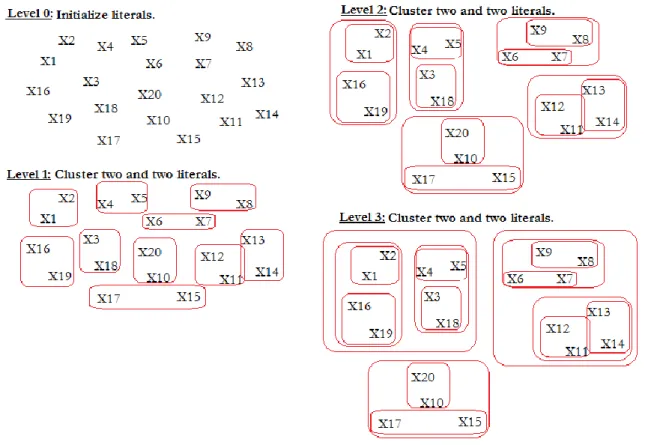
The Multilevel clustering technique simplifies the computation of SAT instances by dividing the number of literals in several levels - literals get clustered together. The Multilevel paradigm consists of three phases: clustering, initial solution and refinement.
As an example, consider a SAT instance with 20 literals. The literals are initialized in the initial level, in the first level the literals get clustered together (two and two) and this continues. So in the first level there would be 10 literals, in the second 5 literals, in the third 3 literals and so on. The amount of levels created is optional, however a relatively big amount is recommended. Figure 5 illustrates the clustering process of a SAT instance with 20 literals.
Figure 5: The Multilevel clustering technique used on a SAT instance with 20 literals.
Once the clustering phase is complete, the clusters in the final level are assigned logical TRUE/FALSE values and an initial solution is calculated. The solution found is then extended to provide a solution for the level
above and then refined using a metaheuristic algorithm. This is done on all levels until a solution to SAT is found. If the initial level is reached and a solution is not found, then the SAT instance could not be solved. The following steps summarize the Multilevel process:
1. Initialize literals.
2. Randomly cluster two literals together, or cluster two neighbouring literals in each level. 3. Do step 2 until the wished amount of clusters is reached.
4. Randomly assign logical TRUE/FALSE values to the clusters in the final level. 5. Compute initial solution.
6. Start refinement phase using metaheuristic algorithm.
The core strength of the Multilevel technique is that during the refinement phase, the algorithm used will compute clusters of literals instead of single literals at a time. This allows the algorithm to view clusters of literals as a single entity, making the search space guided and restricted to only those literals within the clusters. This offers a better sampling of the solution space compared to single level computation.
3.2
Combining Multilevel with Tabu Search
During the refinement phase of the Multilevel technique, an algorithm such as Tabu Search can be used. As discussed earlier in chapter 4, Tabu Search maintains a tabu list which contains flipped literals. Instead of containing flipped literals, it will in this case contain flipped clusters. The tabu list is updated each time a cluster of literals is flipped. Using the list, the algorithm prevents the clusters in the list from being flipped again during the computation.
3.3
Combining Multilevel with Finite Learning Automata
Similarly, during the refinement phase of the Multilevel technique, a technique such as finite Learning Automata can be used. Since this is a technique, it must be combined with an algorithm. For simplicity, it can be combined with the Tabu Search algorithm. As discussed earlier in chapter 4, finite Learning Automata assigns each literal a dedicated learning automaton. In this case, it will assign each cluster a learning automaton. It will then handle the cluster as a single entity, affecting all literals within the cluster. The state of the learning automaton can either be positive or negative. In the latter case, the action FALSE will be performed by the learning automaton. In the former, the action TRUE will be performed. The environment is the SAT instance, which can provide a reward or penalty response to the learning automaton depending on the automaton's action, as explained earlier in chapter 4.
3.4
Tabu Search Implementations
Several Tabu Search variants (five in total) were implemented in order to find the most efficient of the latter. In the following sections each variant is thoroughly examined.
3.4.1
Tabu Search Version 1.0
This is the basic version of Tabu Search. Each version (with the exception of the greedy version) is based on this one. The pseudo code below shows the procedure of Tabu Search version 1.0 (TS v.1.0).
Procedure Tabu Search version 1.0 Begin
initialize tabu list
randomly assign TRUE/FALSE values to the literals current = evaluate initial solution
bestSoFar = current
while current < number_of_clauses do bestGain = -999
gain = 0
for i = 1 to number_of_clauses - current pick an unsatisfied clause i
randomly pick a literal inside the clause i which is not visited mark literal visited
flip literal
gain = compute new_gain if literal is tabu then
store the literal and its gain else if literal is not tabu then if gain == bestGain then pick a gain randomly bestGain = gain
store the literal and its gain if not stored already else if gain > bestGain then
bestGain = gain
store the literal and its gain flip literal
end-for
pick literal with best gain
if literal is tabu AND gain + current < bestSoFar then do not flip
else flip literal
update clauses, current, bestSoFar
tabuBestUnsatisfied = find the tabu literal from tabu list which has the lowest number of unsatisfied clauses if literal is not tabu AND number_of_clauses - current < tabuBestUnsatisfied then
make literal tabu with the value (number_of_clauses - current)
else if literal is not tabu AND number_of_clauses - current >= tabuBestUnsatisfied then make literal tabu with the value tabuBestUnsatisfied
decrease all other literals in tabu list with value bigger than 0 by 1 end-while
End
The idea of Tabu Search is to use a history based selection strategy where flipped literals along with the number of unsatisfied clauses are stored in a so called tabu list. The algorithm will run as long as there are unsatisfied clauses present or a maximum amount of flips is reached (this constraint can be substituted by a time limit). A loop will go through all unsatisfied clauses, picking an unsatisfied clause each time and randomly choosing an unhandled/unvisited literal from the clause. The unvisited literal is then flipped and marked visited and its truth value gain is computed. The literal is then checked if it is tabu or not. If it is tabu, the literal and its gain is stored. If it is not tabu, its gain is checked with the best gain so far. If they are equal, one of them is stored randomly. If the gain is bigger, the best gain so far is updated and the new gain is stored. Once the loop is finished, the literal with the best gain so far is picked. This literal is first checked if it is tabu, and if its gain has improved the total number of satisfied clauses. If that is not the case, the literal is not flipped. Otherwise the literal is flipped and the clauses are updated. The next process is to make this literal tabu - if it is not already tabu - and update the tabu list. In this version of Tabu Search, the tabu literal with the lowest
number of unsatisfied clauses (that is not zero) is located from the tabu list. This tabu literal's number of unsatisfied clauses is then checked with the current number of unsatisfied clauses. If the latter is smaller than the former, then the flipped literal is made tabu with the current number of unsatisfied clauses. If opposite or if they are equal, then the flipped literal is made tabu with the lowest number of unsatisfied clauses from the tabu list. If the flipped literal is already tabu, then this process is ignored. Once this is finished, all tabu literals (with values bigger than zero) are decreased by one. The idea here is to make a literal tabu for a certain length of time. The algorithm is then terminated if all clauses are satisfied or if a maximum number of flips is reached (a time limit could also be used).
3.4.2
Tabu Search Version 2.0
This version of Tabu Search (TS v.2.0) is similar to the one in the previous section except that here if a literal is tabu it is not handled. Simply put, tabu literals are ignored during the loop. This has the consequence of increasing the number of tabu literals in the tabu list.
3.4.3
Tabu Search with Fixed Tabu List Lengths
This version of Tabu Search is similar to the one in section 3.4.1 except that here static lengths are used for the tabu list. It has been observed in earlier research [14] that using static lengths has a positive effect on increasing the number of satisfied clauses. In the following sections, we investigate this by setting various lengths.
3.4.3.1
Static Lengths
Suggested by associate professor Bouhmala, when making a literal tabu we set its value to 1 (in contrast to setting this value to the number of unsatisfied clauses). The process of making the literal tabu and updating the tabu list would then look as shown in the pseudo code below.
if literal is not tabu then
make literal tabu with the value 1
decrease all other literals in tabu list with value bigger than 0 by 1
The lengths from ten to thirty-five were also suggested by associate professor Bouhmala, and were tested in the following sequence; ten, fifteen, twenty, twenty-five, thirty, thirty-five.
3.4.3.2
Static Optimal Lengths
As mentioned earlier in chapter 2.4, B. Mazure, L. Saïs and E. Gregoire showed in their paper a certain optimal length that can be used when setting the tabu list length. This value seemed to be linear with the amount of literals present. Using this length, the pseudo code of making a literal tabu and updating the tabu list would then look as shown below.
if literal is not tabu then
make literal tabu with the value (0.01875number of_ _literals2.8125) decrease all other literals in tabu list with value bigger than 0 by 1
3.4.4
Greedy Tabu Search
This version of Tabu Search is based on a greedy approach introduced by associate professor Bouhmala. This version is seen as a possible extension for future work on Tabu Search. The pseudo code below shows the procedure of Greedy Tabu Search (GTS).
Procedure GreedyTabu Search Begin
initialize tabu list
randomly assign TRUE/FALSE values to the literals current = evaluate initial solution
bestSoFar = current
while current < number_of_clauses do gain = 0
for i = 1 to number_of_clauses - current pick an unsatisfied clause i
randomly pick a literal inside the clause i which is not visited mark literal visited
flip literal
gain = compute new_gain if literal is tabu then if gain <= 0 then flip literal else
put the literal and its gain in a sequence list else if literal is not tabu then
put the literal and its gain in a sequence list end-for
find the sequence that best increases the gain from the sequence list flip back the literals after this sequence because they decrease the gain update clauses, current, bestSoFar
tabuBestUnsatisfied = find the tabu literal from tabu list which has the lowest number of unsatisfied clauses for i=1 to literals_in_sequence_list
if literal i is not tabu AND number_of_clauses - current < tabuBestUnsatisfied then make literal i tabu with the value (number_of_clauses - current)
else if literal i is not tabu AND number_of_clauses - current >= tabuBestUnsatisfied then make literal i tabu with the value tabuBestUnsatisfied
decrease all other literals in tabu list (which are not in the sequence list) with value bigger than 0 by 1 clear sequence list
end-while End
This greedy approach for Tabu Search maintains a sequence list that contains literals and their gains. The main idea of this approach is to flip literals during the loop and put them in the sequence list, if a flipped literal is
tabu and the gain gives no improvement, then this literal is flipped back. Otherwise, literals are flipped consecutively without being flipped back. Once the loop is finished, the sequence that gives the best gain increase is chosen from the sequence list. The literals after this sequence are flipped back because they decrease the gain. The flipped literals are then all made tabu using the same process in Tabu Search version 1.0 (discussed in section 3.4.1) and the tabu list is updated. After this is done, the sequence list is cleared and the same process is repeated for the next iteration of the while-loop. The algorithm will terminate if all clauses are satisfied or if a maximum number of flips is reached (a time limit could also be used).
3.5
Selecting the Best Tabu Search Implementation
In order to decide which Tabu Search implementation is the most efficient, the algorithms were tested on the following random benchmark problems from SATLIB [21]; 600 literals and 2550 clauses (f600), 1000 literals and 4250 clauses (f1000) and 2000 literals and 8500 clauses (f2000). Each algorithm ran each problem with a 600 seconds timeout, 10 times in order to make a mean estimate. Tables 1, 2 and 3 show the results of solving each problem.
Algorithm Problem Mean solved (%) Mean time (seconds)
TS v.1.0 f600 99.4 % 605.4 s.
TS v.2.0 f600 99.7 % 606 s.
TS with fixed lengths f600 99.4 % 617.2 s.
GTS f600 97.1 % 604.6 s.
Table 1: Tabu Search implementations solving a 600 literals and 2550 clauses (f600) random SATLIB benchmark problem. The percentage solved is the number of satisfied clauses. Time limit set to 600 seconds.
Algorithm Problem Mean solved (%) Mean time (seconds)
TS v.1.0 f1000 99 % 607 s.
TS v.2.0 f1000 99.1 % 606.6 s.
TS with fixed lengths f1000 99 % 606.4 s.
GTS f1000 97.3 % 606.4 s.
Table 2: Tabu Search implementations solving a 1000 literals and 4250 clauses (f1000) random SATLIB benchmark problem. The percentage solved is the number of satisfied clauses. Time limit set to 600 seconds.
Algorithm Problem Mean solved (%) Mean time (seconds)
TS v.1.0 f2000 93.7 % 615.3 s.
TS v.2.0 f2000 93.4 % 617.2 s.
TS with fixed lengths f2000 93.4 % 617.2 s.
GTS f2000 92.7 % 617.5 s.
Table 3: Tabu Search implementations solving a 2000 literals and 8500 clauses (f2000) random SATLIB benchmark problem. The percentage solved is the number of satisfied clauses. Time limit set to 600 seconds.
Tables 4, 5 and 6 show the mean solved, variance and standard deviation.
Algorithm Problem Mean solved (%) Variance Standard
deviation TS v.1.0 f600 99.4 % 0.5 0.71 TS v.2.0 f600 99.7 % 0.4 0.63 TS with fixed lengths f600 99.4 % 0.4 0.63 GTS f600 97.1 % 8.2 2.86
Table 4: Tabu Search implementations solving a 600 literals and 2550 clauses (f600) random SATLIB benchmark problem. The mean solved, variance and standard deviation are shown.
Algorithm Problem Mean solved (%) Variance Standard
deviation TS v.1.0 f1000 99 % 0.5 0.71 TS v.2.0 f1000 99.1 % 0.3 0.55 TS with fixed lengths f1000 99 % 0.3 0.55 GTS f1000 97.3 % 80.2 8.96
Table 5: Tabu Search implementations solving a 1000 literals and 4250 clauses (f1000) random SATLIB benchmark problem. The mean solved, variance and standard deviation are shown.
Algorithm Problem Mean solved (%) Variance Standard
deviation TS v.1.0 f2000 93.7 % 0.2 0.45 TS v.2.0 f2000 93.4 % 0.1 0.32 TS with fixed lengths f2000 93.4 % 0.1 0.32 GTS f2000 92.7 % 8.1 2.85
Table 6: Tabu Search implementations solving a 2000 literals and 8500 clauses (f2000) random SATLIB benchmark problem. The mean solved, variance and standard deviation are shown.
In addition to these problems that were tested, seven other random problems (specifically f100, f125, f150, f175, f200, f225 and f250) from SATLIB benchmarks were tested and all algorithms gave high success rates ranging from 97.8 % to 100 %. Tabu Search version 2.0 was the only version to have solved six of these problems 100 %, and the seventh 99.3 %. Based on these results and the results shown in tables 1, 2 and 3, Tabu Search version 2.0 proved to be the best overall algorithm. It was therefore selected to be combined with the Multilevel paradigm (and later with Learning Automata).
Tables 4, 5 and 6 further illustrate the variance and standard deviation of each algorithm solving f600, f1000 and f2000. As can be seen, the variance and standard deviation are relatively low in almost all cases (with the exception of the GTS algorithm). This indicates that the algorithms are overall stable and the results are not widely spread around the mean. GTS seems to be the only algorithm that contradicts this, as it in all cases gave a rather high variance and standard deviation.
3.6
Learning Automata with Tabu Search Implementation
The implementation of Learning Automata with Tabu Search (LATS) is based on the algorithm discussed in section 2.5. The idea here is to integrate the Learning Automata implementation for SAT into Tabu Search, the pseudo code below shows the procedure of this.
Procedure Learning Automata withTabu Search Begin
initialize tabu list
for i=1 to number_of_literals
randomly set the state of literal i to -1 or 1 if state == -1 then
set literal i to FALSE else
set literal i to TRUE end-for
current = evaluate initial solution bestSoFar = current
while current < number_of_clauses do /*Learning Automata start*/ randomly pick an unsatisfied clause
randomly pick a literal or its negation from inside the clause
if literal was picked AND state < (number_of_clauses – current) then increase the state of the literal by 1
if state == 0 then flip literal
update clauses, current, bestSoFar
else if negated literal was picked AND state > -(number_of_clauses - current) then decrease the state of the negated literal by 1
if state == -1 then flip negated literal
update clauses, current, bestSoFar randomly pick a satisfied clause
randomly pick a literal or its negation from inside the clause
if literal was picked AND state >= 0 AND state < (number_of_clauses – current) then increase the state of the literal by 1
else if negated literal was picked AND state < 0 AND state > -(number_of_clauses - current) then decrease the state of the negated literal by 1
/*Tabu Search start*/ bestGain = -999 gain = 0
for i = 1 to number_of_clauses - current pick an unsatisfied clause i
randomly pick a literal inside the clause i which is not visited mark literal visited
flip literal
gain = compute new_gain if literal is not tabu then if gain == bestGain then pick a gain randomly bestGain = gain
store the literal and its gain if not stored already else if gain > bestGain then
bestGain = gain
flip literal end-for
pick literal with best gain
if literal is tabu AND gain + current < bestSoFar then do not flip
else
flip literal
update clauses, current, bestSoFar
tabuBestUnsatisfied = find the tabu literal from tabu list which has the lowest number of unsatisfied clauses
if literal is not tabu AND number_of_clauses - current < tabuBestUnsatisfied then make literal tabu with the value (number_of_clauses - current)
else if literal is not tabu AND number_of_clauses - current >= tabuBestUnsatisfied then make literal tabu with the value tabuBestUnsatisfied
decrease all other literals in tabu list with value bigger than 0 by 1 end-while
End
The idea of Learning Automata with Tabu Search is to use the techniques of the latter and former together. As discussed in section 2.5, Learning Automata with a Random Walk approach provided good results when solving SAT instances. Therefore, combining Learning Automata (using a Random Walk approach) with Tabu Search should in theory provide better results than using the latter alone.
In Learning Automata, each literal has an automaton resulting in a team of automata. Each automaton starts randomly with a certain state value; -1 or 1. Literals with negative state values are assigned FALSE values, and literals with positive state values are assigned TRUE values (as illustrated in figure 6). The algorithm randomly picks an unsatisfied clause and a literal or its negation from inside the clause. The state value of the literal or its negation is strengthened by either increasing it (if it is positive) or decreasing it (if it is negative). If the state value of the literal or its negation changes from negative to positive - or vice versa - then it is flipped. The minimum state value is set to minus the number of unsatisfied clauses and the maximum state value is set to the number of unsatisfied clauses (we set these limitations in order to have a finite amount of state values). The algorithm then randomly picks a satisfied clause and a literal or its negation from inside the clause, this literal or its negation is then strengthened (rewarded) if its truth assignment contributes to the satisfaction of the clause. Its state value is increased (if it is positive) or decreased (if it is negative). Eventually, literals found in unsatisfied clauses are penalized and frequently flipped while literals found in satisfied clauses (which with their truth assignments contribute to the satisfaction of the clauses) are rewarded. Once the Learning Automata process is complete, Tabu Search - which we have covered in sections 3.4.1 and 3.4.2 - starts its process. The algorithm is then terminated if all clauses are satisfied or if a maximum number of flips is reached (a time limit could also be used).
3.7
Multilevel Paradigm Implementation
As mentioned in section 3.1, the Multilevel paradigm consists of three phases; clustering, initial solution and refinement. A metaheuristic algorithm is used in the last phase of the paradigm, in our case, Tabu Search and Learning Automata.
3.7.1
Clustering, Evaluation of Initial Solution and Refinement Phases
Clustering, evaluation of initial solution and refinement are the three phases of the Multilevel paradigm. The pseudo code below shows how the first two phases work. The third phase will be explained in the next sections.
The Multilevel paradigm works as explained in section 3.1. A size limit on the number of clusters at the final level decides how far the clustering process will go. Setting this value to 10 % of the total number of literals is a good measurement. Once the clustering process is complete, the clusters at the final level are randomly assigned TRUE/FALSE values. The initial solution is then computed and the refinement phase is ready to start.
Procedure Multilevel Paradigm Begin
level = 0
clusterCollection = initialize literals
while clusterCollectionSize != size_limit do
randomly cluster two literals or clusters together and put them in clusterCollection update clusterCollection, clusterCollectionSize
if reached_end_of_clusterCollection then increase level by 1
end-while
randomly assign TRUE/FALSE values to the clusters in clusterCollection (final level) current = evaluate initial solution
start refinement phase End
3.8
Multilevel Tabu Search Implementation
Tabu Search is slightly modified in order to work properly in the refinement phase of the Multilevel paradigm. The modifications to the algorithm will be explained in the next section.
3.8.1
Refinement Phase Using Tabu Search
The implementation of Tabu Search is slightly modified in order to handle clusters of literals. The pseudo code below shows the Tabu Search refinement procedure.
Procedure Multilevel Tabu Search (refinement phase) Begin
bestSoFar = current
while current < number_of_clauses do initialize tabu list for level
bestGain = -999 gain = 0
if level != 0 then
for i = 1 to number_of_clusters_in_level randomly pick a cluster i
mark cluster i visited flip cluster i
gain = compute new_gain if cluster i is not tabu then if gain == bestGain then pick a gain randomly bestGain = gain
else if gain > bestGain then bestGain = gain
store cluster i and its gain flip cluster i
end-for
decrease level by 1 pick cluster with best gain
if cluster is tabu AND gain + current < bestSoFar then do not flip
else
flip cluster
update clauses, current, bestSoFar
tabuBestUnsatisfied = find the tabu cluster from tabu list which has the lowest number of unsatisfied clauses if cluster is not tabu AND number_of_clauses - current < tabuBestUnsatisfied then
make cluster tabu with the value (number_of_clauses - current)
else if cluster is not tabu AND number_of_clauses - current >= tabuBestUnsatisfied then make cluster tabu with the value tabuBestUnsatisfied
decrease all other clusters in tabu list with value bigger than 0 by 1 else
start procedure Tabu Search end-while
End
The Multilevel variant of Tabu Search (MTS) works as the latter except that here clusters of literals instead of single literals are handled at a time; a loop runs through all the clusters in a level and handles each cluster. Once finished with a level, the best cluster is flipped and made tabu (if not already tabu). The tabu list is then