»ROGRAMI
PROGRESS
REPORT
July - December 1981
COMMISSION OF THE EUROPEAN COMMUNITIES
JOINT RESEARCH CENTRE
Ispra Establishment
Italy
0«^Γ?Τ1ΐΓΤ1ίΓ;·''Τ-"ΤιΤίίΠΠΜΜί·Γ
L
^CLASSIFIED
released as
?ns
PHgg?=g=agai«i»nww)iii.jj.i .***,<,.>***&*COMMUNICATION
Category 1.3
Nr 3925
Safety of
nuclear materials
WARNING
The information contained in this document is
communicated confidentially by the Commission of the European Communities to Member States, persons and undertakings and should not be passed on to third parties.
July-December 1981
Programme Progress Report - JRC Ispra July-December 1981
SAFETY OF NUCLEAR MATERIALS
Abstract
This document is the progress report of the JRC programme Safety of Nuclear Ma-terials for the period July-December 1981.
On the basis of the Council decision on the JRC plan 1980-1983, the activity on ra-dioactive waste management which is carried out in the framework of the program-me Safety of Nuclear Materials, has been organized into 4 projects:
- Risk Evaluation - Protective Barriers - Actinide Separation - Actinide Monitoring
The main results obtained during the reporting period are the following: Project 1. Risk Evaluation
The risk analysis methodology for geological disposal of radioactive waste, develo-ped by the JRC, is being applied to the Boom clay formation in Belgium.
Consequences of various release scenarios are under evaluation; the analysis of the uncertainty in the results is carried out by means of a Monte Carlo method. In the framework of the assessment studies on alpha-waste management an inte-gral waste management strategy, based on the utilization of the OXAL process, has been developed.
Project 2. Protective Barriers
In the field of radiation damage in borosilicate glasses, work has been continued to provide information on the basic mechanisms of damage.
Leaching and corrosion tests have been carried out on borosilicate glasses and ma-terials for waste containers.
In the field of interaction of radionuclides with the environment, results have been obtained on the chemical forms of radionuclides leached from borosilicate glasses and on their behaviour in the migration in geological media.
Project 3. Actinide Separation
Experimental work has been carried out on the separation of plutonium from me-dium level waste (MLW) streams of reprocessing plants. In particular the OXAL pro-cess has been sucpro-cessfully tested on a simulated MLW concentrate.
Project 4. Actinide Monitoring
Progresses have been made in the setting-up of a reference monitor for passive neutron assay.
COMMISSION OF THE EUROPEAN COMMUNITIES
JOINT RESEARCH CENTRE
Ispra Establishment
Italy
B E M Æ R K
Den viden, som rummes i dette dokument, meddeles som fortrolig fra Kommissionen for de europæiske Fællesskaber til Medlemsstater, per-soner og virksomheder og ma ikke videreaives til trediemand. (Euratom-traktatens artikel 13 og Minersterrådets forordning(EÛF) N° 2380/74).
Hverken Kommissionen for de Europæiske Fælleskaber eller nogen, som optraeder pa Kommissionens vegne er ansvarling for den eventuelle brug af information, som er indeholdt i det følgende .
ZUR BEACHTUNG
Die in diesem Dokument enthaltenen Kenntnisse werden von der Kom-mission der Europäischen Gemeinschaften den Mitgliedstaaten, Per-sonen und Unternehmen der Gemeinschaft vertraulich mitgeteilt und dürfen nicht an Dritte weitergegeben werden. (Euratom-Vertrag, Arti-kel 13, und Beschlussdes Ministerrates (EWG) Nr. 2380/74).
Weder die Kommission der Europäischen Gemeinschaften noch Perso-nen, die im Namen dieser Kommission handeln, sind für die etwaige Verwendung der nachstehenden Informationen verantwortlich.
NOTICE
The information contained in this document is communicated confi-dentially by the Commission of the European Communities to Member States, persons and undertakings and should not be passed on to third parties. (Euratom-Treaty, Article 13, and Regulation (EEC) No. 2380/74 of the Council of Ministers).
Neither the Commission of the European Communities nor any person acting on behalf of the Commission is responsible for the use which might be made of the following information.
AVERTISSEMENT
Les connaissances contenues dans le présent document sont communi-quées confidentiellement par la Commission des Communautées euro-péennes aux Etats membres, personnes et entreprises et ne peuvent être transmises à des tiers. (Traité Euratom, article 13, et règlement (CEE) N° 2380/74 du Conseil de Ministres).
Ni la Commission des Communautés européennes, ni aucune personne agissant au nom de la Commission, n'est responsable de l'usage qui pourrait être fait des informations ci-après.
A V V E R T I M E N T O
Le cognizioni contenute nel presente documento sono comunicate con-fidenzialmente dalla Commissione delie Comunità europee agli Stati membri, persone ed imprese e non debbono essere trasmesse a terzi. (Trattato Euratom, articolo 13, e regolamento (CCE) N° 2380/74 del Consiglio dei Ministri).
Né la Commissione delle Comunità europee, né alcuna persona che agisca per suo conto, è responsabile dell'uso che dovesse essere fatto delle informazioni che seguono.
OPMERKING
De kennis, die in dit document is vervat, wordt door de Commissie van de Europese Gemeenschappen vertrouwelijk aan de Lid-Staten, per-sonen en ondernemingen medegedeeld en mag niet aan derden worden doorgegeven. (Euratom-Verdrag, artikel 13, en het besluit van de Mi-nisterraad (EEG) No. 2380/74).
per-CONTENTS
Introduction 3
Executive Summary 5
Projects 15
1. Risk Evaluation 15
Risk Analysis of Geological Disposal of Radioactive Waste 15
Assessment Studies on Alpha-Waste Management...: 19
2. Protective Barriers 25
Long-Term Stability of Conditioned Waste 25
Interaction of Radionuclides with the Environment 36
3. Actinide Separation 45
4. Actinide Monitoring 51
J.R.C. Publications 53
List of Authors 55
INTRODUCTION
The safe and economic management of the radioactive wa-ste, produced in the exploitation of nuclear energy at an in-dustrial level, requires a considerable effort of R and D. The Joint Research Centre started work in the field of ra-dioactive waste management in 1973. Two multlannual plans 1973-1976 and 1977-1979 have been completed. In the framework of the 1980-1983 plan of the JRC the acti-vity on radioactive waste management is carried out in the programme Safety of Nuclear Materials.
This programme is part of the activity of the JRC in the field of Nuclear Safety and the Fuel Cycle which includes also the programmes Reactor Safety, Plutonium Fuels and Acti-nide Research, and Fissile Materials Control and Manage-ment.
The staff allocated to the programme Safety of Nuclear Ma-terials consists of 52 research-men corresponding to about 5% of the total JRC research staff.
The programme is carried out at the Ispra Establishment with a participation of the Karlsruhe Establishment. The Commission of the European Communities started in 1975 an indirect action programme on Radioactive Waste Management. In this programme, which is conducted by means of contracts with national laboratories, various aspects of waste conditioning technologies are studied and a large coordinated action for the study of waste disposal in various :ypes of geological formations is established. The first plan 1975-1979 of the Indirect action programme has been completed. The second plan 1980-1984 is in pro-gress.
Strict relations are maintained between the two program-mes.
In addition to the research programmes, the Council appro-ved in February 1980 the Community Plan of Action in the field of Radioactive Waste (1980-1992). This plan entrusts the Commission with a wider role in the implementation of the waste management practices.
In the management of the research programmes and of the Community Plan of Action a very important contribution is given by the Advisory Committee for Programme Manage-ment (ACPM).
The programme Safety of Nuclear Materials of the JRC has been organized into 4 projects:
Risk Evaluation
The project includes:- Risk analysis of geological disposal of radioactive waste including sea bed disposal.
- Assessment studies on alpha-waste management.
Protective Barriers
The project includes:- Studies on the long-term stability of conditioned waste. - Studies on the interaction of radionuclides with the
envi-ronment.
Actinide Separation
The project is mainly directed to develop chemical methods for the reduction of the plutonium content in various waste streams.
Actinide Monitoring
EXECUTIVE SUMMARY
M. BRESESTI - Programme Manager-Projects Directorate - JRC Ispra
Introduction
Following the Council decision, the programme Safety of Nuclear Materials has been organized into 4 projects: Project 1. Risk Evaluation
Project 2. Protective Barriers Project 3. Actinide Separation Project 4. Actinide Monitoring
The J.R.C, programme is essentially dealing with long-term safety aspects of radioactive waste management, the two main objectives being:
the assessment of the long-term safety of geological di-sposal
- the optimization of the alpha-waste management taking into account mainly cost and long-term safety.
The multidisciplinary group of about 50 people working at the JRC - Ispra constitutes the most important single group of the Community working in the area of long-term safety of radioactive waste management.
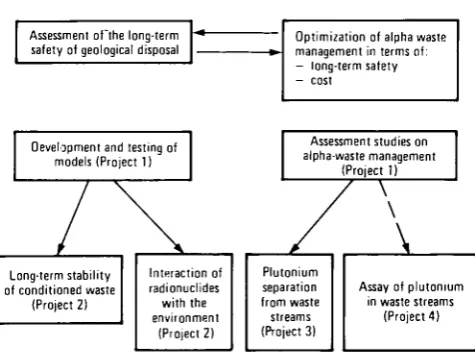
[image:11.595.59.297.597.774.2]The relations between the various projects are indicated in Fig. 1.
Project 1 groups the theoretical activities of the programme which are related to the various experimental activities. The activity of development and testing of models for safety assessment of geological disposal (Project 1) is strictly con-nected with the experimental activities (Project 2) concer-ning the barriers constituted by long-term stability of condi-tioned waste and retention of radionuclides in the environ-ment.
The activity of assessment on alpha-waste management (Project 1) Is strictly connected with the laboratory work on the plutonium separatlon from various waste streams (Pro-ject 3); at present the connections are less strict with the activity on actinide monitoring (Project 4).
J.R.C. PROGRAMME 1980- 1983
Assessment oHhe long-term
safety of geological disposal Optimization of alpha waste management in terms of: - long-term safety - cost
Development and testing of models (Project 1)
Long-term stability of conditioned waste
(Project 2)
Interaction of radionuclides
with the environment
(Project 2)
Assessment studies on alpha-waste management
(Project Ì)
T
\ \
Assay of plutonium in waste streams
(Project 4)
The development of the programme wil the basis of the subdivision by projects, rious interrelations.
be presented on indicating the
va-Fig. 1. J.R.C. Programme 1980-1983: Safety of Nuclear Materials
Project 1. Risk Evaluation
Risk analysis of geological disposal of radioactive waste
The activity on safety assessment of geological disposal is at present mainly directed to the application of the metho-dology developed at the J.R.C., on the potential disposal si-te constitusi-ted by the Boom clay formation in Belgium. The activity is carried out in the framework of a collabora-tion with CEN/SCK, Mol.
The JRC approach includes a probability assessment of the possible failure of the geological containment and an analy-sis of the consequences for different release scenarios. The work in progress on the Boom clay formation constitu-tes the first exercise in the Community of complete asses-sment (release probabilities and release consequences) for a specific site.
The probability assessment using Fault Tree Analysis, was completed during 1980. A summary of the work was publi-shed as Topical Report in the previous Programme Pro-gress Report. The complete work has been recently publi-shed in the Journal Radioactive Waste Management (see Section J.R.C. Publications).
The assessment has indicated the probabilities of various scenarios of failure of geological containment.
For the most important scenarios, a consequence analysis has been undertaken to assess doses to man, in particular dose rates to the maximum exposed individual; multiplica-tion of doses by the^corresponding event probabilities per-mits to quantify the risk.
In agreement with the planning (see APPENDIX 1 - Table I) the consequence analysis for the scenario involving a per-meable fracture across the repository, has been comple-ted; a Monte Carlo method has been utilized to generate the probability distribution of the consequences, given the di-stribution of the input parameters: this method has been ap-plied to take into account the-input parameter uncertainties for the consequence analysis related to the permeable frac-ture; a draft version of the work has been prepared. The en-tire methodology is described in a paper which has been submitted for publication.
During the reporting period consequence analysis has also been started on a glacial erosion scenario.
In the area of seabed disposal it is worth mentioning that the Commission is now an official member of the ΝΕΑ Sea bed Working Group. This involves the participation of staff members of JRC and of the indirect action programmes in various task groups. The JRC staff contributes particularly to the activity of the System Analysis task group and to the coordination between Systems Analysis and Engineering Studies task groups.
In agreement with the planning a base-case model for risk analysis has been developed on the basis of which the im portance of the retention phenomena in the sediments, in controlling radionuclide migration, has been confirmed. In view of a possible enlargement of the activity on seabed disposal, in the framework of the next multiannual JRC plan, programme proposals are under evaluation in various re search areas; in particular the role and the characteristics of high pressure facilities are being evaluated through a stu dy contract.
In September 1981 the coordinated study on the Geological Disposal Risk (GDR) lo be carried out in the framework of the Community Plan of Action has received a favourable ad vice of the Advisory Committee for Programme Manage ment.
Objective of this study is to obtain In about 6 years a harmo nized evaluation of the main waste disposal options presen tly under study in the Community (salt, granite, clay, sub-seabed).
The activity of the JRC will particularly deal with the clay and sub-seabed disposal options.
Coordination of the study will be assured jointly by JRC and Indirect action programmes.
In view of the importance of this initiative an increase of staff is planned in the group working on risk analysis of geo logical disposal.
Assessment studies on alpha-waste management
The activity in this area started in the second semester of 1980 following the reduction of the activity on chemical se paration and nuclear transmutation of actinides. Aim of the study is the optimization of the waste management pro cedures on the basis of various parameters and in par ticular of cost and long-term safety.
As first step of the study a Baseline Waste Management Strategy (BWMS) has to be'defined. The introduction of al ternative options in this reference strategy will be evaluated in terms of cost/benefit.
During the reporting period the BWMS has been completed with the definition of a Reference Waste Treatment Facility. In agreement with the planning, taking into consideration the results obtained at laboratory level, an integral waste management strategy, based on the utilization of the OXAL process, has been developed. This strategy considers both HLW and different categories of MLW.
Various incentives for this strategy have been qualitatively evaluated. It is the intention of the JRC to present this pro posal at Community level in view of a possible Integrated ef fort in this area.
During the first semester of 1982 it is planned to evaluate in
Project 2. Protective Barriers
Long-term stability of conditioned waste
The JRC activity in this area includes radiation damage stu dies on borosilicate glasses, leaching and corrosion experi ments and an exploratory investigation on a special matrix for conditioning of actinides + rare earths.
In the field of radiation damage the study at the HV electron microscope of the growth of bubbles under electron irradia tion in borosilicate glasses made possible to evaluate the swelling paramaters and to associate it to the displacement process of single defects. In any case it has been confir med that this effect starts at dose rates much higher than those expected during storage of HLW.
Other information on the basic aspects of radiation damage is being obtained by means of irradiation experiments on si lica.
Following results obtained in a French laboratory which in dicated a strong increase of leaching rates in damaged bo rosilicate glasses, a critical review of radiation effects on borosilicate glasses has been carried out at the JRC. This review is presented as a Topical Report in Section 2: Protective Barriers.
The conclusions of this review are quite reassuring; in fact it is stated "The existing values for the examined properties seem to indicate that the effects of radiation will not greatly influence the stability of the glass at the doses and dose ra tes expected. An extension of the experiments to higher do ses could increase the confidence in the results obtained". Concerning relations between radiation damage and lea ching rate, experiments carried out at the JRC during the past years indicated negligible effects on the leaching rate due to radiation damage. This point has to be checked again by performing leaching tests on borosilicate glasses irradiated in the HFR reactor, Petten (fission fragment simu lation) at a dose equivalent to a vitrified waste irradiation of 1 million years.
The start of the leaching tests has been delayed to 1982 due to difficulties in handling the irradiated capsules (see APPENDIX 1 - Table II and APPENDIX 2 - Table II). The JRC planning in the area of radiation damage envisa ges to conclude the activity on bulk properties for the end of 1982.
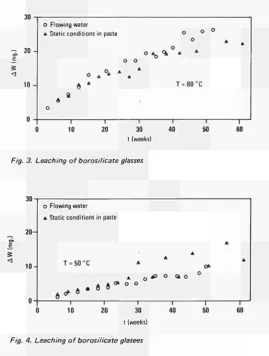
In the area of the leaching tests on borosilicate glasses the major effort is being spent to study the leaching in normal repository conditions i.e. with the glass in contact with limi ted amount of water and the backfilling materials.
The results of laboratory experiments conducted for 60 weeks on glasses In contact with a paste of montmorillonlte and sand indicate that the leaching rates in these condi tions are similar to those measured In a large amount of flo wing water.
A possible explanation of these results Is that the various elements leached from the glass are trapped by the mont-morillonite which acts as an ion exchanger.
of absorbent systems like clay, in which the transport is controlled by diffusion.
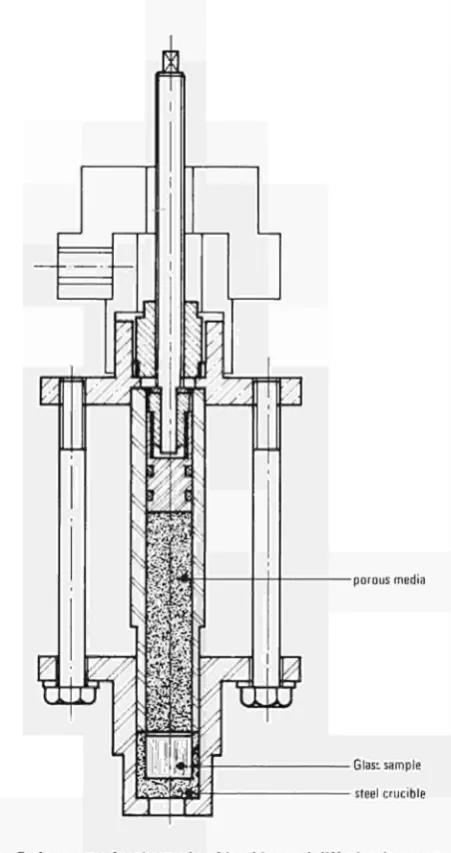
For this reason we are setting-up experiments in which the glass leaching and the diffusion in clay are studied simulta-neously.
For the same reason we are envisaging a deeper integra-tion between the experiments of leaching and the studies of radionuclide migration.
The JRC intends also to contribute to a better knowledge of the basic mechanisms of leaching which is required to ma-ke possible correct evaluations of the long-term stability of borosilicate glasses for various repository conditions. In this connection an experimental facility is being set-up at the JRC Ispra for the measurement of the relevant surface quantities which determine the mechanisms of leaching. The activity on surface analysis will be carried out em-ploying the staff made available by a reduction of activity in the field of radiation damage.
In the area of corrosion of waste containers exploratory in-vestigations are in progress concerning corrosion of punc-tured containers and diffusion controlled corrosion in mild steels.
Finally concerning a special matrix for the conditioning of actinides + rare earths an exploratory investigation has been carried out on the use of monazite type ceramics. It has been realized that the main problem to be resolved is of technological nature. In fact the real problem is not the preparation of a material with a low leaching rate but the preparation of blocks of considerable size having a low spe-cific surface. Thus it would be necessary to perform tech-nological tests which are outside the present possibilities of the J.R.C, programme.
As a consequence it was decided to stop the actual tests and to follow the developments in progress in various labo-ratories on synthetic materials.
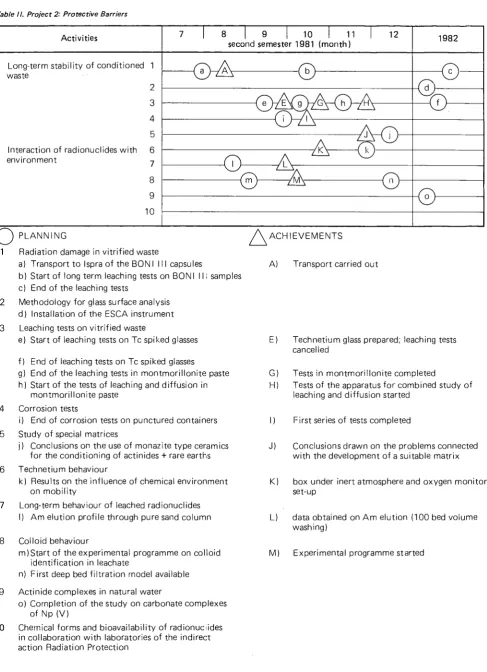
Comparisons between planned activities and achievements for the second semester of 1981 and the planning for the first semester of 1982 are reported in APPENDIX 1 -Table II and APPENDIX 2 - Table II respectively.
Interaction of radionuclides with the environment
The JRC activity in this area is mainly directed to investigate the migration behaviour of the radionuclides following the leaching of vitrified waste in a repository.
Thus the leachate of the borosilicate glasses, containing the radionuclides to be studied, is used in the laboratory ex-periments.
The tests carried out in the past years have indicated that the presence in the leachate of colloidal forms, which can be subjected to filtration by the soil layers, has an important role in governing the radionuclide migration in the short term; the tests have also indicated that the formation of car-bonate complexes of actinides, which are not retained by geological media, can favour their migration and conse-quently increase their potential risk.
Thus the JRC experiments are mainly directed to study for-mation and behaviour of colloidal forms and carbonate complexes.
Initially the work concerned actinides; now an investigation is in progress also on the behaviour of technetium. The other important line of activity concerns the relations between chemical forms and bioavailability, this aspect being investigated In the framework of collaborations with laboratories working in the indirect action programme Ra-diation Protection.
The activity on colloidal forms includes:
- laboratory experiments on the retention and subsequent release of radionuclides in columns of various media - characterization of the colloids
- development of a model for deep bed filtration. The whole activity is directed to provide an overall descrip-tion of the colloid behaviour in geological media.
During the reporting period the laboratory experiments mainly concerned the elution of Am from a glauconitic sand column. The experiments were carried out in such a way to simulate the conditions existing in the porous media over-lying the Boom clay formation.
Various aspects of the colloid retention and successive dis-solution are presented in Section 2: Protective Barriers in the Topical Report "Underground migration of long-lived ra-dionuclides from a borosilicate glass matrix".
Concerning characterization of colloids a photon correla-tion particle analyzer has been set-up and measurements have been started on leachates of borosilicate glasses. The deep filtration model which takes into account the va-rious retention mechanisms is under development by the Ecole des Mines de Paris (Armines) in the framework of a study contract.
In the area of carbonate complexes the work concerning compositions and stability constants of Am complexes has been completed. On the basis of the results obtained it is possible to evaluate the relative importance of the various soluble species of Am in groundwater.
It was planned to start in the second semester of 1981 a si-milar work on Np complexes: due to some competition in the staff utilization with the activity on technetium beha-viour, the work on neptunium will be started only in the first semester of 1982.
Concerning the technetium behaviour the results obtained in the first semester 1981 have indicated a tendency to mi-grate more important than for other long-lived radionucli-des.
However due to a poor reproducibility of the results it was realized that, in order to obtain significative data, it is ne-cessary to operate out of contact with atmospheric oxygen. Thus during the reporting period a special experimental ar-rangement has been set-up.
Finally the studies on the biogeochemical behaviour of plu-tonium and americium and the relations between chemical speciation and bioavailability have been continued. The significant achievements compared to planning for the second semester of 1981 and the planned activities for the next period are reported in APPENDIX 1 - Table II and AP-PENDIX 2 - Table II, respectively.
The reported planning refers to the utilization of the staff presently allocated to the project.
It is worth mentioning that the possibility to increase the ef-fort in the area of protective barriers and in particular of ra-dionuclide migration is being considered. A reinforcement of this activity can be obtained by means of a parallel reduc-tion of effort in the area of the plutonium separareduc-tion from waste streams.
We are pushed in this direction by various considerations: - Interest to apply our methodology to situations relevant to other geological formations in addition to clay, follo-wing requests of collaboration by national organizations. - Interest to increase the contribution to the project
Geo-logical Disposal Risk (GDR) to be developed in the fra-mework of the Community Plan of Action.
As already reported above, an increase of staff should ma ke possible in particular to set-up experiments in which va rious aspects of corrosion, leaching and migration are stu died as a whole simulating at laboratory level conditions of geological repositories.
Project 3. Actinide Separation
The JRC has carried out in the past years an important acti vity on the study of the actinide separation from high level waste (HLW) in view of their transmutation in nuclear reac tors or of a special conditioning and disposal. The flow sheets developed by the JRC for the actinide separation from HLW are being tested on a larger scale, by continuous countercurrent experiments, at Fontenay-aux-Roses in the framework of a collaboration contract between JRC and CEA.
The typing of the final version of the summary report of the JRC programme on chemical separation of actinides, has been started. It is planned to have the report printed during the first semester of 1982.
Starting in the second half of 1980 the laboratory activity has been progressively transferred from the study on actini de separation from HLW to the study on the plutonium se paration from medium level waste (MLW) in view of separa ted conditioning or recycling.
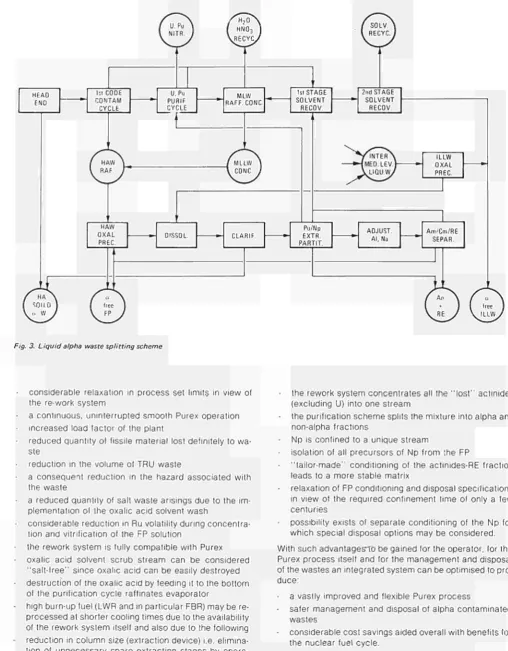
During 1981 the application of the OXAL process, previou sly developed for HLW, to MLW concentrates from repro cessing plants, has been extensively investigated. The work has been carried out on simulated solutions; their compositions had been defined In the framework of tne As sessment Studies on Alpha-Waste Management. The labo ratory experiments have indicated that the oxalate precipi tation, adding Ce carrier, makes possible to recover more than 99% of plutonium; the contamination of the precipita te by other materials Is limited. The process is compatible with current precipitation methods which can successively be applied to separate other radionuclides.
During the reporting period the experimental work on the plutonium recovery from exhausted TBP, by means of oxa lic acid washing, has also been completed. Plutonium can be recovered with a very high yield; if the oxalic washing is applied the successive washing of TBP with Na2C03 solu tion, required for the removal of dibutylphosphate (HDBP), would produce an alpha-free solution. It has to be reminded that the Na2C03 solution is one of the important waste streams of the reprocessing plants.
Experimental work has also been carried out concerning treatment of dissolution residues with formic acid in view of a possible plutonium recovery. It may be expected that for mic acid in presence of noble metals dissolves plutonium by its reduction to the more soluble trivalent state. The labo ratory tests have given negative results.
The various tests on the utilization of the OXAL process are the basis for the integral waste management strategy which has been developed in the framework of the Asses sment Studies on Alpha-Waste Management.
During the next months it is planned to complete the work concerning application of OXAL to MLW concentrates of re processing plants.
As already reported a reduction of effort in this area is being considered in order to make possible a reinforcement of the activity dealing with protective barriers.
It is planned to take a decision on this matter during the next months also in connection with the orientations which will be given by the General Director in view of the prepara tion of the programme proposals for the new JRC plan to be started in 1984.
At the same time a decision will also be taken concerning possible utilization of the ADECO cells.
The significant achievements compared to planning for the second semester of 1981 and the planned activities for the first semester of 1982 are reported In APPENDIX 1 - Table III and APPENDIX 2 - Table III respectively.
Project 4. Actinide Monitoring
The JRC activity on actinide monitoring is carried out follo wing two main lines:
- development of methodology and instrumentation for the non-destructive assay of plutonium content in waste streams.
- application of the JRC methodology and instrumentation in nuclear plants of the Community.
Concerning the first line of activity the JRC is spending a particular effort in the area of passive neutron assay. During the reporting period a 4 π geometry detection head has been completed and assembled. Progresses have been made in the development of the software required for the connected computerized system. The detection head and the computerized system constitute the passive neutron re ference monitor which makes use of an upgraded time cor relation analysis.
It is planned to perform an assessment of the various me thods applied for passive neutron assay, using the compu terized system and a Monte Carlo simulation. This asses sment should provide indications of possibilities and limits of the various methods.
Concerning application of the JRC methodology in nuclear plants, the major effort is directed to the evaluation of va rious NDA systems applied at DNPDE Dounreay for the mo nitoring of plutonium contaminated solid waste streams. During the reporting period the first draft of Part 1 of the fi nal report on Interpretatlonal Models and Calibration Me thods, has been prepared.
The JRC methodology will find application also in the frame work of the Interlaboratory Comparison organized by the in direct action programme.
APPENDIX 1 S I G N I F I C A N T A C H I E V E M E N T S COMPARED TO PLANNING
Table I. Project 1: Risk evaluation
Activities 8 | 9 | 10 11 12
second semester 1981 (month) 1982
Risk analysis of geological disposal
Assessment studies on sea bed disposal
Assessment studies on alphawaste management
Assessment studies on nuclear transmutation of actinides
<¡>
-Ær®-A
ο ^
Ο
P L A N N I N GΔ
A C H I E V E M E N T S 1 Promotion and coordination of risk analysis activities inthe Community in collaboration w i t h DG X I I
2 Application of the JRC methodology on the Boom clay formation
a) Final version of the consequence analysis ready b) Draft version of the uncertainty analysis ready
Assessment studies on seabed disposal c) Draft of risk analysis model ready
Assessment studies on alphawaste management
d) First evaluation of the alternative management scheme based on oxalate precipitation
Assessment studies on nuclear transmutation of actinides e) Summary report ready
X) Start of the coordinated study on the Geological Disposal Risk (GDR) in the framework of the Community Plan of Action
A) Revised version of consequence analysis ready B) Draft version of the consequence analysis
including uncertainty analysis ready Y) Draft version of a paper illustrating the JRC
probabilistic approach for the longterm risk, prepared
C) Basecase model developed
D) Integral waste management strategy based on O X A L , developed
APPENDIX 1 S I G N I F I C A N T ACHIEVEMENTS COMPARED TO PLANNING
Table II. Project 2: Protective Barriers
Activities
Longterm stability of conditioned 1 waste
2
3
4
5 Interaction of radionuclides with 6
environment η
8
9
10
7 8 9 10 11 12
second semester 1981 (month)
I n i / f V f h i
( e )/E\( 9 J /C\
\U ¿—\
0)
A
vV
Λ
W
1982
^ 7 ^
1 d
VV
—(TV
w .
Yo~V
v ^
o
10
P L A N N I N G
Radiation damage in vitrified waste
a) Transport t o Ispra of the BONI III capsules
b) Start of long term leaching tests on BONI 111 samples c) End of the leaching tests
Methodology for glass surface analysis d) Installation of the ESCA instrument
Leaching tests on vitrified waste
e) Start of leaching tests on Tc spiked glasses
f ) End of leaching tests on Tc spiked glasses
g) End of the leaching tests in montmorillonite paste h) Start of the tests of leaching and diffusion in
montmorillonite paste
Corrosion tests
i) End of corrosion tests on punctured containers
Study of special matrices
j) Conclusions on the use of monazite type ceramics for the conditioning of actinides + rare earths Technetium behaviour
k) Results on the influence of chemical environment on mobility
Longterm behaviour of leached radionuclides I) A m elution profile through pure sand column
Colloid behaviour
m)Start of the experimental programme on colloid identification in leachate
n) First deep bed filtration model available
Actinide complexes in natural water
o) Completion of the study on carbonate complexes of Np (V)
Chemical forms and bioavailability of radionuclides in collaboration w i t h laboratories of the indirect action Radiation Protection
Λ A C H I E V E M E N T S
A) Transport carried out
E) Technetium glass prepared; leaching tests cancelled
G) Tests in montmorillonite completed
H) Tests of the apparatus for combined study of leaching and diffusion started
I ) First series of tests completed
J) Conclusions drawn on the problems connected w i t h the development of a suitable matrix
K) box under inert atmosphere and oxygen monitor setup
L) data obtained on A m elution (100 bed volume washing)
[image:16.595.46.534.61.734.2]APPENDIX 1 - SIGNIFICANT ACHIEVEMENTS COMPARED TO PLANNING
Table III. Project 3: Actinide separation
Activities
Plutonium separation from MLW
Actinide separation from HLW
Equipping of the ADECO hot cells
1
2
3
4
7 8 9 10 11 12
second semester 1981 (month)
ΓΛ\
A
/ p \ ( k l
^
W
í H i 'ΓΎ1
1982
O
PLANNING1 Plutonium separation from liquid MLW
a) Completion of a series of experiments on oxalate precipitation followed by Pu-recovery
2 Plutonium recovery from dissolution residues b) Completion of a first series of experiments 3 Actinide separation from HLW
c) Final summary report ready 4 Equipping of the ADECO hot cells
d) Decision on the operation
Δ
ACHIEVEMENTSA) Series of tests completed on MLW concentrate and exhausted TBP
B) Experiments completed
C) Typing of the final version started
D) Evaluation of the operation continued: decision postponed to 1982
APPENDIX 1 - SIGNIFICANT ACHIEVEMENTS COMPARED TO PLANNING
Table IV. Project 4: Actinide Monitoring
Activities second semester 1981 (month) 8 | 9 | 10 I 11 | 12 1982
Revision of the guide Passive neutron assay
Experimentsat DNPDE Intercomparison experiment
1 2 3 4 5
A\
' B \ — / C
&Θ-
-&-<ÎXÎ)A
O
PLANNINGΔ
ACHIEVEMENTS1. Revision of the Guide
a) Publication of the revised version
2. Passive Neutron Assay
b) Settingup of software for TCA
c) Settingup of hardware (detection head + electronics)
3. Variable Dead Time Counter 4. Experimentsat DNPDE
d) Final interpretation of Ν DA measurements e) Publication of final report Part 1
f) Publication of final report Parts 2 3 5. Intercomparison Exercise
g) Samples to be measured at Ispra
A) Draft of the revised chapter 1 completed
B) Monte Carlo simulation software completed C) Association pulse to time converter to Plessey
completed; Mechanical settingup of detection heads completed
Draft of part 1 completed
APPENDIX 2 - PLANNED ACTIVITIES A N D IMPORTANT MILESTONES
Table I. Project 1: Risk Evaluation
Activities 1 I 2 | 3 I 4 I 5 first semester 1982 (month)
2nd semester 1982
Risk analysis of geological disposal
Assessment studies on seabed disposal Assessment studies on alpha-waste management
Assessment studies on nuclear transmutation of actinides
1 2 3 4
<5>
-Θ-
.©.
<&
®
1. Implementation of the coordinated study on the Geological Disposal Risk (GDR) in the framework of the Community Plan of Action
2. Application of the JRC methodology on the Boom clay formation a) Final version of a paper illustrating the JRC probabilistic approach b) Draft version of glacial erosion scenario analysis
c) Final version of consequence analysis including uncertainty analysis d) First revision of the clay model
3. Assessment studies on seabed disposal
e) Preparation of programme proposals for the next JRC plan
f) Risk evaluations in the framework of the ΝΕΑ Systems Analysis Task Group 4. Assessment studies on alpha-waste management
g) Cost/benefit evaluation for the application of O X A L to liquid MLW of reprocessing plants 5. Assessment studies on nuclear transmutation of actinides
APPENDIX 2 PLANNED A C T I V I T I E S A N D I M P O R T A N T MILESTONES
Table II. Project 2: Protective Barriers
Activities 1 I 2 I 3 I 4 I 5 6 first semester 1982 (month)
2nd semester
Longterm stability of conditioned waste 1
2
3
0
0
ΘΘ
Interaction of radionuclides w i t h environment
0
0
0
0
00
0
1. Radiation damage in vitrified waste
a) Start of leaching tests on BONI III samples b) End of the leaching tests
c) Completion of the studies on the bulk radiation damage
2. Methodology for glass surface analysis
d) Installation of the experimental facility including ESCA, AES and SAM
3. Leaching tests on vitrified waste
e) Completion of a first series of tests on leaching and diffusion in a clay paste using inactive glasses; decision for a possible use of spiked glasses
4. Corrosion tests
f ) Start of diffusion controlled corrosion experiments on mild steels g) Completion of a second series of tests on punctured containers h) Completion of a first series of tests on mild steels
5. Technetium behaviour
i) Technetium behaviour under inert atmosphere
6. Longterm behaviour of leached radionuclides j) Further elution data on A m
7. Colloid identification
k) Measure of colloid polydispersion in glass leachate I) First filtration model available
8. Actinide complexes in natural water
m) Start of the study on Np carbonate complexes
APPENDIX 2 P L A N N E D A C T I V I T I E S A N D I M P O R T A N T MILESTONES
Table III. Project 3: Actinide Separation
Activities
Plutonium separation from MLW
Actinide separation from HLW
Equipping of the ADECO hot cells
1
2
3
1 2 3 4 5 6
first semester 1982 (months)
Í?)
^
O)
η
ω
^J
2nd semester 1982
1. Plutonium separation f r o m liquid MLW
a) Completion of the tests on the application of O X A L ; decision on the continuation of the activity
2. Actinide separation f r o m HLW b) Printing of the summary report
3. Equipping of the A D E C O hot cells c) Decision on the operation
APPENDIX 2 - PLANNED ACTIVITIES AND IMPORTANT MILESTONES
Table IV. Project 4: Actinides Monitoring
Activities 1 I 2 I 3 I 4 I 5 first semester 1982 (month) 2nd semester
1982
Revision of the Guide Passive neutron Assay Experimentsat DNPDE
Intercomparison Exercise
KD-0 -
0
1. Revision of the Guide
a) Publication of the revised version, chapter 1, 2, 3, 4 2. Reference Monitor
b) Theoretical assessment by Monte Carlo method c) Experimental verification on the theoretical assessment d) Preparation of coupling software
3. Experimentsat DNPDE
PROJECTS
1. Risk Evaluation
The project includes two main actions:
- Risk analysis of geological disposal of radioactive waste including seabed disposal.
- Assessment studies on alpha-waste management. The project includes also the preparation of the final sum mary report of the assessment studies on nuclear transmu tation of actinides.
Objective of the assessment studies on alpha-waste mana gement is the optimization of the procedures to be adopted, taking into account mainly cost and benefit on the long-term risk. Thus the assessment studies on alpha-waste manage ment have to be strictly connected with the studies of risk analysis of geological disposal.
Risk Analysis of Geological Disposal
of Radioactive Waste
This activity includes:
- The development of models for risk analysis of geologi cal disposal and their application to a potential disposal site (Boom clay formation).
- Assessment studies on seabed disposal.
Development and application of models for
risk analysis of geological disposal
One critical point is due to the presence of large data un certainties.
Models currently in use are often implemented in determini stic manner. In fact, both the variability of the system and the distribution of the input data are neglected; thus, the predictions generated consist of single values, which are scarcely realistic. Indeed, long-term risk assessments al ways imply a large degree of uncertainty, due to scarce knowledge of the values of the parameters utilized both in probability assessment models and in consequence asses sment models.
The following way can be adopted to evaluate how uncer tainties in input parameters are reflected in the model re sults: a probability distribution is defined for each uncertain Input parameter to cover the range over which it may vary; as a result, a probability distribution is obtained for the quantity which is being assessed; this latter, In the present case, can be any type of release consequences, or release probabilities, or probabilistic risk.
The competences developed by the J.R.C, will be utilized in the coordinated study on the Geological Disposal Risk (GDR) to be carried out in the framework of the Community Plan of Action.
GDR has received the favourable advice of the ACPM Com munity Plan of Action on September 30, 1981.
Objective of this study Is to obtain in due time (about 6 years) a harmonized evaluation of the principal waste di sposal options presently under study in the Community (salt, granite, clay, sub-seabed).
The activity of the J.R.C, will particularly deal with the clay and sub-seabed disposal options.
Coordination of the study will be assured jointly by J.R.C, and indirect action programmes.
Objectives
Results
Aim of this study is to develop and test a methodology for the assessment of the risk linked to the disposal of radioac tive wastes into geological formations.
The starting point is the mathematical definition of the risk: RISK = Event Probability χ Event Consequences In accordance with this definition, risk analysis is split Into two components:
I - Release Scenario Analysis. II - Release Consequence Analysis.
where the first component accounts for the probability term, while the second one provides information on the ex pected consequences, if the release occurs.
On these bases, the methodology which at present is being developed consists of the following steps:
1. Assessment of release probabilities, through application of the Fault Tree Analysis.
2. Evaluation of release consequences, through modelling of the barrier system which is interposed between the waste repository and population.
3. Risk assessment, by combining points 1 and 2.
A. The CEN/SCK of Mol (Belgium) is investigating the possi bility of disposal of radioactive waste Into the clay formation of Boom.
In the framework of a collaboration JRC - CEN/SCK, the above described methodology is being applied to a poten tial repository In the mentioned formation.
The probability assessment model utilized and the results obtained were already presented in the previous Program me Progress Report (1).
The study allowed to recognize the most important release scenarios; among them, the creation of a permeable fractu re across the repository was identified as the most likely one, and therefore was chosen for consequence modelling. The preliminary results of this analysis were assembled in an interim report (2).
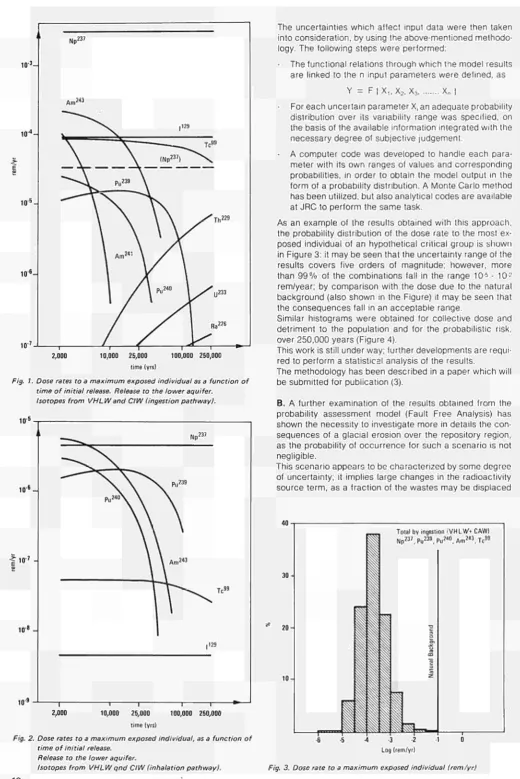
Np-237 could be identified as the most important isotope in governing the long-term risk; this fact is due to the concur rence ot its very long half-life together with its large mobili ty, and large dose factor. Other isotopes of concern appea red to be 1-129 and Tc-99, while plutonium isotopes are especially Important for inhalation pathways (Figures 1 and 2).
2,000 10,000 25,000
time (yrs)
100,000 250,000
Fig. 1. Dose rates to a maximum exposed individual as a function of time of initial release. Release to the lower aquifer.
Isotopes from VHLW and Cll/V (ingestion pathway).
The uncertainties which affect input data were then taken into consideration, by using the abovementioned methodo logy. The following steps were performed:
The functional relations through which the model results are linked to the η input parameters were defined, as
Y F Ι Χι, X?, XÎ
For each uncertain parameter X, an adequate probability distribution over its variability range was specified, on the basis of the available information integrated with the necessary degree of subjective judgement.
A computer code was developed to handle each para meter with its own ranges of values and corresponding probabilities, in order to obtain the model output in the form of a probability distribution. A Monte Carlo method has been utilized, but also analytical codes are available at JRC to perform the same task.
As an example of the results obtained with this approach, the probability distribution of the dose rate to the most ex posed individual of an hypothetical critical group is shown in Figure 3: it may be seen that the uncertainty range of the results covers five orders of magnitude; however, more than 99% of the combinations fall in the range 105 102 rem/year; by comparison with the dose due to the natural background (also shown in the Figure) it may be seen that the consequences fall in an acceptable range.
Similar histograms were obtained for collective dose and detriment to the population and for the probabilistic risk, over 250,000 years (Figure 4).
This work is still under way; further developments are requi red to perform a statistical analysis of the results.
The methodology has been described in a paper which will be submitted for publication (3).
B. A further examination of the results obtained from the probability assessment model (Fault Free Analysis) has shown the necessity to investigate more in details the con sequences of a glacial erosion over the repository region, as the probability of occurrence for such a scenario is not negligible.
[image:22.595.31.552.24.804.2]Source Pathway Rel. See Isotopes
VH LWtCAW Ingestion Low. Aquifer
„237 p„239 D.,240
40
30
20
10
■8 7 6 5 4 3 2 1
Log (health effects/yr)
Fig. 4. Detriment to population (/////A) probabilistic risk over 250,000 years fWWWO
from the repository while undergoing important mechanical actions; the availability of the radioelements to transport in to the biosphere would be increased. Preliminary dose as sessments seem to Indicate that the consequences of this scenario could be of some importance and therefore requi re to be carefully weighed against the corresponding proba bilities, in order to get a comprehensive view of the risk.
Collaboration with External
Organizations
Collaboration contract with CEN/SCK Mol.
Relations with organizations working in the indirect action programme.
References
1. M. D'Alessandro: "Radioactive waste disposal into a plastic clay formation: probabilistic assessment of the geological containment". Topical report in Programme Progress'Report JanuaryJune 1981.
2. G. Bertozzi and M. D'Alessandro: "Radioactive waste di sposal into a plastic clay formation: a site specific exer cise of consequence analysis". Technical note N.° 1.07.03.81.66(1981).
3. G. Bertozzi and M. D'Alessandro: "A probabilistic ap proach to the assessment of the longterm risk linked to the disposal of radioactive waste in geological reposito ries". To be published.
Assessment Studies on Seabed Disposal
Objectives
The activities to be developed at present Include three aspects:
A. The participation of the Commission of the European Communities in the NEA International Seabed Working Group.
B. Assessment methodology for disposal of highlevel wa ste into the deep ocean floor.
C. Development of a proposal for a marine disposal asses sment programme for consideration In the next J.R.C, research plan.
Results
A. The Commission participates as an official member in the NEA International Seabed Working Group (SWG). Three Commission's programmes are involved in the study of the seabed disposal option: indirect action Management and Storage of Radioactive Waste, indirect action Radiation Protection and direct action Safety of Nuclear Materials. At present five task groups of the NEA Working Group have been identified as of direct interest to the European Com mission's programmes. These concern systems analysis, sediment and rock, waste form and canister, biology and engineering studies. Representatives from the Commission were designated for each of these task groups.
Two interim meetings of Engineering Studies (ESTG) and Systems Analysis (SATG) Task Groups were held in SeptemberOctober 1981. In view of the Importance atta ched to engineering studies by the Systems Analysis Task Group the Joint Research Centre and the Sandia National Laboratories were charged to act as liaisons between the two groups in order to facilitate and accelerate information exchange.
The meeting of the Engineering Studies Task Group was held in Delft, 2125 September, 1981 at the Delft Soil Me chanics Laboratory. The main business of the meeting was the development of a detailed network analysis on the basis of the preliminary evaluation carried out during the Sixth Annual Meeting of the Seabed Working Group (SWG), Paris, February 1981.
Other items discussed were the following:
1) Progress relevant lo engineering studies made In va rious national programmes since the Paris meeting.
2) Boundary Conditions and Scope of Work of the task group as previously defined at the Paris meeting.
3) The Draft II SWG FiveYear Plan and the deep ocean drilling proposed by Site Selection Task Group at the Pa ris meeting and expanded upon at their May 1981 mee ting.
It was concluded, after discussion of the above points, that by the end of 1983 the ESTG will have selected a limited number of operations for preconceptual design studies. By 1984 one or more options will have been Identified for detai led design and analysed for technical feasibility. Sensitivity studies should have been completed by 1985. Preconcep tual designs of the preferred options will have been made by 1986.
The interim meeting of the Systems Analysis Task Group (SATG) was held in Antibes, Ecole des Mines, 28 September 2 October, 1981. The main purpose of this meeting was to discuss the requirements for radiological assessment of operational failures before and during disposal and low pro bability postdisposal events as had been decided during the Paris meeting.
Other items discussed were:
1) Progress of work done by SATG members, in particular
the modelling being carried out by Sandia National Labo ratories, USA and Whiteshell, Canada.
2) Report on Engineering Studies Task Group meeting in Delft.
3) Report on progress made in the field of radiological cri teria for nuclear waste disposal.
4) Report on progress in the field of legal, social and inter national aspects.
5) Draft II SWG Five-Year Plan.
6) Draft paper to be submitted by SATG for publication. This paper summarizes the results obtained by the SATG in the initial modelling attempt presented at the Paris meeting.
The problems associated with various probabilistic approa ched applied to sub-seabed disposal were considered to re quire detailed investigation.
It was decided to operate on the following lines:
- to evaluate the possibility to develop a probabilistic sy stems model using the Canadian SYVAC (1) methodolo gy, using the simple set of submodels developed by the SATG for its first deterministic assessment (2).
- to identify operational failure scenarios using the base-case model and to calculate the consequences. - to review probabilistic methodologies for low probability
post-disposal events.
The first results of these studies should be available in 1982.
B. The development of assessment methodologies parallel to those used for terrestrial formations is being carried out in co-operation with the Systems Analysis Task Group. A simple overall system (deterministic) model has been deve loped and preliminary details and calculations were presen ted at the ΝΕΑ International Seabed Working Group mee ting in Paris (February 1981).
In a study carried out by the J.R.C, where a simple radiologi cal methodology was also developed for the assessment of the feasibility of the disposal of high-level radioactive waste into deep ocean sediments, a number of conclusions simi lar to those of the preliminary Systems Analysis model could be drawn:
- The sorption of radionuclides within the sediment co lumn plays an extremely important role in controlling the actual radionuclide concentration eventually reached in the water column.
- Under the conditions of the model and for the emplace ment depth studied (100 m) retention times of between 105 - 109 years seem to be attainable.
- The recycling and downward transport of the actinides by biological or sedimentary processes may be of signifi cant importance in the long-term in decreasing surface and mid-depth water concentrations.
- Due to the importance of the geochemical barrier for ra dionuclide migration, careful experimental study must be made of the properties of deep ocean sediments which control retardation processes. Further the effect
elusions concerning the feasibility of this option can even tually be drawn. The development of the necessary engi neering studies (including modelling) of a number of diffe rent emplacement methods will be needed to show engi neering capability for shallow and deep burial options. C. In view of the development of a proposal for a marine di sposal assessment programme for consideration in the next J.R.C, research plan, more detailed evaluations are un der way on three main project areas.
They may be summarized as being:
a) To increase modelling activity on risk analysis of the seabed disposal option. Two main aspects could be en visaged, the first relates to a continued collaboration with the Systems Analysis Task Group in developing de terministic and probabilistic methodologies for sub-seabed emplacement; the second aspect concerns de veloping (at the J.R.C. Computing Centre) the ability to use a methodology for evaluating the radiological conse quences of radioactive effluent releases.
b) To develop experimental studies on the barriers against radionuclide migration by including investigations car ried out in conditions simulating the deep ocean, i.e. pressure up to 500-1000 bars, temperatures down to 2°C.
This project would possibly consist of four aspects: 1) Development of high pressure facilities including in
strumentation and in-situ sampling systems/engi neering studies.
2) Increasing activity concerned with biogeochemical studies related to radionuclide migration, chemical speciation and bioavailability, under varying simula ted deep ocean conditions.
3) Studying the effect of corrosion and leaching proces ses under different thermal, radiation and pressure fields on various waste forms and canister materials. 4) Increasing modelling efforts on thermodynamic and
nuclide migration processes.
c) For the European Commission to act as a focal point for multinational in-situ experimental activities.
In view of fact that deep ocean studies are inherently complicated and expensive and of the increasing need for cost sharing of large scale projects, specially related to engineering studies and in-situ experimental systems, a co-ordinating role by the Commission could play an im portant part in getting major projects undertaken for the study of sub-seabed disposal feasibility.
A number of areas could be of eventual interest: deve lopment of experimental plateforms, study of emplace ment techniques, large scale cruises/ocean current stu dies, deep drilling experiments etc.
Study contracts are being undertaken to define more clear ly the needs and requirements of various aspects of these projects.
Collaboration with external
organizations
Collaboration with various organizations participating in the ΝΕΑ International Seabed Working Group.
Further discussions have been held between the J.R.C. Ispra, CNEN Fiascherino Laboratory and the D.G. XII Radiation Protection Programme concerning a joint pro gramme on the blogeochemistry of technetium. A first shipment of Tc 95m has been sent from the J.R.C, to Fia scherino.
Studies are proceeding on the chemistry of this element in natural waters.
Contacts have been maintained with the IAEA Monaco Laboratory for studies concerned with transuranics in the marine environment.
References
1. K.W. Dormuth, R. Sherman: "Syvac, a computer pro gramme for assessment of nuclear fuel waste manage ment systems, Incorporating parameter variability". Re port AECL6814. (August 1981).
2. Systems Analysis Task Group, International Seabed Working Group, Report on the SATG Interim Meeting held at the National Radiation Protection Board. (No vember 1980).
Assessment Studies on
AlphaWaste Management
Objectives
Aim of the study is the optimization of the management of alpha waste streams produced both in reprocessing and fa brication plants.
In continuation of the assessment studies on alpha waste management, effort has been directed during the respecti ve work period on the following:
the completion of the reference waste treatment facility a report on the present status of waste classification proposal for the improvements in the Purex reproces
sing scheme for irradiated nuclear fuel material by the integration of a routine waste streams rework process the design stage completion for a scaleup of a precipi
tation denitration reactor.
During the reporting period it was also planned to continue the preparation of the final summary report on the nuclear transmutation of actinides.
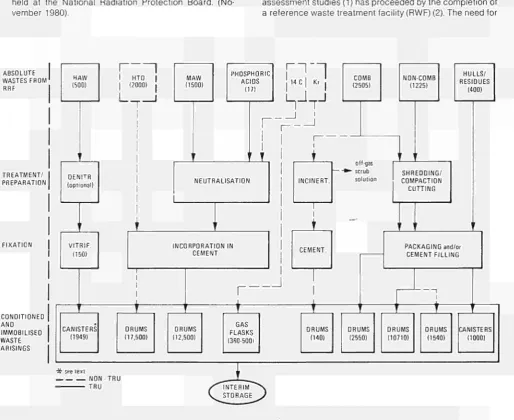
The Reference Waste Treatment Facility
The Baseline Waste Management Strategy (BWMS) adop ted for the initial study phase on alpha waste management assessment studies (1) has proceeded by the completion of a reference waste treatment facility (RWF) (2). The need for
ABSOLUTE WASTES FROM RRF
TREATMENT/ PREPARATION
FIXATION
CONDITIONED AND IMMOBILISED WASTE ARISINGS
HAW (500)
DENITR (optional)
VITRIF. (150)
CANISTERS (1949)
ι
I
I HTO I | (2000)
I
„ ι
DRUMS (17,500)
14 C Kr
h
V
Γ"
t τ
NEUTRALISATION INCINERT.
offgas ■ scrub solution
INCORPORATION IN CEMENT
Γ
. J
DRUMS (12,500)
GAS FLASKS (3FJD500I
NONCOMB (1225)
HULLS/ RESIDUES
(400)
SHREDDING/ COMPACTION CUTTING
v w
PACKAGING and/or CEMENT FILLING
DRUMS (2550)
DRUMS (10710)
DRUMS (1540)
CANISTERS (1000)
# see text
N 0 N T R U TRU
Fig. 1. Schematic representation of the functional operation of the reference waste treatment facility for the wastes arising in the RRF.
[image:25.595.62.577.362.782.2]such a RWF became the next logical step in the asses-sment studies after the qualitative and quantitative analysis of the absolute wastes arising in the reference reproces-sing and MOX fuel fabrication facilities (RRF and RFFP re-spectively).
The absolute wastes emanating from the RRF and the RFFP facilities are of various physical, chemical and radioactive compositions and are considered to typify the next genera-tion commercial facilities.
The basic concept envisaged to solve the problems created by these wastes aims at immobilising them in suitable ma-trices and placing in suitable containers such that the ne-cessary criteria for a particular disposal option can be sati-sfied. From the reference facilities (3, 4) it is clear that in contrast to the HAW arisings the volumes of intermediate and low level waste arisings are much greater and in addi-tion cover a range of radioactivity and actinide content. These medium (intermediate) and low level wastes have therefore received closer attention over the past few years in view of their generation rate, conditioning and disposal, especially in function of their actinides content. Volume re-duction and suitable immobilisation has therefore been the prime concern of many nuclear research facilities for these waste types. The main emphasis has been directed on the evaluation and improvement for final disposal requirements of cement and bitumen solidification techniques, which had been developed and implemented on an industrial scale al-ready for many years. In recent years synthetic polymers, ceramics, mixed resin/cement, slags and improved bitu-men matrices have been considered and represent still an ongoing research effort.
Establishing such a conceptual base case RWF witnin the BWMS requires for each absolute waste arising the imple-mentation and selection of the following:
- treatment process
- matrix conditioning medium - reference container
- controlled interim storage facility.
One common feature of all immobilisation techniques for all waste forms is the need for some form of container in which the waste and matrix are placed. Evidently the choice of a suitable reference container becomes the first real need for a RWF concept. Information in this respect was taken from INFCE (5) although by far the most usual container is the 55 gallon standard oil barrel.
For each of the absolute wastes arising from the two refe-rence plants (reprocessing and fabrication) considerations have been given to the present day methods for their treat-ment and conditioning which are already impletreat-mented on an industrial scale or which are promising to reach maturity and reliability in the near future. For the various waste cate-gories the selection has been as follows:
HAW
For this waste, glass was adopted as the conditioning, me-dium. The INFCE studies (5) assumed a volume of 0.15 m3 of glass resulting from the reprocessing of one-MTHM fuel which corresponds to approximately 15% by weight of fis-sion products assuming a concentration of 120 g/l fisfis-sion products and a final glass density of 2.6 g/cc filled into stainless canisters of 20 cm diameter and 300 cm height.
Hulls, spacers, dissolver residues
The INFCE studies assumed that the hulls, spacers and dis-solver residues are suitably immobilised in HWR-type cani-sters without indicating the immobilising medium.
The present state of the art already implemented for the hulls treatment is simply cementation (WAK, EUREX) and is also envisaged for the future arisings at Cap de la Hague and Windscale. For some sites actually the hulls are placed in suitable containers and stored pending the decision on the conditioning medium. The dissolver fines are also envi-saged as being placed In the containers with the hulls.
ABSOLUTE WASTES FROM RFFP
TREATMENT/ PREPARATION
FIXATION
CONDITIONED AND IMMOBILISED WASTE ARISINGS
COMB
'
*
N0N-C0MB
! '
HEPA
! '
DEC0M
! '
SHREDDING/CUTTING/COMPACTION
'
J 1 1 ' \ 'DIRECT PACKAGING
'
fDRUMS (1815)
r
DRUMS (715)
'
DRUMS (1381
1 1
DRUMS (55)
PROCESS WASTE
}
SCRAP RECOVERY SOLUTIONS
' 1
'
INCORPORATION IN CEMENT
'
1DRUMS (72)
r
[image:26.595.29.552.374.797.2]