FFECTIVENESS OF PROGRAMMED TEACHING ON LEVELS
OF KNOWLEDGE AND EXPRESSED PRACTICES REGARDING
FIRST AID MANAGEMENT AMONG PRIMARY SCHOOL
TEACHERS AT SELECTED SCHOOLS VELLORE
M.Sc. (NURSING) DEGREE EXAMINATION BRANCH- II CHILD HEALTH NURSING SRI NARAYANI COLLEGE OF NURSING,
VELLORE-55
A Dissertation Submitted to
THE TAMIL NADU DR. M. G. R. MEDICAL UNIVERSITY,
CHENNAI- 600 032.
In partial fulfillment of the requirement for the degree of
MASTER OF SCIENCE IN NURSING.
CERTIFICATE
This is to certify that the dissertation entitled
³EFFECTIVENESS OF
PROGRAMMED TEACHING ON LEVELS OF KNOWLEDGE AND EXPRESSED PRACTICES REGARDING FIRST AID MANAGEMENT
AMONG PRIMARY SCHOOL TEACHERS AT SELECTED SCHOOLS ±
VELLORE
´
is a bonafide research work done by Ms.
SUMITHRA.M, Sri NarayaniCollege of Nursing, Vellore ± 55, in the partial fulfillment of the requirement for the degree of Master of Science in Nursing, Branch II ± Child Health Nursing, under my guidance and supervision during the academic year 2014-16.
Prof. Mrs. Lalitha Purushothaman,
M.Sc., (N), M.Phil.,Administrative cum Liaison Officer , HOD of Nursing Research Department, Sri Narayani College of Nursing, Thirumalaikodi,
³
EFFECTIVENESS OF PROGRAMMED TEACHING ON
LEVELS OF KNOWLEDGE AND EXPRESSED PRACTICES
REGARDING FIRST AID MANAGEMENT AMONG PRIMARY
SCHOOL TEACHERS AT SELECTED SCHOOLS, -VELLORE.
´
Approved by dissertation committee on July 2015
RESEARCH GUIDE:
PROF. MRS. SUJATHA.V, M.Sc.(N)., Principal and Research Co- Ordinator, HOD of Community Health Nursing,
Sri Narayani College of Nursing, Vellore-55.
SPECIALITY GUIDE:
PROF. MRS. DHANALAKSHMI.N, M.Sc (N)., Research guide,
HOD of Child Health Nursing, Sri Narayani College of Nursing, Vellore-55.
A Dissertation submitted to
THE TAMIL NADU DR. M. G. R. MEDICAL UNIVERSITY,
CHENNAI ± 600 032.
In partial fulfillment of the requirement for the degree of MASTER OF SCIENCE IN NURSING.
³())(&7,9(1(662)
PROGRAMMED TEACHING ON
LEVELS OF KNOWLEDGE AND EXPRESSED PRACTICES
REGARDING FIRST AID MANAGEMENT AMONG PRIMARY
SCHOOL TEACHERS AT SELECTED SCHOOLS,
9(//25(´
BY 301417703
M.sc (Nursing) Degree Examination Branch-II Child Health Nursing Sri Narayani College of Nursing,
Vellore-55.
A Dissertation Submitted to
THE TAMIL NADU DR. M. G. R. MEDICAL UNIVERSITY,
CHENNAI- 600 032.
In partial fulfillment of the requirement for the degree of
MASTER OF SCIENCE IN NURSING.
APRIL-2016
--- ---
i
ACKNOWLEDGEMENT
My most heartfelt gratitude is articulated to be the Almighty God and
Beloved SRI SAKHTI AMMA, for his Abundant Grace, Love, Compassion and
Immense showers of blessing, which gave me the strength and courage throughout the study.
I am grateful to our managing Director Dr. N. BALAJI, Ph.D., MACE,
FIMSA, FACSC, MBA, SNHRC and SNCON, who gave opportunity to conduct the
study.
I express my deepest and heartfelt thanks to Prof. Mrs. LALITHA
PURUSHOTHAMAN, M.Sc (N)., M.Phil., Administrative cum liaison officer -
SNCON, who has given me the support and being my role model throughout these years.
My feel pleasure to express my gratitude and sincere thanks to principal
Prof. Mrs. V.SUJATHA, M.Sc (N)., Principal of SNCON for her guidance and
support throughout my study
I extend my whole hearted thanks to enthusiastic personality who is my
research Guide Mrs. Dhanalakshmi.N., M.Sc (N)., HOD OF Child health Nursing
ii
I am greatly indebted and express my gratitude and sincere thanks to my
Co-guide Tutor Mrs.
Shanthakumari,
MSc., (N) Sri Narayani College of Nursing,for her enduring work , encouraging guidance and support to complete my study.
I extend my thanks to Prof. Mr. S. Muthurathinam, M.Sc., Biostatistics,
SNCON for his assistance in statistical analysis and for presentation of data.
I extend my cordial thanks to Prof. Mr. B.G. Thiruinbaezhilan, M.A., B.ed.,
M.Phill., Ph.D., & Prof. Mr. Thomas Sekar., M.A., B.Ed., M.Phil., who helped me
in Tamil & English editing Voorhees College, Vellore
I express my gratitude to the chief educational officer, Headmaster and to the all the teachers who were working in primary school in Anaicut. Vellore for their cooperation in my study
I extend my cordial thanks to J.J Computer Center Incharge Mr.Nelson, who helped me in the English editing.
My deepest gratitude goes to my family Mrs.Valliyammal.M and my brother Mr.Gopal.M for their unflagging love and unconditional support throughout my life and my studies.
iii
TABLE OF CONTENT
CHAPTER NO.
CONTENT
PAGE NO.
I INTRODUCTION 1
x Need for the study 6
x Statement of the problem 10
x Objectives of the study 10
x Operational definition 11
x Research hypotheses 12
x Limitation 12
x Conceptual Framework 13
II REVIEW OF LITERATURE 16
III RESEARCH METHODOLOGY 29
x Research approach 29
x Research design 30
x Setting of the study 30
x Population of the study 30
x Sample technique 30
x Sample size 30
iv
x Variables 31
x Demographic tool 31
x Pilot study 32
x Validity and Reliability 33
x Data collection procedure 33
x Data analysis plan 34
IV DATA ANALYSIS AND INTERPRETATION 36
V RESULT AND DISCUSSION 57
VI SUMMARY AND RECOMMENDATIONS 61
x Summary 61
x Conclusion 62
x Nursing implication 63
x Recommendations 64
v
LIST OF TABLES
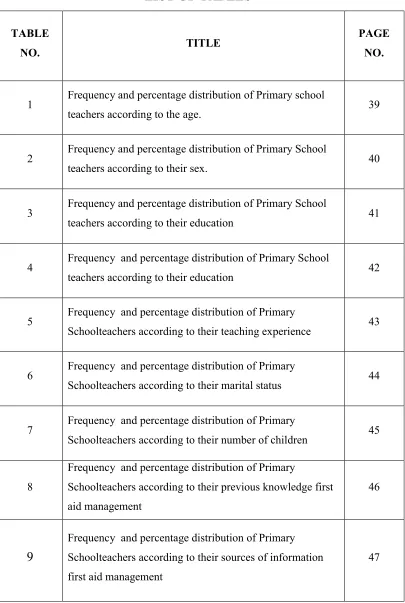
TABLE
NO. TITLE
PAGE NO.
1 Frequency and percentage distribution of Primary school
teachers according to the age. 39
2 Frequency and percentage distribution of Primary School
teachers according to their sex. 40
3 Frequency and percentage distribution of Primary School
teachers according to their education 41
4 Frequency and percentage distribution of Primary School
teachers according to their education 42
5 Frequency and percentage distribution of Primary
Schoolteachers according to their teaching experience 43
6 Frequency and percentage distribution of Primary
Schoolteachers according to their marital status 44
7 Frequency and percentage distribution of Primary
Schoolteachers according to their number of children 45
8
Frequency and percentage distribution of Primary
Schoolteachers according to their previous knowledge first aid management
46
9
Frequency and percentage distribution of Primary Schoolteachers according to their sources of information first aid management
[image:9.612.125.530.80.683.2]vi
10
Frequency and percentage distribution of pre and post-testlevels of knowledge regarding first aid management. 48
11
Frequency and percentage distribution of pre and posttestlevels of expressed practice regarding first aid management. 49
12
Mean, standard deviation and paired µW¶YDOXHRISUHDQG posttest levels of knowledge regarding first aid
management among primary school teachers.
50
13
0HDQ VWDQGDUG GHYLDWLRQ DQG SDLUHG µW¶ YDOXH RI SUH DQG
post levels of expressed practices regarding first aid management.
51
14
Analysis of association between pre and posttest levels ofknowledge and selected demographic variables. 52
15
Analysis of association between pre and posttest levels ofvii
LIST OF FIGURES
FIGURE NO. TITLE PAGE
NO.
1 Conceptual Frame work 15
2 Research design 35
3
Bar Diagram shows percentage distribution of primary
school teachers according to the age group 39
4
Pie Diagram shows percentage distribution of primary
schoolteachers according to their sex 40
5
Pie Diagram shows percentage distribution of primary
schoolteachers according to their education 41
6 Bar Diagram shows percentage distribution of primary
schoolteachers according to their residence 42
7
Cylinder Diagram shows percentage distribution of primary schoolteachers according to their teaching experience
43
8 Cone Diagram shows percentage distribution primary
of schoolteachers according to their marital status 44
9 Pie Diagram shows percentage distribution of primary
teachers according to their number of children
45
10
Pie Diagram shows percentage distribution of primary schoolteachers according to their previous knowledge first aid management.
46
11
Cylinder Diagram shows percentage distribution of primary schoolteachers according to their sources of information first aid management
47
12 Bar Diagram shows percentage distribution of pre and
post-test levels of knowledge regarding first aid management
48
13 Cylinder Diagram shows percentage distribution of
pre and posttest levels of expressed practice regarding first aid management
viii
LIST OF APPENDICES
APPENDIX TITTLE PAGE
NO.
A Letter seeking permission to conduct study i
B Certificate of validation ii
C List of experts for tool validation iii
D Certificate of English editing iv
E Certificate of Tamil editing v
F Letter requesting participation in the study vi
G
Data collection instrument -English Section A -Demographic variables Section B
Part 1 ± Self Questionnaire on Knowledge. Part 2 ± Check list for expressed practice.
vii
ix xvii
H
Data collection instrument ± Tamil Section A -Demographic variables Section B
Part 1 ± Self Questionnaire on Knowledge. Part 2 ± Check list for expressed practice.
xix
xxi xviii
I Lesson Plan English xxix
ix
ABBREVATIONS
EP Expressed Practice
FAM First Aid Management
KSA Kingdom of Saudi Arabia
PM Programmed Teaching
SHP School Health Programmed
VCT Video Clipping Teaching
x
ABSTRACT
INTRODUCTION:
Knowledge of first aid, which constitutes life saving treatment for injuries or unexpected illness is important for every individual especially children. Hence the knowledge of first aid among school teachers is essential for undertaking measures to prevent them.
Statement of the problem:
Effectiveness of programmed teaching on levels of knowledge and expressed practices regarding First Aid Management among primary school teachers at selected schools ±Vellore
Objectives:
¾ To assess the pre-test levels of knowledge and expressed practices regarding
first aid management among primary school teachers.
¾ To assess the effectiveness of programmed teaching levels of knowledge and
expressed practice regarding first aid management among primary school teachers.
¾ To find out the association between post- test levels of knowledge and
xi
Methods:
The study adopted a quantitative approach and the research design was pre experimental one group pre and Post-test design. Non probability convenient sampling technique was used to select 30 primary school teachers in Anaicut.
Result and interpretation:
Regarding the effectiveness of programmed teaching the pretest level of
knowledge mean score 18.9±2.99 and the posttest level of knowledge mean score
was 25.3 ± 3.15 the mean difference of pre and posttest knowledge was 6.4 the
calculated paired µW¶ WHVW YDOXH was significant at p<0.05 level. The pretest of expressed practices mean score was 5.5 ± 0.67 and the posttest mean score was 7.2 ± 0.WKHPHDQGLIIHUHQFHRISUHDQGSRVWWHVWZDV7KHFDOFXODWHGSDLUHGµW¶YDOXH 15.6 higher than the table value 2, which is significant at p<0.05 level.
xii
Conclusion:
The finding of the study concluded that there was significant increase in the level of knowledge and good expressed practice of primary school teachers. After programmed teaching using video on first aid management among primary school teachers. The level knowledge increased and expressed practices improved due to effectiveness of programmed teaching.
Keywords:
1
CHAPTER I
INTRODUCTION
School should be a safe place for all students to learn and play and it is job
of each teacher and administrator to ensure that safety.
Mrs.Susan Teacher & Psychologist
Child is a unique individual, he or she is not a miniature adult not a little man or woman. The childhood period is vital because of socialization process by transmission of attitude, customs and behavior through the influence of family and community.
The development of a country can be determined by estimating the health status of children in that country. Children are the major consumers of health care. In India about 35% - 40% of total population is children below 15 years of age. This group is considered as special risk group as they are vulnerable to various health problems. Children always need special care to survive.
Children injuries are growing as global public health problems. Thousands of children die each year from injuries or violence, and millions suffer the consequences of non-fatal injuries.
Children constitute large sections of the population in India. It is a great challenge
to the nation to provide health, education and food to the children below 15 years who are the dependent, unproductive section which comprising of 40% of the total population of the country (Census 2011). This is the section of population with great potential.
³&KLOGUHQDUHWKHZHDOWKRIWRPRUURZ7DNHFDUHRIWKHPLI\RXUZLVKWRKDYHD
2
First aid is the immediate care given to a person who has been injured or suddenly fallen ill. It includes self-help and home care if medical assistance is not available or is delayed. It also includes well-selected words of encouragement, evidence of willingness to help, and promotion of confidence by demonstration of competence.
The school is a place where children spend most of the time and process of
socialization occurs there, as they are more active and adventuresome. Unfortunately, accidents in nursery schools , are fairly common. Especially in schools they are exposed to various types of minor injuries like sports injury, bleeding, fracture, wound, etc.
Accidents and injuries are major causes for disability and death among children.
In 2011, there are over 98% (50.4million boys & 47.7 girls) enrolled in about 5.55 lakh primary schools in India. In rural areas, 96.6% of population is served by primary schools located within one kilometer.
7KHSULPDU\VFKRROLVZKHUHDVWURQJIRXQGDWLRQRIDFKLOG¶VHGXFDtion is set. This
LVZKHUHDFKLOG¶VPLQGDQGERG\PXVWEHQXUWXUHGDQGSUHSDUHGIRUWKHIXWXUH3ULPDU\
school children are also highly active physically and hence, more prone to injuries. That is why in addition to the academic education imparted here, their physical health also needs to be cared for meticulously.
3
Each year, 20 % to 25% of all children sustain an injury and need to seek medical attention or miss the school. The future development of the children depends on their enjoying good health today. A school is an exciting place for children, who love to H[SORUHEXWDUHQ¶WDZDUHRIWKHSRWHQWLDOGDQJHUV7KHLQFLGHQFHRIDFFLGHQWDOLQMXULHVLV
incUHDVLQJ LQ ,QGLD HVSHFLDOO\ VFKRRO DFFLGHQWV LQ FKLOGUHQ /LIH FDQ¶W EH ULVN-free, but most accidents can be prevented by utilizing a safety list.
First aid is not only just about helping crash victims at the roadside, but also calming an injured person as profound as saving a life. Certain self-limiting illnesses or minor injuries may not require further medical care immediately, if first aid is given. It aims to preserve and protect life, prevent further injury or deterioration of illness and help to promote recovery. The internationally accepted symbol for first aid is the white cross on a green background, St John Ambulance 2008.
The first hour after injury is the golden hour. It is estimated that 50% of deaths occur within first hour of an accident, 30% between one hour and one week, and 20% occur after the first week.
Knowledge of first aid, which constitutes lifesaving treatment for injuries or unexpected illness, is important for every individual at any age.
Teachers are the adults responsible for school children in the absence of the parents. Hence the knowledge of school teachers is essential for undertaking measures to prevent children from injuries.
4
of the students. There is an interrelation between the school and the homes of children and that greatly facilitates an organized approach to health promotion, health appraisal and health restoration.
Teacher is the key person who can attend to the children for minor injuries in school through complete knowledge regarding first aid management.
There are variety of measures teachers can take to reduce the risks like wound, QRVHEOHHGEHHVWLQJELWHVHWF7KHFKLOGUHQDUHRXUQDWLRQ¶VPRVWSUHFLRXVUHVRXUFHEXW
they often lack the skills to protect themselves in the risk situations. It is the responsibility of the teachers to safeguard children and to teach them the skills to be safe.
Injuries are the major cause of illness, especially for primary school children. Schools are one of the common places of accidents. Knowledge on first aid among school teachers is very important to save the school children immediately. First aid is the initial care for the ill and injured. It helps to urgently manage the health problems of school age children. Therefore, first aid training is given to all types of teachers at all levels during their education. Instead teaching and reinforcing about first aid measures for teachers in primary schools should be still needed is through advanced methods of teaching strategies which help causality as soon as injuries occur so that children life could be saved.
Basic first aid knowledge helps the teachers to deal with emergency situations. So they are mentally prepared for emergencies. Teachers should be taught about different first aid measures at school, which helps emphasize the importance of child safety. This enables them to overcome difficult situations like injuries, bites, fracture and outdoor
emergencies. First aid is all about using common sense in the hour of need. Preventing
5
Children spend most of the time in school under the direct supervision of teachers. They are also exposed to various types of epidemiological factors in the school, which influence their present and future state of health. Hence, first aid should be known by school teachers to meet the urgent needs of these school children during minor injuries fracture. Teacher is the key person in school who attend such type of victims and always in a position to save the life. Healthy safe environment is very important to avoid these hazards beside qualified teachers who can detect any health problem and can give first aid for commonly occurring emergencies in schools.
World Health Organization [Sept 2010] Dog bite Bangalore also shows that 42% of dog-bite victims are children. The result showed that majority of dog bite injuries (62.8%) were sustained by male children, dog bite injuries were most prevalent during the months of June and July (24.1%); grade school-aged children (6 to 12 years) constituted the majority of victims (51%) followed by pre schools (2 to 5 years; 24.0%); infants (birth to 1 year; 4.5%). Injuries sustained by infants and preschoolers often involved the face (53.5%), whereas older children sustained injuries to the extremities (60.7%). The study concludes that the children under 15 are the main victim for dog bites.
Developing Country perception regarding first aid Out of 262 school teachers 255
6 Developing country Uttarakhand, India (2014)
Children spend most of the time in school under the direct supervision of teachers. They are also exposed to various types of epidemiological factors in the school, which influence their present and future state of health. Hence, first aid should be known by school teachers to meet the urgent needs of these school children during minor injuries. Teacher is the key person in school who attend such type of victims and always in a position to save the life. Healthy safe environment is very important to avoid these hazards beside qualified teachers who can detect any health problem and can give first aid for commonly occurring emergencies in schools.
In this study, the knowledge and practices posttest score of primary school teachers were significantly higher compare to pretest knowledge and practice score about first aid management of selected minor injuries such as minor fracture, epistaxis, minor wounds, etc. Similar studies from mother parts of world also shows that teachers agreed the all (90-100%) that epistaxis, due to sports or playing is common in primary school children. Another study also shows that 72-80% primary school teachers have improved their knowledge and continue practice regarding first aid management for emergency condition in school campus.
NEED FOR THE STUDY
Children are most important citizen of the country because they will be WRPRUURZ¶V \RXWK DQG SURYLGH WKH KXPDQ SRWHQWLDOV UHTXLUHG IRU WKH FRXQWU\
development. The national policy for children initiated on has placed high priority on early childhood care.
7
as it is to know what should be done. First Aid equipment and materials must be simple, and capable of being used by anyone without risk of exacerbating any injuries or causing the condition of an injured person to deteriorate.
As per WHO (2010) estimates, nearly 950,000 children die in the world due to an injury each year. National Crime Record Bureau data and few independent studies reveal that nearly (2012) 15 - 20 % of injury deaths occur among children. For every death, nearly 30% to 40% of children are hospitalized and are discharged with varying levels of disabilities.
In US, 3925 sports related deaths occurred in the year 2013, and out of these deaths 85% were involved in spot death while 12% in late death for children under 14years. The US death rate is such that more than 600 children die each year from unintentional injury and burns related injuries.
A study conducted in USA on 2012 public school teachers showed that only one third of them were trained in first aid. The majority of public school teachers (87%) thought that emergency care training should be a part of teacher preparatory.
A study was conducted in China (2011) on sports injury in children. They found a total incidence rate of 73.3 per 1000 per year. The types of injuries were contusions 37.1%, fractures 22.0%, sprains 24.8%, and wounds 9.5%. The study concluded, hospitalization rate was 3.8% and the incidence rate of fractured injuries was high.
Globally every year 1,50,000 people die in situations where first aid could have given them a chance to live. Even so, fewer than one in 10 people have been trained in first aid. The school primary school teachers have to be equipped with the first aid training.
8
were obtained from the general hospital records data base. A total of 434 accidents were analyzed, with 0.7% mortality Boys predominated (53.7%), with incidence rate highest among children 1-3 (7.2/1000 children), foreign body penetration (eyes, nostrils and ear) 94%, inhalation / ingestion of objects (2.5%), aspiration of gastric contents (0.7%).
First aid is a measure to save the life of the person. India is one of the largest developing countries in the world; it constitutes around 20% of school going children. The future of our country rests on the children who will become the future citizens and leaders. Care for the children is not only vital in itself but the most important aspect of the
health of the community as a whole.
The first aider is also likely to be trained in dealing with injuries such as cuts,
chocking, fracture, wound, bleeding. They may be able to deal with the situation an in its entirety. A small adhesive bandage on a paper cut or may be required to maintain the condition of something like a broken bone, until the next stage of definitive care, usually an ambulance arrives.
India - a country of over a billion people - is today one of the youngest countries in the world. Nearly one third of its population is under 15 years of age. Economists and advocates of developments have repeatedly stressed that India needs to provide far greater access to improved healthcare and education for this young population.
9
According to national center for health statistics 2013, indicates that estimated 48.9 million children who have disability. Among them who are younger than three years of age, the prevalence of disability is 2.2% -3-5% years of age group, 5.2% belong to male who are more disabled than the females. About 85% external bleeding is reported due to scalds from school sports in playground, SCI (spinal cord injury) in the United States, 10% is estimated in children age 1-12 years.
A study conducted by L.D. Howe (2010) in Pune City suggest that designed health education and training program led to significant improvement of knowledge and practice of nursery school teachers in first aid and dealing with emergency situations occurring to preschoolers.
%DVHGRQOLWHUDWXUHUHYLHZDQGLQYHVWLJDWRUV¶H[SHULHQFHVUHVHDUFKHUIHOWWKDWLWLV
essential to give adequate knowledge about first aid emergency care to school teachers especially to volunteer groups like primary school teachers. At the time of accidents, injury wound, fracture, snake bite, the primary school teachers has significant role in rescue services. The knowledge regarding first aid emergency care in addition to the physical and mentally training to school teachers help them to play a major role in emergency management in adverse condition where the medical professionals find difficulty primary school teachers first aid training to reach the school teachers.
First aid of common injuries which has motivated the researcher to undertake the Evaluative study to educate using multimedia package and make the school teachers to acquire and update their knowledge with the help of programmed teaching and self-TXHVWLRQDULHV¶ DQG GHPonstration and develop first aid knowledge skill to make them
10
As a nurse educator she has a greater role to educate the school teachers regarding various aspect of health like hand washing, waste disposal, prevention of accidents, safety needs and first aid. Since the researcher selected one among them. She needs to contribute a small portion to this life saving measures through this Major VWXG\6ROHW¶VDOO1XUVHV teachers and Public) take it as a challenge to save the life and promote the well being of FKLOGUHQDQGFRPPXQLW\ZKRDUHWRPRUURZ¶VNLQJVDQGTXHHQV
STATEMENT OF THE PROBLEM
Effectiveness of programmed teaching on levels of knowledge and expressed practices regarding First Aid Management among primary school teachers at selected schools, Vellore
OBJECTIVES:
¾ To assess the pre-test levels of knowledge and expressed practices regarding first
aid management among primary school teachers.
¾ To assess the effectiveness of programmed teaching levels of knowledge and
expressed practices regarding first aid management among primary school teachers.
¾ To find out the association between post- test levels of knowledge and expressed
11
OPERATIONAL DEFINITIONS
:Effectiveness :
It refers to significant gain in levels of knowledge favorable expressed practices regarding first aid management as measured by questionnaire, and check list prepared by the researcher respectively.
Programmed teaching:
It is systematically developed teaching plan on various aspects of first aid management such as bleeding, wound, fracture, foreign body aspiration, bites and stings through multimedia teaching.
Knowledge:
It refers to awareness and understanding regarding knowledge of first aid Management among the primary school teachers as measured by structured questionnaire. Expressed Practices:
,QWKHSUHVHQWVWXG\HIIHFWLYHQHVVUHIHUVWRµWKHgain in level of knowledge and
expressed practices regarding first aid management among primary school teachers as evidenced by improvement in post-test knowledge scores when compared with pre-WHVW¶ First Aid Management:
It refers to the assistance given to the victim after a traumatic injury before actual treatment is given for selected conditions such as bleeding, wound, fracture, foreign body aspiration, bites and stings.
Primary school teachers:
12
HYPOTHESES:
H1 - There is a significant difference between pre and post- test levels of
knowledge and expressed practices regarding first aid management among primary school teachers.
H2 -There is a significant association between post-test levels of knowledge score
expressed practices and selected demographic variables regarding first aid management among primary school teachers.
ASSUMPTIONS
:-¾ Teachers may have attended training in first aid management.
¾ Teachers may need refreshers courses on first aid management.
¾ Programmed teaching may help in imparting knowledge on first aid management
DELIMITATION:-This study is limited to
¾ Selected primary school teachers at Vellore only.
¾ Sample size 30 only.
13
CONCEPTUAL FRAMEWORK
Conceptual framework is a theoretical approach the study of problems that are scientifically based and emphasizes the selection and clarification of its concepts. A conceptual framework status functional relationship between events and is not limited to statistically relationship, the present study aims to evaluate the effectiveness of programmed teaching on levels of knowledge and expressed practice regarding first aid management, among primary school teachers.
The conceptual framework of the present study was modified by the researcher EDVHG RQ ,PRJHQH .LQJ¶V JRDO DWWDLQPHQW PRGHO 7KH PRGHO IRFXVHV RQ
interpersonal relationship between the client and the nurse, in which interaction takes place between them and this interaction is influenced by the perception of the nurse. This interaction leads to goal setting by the nurse that has to be achieved by the client. In the present study the interaction takes place between the researcher and the primary school teachers who may have inadequate, moderate and adequate knowledge on First aid management.
PERCEPTION
:14
ACTION
:A sequence of behavior involving mental and physical action in the study during the action phase. The researcher prepared the self-administered questionnaire to assess the levels of knowledge and check list to assess the expressed practice among primary school teachers. 30 primary school teachers were selected using convenient sampling. A plan was made for education on First Aid management with the help of multimedia package after pre-test to improve the knowledge of primary school teachers.
INTERACTION
:A different set of value ideas, levels of knowledge and expressed practices, during interaction the researcher will deliver on programmed education on First Aid management to primary school teachers. After programmed teaching, researcher will assess the levels of knowledge and expressed practices on first aid management among primary school teachers.
TRANSACTION:
15 PE R C E PT IO N Ass es s t h
e level o
f kno wl ed ge a n d expressed practice in fi rs t a id ma na ge me n t a m ong s c h ool teach ers
)LJ&
RQFHSWX
DO)
UDP
HZR
UN
EDVHGR
Q
,P
RJHQH0
.L
QJ
V
Goal A
tt
ainm
ent Th
eor
y
(1981)
R E S E A R C H E R
PERCEPTI O N Id entif y the primar y school teache rs Mutual g o al settin g
To improve the
leve
ls of knowled
g e and ex pressed practices reg ardin g first aid manag ement amon g ACT ION List dem og raphic v
ariables such as
ag e, sex, res iden ce, m ari tal statu s, num
ber of ch
ild ren, teac hing exp erienc es, perv ious k nowle dg e on fir st aid m anag em ent, sourc es o f i n fo rm ation. Prog ramm ed teach ing on lev els o f k nowledg e and expre sse d pr act ic es an d dem onst ra tio
n on f
ir st aid m anag e m ent am on g prim ary schoo l te ach ers . INT E RACT IO N Pre t es t Assess th e lev el of k nowledg
e and exp
res sed prac ti ces reg ard ing fi rs t aid m anag e m ent usi ng sel f-k nowledg e questionn aire a nd check li st am ong prim ary schoo l t each ers . Prog ramm ed teach ing by lec tur e m ethods u si n g dem onst ra tio
n on f
ir st aid m anag e m ent with he lp o f v ideo cl ip. Post tes t Assess the pos tt est lev el of k nowledg
e and exp
res sed prac ti ce u si n g sam e k nowledg e questionn aire a nd check li st for exp res sed prac ti ce.
T R A N S A C T I O N
16
CHAPTER - II
REVIEW OF LITERATURE
Review of literature is an essential component of the research process. Relevant literature from various perspectives like primary school teachers, programmed teaching on level of knowledge and expressed practice on first aid management are focused explaining the first aid management among primary school teachers. Review of literature in this study has been organized under the following heading
¾ Studies Related to knowledge and expressed practices regarding first aid
management
¾ Studies Related to effectiveness of programmed teaching on first aid
management.
Studies Related to knowledge expressed practices regarding first aid management:
Mahran D G (2010) conducted a cross sectional study on schools in Egypt
among primary schools teachers. A 12-item questionnaire was self-administered to 189 teachers, who were selected randomly. All teachers had heard about fracture, 54% of teachers deal with students with fracture as normal students. About one
quarter (23.8%) of teachers accepted to give student with in the class first
17
B.Toure (2011) conducted a study in fifty randomly chosen primary schools
from Casablanca, Morocco. All teachers of the selected schools were included in the study. The data were collected by self-administered questionnaire. The questions IRFXVHG RQ WKH WHDFKHU¶V general characteristics, experience of fracture and the
importance of emergency management. The data were analyzed using chi square test.
Results showed that a total of 501 teachers, of which 23.6% were male and 75.4%
were female, answered the questionnaire. The results showed that 44.5 % of the teachers had an experience of fracture at school, 82.82% of them knew the importance of emergency management and 32.6%. Therefore, the results indicated that educational programs are necessary for improvement in their level of knowledge in primary school teachers.
18
Piyali de (2012) conducted a study among school teachers at Nekal taluk,
Bangalore. To create awareness about different accidents of children at primary school premises and their first aid management. The samples consisted of 30 primary school teachers selected by convenient sampling technique. The analysis showed that improvement of knowledge occurred after administering structured teaching programme on first aid management. In pre test 40% of samples had poor knowledge and60% samples had moderate knowledge, In posttest 100% samples had adequate knowledge among school teachers. Post test score was significantly higher than their mean pre- WHVWVFRUH7KHFDOFXODWHGµW¶YDOXHW ZHUH JUHDWHU than the table value at 0.001 and researcher concluded that after structure teaching programme primary school teachers gained knowledge regarding first aid management.
Deepek.M (2012) conducted a quasi experimental study to assess the
19
Leilabasirelachehashery (2013) conducted a study in twenty randomly
attending first aid training selected primary schools of Ahvazing, Canada. The 269
teachers in the schools were selected and asked to fill out the self-report questionnaires for data collection. The questionnaire was inspired from one used by Mori et al and FRQVLVWHG RI WKH WKUHH SDUWV WHDFKHU¶V GHPRJUDSKLF GDWD WKHLU knowledge about importance of emergency management and emergency method that
they used. The data were analyzed using µchi¶-square test.Out of a 269 teachers,
41.6% male and 58.4% female answered the questionnaire. The results showed that 15.2 % bleeding and chocking first aid management practice of primary school teachers all of them knew the importance of emergency management and 36.4% would look for a fracture for treatment of the cases. The results of the current study VKRZHGWKDWVFKRROWHDFKHUV¶ODFNHGNQRZOHGJHUHJDUGLQJIUDFWXUH
Sunil Kumar, D (2013) conducted a cross sectional study for 9 months in 40
20
Jobran M Alqahtan (2015) conducted a cross ±sectional & descriptive study
among male teachers, A 315 teachers filled a well-designed and pretested self-administered questionnaire. Result approximately three- quarters (77.7%) of the school teachers had witnessed fracture, forty six percent believed that fracture was caused force of ligament . most of the school teachers (79.7%) disagreed with the idea of teaching children with fracture separately, or preventing them from sporting activity (50.5%) in addition,94.9% disagreed with the idea that fracture was shameful. Unfortunately 64.1% of the teachers, who were exposed to cases of fracture were not able to provide first aid to students having fracture (p=0.03) the school teachers were knowledgeable about fracture.
Matheus Melo Pitho (2014) conducted a study in public schools in North
Eastern Brazil. A questionnaire was applied to 195 school teachers and comprised of 12 objective questions about dental trauma and methods for its prevention and management. The study revealed that out of the 141 teachers, who responded to the questionnaire, the majority were women (70.2%) and most of them had experienced previous dental accidents involving a child (53.2%). The majority (84.4%) had incomplete college education and few were given some training on how to deal with emergency situations during their undergraduate course (13.5%) or after it (38.3%). Their level of knowledge about dental trauma and emergency protocols showed that they processed unsatisfactory knowledge approximately half of teachers evaluated had unsatisfactory knowledge about dental trauma and emergency protocols, with female teachers showing more knowledge than men.
Fan Jiang and Xiaoming Shen (2014) conducted a study by satisfie random
21
pediatric first aid training. Follow-up assessments were conducted 6 months, 9 months and 4 years following the training. A standardized collection of demographics was performed, and participants were given a questionnaire to indicate knowledge of and emotions about first aid. In the pretest, 1067 people responded with a mean of 21.0 correct answers to 37 questions, this shows that knowledge levels on first aid management is not adequate among teachers.
Rohitash Kumar (2015) conducted a study was to assess the knowledge of
primary school teachers regarding first aid management of minor accidents among
children (5-10 Years) at selected primary schools of Ambala districtHaryana.
Descriptive research design was used for the study 40 sample primary school teachers chosen from different primary schools. Both government and private primary schools were selected for the study Sample was taken by convenient sampling technique. The tool was structured questionnaire schedule which consisted of 27 items and demographic variables. The data was collected from teachers over 5. The results show that most of the primary school teachers (52.5%) had moderate knowledge score (16-21), followed by 37.5 percent teachers who had excellent knowledge score (21 -27), a small portion (10%) of school teachers had poor knowledge. The study shows that structured teaching program is necessary to improve knowledge regarding first aid management.
Studies related to effectiveness of programmed teaching on first aid management:
Shoaba Masih, Rajesh Kumar, Sharma (2014) conducted
22
primary school teachers at Dehradun district of Uttarakhand. Fifty primary school teachers were selected by non-probability convenient sampling. Data were collected by knowledge questionnaire (maximum possible score 42) and self-reporting checklist (maximum possible score 23). Majority (94%) of the teachers were female. Paired
sample µt¶-test revealed that the mean post- test knowledge score regarding first aid
management of selected minor injuries was significantly higher (34.76 ± 4.35) than
that of mean pretest knowledge score (27.32 ± 5.73) (P < 0.005); mean post-test
practice score was significantly higher (18.52 ± 2.63) then mean pretest practice score
(14.52 ± 2.39) (P < 0.005). There was a significant positive correlation between
knowledge score and practice score of participants (r = 0.9; P < 0.001). This
concludes that the training program was effective in improving knowledge and practice score regarding first aid management of selected minor injuries among study participants.
De P (2014) conducted a study among school teachers at Anekal Taluk,
Bengaluru to make teachers awareness about different accidents of children at school premises and their first aid management. The sample consisted of 30 primary and higher primary school teachers selected by convenience sampling technique. The analysis showed that improvement of knowledge on first aid management for teaching professionals can benefit the area of community, administration, research and educational institute.
Avinash H. (2014) conducted a study to assess the effectiveness of Planned
23
Systematic Proportionate sampling technique with random allocation of groups. It ZDV REVHUYHG WKDW 2YHUDOO 0HDQ NQRZOHGJH UHJDUGLQJ GRJ ELWH ZRXQG DQG LW¶V ILUVW
aid among the subjects (15%) had good knowledge, (71%) had average, while (14%) had poor knowledge. After structured teaching programme (STP) overall Mean knowledge about management of first aid in dog bite among the subjects was (16%) had good knowledge, (80%) had average while (4 %) had poor knowledge.3) It was evident that maximum number of subjects had average knowledge.
Ayodeji M. Adebayo Modupe Onadeko (2015) conducted a study to assess
and compare the knowledge of school health programme (SHP) among public primary school teachers in rural and urban areas of Oyo State, South-west Nigeria. A comparative cross-sectional survey was conducted among teachers in selected rural and urban public primary schools using a 2-stage cluster sampling technique. Knowledge scores were computed giving minimum and maximum obtainable scores of 0 and 33 respectively. Respondents were reported as having inadequate knowledge if aggregate score was<16.5 and adequate if >16.5 Associations were tested using µchi¶- square and¶ t µ±test for qualitative and quantitative variables respectively at
24
Jaklein. R.Younis Amal El-Abassy (2015) conducted a study to assess
effectiveness of video assessed teaching (VAT) & lecture methods in improving knowledge & skills regarding first aid management Comparative research design was used for this study. Simple random sample of 200 primary school teachers was included. Settings: The study was carried out at four primary schools in Shebin - Elkom town and EL Shohadaa town, western Alaska islands Menoufia Governorate. Structured knowledge questionnaire was administered regarding first aids measures. Tool two: A five points Likert- scale structured performance check list was used to DVVHVV GHJUHH RI LPSURYHPHQW LQ SULPDU\ VFKRRO WHDFKHUV¶ PDQDJHPHQW VNLOOV
UHJDUGLQJ ILUVW DLGV IRU FKLOGUHQ¶ VFKRRO GD\ DFcidents after utilization of
Video-assisted teaching method versus Lecture Method. The study showed a statistical significant improvement at (p<0.05) level in total knowledge score of primary school teachers undergoing video-assisted teaching method regarding first aids of children regarding school day accidents (28.68 ± 3.77) compared to teachers undergoing traditional lecture (12.77 ± 5.00).Utilization of video-assisted teaching method was succeeded in achieving significant improvements in the primary school teachers NQRZOHGJHDQGVNLOOVUHJDUGLQJILUVWDLGRIFKLOGUHQ¶VVFKRROGD\DFFLGHQWVFRPSDUHG
to traditional lecture method.
Kabeta T (2015) conducted cross-sectional study at karachi, Pakistan. A
25
(41.7%) recognized vaccination of dogs/cats as an important preventive strategy. Regarding, practices most (91.1%) agreed that medical evaluation should be sought as soon as possible. However, most (75.0%) also believed that traditional healers could cure rabies. Rural residence (adjusted odds ratio [OR] = 2.1, p = 0.015) and Protestant religion (OR = 2.4, p = 0.041) were independently associated with this belief. Among 186 participants who owned dogs, only 9 (4.8%) had ever vaccinated their dog and more than 90% of respondents indicated that their dog was free-roaming or cohabitated with the family. Only 7.0% of participants applied correct first aid following exposure, and the may (47.7%) reported that the animal was killed by the community following the incident teachers.
Tanner R, Harney M.S. (2015) conducted a cross sectional study and
26
Awad S. al-Samghan, S.B.F.M (2015) conducted a cross- sectional study and
descriptive study design was applied among primary school teachers at governmental primary schools for boys in Abha City, Kingdom of Saudi Arabia. A self-administered questionnaire was designed by the researchers, which included socio demographic data and knowledge about first-aid measures for the most common incidents among school children. The study included 187 teachers. Their ages ranged between 25 and 58 years with a mean of 41.5±7.4 years. Fifty-three teachers (28.3%) attended a course on first-aid. Of them, 33 (62.3%) reported that these courses included practical training. About half of the teachers (52.4%) had satisfactory knowledge about bleeding, and 31% had satisfactory knowledge level of Knowledge about first aid is not satisfactory among teachers of primary schools for boys in Abha, kingdom of Saudi Arabia (KSA) so the study recommended that First aid educational and training programs should be introduced at school.
Rémi Gagnayre (2014) conducted a across ± sectional study was carried out
among the staff members at selected preschoolsMetropolitan Area, Nigeria Eighteen
27
trained teachers to describe an emergency situation (p<0.005) and raise the alert (p<0.0001).
A K G Gopa Kumar (2015) conducted a cross ± sectional descriptive study
146 teachers in nine schools in Mangalore, India, using a self-administered questionnaire. The schools were also inspected for first aid equipment and facilities. Only69 (47%) teachers had received, First aid training, Previously Poor, and Moderate Knowledge of First aid was observed among 19 (13%) and 127 (87%) teachers, respectively. Only eight teachers knew the correct procedure for chocking. Most teachers 96 (66%) were willing to administer first aid if provided with the required training. A total of 74 teachers reported having practiced first aid in response to a situation arising at their school. Wounds (36%) and bleeding (23%) were among the commonly encountered situations requiring first aid management at schools. Teachers confidence level in administering first aid was significantly associated with prior training in first aid (p= 0.0 01). First aid kits were available in only five of the nine schools surveyed. The current competency level among teachers in Mangalore to administer first aid is inadequate. Measures need to be taken at schools to ensure initiation of first aid training followed by periodic training for teachers in first aid.
Baser M. (2010) conducted a cross ±sectional and study on Turkish teachers
28
Rajeswari C (2014) conducted a descriptive and cross-sectional study among
150 school teachers from North Chennai, selected through convenient sampling. A questionnaire was used to collect the data. Out of 150 teachers, 58% were from private schools and 42%, from public schools. Very few of them had attended a First Aid training programme. Majority of them were aware of the first aid treatment for open wound (56%), burns (74%), choking (55%), and fracture (77%), use of inhaler (97%), wound (73%), and nasal bleed (65%). Majority were unaware that scraping out the stinger was the first line of management for bee stings (92%), Study results revealed that that there are grave deficiencies among school teachers in north Chennai with regard to first aid knowledge of common emergencies. Continuing education programme would help teachers to improve the knowledge and practices on the first
aid management of common emergencies among school teachers
.
Nabila Hassan (2015) conducted a intervention study, the sample is
29
CHAPTER-III
RESEARCH METHODOLOGY
Research designed to develop or refine methods of obtaining, organization, or analzinging data.
Polit & Hungler, 2013
7KHSUHVHQWVWXG\XWLOL]HGDTXDQWLWDWLYHDSSURDFKWRDVVHVVWKH³(IIHFWLYHQHVV
of programmed teaching on levels of knowledge and expressed practices regarding )LUVW$LG0DQDJHPHQWDPRQJSULPDU\VFKRROWHDFKHUVDWVHOHFWHGVFKRROV9HOORUH´
This chapter includes research method, of research design, research setting, population, sample, and sample size, sampling techniques, selection of the tool, content validity, reliability, pilot study, data collection procedure and plan for data analysis.
RESEARCH APPROACH
The research approach used for this study was quantitative approach.
RESEARCH DESIGN
Research design used in this study was Pre experimental one group pre and post-test design.
Key:
O1 ± Pretest to assess the level of knowledge and expressed practices regarding First Aid Management among primary school teachers.
X - Programmed teaching regarding First Aid Management.
30
O2 ± Posttest to assess the level of knowledge and expressed practices regarding First Aid Management among primary school teachers.
SETTING OF THE STUDY
The study was conducted in selected primary schools at Vellore. The setting was chosen on the basis of feasibility and availability of adequate samples.
POPULATION
The target population for the present study was primary school teachers at Vellore.
SAMPLE
The study sample comprises of selected primary school teachers in government primary school Anaicut
SAMPLING TECHNIQUE;
Non probability convenient sampling technique was used for selection samples.
SAMPLE SIZE
30 primary school teachers were selected.
CRITERIA FOR SELECTION OF SAMPLES Inclusion criteria:-
Teachers who
x Are working in the primary school
x Are willing to participate in the study.
31 Exclusion Criteria:-
Teachers who
x Are not present at the time of data collection
x Are not willing to participation in the study.
x Have already undergone first aid training within 6 months
VARIABLES:
Independent variable: Programmed Teaching on first aid management. Dependent variable: Levels of knowledge and Expressed practice regarding First aid management.
DESCRIPTION OF TOOL:
The tool for was divided into two sections, which consisted of Section A and
Section B.
SECTION -A : Demographic Profile
This section consists of 9 items pertinent to primary school teachers such as age gender, education , residence, years of teaching experience, marital status, if married no of children, previous knowledge regarding first aid management, if yes sources of information regarding first aid management.
SECTION -B: Levels of Knowledge & Expressed practices regarding First aid
management.
32
Part-I: Knowledge questionnaire
It consists of 30 knowledge questions related to causes, signs and symptoms, types, and management of first aid management. Bleeding, wound, fracture, foreign body aspiration(nose bleeding, ear bleeding, eye bleeding )dog bite, snake bite, honey bee sting.
Score Interpretation:
The tool consists of 30 questions each where a correct response was awarded a score of one (1) mark and wrong response was given a score of zero (0)
Inadequate - < 50 %
Moderately adequate - 50-75 %
Adequate - >75%
Part -II: Expressed practices on first aid management
It consists of 10 items of expressed practice questionnaire where each correct answer carries one (1) mark incorrect answers carries zero (0) marks.
Scoring Interpretation Percentage
Poor : 0-3 <50%
Average : 4-6 50-75%
Good : 7-10 >75%
PILOT STUDY:
33
pretest was conducted with structured knowledge questionnaire and expressed practices along with the assessment of demographic variables, Soon after the pretest intervention was administered as programmed teaching method which composed of lecture and video clipping. The post test was conducted after 7 days of intervention by administering same structured knowledge questionnaire and check list for expressed practice. The result shows that it was feasible and predictable to conduct.
VALIDITY AND RELIABILITY:
To determine the content validity, the tool was submitted to 5 experts from the specialty of child health nursing and bio statistics. After obtaining valuable suggestions, necessary modifications were made accordingly. The reliability of the tool was established by test and retest method.
The reliability of knowledge self-questionnaire schedule r =0.92 The reliability of expressed practice check list r =0.99
DATA COLLECTION
34 DATA ANALYSIS AND INTERPRETATION: ORGANIZATION OF DATA
SECTION A : Distribution of demographic variables of primary school
teachers
at selected school, Vellore.
SECTION B : Assessment of pre -test and post -test level of knowledge and
expressed practice among school teachers.
SECTION C : Association between the Post test scores of teachers on
knowledge
and expressed practices and selected demographic variables.
PLAN FOR DATA ANALYSIS:
Data obtained will be analyzed in view of objectives of the study using descriptive and inferential statistics. The plan of data analysis was as follows.
Descriptive statistics:
¾ Frequency and percentage to describe the sample characteristics.
¾ Score of level of knowledge and expressed practices were given in mean and
standard deviation.
Inferential statistics:
¾ Paired µW¶ ZDV XVHG WR DVVHVV WKH HIIHFWLYHQHVV of multimedia education on
levels of knowledge and expressed practices regarding first aid management.
¾ µ&KL¶- square was used to associate the posttest levels of knowledge and
35
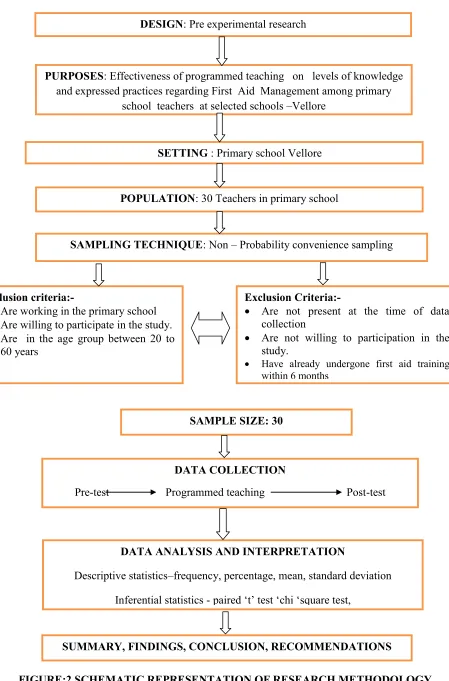
FIGURE:2 SCHEMATIC REPRESENTATION OF RESEARCH METHODOLOGY
DESIGN: Pre experimental research
PURPOSES: Effectiveness of programmed teaching on levels of knowledge
and expressed practices regarding First Aid Management among primary school teachers at selected schools ±Vellore
SETTING : Primary school Vellore
POPULATION: 30 Teachers in primary school
SAMPLING TECHNIQUE: Non ± Probability convenience sampling
SAMPLE SIZE: 30
DATA COLLECTION
Pre-test Programmed teaching Post-test
DATA ANALYSIS AND INTERPRETATION
Descriptive statistics±frequency, percentage, mean, standard deviation Inferential statistics - SDLUHGµW¶WHVWµFKLµVTXDUHWHVW
SUMMARY, FINDINGS, CONCLUSION, RECOMMENDATIONS Inclusion criteria:-
x Are working in the primary school
x Are willing to participate in the study.
x Are in the age group between 20 to
60 years
Exclusion Criteria:-
x Are not present at the time of data
collection
x Are not willing to participation in the
study.
36
CHAPTER IV
DATA ANALYSIS AND INTERPRETATION
This chapter deals with the analysis and interpretation of the data collected to determine the effectiveness of programmed teaching on levels of knowledge and expressed practices regarding first aid management among primary school teacher at selected schools, Vellore.
The demographic variables were coded and analyzed. Analysis and Interpretation was done with the help of descriptive and inferential statistics to meet the objectives of the study.
Analysis is the categorizing ordering and summarizing of the data to obtain answers to the research questions.
The purpose of analysis is to reduce data to an intelligible and interpretable form so that the relations to research problems can be studied and tested
(Geri Lobiondo 2010).
37
The Objectives of the study on first aid management:
` To assess the pre-test levels of knowledge and expressed practices regarding
first aid management among primary school teachers.
` To assess the effectiveness of programmed teaching on levels of knowledge
and expressed practices regarding first aid management among primary school teachers.
`
To find out the association between post- test levels of knowledge and38 ORGANIZATION OF DATA:
SECTION A : Distribution of demographic variables of primary school
teachers at selected schools , Vellore.
SECTION B : Frequency and percentage distribution of levels of
knowledge and expressed practice regarding first aid management among primary school teachers.
SECTION C : Association between the posttest levels of knowledge
And expressed practice score among primary schools
39
[image:55.612.128.535.145.551.2]SECTION ±A
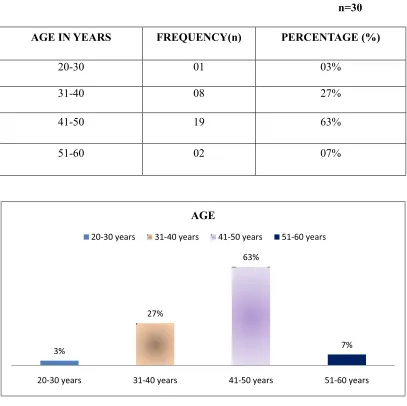
Table: 1 Frequency and percentage distribution of primary school teachers according to their age.
n=30
AGE IN YEARS FREQUENCY(n) PERCENTAGE (%)
20-30 01 03% 31-40 08 27%
41-50 19 63%
51-60 02 07%
Fig:3 Bar diagram shows frequency and percentage distribution of Primary School Teachers according to their age group
Table 1 and fig 3 represent the majority of the teachers 19(63%), were in the age group of 31-40 years whereas 8 (27%) were in the age group of 51-60years ,2(7%) and1(3%) were in the age group of 20 -30 years.
3%
27%
63%
7%
20-30 years 31-40 years 41-50 years 51-60 years
AGE
40
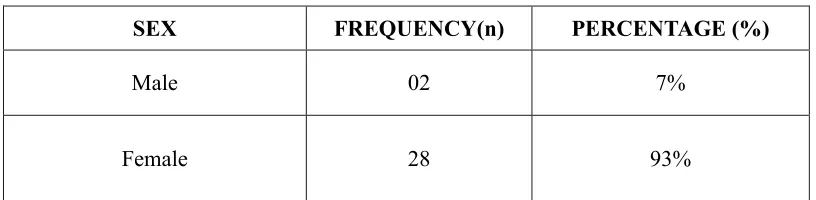
Table:2. Frequency and percentage distribution of primary school teachers
according to their sex.
n=30
SEX FREQUENCY(n) PERCENTAGE (%)
Male 02 7%
Female 28 93%
Fig:4 Pie diagram shows frequency and percentage distribution of primary
schoolteachers according to their sex.
Table 2 and figure 4 represent that majority of teachers according to their sex shows that 28 (93%) are females and 2 (7%) are males.
7%
93%
SEX
Male
[image:56.612.126.534.143.243.2]41
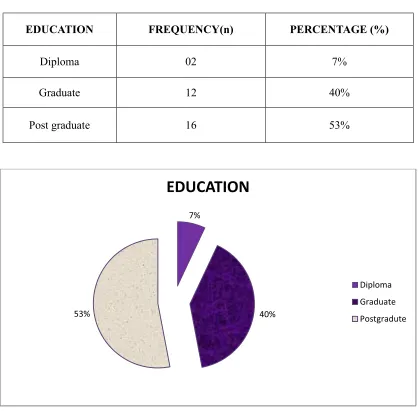
Table:3. Frequency and percentage distribution of primary school teachers according to their education.
n=30
EDUCATION FREQUENCY(n) PERCENTAGE (%)
Diploma 02 7%
Graduate 12 40%
[image:57.612.129.547.159.570.2]Post graduate 16 53%
Fig 5 Pie diagram shows Frequency and percentage distribution of primary school teachers according to their education.
Table 3 and figure 5 depict that most of the primary schoolteachers 16 (53%) have studied up post graduate, 12 (40%) have studied up to graduate and 2(7%) have studied up to diploma in education.
7%
40% 53%
EDUCATION
Diploma
Graduate
42
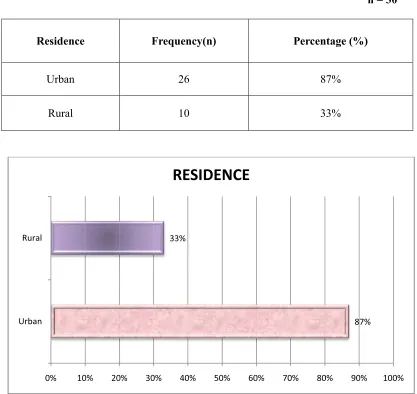
Table:4. Frequency and percentage distribution of primary school teachers according to their residence.
n = 30
Residence Frequency(n) Percentage (%)
Urban 26 87%
[image:58.612.121.538.127.521.2]Rural 10 33%
Fig 6 Bar diagram shows Frequency and percentage distribution of primary school teachers according to their residence.
Table4 and figure6 depict that with regard to residential area 26 (87%) primary schoolteachers were from urban area and 4 (33%) primary school teachers were from rural area.
87% 33%
0% 10% 20% 30% 40% 50% 60% 70% 80% 90% 100% Urban
Rural
43
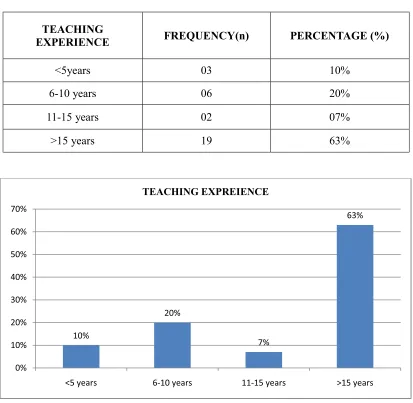
Table: 5. Frequency and percentage distribution of primary school teachers
according to their teaching experience.
n =30
TEACHING
EXPERIENCE FREQUENCY(n) PERCENTAGE (%)
<5years 03 10%
6-10 years 06 20%
11-15 years 02 07%
[image:59.612.129.542.134.537.2]>15 years 19 63%
Fig 7 Column diagram showing Frequency and percentage distribution of primary school teachers according to their teaching experience.
Table5 and figure 7depicts shows that in consideration with teaching experience majority19 (63%) >15 years of experience 6 (20%) 6-10 years of experience 3 (10%) have 5 years of experience and 2 (7%) have 11-15 years of experience.
10%
20%
7%
63%
0% 10% 20% 30% 40% 50% 60% 70%
<5 years 6-10 years 11-15 years >15 years
44
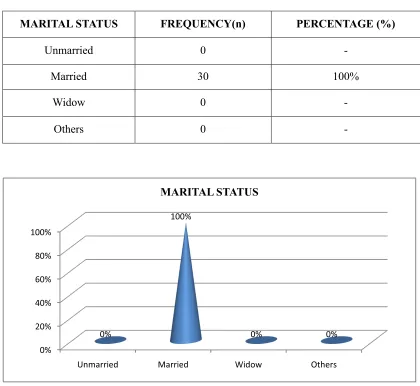
Table: 6. Frequency and percentage distribution of primary school teachers
according to their marital status.
n=30
MARITAL STATUS FREQUENCY(n) PERCENTAGE (%)
Unmarried 0 -
Married 30 100%
Widow 0 -
[image:60.612.120.540.135.521.2]Others 0 -
Fig:8 Cone diagram shows the frequency and percentage distribution of primary school teachers according to their marital status.
Table 6and figure 8 depict the majority of the primary school teachers 30 (100%) were married, none of them were unmarried or widow.
0% 20% 40% 60% 80% 100%
Unmarried Married Widow Others 0%
100%
0% 0%
45
Table:7. Frequency and percentage distribution of primary school teachers
according to the number of children.
n =30
NO OF CHILDERN FREQUENCY(n) PERCENTAGE (%)
One child 03 10%
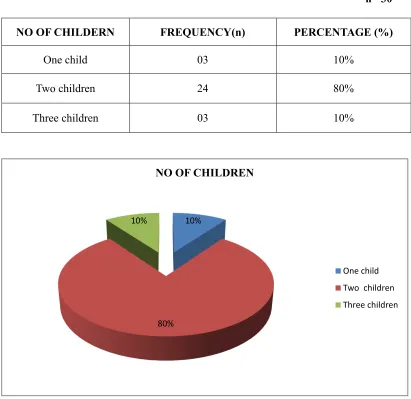
Two children 24 80%
[image:61.612.126.537.128.527.2]Three children 03 10%
Fig:9 Pie diagram shows Frequency and percentage distribution of primary school teachers according to the number of children .
Table7and figure 9 depict most of primary school teachers 24 (80%) have two children, 3 (10%) primary school teachers have three children and 3 (10%) have one child.
10%
80% 10%
NO OF CHILDREN
One child
Two children
46
Table: 8. Frequency and percentage distribution of primary school teachers according to their previous knowledge regarding first aid management.
n =30
PREVIOUS KNOWLEDGE FREQUENCY(n) PERCENTAGE (%)
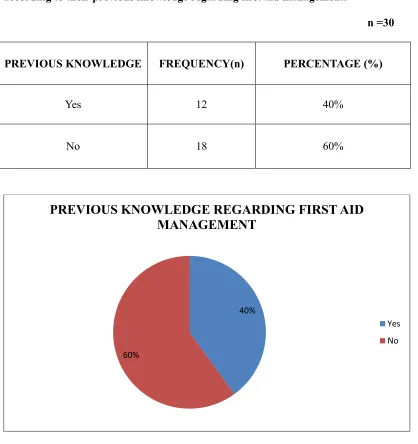
Yes 12 40%
[image:62.612.124.542.104.548.2]No 18 60%
Fig 10 Pie diagram shows Frequency and percentage distribution of primary school teachers according to their previous knowledge regarding first aid
management.
Table 8 and figure 10 shows that majority of the primary school teachers 18 (60%) were not having previous knowledge on first aid management whereas 12 (40%) had previous knowledge on first aid management.
40%
60%
PREVIOUS KNOWLEDGE REGARDING FIRST AID
MANAGEMENT
Yes
47
Table:9. Frequency and percentage distribution of primary school teachers according to their sources of information regarding first aid management.
n =30
SOURCES INFORMATION FREQUENCY(n) PERCENTAGE (%)
Books 06 20%
Health workers 13 43%
Friends 06 20%
[image:63.612.125.533.126.542.2]Mass media 05 17%
Fig:11 Cylinder diagram shows frequency and percentage distribution of primary school teachers according to their sources of information first aid
management.
Table 9 and figure 11 depicts that many of the primary schoolteachers 13 (43%) received information from health professionals, 6 (20%) got information through books, magazine or friends and relatives, some of them 5 (17%) got information through mass media regarding first aid management.
0% 5% 10% 15% 20% 25% 30% 35% 40% 45%
Books Healthworkes Friends Mass media 20%
43%
20%
17%
48 SECTION B
Analysis of pre and posttest levels of knowledge and expressed practices
regarding first aid management among primary school teachers.
Table 10 Frequency and percentage distribution of pre and post-test levels of knowledge regarding first aid management.
n =30
KNOWLEDGE PRETEST POSTTEST
Inadequate knowledge Moderate knowledge Adequate knowledge
NO % NO % 17
9 4
57 30 13
- 2 28
[image:64.612.126.532.217.517.2]- 7 93
Fig:12 Column diagram shows frequency and percentage distribution of pre and post-test levels of knowledge regarding first aid management.
Table 10and figure 12 represents that in the pre-test 17 (57%) teachers had inadequate knowledge, 9 (30%) teachers had moderately adequate knowledge and 4 (13%) teachers had adequate knowledge on first aid management. With regarding to the post - test 28 (93%) of the teachers had adequate knowledge, 2 (7%) had moderately adequate knowledge and none of the teachers had inadequate knowledge after programmed teaching on first aid management.
57%
30%
13%
0% 7%
93%
0% 20% 40% 60% 80% 100%
Inadequate knowledge(,50%)
Moderately knowledge(50-75%)
Adequate knowledge(>50%
pretest
49
Table: 11 Frequency and percentage distribution of pre and posttest levels of
expressed practice regarding first aid management.
[image:65.612.131.528.141.522.2]n=30
Fig 13 Cylindrical diagram shows frequency and percentage distribution of pre
and post test levels of expressed practice regarding first aid management.
Table 11and figure 13 represents that in pretest most of the teachers 17 (53%) had poor expressed practice 10 (33%) had average and 3 (10%) had good. Expressed practices. In the post-test 22 (73%) of teachers had good expressed practices and 8(27%) teachers had moderately expressed practices regarding first aid management.
EXPRESSED PRACTICE
PRE TEST POST TEST
Poor Average Good
NO % NO % 17
10 03
56 33 10
- 08 22
- 27 73
0% 10% 20% 30% 40% 50% 60% 70% 80%
Poor Average Good 56%
33%
10% 0%
27%
73%
preteat
50
7DEOH0HDQVWDQGDUGGHYLDWLRQDQGSDLUHGµW¶YDOXHRISUHDQGSRVWWHVWOHYHOV
of knowledge regarding first aid management among primary school teachers.
n =30
Level of knowledge Mean
Standard Deviation
Mean difference
3DLUHG¶W
µWHVW
Pre-test 18.9 2.99
6.4 20.5*
Post-test 25.3 3.15
Statistically significant (p<0.05)
Table12 represents that the pretest knowledge mean score was 18.9, standard deviatio