A STUDY TO ASSESS THE EFFECTIVENESS OF IEC PACKAGE
ON KNOWLEDGE AND SELF EXPRESSED PRACTICE
REGARDING BULLYING BEHAVIOR OF CHILDREN AMONG
THE PRIMARY SCHOOL TEACHERS AT SELECTED SCHOOLS,
TRICHY.
BY
REG.NO : 301332102
A DISSERTATION SUBMITTED TO THE TAMILNADU DR.M.G.R
MEDICAL UNIVERSITY, CHENNAI IN PARTIAL FULFILMENT
OF THE REQUIREMENT FOR THE AWARD OF THE DEGREE OF
MASTER OF SCIENCE IN NURSING.
A STUDY TO ASSESS THE EFFECTIVENESS OF IEC PACKAGE
ON KNOWLEDGE AND SELF EXPRESSED PRACTICE
REGARDING BULLYING BEHAVIOR OF CHILDREN AMONG
THE PRIMARY SCHOOL TEACHERS AT SELECTED SCHOOLS,
TRICHY.
BY
REG.NO: 301332102 Research Guide :
Prof.Mrs.THAMARAI SELVI, M.Sc(N), Ph.D., Principal,
Our Lady Of Health College Of Nursing, Thanjavur.
Clinical Guide:
Mrs.SARANYA, M.Sc(N), HOD of Mental Health Nursing .
Our Lady Of Health College Of Nursing, Thanjavur.
CERTIFICATE
CERTIFIED THAT IS THE BONAFIDE WORK OF
301332102
AT OUR LADY OF HEALTH COLLEGE OF NURSING,
THANJAVUR.
SUBMITTED TO THE TAMILNADU DR.M.G.R MEDICAL
UNIVERSITY, CHENNAI IN PARTIAL FULFILMENT OF THE
REQUIREMENT FOR THE AWARD OF THE DEGREE OF
MASTER OF SCIENCE IN NURSING.
Examiners:
1.
2.
Prof.Mrs.Thamari selvi M.Sc (N) , Ph.D Principal,
TABLE OF CONTENTS
CHAPTER
NO
CONTENTS
PAGE
NO
I INTRODUCTION
Background of the study Need for the study Statement of the problem Objectives Hypothesis Operational definition Assumptions Delimitations Projected outcome 1 3 4 5 5 5 6 7 7
II REVIEW OF LITERATURE
Review of literature Conceptual framework
8 16
III RESEARCH METHODOLOGY
Criteria for sample selection Data collection tool
Report of the pilot study
Reliability and validity of the tool Method of data collection
Scoring and interpretation procedure Plan for data analysis
20 21 23 23 23 21 24
IV DATA ANALYSIS AND INTERPRETATION
Organization of data Presentation of data
27 29
V DISCUSSION 43
VI SUMMARY AND CONCLUSION
Summary Conclusion
Nursing implications Recommendations Limitation
47 47 48 49 49
VII REFERENCES
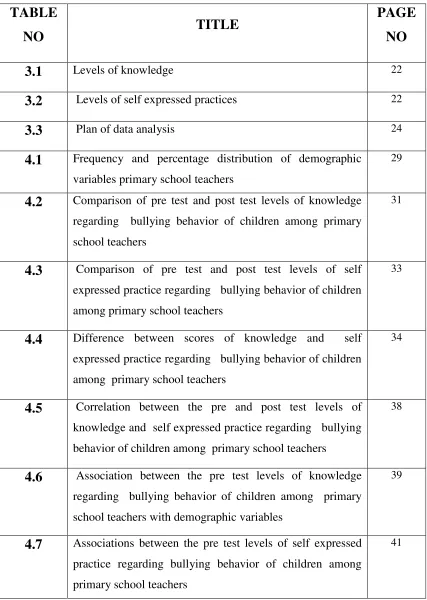
LIST OF TABLES
TABLE
NO
TITLE
PAGE
NO
3.1
Levels of knowledge 223.2
Levels of self expressed practices 223.3
Plan of data analysis 244.1
Frequency and percentage distribution of demographic variables primary school teachers29
4.2
Comparison of pre test and post test levels of knowledge regarding bullying behavior of children among primary school teachers31
4.3
Comparison of pre test and post test levels of self expressed practice regarding bullying behavior of children among primary school teachers33
4.4
Difference between scores of knowledge and self expressed practice regarding bullying behavior of children among primary school teachers34
4.5
Correlation between the pre and post test levels of knowledge and self expressed practice regarding bullying behavior of children among primary school teachers38
4.6
Association between the pre test levels of knowledge regarding bullying behavior of children among primary school teachers with demographic variables39
4.7
Associations between the pre test levels of self expressed practice regarding bullying behavior of children among primary school teachers41
[image:7.612.103.530.88.688.2][image:8.612.106.512.113.483.2]
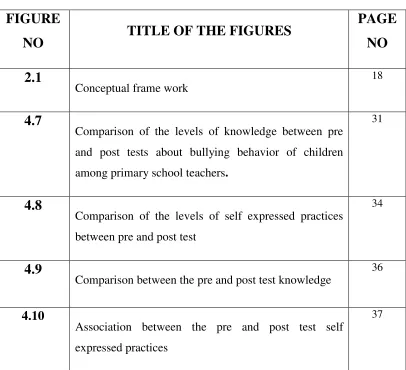
LIST OF FIGURES
FIGURE
NO
TITLE OF THE FIGURES
PAGE
NO
2.1
Conceptual frame work 18
4.7
Comparison of the levels of knowledge between pre and post tests about bullying behavior of children among primary school teachers.
31
4.8
Comparison of the levels of self expressed practices between pre and post test
34
4.9
Comparison between the pre and post test knowledge 36
4.10
Association between the pre and post test self expressed practices
LIST OF APPENDICES
NO TITLE OF THE APPENDICES
1 Letter Seeking Permission To Conduct Research Study. 2 Ethical Clearance Certificate
3 Letter Seeking Expert Opinion For Content Validity.
4 List Of Experts Validated The Tool And Independent Variables. 5 Content Validity Certificates
6 Data Collection Tool With Answer Key. 7 Certificate For English Editing.
8 Research Tool. 9 IEC Package
LIST OF THE ABBREVIATIONS
SHORT
FORMS
ABBREVIATIONS
IEC
Information communication and education.No:
NumberN
Number of samplesf
Frequencyχ2 Chi – square.
%
PercentageSD
Standard deviationS
SignificanceNS
No significanceBAPD
Bullying amongst diverse populationABSTRACT
IntroductionIn the world bullying in school was a worldwide problem and it was found in every school that has been documented as an international phenomenon. It has a lot of negative consequences on the children and it cause lifelong damage.
Objectives
The study focuses on to assess the effectiveness of IEC package on knowledge and self expressed practice regarding bullying behavior of children among primary school teachers, Trichy.
Methodology
The sample was 50 primary school teachers, pre-experimental research design was used, and non probability convenience sampling technique was chosen. Structured knowledge questionnaire was used to assess the knowledge and structured self expressed practice questionnaire was used to assess the self expressed practice.
Result
The knowledge and self expressed practice was calculated by the paired‘t’ test for knowledge (‘t’= 1.96) and for self expressed practice (‘t’=1.96). This proves that there is a significant difference at 0.05 levels.
Conclusion
Where as in correlation between the post test scores of knowledge and self
expressed practice ‘r’ value (r=0.7) revealed that there is a positive and highly significant correlation. It indicated that the given IEC was effective.
ACKNOWLEDGEMENT
I praise and thank God Almighty for his grace and abundant blessings; he has showered upon me, to bring this dissertation with an immiscible presence and guidance to complete the project successfully.
I extend my sincere gratitude to our bishop Rev. Fr. Dr. Devadoss Ambrose D.D.L.S.S, S.T.D., for his valuable prayer and support throughout our studies.
I would like to thank our correspondent Rev. Fr. ArockiyaBaskar who boosted me to get along with my studies and who stands as a source of inspiration.
I express my cordial thanks toProf. Mrs.Tamarai selvi, M.Sc (N).,Ph.D(N)., Principal of Our Lady of Health School and College of Nursing, who granted permission to do this project.
Heartfelt thanks to our Vice Principal Mrs.Irai mani M.Sc (N)., for her valuable guidance and suggestions.
It is my privilege to, owe my sincere thanks to,Mrs. Saranya M .Sc (N).,HOD for Mental Health Nursing, as well as my coordinator. Her interest, valuable guidance and generous contribution, thoughtful suggestions, enthusiasm, insight and judgment, which enlighten my path to complete the work systematically.
I express my special gratitude and thanks to the Principal of the Primary Schools, who permitted to do the study in their reputed schools.
I submit my extreme gratefulness to the statistician Dr. Dharamalingam Ph.D., for his excellent advice and support for analyzing the data of my study.
I extend my warm and heartfelt thanks to, all the Teachers from the schools, who were willing to participate in the study time.
I wish to extend my sincere thanks to Mrs.Magdaline M.A., B.Ed., M.Phil Asst professor department of English Bishop Heber College, Trichy. For editing the thesis.
I extend my thanks to the Librarian, Mrs. Jenifer BBA, M.L.I.S, PGDCA, for her co-operation in procuring books whenever needed.
I also accord my respect and gratitude to the Faculty of Our Lady of Health College of Nursing for their timely support throughout the period of my project.
I express my gratitude to my beloved husband Mr.D.James, who encouraged and boosted me and made my dream become true, and my lovely daughter J.P.Christina Jamsy, my loveable parents Mr. and Mrs.Pooranam Gunasekaran and my family members for their care, support and unending love.
CHAPTER I
INTRODUCTION
“Without your involvement you can’t succeed. With your involvement you can’t fail”
(A.P.J. Abdul Kalam)
Background of the Study
Bullying is a form of abuse it comprises repeated act overtime that involves a real or perceived imbalance of power with the more powerful individual. Bullying is a pervasive and serious issue affecting the school children ( Duccan 2011). Primary school level is the ground work for a child educational progression and crucial phase for children at the formal school in meeting someone outside their family for the first time and learning the meaning of friendship. Hence the children of the 21st century are busy dealing with and trying to cope with different forms of bullying incidents informing and educating primary school children in skills of conflict resolution set the foundation for a peaceful world (Wood 2008).
Bullying is becoming worldwide problem and can occur in ever school. Bullying is an aggressive behavior of intentional harm doing which carried out repeatedly and over time within a personal relationship characterized by an imbalance power. Bullying be includes aggression behavior such as repetitive, physical, psychological harm, harm on one or more students that create an initiating school environment and seems to interfere with school performance (Kilenberg and stans fold 2011).
The impact of bullying intervention training on participants especially perspective teachers and school personal on teachers knowledge of various bullying behavior, empathy and their ability to recognize bullying (Criag, et al., 2000). Bullying has been recognized as a school problem in several countries around the world, but international research studies report significant variability of this aggressive behavior between countries (Nansel, et al,2001).
According to the research on the National Centre of Social Research the 37% students accepted that they have been under the past victims of bullying and 13% admitted participation in violent incidents, in which 2000 students from 101 usually occur towards new comers and weak students.
Bullying can occur through a variety of forms such as first, direct physical contact, for example: hitting, slapping, pushing, biting, hair pulling, pinching, kicking, scratching etc. Second, verbal contacts directly, for example: threaten, embarrass, giving the bad nickname, spreading the bad news etc. Third, Non verbal behaviors directly, for example see sarcastically, showing the face expression mocked, threatening etc. Fourth, Non verbal behavior, include the indirect silencing someone, manipulate the friendship so be broke, isolate or neglect etc. Many factors causes bullying, like parental relationship, school failure, peer rejection etc. Bullying is characterized by fear of going to school, Poor or deteriorating schoolwork, inability to concentrate, withdrawn behavior, depression, loss of confidence, reluctance to go out, shortage of money, torn clothes, broken glasses, missing schoolbooks, repeated signs of bruising and injuries. (Nasal, et al., 2004)
providing all children opportunities to develop good interpersonal skills, and creating a social context which is supportive and inclusive.
Most of the times bullying occurs without the knowledge of teachers and parents. Due to the low numbers of students who actually report incidents of bullying, teachers need to have a certain level of awareness that will lead to any potential problems. This awareness starts with understanding of bullying.Teachers and school administrators have a duty of care; they must ensure that these rights are upheld. It is important to look more closely at the teachers within schools and the characteristics of the teachers that influence their responses in bullying cases.
They play a vital role in establishing the climate for bullying in schools. Teachers should become familiar with the school’s definition of bullying and bullying prevention policies.
Need for the study
“I wake to sleep, and take my waking slow, I feel my fate in what I cannot fear, I learn by going where I have to go.”
(Theodore Roethke)
Bullying is a serious issue that may result in severe consequence. Teachers have a central role in the management and prevention of bullying within schools and are in turn involved in the implementation of anti bullying intervention. Prevalence of bullying in India which is believed to be one of the highest in the world. A news report indicated that bullying in India is high. The report also states that most of the bullying happens inside the classroom. Bullying behavior includes. Loneliness, poor academic achievement, poor social judgment and greater risk of drug and alcohol use of being convicted of crime. (Olwers 1997).
aggressions, victims or defender although 30% were assigned to role of aggressor and 22% of the role of victims, 16% to the role of defender (Monk etal). Teachers play a vital role in tackling bullying and creating a positive social environment in classroom the researcher suggests that may not be fully prepared to tackling bullying teachers who received ant -bullying program still had difficulties handling bullying effectively (Oldenberg, et al., 2016). The Olwes bullying prevention program in Sweden has been on children and youth of elementary and secondary schools age documented that behaviour such as name calling, exclusion, and hitting frequently occur in early childhood settings. If such early aggressive behaviour is not systematically addressed, patterns of bullying are likely to emerge (Dan Olwes 2016). Bullying behaviour in children and adolescent an ongoing story bullying in school aged children is a universal problem which continuous to be serious threat to physical and emotional health of children efficacy of bullying prevention program which can help health care providers it assess and provide intervention to children affected by bullying (Artemis, et al., 2013).
Statement of the problem:
Objectives:
To assess the knowledge and self expressed practice regarding bullying behavior of children among the primary school teachers.
To evaluate the effectiveness of IEC package regarding bullying behavior of children among the primary school teachers.
To correlate the post test knowledge with self expressed practice regarding bullying behavior of children among the primary school teachers
To determine the association between the pre test level of knowledge and self expressed practice regarding bullying behavior of children and their selected demographic variables.
Hypotheses:
All the hypotheses are tested at the 0.05 level of significance.
H1: There will be a significant difference in the knowledge and self expressed
practice regarding bullying behavior of children among the primary school teachers.
H2: There will be a significant correlation between the knowledge and self
expressed practice regarding bullying behavior of children among the primary school teachers.
H3: There will be significant association between the pre test knowledge and self
Operational definition:
Effectiveness
I
t refers extend to which the IEC package improved the knowledge and self expressed practice regarding bullying behavior of children among primary school teachers.IEC package (Information Education and Communication) It refers to power point preparation with pamphlets and posters knowledge and
self expressed regarding bullying behavior of children among primary school teachers with the help of IEC package.
Knowledge
It refers to the awareness, understanding of fact and descriptions gained by primary school teachers regarding bullying behavior which was measured by self administered – structured knowledge questionnaire.
S
elf expressed practice
It refers to a routine activities expressed by the school teachers in order to control bullying behavior which was measured by self administered structured self expressed practice questionnaire.
Bullying behavior
It refers to the intention of repeated aggressive behavior of primary school
children to hurt another person either physically or mentally such as poking, throwing things, slapping, choking, punching, kicking, beating, producing rumor, pulling hair etc.
Primary school teachers:
Assumption
: Bullying behavior is harmful.
Teachers have a responsibility to aware about aggressive behavior of school children.
Teachers have an important role to control bullying behavior of children.
Knowledge on bullying behavior was being useful to practice better control measures on them.
Delimitation:
The study will be delimited to the primary school teachers who are working in schools, Trichy.
The data collection period will be delimited to six weeks. The study will be delimited to 50 samples.
Projected outcome
This study will helps to improve the knowledge and self expressed practice regarding bullying behavior of children among the primary school teachers. The study will help the primary school teachers early identification of children
B
Ina
PRETEST: Assess the level of knowledge and self expressed practice regarding bullying behavior of children among primary school teachers using structure knowledge questionnaire and self expressed practice questionnaire regarding bulling behavior IEC: Information Education and Communication POST TEST:
Assess the level of knowledge and self expressed practice regarding bullying behavior of children among primary school teachers using structure knowledge questionnaire and self expressed practice questionnaire regarding bulling behavior Adequate knowledge and self expressed practice
Moderately adequate knowledge and self expressed practice
Inadequate
knowledge and self expressed practice FEED BACK Demographic variables: Age, Qualification teaching experience, Gender, Working sector, previous source of knowledge.
Part II Figure.2.1 Modified conceptual frame work based on Widenbach’s helping art of clinical nursing theory
CHAPTER II
REVIEW OF LITERATURE
Review of literature is a summary of the writing of recognized authorities of previous research provides evidence that the researcher is familiar and which is already known and what is still unknown and interested. Literature reviews are secondary source, and as such, do not report any new or original experimental work. Also, a literature review can be interpreted as a review of an abstract accomplishment. Review of Literature is the reading and organizing of previously written materials relevant to the specific problems to be investigated; frame work and methods appropriate to perform the study”.
Part I
Review of literature related to bullying. Part II
Conceptual framework.
Part I
Bullying related review of literature
Bindhu shaiju, et.al (2016) conducted a study to assess the patterns and impact of bullying behavior among school children in selected schools of Kashmir and seeks the relationship between type of bullying behavior and impact. The descriptive study includes 100 school children aged 10 to 14 years studying in baramulla public school. Through the structured interview revealed that majority of the school children had moderate impact as a result of bullying behavior.
during the years 1994 and 1998, the logistic regression model showed significant decreasing trends in bullying others and also being bullied.
Halah. F. Nouran (2015) exploded a study on teacher knowledge about bullying in elementary schools in Saudi Arabia .A goal of this study was increase awareness of bullying find appropriate strategy to prevent bullying 100 female teachers working in five elementary schools by convergent parallel mixed method study design. Through a questionnaire and follow up interview findings shows fewer than half of teachers knew about bullying and those who did not know the world did not know how to treat student or to prevent bullying.
Anamika yadav Dr. Deepa Mehta (2015) influenced a study on bullying in elementary school students of Varanasi city. The investigator was under taken the objective to study bullying experience and bullying behavior of seventh class student total of 100 students selected from four schools the descriptive survey method was used. After analysis it was found that majority of the students get bullied by their own classmates. Commonly same sex student did the bullying and mainly occur in playground and class rooms.
Dr. Leticja (2015) study was reported on gender difference between teenagers regarding verbal bullying.aim of the study was to presented general perception of teenage students about verbal bullying and examined the difference between that exit between boys and girls regarding verbal bullying. The sample of the study was senior year students in high school of triana 168 boys and 232 girls. Approach of this study was quantitative research design, for date collection likert scale was used. The result from the mann-whiteny U test revealed significant difference between teenage boys and girls about verbal bullying.
on the effectiveness of preventive strategy. Majority of the female students indicated that cyber bullying was problem than male students.
Saarento S,et al., (2015) study shows that reducing bullying victimization: student-and class room-level mechanism of change. The longitudinal study examines the mediating mechanism by the ant- bullying program, based on the participant’s role approach to reduce bullying and victimization among elementary school students grade in 4th 5th and 6th by the self reported bullying perception. At the class room level the program effects on both self- and peer- reported bullying were mediated by the students on peers report bullying were mediated only on ant- bullying attitude, for the teachers attitude towards bullying was collective perception. Finally bullying mediated the effects of class room –factors on victimization.
Sangeeta basu ,et al .,(2014) conducted a study on Bullying and its relation to common health symptoms in school children. Victims of regular bullying lack confidence have lower self esteem, regard themselves as less competent. Studies have shown that victimization from bullying behavior is associated with substantial adverse effects on physical and psychological health. There is a higher prevalence of depression, school absenteeism and detonation in school performance. Health professionals seeing children with common health symptoms should ask whether the child is being bullied. The anti-bullying program can be implemented.
Salehi (2014) qualitative study on the primary school teachers and parents perception of peer bullying among children in Iran. Eight teachers and four parents of children involved. By the semi- structured interview they were identifying of the teachers and parents perceived bullying mainly as physical and verbal attack. Based on the outcomes of the study it was recommended that the teachers participate in anti-bullying program oriented to prevent bullying behavior and strong supportive relationship with parents to reduce this behavior. Thus the study reveals they had
elementary school in minas. The study result indicated that the teachers are not understand about school violence they planned to provide support for the planning and implementation about the school bullying of intersectoral intervention
Laurice , et al., (2013) exploratory study on students and teachers attitudes towards three types of bullying physical, verbal and social exclusion in elementary school teachers. 2 x 2 factorial designs was used, 3rd and 5th grade students and 11 teachers were
participated in this study. Personal data questionnaire and six vignettes used from that it was revealed that the students continue to exhibit high levels of bullying behavior in school, teachers continue to intervene at higher levels for physical and verbal but not social exclusion.
Willim E, et al.,(2013) study shows Adult psychiatric outcomes of bullying and being bullied by peers in childhood and adolescent. To test whether bullying and or being bullied in childhood predicts psychiatric problems. Prospective, population based study sample from 11 countries in western North Carolina a total 1420 participants’ ages of 9 and 16 years. They found higher prevalence of agoraphobia, general anxiety and panic disorder and that bullies/ victims were at increased risk of young adult depression, panic disorder agoraphobia and suicidality. Thus the findings revealed that the Bullies were higher prevalence at risk for anti social personality disorder in younger adult..
Gerarde osman (2013) study was influenced on regarding teachers perspective on school bullying insights from two primary school teachers in cape town the purpose of this study was to explore teacher’s perspectives on school bullying by mixed method research design. The concept of habitus, capital field was used to provide theoretical lens through which to examine the topic. The study was based on sample of 31 teachers drawn from two primary schools consist of two phases in which data collection took place first was a questionnaire second as interviews. Through this study Indicated that teachers had various conceptions of bullying but not the exact concept bullying.
Seriasha.J.Chatters (2012 investigated a study on regarding impact of bullying prevention training on the knowledge, attitude and behavior of pre- education majors by BAPD training. Bullying amongst diverse population (BAPD) questionnaire, quick discrimination inventory (QDI) and basic empathy scale was used. The sample of this study was pre-education majors in United States 172 participants were involved in this study. A quantitative research design was used. The result of this study was showed overall positive impact on participants knowledge and skill to respond to situation involving bullying.
Konstantia magklara (2012) study was revealed an association in Bullying behavior in schools , socioeconomic position and psychiatric morbidity a cross section sectional study in late adolescents at Greece. The aim of the study was to investigate the association between bullying and socioeconomic status. 4.1%. Psychiatric morbidity was associated with all types of bullying-related behaviors. No socioeconomic associations were reported for victimization. A lower school performance and unemployment of the father were significantly more likely among perpetrators, while economic inactivity of the mother was more likely in pupils who were both victims and perpetrators. These results show that lower school performance and unemployment of father were highly significant among perpetrators.
Hulya (2011) explored a study on the relationship between bullying and health
primary school at Izmir collected by peer bullying scale adolescents forms and identification of health problem . It revealed that the student exposed to bullying have more health problem than the bullying students thus there was relationship between explore bullying and health problem.
Dianne Byers et al,(2011) study influenced on the teachers attitudes towards overt and covert buying and perceived efficacy to intervene. This study explores teacher characteristics that influence their attitudes and responses to covert bullying 62 teachers from a Catholic Diocese in Queensland. Overt bullying incidents were taken more seriously than covert bullying; victims were shown empathy and intervention was likely. All teachers showed high levels of self efficacy and were likely to intervene in overt bullying incidents. Thus the finding shows all the teachers shows high response in covert bullying than overt bullying.
Jianghong (2011) study shows about childhood bullying a review of construct, context and nursing implication among children. Aim was to summarize empirical evidence for predictors of bullying and victimization, which can provide strategies for intervention and prevention by public health nursing professionals the investigator can better address methodological gaps and effectively move toward developing studies to inform nursing treatment programs and enhance public health initiatives that reduce violence in school settings. Thus the finding revealed that the investigator should needed to improve the effectiveness of program to reduce childhood bullying.
they had to be shows their importance in providing pre service teachers with training regarding anti-violence strategies.
Sadaf Tariq (2011) study investigated on the attitudes of children, parents, and teachers towards bullying. The samples of the study was comprised of 100 children (50 male; 50 female), 100 parents (59 fathers; 41 mothers) and 100 teachers (43 male; 57 female ). Findings depicted thatchildren were largely sympathetic towards victims; most of the parents were found to be largely sympathetic towards victims, supportive of intervention, but less understanding towards bullies; whereas teachers showed best understanding of all three dimensions. There was little association between parental and children’s attitudes, although there was significant association between teachers’ and parents attitudes on victim and bullies.
Victoria Stuart-Cassel(2011) study evaluated on model bullying policies formulated by state departments of education suggests that state agencies are recognizing the importance of providing local school districts with guidance on how to develop bullying policies, and often borrow from each other in crafting model bullying policies for their states. By compiling and coding state law, and by compiling and coding state model although that only 27 state laws legally require departments to provide guidance documents, 41 states have developed them, with the majority drafted in the most recent three or four-year period. For states without bullying legislation, these state models replace legislative requirements as the leading source of guidance on policy development.
differences were found between girls. Thus the study revealed that there was no difference found between girls.
Maria et al (2010) studyreported on systematic review and meta-analysis on the effectiveness of anti-bullying programs in schools.. A total of 622 reports concerned with bullying prevention were found, and 89 of these reports (describing 53 different program evaluations) were included in our review. Of the 53 different program evaluations, 44 provided data that permitted the calculation of an effect size for bullying or victimization. The meta-analysis of these 44 evaluations showed that, overall, school-based anti-bullying programs are effective: on average, anti-bullying decreased by 20–23% and victimization decreased by 17–20%. Thus this study revealed that bullying program was effective.
Dieter Wolke , et al.,(2016) study shows bullying and parasomnias a longitudinal cohort study objectives was environmental factors such as serious trauma or abuse and related stress can lead to nightmares or night tremors. Birth cohort was interviewed at elementary school age 8and 10 years about bullying experiences with a previous validated. Resulted that being bullied in elementary school and parosomnias in early adolescence.
Part II: Conceptual Framework
Wiedenbach
’
s helping art theory
Conceptual framework is a basic structure that consist of certain abstract block which represent the observational the experimental and analytical / synthetically aspect of a process or system being conceived the interconnection of these blocks completes the framework for certain expected outcomes.. A conceptual framework is used in research to outline possible course of action or to present a preferred approach to an idea or thought .nursing theory should provide the principles that underpin practical and help to generate further nursing knowledge.
The study was based on Wiedenbach’s helping art theory (1970) was designed to a “Theory in a practice discipline”. According to her it defines nurturing and caring for someone in a motherly fashion. The care is given by any caring person that is render with compassion, skill and understanding to those in need of care, counsel and help to win the confident.
The model is focus on the three factors
Identification
Nurse observes the patient, looking for an inconsistency between the expected behavior and apparent behavior of the patient.
In this study researcher assess the level of knowledge and self expressed practice regarding bullying behavior of children among primary school teachers using structure knowledge questionnaire and self expressed practice questionnaire regarding bulling behavior and explores that the school teacher had inadequate knowledge and self expressed practice.
Ministration
In this study the researcher improved the knowledge and expressed practice through the IEC package.
Validation
Nurse validates that the actions were indeed helpful. Evidence must come from the patient that the patient that the purpose of the nursing actions has been fulfilled.
In this study the researcher collected the evidence by assessing the levels of knowledge and self expressed practice through structure knowledge questionnaire and self expressed practice questionnaire regarding bulling behavior after IEC package and they gain adequate knowledge and self expressed practice.
CHAPTER III
RESEARCH METHODOLOGY
Research methodology is a way to systematically solve the research problem. In this chapter the investigator discusses the Research approach, Research design, Variables, Setting, Population, Sample, Sample size, Sampling technique, Criteria for data collection, Description of the tool, Plan for data analysis and production of human rights.
Research Approach:
Quantitative approach was used in this study.
Research Design:
Pre - experimental research design was used in this study.[one group pretest-post test design].
O1– pre test
X – IEC Package, O2– Post test.
Variables
:
Independent variables: IEC package regarding bullying behavior.
Dependent Variables: Knowledge and self expressed practice of primary school teachers regarding bullying behavior.
Demographic Variables: Age of the teacher, Qualification, Teaching experience, Gender, Working sector, previous source of knowledge.
Setting
The study was conducted among the primary school teachers at selected schools, Trichy. Annai velankani matriculation school in poolankudi colony in that school nearly 40 teachers where there from them investigator selected 24 primary school teachers. Little Angles school in poolankudy in that school nearly 15 primary school teachers from them investigator selected 14 teachers. Thuvakudi government school nearly 12 teachers where there from them investigator selected 12 school teachers
Population:
The population comprised of primary school teachers.
Sample:
Primary school teachers who are handling the class from 1st to 5th standard.
Sample size:
The sample size comprised of 50 primary school teachers from three selected
schools at Trichy.
Sampling Technique:
Non probability convenience sampling technique was chosen for this study.
Criteria for sample selection:
Inclusion criteria:
Primary school teachers who are willing to participate in this study.
Primary school teachers who are both male and female.
Exclusion criteria:
Primary school teachers who are working as a part time teachers.
Description and interpretation of the tools:
Part I: Demographic variables such as age of the teachers, qualification, teaching
experience, gender, working sector, previous source of knowledge.
Part II: Structured self administered knowledge questionnaire was used to assess the knowledge.
Part III: Structured self administered Self expressed practice questionnaire to assess the self expressed practice.
Scoring of the tool
Part- II
The questionnaire consist of 24 items based on definition, types, risk factors,
causes, signs and symptoms, identifying and preventing. Each item was given four options; among four options one was the right answer other three options were distracters. The knowledge questionnaire maximum score was 24 and minimum score was zero. The percentage of the obtained score was calculated as follow.
Obtained Score
X 100
Table 3.1 Levels of knowledge LEVELS OF KNOWLEDGE
SCORE PERCENTGE
Inadequate knowledge 0-8 0-33%
Moderately adequate knowledge
9-16 34-67%
Adequate knowledge 17-24 68-100%
Part III
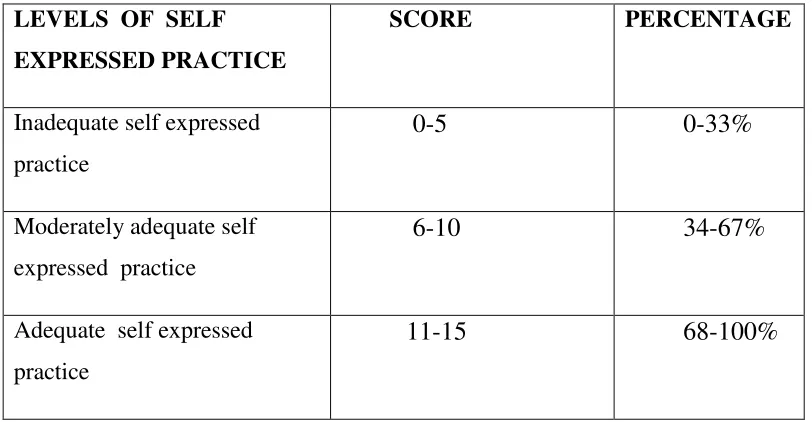
[image:35.612.138.506.103.284.2]The self expressed practice questionnaire consists of 15 items. Each item was given yes or no response. 13 positive items and 2 negative items. The self expressed practice maximum score was 15 and minimum score was zero.
Table 3.2Levels of self expressed practice LEVELS OF SELF
EXPRESSED PRACTICE
SCORE PERCENTAGE
Inadequate self expressed practice
0-5 0-33%
Moderately adequate self expressed practice
6-10 34-67%
Adequate self expressed practice
[image:35.612.120.526.450.661.2]Reliability and validity of the tool
The validity of the tool was done by review of literature and tested in the field of
medicine and nursing. The tool was modified according to their suggestion and recommendation of experts and the tool was finalized. The reliability of the tool was established by test- retest (Karl Pearson Co-efficient Formula) method the reliability r=0.7.
Report of pilot study
Pilot study was conducted for a period of two weeks. The investigator obtained permission from the participants prior to the study.
The purpose of the study was explained to the participants prior to the study. Pilot study was conducted for 5 school teachers in St. Joseph school and Convenience sampling technique was used to select the sample.
The knowledge and self expressed practice was assessed by self administered structured knowledge questionnaire and self administered self expressed practice questionnaire. Immediately after the pre test, IEC Package given in the form of PowerPoint presentation, pamphlets and posters.
The effectiveness was assessed on 14th day by using same questionnaire. The
mean value of knowledge (9.6) of post test was higher than the mean value of pre test (15.6) and the mean value of post test self expressed practice (6.6) was higher than the mean value of pre test self expressed practice (10.4). It shown IEC Package was effective. After pilot study, the tool was considered to be feasible and practicable. So the main study was preceded.
Method of data collection
On 1st day pre test was conducted, by administer structure self expressed using
self administer structure knowledge questionnaire and self practice questionnaire, teachers requested to fill the answers finally the questionnaire was collected from the teachers. The investigator has given self introduction and the rapport was maintained.
Then the IEC package for one hour duration was given through power point, pamphlets and posters. At end of the class teachers allowed to discuss and clarified their doubts and also allowed the teachers to share their experience regarding bullying behavior.
Investigator thanked the teachers and school principal for their participation and co-operation and also the investigator informed them that she will come for post test after two weeks.
On 14th day, the investigator conducted the post test to determine the knowledge and self expressed practices with the same questionnaire and same technique.
The investigator went to the school and met the school principal got the oral permission clarified about the presence of the respective sampling teachers, asked to seated in one classroom all the sampling teachers are welcomed by investigator , the knowledge and self expressed practice questionnaire was given to teachers to fill the answer. After one hour the filled questionnaire were collected from the teachers.
Investigator asked the experience about the pre test and post test and some teachers share their experience about bullying behavior.
Before leaving from the school the investigator met the school principal gave the pamphlets regarding bulling behavior and said thanks for theirs participants and co-operation.
Plan for data analysis
Table3.3Plan for data analysis. S.N
O
DATA ANALYSIS
METHODS REMARKS
1. Descriptive statistics
Frequency and percentage.
Mean and
standard deviation
To describe the demographic variables to assess the knowledge and self expressed practices values of pre test and post test.
To assess the knowledge and self expressed practice regarding bullying behavior of children among the primary school teachers.
correlation Analyzing the correlation between pre and post test scores of knowledge and self expressed practices of bullying behavior among primary school children. 2. Inferential
statistics
T test, Paired “t” test
Analyzing the significant difference between the effectiveness of knowledge and self expressed practices of bullying behavior among primary school children.
Ethical consideration.
The research proposal was approved by the dissertation committee prior to conduct the pilot study.
Ethical clearance was obtained from the ethical committee of Our Lady of Health College of Nursing.
The written formal permission was obtained from head of the institutional authorities of the school.
The informed oral consent was obtained from each subject before starting the data collection.
CHAPTER-IV
DATA ANALYSIS INTERPRETATION
This chapter deals with the description of sample characteristics, analysis and interpretation of data collected from primary school teachers regarding bullying behavior of primary school children.
This chapter represents the organization of data and interpretation of the data by using the descriptive and inferential statistical methods. The data was collection and analyzed as per the objectives of the study.
Organization of data
The data has been organized and tabulated as follows.
Section: 1
Assessment of demographic variables of the primary school teachers regarding bullying behavior of primary school children.
Section : 2
Assessment of pre test and post test levels of knowledge regarding bullying behavior of primary school children.
Section : 3
Assessment of pre test and post test levels of self expressed practices of bullying behavior of primary school children.
Section : 4
Section : 5
Assessment of correlation between the post test scores of knowledge and self expressed practices of bullying behavior of primary school children.
Section: 6
Presentation of data
Section: IAssessment of demographic variables of the primary school teachers.
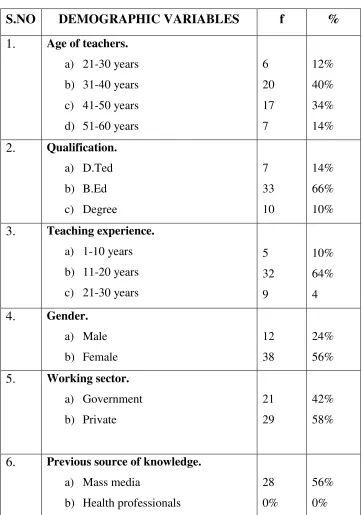
Table 4.1: Frequency and percentage distribution of demographic variables of the primary school teachers at Trichy.
N=50
S.NO DEMOGRAPHIC VARIABLES f %
1. Age of teachers. a) 21-30 years b) 31-40 years c) 41-50 years d) 51-60 years
6 20 17 7 12% 40% 34% 14%
2. Qualification. a) D.Ted b) B.Ed c) Degree 7 33 10 14% 66% 10%
3. Teaching experience. a) 1-10 years b) 11-20 years c) 21-30 years
5 32 9 10% 64% 4
4. Gender. a) Male b) Female 12 38 24% 56%
5. Working sector. a) Government b) Private 21 29 42% 58%
6. Previous source of knowledge. a) Mass media
b) Health professionals
28 0%
[image:42.612.130.493.198.713.2]c) Friends d) Relative e) None
3 3 16
[image:43.612.129.493.71.137.2]6% 6% 36%
Table 4.1 reveals that among the age between 21-30 years, among them 6 (12%) are between 31-40 years, 20 (40%) are between 41-50 years, 17 (34%) are between 51-60 years, 7 (14%) Regarding the qualification 7 (14%) D.TEd qualification, 33 (66%) B.Ed qualification, 10 (20%) Degree.
With reference to teaching experience 5 (10%) between 1-10 years, 32 (64%) between 11-20 years, 9 (18%) between 21-30 years, 4 (8%) between31-40 years. Estimating the gender 12 (24%) are male, 38 (56%) are female.
In assessing of the working sector 21 (42%) are government employee, 29 (58%) are private employee. viewing the previous source of knowledge 28 (56%) are gaining information from mass media, 0 (0%) are health professionals, 3 (6%) are gaining information from friends, 3 (6%) are gaining information from relatives, 16 (32%) are gaining information from none.
Section 2
[image:44.612.101.481.228.404.2]Assessment of pre test and post test levels of knowledge regarding bullying behavior of children among primary school teachers.
Table 4.2: Comparison of the levels of knowledge between pre and post test regarding bullying behavior of children among primary school teachers
N=50
LEVELS OF KNOWLEDGE
PRE TEST POST TEST
f % f %
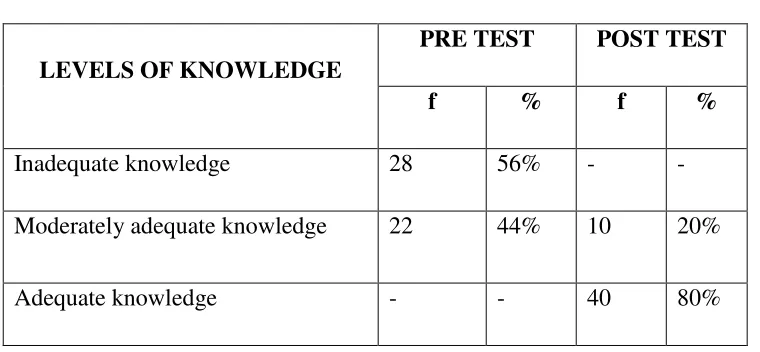
Inadequate knowledge 28 56% - - Moderately adequate knowledge 22 44% 10 20%
Adequate knowledge - - 40 80%
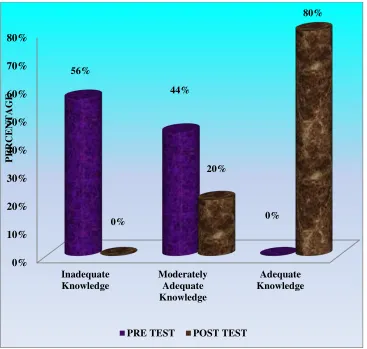
Table 4.2 shows that in pre test level of knowledge 28(56%) had inadequate knowledge, 22(44%) had moderately adequate knowledge and none of them had adequate knowledge. The post test level of knowledge reveals that none of them had inadequate knowledge, 10(20%) had moderately adequate knowledge, 40(80%) had adequate knowledge.
Figure 4.2: Comparison of the levels of knowledge between pre and post tests regarding bullying behavior of children among primary school teachers.
0% 10% 20% 30% 40% 50% 60% 70% 80%
Inadequate Knowledge
Moderately Adequate Knowledge
Adequate Knowledge 56%
44%
0% 0%
20%
80%
P
E
RCENT
AG
E
[image:45.612.142.509.162.511.2]Section 3
[image:46.612.102.512.200.397.2]Assessment of pre test and post test levels of self expressed practices regarding bullying behavior of children among the primary school teachers.
Table 4.3: comparison of the levels of self expressed practices between pre and post test regarding bullying behavior of children among the primary school teachers.
LEVELS OF SELF EXPRESSED PRACTICE
PRE TEST POST TEST
f % f %
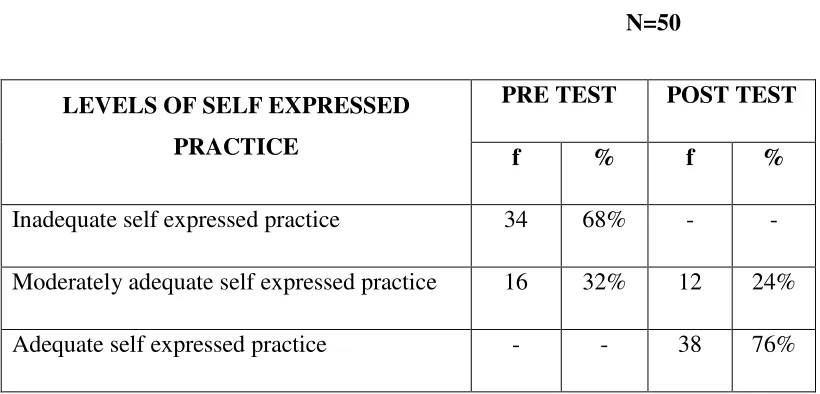
Inadequate self expressed practice 34 68% - - Moderately adequate self expressed practice 16 32% 12 24% Adequate self expressed practice - - 38 76%
Table 4.3 shows that in pre test score 34(68%) had inadequate self expressed practices, 16(32%) had moderately adequate self expressed practices, none of them had adequate self expressed practices. In post test none o them had inadequate self expressed practices, 12(24%) had moderately adequate self expressed practices, 38(76%) had adequate self expressed practices.
The comparison of pre test score as well as post test score of the primary school teacher improvement in IEC regarding bullying behavior. So this table concludes that the IEC Package regarding bullying behavior was very effective for the primary school teachers.
Figure 4.3: Comparison of the levels of self expressed practices between pre and post test regarding bullying behavior of children among primary school teachers.
0%
10% 20% 30% 40% 50% 60% 70% 80%
Inadequate Practice Moderately
Adequate Practice
Adequate Practice 68%
32%
0% 0%
24%
76%
P
E
RCENT
AG
E
Section 4:
Assess the significant difference between the knowledge and self expressed practice regarding bullying behavior of children among the primary school teachers.
Table 4.4: significant difference between the knowledge and self expressed practices regarding bullying behavior of children among the primary school teachers.
N=50
VARIABLES
PRE TEST POST TEST PAIRED
‘t’ TEST
MEAN SD MEAN SD
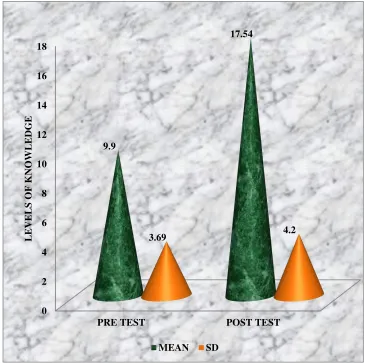
Knowledge 9.9 3.69 17.54 4.20 18.80 Self expressed
practices 5.46 2.81 10.65 3.76 16.54
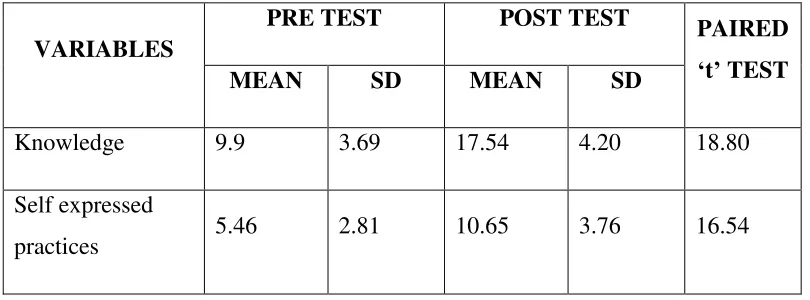
Table 4.4 shows that the mean and SD of pre and post test survey regarding knowledge and self expressed. In pre test, the mean score regarding knowledge was 9.9with SD of 3.69 and in post test, the mean score was 17.54 with SD of 4.20‘t’ value of CV = 18.08, TV = 1.96(CV > TV) which statistically significant at 0.05 level.
H0 – There is no significant difference between the knowledge and self expressed
[image:48.612.101.506.235.385.2]Figure 4.4: assessment of significant difference between the pre and post test knowledge.
0 2 4 6 8 10 12 14 16 18
PRE TEST POST TEST
9.9
17.54
3.69 4.2
L
E
VE
L
S
O
F
K
NO
WL
E
DG
E
[image:49.612.141.506.132.495.2]Figure 4.5: assessment of significant difference between the pre and post test self expressed practices
0 2 4 6 8 10 12
PRE TEST POST TEST
5.46
10.65
2.81
3.76
L
E
VE
L
S
O
F
P
RACTI
CE
[image:50.612.140.507.138.473.2]Section 5
Assessment of correlation between the post test scores of knowledge and self expressed practices regarding bullying behavior of children among the primary school teachers.
Table 4.5: correlation between the post test scores of knowledge and self expressed practices regarding bullying behavior of children among the primary school teachers N=50
VARIABLES
PRE TEST POST TEST CORRELATION
‘r’ value
MEAN SD MEAN SD
Knowledge 9.9 3.69 17.54 4.20 0.7 positive and significant
correlation Self expressed
practices
5.46 2.81 10.65 3.76
Table 4.5 shows that the mean and standard deviation of pre and post test survey regarding knowledge and self expressed practices. In pre test, the mean score regarding knowledge was 9.9 with the SD of 3.69 and in post test, the men score was 17.54 with the SD of 4.20
In pre test mean score was 5.46 with the SD of 2.81 and in post test, the mean sore was 10.65 with SD of 3.76 and the correlation r = 0.7 which is positive and highly significant for post test scores.
[image:51.612.111.518.235.385.2]Section 6
Association between the pre test levels of knowledge and self expressed practices scores regarding Bullying behaviour of primary school children and their demographic variables such as. Age of the teacher, Qualification, Teaching experience, Gender, Working sector, previous source of knowledge.
Table 4.6 :Association between the pre test levels of knowledge scores regarding bullying behavior of primary school children and their demographic variables such as. age of the teacher, qualification, teaching experience, gender, working sector, previous
source of knowledge
N = 50
S.NO
Demographic variables
Level of knowledge
χ² In adequate moderately adequate adequate
f % f % f %
1 Age of the
teacher. a)21-30 years b)31-40 years c)41-50 years d)51-60 years 4 13 8 3 8 26 16 6 2 7 9 4 4 14 18 8 - - - - - - - - 3.3 N.S
2 Qualification
a)D.Ted b)B.Ed c)Degree 2 25 1 4 50 2 5 8 9 10 16 18 - - - - -
3 Teaching Experience a)1-10 years b)11-20years c)21-30years d)31-40years 1 24 1 1 2 48 2 2 4 8 8 3 8 16 16 6 - - - - - - - - 13.6 NS
4 Gender
a)Male
b)Female 9 19 18 38 3 19 6 38 - - - - 2.1 N
5 Working
sector
a)Government
b)Private 18 20 36 40 3 19 6 38 - - - - 9.3 NS
6 Previous
source of
knowledge a)Mass Media b)Health professional c)Friends d)Relatives e)None 10 0 2 2 14 20 0 4 4 28 18 0 1 1 2 36 0 2 2 4 - - - - - - - - - - 12.7 S
S- significant, NS –not significant.
Table 4.7: Association between the pre test levels of self expressed practice scores regarding bullying behavior of primary school children and their demographic variables.
N = 50
S.N O
Demographic variables
Level of self expressed practices
χ² In adequate Moderately adequate adequate
f % f % f %
1 Age of the teacher. a)21-30 years b)31-40 years c)41-50 years d)51-60 years 4 17 11 2 8 34 22 4 2 3 6 5 4 6 12 10 - - - - - - - - 35.1 NS
2 Qualification a)D.Ted b)B.Ed c)Degree 5 24 5 10 48 10 2 9 5 4 18 10 - - - - -
- 8.3 S
4 Gender a)Male
b)Female 6 28 12 56 6 10 12 20 - - - - 1.8 S
5 Working sector a)Government
b)Private 18 16 36 22 3 13 6 26 - - - - 5.2 S
6 Previous source of knowledge a)Mass Media b)Health professional c)Friends d)Relatives e)None 17 0 1 2 14 34 0 2 4 28 11 0 2 1 2 22 0 4 2 4 - - - - - - - - - - 17.2 NS
S- significant, NS –not significant.
CHAPTER V
DISCUSSION
This chapter represents the discussion of the study based on the objectives.
The study was a Pre- experimental (one group pre test post test) design. To evaluate the effectiveness of IEC package on knowledge and self expressed practice regarding bullying behaviour of children among primary school teachers at, Trichy.
The was conducted to assess the knowledge and assess the self expressed practice by knowledge and self expressed practice questionnaire in three schools at Trichy After pre test the IEC Package was given by the investigator. After 14 days from the pre test, post test was conducted by using same knowledge questionnaire and self expressed practice questionnaire. The data was grouped and analyzed using descriptive and inferential statistics.
The first objective of this study was to assess the knowledge and self expressed practice regarding bullying behaviour of children among primary school teacher.
The data analysis reveals that the level of knowledge in pre test10 (20%) possessed Inadequate knowledge, 40 (80%) had moderately adequate knowledge and none of them had adequate knowledge. The results shown that there was a lack of knowledge among the primary school teachers regarding bullying behaviour. In pre test, the level of self expressed practice were 38(76%) had inadequate self expressed practice, 12(24%) had moderately adequate self expressed practice and no one had adequate self expressed practice.
This finding of the present study was supported by the following study
findings suggest that pre professional and continuing educations are needed to improve the teacher knowledge. (Joseph A, et al., 2003)
The second objective of this study was to evaluate the effectiveness of IEC package regarding bullying behavior of children among primary school teachers. In pre test, the overall mean score for knowledge was 9.9 with SD of 3.69 and in post test the mean score for knowledge was 17.54 with SD of 4.20 Here, the calculated ‘t’ value of CV= 18.894,TV= 1.96 (CV>TV) at 0.05 level. For self expressed practice the pre test mean score was 5.46 with SD of 2.81 and in post test, the mean score was 10.65 with SD of 3.76 Here the calculated ‘t’ value of CV= 16.54, TV = 1.96 (CV> TV) at 0.05 level. Hence, both the value of knowledge and self expressed practice were CV > TV, which is statistically significant at0.05 level. So, the research hypothesis H1
was accepted. Finally, there was a significant difference between the knowledge and self expressed practice regarding bullying behavior of children among primary school teachers.
This finding of the present study was supported bythe following study
Effectiveness of information, education and communication package on knowledge regarding impact of watching television among children at selected school, was conducted to assess the effectiveness of IEC package, quasi experimental research design (one group pre and post test) was used. The study was conducted in jain matriculation higher secondary school with 100 samples. The result revealed that in pre test 85% majority of the children had inadequate knowledge and in post test 61% had adequate knowledge 39% children had moderately adequate. (Ganga devi and Ramya rathi 2016)
The third objective of this study was to correlate the knowledge and self expressed practice regarding bullying behavior of children among primary school teachers.
knowledge and self expressed practice regarding bullying behavior of children among primary school teachers.
This finding of the present study was supported by the following study
Quantitative research design was used to assess the impact of bullying prevention training on the knowledge, attitude and belief of pre education majors (future trainers). The purpose of the study was to investigate any correlation between changes in knowledge, skills, efficacy, like hood to intervene, empathy and prejudicial attitude and changes in the recognitions of interventions. The result indicates positive relationship between racial attitude and skills at post test by Pearson correlation(Seria shina joycee 2012)
The fourth objective of this study was to determine the association between the pre test knowledge and self expressed practice regarding bullying behavior of children and their selected demographic variables such as age of the teacher, Qualification, Teaching experience, Gender, Working sector, previous source of knowledge.
Regarding demographic variables, the analysis reveals that there was significant association between the qualifications, teaching experience, working sector of pre test level of knowledge and there is no significant difference between the age of the teacher, gender, previous source of knowledge. Where as in pre test level of self expressed practice reveals that there is a significant association between the age of teacher, teaching experience, previous source of knowledge, and there is no significant association between the qualification, gender and working sector. So the H0 is rejected.
This findings of the present study was supported by the following study
between the independent variable (age, sex) and bullying behavior in adolescent by using chi-square test. (Ricardo et al 2012)
The significant association was tested at 0.05 levels. Hence there is a significant association in pre test level of knowledge and self expressed practice in their selected demographic variables. The third hypothesis H3 was accepted.
In knowledge questionnaire regarding performance of the student and handling of student majority of the teacher were answered correctly and in self expressed practice questionnaire regarding taking action and behaviour of students they were answered correctly due to their year of experience, qualification and media influence.
CHAPTER
–
VI
SUMMARY AND CONCLUSION
Major findings of the study
The statistical analysis revealed that in pre test the group knowledge level shows that maximum 28(56%) teachers had inadequate knowledge and level of self expressed practice shows that 34(68%) teachers had inadequate self expressed practice. In post test the group knowledge level shows that maximum 40(80%) teachers had adequate knowledge and level of self expressed practice shows that 38(76%) teachers had adequate self expressed practice.
There was significant difference in pre and post level of knowledge and self expressed practice regarding bullying behaviour among primary school teachers as revealed by paired ‘t’ test knowledge(t= 18.8) and self expressed practice (t= 16.5).
The statistical analysis for correlation between the pre and post test scores of
knowledge and self expressed practice was calculated by karl pearson correlation between the pre and post test scores of knowledge and self expressed practice was r=0.7 this indicates that there was a positive and significant improvement in their knowledge and self expressed practice regarding bullying behavior of children among primary school teachers.
There is a significant association with qualification, working sector and teaching experience for pre test level of knowledge and in self expressed practice there is a significant association with age of the teacher, teaching experience, previous source of knowledge.
Conclusion
significant difference between pre and post test level of knowledge and self expressed practice, thus indicated the given IEC Package was effective for primary school teachers.
Nursing implications
The study which enables us to conclude that IEC Package is effective on improving knowledge and self expressed practice related bullying behavior of children among the primary school teachers. The study findings had thrown new light on the Nursing profession, including nursing practice, nursing education, nursing administration, and nursing research as follows.
Nursing education
The nursing education is framed such a way that equip the nurse with the essential knowledge , attitude and skills for meeting the need of the society in primary, secondary and tertiary level to prevent bullying.
The nursing curriculum should also include about bullying behavior in mental health nursing.
Nursing students should be enlightened with adequate knowledge to assess and handle the bullying through IEC Package which is essential for basic principles of nursing services.
Nursing administration
Effective strategies should be considered by a nurse administration to handle the bullying behavior with a use of IEC package.
Nursing research
It is important to conduct studies which test the effectiveness of preventing bullying in order to add evidence based practice in nursing and to maintain quality of care to handle the bullying.
The researcher should be aware of the existing healthcare system and the status of nursing profession which would help to improve the knowledge, skills and attitude. In this study intervention for bullying behavior was highlighted by the use of IEC package.
Nursing practice
Bullying behavior is most problems that were occur in everywhere, this IEC package regarding bullying can be practice to identify, manage and to create awareness. There by present study enhancing evidence base practice, quality of care and autonomous role of nursing intervention.
Recommendation
The following recommendations are done based on this study:
The similar stud