2 EXPLORING CREATIVITY AS EXPERIENCED BY WORLD-LEADING CHEFS
ABSTRACT
3 BACKGROUND
The purpose of this paper is to research the phenomenon of creativity as experienced by world-leading chefs in the organizational setting of their creative industry - haute cuisine (literally ‘high cooking’). Understanding the phenomena of world-leading chefs’ lived experiences of creativity is important for management researchers for several reasons: (1) creativity is ensconced at the highest levels of human endeavor and is essential not only in artistic and scientific achievement but also in business where it is an acknowledged and vital source of competitive advantage for firms; (2) whilst it is generally accepted that creative ideas emanate from the minds of creative individuals, there is only a small body of work in management which has sought to understand the intra-subjective experience of creating from the perspective of the originator; (3) creative workers and the creative industries (of which chefs and haute cuisine are an important part) are not only inherently interesting but, through a narrowing of the focus of researchers’ attention to these highly creative individuals in a deeply creative context, they also afford an opportunity to understand what is most essential in the experience of creativity in a commercial setting.
Imagine a scoop of foie gras ice cream, a distilled liquid of forest moss, or a machine that produces layers of milk skin a fraction of a millimeter thick. These inventions are the results of the creativity of some of the world-renowned chefs investigated in this research (one of our research participants, Ferran Adrià, has been described as “the world’s greatest chef” and “the most imaginative generator of haute cuisine on the planet”1). But what is it about these individuals that enable them
to produce consistently such highly original, inventive and innovative products? Furthermore, what can be learned about the phenomenon of creativity and the creative process in business and management more generally from analyzing their experiences of being exceptionally creative?
Researchers in management have tended to focus their attentions on creativity’s antecedents and outcomes (Woodman et al., 1993) or its personality traits and social processes (e.g. Elsbach and Flynn, 2013, Vandenbosch et al., 2006). One consequence of doing so is that the creative process itself as essentially experienced by the creative individual is something of a ‘black box’ (Kurtzberg and Amabile, 2001). Focusing attention on the delineation of various psychological attributes of the creative personality (which represents an extensive corpus of psychometric, experimental and correlational research emanating from Guilford’s seminal analysis in the 1950s (see Guilford, 1950, Guilford, 1957), whilst being a valid endeavor, has meant that the intra-subjective experience of ‘being creative’ has been somewhat neglected in management research. It is not our aim here to present an extensive review of the creativity in management literature (see George, 2007, Hennessey and Amabile, 2010), suffice to say we think there is further work to be done in unraveling the phenomenon’s cognitive, affective and conative complexities and interactions and the ways actors create meaning out of experiencing creativity. Through ‘thick description’ (Geertz, 1973) we aimed to capture holistically the complexities and interactions of high-level creativity (as practiced by some of the best chefs in the world) in high-performance settings (in their Michelin- and Gault Millau-rated restaurants). In doing so we endeavored to illustrate how
4 leading haute cuisine chefs constructed and understood their experience of being creative (Gioia et al., 2013).
Haute cuisine is acknowledged as an economically and culturally important sector of business. This was formally recognized in 2010 when the UNESCO (United Nations Educational, Scientific Cultural Organization) added the gastronomic meal of the French to its ‘Representative List of the Intangible Cultural Heritage of Humanity’ (UNESCO, 2010). The economic and cultural importance of haute cuisine is manifested by its value-creation through aesthetic and symbolic work (Svejenova et al., 2007) and the success of haute cuisine restaurants is reliant vitally on the reputation, craftsmanship and personal creativity of their chefs (Balazs, 2001, Balazs, 2002). Haute cuisine therefore is an excellent representative of a high-level creative industry that is of considerable cultural and commercial significance in which the creative individual stands center-stage (Petruzzelli and Savino, 2012, Svejenova et al., 2012, Ferguson, 1998). Creative products are socially evaluated by the domain’s professional bodies (Rao et al., 2003) who guard strictly its conventions and traditions (Svejenova et al., 2007) as well as the creative progress (Stierand et al., 2014). Two of the most influential professional bodies that have a ‘gatekeeper’ function are Michelin (which rates a small number of outstanding restaurants on a one- to three-star scale) and Gault Millau (which rates restaurants on a 1- to 20-point scale) restaurant guides. High-level creativity in a high-performance setting is an important expectation in these assessments (Fine, 1992, Fine, 1996, Balazs, 2001, Balazs, 2002, Rao et al., 2003, Svejenova et al., 2007, Svejenova et al., 2010, Peterson and Birg, 1988).
We believe that what may be learned about the intra-subjective experience of creativity through researching the haute cuisine sector extends into other areas of business and management. Our research started with a general, well-specified research question: What is the lived experience of culinary creativity from the perspective of extraordinary chefs? It was important that the research question was broadly conceived because we endeavored to seek emergent properties of the experience of high-level creativity in high-performance settings. Our research aim was to find out how some of the world’s leading haute cuisine chefs construe their experiences of being creative and what this can tell us about the nature of creativity more generally.
RESEARCH DESIGN
5 ways (see Suddaby, 2006). For example, the first-named author had worked previously as chef in several Michelin restaurants and luxury hotels (as well as now being an academic faculty member) he therefore possessed not only an in-depth practical and professional knowledge of the domain, but also possessed an attribute we considered to be important in a study of this nature: that of being an ‘insider’ (see Gioia and Chittipeddi, 1991).
Interviewees
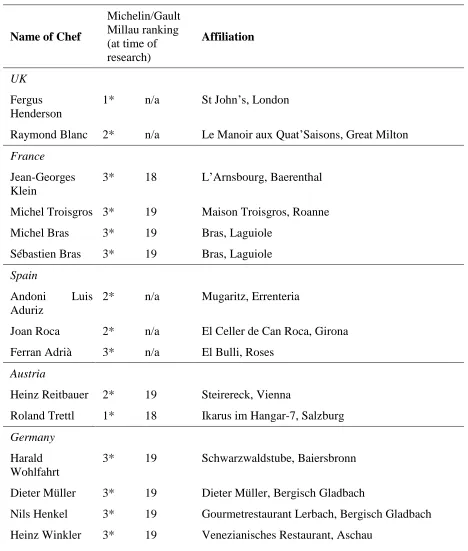
Two of our ‘ground assumptions’ are that haute cuisine chefs are highly creative, and that haute cuisine chefs are ‘knowledgeable agents’ who know what they are trying to achieve and are able to report and “explain their thoughts, actions and intentions” (Gioia et al., 2013, p. 17). As noted, creativity is a fundamental expectation of haute cuisine (e.g. Balazs, 2001, Balazs, 2002, Fine, 1992, Fine, 1996, Rao et al., 2003, Svejenova et al., 2007, Svejenova et al., 2010, Peterson and Birg, 1988), hence we assume that chefs who are listed in the Michelin and Gault Millau restaurant guides are engaged in high-level creativity (cf. Averill, 2005). For example, Michelin star ratings are based on quality of ingredients, skill in preparation, value for money, consistency of culinary standards and the level of creativity2. This provided us with an externally referenced and inter-subjective means to identify outstandingly creative chefs, namely the identification of interviewees for our sample was based on the Michelin and the Gault Millau restaurant guides and required that each interviewee be recognized in at least one of these. Table 1 lists all participating chefs by countries, their accolades, and restaurants.
--- Insert Table 1 about here ---
The selection of interviewees was based on a variety of data sources: the first named author’s insider experience, trade press articles, cookery books, websites of chefs, and an initial interview with the world-renowned, Michelin 3-star German chef, Harald Wohlfahrt (
www.traube-tonbach.de). The interview with Harald Wohlfahrt, besides being rich in insight, was also of great
strategic value for the research because he signed a letter of support in which he encouraged the selected chefs to participate in this study. This letter was originally written in German, then translated into English and French and sent via email to chefs he had recommended. Wohlfahrt’s reputation in the field, having held three Michelin stars for two decades, resulted in a number of significant and positive responses to our requests. Upon receipt of these, further emails were sent to other chefs now also including the names of those who had agreed to participate. ‘Snowballing’ in this way was successful in encouraging more top-level chefs to participate. In total 35 chefs from France, Spain, Austria, Germany, and the UK were contacted of which nine did not reply, seven refused, and 18 agreed to participate. This group comprised two chefs from the UK, four from France, three from Spain, two from Austria, and seven from Germany. All are world leaders
6 in the field of haute cuisine. The composition of the sample is a result of the sampling strategy rather than any personal or professional preferences.
Data Collection
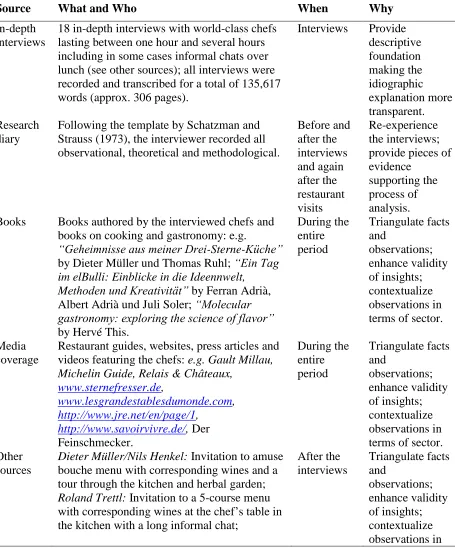
Data collection was conducted by means of in-depth, semi-structured interviews and the compilation of a research diary in which the observational, theoretical and methodological notes were recorded after each interview (Schatzman and Strauss, 1973). These notes were helpful in re-experiencing the interviews and provided additional insights and evidence in the data analysis. We also used a number of additional data sources in order to achieve an in-depth understanding of the underlying structure of the experience of creativity, see Table 2.
--- Insert Table 2 about here ---
The interviews were based on only a small number of pre-planned topics for discussion since we aimed at an emergent dialogue that could help elucidate and better understand the interviewees’ intra-subjective experiences (see Boje, 1991, Cunliffe, 2011, Ibarra, 1999, Cunliffe, 2002). This ‘fluid’ style of interviewing was possible because of the interviewer’s insider knowledge and experience as an haute cuisine chef. This facilitated trust-building and enabled deeper conversations between professionals that would have been more difficult otherwise (see Gioia and Chittipeddi, 1991). On the other hand, the interviewer’s prior experience also demanded rigorous self-reflection which was supported by critical discussions within the research team which took place after each interview in order to stay alert to any influences that might have blurred the understanding or biased the interpretation of interviewees’ accounts. The attitude of phenomenological reduction was practiced through the process of bracketing whereby we looked at the data as open-mindedly as possible (Giorgi, 1994). We put this attitude of relative openness into practice by following a dialectic process in which we iterated between bracketing and using our pre-understandings reflexively as a source of insight (Finlay, 2009).
Data Analysis
7 themes to emerge naturally from the interviewees’ descriptions. This descriptive analysis was helpful in providing transparency for the interpretive-explanations that followed.
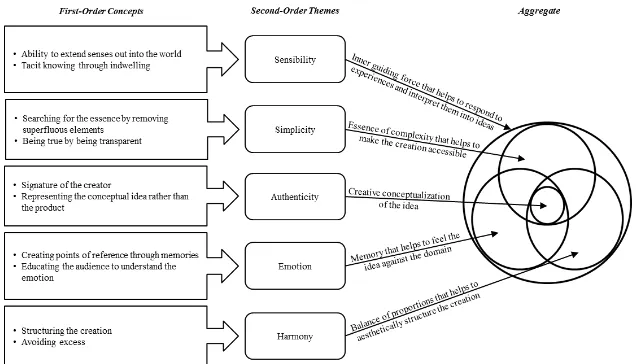
Further iterations took place subsequently between the descriptive themes, an interpretation as self-reflective practitioner (i.e. chef/researcher), the data, and the extant literature (see Douglass and Moustakas, 1985, Moustakas, 1990 for more details on heuristic inquiry). The reason for this interpretive-explanatory analysis was not to find some ‘hard proof’ but to explain what we have learned about the nature of the experience of personal creativity from the interviewees’ accounts and from our own subjective experiences. Nine first-order concepts emerged from the data. These were categorized into five second-order themes, see Figure 1 below.
--- Insert Figure 1 about here ---
In addition, to further establish accuracy and credibility of our interpretations we followed recommendations for using member-checking (see Lincoln and Guba, 1985, Anand et al., 2007, Hemetsberger and Reinhardt, 2006, Abma, 2003). Our specific strategy was to ‘play-back’ the findings and our interpretation of them to other leading chefs who were able to be informed discussants (see Wolcott, 1990, p. 132). Hence, we conducted unstructured validation interviews with four chefs who carry the title Meilleur Ouvrier de France (MOF,
www.meilleursouvriersdefrance.info and www.meilleursouvriersdefrance.org), which means Best
Craftsman of France. They are considered ambassadors for their trade and have the duty to share their knowledge and expertise with the next generation of elite craftsmen3. All four MOFs validated our interpretation, sample quotes are: ‘it is the base of creativity’, ‘I see myself in this model’, ‘this model, I think, is creativity’, and ‘I agree with this [model]’. Their interpretation of the findings resonated strongly with ours and offered assurances that we had not become too close to the informants’ view (Gioia et al., 2012).
FINDINGS
In this section we present the five second-order themes or ‘essential components’. We label them in this way since they represent the ‘essence’ of the chefs’ experience of creativity, i.e. sensibility, emotion, simplicity, harmony, and authenticity. The data structure was shown in Table 3 above. In what follows we discuss the five essential components, illustrate them with relevant power quotes in which our informants were “concise and insightful” to the extent that we “could not do a better job of making the same point” in our own words” (Pratt, 2008, p. 501).
3
8 Sensibility
Sensibility aggregates two first-order concepts ‘ability to extend sense out into the world’ and ‘tacit knowing through indwelling’. The chefs described a ‘sensibility’ through which they interpret their creative process and embed this sense-making in their creations:
When I go to China, it has nothing to do with my own culture. You see something from 500 years ago from another world… culturally speaking you don’t get it, but you interpret it! Even if you don’t recognize it, you understand that there is a sensibility behind this… it might not be your culture, but you understand what’s behind it. We have a receptor for universal sensibility. (Andoni Luis Aduriz)
This form of sensibility is a mode of ‘indwelling’ i.e. a form of personal knowing through participation (Polányi and Prosch, 1975), which can be seen as an interior creative guiding force that helps them to not only respond to experiences of the world but also interiorize them (Polányi and Prosch, 1975) and thereby interpret them into creative products:
When it is hot outside you have to do things a bit fresher and when it is raining you have to create a warmer feel in your creations… this sensibility is important and an ordinary cook doesn’t have this. (Jean-Georges Klein)
I develop most of my ideas while I am working. When I debone a saddle of lamb I reflect and ask myself what I have developed so far and what I could do next. During this process I smell spices, herbs and this is how I get my inspirations… It is like an artist painter who paints the picture in his head. (Harald Wohlfahrt)
This sensibility is achieved not only through an indwelling but also through an embodying of the tools of the craft to the extent that they become extensions of the chefs themselves allowing them to ‘forget’ about the tools and concentrate only on the element of creative sensibility (Dörfler and Ackermann, 2012). The tools become extensions of the chefs’ body and senses allowing them to meld their explicit and tacit knowings in the creative process.
Emotion
Emotion aggregates two first-order concepts: ‘creating points of reference through memories’ and ‘educating the audience to understand emotion. The chefs referred to their ‘creative emotion’, which forms part of their ‘creative memory’ and helps them to intuitively ‘feel the creative idea’ within the context of the culture and occupational norms and practices of the haute cuisine domain:
9 By tasting a dish chefs were able to recall emotionally-charged memories particularly if the taste is linked to memorable childhood experiences. It is through memories of emotions, both positive and negative, that points of reference are established with regards to tastes and flavors:
We are using memory as a concept… a very important part of the traditional cooking here is the mixture of the earth and the sea… We collected some soil from a small forest… and then put it into distillation. This way we were able to capture the smell of the earth in the liquid from which we made a sauce… then we put an oyster together with this distillation of the earth… and when you put it in your mouth you had the absolute sensation of earth and sea together… Your memory starts going and more or less everybody had a very agreeable memory… nostalgia from the earth and from the childhood or other intimate sensations like walking in the forest after it had been raining… But one person said: ‘I don’t like it. It’s a bad experience!’… this guy was a football player for Barcelona and when he tried the dish he remembered the last time he was playing against Real Madrid when he fell and got some soil from the football pitch in his mouth. (Joan Roca)
This creative emotion captures the chef’s ‘impetus of love’ (Fromm, 1957), a blend of sympathy and joy:
It is what the children want to say. The success of our business comes from the sincerity of what we offer. (Sébastien Bras)
Yet, at the same time, haute cuisine is paradoxically the most intellectual and perhaps most ‘artificial’ – in the sense of manmade – form of food and cooking:
… comparing the cooking here with home-cooking is like comparing a F1 car with an old Daimler with which you cruise and enjoy the scenery… The two have absolutely nothing to do with each other… It is absolutely not like home-cooking and it is not familiar cooking! (Ferran Adrià)
The intellectualization and ‘artificial’ character of haute cuisine creates a ‘barrier of creativity’ for many consumers, who probably feel, and probably are, like novices or children unaccustomed to such experiences and who first have to develop reference points in order to qualify for appreciating and enjoying vicariously the chef’s creative emotion (see Jacobsen, 2008). Therefore, the chefs aimed to progressively educate their guests by introducing them to increasingly more creative interpretations and thus build in their guests an awareness of and familiarity with the chefs’ experience of creativity:
10 The high-level creativity Adrià refers to is at the interface of knowledge and emotion: in terms of the former creativity is amongst the highest of the ‘higher’ thought processes; in terms of emotion, creativity can be an occasion for intensely affective personal experiences (Averill, 2005).
Harmony
Harmony aggregates two first-order concepts: ‘structuring the creation’ and ‘avoiding excess’. Chefs also sensed and searched for creative harmony necessary to bring structure to a creation. It is analogous to the structural form of the sonata in music or the intuitively sensed balance in an architectural object instantiated in the aesthetically pleasing ‘golden section’. In cooking, harmony can be in a taste or expressed in the balance that exists between the dishes of a menu. As a concept, creative harmony can be partly explained through the concept of proportion as used by many artists:
… very important is the proportion. When you transgress the norms of what you do, you must be very, very respectful or the thing just doesn’t work. (Joan Roca)
For instance, the proportion of the so-called ‘golden section’ (or ‘golden ratio’) is intuitively aesthetically pleasing. It can be found in the paintings of artists as disparate as Leonardo da Vinci and Mondrian, the architecture of the Acropolis and Notre Dame Cathedral, and the music structures employed by composers such as Bartók and Chopin (see Gross and Miller, 1997). Artists, often unconsciously (i.e. intuitively), make use of this harmonious and pleasing mathematical ratio; it allows the smaller portion to occupy a part of the whole that makes the whole maximally harmonious (see Berlyne, 1971):
The harmony of the dish is very important… you have to think whether to intensify or tone down a flavor… you have to arrange it on the plate in a way that people eat it the way it should be eaten… important is also the architecture of the dish… I have a picture of a dish in my head… it has to look in such a way that the guest automatically starts concentrating on the dish without getting scared. (Juan Amador)
There is a further parallel between the notion of formal harmony referred to above and what the Oxford historian and Leonardo da Vinci scholar Martin Kemp labelled ‘structural intuitions’: “the recurrence of decorative motifs in very different civilizations, such as spiral formations, polygonal patterns and diverse symmetries’ which endure across ages, cultures and different modes of expression” and are implicit and sensed rather than explicit and analyzed (Sadler-Smith, 2008, p. 18).
11 We have quarter notes, eighth notes, half-notes, and full-notes and look how many pieces have been created. It seems to be endless. And it’s basically the same with produce, with spices, with all the tender loving care. (Harald Wohlfahrt)
For example, Beethoven, who is widely considered as an extraordinarily creative composer, often excessively used one simple and common rhythmic motif in several of his major compositions such as the famous four-note motif in his fifth symphony (Brindle, 1986). Thus creative excellence does not depend on how complicated the ingredients are, but how the ingredients are subtly adjusted in such a way that they create a ‘creative simplicity’.
Simplicity
Simplicity aggregates two first-order components ‘searching for the essence by removing superfluous elements’ and ‘being true by being transparent’. This component of personal creativity may be understood as an ‘essential beauty’ whereby the attributes of the dish have ‘no place to hide’ behind any gloss or veneer that would make the dish unnecessarily complicated:
Innovation is in simplicity, because simple things make sense! (Fergus Henderson)
A common theme was ‘great dishes do not become better by complicating them’:
Beef olives exist since hundreds of years, but nobody before thought of doing it this way… it’s more difficult to cut nice slices from the cheeks and you have to be a bit skilled… But why always topside? Because with the topside you just have to cut slices and this is very easy! (Hans Haas)
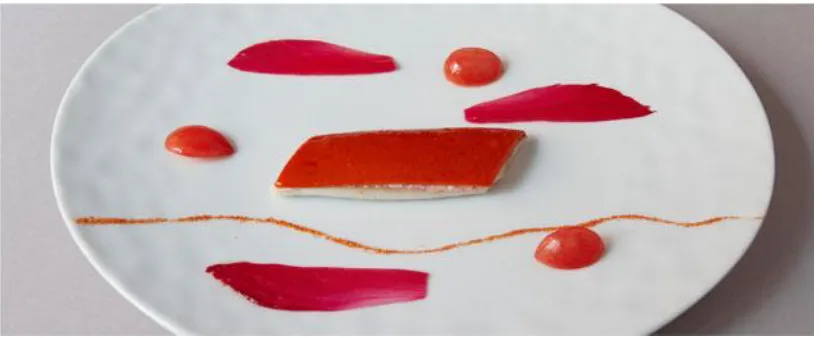
The chefs aimed to extract the essence from the complexity of experiences from which they create new dishes. In this sense, one can argue, that true simplicity is the essence of real complexity. For example, in philosophy the notion of simplicity can be conceptualized in terms of the principle of Occam’s razor (i.e. if there are several acceptable explanations of a phenomenon, the simplest among them should be accepted) and in science by parsimony (i.e. the selection of the hypothesis with the fewest number of assumptions). Creating creative simplicity is a complex process that leads to a simple outcome. To illustrate this component of the experience of creativity the following picture of a dish called Red Mullet, Spiced Butter, Tomato by Michel Troisgros can ease the understanding of how simplicity manifests itself in a culinary creation:
--- Insert Figure 2 about here ---
12 Authenticity
Authenticity aggregates two first-order concepts: the ‘signature of the creator’ and ‘representing the conceptual idea rather than the product’. We define authenticity in this study as the chef’s ‘creative signature’:
My cuisine is very particular. Special. It has a kind of ‘personal signature of acidity’. I work a lot with acidity. It is like a play of contrasts. A play between shadow and light. (Michel Troisgros)
Authenticity implies that chefs do not have to cook their creations to make them authentic rather they must have conceptualized the idea for the creation to make it authentic:
… I was the only one in my family to eat the skin of the milk… to find real milk today is hard… I tried to understand what happens with the milk… so I worked along the lines of how to make cheese… you add lab-ferment… bring it to the right temperature and then pour it and leave it. But instead of doing a big cheese loaf, I make it very flat… I developed this technique… it makes leaves of milk skin… which I call ‘lait caillé’ or ‘caillé de lait’ (curdled milk). I serve mousseron with it, which are small mushrooms, coming out in the spring… only in the field where the cows are. So, for me there is a story behind: the cow, the milk, the mushrooms… it comes naturally. (Michel Troisgros)
Hence in the same way that there are musical compositions or styles that are instantly recognizable as the ‘voice’ of a particular composer or performer, for example Mozart or Billie Holiday, there are authentic and recognizable ‘Ferran Adrià dishes’ that are imprinted with the creative signature of Ferran Adrià. Moreover the signature and the authenticity are detectable instantly by an expert, connoisseur or chef, whether Adrià cooked the dish himself or whether his brigade of chefs executed it following his ideas. On the other hand, the process is reciprocal in that the audience’s perspective may include questioning whether the creation is authentic in terms of the perception they have of the chef:
I love the work done by Ferran. The work of a Gagnaire! A Roellinger! People who have a signature. Even if I don’t completely agree with everything they did but their approaches are interesting. (Sébastien Bras)
More recently, perhaps triggered by fashion for ‘molecular gastronomy’, original ideas are being copied more frequently, because they present new and highly innovative techniques, which, at least for the layman, can more easily be hidden in a dish. However, the chefs were very clear in their evaluation that the chefs who ‘steal’ their ideas are either novice chefs who are just blinded by the effects new techniques can achieve or they are chefs that are more motivated by the commercial aspects of gastronomy rather than the intrinsic value of creativity itself:
13 The ‘stealing’ of original ideas has led to the creative authenticity of chefs being eroded and created a demand for hyper-creativity amongst audiences and in the media which does not always yield positive consequences for the creative domain.
It is all in the hands of trend setters. People who don’t love, people who don’t know better, who are creating a masquerade… the same happened with the Nouvelle Cuisine… chefs like Chapel and so on… they understood that our world was changing, our needs were changing and obviously they wanted to create food, which corresponded to the modern needs, i.e. seasonality, curiosity, creativity, but the responsible creativity, based on authenticity, based on important values… and that was completely ruined… most revolutions fall in the wrong hands! (Raymond Blanc)
DISCUSSION AND CONCLUSION
We now consider what we have learned about the phenomenon of creativity and the creative process which can be generalized to other settings. A contribution of this research is an increased understanding of the phenomenon of creativity as experienced by world-leading highly creative individuals in an important sector of the creative industries. Our research also has more general implications for understanding the intra-subjective nature of creativity, how intra-subjective meaning making of what high-level creativity entails impacts upon the creative outcome, and what this means for the self-concept of a ‘creative worker’ and the theories that such individuals hold about themselves in relation to others (creative workers and consumers) and their domain (Csíkszentmihályi, 2006, Elsbach and Flynn, 2013). It is evident that highly creative chefs do not follow any tangible or predetermined set of ‘steps’ or any idea management system at the end of which an original and useful idea is produced or guaranteed (Stierand et al., 2014, Cooper, 2008). Rather there is much which is tacit and intuitive and risky in what they produce and the ways in which they produce it. Interviewees’ retrospective accounts of creativity indicate strongly that high-level creative work necessarily contains an intuitive, tacit component. This component is not subject to the laws of any simple or conventional logic, rather it has metaphorically speaking its “own kind of logic” (Runco, 1996, p. 8) which may be considered to be “‘a creative intuition’, in Bergson’s sense” (Popper, 1968, p. 8).
14 114). Understanding this embodiment of being creative provides insights into how experienced practitioners overcome the novice’s ‘clumsiness’ and automatize their use of their ‘tools’ (e.g. the managers’ PowerPoint presentation or flip chart, or the accountants’ Excel spreadsheet) and make them ‘amplifiers’ of their senses (see Tsoukas, 2005a). Building the requisite expertise (see Ericsson et al., 2007) and acknowledging this interiorization helps to access intuitively the creative sensibility that forms a vital aspect of the experience of creativity and is the fount of invention and innovation.
The salience of emotion in the experience of creativity can lead to a better understanding of how managers and innovators either liberate themselves from their ‘inherited background’ (see Wittgenstein, 1979) or embrace their tradition, and also how they may overcome any routinized or over-learned plans of action (see Deleuze, 1988, Rooney, 2004). Emotions can be a source of ‘creative destruction’ (but not in a Schumpeterian sense) in this regard. The idea of ‘creative emotion’ might be a starting point for research exploring how people in different occupations (e.g. managers, new product developers, etc.) respond creatively and dynamically to the role of affect in their lived experiences of creation, invention and innovation (see Clegg et al., 2005). Furthermore the emotional component of the experience of creativity adds to the understanding of the role that affect plays in the creative process and more specifically the likely effects of differing strengths and valances of the affective charge which accompanies creative intuitions (see Dane and Pratt, 2009, Gore and Sadler-Smith, 2011) may have on creative, innovative and entrepreneurial behaviors in the workplace and the business environment more generally.
While the notions of creative harmony and creative simplicity remain largely unaddressed in the management and organization literature (but have been long-acknowledged in the creative arts), they bear, in our opinion, consequences for a better understanding of creativity in general, the role of aesthetics, and the experience of creativity in business and management. Their importance for management is underlined by the significant role that they are acknowledged to play in the creative arts (cf. formal musical structures, compositional devices in painting and architectural forms, the ‘golden section’, etc.). Creative harmony is vital in bringing form and structure to a creation. It can be understood as the expert balancing of proportions in a creation, and is vital for achieving an aesthetically pleasing outcome whether this is a musical composition or performance, an architectural space, a device such as an iPad (in which simplicity belies a phenomenal complexity), a customer service encounter, or an haute cuisine dish. Our research of the experience of creativity informs critical discussion of aesthetics in business in general and in new product development in particular (one need only think of the simplicity, harmony and kinesthetic appeal of most of Apple’s products in this respect).
15 or not understand well the tacit dimensions of creativity, such research might examine the roles that ‘aesthetic intuition’ and creative intuitions and insights might play in these important organizational processes. Our research sheds important light on these matters in the creative industry context and signals directions for future research in product, process, and organizational aesthetics.
Exploring creative harmony cannot be divorced from acknowledging the role of creative simplicity, described as an ‘essential beauty’. This component of simplicity extracts the essence from the complexity of experiences: true simplicity is the ‘essence of complexity’. Apple aesthetics are strongly led by a Zen-like notion of simplicity and a Bauhaus-like aesthetic which imbues products with a beauty which captivates users in ways that subsume but also transcend functionality. Understanding how successful creative individuals extract the essence from the complexity of experiences and how they interpret this essence into creative products is vitally important for our understanding of competitiveness, in general, and the structure of ‘beauty’ as perceived by potential adopters of a new product or service in particular.
The notion of authenticity is sometimes used to manage audiences’ impressions, for example in the luxury wine industry (Beverland, 2005), about the quality of products, the use of special methods of production, or the long tradition of businesses and their honorable founders (Peterson, 2005). Authenticity is therefore also a social (inter-subjective) as well as individual (intra-subjective) aspect of experiencing creativity. For example, authenticity may be invoked as a rationale for the preservation of tradition (Jones et al., 2005) but the downside is that it also may become over-used and clichéd (Moeran, 2005) to the extent that being ‘authentic to the tradition’ can present a core rigidity which is a counterforce to originality. Perceived legitimacy may emanate from the fact that a creator belongs to a specific ethnic or cultural group with status identity conferred by the group and which may for example be linked to a ‘bizarre’ or unconventional biography such as being from a humble background or naïve and untrained (Peterson, 2005), or the benefit which accrued from a good reputation within a relevant social network (Delmestri et al., 2005).
16 authenticate an original creation as ‘innovative’ when they experience it (see Csíkszentmihályi, 1997, Csíkszentmihályi, 2006, Amabile, 1983, Amabile, 1982).
In conclusion, through capturing and elucidating on world-class haute cuisine chefs’ experiences of creativity our research has shown that sensibility, emotion, harmony, simplicity and authenticity are essential to the phenomena of creativity and innovation in this domain. These five essential components are not only vital for the individual chefs’ becoming and being creative, but also are instantiated in their creative outcomes. The experiences of our sample of chefs indicate that the phenomenon of creativity is an evolutionary process of ‘becoming creative’. Methodologically the two-layered analysis (‘Discussion’ to ‘Findings’) moved from describing how the chefs acquired their knowledge and how they use it to generate creative outcomes to explaining the essence of experiencing creativity. Our study is located in the under-researched field of the creative industries and cultural economy but has much to contribute to the study of creativity and innovation in management more generally. Csíkszentmihályi and Sawyer (1995: 336) conceptualized creativity as a “recurring circle from person to field to domain and back to person”. In the domain of haute cuisine this cycle depends on the creative individual’s appreciation and integration of emotion, simplicity, harmony instantiated in a sensibility which is intelligible to the field. The component of authenticity is central to the chef’s personal creativity – (s)he is constantly trying to present the self in the creation and is constantly self-reflecting between identity and image constructing, which is in essence an intra-subjective (individual) and inter-subjective (social) process. Moreover, the authenticity component is also in a dynamic relationship with the sensibility component, which represents the chef’s inner guiding force that helps to make and give sense by communicating between the self and the domain and its symbolic resources and the field and its social resources.
17 REFERENCES
Abma, T. 2003. Learning by telling storytelling workshops as an organizational learning intervention. Management Learning, 34, 221-240.
Amabile, T. 1982. Social psychology of creativity: A consensual assessment technique. Journal of Personality and Social Psychology, 43, 997-1013.
Amabile, T. 1983. The social psychology of creativity: A componential conceptualization. Journal of Personality and Social Psychology, 45, 357-376.
Anand, N., Gardner, H. & Morris, T. 2007. Knowledge-based innovation: Emergence and embedding of new practice areas in management consulting firms. Academy of Management Journal, 50, 406-428.
Averill, J. R. 2005. Creativity in the domain of emotion. In: Dalgleish, T. & Power, M. J. (eds.) Handbook of cognition and emotion. Chichester, UK: John Wiley & Sons.
Balazs, K. 2001. Some like it haute: Leadership lessons from france’s great chefs. Organizational Dynamics, 30, 134-148.
Balazs, K. 2002. Take one entrepreneur: The recipe for success of france’s great chefs. European Management Journal 20, 247-259.
Berlyne, D. 1971. Aesthetics and psychology, New York, NY, Appleton, Century and Crofts.
Beverland, M. 2005. Crafting brand authenticity: The case of luxury wines. Journal of Management Studies, 42, 1003-1029.
Boje, D. 1991. The storytelling organization: A study of story performance in an office-supply firm. Administrative Science Quarterly, 36, 106-126.
Brindle, R. 1986. Musical composition, Oxford, Oxford University Press.
Butterfield, K., Trevino, L. & Ball, G. 1996. Punishment from the manager’s perspective: A grounded investigation and inductive model. Academy of Management Journal, 39, 1479-1512.
Clegg, S., Kornberger, M. & Rhodes, C. 2005. Learning/becoming/organizing. Organization, 12, 147-167.
Cooper, R. 2008. Perspective: The stage‐gate® idea‐to‐launch process-update, what’s new, and nexgen systems. Journal of Product Innovation Management, 25, 213-232.
Csíkszentmihályi, M. 1997. Creativity: Flow and the psychology of discovery and invention, New York, NY, HarperCollins.
Csíkszentmihályi, M. 2006. A systems perspective on creativity. In: Henry, J. (ed.) Creative management and development. 3rd ed. London: Sage.
Cunliffe, A. 2002. Social poetics: A dialogical approach to management inquiry. Journal of Management Inquiry, 11, 128-146.
18 Dane, E. & Pratt, M. 2009. Conceptualizing and measuring intuition: A review of recent trends.
In: Hodgkinson, G. & Ford, J. (eds.) International review of industrial and organizational psychology. Chichester: Wiley.
Deleuze, G. 1988. Bergsonism, New York, Zone Books.
Delmestri, G., Montanari, F. & Usai, A. 2005. Reputation and strength of ties in predicting commercial success and artistic merit of independents in the italian feature film industry. Journal of Management Studies, 42, 975-1002.
Dörfler, V. & Ackermann, F. 2012. Understanding intuition: The case for two forms of intuition. Management Learning, 43, 545-564.
Douglass, B. & Moustakas, C. 1985. Heuristic inquiry: The internal search to know. Journal of Humanistic Psychology, 25, 39-55.
Elsbach, K. D. & Flynn, F. J. 2013. Creative collaboration and the self‐concept: A study of toy designers. Journal of Management Studies, 50, 515-544.
Ericsson, K. A., Prietula, M. J. & Cokely, E. T. 2007. The making of an expert. Harvard Business Review, 85, 115–121.
Ferguson, P. 1998. A cultural field in the making: Gastronomy in the 19th century france. American Journal of Sociology, 104, 597-641.
Fine, G. 1992. The culture of production: Aesthetic choices and constraints in culinary work. The American Journal of Sociology, 97, 1268-1294.
Fine, G. 1996. Justifying work: Occupational rhetorics as resources in restaurant kitchens. Administrative Science Quarterly, 41, 90-115.
Finlay, L. 2008. Introducing phenomenological research.
http://www.lindafinlay.co.uk/phenomenology.htm.
Finlay, L. 2009. Debating phenomenological research methods. Phenomenology & Practice, 3, 6-25.
Fromm, E. 1957. The art of loving, London, UK, Harper Collins.
George, J. 2007. Creativity in organizations. Academy of Management Annals, 1, 439-477.
Gioia, D. & Chittipeddi, K. 1991. Sensemaking and sensegiving in strategic change initiation. Strategic Management Journal, 12, 433-448.
Gioia, D. A., Corley, K. G. & Hamilton, A. L. 2013. Seeking qualitative rigor in inductive research notes on the gioia methodology. Organizational Research Methods, 16, 15-31.
Giorgi, A. 1994. A phenomenological perspective on certain qualitative research methods. Journal of Phenomenological Psychology, 25, 190-220.
Giorgi, A. 2006. Difficulties encountered in the application of the phenomenological method in the social sciences. Análise Psicológica, 3, 353-361.
19 Gore, J. & Sadler-Smith, E. 2011. Unpacking intuition: A process and outcome framework.
Review of General Psychology, 15, 304-316.
Grayson, K. & Martinec, R. 2004. Consumer perceptions of iconicity and indexicality and their influence on assessments of authentic market offerings. Journal of Consumer Research, 31, 296-312.
Gross, S. & Miller, N. 1997. The "golden section" and bias in perceptions of social consensus. Personality and Social Psychology Review, 1, 241-271.
Guilford, J. 1950. Creativity. American Psychologist, 5, 444-454.
Guilford, J. 1957. Creative abilities in the arts. Psychological Review, 64, 110-118.
Handler, R. & Linnekin, J. 1984. Tradition, genuine or spurious? The Journal of American Folklore, 97, 273-290.
Hemetsberger, A. & Reinhardt, C. 2006. Learning and knowledge-building in open-source communities a social-experiential approach. Management Learning, 37, 187-214.
Hennessey, B. & Amabile, T. 2010. Creativity. Annual Review of Psychology, 61, 569-598.
Husserl, E. 1999. Cartesian meditations, Dordrecht, Kluwer.
Ibarra, H. 1999. Provisional selves: Experimenting with image and identity in professional adaptation. Administrative Science Quarterly, 44, 764-791.
Jacobsen, J. 2008. The food and eating experience. In: Sundbo, D. & Darmer, P. (eds.) Creating experiences in the experience economy. Cheltenham: Edward Elgar.
Jones, C., Anand, N. & Alvarez, J. 2005. Guest editors’ introduction: Manufactured authenticity and creative voice in cultural industries. Journal of Management Studies, 42, 893-899.
Jones, D. & Smith, K. 2005. Middle-earth meets new zealand: Authenticity and location in the making of the lord of the rings. Journal of Management Studies, 42, 923-945.
Kurtzberg, T. R. & Amabile, T. M. 2001. From guilford to creative synergy: Opening the black box of team-level creativity. Creativity Research Journal, 13, 285-294.
Lincoln, Y. & Guba, E. 1985. Naturalistic inquiry, Beverly Hills, CA, Sage.
Moeran, B. 2005. Tricks of the trade: The performance and interpretation of authenticity. Journal of Management Studies, 42, 901-922.
Moustakas, C. 1990. Heuristic research: Design, methodology, and applications, Newbury Park, CA, Sage Publications.
Peterson, R. 1997. Creating country music: Fabricating authenticity, Chicago, IL, University of Chicago Press.
Peterson, R. 2005. In search of authenticity. Journal of Management Studies, 42, 1083-1098.
20 Petruzzelli, A. & Savino, T. 2012. Search, recombination, and innovation: Lessons from haute
cuisine. Long Range Planning, EarlyView.
Polányi, M. 1969. Knowing and being, Chicago, IL, University of Chicago Press.
Polányi, M. & Prosch, H. 1975. Meaning, Chicago, IL, The University of Chicago Press.
Popper, K. R. 1968. The logic of scientific discovery, London, UK, Routledge.
Pratt, M. 2008. Fitting oval pegs into round holes: Tensions in evaluating and publishing qualitative research in top-tier north american journals. Organizational Research Methods, 11, 481-509.
Rafaeli, A. & Vilnai-Yavetz, I. 2004. Emotion as a connection of physical artifacts and organizations. Organization Science, 15, 671-686.
Rao, H., Monin, P. & Durand, R. 2003. Institutional change in toque ville: Nouvelle cuisine as an identity movement in french gastronomy. American Journal of Sociology, 108, 795-843.
Rindova, V. P. & Petkova, A. P. 2007. When is a new thing a good thing? Technological change, product form design, and perceptions of value for product innovations. Organization Science, 18, 217-232.
Rooney, C. 2004. From the universal to the cosmic - the surroundings of beau travail. Journal of European Studies, 34, 106-127.
Runco, M. A. 1996. Personal creativity: Definition and developmental issues. New Directions for Child and Adolescent Development, 1996, 3-30.
Sadler-Smith, E. 2008. Inside intuition, London, UK, Routledge.
Schatzman, L. & Strauss, A. 1973. Field research: Strategies for a natural sociology, Englewood Cliffs, Prentice Hall.
Stierand, M., Dörfler, V. & Macbryde, J. 2014. Creativity and innovation in haute cuisine: Towards a systemic model. Creativity and Innovation Management, 23, 15-28.
Suddaby, R. 2006. From the editors: What grounded theory is not. Academy of Management Journal, 49, 633-642.
Svejenova, S. 2005. The path with the heart’: Creating the authentic career. Journal of Management Studies, 42, 947-974.
Svejenova, S., Mazza, C. & Planellas, M. 2007. Cooking up change in haute cuisine: Ferran adrià as an institutional entrepreneur. Journal of Organizational Behavior, 28, 539-561.
Svejenova, S., Planellas, M. & Vives, L. 2010. An individual business model in the making: A chef’s quest for creative freedom. Long Range Planning, 43, 408-430.
Svejenova, S., Slavich, B. & Abdel-Gawad, S. 2012. Business models of creative entrepreneurs, the case of haute cuisine chefs. In: Jones, C., Lorenzen, M. & Sapsed, J. (eds.) Handbook of creative industries. Oxford: Oxford University Press.
21 Tsoukas, H. 2005a. Complex knowledge: Studies in organizational epistemology, Oxford,
Oxford University Press.
Tsoukas, H. 2005b. Do we really understand tacit knowledge? In: Little, S. & Ray, T. (eds.) Managing knowledge - an essential reader. 2nd ed.: Sage.
Unesco. 2010. The gastronomic meal of the french [Online]. Available:
http://www.unesco.org/culture/ich/en/RL/00437.
Vandenbosch, B., Saatcioglu, A. & Fay, S. 2006. Idea management: A systemic view*. Journal of Management Studies, 43, 259-288.
Weick, K. 1993. The collaspe of sense-making in organizations: The mann-gulch disaster. Admistrative Science Quarterly, 38, 628-652.
Weick, K. E. 1995. Sensemaking in organizations, Thousand Oaks, CA, Sage Publications.
Weick, K. E. 2001. Making sense of the organization, Oxford, UK, Blackwell Publishers.
Wittgenstein, L. 1979. On certainty, Oxford, Blackwell.
Wolcott, H. 1990. On seeking - and rejecting - validity in qualitative research. In: Eisner, E. & Peshkin, A. (eds.) Qualitative inquiry in education: The continuing debate. New York, NY: Teachers College Press.
22 FIGURE 1
23 FIGURE 2
“Red Mullet, Spiced Butter, Tomato” by Michel Troisgros
24 TABLE 1
List of Interviewees and Validation Interviewees
Name of Chef
Michelin/Gault Millau ranking (at time of research)
Affiliation
UK
Fergus Henderson
1* n/a St John’s, London
Raymond Blanc 2* n/a Le Manoir aux Quat’Saisons, Great Milton
France
Jean-Georges Klein
3* 18 L’Arnsbourg, Baerenthal
Michel Troisgros 3* 19 Maison Troisgros, Roanne
Michel Bras 3* 19 Bras, Laguiole
Sébastien Bras 3* 19 Bras, Laguiole
Spain
Andoni Luis Aduriz
2* n/a Mugaritz, Errenteria
Joan Roca 2* n/a El Celler de Can Roca, Girona
Ferran Adrià 3* n/a El Bulli, Roses
Austria
Heinz Reitbauer 2* 19 Steirereck, Vienna
Roland Trettl 1* 18 Ikarus im Hangar-7, Salzburg
Germany
Harald Wohlfahrt
3* 19 Schwarzwaldstube, Baiersbronn
Dieter Müller 3* 19 Dieter Müller, Bergisch Gladbach
Nils Henkel 3* 19 Gourmetrestaurant Lerbach, Bergisch Gladbach
25 Hans Haas 2* 18 Tantris, Munich
Joachim Wissler 3* 19 Vendôme, Bergisch Gladbach
Juan Amador 3* 17 Amador, Langen
Meilleurs Ouvriers de France
(MOF) Validation Interviews Affiliation Switzerland
Christophe Pacheco
École hôtelière de Lausanne, Lausanne
Fabien Foare École hôtelière de Lausanne, Lausanne
Fabien Pairon École hôtelière de Lausanne, Lausanne
Gérard Caballero École hôtelière de Lausanne, Lausanne
26 TABLE 2
Data Collection
Source What and Who When Why
In-depth interviews
18 in-depth interviews with world-class chefs lasting between one hour and several hours including in some cases informal chats over lunch (see other sources); all interviews were recorded and transcribed for a total of 135,617 words (approx. 306 pages).
Interviews Provide descriptive foundation making the idiographic explanation more transparent. Research diary
Following the template by Schatzman and Strauss (1973), the interviewer recorded all observational, theoretical and methodological.
Before and after the interviews and again after the restaurant visits Re-experience the interviews; provide pieces of evidence
supporting the process of analysis. Books Books authored by the interviewed chefs and
books on cooking and gastronomy: e.g.
“Geheimnisse aus meiner Drei-Sterne-Küche” by Dieter Müller und Thomas Ruhl; “Ein Tag im elBulli: Einblicke in die Ideennwelt, Methoden und Kreativität” by Ferran Adrià, Albert Adrià und Juli Soler; “Molecular gastronomy: exploring the science of flavor” by Hervé This.
During the entire period Triangulate facts and observations; enhance validity of insights; contextualize observations in terms of sector.
Media coverage
Restaurant guides, websites, press articles and videos featuring the chefs: e.g. Gault Millau, Michelin Guide, Relais & Châteaux,
www.sternefresser.de,
www.lesgrandestablesdumonde.com,
http://www.jre.net/en/page/1,
http://www.savoirvivre.de/, Der Feinschmecker. During the entire period Triangulate facts and observations; enhance validity of insights; contextualize observations in terms of sector. Other
sources
Dieter Müller/Nils Henkel: Invitation to amuse bouche menu with corresponding wines and a tour through the kitchen and herbal garden; Roland Trettl: Invitation to a 5-course menu with corresponding wines at the chef’s table in the kitchen with a long informal chat;
27 Jean-Georges Klein: Invitation to a 12-course
menu with corresponding wines followed by a long informal chat;
Andoni Luis Aduriz: Invitation to a whole menu that the interviewer had to refuse because of time/travel constraints, but Aduriz offered instead a quicker cold lunch with ‘special’ products he wanted to show;
Joan Roca: Tour through the kitchen and wine cellar and invitation to a 18-course menu with corresponding wines;
Raymond Blanc: Invitation to choose freely from the menu including corresponding wines; Hans Haas: Invitation to dine that the
interviewer had to refuse because of time/travel constraints, but Haas offered instead a char of homemade apricot jam and a long informal chat;
Heinz Winkler: Invitation to a glass of champagne after the interview and a long informal chat;
Heinz Reitbauer: Offered at the end some of his ‘food cards’ that he invented and a long informal chat;