PARAMETER OPTIMIZATION IN 3D PRINTER RECYCLE MACHINE
AHMAD AL IDRISI BIN MUSTAFAR
PARAMETER OPTIMIZATION IN 3D PRINTER RECYCLE MACHINE
AHMAD AL IDRISI BIN MUSTAFAR
A report submitted
in fulfillment of the requirements for the degree of Bachelor of Mechanical Engineering
Faculty of Mechanical Engineering
UNIVERSITI TEKNIKAL MALAYSIA MELAKA
DECLARATION
I declare that this project report entitled ―Parameter Optimization in 3d Printer Recycle Machine‖ is the result of my own work except as cited in the references
APPROVAL
I hereby declare that I have read this project report and in my opinion this report is sufficient in terms of scope and quality for the award of the degree of Bachelor of Mechanical Engineering.
DEDICATION
ABSTRACT
ABSTRAK
ACKNOWLEDGEMENTS
First and foremost, I would like to take this opportunity to express my sincere acknowledgement to my supervisor Dr. Faiz Redza Bin Ramli from the Faculty of Mechanical Engineering (FKM), Universiti Teknikal Malaysia Melaka (UTeM) for his essential supervision, endless support and encouragement towards the completion of this project report.
TABLE OF CONTENT
PAGE
DECLARATION APPORAVAL DEDICATION
ABSTRACT i
ABSTRAK ii
ACKNOWLEDGEMENTS iii
TABLE OF CONTENT iv
LIST OF TABLE vii
LIST OF FIGURE viii
LIST OF SYMBOL x
LIST OF APPENDICES xi
CHAPTER 1 INTRODUCTION 1
1.1 Background 1
1.2 Problem statement 2
1.3 Objective 3
1.4 Scope of Project 3
CHAPTER 2 LITERATURE REVIEW 4
2.1 3D printing 4
2.2 Recycle System Integration 5
2.3 Parameter Optimization 5
2.3.1 Taguchi Method 6
2.4 Injection Moulding 6
2.4.1 Process Element 7
2.5 Filament 8
2.5.1 Characteristic of PLA and ABS 9
2.7 Polymer Recycling 12 2.7.1 Code Identification of Plastics 12 2.7.2 Filament Recycling 13
2.8 Tensile Test 14
2.8.1 Tensile Specimen 15
2.9 Minitab Software 16
2.10 Plastic Decomposition Technique 16
2.10.1 Plastic Shredder 17
CHAPTER 3 METHODOLOGY 18
3.1 Introduction 18
3.2 Flow Chart 19
3.2.1 PSM I 19
3.2.2 PSM II 20
3.3 Methodology Description 21
3.3.1 Project Proposal 21
3.3.2 Project Planning 21
3.3.3 Literature Review 21
3.3.4 Analysis 22
3.3.5 Extruding Process 25 3.3.6 Printing Process 25
3.3.7 Report Writing 25
3.4 Summary 26
CHAPTER 4 RESULT AND DISCUSSION 27
4.1 Introduction 27
4.2 Experimental Setup 27
4.2.1 Taguchi Method 28
4.3 Determination of Optimal Extrusion Parameters 31 4.3.1 Orthogonal Array Experiment 32 4.3.2 Analysis of the signal-to-noise (S/N) ratio 33 4.3.3 Analysis of variance 35
4.4 Filament Extrusion 36
4.4.1 Extruding Process 36
4.4.2 Extruding data 38
4.5 Printing Process 39
4.6 Tensile Test and Analysis Data 41
CHAPTER 5 CONCLUSION AND RECOMMENDATIONS 45
5.1 Conclusion 45
5.2 Recommendation 46
REFERENCES 47
LIST OF TABLES
TABLE TITLE PAGE
2.1 Characteristics of PLA and ABS 9 2.2 Advantages and disadvantages of thermoplastics 12 2.3 Plastic Identification Code (PIC) with properties, material and 13
their applications. (http://oss.aliyuncs.com)
4.1 Extruding parameters and their levels 30 4.2 Performance characteristic in the analysis of the S/N ratio 32 4.3 Experimental results for diameter of filament and S/N ratio 33 4.4 Response table mean S/N ratio for diameter factor and significant 34
Interaction
LIST OF FIGURE
FIGURE TITLE PAGE
1.1 Integrated 3D printer recycle machine 2 2.1 Example of Taguchi method table (Shrestha & Manogharan, 2017) 6 2.2 Single Stage Screw Machine (dc.engr.scu) 8 2.3 Surface finish comparison of printed parts using PLA (left) and 10
ABS (right) (cubex3dprinting.blogspot.my)
2.4 Nomenclature of a tensile test specimen. From (www.azom.com) 15 2.5 Example tensile specimen from (https://en.wikipedia.org) 15 2.6 Example of analysis model by using Minitab software. 16
(http://www.inprolink.com)
2.7 Multiple processing approach to evaluate thermo-mechanical 17 degradation. From a review in Macromolecular Materials and
Engineering (2008)
2.8 Example of plastic shredder. From (https://i.pinimg.com) 17 3.1 Methodology flow chart for PSM I 19 3.2 Methodology flow chart for PSM II 20 3.3 Example data obtained from Minitab software. 23
From (http://kavanaugh.ca)
3.4 Tensile test analysis data. From (http://practicalmaintenance.net) 24 4.1 Taguchi orthogonal array design 29 4.2 Performance characteristic in the analysis of the S/N ratio. 30
4.4 Temperature setting for Filastruder and error printed product 37 used for recycle
4.5 Filament extrude out from nozzle 37 4.6 Fused Deposition Modelling (FDM) that used to print 39
the product
4.7 Tensile test specimen in STL format 40 4.8 Printed process of tensile specimen test 40 4.9 Tensile specimen during operation 41 4.10 Result of original filament in tensile stress versus 42 tensile strain
LIST OF SYSMBOL
RP - Rapid prototyping PLA - Polylactic acid
ABS - Acrylonitrile butadiene styrene € - Modulus young‘s
oC - Temperature % - Percentage S/N - Single to noise Ŋ - Single to noise ratio Y - Variance
LIST OF APPENDICES
APPENDIX TITLE PAGE
A Taguchi Method Analysis 50
CHAPTER 1
INTRODUCTION
1.1 Background
In today's era, technology evolves rapidly from day to day. Rapid prototyping (RP) or mostly known as 3D printing is a good example of growth manufacturing technology which just not increase production rate but also saves time consumption and overall cost including cutting down labor cost. There are a lot of advantages in 3D printing such as low material using. That is because Rapid prototyping technologies are able to produce complex physical model in a layer by layer. Before we can successfully manufacture a batch of zero defect product, there is always some reject of final products due to human error or technical error. Due to this, there will be a bunch of 3D printed material waste.
Plastic filament is available in a variety of types of material, colours, diameters and lengths. Two types of materials commonly used as filament for 3D printing which are known as Polylactic Acid (PLA) and Acrylonitrile-Butadiene-Styrene (ABS). Both of the materials are plastic based and easy to melt once it is exposed to heat. 3D filament is the basic consumable resource that most types of 3D printers use for printing. As a traditional printer needs ink cartridges in order to print, 3D printers need plastic filament. Most of the filament produced today is from virgin, unused petroleum based plastic which generates not only increasing amounts of global waste but contributes to carbon emissions, resulting in significant environmental damage. That is why it is necessary to recycle the rejected products to prevent waste and to achieve cost effective production in 3D printing technology.
filament.
1.2 Problem Statement
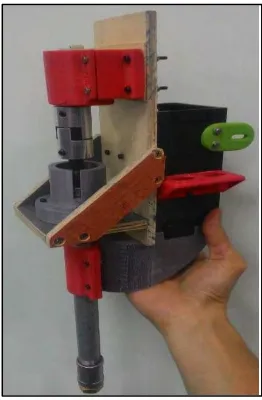
[image:18.612.247.378.357.557.2]In this project, existing low cost 3D printing machine which is called Mendel 3D printer is used as reference model. This machine is built by using open source technology. The filament is quietly expensive because the materials are mixture of petroleum-based and plant-based source and this are not biodegradable material. That is why technology on recycle device for filament is elevating. So there goes production of several 3D printer recycle machines by different companies. But, none of them are integrated recycle machine which can be attached to the 3D printer. Due to that, a project for integrated 3D printer recycle machine had been developed as shown in Figure 1.1.
Figure 1.1 : Integrated 3D printer recycle machine
1.3 Objective
The objectives of this project are as follows:
1. To optimize the parameter in 3D printer recycle machine by measuring a new recycle filament.
2. To analyze the parameter in 3D printer recycle machine by using Taguchi method application in Minitab software.
3. To make a comparison of mechanical properties with two different filament by using tensile test method.
1.4 Scope of Project
The scopes of this project are:
1. Minitab software will be used in analyze parameter in 3D printer recycle by using Taguchi method.
2. The new recycle machine will implement the similar working principle of the previous one.
CHAPTER 2
LITERATURE REVIEW
2.1 3D Printing
3D printing is a common method being used in rapid prototyping technology. It is basically used to manufacture plastic parts used for concept visualization or even final parts. (Bak, 2003) state that during future dramatic increase within the application of 3-d printing generation. In addition, manufacturers in various industries already implement the use of 3D printing due to its efficiency and faster rate of production. These mean that 3D printing is on rising demand for production line.
To ensure faster progress on the improvement of 3D printing technology, open source platform such as RepRap is the one with low cost of investment needed compared to others. RepRap are the most commonly used 3-D printers (Moilanen & Vadén, 2012). There are various model of open source for low cost 3D printer such as Prusa i3 and delta. To considerably abbreviate the ideal opportunity for creating patterns, molds, and models, some manufacturing ventures have begun to utilize fast prototyping strategies for complex patterns making and factor prototyping (Yan & Gu, 1996).
2.2 Recycle System Integration
As the demand on the low cost 3D printing seems to reach the extravagant level due to its ability to just not only work efficiently but also cheap and reliable, has cause the high request on the building materials. Devices which can recycle material and help slow the depletion of natural resources and make engineering and manufacturing a more ecological-friendly practice are very beneficial in the industry (Rensberger & Hinora, 2016). That is why a recycle system for plastic waste is required.
In addition to the system, extrusion principal is needed to extrude the filament produced by the recycle system. They made use of the similar principle to injection moulding that used screw, which in their cases was to force the material into the barrel with heating element and then plastic was melted before being compressed and driven through a die (Rensberger & Hinora, 2016). To be clear, those initial projects are not integrated with low cost 3D printing. They made the recycle machine that extrude new filament separately. Besides, the plastic shredder and filament extruder are disassociated from one another for the recycle system. This will cause more time being consumed due to the need to handle separate machines one after another. Thus, this method does not comply with the requirement for integrated recycle machine with low cost 3D printing.
To meet the objective of having an integrated recycle machine on a low cost 3D printing, (Ramli et al. 2015) came out with a concept system. The concept was about low cost 3D printers that are integrated with a plastic waste recycle machine which can produce filament with only one cycle of process. In addition, the cost of feedstock for 3D printing were reduced along with the energy used because of the proposed system did not use filament, but fed directly from the shredded plastic waste as the source of the recycle machine.
2.3 Parameter Optimization
need to optimize is their pressure, temperature and the material using. (Udroiu & Nedelcu, 2011) say that some extruding parameters must be optimized, such as pressure, temperature control and material consumption.
2.3.1 Taguchi Method
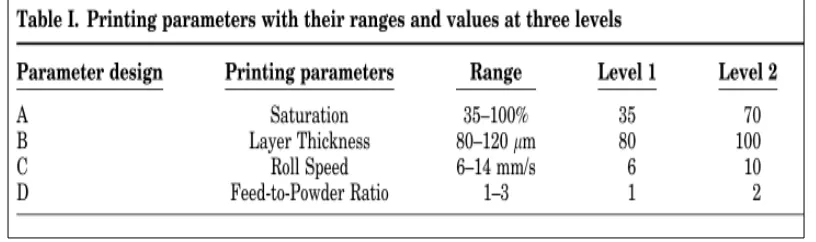
[image:22.612.110.518.458.579.2]Genichi Taguchi, Japanese engineer proposed the Taguchi method is an advancement approach that contains exploratory outline and factual examination to enhance the item quality by coordinating quality control at the planning stages (Shrestha & Manogharan, 2017). This strategy accomplishes by making the item or process execution coldhearted to varieties in components, for example, materials, manufacturing hardware, workmanship and working conditions. The fundamental objective is to present the impact or advantage of the procedure as a component of certain plan factors with a general target to amplify or limit the estimation of the capacity inside the manufacturing procedure. Figure 2.1 show example table of Taguchi method included the parameters.
Figure 2.1: Example of Taguchi method table (Shrestha & Manogharan, 2017)
2.4 Injection Moulding
used with injection moulding depending on the required product to produce and this manufacturing method is suitable and reliable. Various issues identifying with cost, exactness, and quality of 3-D items should be overcome before this innovation can accomplish across the board appropriation. (Sherman, 2009) stated that in terms of cost, materials suitable for 3-D printing can run 10 to 100 times more than typical injection molding thermoplastics.
2.4.1 Process Elements
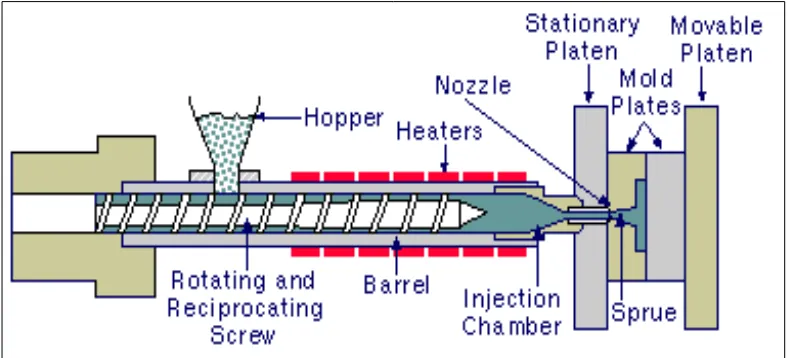
The fundamental process for injection moulding is part formation in the mould cavity from injected molten polymer that is compressed and forced into a die after being compressed inside the heated barrel (Berman, 2012).
There are four significant units involve in the injection moulding process which are hopper, injection unit, control unit and the clamp unit. Hopper is mainly to shred material into little pieces or bits before being melted in the injection unit. In the injection unit, there are heating and melting elements followed by pumping and material injection into the mould cavity. Then the control unit has the task to monitor and control the injection unit. Finally the clamp unit that has ejecting plate is used for clamping the mould and ejecting solidifies material inside it. Another source states that 3-D printing is competitive with plastic injection molding of runs around 1,000 items (‗‗Print Me,‘‘ 2011).
Figure 2.2: Single Stage Screw Machine (dc.engr.scu)
2.5 Filament
As we know 3D printing is additive manufacturing that build a product layer by layer by using plastic as their raw material that call filament. There are two types of filament that are commonly being used in 3D printing which are Polylatic Acid (PLA) and Acrylonitrile butadiene styrene (ABS). There are lots of materials that had been explored for 3D printing because of its characteristic which is thermoplastic. Two recent open-source equipment innovative improvements, 3-D printers and RecycleBots, offer another way to deal with polymer reusing enveloping the potential for disseminated handling to high-value included items. (Kreiger et al., 2014) stated that this can reverses the historical trend towards centralized recycling facilities. Commercial 3-D printers, which allow for accurate fabrication of merchandise or scale fashions, are a beneficial production and design tool.