0022-538X/93/084822-09$02.00/0
CopyrightX 1993, American Society for Microbiology
The Rule of Six,
a
Basic
Feature
for
Efficient Replication of
Sendai Virus Defective
Interfering
RNA
PHILIPPECALAIN AND LAURENT ROUX*
Departmentof Genetics and Microbiology, University of GenevaMedical School,
C.M.
U.,
9avenuedeChampel,
1211 Geneva4,
SwitzerlandReceived23 February 1993/Accepted 8 May 1993
The addition of the hepatitis delta virus genomic ribozyme to the3' end sequence of a Sendai virus defective interfering RNA(DI-H4) allowed the reproducible and efficient replication of this RNA by the viral functions expressedfrom cloned genes when theDIRNA wassynthesized from plasmid. Limited nucleotide additions or deletions(+7 to -7nucleotides) in the DI RNA sequence were then made at five different sites, and thedifferent RNA derivatives were tested for their abilities to replicate. Efficient replication was observed
only
when the total nucleotide numberwas conserved, regardless of the modifications, or when the addition of a total of 6 nucleotides was made. The replicated RNAs were shown to beproperly
enveloped into virus particles. It is concludedthat,toformapropertemplatefor efficient replication, the Sendai virus RNA must contain a total number of nucleotides which is a multiple of 6. This was interpreted as the need for the nucleocapsid protein to contactexactly
6nucleotides.Sendai virus (SV) is a member of the
Paramyxoviridae
family and the genus Parainfluenza. It is a nonsegmented negative-strandedRNAvirus,amurinecorrespondentof the human respiratory parainfluenza type 1 to4 viruses, anda close cousin of mumps virus and measles virus, and it is moredistantly related to human respiratory syncytialvirus. The viral RNA of this familyof viruses ismorethan 15,000 nucleotides long, complementaryto the mRNA sense, and noninfectious. The minimum infectious unit is in fact the viral RNAwrapped in a helical nucleocapsid structure by about2,600copiesof the NPproteinand associated with 300 copiesof the P/C and40 copies of the L proteins (14), the latter two ofwhich form the RNApolymerase complex (for a recent review, see reference10). Because the basic rules governing encapsidation and replication are unclear, and also because of the large size of the viral RNA, it has not beenpossibleupto now toproduceinfectious virusparticles by transfecting cells with a plasmid expressing the viral RNA.Therefore,genetic manipulation ofthe viral genome is notyet possible for this category ofviruses, consequently limitingthestudyof theviral functionsand thedevelopment of otherapplications (e.g., vaccines).
In recent years, however, successful encapsidation and replicationof shorter versions of the viral RNAsynthesized fromplasmids have been achievedby usingviral functions expressed from cloned viral genes or provided by regular infections with thehomologous virus(3,4, 16, 19, 20).Two approaches have previously been taken for designing the shorter viral RNAs. On one hand, the RNA sequence has been constructed byflanking the reporter chloramphenicol acetyltransferase (CAT) gene sequence with the 3' and 5' viral RNAend sequences (4, 16,19). Onthe other hand, the viral RNAwassimply a copy of a defective interfering (DI) RNAnaturally selected for its ability to efficiently replicate (3, 20). These two approaches obeyed different strategies. The formerapproach relied on the extreme sensitivity of the enzymatic assay performed by the reporter gene to detect replication. The latter approach relied on the ensured
pres-*Correspondingauthor.
enceof all of the required sequences (some of which may have been omitted from thesyntheticconstructs)needed for efficientreplication, therebyalsoensuringthatthereactions involvedwould be closer to those taking place in natural infections.
These systems,morethanshowing thatproper encapsida-tionandreplicationofanRNAexpressedfromplasmidwere feasible, opened thepossibility ofdissectingthe viral func-tions as well as the cis RNA sequences involved. In this study,afterwehadobserved thatlarge internaldeletionsin the DI-H4 RNA obliterated its replication bythe SV func-tionsprovidedfromplasmids,weconstructed RNA deriva-tives with limited nucleotidemodifications. From the repli-cation pattern of the derivatives emerged the need for the total length of the RNAto be a multiple of 6 nucleotides. This conclusion is in agreement with the total number of nucleotides in the SV nondefective and DI-H4 RNAs andis consistentwiththe conclusions ofprevious structural stud-ies of thenucleocapsid.
MATERIALSANDMETHODS
Virusesand cells.SVHarris strain nondefective andDI-H4 copy-backdefective viral stockswerepreparedand charac-terizedasdescribed before(23).Vaccinia recombinant virus expressing the T7 RNA polymerase, vTF7-3, a gift from Bernard Moss (National Institutes of Health, Bethesda, Md.), has been describedbyFuerst andcolleagues (9)and wasusedaccordingly.vTF7-3 stockswerepreparedin Vero cells with titersrangingfrom 5x10⁷to5 x108
PFU/ml.
CV1 and Vero cells were routinely grown in minimal Eagle mediumsupplementedwith5%fetal calfserumundera5% CO2 atmosphere.Sequences and plasmids. The total SV RNA sequence is derived from the work of Shioda andcolleagues (24,
25).
It contains atotal of 15,384nucleotides. The pGem plasmids expressingthe SVNP,P/C,and L genes under the control of theT7 RNApolymerase have been describedpreviously (5, 12). The cloningand the description of thepSP65 plasmid containingthe SVDI-H4 insert under the control of the T7 RNA polymerase promoter, pSV-DIH4/A, have been de-4822on November 9, 2019 by guest
http://jvi.asm.org/
scribed
by
Calain et al.(3).
In summary, this plasmid containsthe sequenceofthe DI-H4copy-backRNA(1,410 nucleotideslong;
seeResults)
under the control ofthe T7 RNApolymerasepromoter. Afterlinearization of the plas-midby
BsmI, the T7 RNA transcript represents an exact copy of theplus-strand
DI-H4 RNA(3).
Addition of thehepatitis
deltavirusgenomic ribozyme (21, 22)tothe end of the T7 RNAtranscript
was done in the following way.pSV-DIH4/A
wasdigested
withBsmI,
treated with Klenow to removethe3'protruding nucleotides,
andfinally digested
with BamHI
flanking
the BsmI site to generate a blunted-BamHIpSV-DIH4/A
(3).
Thehepatitis
delta virusgenomicribozyme
sequence was recovered bypolymerase
chain reaction(PCR) amplification
fromplasmid
HN 3-24(27),
agift
from MichaelLai(Los Angeles, Calif.),
withprimer Ribl(5'
GGCCGGCATGGTCCC3')
complementary to theri-bozyme
5' end andprimer
Rib3(5'
CGAGGATCCGTC CCATTCGCCATTAC3') complementary
to the 3'ri-bozyme
endsequence and flankedwithaBamHI site. The PCRproduct
wasdigested
with BamHI and cloned intopSV-DIH4/A
blunted-BamHI(see above).
Theresulting
plasmid
was calledpSV-DIH4/Rbz.
Large deletions in the insert ofpSV-DIH4/Rbz
weregenerated by
excisions of EcoRV(positions
958 and1244), HpaI-EcoRV (positions
461, 958,
and1244),
orSpeI-EcoRV (positions 125, 153,
958, and1244) fragment,
followedby
fill-inreactions,
whenadequate,
andreligations.
Theresulting plasmids
werecalled,
respectively, pSV-DIH4/RbzA1125, pSV-DIH4/RbzA628,
and
pSV-DIH4/RbzA296,
with the last numberreferring
to theresulting
size of the DI-H4 insert(see Fig. 2).
Limitedstepwise
modificationswerecreatedby opening pSV-DIH4/
Rbzat
unique
sites(see
Table2).
Aftertreatmentwith 1 U of T4 DNApolymerase
in standard buffer for 15 minat12°C
in the presence of 0.3 mMdeoxynucleotide triphosphate
(dNTP),
theplasmids
werereligated. Every
modificationwasverified
by sequencing.
Ribozyme
activity testing.
Totesttheself-cleaving activity
of the
hepatitis
delta virusribozyme,
theplasmids
were linearized at theBamHI site located 85 nucleotides down-streamfrom theribozyme cleavage
site(these
85nucleotides in fact represent theribozyme
sequence attached to the BamHIsite).
TheT7
RNAtranscripts
werethensynthesized
in the presence of
[a-32P]UTP
in vitro with theT7
RNApolymerase
(Biofinex,
Praroman,
Switzerland) according
to the manufacturer's instructions. The labelledtranscripts
were then ethanolprecipitated
andseparated
on a 6%polyacrylamide gel
to detect the 85-nucleotidefragment
resulting
from theself-cleavage activity. Negative
controls forcleavage
weremadeby cutting
thepSV-DIH4/Rbz
plas-mids with
BglI,
which cleaves in the middle(38
nucleotides from the 5'end)
of theribozyme
sequence.The driedgels
werequantitated
inaphosphorimager (Molecular Dynamics)
toestimate the percentageofcleavage.
Encapsidation-replication
assays. For acomplete
replica-tion assay,CV1
cells,
seededon9-cm-diameterpetri dishes,
wereinfected with vTF7-3 at a
multiplicity
of infectionof 2 to3. One hourpostinfection,
the cellsweretransfected withpGem4-NP
(5 jig),
pGem4-P/C (5
,ug),
pGem4-L
(1.5
rtg),
andpSV-DIH4/Rbz
or its derivatives(5 ,ug)
aspreviously
described(3, 5).
Cytoplasmic
extracts wereprepared
24 hpostinfection,
and CsClgradient-purified nucleocapsid
RNAs were
analyzed by
Northern(RNA) blotting (18).
Replication
wasmonitoredby using
a5'exriboprobe (18)
ofpositive polarity
(same polarity
as theT7-RNA transcript).
Encapsidation
wasinvestigated
in an assay from whichpGem4-P/C
andpGem4-L
were omitted. Theputative
nu-cleocapsids were then purified and the nucleocapsid RNAs wereanalyzed by Northern blotting with a 5' ex riboprobe of negative polarity (complementary to the T7 RNA transcripts [18]).
In vitro-synthesizedT7 and SP6 RNA transcripts. In vitro RNA transcripts used as size and polarity markers were synthesized by TI7 RNAorSP6 RNA polymerase (Biofinex), accordingto the supplier's instructions after proper linear-ization of pSV-DIH4 plasmids devoid of the ribozyme se-quence(see Results).
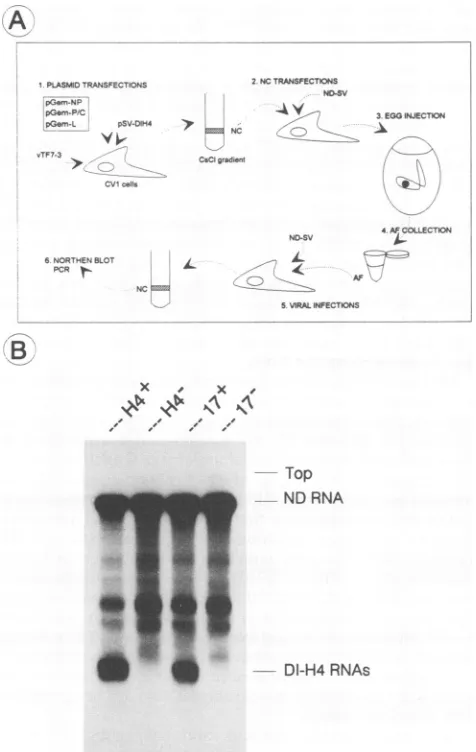
Preparation of SV DI viral stocks from theDInucleocapsids rescuedfromplasmids. The DI-H4 (or its derivative) nucleo-capsids obtained in a replication assay were purified by banding on CsClgradients, concentrated by centrifugation through glycerol onto a cushion of 68% sucrose in D20 (SW55; 40,000rpm,12°C,3h),andtransfected with 25 ,ul of TransfectACE (GIBCO BRL) into CV1 cells previously infected(2 h)withnondefective SV (multiplicity of infection = 20). After20 h ofinfection, performedinthepresenceof 100 Fg ofcytosinearabinoside per ml toblockcontaminating vacciniavirusmultiplication, the cells wererecovered by 5 mM EDTA treatment and injected into 9-day-old embryo-nated chicken eggs(about3x 106 cells peregg). After3days of incubation at 33°C, the allantoic fluids (AFs) were col-lected and clarified by centrifugation (45min, 12,000 xg). One milliliter of the AFs was mixed with 20 PFU of nondefective SV per cell and usedtoinfect CV1 cells. The presence of infectious DI nucleocapsids originating from pSV-DI-H4 plasmids amplified in the CV1 cellswas finally monitoredbyNorthern blot andreversePCRanalysisof the intracellular viral nucleocapsid RNAs (see Fig. 5 for a schematic representationof thecomplete protocol).
PCR
analysis.
The viral nucleocapsids produced in the CV1 cells infected with the AFs obtained from the embryo-nated eggs(see above)werepurifiedon aCsClgradient.The nucleocapsid RNAs (isolated from about 5 x 10⁶ cells) were then reverse transcribed with 20 pmol of the oligo-mer SV-LN6738 (15265-5'-TTCTGCACGATAGGGAC-3'-15248,with the numbersoneach endreferringtotheposition intheSVgenome) of negative polarity with Moloney murine leukemia virus reverse transcriptase (Bethesda ResearchLaboratories)
in 50-,ul reaction mixtures according to thesupplier's
instructions. The cDNAs were diluted 1:10 in H20, and 5 ,ul was amplified with 20 pmol of oligomers SV-LN6738 and SV-B1 (14894-5'-GTTGAAGACAATl-TC TAGAAGACT-3'-14917) as amplimersin a 100-,u reaction mixture containing 2.5 U ofAmpliTaq DNA polymerase(Cetus)-3
mM Mg2+-50 ,uM dNTP in a GeneAmp PCR System 9600 according tothe supplier's instructions (94°C for30 s, 57°Cfor 30 s, and 72°Cfor 30 s, 30 cycles). PCR amplifications ofreversetranscriptaseminus reactions wereperformed
to control for contaminating plasmidDNA (see Results andFig.6).RESULTS
Replication of DI-H4 RNA starting from plasmid pSV-DIH4/Rbz. We have previously shown that a T7 RNA transcriptmade fromplasmid pSV-DIH4/Awassuccessfully
encapsidated
andreplicated
bythe SV functionsNP,P,
and Lprovided intransby cotransfection withpGemplasmids
(3). In those experiments, the correct 3' extremity ofthe RNA transcript was generated by BsmI linearization of pSV-DIH4/Abefore transfection. This method of transfec-tion is generally viewed as a
low-efficiency
transfection method, and accordingly, this was reflected in the pooron November 9, 2019 by guest
http://jvi.asm.org/
A t
I u)
0:
coeowcnuco c_B
iC (D PpSV-DIH4 .296 .-.628 1125
Q.> ++ + + + +
1410
1125
628 296
[image:3.612.320.547.69.324.2]- Probe
FIG. 1. Replication of DI-H4 RNA from plasmid pSV-DIH4/ Rbz. About 10 million CV1 cells were infected with vTF7-3 and transfected with pSV-DIH4/Rbz (lanes 2 and 3) or pSV-DIH4/A
(lanes4and5) either with pGem-NP, -P/C, and -L (lanes 2 and 4)or
without these viral replicatingfunctions (lanes 3 and 5). Twenty-four hoursposttransfection, thenucleocapsidswerepurified and the viral
RNAwasanalyzed by Northern blottingasdescribed inMaterials
and Methods.The 5' exriboprobe used is of positivepolarity. In
lane 1, 1/200th ofasimilaramountofCV1 cells infected with the SV viralstockDI-H4, in thepresenceof vTF7-3, is similarly analyzed.
The molecular weight marker indicating the size of the natural
DI-H4 RNAis shown(lane 1).
reproducibility of the reactionaswellasintheefficiency of
replication, which was often at the limit ofNorthern blot detection (3). To avoid such a drawback, the self-cleaving ribozyme sequence of the hepatitis delta virus was cloned
into the pSV-DIH4/A to generate plasmid pSV-DIH4/Rbz. Replication assays using pSV-DIH4/Rbz to provide the DI-H4 RNAwere indeed found tobe more consistent and efficient. A typical exampleispresented in Fig. 1, inwhich the results ofassays usingpSV-DIH4/Rbz or pSV-DIH4/A areshownsidebyside.Underconditions in which transfec-tion with pSV-DIH4/Rbz allowed the detection ofa strong replication signal (lane 2), theuse of BsmI-linearized
pSV-DIH4/A (lane 4) showed no signal above the background
(lane 5)atthis level ofgelexposure. Although theefficiency
ofreplicationvariedbyfactors of 2to5 fromexperimentto experiment, inmorethan15 differentexperimentsnofailure
to replicate DI-H4 RNA from pSV-DIH4/Rbz was ever
observed. In these experiments, the criteria for assessing replicationareidenticaltothoseused earlier(3),i.e., (i) the RNAwaspurifiedin the form ofanucleocapsidbanding at the right density in a CsCl gradient and is resistant to ribonucleasedigestion (not shown), (ii)it is complementary totheT7 RNAtranscript (theriboprobe usedinthe
North-ernblot is ofthesamepolarityasthistranscript),and (iii) its
presence depended on the cotransfection of all three SV
replicating functions (Fig. 1, lane 3).
Large internaldeletions in DI-H4sequenceobliterate repli-cation.Confidentthat thereplicationassaywasvery
repro-ducible, we made large internal deletions in the DI-H4
sequence in an attempt to estimate the effect of total RNA sizeontheefficiencyofreplication. As shown in Fig. 2C, the internaldeletions left untouched the ends oftheRNAs;even
the inverted repeats of 110 nucleotides were conserved. Surprisingly, none of the deleted RNAs was replicated in
conditions inwhichintegral DI-H4 RNAwasreplicated (Fig.
NP/P/L
Probe
C
Spe HpaI
(125) (461)
EcoRV EcoRV
(958) (1244)
v - PSV-DIH4/Rbz
1125 296
FIG. 2. Unsuccessful replication of DI-H4 RNAs with large internal deletions. (A) In vitro T7 RNA transcripts made from plasmids pSV-DIH4/A, pSV-DIH4-A1125, pSV-DIH4-A628, and pSV-DIH4-A296. (B) Nucleocapsid-purified RNAs isolated from replication assays after transfections with DIH4/Rbz, pSV-DIH4/Rbz-A296, pSV-DIH4/Rbz-A628, andpSV-DIH4/Rbz-A1125, withorwithout the viral replicating functions. Transfections with pSV-DIH4/Rbz arepresented intriplicate. Inpanels A andB, the RNAs are analyzed in identical Northern blots and the 5' ex
riboprobesareofnegative and positive polarities,respectively. (C) Schematic description of the deletions. Shaded boxes represent invertedrepeatsof theDI RNAs.Thenumbers in thedesignations of the deleted plasmids refer to the final size of the DI RNA sequence.
2B). As shown in Fig. 2A, the deleted plasmids were as competentaspSV-DIH4forsynthesizingthe T7transcripts. Moreover, noreduction of theself-cleaving activityusedto generatetheexact3' end of thetranscriptcould beobserved (Table 1).
[image:3.612.103.251.72.236.2]Effects of limited internal deletions in DI-H4 RNA on replication. Explanations to accountfor the failure in repli-cationreportedabovecouldbe,amongothers,theremoval
TABLE 1. Self-cleaving activities oflargeDI-H4 RNAdeletionsa
ArbitraryU of Amtof
Derivative of radioactive Sizeof radioactivity %
pSV-DIH4/Rbz signalin: 8(hmer in85-mer Cleavaged
Topbands 85-mer (%)C
633,970 9,586 5.40 1.50 28
-1125 1,020,019 20,318 6.60 2.00 30
-628 560,712 18,759 11.30 3.30 29
-296 123,370 12,982 21.40 10.50 49
aFordetailsontheprocedure usedtoestimateself-cleavingactivity,see Materialsand Methods.
bRelativetothatofthe totaltranscript.
cRelativetothat in thetotal
transcript.
dDetermined by dividing amount ofradioactivity in 85-merbysize of 85-mer.
1 2 3 4 5
Top
H
N..
_:~~_
~
VDI-H4RNA
on November 9, 2019 by guest
http://jvi.asm.org/
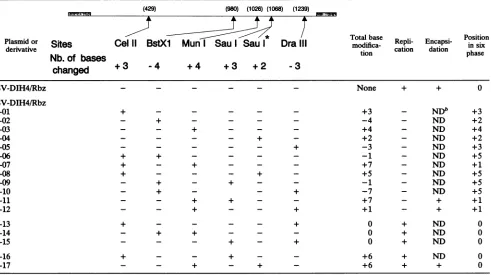
[image:3.612.313.555.585.670.2]TABLE 2. Replication ability ofDI-H4 RNA and itsderivativesa
(429) (980) (1026) (1068) (1239)
Plasmidor~~ ~ ~ ~ ~ ~ ~ ~ 7Totalbase
RpiEnas-Position
Plasmid
or
Sites
Cel
11
BstX
Mun
Sau
I Sau I
Dra
III
modifica
R
catlon
dation
in six
Nb. of
bases
tion phasechanged
+3
4
+4
+3
+2
3
pSV-DIH4/Rbz - - - None + + 0
pSV-DIH4/Rbz
-01 + - - - +3 - NDb +3
-02 - + - - - - -4 - ND +2
-03 - - + - - - +4 - ND +4
-04 - - - - + - +2 - ND +2
-05 - + -3 - ND +3
-06 + + - - - - -1 - ND +5
-07 + - + - - - +7 - ND +1
-08 + - - - + - +5 - ND +5
-09 - + - + - - -1 - ND +5
-10 - + - - + -7 - ND +5
-11 - - + + - - +7 - + +1
-12 - - + - - + +1 - + +1
-13 + - - - - + 0 + ND 0
-14 - + + - - - 0 + ND 0
-15 - - - + - + 0 + ND 0
-16 + - - + - - +6 + ND 0
-17 - - + - + - +6 + + 0
a Sau
I*,
variant ofSauI site modification thatyieldedonlya2-base addition. bND,not done.ofcis-acting essential sequences, the generation of DI-H4 RNAs too short to support replication, or some structural requirements of the nucleocapsidspreventinganychange in
the number of nucleotides. These possibilities were made
likely by the large size deletionsperformed. Carewas then
taken to disrupt as little as possible the RNA sequence in ordertolearn the rulesgoverning replication. Consequently, 2-to7-nucleotide deletionsorinsertionsonlywereproduced
by cutting and filling in at different unique sites along the
sequence. A total of 17 derivatives ofpSV-DIH4/Rbzwere
produced in this way (Table 2, pSV-DIH4/Rbz-01 through
-17) and checked in replicationassays.Figure 3presentsthe Northern blot analysis of the five derivatives (samples 14, 15, 13, 16, and 17) whichwere successfully and efficiently
amplified, and of a selected sample of four derivatives
(samples 02, 03, 05, and 01) which were, relative to the previous samples, negative for replication, although afaint signal could sometimes be detected (see in this particular experiment samples 03 and 01). Table 2 summarizes all of the results obtained. Thefollowing observationsarerelevant.(i)
The addition ofatotal of1, 2, 3, 4, 5,or7nucleotides ledto negative results, asdid the removal ofatotalof1, 3, 4,or7
nucleotides, regardless of the site of modification (Table 2, pSV-DIH4/RbzandpSV-DIH4/Rbz-01 through -12). (ii)The addition of 3 or 4 nucleotides, with the compensatory removal of 3or4nucleotidesatdifferentsites, reestablished thehigh replication ability(pSV-DIH4/Rbz-13 through -15). (iii) The addition of a total of 6 nucleotides by stepwise additions of 3 plus 3 or 4 plus 2 nucleotides at different locations ledtoefficientreplication (pSV-DIH4/Rbz-16 and -17). (iv) The resulting number of nucleotide changes andnot the position of the changes appeared tobe important. For instance, a3-base additionatthe CelII site abolished
repli-cation
(sample
pSV-DIH4/Rbz-01).
The samemodification,
when corrected by a 3-base removal at the DraIII site
(sample
pSV-DIH4/Rbz-13)
or by a 3-base addition at the SauI site(sample
pSV-DIH4/Rbz-16),
was nolonger nega-tive.As inthe caseoflargeinternaldeletions,
thenegative
resultsseenherecouldnotbeexplained byalack ofT7RNA
transcript synthesis
norbyalack ofribozyme activity(not
shown).
Encapsidation ofnonreplicated DI-H4 RNAs. For replica-tiontotakeplace,apropertemplaterecognized bythe viral
polymerase
hastofirstbe formed. This step involves encap-sidation by the NPprotein
of the T7 RNAtranscripts.
Encapsidationmust,of course, have taken
place
for the DIRNAstohave
successfully
replicated.
Whetherthiswasthecase for the derivativesthat did not
replicate
wasopen toquestion.
Tworeplicating
and twononreplicating
DI-H4 RNAs were thereforecompared
for their abilities to be encapsidatedwhensynthesized
in the presence of NP alone (Fig. 4). Figure4Aillustrates thereplication abilities of the RNAsused. In the presence of the three SV functions but not in the presence of NPalone,
DI-H4 RNA and the derivative pSV-DIH4/Rbz-17efficiently replicated,
while derivativespSV-DIH4/Rbz-12
and -11 did not. However, examination of theT7
RNAtranscripts
(with
aprobe
of negative polarity [Fig.4B])
showed that in the presence of NPalone(orinconjunctionwithP/CandL)
thesetranscripts
were all found innucleocapsid structures
(banding
inCsCl gradients).Notethatthe RNAs recovered from thenucleo-capsids
in the absence ofreplication
wereslightly
smaller than thoseseenin the presence ofreplication (for
themost obviousexample,comparelanes 3 and 12 with lanes 5 and14 in Fig.4B).
This is likely to reflect the presence on the agarosegel
ofonly
theplus-sense
transcript
in the absence ofon November 9, 2019 by guest
http://jvi.asm.org/
I pSV-DIH4/Rbz bz& CZ) .. 0" V%
T7 c 1 2 3 , /, , 1 I I
A
a) 0
CL
a)
_
FIG. 3. Replication ofDI-H4 RNAs withlimited internal
modi-fications. Northern blot analysis of nucleocapsid-purified RNAs
from cellstransfected with the plasmids expressingthe DI-H4 RNA
and their derivatives (foradescription,seeTable 2). For all of the
rescueexperiments (lanes 1 and 14 through 17), pGem-NP, -P/C, and-Lwerecotransfectedwith theplasmid expressingthe DI-H4
RNA,exceptfortwosamples usingpSV-DIH4/Rbz from which the three functionswereomitted (lane 2)orinwhich only pGem-NPwas
used(lane 3). In vitro T7 RNA transcript synthesized from pSV-DIH4/A linearized with BamHI (lane T7) and nucleocapsid RNA
isolated from cells infected with SVDI-H4 (lane DI-H4) arealso shown.A5'exriboprobe of positive polarityhas been used.
replication, in contrast to the presence of the plus- and minus-sense RNAswhenreplication takes place. Alsonote in Fig. 4B the higher-molecular-weight molecules reacting with theminus-strand probe. Most ofthese moleculeswere
found to be resistant to ribonuclease digestion (data not shown). They are likely to represent mostly encapsidated large T7 RNA transcripts, since they were purified as
nucleocapsids. They obviously did not replicate, as
evi-dencedbythe absenceof theirnegative-strandcounterparts in Fig. 4A, in which residual plasmid contamination is probablyresponsiblefor the faintsignalsobserved above the DI RNA bands (Fig. 1,lanes 1 to5).
DI-H4 RNAreplicatedfromplasmidis infectious. Toverify that the nucleocapsids containingDI-H4 RNAs originating fromplasmids represented fullycompetentviral nucleocap-sids,amethodtoproducecompetentviral stockscontaining thesenucleocapsidswas developed (presentedin Fig. 5A).
The multiple steps involved were required to provide the nucleocapsids with a viral envelope (adding nondefective virus instep2)andtoproduce infectious virus (passage into embryonated eggs in step 3). In step5, nondefective virus
was addedtoensure anefficientamplicationof theputative
infectious DI virus produced in eggs. According to this scheme, DI-H4 RNAs should only be amplified in step 5 when efficiently replicated in step 1. A control in this experiment was, therefore, to omit the three replicating functions in step 1. Figure 5B shows that indeed DI-H4 RNAswere amplified in step5 (samples H4+ and 17+). In contrast, theywere not detected when replication was not made possible in step 1 (samples H4- and 17-). This demonstrated that the AFs contained infectious viral parti-cles with DI-H4 RNAs originating fromplasmids. Inthese experiments, two types of DI-H4RNAs were used: (i) the original DI-H4 RNA, synthesized from pSV-DIH4/Rbz, whosesequence aligns with that of the nondefective RNA,
except for the inverted repeats, and (ii) that produced by
pSV-DIH4/Rbz - 12 -11 -17 + - + + - + + - + + - + NP
+ - - + - - + - - + - - P/c
T7SP6 + - - + - - + - - + - - L
do
B
1 2 3 4 5 6 7 8 9 10 11 12 13 14
FIG. 4. Encapsidation of DI-H4 RNAs and their derivatives. pSV-DIH4/Rbz and its derivativespSV-DIH4/Rbz-12,-11, and-17 (see Table2foradescription)weretransfectedintoCV1cells,with orwithout theplasmids expressing the SV replicating functions(NP, P/C, andL)asindicated,inreplicationorencapsidationassays(see Materials andMethods). Viral nucleocapsidswereisolatedand the presence of the DI-H4 RNAs was monitored by Northern blot analysis. Lanes: T7 andSP6,invitroRNAtranscriptssynthesized from pSV-DIH4/A with T7 and SP6 RNA polymerases, respec-tively. 5' exriboprobes of negativeorpositive polarityhavebeen usedasindicated.
pSV-DIH4/Rbz-17,inwhich4and 2 nucleotideswereadded, atthe MunI and SauIsites, respectively,therebydestroying these sites (Table 2). To confirm that the DI RNAs that replicated in step 5 originated from
plasmids,
aregion
covering the two MunI and SauI sites was
amplified by
reverse PCR (see Fig. 6A). The PCR products were then assayedforsensitivitytoMunIand SauIdigestions.
Figure
6Bshowsthe successfulamplificationof the
expected
DNA fragment from the foursamples presented in Fig. SB. Not surprisingwas the recovery of the PCRproduct from sam-ples H4- and 17-, in which DI-H4 did notreplicate, since nondefective RNA could also serve as template for the reaction. Note,however, that these PCRproductscouldnot be found inthe absence of thereversetranscriptionreaction (RTase - lanes in Fig. 6B), excluding the fact that theplasmidsused in theoriginaltransfections(step1inFig.5A) could have been carried along. Digestions with MunI and Saul are presented in Fig. 6C. In the controlsamples, the 371-nucleotide PCR products originated from pSV-DIH4/ Rbz-17showed total resistance(sample
p17),
incontrast to sample pH4,whichwasmade fromplasmidpSV-DIH4/Rbz. Of the foursamplesproducedfrom the RNAs presentedin Fig. 5 (samples H4+, H4-, 17+, and 17-), only the one containingDI-RNA-17(17+)led to aPCRproductresistant toboth restriction enzymes. All of thesamplescontained,on the other hand, a371-base fragment sensitive to digestion, since they all contained nondefective viral RNA which served equally as a template for the reverse PCRs. This experiment unequivocallydemonstrated thatthe RNAsorig-co
0
...0
a
on November 9, 2019 by guest
http://jvi.asm.org/
[image:5.612.74.295.73.226.2] [image:5.612.322.555.74.307.2]RULE OF SIX AND SV DI RNA 4827
A
A
IPLASMIDTRANSFECTIONS pG.em-NP pGem-P-C
pGem-L pSV-D!H4
Y,TF73
CV-ceAs
2 NC TRANSFECTPONS ND.SV
...-~
- 3EGG INJECTION OF-7NCN ACsCIgrad,e4t
Mun fSu
14084 14894 15000 15042
-- T.. --T. 15384 NONDEFECTIVEGENOME
* 371__ PCRPRODUCT
-- -___-_.. =- 1410 DEFECTIVEGENOME PCRPRODUCT
PCRpod0ct 371n.
MunI SsuIdigestions 223 .106042 4.AFCOLLECTiON
ND-SV A
..-A c----c---
--IL 4....
X4v
-8
A-... I AI
SVkIRALINFECTONS
6NORT-ENBLOT
PCR V-t
H4- 17 17
I RTase
X .
-- Top ---ND RNA
403 281 257 226
C
DI-H4RNAs
FIG. 5. DI-H4 RNAsproducedfromplasmidsareenveloped into
competent virus particles. (A) Scheme of the steps leading to
infectious virus from plasmid transfection (for more details, see
Materials andMethods).In step2,thenucleocapsids (NC)isolated fromstep 1weretransfected and infected with nondefective (ND)
SV. Instep3, the whole cellswereinjected into theembryonated
eggs. In step 5, AF collected from the eggs was mixed with
nondefective SV. Instep6,thePCRanalysis presentedinFig.6is shown. (B) Northern blot analysis of the nucleocapsid RNAs amplifiedin step5. H4or 17samplesin theirrespectivelanesare
nucleocapsid RNAs isolated from assays with, in the original transfection (step1), respectively, pSV-DIH4/Rbz andpSV-DIH4/ Rbz-17,withorwithout the threereplicatingfunctions(samples H4+ and17+and H4- and17-).The wholeprocedurewascarriedoutin parallelforeach of the foursamples.NDRNA,nondefective RNA.
inatingfromplasmidswerenotonly efficiently replicatedbut behaved like bona fidesubgenomicviral RNAs inthatthey
were replicated bythe helpervirus and envelopedin
com-petentvirusparticles.
Total length ofthe DI-H4 insert in pSV-DIH4/Rbz. When DI-H4RNAwascloned intopSV-DIH4/A,anestimate of its
length basedon partial sequencing of crucial regions of the insert andonalignmentwithpublishedsequences(24, 25)led
to atotal of1,411nucleotides (3). Since then, the complete
sequence of the insert has been done (data not shown). A single-base deletion was found atposition 111 downstream
Ft I~ 11:"
1q
-L -L -LI L
Mun Sau
403 281 257 226
FIG. 6. Reverse PCR analysis ofthe DI-H4 RNAs originating fromplasmidsandproperly enveloped incompetentvirus particles. (A) Schemeof thereversePCR method(fordetails aboutprimers
and reactions, see Materials and Methods). The reverse PCR
amplifies aproductof371 nucleotides fromboth the nondefective and the DI SV RNAs. When amplified from pSV-DIH4/Rbz-17, however,thisproductis resistanttodigestionwith MunI and Saul. (B)A1%agarosegel analysisof thereversePCRproducts obtained
withnucleocapsid RNAs purified fromcells instep5 astemplates
(Fig. 5A)after theoriginaltransfection(step1inFig. 5A)with either pSV-DIH4/Rbz (samples H4) or pSV-DIH4/Rbz-17 (samples 17)
withorwithout the threereplicatingfunctions(samples H4+and17+
and H4- and17-). LanespH4 andp17 contain PCRproducts of reactions with pSV-DIH4/Rbz and pSV-DIH4/Rbz-17 plasmids. RowRTase indicates whether reversePCRsincluded the reverse
transcriptase.Molecular markers(inbases)areonthe left.(C)A1%
agarose gel analysis of the sensitivity of the PCR products to
digestionwithMunIorSauI.Fordetails,seethelegendtopanel B.
from thegenomic3' end(for details,seereference3). There-fore, the total number of nucleotides in the insert is1,410.
DISCUSSION
In the experiments presented here, the replicationof DI RNAs fromplasmidswas detected byNorthern blotting, a
B
B
COII +H4+-VOL. 67, 1993
on November 9, 2019 by guest
http://jvi.asm.org/
[image:6.612.328.564.72.466.2] [image:6.612.68.306.73.449.2]relatively insensitive method. This argues for a high effi-ciencyofreplication,at best 1 order and at worst 2 orders of magnitude lower than that seen in natural virus infections. This estimate does not take into account the fraction of the cells transfected. The replication mechanisms were, there-fore, likely to be similar to those seen in natural infections. The absence of replication in our experiments, however, should not beinterpreted as absolute. Clearly, low-efficiency replicationleading to amounts of RNA lower by 2 or 3 orders ofmagnitudewould have been scored negative in our assays
(see
Results and text below). The beneficial effect of the addition of the self-cleaving activity which generates the correct T7 RNA 3' end has been recognized before (20) and islikelytoresult from a higher transfection efficiency as well as from agreater stability of the transfected plasmids. The consistency of this self-cleaving activity (measured in vitro for all of theconstructions used here) excludes its implica-tion in the cases in which failure to replicate was observed. Startingfrom apSV-DIH4/Rbzplasmid that led to efficient DI-H4 RNAreplication,largeinternal deletions in the DI-H4 RNAcodingsequence abolished replication. This was unex-pected, since the end sequences, generally accepted to be criticalforreplication for SV as well as for other members of the negative-stranded RNAvirus family (4, 6, 15, 17), wereperfectly
conserved. Because of the large size deletions, it was, however, difficult to easily explain these failures. The removal of essential cis sequences, the generation of too-shortRNAs, and the modification of a critical RNA length required to provide specific NP-RNA interactions were considered. Among these possibilities, the last was judged most easily open to experimentation and was therefore tested. Limited nucleotide additions or deletions leading to unsuccessful orsuccessful replication were indeed indicative of the mechanisms involved. Disruption of the correct se-quence at various positions was found to be irrelevant to efficient replication as long as the total number of nucle-otides remained unchanged (Table 2, pSV-DIH4/Rbz-13 to-15).
Moreover, in two cases, two-step additions of a total of 6nucleotides in two different sites led to successful replica-tion,while the modificationofeach of these individual four sites led to failures (Table 2, pSV-DIH4/Rbz-16 and -17). Therefore, if the total number of nucleotides appeared critical, the addition of 6 nucleotides was allowed. The simplest interpretation of these results is that the total number ofnucleotides must be a multiple of six. This rule(rule
of six) is verified in our experiments (Table 2, last column) and is also in agreement with the total number of nucleotides of the nondefective genome and of the DI-H4 genome produced from pSV-DIH4/Rbz, which amount to 15,384 (24, 25) and 1,410, respectively. This rule provides alikely
explanation for the failure to replicate the large inter-naldeletionsaswell, since the DI-H4 RNAs were shortened by 285, 782, and 1,114nucleotides; none of these numbers is amultiple ofsix. Other causes for failure are possible.In the failures toreplicate, encapsidation of the T7 tran-scripts (starting at the 5' end) did not appear to be the limitingstep, since thetranscriptswere found in nucleocap-sid structuresbanding on CsCl gradients (Fig. 4). Assuming, therefore, that correct encapsidation of the T7 transcripts takesplace anyway, the critical step for allowing replication maybecome the correctencapsidation of the 3' extremity. This extremity is crucial in that it represents the promoter for the synthesis of the strand complementary to the T7 RNA transcript. The 5' end contains the signal for proper
positioning
of the first NP subunit and for encapsidation initiationthis signal is likely to be not only geographic (the 5'extremity) but also aspecific nucleotide sequence(shownfor vesicular stomatitis virus [VSV] to lie among the first 14 nucleotides [1, 2]). Subsequent NPswould then be sequen-tially positioned by contacting the previous NP and estab-lishing specific contacts with a series of nucleotides. The data presented here support evidence that the number of nucleotides that NP contactsis six. Therefore, from 6 to the next 6 nucleotides, the NP subunits would be sequentially added until they reach the 3' RNAextremity. There, ifthe RNA contains a number of nucleotideswhichis a multiple of six, the last 6 nucleotides will be correctly covered by the last NP. In contrast, extra nucleotides would leadeither to dangling nucleotides or to an NP subunit making contact with fewer than 6 nucleotides. Our data suggest thatneither structure can serve as a properreplication promoter. Inthis model, the NP proteins have to be tightly packed on the RNA(full resistance to nuclease has beenpreviouslyshown, regardless of the extension of the helical pitch [11]) and not free to move along the RNA.
That each NP molecule specifically contacts 6 nucleotides is in agreement with the total number of NP proteins per nondefective nucleocapsid estimated by analysis of electron microscopic pictures (7, 8). Egelman and colleagues in particular come upwith a stoichiometry of 6 nucleotides to 1 NP subunit on the basis of their observations (13 NP subunits per helical turn, 210helical
turns
pernucleocapsid) and on therationalization that nonbroken helical symmetry suggests an integer stoichiometry between bases and NP subunits. With the total number of NP subunits that they calculate (13 x 210 = 2,730), the deduced stoichiometrybecomes 5.6:1 (15,384/2,730), a noninteger stoichiometry. Egelman and colleagues favor a 6:1 stoichiometry, sincethis would not break the helical symmetry and would fit with the estimation of the total number of NP subunits better than a 5:1 stoichiometry, requiring more than 3,000 NP subunits. It is certainly comforting that structural data arein agreement with functional assays.
In a recent paper, Pattnaik and colleagues (20) have reported, using a system similar to the one used here, efficient encapsidation and replication of a VSV DI RNA expressed from plasmid. They made the interesting obser-vation that 4 to 5 extra nucleotides at the 5'-endT7 transcript were tolerated, in that they did not kill replication. They were, however, trimmed in the DI RNA that was success-fully amplified. On the other hand, as few as 2 extra nucleotides at the 3' end of the T7 transcript abolished replication. In view of the results presented here, and assuming that a basic rule such as the rule of six applies to VSV, these results can be interpreted as follows. Correct positioning of the first NP only takes place internally at the true viral RNA 5' end by recognition of a specific nucleotide sequence (leaving dangling extra nucleotides). Encapsida-tion would then proceed to the 3' end, regardless of the nucleotide sequence, but with the correct integer
NP/nucle-otide stoichiometry observed. At the 3' end, only the precise number of nucleotides would be tolerated to generate the replication promoter for the complementary strand (no extra nucleotides allowed). That the synthesis of the complemen-tary strand leads to a successful template for the next round of replication, despite the dangling 5' extra nucleotides, could be explained if the unprotected 5' nucleotides are cleaved. Alternatively, they could not be copied by the viral replicase, because they are not covered by NP. That correc-tion at the 3' end does not take place (no trimming) may suggest that extra nucleotides are not dangling but rather are covered with an extra NP protein, enough to be protected,on November 9, 2019 by guest
http://jvi.asm.org/
but not properly so that a correct replication promoter is formed.
The rule of six doesnotprecludethe need foraparticular nucleotide sequenceatthe RNA ends.Assuggested before andmentionedabove, these 11to 14 nucleotides conserved between theplusandminusstrandsarelikelytoconstitute, when in the properphase with the NP proteins, a specific signal required for forming anadequate template for repli-cation. Moreover, the rule of six does not exclude other possible requirements, suchastotal minimalRNAlengthor particularcis RNA sequences. NotethatanRNAconstruct containingthe CAT gene sequenceflankedbythe SV 3'- and 5'-end sequences has beensuccessfully replicatedwith non-defectiveSVtoprovidethe helper functions(19). The total number of nucleotides in this RNA amounts to 924, a multipleofsix.However, thereplicationof this RNAlacking all but the 145 nucleotidesatthe 3'-end and 119 nucleotides at the 5'-end SV sequenceswasonlydetected by measure-mentof theCATactivity (a highly sensitiveassaycompared with Northern blotting). This could suggest the need for internalsequences, absent fromthissyntheticconstruct,to reachhigher replication
efficiency.
Alternatively, this could reflect the difference in plus- and minus-strand replication promoters. Incopy-backDI RNAs, the promoterresponsi-ble for minus-strand
synthesis (generally
accepted tobe of high efficiency) ispresentonbothRNAstrands(containedin the invertedrepeat).
This is obviouslynotthe casefor the RNAsyntheticconstruct(analogous
to an internal deletion DIRNA),which has retained the ends of thegenomicRNA. Note that when a synthetic RNA construct of the type reported byParketal. (19)wasconfronted with the rule of six, thecorrectnumber ofnucleotides hada positiveeffect (three- to fivefold) on the efficiency of replication. This, however, was still marginal (i.e., only detected after PCR amplification) comparedwith the level ofreplicationreached with the naturalcopy-backDIRNA(lla).It is
therefore possible
that the rule of six shows asignificant
effect onreplication only
when all of the other rules needed for replication are observed. The rule of six would thus become necessary for efficient replication inconjunction
with other rules needed for replication. This interpretationcouldaccountfor theout-of-phasederivatives exhibiting sporadic replication abilitiesatthe limitof detec-tion (Fig. 3, samples 03 and 01) or fora marginal effecton syntheticconstructsobeyingthe rule of six(cf.constructsin reference lla).Successful
replication by negative-stranded
RNAvirusor virus functions of RNAsproduced from plasmidshas been reported for other viruses aswell. Apartfrom the VSV DI RNA and the SV CAT construct already discussed above, RNAmoleculescontaining
the reporter gene CAT sequence flankedby3' and 5' viral RNA end sequences of influenzaA orrespiratory syncytial
viruseshave beenreplicated bytheir respective homologousviruses(4, 16).Theseartificial defec-tive RNAs were correctly enveloped in virus particles. Amongthese differentRNAs,onlythe VSV DI RNA repli-cated with an efficiency comparable to that observed here (direct detection of the DI RNA), therefore potentiallyfulfilling
theconditions for the rule of sixtoapply.However, althoughthe natural VSV DI RNA is2,208(a multipleofsix) nucleotides long, the DI RNAwhich was reported to effi-ciently replicate from plasmid is 1 nucleotide longer (20). Moreover, Wertzand colleagues recently reportedthe suc-cessfulreplication
ofaseries ofdeletions of theiroriginalDI RNA forwhich astrict correlation with the rule of sixwas notobserved(26). AmongtheCAT constructs, for which therule of six may notapply with full potential according to our interpretation (see above), the influenza constructs of Luytjes et al. (16) fittedthe rule. This, however, has to be balanced by the fact that for influenza virus, none of the natural full-length genes are made up of nucleotides in multiplesofsix(see reference 13forareview).
In conclusion, the available sequence data do not, at present,speakforawideapplicationof the ruleof six. It is not clear whether a more extended sequence comparison willbringmore information, since formostofthereported sequences,thedegreeof confidence doesnotlie withinplus or minus 1 or 2 nucleotides. Rather than elucubrate the general prevalence of the rule of six, one would like to proposethatalthoughthenumber of nucleotides per nucleo-capsid protein unitmaydependonthetypeofvirus(onthe size of the nucleocapsidprotein), the rule that the stoichi-ometryofnucleotide per NPproteinmustbeanintegerhas tobeconsidered for all of the viruses containing a nucleo-capsidwithtighthelical symmetry.
ACKNOWLEDGMENTS
We are indebted to Tatsuo Shioda,who made us aware of the possibilityof the rule of six. We also thank Genevieve Mottetfor excellent technical assistance andJoseph Curran and Daniel Kola-kofsky for fruitful interactions of allsorts.
This work was supported by a grant from the Swiss National Foundation for Scientific Researchand grantsfromSandoz, Ciba-Giegy, and the Soci6teAcad6mique deGeneve to L.R. P.C. is a
recipient of fellowships from the Schweizerische Akademie der Medizinischen Wissenschaften, the Holderbank-Stiftung, the Jan-gen-Pohn-Stiftung,andthe Rocheand the deReuterFoundations.
REFERENCES
1. Blumberg,B.M.,C.Giorgi,andD.Kolakofsky.1983.Nprotein of vesicular stomatitis virus selectively encapsidates leader RNAin vitro. Cell32:559-567.
2. Blumberg,B.M.,and D.Kolakofsky.1981. Intracellular vesic-ularstomatitis virus leader RNAs are found in nucleocapsid
structures.J.Virol.40:568-576.
3. Calain, P., J. Curran, D. Kolakofsky, and L. Roux. 1992. Molecular cloning of natural paramyxovirus copy-back defec-tiveinterferingRNAs and theirexpression fromDNA.Virology 191:62-71.
4. Collins, P. L., M.A. Mink,and D. S. Stec. 1991. Rescue of synthetic analogs of respiratory syncytial genomic RNA and effect of truncations and mutations on the expression of a
foreign reporter gene. Proc. Natl. Acad. Sci. USA 88:9663-9667.
5. Curran, J.,R.Boeck,and D.Kolakofsky.1991.The Sendai virus Pgene expressesbothanessentialprotein andaninhibitorof RNAsynthesis byshufflingmodulesvia mRNAediting.EMBO J. 10:3079-3085.
6. Curran, J. A., and D. Kolakofsky. 1991. Rescue ofa Sendai virusDIgenomeby otherparainfluenzaviruses:implications for genomereplication. Virology182:168-176.
7. Egelman, E. H., S.-S. Wu, M. Amrein, A. Portner, and G. Murti. 1989. The Sendai virus nucleocapsidexists in at least fourdifferent helicalstates. J.Virol. 63:2233-2243.
8. Finch, J. T., and A. J. Gibbs. 1970. Observations on the
structure of the nucleocapsids of some paramyxoviruses. J. Gen.Virol. 6:141-150.
9. Fuerst,T. R., E. G.Niles,F. W. Studier, and B. Moss. 1986. Eukaryotic transient-expression systembased onrecombinant vaccinia virus that synthesizes bacteriophage T7 RNA
poly-merase.Proc.Natl. Acad. Sci. USA83:8122-8126.
10. Galinsky, M. S., and S. L. Wechsler. 1991. The molecular biologyof theparamyxovirusgenus, p. 41-82. In D. W. Kings-bury(ed.),Theparamyxoviruses. PlenumPress,NewYork. 11. Heggeness, M. H.,A. Scheid, and P. W. Choppin. 1981. The
relationship of conformational changes in the Sendai virus
on November 9, 2019 by guest
http://jvi.asm.org/
nucleocapsid to proteolytic cleavage of the NP polypeptide. Virology114:555-562.
11a.Jacques,J.-P., and D. Kolakofsky.Personal communication. 12. Kast, W. M., L. Roux, J. Curran, H. J. J. Blom, A. C.
Voordouw, R. H. Meloen, D. Kolakofsky, and C. J. M. Melief. 1991.Protection againstlethal Sendai virusinfection by in vivo priming ofvirus-specific cytotoxicTlymphocytes with a free synthetic peptide.Proc.Natl. Acad.Sci.USA88:2283-2287. 13. Lamb, R. A., and P. W.Choppin.1983. Thegenestructureand
replicationofinfluenzavirus. Annu. Rev.Biochem.52:467-506. 14. Lamb, R. A., B. W. J. Mahy, and P. W.Choppin. 1976. The synthesis of Sendai virus polypeptides in infected cells. Virol-ogy69:116-131.
15. Li, X. Q., and P. Palese. 1992. Mutational analysis of the promoterrequired forinfluenza virus virionRNAsynthesis. J. Virol. 66:4331-4338.
16. Luytjes, W., M.Krystal,M.Enami, J. D.Parvin,and P.Palese. 1989.Amplification, expression, and packagingof aforeigngene byinfluenza virus. Cell 59:1107-1113.
17. Mink, M. A., D. S. Stec, and P. L. Collins. 1991. Nucleotide sequences of the 3' leader and 5' trailer regions of human respiratory syncytial virus genomic RNA. Virology 185:615-624.
18. Mottet, G., and L. Roux. 1989. Budding efficiency of Sendai virus nucleocapsids: influence of sizeand ends ofthe RNA. Virus Res. 14:175-188.
19. Park, K. H., T. Huang, F. F. Correia, and M.Krystal. 1991. Rescue of aforeigngenebySendaivirus.Proc. Natl. Acad. Sci. USA 88:5537-5541.
20. Pattnaik,A.K.,L.A.Ball,A.W.LeGrone,and G.W. Wertz. 1992. Infectious defective interfering particles of VSV from transcriptsofacDNA clone. Cell69:1011-1020.
21. Perrotta,A.T.,andM. D. Been. 1990.Theself-cleavingdomain from the genomic RNA of hepatitis delta virus: sequence requirementsand theeffects ofdenaturants. Nucleic Acids Res. 18:6821-6827.
22. Perrotta, A. T., and M. D. Been. 1991. A pseudoknot-like
structure required for efficient self-cleavage ofhepatitis delta virus RNA. Nature(London)350:434-436.
23. Roux, L.,andJ. J.Holland. 1979. Role of defectiveinterfering particles of Sendai virus in persistent infections. Virology 93:91-103.
24. Shioda,T.,Y.Hidaka,T.Kanda,H.Shibuta,A.Nomoto,and K. Iwasaki. 1983.Sequenceof3,687nucleotides from the 3' end of Sendai virus genome RNA and thepredicted amino acid
se-quences ofviral NP, P and C proteins. Nucleic Acids Res. 11:7317-7330.
25. Shioda, T.,K.Iwasaki, and H. Shibuta. 1986. Determination of thecompletenucleotidesequenceofthe Sendai virusgenome RNA and thepredictedamino acidsequences of theF, HN,and Lproteins. Nucleic Acids Res. 14:1545-1563.
26. Wertz,G. W. et al. 1993.Presented at theReverseGeneticsof Negative-Stranded RNA Viruses Meeting, Madrid, February 1993.
27. Wu, H.-N., Y.-J.LAn,F.-P.Un,S.Makino,M.-F.Chang,and M. M. C. Lai. 1989.Humanhepatitisdeltavirus RNA subfrag-mentscontain anautocleavable activity.Proc.Natl. Acad.Sci. USA86:1831-1835.