Abstract: There is a huge problem in creating space today because of growing population and research is going on profusely in finding space to dump waste. The waste has been dumped to rivers, underground and mixed with soil and by other methods. But all these methods are harmful to environment in long term. Our research is done on finding efficient way to segregate waste followed by recycling of wastes. The difficulties in isolation of various products are dealt using machine learning approach. The framework used to robotize the procedure of waste isolation to deal with the junk effectively and productively is one of the Machine Learning strategies called Convolutional Neural Network (CNN). The experiments showed that the performance of CNN is better because it recognizes the components in an image and recombines these components to recognize other structures while other methods learn to recognize as they go through it. The work will be segregated into 6 bins consisting of biodegradable, non- biodegradable. Here we have used the TensorFlow algorithm which uses Python. The applications of TensorFlow are Python application itself. The application of our research includes waste segregation in society, in industries, in agricultural fields. The recycled wastes can be used as organic material in many places.
Index Terms: TensorFlow, Convolutional Neural Networks, Arduino, Python, Machine Learning.
I. INTRODUCTION
Sanitation being one of the most important sectors to be taken care of in both developed and developing countries. Accordingly, different projects have been proposed recently for advancing sanitation and neatness. High wastage per capita from megacities has created a huge problem in waste segregation. To overcome these problems and to have a sustainable society we need recycling. The human intervened system will be inefficient and is not guaranteed with 100% accuracy in segregating waste.
Revised Manuscript Received on July 09, 2019
Kavyashree M K , assistant professor in the Department of Electronics and Communication Engineering.
Arpitha G R, Bachelor of Engineering in Electronics and Communication from Sri Jayachamarajendra College of Engineering.
Kavya R, Bachelor of Engineering in the department of Electronics and Communication Engineering from Sri Jayachamarajendra College of Engineering.
Phi I Banrisha L R, B.E graduate student from the department of Electronics and Communication Engineering from Sri Jayachamarajendra College of Engineering, Mysore.
Surabhi C, B.E graduate student from the department of Electronics & Communication Engineering from Sri Jayachamarajendra College of Engineering, Mysore.
Waste isolation implies segregating waste into biodegradable and non-biodegradable waste. Biodegradable waste includes orange, apple and other type of food waste. Non-biodegradable waste includes E-waste, toothbrush, wine glass and etc.The automatic method to segregate the waste will benefit the society economically and also has positive environmental effects. In our project, we are using images of garbage and classifying it to a particular recycling material type. The image captured using the camera is classified based on CNN algorithm which uses TensorFlow library. The images are classified into 6 categories of wastes. By using the aforementioned algorithm we predict the category of waste that the captured image belongs to. Accordingly it will be dumped to the respective bins.
II. LITERATURE SURVEY
In “Design of Smart Bin for Smarter Cities” [1], they have explained about smart bins unlike ordinary bins which are equipped with sensors to provide information specifically to monitor and check the waste in real time. They have used PIR Sensor, Ultrasound range Sensor, Temperature Sensor, Proximity Sensor. This provides basic idea about automation of monitoring waste and avoiding human intervention.
In “Deep Convolutional Neural Networks for Computer-Aided Detection: CNN Architectures, Dataset Characteristics and Transfer Learning” [2] they have explained about pattern/image recognition using deep convolutional neural networks (CNN). We learnt about using CNN for image recognition which we have adopted in our paper. The paper has explained thoroughly about CNN architecture and transfer learning.
In “A Study on Object Detection Method from Manga Images using CNN” [3] they have explained about CNN which is used to detect objects. They have applied to manga images. They have used faster R- CNN for more effective and quick results. They have used images in Manga 109 dataset. Detectors are trained and evaluated using this. They select the training dataset in a random manner which is 19 titles among 109 titles.
In “Application of Deep Learning in Object Detection” [4] they have explained about computer vision which is mainly about deep learning application in object detection. They have used new dataset based on commonly used datasets. They have also used faster R-CNN to experiment on their new datasets. Thus gives a detailed importance of deep learning technology.
CloudBridge Waste Segregator Automation
using Machine Learning
2795
Published By:
Blue Eyes Intelligence Engineering Retrieval Number: I8511078919/19©BEIESP
DOI:10.35940/ijitee.I8511.078919
In “Classification of Trash for Recyclability Status” [5] they have explained about using convolutional neural networks (CNN) and support vector machines (SVM) for classifying waste into six classes. They have created a dataset which contains around 400-500 images in each class. Their main objective is to use images of garbage and classifying them. Thus they have given an efficient way to monitor and classify the waste by reducing human intervention.
III. PROPOSED SYSTEM
A. Problem Statement
The aim of the project is to segregate the waste into different categories of bins automatically without human intervention which is efficient and is environment friendly. The present Indian government has started different projects for advancing sanitation and neatness. Megacities in India, for example, Ahmedabad, Hyderabad, Bangalore, Chennai, Kolkata, Delhi and more noteworthy Mumbai have dynamic monetary development and high wastage per capita. These cities also have sanitation problems and difficulties such as absence of gathering and isolation at source, shortage of land, dumping of E-Waste, and so on. The present waste accumulation framework assembles a wide range of waste in an unsorted way by utilizing physical work.
B. Block Diagram of Automated Waste Segregator The block diagram which gives the overview of automated waste segregator using Machine Learning and microcontroller is shown in the Fig. 1. The input feed system takes the objects which are captured using camera and then processed using CNN algorithm. The bins are opened and closed using Arduino microcontroller.
C. Working of Automated Waste Segregator
The process of data acquisition process was initially done using images from Google. These images are not accurate to represent the type of garbage we require. So, later we used the images that have been trained in the dataset of TensorFlow. The images are treated as garbage as they are crumpled and filthy.
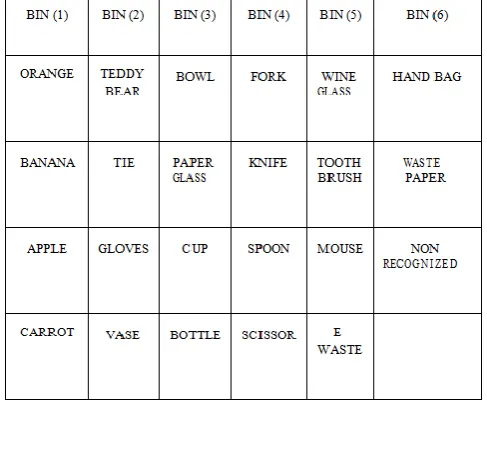
[image:2.595.305.549.513.746.2]Thus, after collecting the dataset we divide into six bins with about 5-12 images in each. Therefore, the data acquisition process involves everything from collecting the images to classifying them into six classes of garbage. The Fig.2 shows the table of six classes of garbage.
Fig.1: Block Diagram
As given in table we have used bin 1 to collect organic waste. Bin 2, bin 3 and bin 4 as recyclable wastes and bin 5 and 6 as non-recyclable. The data acquisition techniques for the image detection include rotation of the image randomly with random brightness control and random image translation. It also includes scaling of the image in a random manner. The transformations of images which are chosen are for different orientations.
The waste is captured using a high resolution web camera and the captured image is detected using 80 trained sets which are stored in TensorFlow library. Once the image has been detected it will be processed and classified using CNN algorithm. Based on the classification Arduino microcontroller is used to open and close the bins accordingly.
D. Equations
1. Hardware Requirements 1.1Arduino Uno
Fig.2: Arduino Microcontroller (Image Source: Google) We have used Arduino Uno. It is a microcontroller and used in our project for controlling the servo motors. When the image of garbage captured is recognized using TensorFlow algorithm, it is also tested using Python programming and decided which bin the garbage belongs. Accordingly the Arduino is used to open that particular bin gate to dump the garbage.
2. Software Requirements 2.1Arduino IDE
We have used IDE for writing code to control the Arduino microcontroller. The code written is dumped to the Arduino. It has been linked with the Python programming to simulate the work properly.
2.2Anaconda Navigator
It is used for scientific computing like data analytics, machine learning applications and predictive analytics etc.
IV. MODEL AND METHODS
A. TensorFlow:
TensorFlow is used in Deep Learning techniques. It is a syntax which is used in Neural Network algorithms. In our project we are using pre-defined systematically trained sets of data. This set of data is stored in a data set known as YOLO. This contains 80 layers of trained dataset. This uses TensorFlow syntax. TensorFlow is a library with huge set of mathematical calculations. YOLO has been written using this library. The trained dataset is stored in the form of shape, attributes, and dimensions of the object.
When a particular object once captured, is sent through these 80 layers whose attributes, dimensions and shape is compared at every layer and finally recognizing the object and then labeling it accordingly using CNN algorithm which is explained later in this paper.
TensorFlow derives its name from the term Tensor since it deals with multidimensional arrays. When we send any object as input which is first recognized as a multidimensional array along graph will be pre-processed by this TensorFlow architecture and it builds a model and finally estimating the model. Thus TensorFlow acts as an interface to express a huge variety of algorithms used in Machine Learning.
B. Convolutional Neural Network (CNN):
The CNN is a Machine Learning algorithm which is similar to the neurons of our brain. We recognize any image by looking at it and once the cortex of our eyes sends this signal to our brain and the image is recognized based on previously seen image. In a similar way CNN is used in image recognition by comparing the present image with the already stored images.
The types of Machine Learning include supervised learning, unsupervised learning and semi-supervised learning or reinforcement learning. In supervised learning we create different labels based on requirement. When it encounters any new input, it is compared with all the labels and finally it recognizes a particular label to which the input belongs. In unsupervised learning there will be dataset but unlike supervised learning it does not contain any labels on these datasets. When it encounters with a new set of data it will classify the dataset by reading the dataset and recognizing the
differences between various kinds of data and not on the basis of labels. This kind of classifying the input is called as clustering. In our project we are using reinforcement or semi-supervised learning which is based on trial and error method. It does not contain any dataset unlike the two previous types of learning. As we send an input it will compare with the real world dataset and corrects the error in recognizing and the object is sent again until it is properly recognized.
The flowchart and algorithm is given below which briefly explains the entire structure of the automated waste segregator.
Algorithm:
Step 1: Place the waste object in front of camera.
Step 2: The camera will capture the image and it will transmit to the system.
Step 3: The system will identify the object using Tensor Flow. Step 4: Further the object will be detected and classified using CNN algorithm.
Step 5: CNN will detect the waste and take the input as an array of pixel values.
Step 6: The pixel values of image will be multiplied with the filter values.
Step 7: The multiplication will be summed and the entire procedure will be repeated for the whole image.
Step 8: Further max pooling will get an output, which has the maximum value in particular window by reducing the parameters and generalizes the convolutional layer.
Step 9: It then determines the features which most correlates to a particular class (dataset). Thus, the waste will be classified.
Step 10: The result of classification will remain in Arduino Uno.
Fig.3: Flow Chart
2797
Published By:
Blue Eyes Intelligence Engineering Retrieval Number: I8511078919/19©BEIESP
DOI:10.35940/ijitee.I8511.078919
V. RESULTS
The results of our experimental procedure are shown in Fig.4. As can be seen from some of the results shown here, the correlation between detection of waste materials and reality is high. The conveyor belt which contains bins is shown in Fig.5.
Fig.4a
Fig.4b
Fig.4c
Fig.4d
Fig.5: Conveyor Belt
VI. CONCLUSIONS
needs to be materialized for better planet to live in. Hence, with our cost effective project proposal, we try to bring in the change. The automated system not only improves the lives of manual scavengers but also is very environmental friendly. Besides, this system utilizes low cost components for the successful segregation of most types of waste. When installed in apartments or small colonies, it proves to be beneficial in sorting the waste at the site of disposal itself.
The project can be extended to increase number of trained objects in TensorFlow library. It can be made for on spot decomposition of waste. Inlet section can be incorporated with a crusher mechanism to reduce the size of the incoming waste.
ACKNOWLEDGMENT
We are thankful to our Head of Department of Electronics and Communication, Dr. Shankaraiah and our project guide Assistant Professor of Department of Electronics and Communication, Ms. Kavyashree M K for their time involved in the discussion and support afforded.
REFERENCES
1. Hitesh Poddar, Rituraj Paul, Sourangsu Mukherjee, Budhaditya
Bhattacharyya, “Design of smart bin for smarter cities”, International Conference on Innovations in Power and Advanced Computing Technologies, April 2017.
2. Hoo-Chang Shin, Alogler R Roth, Mingchen Gao, Le Lu, Ziyue Xu,
Isabella Nogues, Jianhua Yao, Daniel Mollura, Ronald M Summers, “Deep Convolutional Neural Networks for computer aided detection: CNN architectures dataset characteristics and transfer learning”, IEEE Transactions on Medical Imaging, Vol.35, No.5, May 2016.
3. Hideaki Yanagisawa, Takuro Yamashita, Hiroshi Watanabe, “A study
on object detection method from manga images using CNN”, IEEE International Workshop on Advanced Image Technologies, January 2018.
4. Xinyi Zhou, Wei Gong, Wenlong Fu, Fengtong Du, “Application of
Deep learning in object detection”, IEEE/ACIS 16th International Conference on Computer and Information Science, May 2017. 5. Mindy Yang, Gary Thung, “Classification of trash for recyclability
status”, @inproceedings, 2016.
AUTHORS PROFILE
Kavyashree M K: She is working as assistant professor in the Department of Electronics and Communication Engineering. She has received her
Bachelor of Engineering in Electronics and
Communication from Maharaja institute of technology,
Mysore, affiliated to Visvesvaraya Technology
University, Belagavi, Karnataka in the year 2011, and obtained her Master’s degree in Digital Electronics and Communication from M.S Ramaiah Institute Of Technology, Bangalore affiliated to Visvesvaraya Technology of Technology University, Belagavi, Karnataka in the year 2013 and currently pursuing her Ph.D in the area of wireless communication from JSS Science and Technological University, Mysore, Karnataka. Her interest include wireless communication, networking and Internet Of Things.
Arpitha G R: She has received her Bachelor of Engineering in Electronics and Communication from Sri Jayachamarajendra College of Engineering presently called as JSS Science and Technology University, Mysuru. She has worked on several projects and competed in many competitions during her studies.
Kavya R: She has received her Bachelor of Engineering in the department of Electronics and
Communication Engineering from Sri
Jayachamarajendra College of Engineering presently called as JSS Science and Technology University,
Mysuru and currently working in a private sector. She completed diploma in Electronics and Communication Engineering from JSS Polytechnic for Women, Mysuru. Participated in State level project competition in 2016.
Phi I Banrisha L R: She is a B.E graduate student from the department of Electronics and Communication Engineering from Sri Jayachamarajendra College of Engineering, Mysore. Presently the college is known as JSS Science and Technology University. She has graduated her Secondary School (SSLC) from Seven Set School, Malki, Shillong, which is under the Meghalaya Board of School Education. She has graduated her Higher Secondary School (HSSLC) from Pine Mount School, Barik, Shillong, which is under the Council of Indian School Certificate. She has graduated in all educational qualifications with First class.