REAL-TIME FACE RECOGNITION SYSTEM USING RADIAL BASIS FUNCTION NEURAL NETWORKS
(Keywords : Real-time, face recognition system, radial basis function, neural network, image processing)
11
Face detection is the first step in face recognition system. The purpose is to localize and extract the face region from the background that will be fed into the face recognition system for identification. This project used general preprocessing approach for normalizing the image and Radial Basis Function (RBF) Neural Network will be used for face recognition. As for the detection process, new reduced set method for Support Vector Machines is used. The image will then be resized converted into grayscale format. The RBF network is trained using the user image and tested using several faces. Radial Basis Function (RBF) Neural Network was used to distinguish between the user face and imposter. RBF Neural Networks offer several advantages compared to other neural network architecture such as they can be trained using fast two stages training algorithm and the network possesses the property of best approximation. The performance of the RBFNN face recognition system will be based on the False Acceptance Rate (FAR) and the False Rejection Rate (FRR).
E-mail: Tel. No.: Vote No.:
Key Researchers: Khairul Azha bin A. Aziz
Khairuddin bin Osman Ridza Azri bin Rarnlee
[email protected] 06-5552175
l1l
ACKNOWLEDGEMENT
Alhamdulillah, I am very thankful to Allah SWT on His mercy and blessing that makes this project successful.
I would like to express my utmost gratitude and appreciation to my co-researchers, Khairuddin Osman and Ridza Azri Ramlee for their strong support and advice in developing this project.
I sincerely thank to all my friends for all the ideas, information, help and moral support during the development process.
TABLE OF CONTENTS
CHAPTER TITLE
TITLE PAGE ABSTRACT
ACKNOWLEDGEMENT TABLE OF CONTENTS LIST OFT ABLES LIST OF FIGURES
LIST OF ABBREVIATIONS LIST OF SYMBOLS
LIST OF APPENDICES
1 INTRODUCTION
1.1. Background 1.2. Project Objectives
IV
PAGE
11 111 IV Vll Vlll
X xi
xu
1
2
3
4
BACKGROUND
2.1. Introduction ofFace Detection
2.2. Methods for Face Detection in a Single Image 2.2.1. Feature-Based Approach
2.2.1.1. Low Level Analysis 2.2.1.2. Feature Analysis 2.2.1.3. Active Shape Model
2.2.2. Image Based Approach 2.2.2.1. Linear Subspace Method 2.2.2.2. Neural Networks
2.2.2.3. Statistical Approach
2.3. Face And Non-face Image Database 2.4. Face recognition
2.5. Radial Basis Function Neural Networks
2.5.1. Introduction to RBF Neural Networks
2.5.2. RBF Network Design and Training
2.5.3. Selection of the RBF centers 2.6. Neural Networks Learning Method
2.6.1. Supervised Learning
2.6.2. Unsupervised Learning
STATEMENT OF PROBLEM
3.1. Scope ofthe Project
3.2. Problem Statement
APPROACH 4.1. Introduction
4.2. Radial Basis Function Neural Network Face Detection System Design
4.2.1 Grayscale Image
4.2.2 Convert Image to Matrix Form 4.2.3 Create a Sliding Window 4.2.4 Image Preprocessing
4.2.5 Test and Classify Current Window 4.2.6 Radial Basis Function Neural Network 4.2.7 Efficient and Rank Deficient Support Vector
Machine
4.2.8 System Performance
4.2.9 Variance Spread Value of RBFNN
5 RESULTS
5.1. Introduction
5.2. Face Detection Using RBFNN With Variance Spread Value
5.2 Face Recognition Using RBFNN
6 SUMMARY & CONCLUSIONS
5.1. Summary 5.2. Conclusions
Vll
LIST OF TABLES
TABLE TITLE PAGE
5.1 Summary of the best setting for RBF Face Detection with 49
variance spread value
5.2 Testing using user image as input 53
Vlll
LIST OF FIGURES
FIGURES TITLE PAGE
2.1 Face Detection Methods in a single image 5
2.2 Low level analysis approach 6
2.3 Feature Analysis approach 9
2.4 Active Shape Model Approach 10
2.5 Some examples of eigenfaces computed from the ORL 12
dataset
2.6 The subspace LDA face recognition system 13
2.7 The System of Rowley et al. [1] 15
2.8 Pre-processing process 15
2.9 Examples of face and non-face images 17
2.10 RBF network 9
2.11 Gaussian Basis Function 21
2.12 K-means algorithm flow 24
2.13 Supervised Learning Configuration 26
2.14 Unsupervised Learning Configuration 27
4.1 Flow of the training data 33
4.2 Flow of the testing data 34
4.3 Flow of detecting face/s in a single image 35
4.4 Convert Image to Matrix 37
4.5 Convert Matrix to Column Matrix 37
4.6 Sliding Window 38
4.7 Flow Chart for Creating Sliding Window 39
4.8 Preprocessing Process 40
4.9 Flow Chart for RBF Method for single image with one 42
face used in [ 6]
4.10 Flow Chart for RBF Method for single image with many 43
lX
4.11 Same Spread For All Centers 46
4.12 Variance Spread For All Centers 47
5.1 Detection performance on Face & Non-face with various 50
centers
5.2 Output response of the trained RBFNN for CBCL training 50
datasets as input for 180 centers
5.3 Error rate using various centers 51
5.4 RBF with the value of Centre 200 and Spread 4 in [1] 51
X
LIST OF TABLES
TABLE TITLE PAGE
5.1 Summary of the best setting for RBF Face Detection with 51
variance spread value
5.2 Testing using user image as input 55
xi
LIST OF FIGURES
FIGURES TITLE PAGE
2.1 Face Detection Methods in a single image 9
2.2 Low level analysis approach 10
2.3 Feature Analysis approach 13
2.4 Active Shape Model Approach 14
2.5 Some examples of eigenfaces computed from the ORL 16
dataset
2.6 The subspace LDA face recognition system 17
2.7 The System of Rowley et al. [1] 19
2.8 Pre-processing process 19
2.9 Examples of face and non-face images 21
2.10 RBFnetwork 23
2.11 Gaussian Basis Function 25
2.12 K-means algorithm flow 28
2.13 Supervised Learning Configuration 30
2.14 Unsupervised Learning Configuration 31
4.1 Flow of the training data 37
4.2 Flow of the testing data 38
4.3 Flow of detecting face/s in a single image 39
4.4 Convert Image to Matrix 41
4.5 Convert Matrix to Column Matrix 41
4.6 Sliding Window 42
4.7 Flow Chart for Creating Sliding Window 43
4.8 Preprocessing Process 44
4.9 Flow Chart for RBF Method for single image with one 46
face used in [ 6]
4.10 Flow Chart for RBF Method for single image with many 47
4.11
4.12
Same Spread For All Centers
Variance Spread For All Centers
50
51
ANN ATM CBCL CBIR ED FA FAR FE RET FRR FRT LDA OED ORL MD MIT MLP NN PCA PDM RBF RBFNN RGB SOFM SVM XM2VTS
LIST OF ABBREVIATIONS
Artificial Neural Network
Automatic Teller Machine
Center For Biological and Computation
Content Based Image Retrieval
Experiment Design
Factor Analysis
False Acceptance Rate
Facial Recognition Technology
False Rejection Rate
Face Recognition Techniques
Linear Discriminant Analysis
Optimum Experiment Design
Olivetti Research Laboratory
Maximin distance
Massachusetts Institute of Technology
Multi-Layer Perceptrons
Neural Networks
Principal Component Analysis
Point Distributed Models
Radial Basis Function
Radial Basis Function Neural Networks
Red-Green-Blue
Self-Organizing Feature Maps
Support Vector Machine
Extended Multi Modal Verification for Teleservices and
Security applications database
XlV
LIST OF SYMBOLS
A Constant
1
Input space,....
Discrete design .::,
o, Neural Network input signal
oi Neural Network output signal
Oi Receptive field controller
'Pj Hidden unit
Pi Measurement weight
Wi, Center
Xi Data sample
X Input set
XV
LIST OF APPENDICES
APPENDICES TITLE PAGE
CHAPTER 1
INTRODUCTION
1.1. Background
Biometrics deals with the identification of individuals based on their biological or behavioral characteristics [13]. By using that trait to obtain a biometric enrollment, we can say that with a degree of certainty that someone is the same
person in future biometric authentications based on their previous enrollment
authentications [16]. The problem of resolving the identity of a person can be
categorized into two fundamentally distinct types that are verification and
recognition. Accurate identification of a person could deter crime and fraud, streamline business processes, and save critical resources [13]. Biometric identification has the potential to virtually eliminate there problems [15]. No single
biometrics is expected to effectively satisfy the needs of all identification applications. A number of biometrics have been proposed, researched and evaluated for identification applications. Face is one of the most acceptable biometrics because it is one of the most common methods of identification which humans use in their interactions [13].
2
process starts when an image that is obtained from sensors or cameras and the
processing task will be done to the image according to the application. There are
many areas that are related with image detection and recognition such as military and
defense, security system, surveillance monitoring, biomedical engineering systems,
health monitoring, surgery, intelligent transportation systems, manufacturing,
robotics, entertainment, and security systems [3].
The application of image detection and recognition had been increased slowly
in the past due to the constraint in the technology, processing power and also because
of the high cost of developing the system [5]. Due to the advances in technology, the
research had increased and solve many problem related to image processing. As a
part of image detection and recognition, face detection is also a crucial and important. Face detection is the early process before the face recognition process. The output of the face detection system will be the input to the face recognition
system. Same as the application of image detection, face detection is used widely in
security system.
With the development of biometric fusion system, the face detection and
recognition had been fused with other biometric such as fingerprint, iris, signature, voice and etc. The design of biometric system to recognize a person based on
information acquired from multiple biometric sources offers several advantages over
3
1.2. Project Objectives
The main objective of this project is to develop a real-time face recognition
system using radial basis function (RBF) neural network. The algorithm and
graphical user interface are developed using MA TLAB.
Next, the project objective is to compare the result of using fixed and
variance spread values of RBF for face detection. The system will focus on
appearance based approach. In this part, both sets of sample face and non-face data
are trained to form an interconnection of artificial neurons and processes information.
The system will then classified all the inputs as face or non-face.
Finally the system's performance will be measured according to the rate of
CHAPTER2
BACKGROUND
2.1 Introduction of Face Detection
Face can be defmed as the front part of head from the forehead to the chin
[11]. Face detection is a difficult computer vision problem. There are many variation
factors affecting detection accuracy. In order to simplify the task, many researchers
focus only on developing detection algorithms for frontally view faces. For
application such as ATM access control, one can assume that rightful users will show
their faces to the camera in an upright position. The face detector needs to carefully
comb through arbitrary scenes to screen out false facial patterns while remain
responsive to the true face patches [15]. In object-class detection, the main task is to
find the sizes and locations of all objects in an image that belong to a given class. In
other word we are to determine whether there is face or not in the image. Face
detection can be regarded as a more general case of face localization. In face
localization, the task is to find the locations and sizes of a known number of faces
5
2.2. Methods for Face Detection in a Single Image
Numerous teclmiques have been developed to detect faces in a single image.
The methods can be classified into two main categories that are feature based
approach and image based approach [5]. Researchers normally will choose either one
ofthese categories even though some had tried to combine these techniques [17]. All
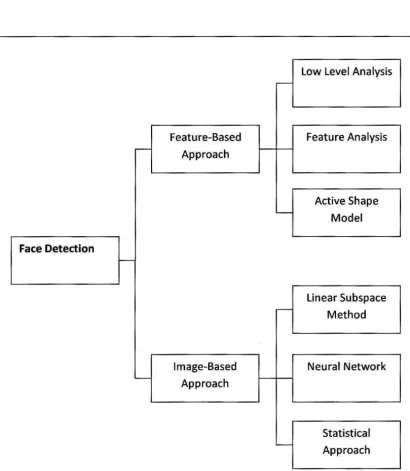
of these categories will be explained briefly in this section. Figure 2.1 shows the face
detection categories.
Low Level Analysis
,..--Feature-Based Feature Analysis r
-Approach
Active Shape
.._
Model
Face Detection
1--Linear Subspace
r
-Method
Image-Based Neural Network
'
-Approach
Statistical
[image:19.527.63.474.248.719.2]-
Approach6
2.2.1. Feature-Based Approach
Feature-based approach can be divided into three areas that are Low Level
Analysis, Feature Analysis and Active Shape Model. Feature-based approach make
explicit use of face knowledge and follow the classical detection methodology where
the low level features are derived prior before goes to the knowledge-based analysis
[5][24]. The apparent properties of the face such as skin color, face geometry, and all
other visual features are manipulated at different system levels. This technique was
termed feature-based approach as feature is the main component [5].
2.2.1.1 Low Level Analysis
For an image containing faces with a cluttered scene, low-level analysis first
deals with the segmentation of visual features using pixel properties such as
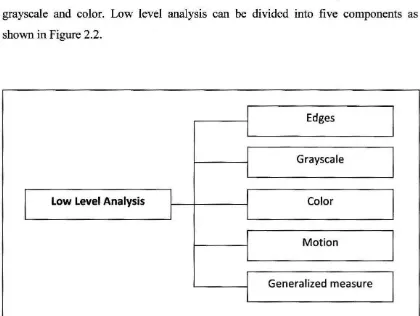
grayscale and color. Low level analysis can be divided into five components as
shown in Figure 2.2.
Edges
Grayscale
Low Level Analysis Color
Motion
Generalized measure
[image:20.527.55.475.400.716.2]7
Edge representation 1s the most primitive feature in computer vision
applications. It was applied in the earliest face detection work by Sakai et al. The work was based on analyzing line drawings of the faces from photographs, aiming to
locate facial features. In order to derive edge representation in edge detection, many
different types of edge operators have been applied. The Sobel operator was the most
common filter that had been used. In an edge-detection-based approach to face
detection, edges need to be labeled and matched to a face model in order to verify
correct detections [ 5].
In Grayscale representation, the gray information within a face can also be
used as features. Facial features such as eyebrows, pupils, and lips appear generally
darker than their surrounding facial regions. This property can be exploited to
differentiate various facial parts. Several facial feature extraction algorithms used to
search for local gray minima within segmented facial regions. In these algorithms,
the input images are first enhanced by contrast-stretching and gray-scale
morphological routines to improve the quality of local dark patches and thereby
make detection easier. The extraction of dark patches is achieved by low-level
gray-scale thresholding [5].
As gray information provides the basic representation for image features, color is a more powerful means of representing the object appearance. Due to the
extra dimensions that color has, two shapes of similar gray information might appear very differently in a color space. It was found that different human skin color gives
rise to a tight cluster in color spaces even when faces of difference races are
considered. One of the most widely used color models is RGB representation in
which different colors are defined by combinations of red, green, and blue primary
color components. Besides RGB color models, there are several other alternative
models currently being used in the face detection research that is HSI color
representation. These models are used to extract facial features such as lips, eyes, and
8
Motion information is a convenient means of locating moving objects in a
video sequence. Frame difference analysis is a way to achieve motion segmentation.
This approach is able to recognize a moving foreground efficiently regardless of the
background content. Another way of measuring visual motion is through the
estimation of moving image contours. Compared to frame difference, results generated from moving contours are always more reliable, especially when the motion is insignificant. Besides the methods described above, there are also methods
rely on the accurate estimation of the apparent brightness velocities called optical flow. Because the estimation is based on short-range moving patterns, it is sensitive to fine motion [5].
Reisfeld et al. [45] proposed that machine vision systems should begin with pre-attentive low-level computation of generalized image properties. Since facial
features are symmetrical in nature, the operator which does not rely on higher level a
priori knowledge of the face effectively produces a representation that gives high
responses to facial feature locations. The symmetry measure assigns a magnitude at
every pixel location in an image based on the contribution of surrounding pixels [ 5].
2.2.1.2 Feature Analysis
In feature analysis, visual features are organized into a more global concept of face and facial features using information of face geometry. Although feature
generated from this analysis are ambiguous because of the low-level nature, visual features are organized into more global concept of face and features using
information of face geometry. The feature ambiguities are reduced and the locations
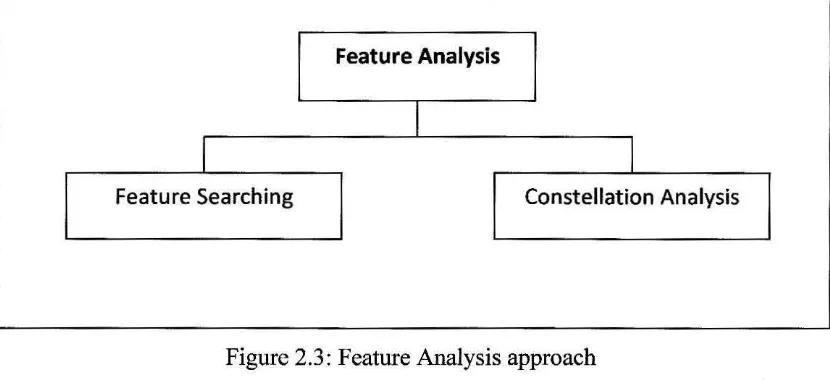
of the face and facial features are determined. Figure 2.3 shows the two approaches
9
Feature Analysis
I
I
I
[image:23.525.60.475.54.244.2]Feature Searching Constellation Analysis
Figure 2.3: Feature Analysis approach
Feature searching techniques begin with the determination of prominent
facial features. The detection of the prominent features then allows for the existence
of other less prominent features to be hypothesized using anthropometric
measurements of face geometry [5].
In constellation analysis, facial features in face-like constellations are group
using more robust modeling methods such as statistical analysis. A probabilistic
model for the spatial arrangement of facial features enables higher detection
flexibility. The algorithm is able to handle missing features and problems due to
translation, rotation, and scale to a certain extent. In face recognition systems, one of
the most widely used techniques is graph matching. Graphs store local feature
information in feature vectors at their nodes and geometrical information in their
10
2.2.1.3 Active Shape Model
The next group involves the use of active shape models. These models
ranging from snakes, proposed in the late 1980s, to the more recent point distributed
models (PDM) have been developed for the purpose of complex and non-rigid
feature extraction such as eye pupil and lip tracking. Figure 2.4 shows the active
shape approach components.
Active Shape Model
Snakes Point Distribution Deformable
Models (PDM) Templates
2.4: Active Shape Model Approach
Active contours, or snakes, are commonly used to locate a head boundary. In
order to achieve the task, a snake is first initialized at the proximity around a head
boundary. It then locks onto nearby edges and subsequently assumes the shape of the
head. Two main considerations in implementing a snake are the selection of the
appropriate energy terms and the energy minimization technique. Elastic energy is
used commonly as internal energy. It is proportional to the distance between the
control points on the snake and therefore gives the contour an elastic-band
characteristic that causes it to shrink or expand. The external energy consideration is