A numerical study of 2D integrated RBFNs
incorporating Cartesian grids for solving 2D elliptic
differential problems
N. Mai-Duy
∗and T. Tran-Cong
Computational Engineering and Science Research Centre
Faculty of Engineering and Surveying,
The University of Southern Queensland, Toowoomba, QLD 4350, Australia
Submitted to
Numerical Methods for Partial Differential Equations
,
15-Dec-2008; revised, 25-May-2009
Short title: 2D-IRBFN Cartesian-grid technique
AbstractThis paper reports a numerical discretisation scheme, based on two-dimensional integrated radial-basis-function networks (2D-IRBFNs) and rectangular grids, for solving
second-order elliptic partial differential equations defined on 2D non-rectangular domains.
Unlike finite-difference and 1D-IRBFN Cartesian-grid techniques, the present
discretisa-tion method is based on an approximadiscretisa-tion scheme that allows the field variable and
its derivatives to be evaluated anywhere within the domain and on the boundaries,
re-gardless of the shape of the problem domain. We discuss the following two particular
strengths, which the proposed Cartesian-grid-based procedure possesses, namely (i) the
implementation of Neumann boundary conditions on irregular boundaries and (ii) the
use of high-order integration schemes to evaluate flux integrals arising from a
control-volume discretisation on irregular domains. A new preconditioning scheme is suggested
to improve the 2D-IRBFN matrix condition number. Good accuracy and high-order
con-vergence solutions are obtained.
Keywords: integrated radial basis function network; Cartesian grid; irregular domain;
Neumann boundary condition; control-volume discretisation; point-collocation
discretisa-tion
1
INTRODUCTION
Discretisation techniques require the replacement of the domain of interest with a union
of small elements, a collection of control volumes, a Cartesian grid or a set of discrete
points. Generating a Cartesian grid or a set of discrete points is seen to be much more
economical than generating a finite-element mesh, particularly for the case of
irregularly-shaped domains. As a result, considerable effort has been put into the development of
Cartesian-grid-based techniques and meshless techniques.
Cartesian-grid techniques, difficulties lie in the handling of irregular boundary geometries.
Since the irregular boundary does not generally pass through grid nodes (regular points),
one expects to have a change in grid spacing in all directions for interior points adjacent
to the boundary. It has been shown that a rapid change of the grid size can result in a
substantial deterioration in accuracy (e.g. [1]). A variety of techniques have been explored
to overcome this problem. Examples include higher-order boundary fitting schemes, where
error bounds for the quadratic boundary treatment are derived, (e.g. [2,3]) and embedded
boundary techniques (e.g. [4,5]). There are further complications for the case of Neumann
boundary conditions. Expressions for computing a gradient boundary condition embrace
first-order derivatives in both coordinate directions. However, at an irregular boundary
point, one is given explicitly information about the change of the field variable in one
coordinate direction only. Special treatments are required. Typically, supplementary
approximations are introduced at the boundary (e.g. [6-8]) or rectangular grids are formed
in a way that boundary points are also grid nodes (e.g. [9]). If one uses a control-volume
approach (subregion collocation) for the discretisation, the accuracy of the technique
depends on both the approximation of gradients (e.g. diffusive fluxes) and the evaluation
of integrals involving these gradients. For the latter, assume that the flux evaluations are
sufficiently accurate, the midpoint rule is capable of yielding second-order accuracy only
as discussed in [10].
Radial-basis-function networks (RBFNs) are known as a powerful tool for the
approxima-tion of scattered data. Their applicaapproxima-tion to the soluapproxima-tion of partial differential equaapproxima-tions
(PDEs) has received a great deal of attention over the last 15 years (e.g. [11] and
ref-erences therein). It is easy to implement RBF collocation methods and they can give a
high-order convergence solution. On the other hand, the RBF matrices are fully
popu-lated and their condition numbers grow quickly with increasing number of RBF centres.
A number of approaches, such as local approximations (e.g. [12,13]), domain
(e.g. [18,19]), have been presented, towards the solution of large-scale problems.
Integrated RBFNs (IRBFNs) have some advantages over differentiated RBFNs (DRBFNs)
in certain types of problems such as those involving the approximation of high-order
derivatives, the implementation of multiple boundary conditions, and the enforcement
of second-order continuity of the approximate solution across the subdomain interfaces
(e.g. [20-22]). In the context of Cartesian-grid techniques, IRBFNs were employed to
represent the field variable on each grid line (1D-IRBFNs), which allows a larger number
of nodes to be employed (e.g. [23-25]). Because 1D-IRBFN approximation schemes with
respect to the two coordinate directions are independent, difficulty is encountered for
irregular domains when one tries to implement normal derivative boundary conditions
and use Gaussian quadrature to evaluate flux integrals. In [24], a technique for generating
a non-uniform grid where the boundary points coincide with regular mesh points [9]
was adopted to implement Neumann boundary conditions. In this paper, we discuss
the use of 2D-IRBFNs over the whole domain that has the ability to overcome these
difficulties. Furthermore, a new preconditioning scheme and a hybrid numerical procedure
are proposed to enhance the performance of the present Cartesian-grid-based technique.
The remainder of the paper is organised as follows. In Section 2, a brief review of
in-tegrated RBFNs is given. In Section 3, the proposed Cartesian-grid-based technique
incorporating 2D-IRBFNs is described and its performance is investigated numerically.
Emphasis is placed on the discussion about some strengths and weaknesses of 2D-IRBFNs
2
TWO-DIMENSIONAL INTEGRATED RBFNs ON
CARTESIAN GRIDS
In the remainder of the paper, we will use
• the notation b[] for a vector/matrix [] that is associated with 1D-IRBFNs, a grid line or a segment of the boundary,
• the notation e[] for a vector/matrix [] that is associated with 2D-IRBFNs or the whole set of grid lines,
• the notation [](η) to denote selected rows η of the vector [],
• the notation [](η,θ) to denote selected rows η and columns θ of the matrix [],
• the notation [](:,θ) to denote all rows of the matrix [],
• the notation [](η,:) to denote all columns of the matrix [], and
• the notation cond([]) to denote the the 2-norm condition number of the matrix [].
The domain of interest, which can be rectangular or non-rectangular, is embedded in a
Cartesian grid of density N1 ×N2. In the case of non-rectangular domains, grid nodes
outside the domain are removed. Boundary points are generated through the
intersec-tion of the grid lines and the boundaries of the domain. The construcintersec-tion of the RBF
approximations can be based on differentiation or integration. For the latter, which is
employed in this study, the highest-order derivatives of the field variable in a given PDE
are decomposed into RBFs. Approximate expressions for lower-order derivatives and the
field variable itself are then obtained through integration. For the solution of second-order
PDEs on 2D domains, the integral scheme will start with
∂2u(x)
∂x2 =
N
X
where u is the field variable, x the position vector,xj the j-component of x(j = [1,2]),
N the number of RBF centres (interior and boundary points) associated with the xj grid lines (N =N1N2 for a rectangular domain), w the network weight and G(x) the RBF.
Integrating (1) with respect to xj leads to
∂u(x)
∂xj =
N
X
i=1
w(i)H(i)(x) +C1(xk), (2)
u(x) = N
X
i=1
w(i)H(i)(x) +xjC1(xk) +C2(xk), (3)
where H =R Gdxj, H =
R
Hdxj, and C1 and C2 are the constants of integration which
are univariate functions of the variable other than xj (i.e. xk (k 6=j)). For points lying on a grid line that is parallel to the xj direction, expressions (2) and (3) will have the same values of C1 and C2.
We also employ IRBFNs to represent the variation of the constants of integration. These
approximate functions are expressed in terms of the nodal values of C1 and C2 (the
physical space) rather than in terms of the RBF weights/coefficients used in past work
(e.g. [26]).
The construction process for C1(xk) is exactly the same as that for C2(xk). To simplify
the notation, some subscripts are dropped. The functionC(xk) is constructed through
d2C(xk)
dx2 k = Nk X i=1
w(i)g(i)(xk), (4)
dC(xk)
dxk =
Nk
X
i=1
w(i)h(i)(xk) +c
1, (5)
C(xk) = Nk
X
i=1
w(i)¯h(i)(xk) +xkc1+c2, (6)
wherec1 and c2 are the constants of integration which are simply unknown numbers, and
Collocating (6) at the local grid pointsx(ki) with i={1,2,· · · , Nk}leads to
b
C =Tb
b w c1 c2
, (7)
where Cb and wb are the vectors of length Nk, andTb the transformation matrix of dimen-sions Nk×(Nk+ 2)
b
C =C(x(1)k ), C(xk(2)),· · · , C(xk(Nk))T = C(1), C(2),· · ·, C(Nk)T ,
b
w= w(1), w(2),· · ·, w(Nk)T ,
b T = ¯
h(1)(x(1)k ), h¯(2)(x
(1)
k ), · · · , ¯h(Nk)(x
(1)
k ), x
(1)
k , 1 ¯
h(1)(x(2)
k ), h¯(2)(x
(2)
k ), · · · , ¯h(Nk)(x
(2)
k ), x
(2)
k , 1
... ... . .. ... ... ...
¯
h(1)(x(Nk)
k ), ¯h(2)(x
(Nk)
k ), · · · , ¯h(
Nk)(x(Nk) k ), x
(Nk)
k , 1
.
Taking (7) into account, the value of (6) at an arbitrary point xk can be computed in terms of nodal values ofC as
C(xk) = ¯h(1)(xk),¯h(2)(xk),· · ·,¯h(Nk)(xk), x
k,1 bT+C,b (8) or
C(xk) = Nk
X
i=1
P(i)(xk)C(i), (9)
where P(i)(xk) is the product of the first vector on RHS of (8) and the ith column of
b
T+, and Tb+ the generalised inverse of Tb of dimensions (N
Substitution of (9) into (2) and (3) yields
∂u(x)
∂xj =
N
X
i=1
w(i)H(i)(x) +
Nk
X
i=1
P(i)(xk)C(i)
1 , (10)
u(x) = N
X
i=1
w(i)H(i)(x) + Nk
X
i=1
xjP(i)(xk)C1(i)+ Nk
X
i=1
P(i)(xk)C2(i). (11)
For convenience of presentation, expressions (1), (10) and (11) can be rewritten as
∂2u(x)
∂x2
j =
NX+2Nk i=1
w(i)G(i)(x), (12)
∂u(x)
∂xj =
NX+2Nk i=1
w(i)H(i)(x), (13)
u(x) =
NX+2Nk i=1
w(i)H(i)(x), (14)
where
{G(i)(x)}N+2Nk
i=N+1 ≡ {0} 2Nk i=1,
{H(i)(x)}N+Nk
i=N+1 ≡ {P(
i)(xk)}Nk i=1,
{H(i)(x)}N+2Nk
i=N+Nk+1 ≡ {0} Nk i=1,
{H(i)(x)}N+Nk
i=N+1 ≡ {xjP(i)(xk)}Ni=1k,
{H(i)(x)}N+2Nk
i=N+Nk+1 ≡ {P
(i)(xk)}Nk i=1,
{w(i)}N+Nk
i=N+1 ≡ {C (i)
1 }
Nk i=1, and
{w(i)}N+2Nk
i=N+Nk+1 ≡ {C
(i)
2 }
Nk i=1.
We seek an approximate solution in terms of nodal values of the field variable. To do
Collocating (14) at the nodal points associated with the xj grid lines,
x(i) Ni=1, leads to
e T e w b C1 b C2
=u,e (15)
whereTe is aN×(N+2Nk) matrix,we= w(1), w(2),· · · , w(N)T,Cb
1 =
C1(1), C1(2),· · · , C1(Nk)T,
b
C2 =
C2(1), C2(2),· · · , C2(Nk)T, and eu= u(x(1)), u(x(2)),· · · , u(x(N))T. The transforma-tion matrix Te has the entriesTeli =H
(i)
(x(l)) for 1≤l≤N and 1≤i≤(N + 2Nk). It is noted that at a grid nodeP(i)(x(j)
k ) is equal to 0 if i6=j and 1 if i=j. Solving (15) for the coefficient vector yields
e w b C1 b C2 = e
T+u,e (16)
where Te+ is the generalised inverse ofTe.
The values of first- and second-order derivatives of u at the nodal points associated with the xj grid lines can then be computed in terms of nodal variable values as
g∂u ∂xj
=HeTe+u,e (17)
g
∂2u
∂x2
j
=GeTe+eu, (18)
Expressions (17) and (18) can be rewritten in compact form
g∂u ∂xj
=De′
ju,e (19)
g
∂2u
∂x2
j
=De′′
jeu, (20)
where De′
j = HeTe+ and De
′′
j =GeTe+ are the first and second-order differentiation matrices in the physical space.
Consider a Poisson equation ∇2u = b with Dirichlet boundary conditions. Using point
collocation, it can be transformed into
e
Aue(θ)=
e
D′′1(η,θ)+De
′′
2(η,θ)
e
u(θ) =eb(η), (21)
where Ae is the system matrix, and η and θ the two sets of indices representing the interior points. It is noted that η and θ are identical and the nomenclature was given at the beginning of this section. The integral solution procedure involves computing the
transformation matrix Te and the system matrixAe. From a computational point of view, it is desirable to haveTe and Aewith low condition numbers.
3
PROPOSED CARTESIAN-GRID TECHNIQUE
The problem domain is simply discretised using a Cartesian grid (i.e. an array of the x1
and x2 grid lines), on which 2D-IRBFNs are constructed to represent the field variable.
The governing equations are approximated by means of point collocation and subregion
collocation. We study three particular issues here, namely the use of preconditioning
schemes, the implementation of Neumann boundary conditions, and the evaluation of
is carried out with the multiquadric basis function whose form is
G(i)(x) =q(x−c(i))T(x−c(i)) +a(i)2, (22)
where c(i) and a(i) are the centre and width of the ith MQ basis function, respectively.
The set of centres is chosen to be the same as the set of collocation points and the MQ
width is taken to be the minimum distance between the ith centre and its neighbours. The error of the approximate solutionuis measured through its discrete relativeL2norm,
denoted by N e(u). The convergence rate is calculated asNe(u)≈γhα=O(hα) in which
h is the grid size, and α and γ the exponential model’s parameters.
3.1
An effective preconditioning scheme
Consider the transformation system (15). The numerical stability of this system is
de-pendent on the condition number of Te. In the case that Te is ill-conditioned, special treatments are required. In this study, we adopt a preconditioning approach. Both sides
of (15) are multiplied by a matrix, denoted byBe, that is close to the inverse of Te.
We propose the use of one-dimensional IRBFNs (1D-IRBFNs) to construct the
precon-ditioner Be. For 1D-IRBFNs, the approximations are constructed “locally” on each grid line. On a grid line that is parallel to thexj axis, the field variableuis sought in the form
u(xj) = M
X
i=1
w(i)h(i)(xj) +x
jc1+c2, (23)
where M is the number of RBF centres (interior and boundary points) on the grid line (M = Nj for a rectangular domain), and h, c1 and c2 defined as before. It can be seen
can describe the transformation system for the 1D case as b T b w c1 c2
=bu, (24)
or b w c1 c2 = b
T+bu, (25)
whereTb+ is the generalised inverse of dimensions (M+ 2)×M, andwb andubthe vectors
of lengthM. The firstM rows ofTb+are associated with the values of wat the grid points
and we use this sub-matrix to construct the preconditioner Be. In the case of rectangular domains, the assembly process can be simply carried out by means of Kronecker tensor
products. Assume that the grid node is numbered from bottom to top and from left to
right. The preconditioner will take the form
e
B =Tb(1 :Nj,:)⊗1, (26)
for xj ≡x1, and
e
B =1⊗Tb(1 :Nj,:), (27) for xj ≡ x2. In (26) and (27), 1 represents a unit matrix of dimensions N2 ×N2 and
N1×N1, respectively. For the case of non-rectangular domains, the assembly process is
similar to that used in the finite-element method.
The transformation system (15) can be preconditioned as
e
BTe
e w b C1 b C2 = e
It leads to e w b C1 b C2 = e
BTe+Beeu. (29)
The proposed preconditioning scheme is examined numerically for both rectangular and
non-rectangular domains.
3.1.1 Rectangular domain
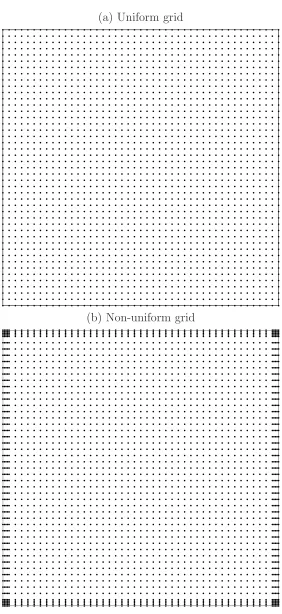
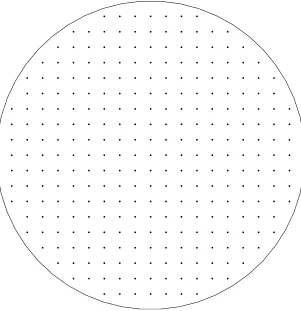
Consider a square domain [0,1]2. The problem domain is replaced with a Cartesian grid
as shown in Figure 1a. Condition numbers of the transformation matrix are computed
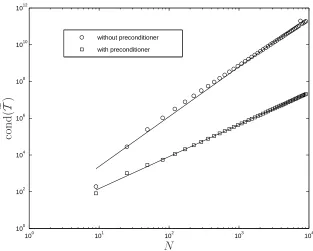
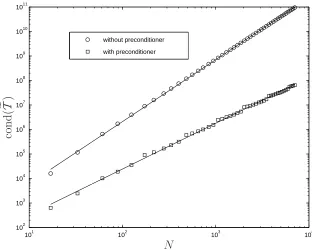
for uniform grids, [3×3, 5 ×5, · · ·, 95 ×95]. It can be seen from Figure 2 that the preconditioned transformation system has much lower condition numbers than the original
system. At N = 9025, the proposed preconditioning scheme produces the condition number lower by about 4 orders of magnitude. The growth in the condition number is
reduced from O(N2.71) (unpreconditioning) to O(N1.74) (preconditioning).
To study the numerical stability of the system matrixAe, we consider the following Poisson equation
∂2u
∂x2 1 +∂ 2u ∂x2 2
= 4(1−π2) [sin(π(2x1 −1)) sinh(2x2−1) + 4 cosh(2(2x1−1)) cos(2π(2x2−1))],
(30)
subject to Dirichlet boundary conditions. The exact solution for this test problem is taken
as
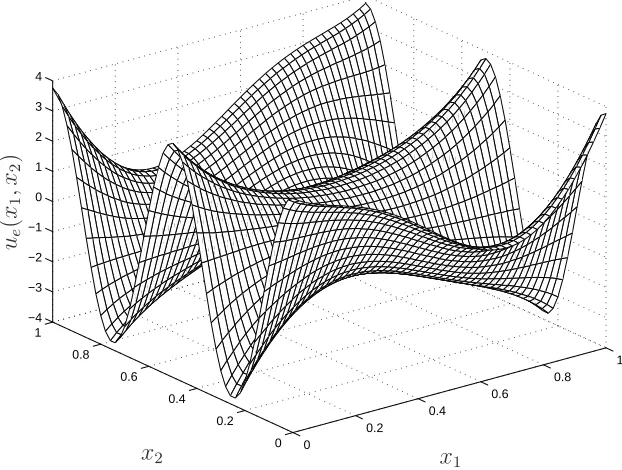
ue= sin(π(2x1−1)) sinh(2x2−1) + cosh(2(2x1−1)) cos(2π(2x2−1)). (31)
Figure 3 shows the variation of (31). To provide a basis for the assessment of the present
technique, we also employ conventional RBFN techniques. Conventional techniques seek
system matrix only. The field variable u is decomposed into RBFs, which are then dif-ferentiated to obtain expressions for its derivatives (difdif-ferentiated RBFNs (DRBFNs)).
We employ a set of RBFs for DRBFNs which is exactly the same as that for IRBFNs
(i.e. both approaches have the same number of RBFs, centres and widths (grid spacing)).
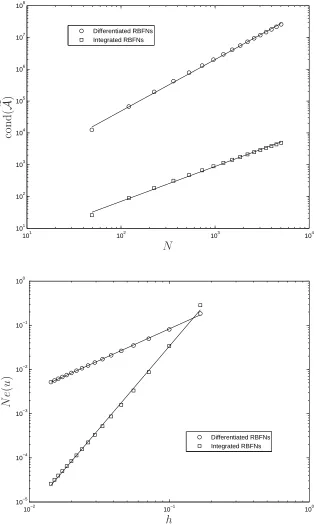
Grid employed are [7×7,11×11,· · · ,71×71]. Figure 4 shows that the IRBFN technique outperforms the DRBFN technique regarding both the matrix condition number and the
accuracy. It is apparent that the present system matrix is much better conditioned. The
condition number grows at the rate of O(N1.10) andO(N1.62) for IRBFNs and DRBFNs,
respectively. At N = 5041, the gap is about 4 orders of magnitude between the two RBF techniques (i.e. 4.89×10³ for IRBFNs and 2.58×10⁷ for DRBFNs). In terms of
accuracy, the integral and differential RBF techniques yield a convergence rate ofO(h3.73)
and O(h1.43) (h-the grid size), respectively.
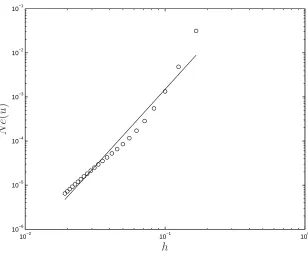
Since IRBFNs do not require an underlying grid, the present method can also work with
a non-uniform Cartesian grid. Such a discretisation is shown in Figure 1b. We employ
several non-uniform grids, namely [13×13,15×15,· · · ,59×59]. The IRBFN solution converges apparently asO(h3.49), wherehis the grid size of the interior region (Figure 5).
Given a number of nodes (e.g. N = 3481), the case of using a non-uniform grid is more accurate than that of a uniform grid (e.g. 6.48×10⁻⁶ versus 5.01×10⁻⁵ for N e(u)).
3.1.2 Non-rectangular domain
The domain of interest is a circular domain of radius 1/2. The governing equation and
the exact solution are respectively taken as
∂2u
∂x2 1
+∂
2u
∂x2 2
= 4(1−π2) [sin(2πx1) sinh(2x2) + 4 cosh(4x1) cos(4πx2)], (32)
This problem has the same exact solution as the previous one, except that the centre of
the domain is shifted from (1/2,1/2) to (0,0). The problem domain is embedded in a
uniform Cartesian grid and the exterior grid nodes are removed (Figure 6). We generate
boundary nodes through the intersection of the grid lines and the boundary. It can be
seen that there may be some interior grid nodes that are very close to the boundary. We
introduce a parameter ∆ to study their effect on the solution accuracy. Interior nodes,
which fall within a small distance ∆ to the boundary, will be set aside. Values of ∆ are
chosen here as h/4, h/6 and h/8, where h is the grid size. In Figure 7, we show a plot of the condition number of the transformation matrix versus the number of grid points.
It can be seen that the preconditioned system has a much lower condition number. Its
rate is reduced fromO(N2.52) (unpreconditioning) toO(N1.86) (preconditioning). Table 1
shows the condition number of the system matrix and the solution accuracy for different
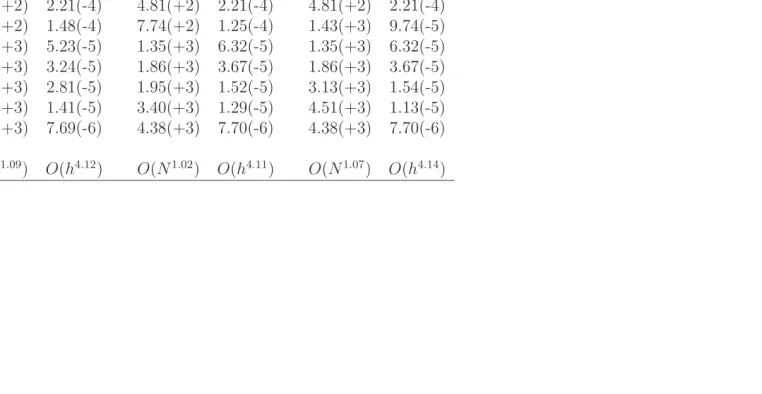
values of ∆. Calculations are carried out for uniform grids, [7×7,13×13,· · ·,61×61]. It is apparent that ∆ only has a little effect on N e(u) and cond(Ae). At ∆ = h/8, the present technique yields a fast rate of convergence of O(h4.14) with the matrix condition
number being in the range of 4.72×101 to 4.38×10³.
3.2
Implementation of Neumann boundary conditions on
non-rectangular boundaries
In the context of Cartesian-grid techniques, Neumann boundary conditions are known to
be more difficult to handle than Dirichlet boundary conditions. It is particularly acute
for the case of non-rectangular boundaries. It should be pointed out that the present
approximations are constructed globally through basis functions that are defined in both
x1 and x2 directions and they do not require an underlying mesh. As a result, the field
variable and its derivatives can be evaluated at any point within the domain and on its
straightforward implementation of Neumann boundary conditions on irregular boundaries.
We consider a domain with a curved boundary that is prescribed with gradient boundary
condition (Figure 8). This curve is an arc, centered at the origin, from 0 to 900 with a
radius of 1/2. The top and right sides of the domain have a unit length. The governing
equation and the exact solution are taken to be the same as those used in the first example
(i.e. (30) and (31)).
As mentioned earlier, boundary points are generated by the intersection of the grid lines
and the boundaries. At boundary points created via the xj grid lines, the values of
∂2u/∂x2
j and ∂u/∂xj are directly obtained from the networks associated withxj (they are nodal values), while the values of ∂2u/∂x2
k and ∂u/∂xk (k 6= j) are computed from the networks associated withxk through interpolation.
A distinguishing feature of IRBFNs is that a set of their coefficients is larger owing to the
presence of integration constants. The Neumann boundary conditions can be imposed
in the final system or in the transformation system. A detailed implementation of the
two approaches for 1D-IRBFNs was presented in [24]. The latter is adopted here and its
implementation is similar to that for 1D-IRBFNs. In contrast to 1D-IRBFNs, 2D-IRBFNs
do not require the boundary points be grid nodes. Consider the xj network and let Nbj be the number of boundary points that are specified with gradient boundary condition.
Collocating the governing equation at the grid points and ∂u/∂xj at the boundary points of Neumann boundary condition, one has
e T e w b C1 b C2 = cue
∂u ∂xj =
eu
1
nj
c∂u
∂n −nkc ∂u ∂xk
, (34)
dimensions (N+Nbj)×(N+2Nk) withTeli =H
(i)
(x(l)) for 1≤l ≤N and 1≤i≤(N+2Nk) and Teli = H(i)(x
(l)
b ) for (N + 1) ≤ l ≤ (N +Nbj) and 1 ≤ i ≤ (N + 2Nk). In (34), derivative boundary conditions are forced to be satisfied exactly. The 2D-IRBFN system
thus contains information about Neumann boundary condition.
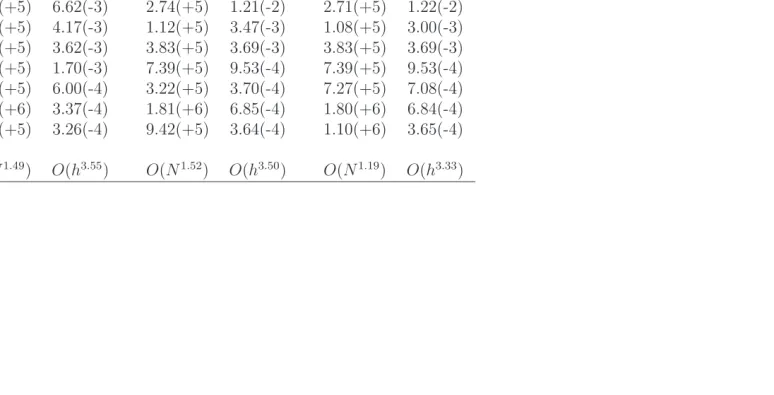
Condition numbers and errors are listed in Table 2. It can be seen that the present
technique yields a fast rate of convergence. However, solutions to Neumann
boundary-value problems are less stable than those to Dirichlet ones.
3.3
Implementation of high-order control-volume discretisations
for non-rectangular domains
Consider a second-order PDE that involves the diffusive term only
∂2u
∂x2 1
+∂
2u
∂x2 2
= 0, (35)
on a circular domain of radius 1/2 centered at the origin, subject to Dirichlet boundary
conditions. The exact solution is taken as
ue(x1, x2) =
1 sinh(π)sin
πx1+
π
2
sinhπx2 +
π
2
, (36)
whose variation on [−1/2,1/2]2 is shown in Figure 9. The problem domain is represented
by a Cartesian grid and each interior grid node is associated with a control volume defined
by the x1 and x2 lines through the middle points of the grid node and its neighbours
(Figure 10). For grid nodes adjacent to the boundary, relevant boundary points are used
Integrating (35) over the ith control volume and applying the divergence theorem lead to
Z
Γi
∂u ∂xdy−
∂u ∂ydx
= 0, (37)
where Γi is the boundary of the control volume i. The field variable is represented by 2D-IRBFNs. The system of algebraic equations is generated by applying (37) to every
interior grid node. We will study what effect the evaluation of integrals in (37) has on the
solution accuracy. Two schemes, namely the midpoint rule and Gaussian quadrature with
5 points, are employed. To provide a basis for comparison, a control-volume approach
described in [27] is also implemented. This approach, where the gradients are represented
by linear functions and the boundary integrals are evaluated using the midpoint rule, is
referred here as linear CVM.
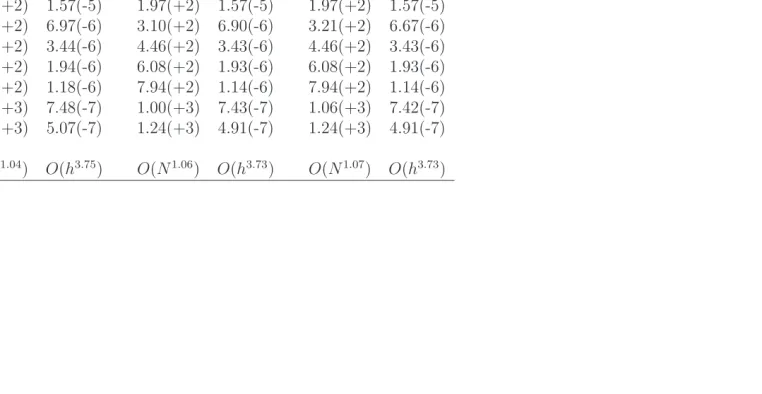
Figure 11 and Table 3 show results obtained by linear-CVM (middle-point rule),
IRBFN-CVMa (middle-point rule) and IRBFN-CVMb (5-point Gaussian quadrature). It is known
that the middle-point rule is only an O(h2) method. One thus expects that
IRBFN-CVMa is second-order accurate. As shown in Figure 11, although more accurate, the
rate of IRBFN-CVMa is similar to that of linear-CVM. On the other hand, 5-point
Gaus-sian quadrature isO(h10) and the IRBFN-CVMb, as expected, outperforms linear-CVM
and IRBFN-CVMa. In terms of cond(Ae), IRBFN-CVMa has a slightly-larger condi-tion number than linear-CVM and IRBFN-CVMb. The linear-CVM, IRBFN-CVMa and
IRBFN-CVMb have respectively their observed rates as O(N1.05),O(N1.09) andO(N1.06)
for the condition number and O(h1.96), O(h2.10) and O(h3.73) for the solution accuracy.
Comparing Table 3 with Table 1, it can be seen that the present control-volume approach
is less sensitive to the parameter ∆ than the present collocation approach. For all values
3.4
Discussion
2D-IRBFNs have some strengths: (i) they allow the use of high-order integration schemes
in the CV approach irrespective of the shape of the problem domain, and (ii) they have the
ability to implement Neumann boundary conditions on irregular boundaries in a direct
manner. However, the cost to construct 2D-IRBFNs is expensive. To alleviate this
draw-back, one can incorporate 1D-IRBFNs into the present Cartesian-grid numerical scheme.
For rectangular regions, 1D-IRBFNs also permit the field variable and its derivatives to
be evaluated at any point in the domain, and therefore one can use Gaussian quadrature
for the control-volume formulation. The domain of complicated shape can thus be
parti-tioned into a number of subdomains through a set of lines that are parallel to thex1 and
x2 axes; one can then employ 2D- and 1D-IRBFNs to represent the solution in irregular
and regular subdomains, respectively.
This domain decomposition procedure, which selectively exploits strengths of 1D- and
2D-IRBFNs, is numerically studied here through the domain shown in Figure 12. The
geometry of Subdomain 1 is exactly the same as that used in Section 3.2, while Subdomain
2 is a unit square. Consider a Poisson equation with Dirichlet boundary conditions. The
exact solution is created by making a simple coordinate transformation for (31) from
[0,1]2 to [0,2]×[0,1]. We employ a control-volume approach with 5 Gaussian points to
discretise the governing equation on each subdomain. The two subdomains are replaced
with uniform rectangular grids of the same density. Subdomains 1 and 2 are handled
with 2D- and 1D-IRBFNs, respectively. On the interface, the values of u at the interior points are taken as unknowns and they are found using continuity of the first-order normal
derivative of the solution across the interface (the substructuring technique). Figure 13
are consistently reduced with decreasing grid size; these solutions converge apparently as
O(h3.70).
4
CONCLUDING REMARKS
This paper is concerned with the use of 2D-IRBFNs in the context of
Cartesian-grid-based discretisation schemes for irregular domains. Some strengths and weaknesses of
2D-IRBFNs are discussed. 2D-IRBFNs have advantages in dealing with issues which
require information on the field variable and its derivatives at points that do not coincide
with regular grid nodes. Examples include the implementation of a Neumann boundary
condition on irregular boundary and the use of high-order integration schemes in the
control-volume framework. However, 2D-IRBFNs have higher matrix condition number
and require more computational effort to construct than 1D-IRBFNs. For the former, an
effective preconditioning scheme is developed. For the latter, a hybrid scheme is proposed,
where 1D-IRBFNs are incorporated into the present Cartesian-grid procedure resulting
in a much better computational efficiency. Numerical results indicate that there is a
significant improvement in matrix condition number over convention RBFN methods,
and very accurate results are achieved using relatively-coarse grids.
Acknowledgement
This work is supported by the Australian Research Council. We would like to thank the
referees for their helpful comments.
References
1. F. G. Blottner, and P. J. Roache, Nonuniform mesh systems, Journal of
2. G. H. Shortley, and R. Weller, The numerical solution of Laplace’s equation, Journal
of Applied Physics 9 (1938), 334–344.
3. Z. Jomaa, and C. Macaskill, The embedded finite difference method for the Poisson
equation in a domain with an irregular boundary and Dirichlet boundary conditions,
Journal of Computational Physics 202(2) (2005), 488–506.
4. H. Johansen, and P. Colella, A Cartesian grid embedded boundary method for
Poisson’s equation on irregular domains, Journal of Computational Physics 147(1)
(1998), 60–85.
5. P. Schwartz, M. Barad , P. Colella, and T. Ligocki, A Cartesian grid embedded
boundary method for the heat equation and Poisson’s equation in three dimensions,
Journal of Computational Physics 211(2) (2006), 531–550.
6. R. V. Viswanathan, Solution of Poisson’s equation by relaxation method–normal
gradient specified on curved boundaries, Mathematical Tables and Other Aids to
Computation 11(58) (1957), 67–78.
7. V. Thuraisamy, Approximate solutions for mixed boundary value problems by
finite-difference methods, Mathematics of Computation 23(106) (1969), 373–386.
8. V. Thuraisamy, Monotone type discrete analogue for the mixed boundary value
problem, Mathematics of Computation 23(106) (1969), 387–394.
9. E. Sanmiguel-Rojas, J. Ortega-Casanova, C. del Pino, and R. Fernandez-Feria, A
Cartesian grid finite-difference method for 2D incompressible viscous flows in
irreg-ular geometries, Journal of Computational Physics 204(1) (2005), 302–318.
10. T. J. Moroney, and I. W. Turner, A finite volume method based on radial basis
functions for two-dimensional nonlinear diffusion equations, Applied Mathematical
11. G. E. Fasshauer, Meshfree Approximation Methods With Matlab (Interdisciplinary
Mathematical Sciences - Vol. 6), World Scientific Publishers, Singapore, 2007.
12. B. Sarler, and R. Vertnik, Meshfree explicit local radial basis function collocation
method for diffusion problems, Computers & Mathematics with Applications 51(8)
(2006), 1269–1282.
13. Y. V. S. S. Sanyasiraju, and G. Chandhini, Local radial basis function based gridfree
scheme for unsteady incompressible viscous flows, Journal of Computational Physics
227(20) 2008, 8922-8948.
14. M. S. Ingber, C. S. Chen, and J. A. Tanski, A mesh free approach using radial
basis functions and parallel domain decomposition for solving three-dimensional
diffusion equations, International Journal for Numerical Methods in Engineering
60(13) (2004), 2183–2201.
15. J. Li, and Y.C. Hon, Domain decomposition for radial basis meshless methods,
Numerical Methods for Partial Differential Equations 20 (2004), 450–462.
16. E. Divo, and A. Kassab, Iterative domain decomposition meshless method modeling
of incompressible viscous flows and conjugate heat transfer, Engineering Analysis
with Boundary Elements 30(6) (2006), 465–478.
17. L. Ling, and E. J. Kansa, Preconditioning for radial basis functions with domain
decomposition methods, Mathematical and Computer Modelling 40(13) 2004, 1413–
1427.
18. H. Wendland, Error estimates for interpolation by compactly supported radial basis
functions of minimal degree, Journal of Approximation Theory 93(2) (1998), 258–
272.
19. C. S. Chen, M. Ganesh, M. A. Golberg, and A. H. -D. Cheng, Multilevel compact
& Mathematics with Applications 43(3-5) (2002), 359–378.
20. N. Mai-Duy, Solving high order ordinary differential equations with radial basis
function networks, International Journal for Numerical Methods in Engineering 62
(2005), 824–852.
21. N. Mai-Duy, and T. Tran-Cong, Solving biharmonic problems with scattered-point
discretisation using indirect radial-basis-function networks, Engineering Analysis
with Boundary Elements 30(2) (2006), 77–87.
22. N. Mai-Duy, and T. Tran-Cong, A multidomain integrated-radial-basis-function
col-location method for elliptic problems, Numerical Methods for Partial Differential
Equations 24(5) (2008), 1301–1320.
23. N. Mai-Duy, and R. I. Tanner, A collocation method based on one-dimensional RBF
interpolation scheme for solving PDEs, International Journal of Numerical Methods
for Heat & Fluid Flow 17 (2007), 165–186.
24. N. Mai-Duy, and T. Tran-Cong, A Cartesian-grid collocation method based on
radial-basis-function networks for solving PDEs in irregular domains, Numerical
Methods for Partial Differential Equations 23 (2007), 1192–1210.
25. N. Mai-Duy, and T. Tran-Cong, A control volume technique based on integrated
RBFNs for the convection-diffusion equation, Numerical Methods for Partial
Dif-ferential Equations (accepted).
26. N. Mai-Duy, and T. Tran-Cong, An efficient indirect RBFN-based method for
nu-merical solution of PDEs, Nunu-merical Methods for Partial Differential Equations 21
(2005), 770–790.
27. S. V. Patankar, Numerical Heat Transfer and Fluid Flow, McGraw-Hill, New York,
Table 1: Non-rectangular, point-collocation approach: Conditioner numbers of the system matrix and errors of the solutionu. It is noted that a(b) denotes a×10b.
Grid ∆ =h/4 ∆ =h/6 ∆ = h/8
cond(Ae) N e(u) cond(Ae) N e(u) cond(Ae) N e(u) 7×7 2.08(+1) 1.94(-1) 4.72(+1) 1.18(-1) 4.72(+1) 1.18(-1) 13×13 1.12(+2) 3.18(-3) 1.76(+2) 5.15(-3) 1.76(+2) 5.15(-3) 19×19 2.65(+2) 8.39(-4) 2.65(+2) 8.39(-4) 2.65(+2) 8.39(-4) 25×25 4.81(+2) 2.21(-4) 4.81(+2) 2.21(-4) 4.81(+2) 2.21(-4) 31×31 7.58(+2) 1.48(-4) 7.74(+2) 1.25(-4) 1.43(+3) 9.74(-5) 37×37 1.09(+3) 5.23(-5) 1.35(+3) 6.32(-5) 1.35(+3) 6.32(-5) 43×43 1.49(+3) 3.24(-5) 1.86(+3) 3.67(-5) 1.86(+3) 3.67(-5) 49×49 1.95(+3) 2.81(-5) 1.95(+3) 1.52(-5) 3.13(+3) 1.54(-5) 55×55 2.48(+3) 1.41(-5) 3.40(+3) 1.29(-5) 4.51(+3) 1.13(-5) 61×61 3.06(+3) 7.69(-6) 4.38(+3) 7.70(-6) 4.38(+3) 7.70(-6)
O(N1.09) O(h4.12) O(N1.02) O(h4.11) O(N1.07) O(h4.14)
Table 2: Non-rectangular, point-collocation approach, Neumann boundary condition: Conditioner numbers of the system matrix and errors of the solution u. It is noted that a(b) denotes a×10b.
Grid ∆ =h/4 ∆ =h/6 ∆ =h/8
cond(Ae) N e(u) cond(Ae) N e(u) cond(Ae) N e(u) 7×7 2.27(+3) 2.34(+0) 2.27(+3) 2.34(+0) 2.77(+4) 1.72(+0) 13×13 5.97(+3) 2.86(-2) 5.97(+3) 2.86(-2) 5.97(+3) 2.86(-2) 19×19 3.80(+4) 2.32(-2) 6.22(+4) 1.24(-2) 6.22(+4) 1.24(-2) 25×25 1.43(+5) 6.62(-3) 2.74(+5) 1.21(-2) 2.71(+5) 1.22(-2) 31×31 2.29(+5) 4.17(-3) 1.12(+5) 3.47(-3) 1.08(+5) 3.00(-3) 37×37 3.84(+5) 3.62(-3) 3.83(+5) 3.69(-3) 3.83(+5) 3.69(-3) 43×43 4.15(+5) 1.70(-3) 7.39(+5) 9.53(-4) 7.39(+5) 9.53(-4) 49×49 3.09(+5) 6.00(-4) 3.22(+5) 3.70(-4) 7.27(+5) 7.08(-4) 55×55 1.32(+6) 3.37(-4) 1.81(+6) 6.85(-4) 1.80(+6) 6.84(-4) 61×61 7.86(+5) 3.26(-4) 9.42(+5) 3.64(-4) 1.10(+6) 3.65(-4)
O(N1.49) O(h3.55) O(N1.52) O(h3.50) O(N1.19) O(h3.33)
Table 3: Non-rectangular, control-volume approach, IRBFN-CVMb: Conditioner numbers of the system matrix and errors of the solutionu. It is noted that a(b) denotes a×10b.
Grid ∆ =h/4 ∆ =h/6 ∆ = h/8
cond(Ae) N e(u) cond(Ae) N e(u) cond(Ae) N e(u) 7×7 1.16(+1) 2.85(-3) 1.13(+1) 2.61(-3) 1.13(+1) 2.61(-3) 13×13 5.10(+1) 2.17(-4) 4.85(+1) 2.08(-4) 4.85(+1) 2.08(-4) 19×19 1.10(+2) 4.70(-5) 1.10(+2) 4.70(-5) 1.10(+2) 4.70(-5) 25×25 1.97(+2) 1.57(-5) 1.97(+2) 1.57(-5) 1.97(+2) 1.57(-5) 31×31 3.14(+2) 6.97(-6) 3.10(+2) 6.90(-6) 3.21(+2) 6.67(-6) 37×37 4.48(+2) 3.44(-6) 4.46(+2) 3.43(-6) 4.46(+2) 3.43(-6) 43×43 6.09(+2) 1.94(-6) 6.08(+2) 1.93(-6) 6.08(+2) 1.93(-6) 49×49 8.77(+2) 1.18(-6) 7.94(+2) 1.14(-6) 7.94(+2) 1.14(-6) 55×55 1.00(+3) 7.48(-7) 1.00(+3) 7.43(-7) 1.06(+3) 7.42(-7) 61×61 1.32(+3) 5.07(-7) 1.24(+3) 4.91(-7) 1.24(+3) 4.91(-7)
O(N1.04) O(h3.75) O(N1.06) O(h3.73) O(N1.07) O(h3.73)
(a) Uniform grid
[image:27.595.170.452.95.709.2](b) Non-uniform grid
100 101 102 103 104 100
102 104 106 108 1010 1012
without preconditioner
with preconditioner
N
co
n
d
(
[image:28.595.152.465.95.346.2]eT)
0
0.2 0.4
0.6 0.8
1
0 0.2 0.4 0.6 0.8 1 −4 −3 −2 −1 0 1 2 3 4
ue
(
x1
,x
2
)
x1
[image:29.595.154.465.93.328.2]x2
Figure 3: Functionue(x1, x2) = sin(π(2x1−1)) sinh(2x2−1)+cosh(2(2x1−1)) cos(2π(2x2−
101 102 103 104 101
102 103 104 105 106 107 108
Differentiated RBFNs Integrated RBFNs
N
co
n
d
(
eA)
10−2 10−1 100
10−5 10−4 10−3 10−2 10−1 100
Differentiated RBFNs Integrated RBFNs
h
N
e
(
u
[image:30.595.152.466.134.660.2])
Figure 4: Rectangular domain, point-collocation approach: Condition numbers of the system matrix and errors of the solution by IRBFNs and DRBFNs. The values of N
10−2 10−1 100 10−6
10−5 10−4 10−3 10−2 10−1
h
N
e
(
u
[image:31.595.156.464.88.344.2])
101 102 103 104 102
103 104 105 106 107 108 109 1010 1011
without preconditioner
with preconditioner
N
co
n
d
(
[image:33.595.152.464.96.346.2]eT)
Figure 7: Non-rectangular domain, ∆ = h/4: Condition numbers of the transformation matrix versus the total number of nodal points. Grids employed are [5×5,7×7,· · · ,95×
∂u/∂n
u
u u
[image:34.595.156.461.84.397.2]u
−0.5
0
0.5
−0.5 0
0.5 0 0.2 0.4 0.6 0.8 1
ue
(
x1
,x
2
)
x1
[image:35.595.155.464.93.322.2]x2
101 102 103 104 100
101 102 103 104
Linear−CVM IRBFN−CVMa IRBFN−CVMb
N
co
n
d
(
eA)
10−2 10−1 100
10−7 10−6 10−5 10−4 10−3 10−2 10−1
Linear−CVM IRBFN−CVMa IRBFN−CVMb
h
N
e
(
u
)
[image:37.595.148.468.122.655.2]Subdomain 1
[image:38.595.154.463.150.655.2]Subdomain 2
100 101 102 100
101 102
Nf
co
n
d
(
bA)f
10−2 10−1 100
10−5 10−4 10−3 10−2 10−1 100 101
Subdomain 1
Subdomain 2
Whole domain
h
N
e
(
u
[image:39.595.149.466.132.671.2])