A STUDY TO ASSESS THE EFFECTIVENESS OF STRUCTURED
TEACHING PROGRAMME ON KNOWLEDGE REGARDING
BEHAVIORAL PROBLEMS OF CHILDREN AMONG PRIMARY
SCHOOL TEACHERS IN SELECTED SCHOOLS AT
COIMBATORE.
Ms.S.Nandhini
Reg. No: 301632952A Dissertation Submitted to
The Tamil Nadu Dr. M. G. R. Medical University,
Chennai – 32.
In Partial Fulfillment of the Requirement for the
Award of the Degree of
MASTER OF SCIENCE IN NURSING
BRANCH - V
MENTAL HEALTH NURSING
A STUDY TO ASSESS THE EFFECTIVENESS OF STRUCTURED
TEACHING PROGRAMME ON KNOWLEDGE REGARDING
BEHAVIORAL PROBLEMS OF CHILDREN AMONG PRIMARY
SCHOOL TEACHERS IN SELECTED SCHOOLS AT
COIMBATORE.
Ms.S.Nandhini
Reg. No: 301632952A Dissertation Submitted to
The Tamil Nadu Dr. M. G. R. Medical University,
Chennai – 32.
In Partial Fulfillment of the Requirement for the
Award of the Degree of
MASTER OF SCIENCE IN NURSING
BRANCH - V
MENTAL HEALTH NURSING
A STUDY TO ASSESS THE EFFECTIVENESS OF STRUCTURED
TEACHING PROGRAMME ON KNOWLEDGE REGARDING
BEHAVIORAL PROBLEMS OF CHILDREN AMONG PRIMARY
SCHOOL TEACHERS IN SELECTED SCHOOLS AT
COIMBATORE.
By
Ms.S.Nandhini
Reg. No: 301632952A Dissertation Submitted to The Tamil Nadu Dr. M.G.R. Medical University, Chennai, in Partial Fulfillment of Requirement for the
Degree of
MASTER OF SCIENCE IN NURSING
BRANCH - V
MENTAL HEALTH NURSING
2018
______________________ ______________________
A STUDY TO ASSESS THE EFFECTIVENESS OF STRUCTURED
TEACHING PROGRAMME ON KNOWLEDGE REGARDING
BEHAVIORAL PROBLEMS OF CHILDRENS AMONG
PRIMARY SCHOOL TEACHERS IN SELECTED SCHOOLS AT
COIMBATORE.
APPROVED BY THE DISSERTATION COMMITTEE
RESEARCH GUIDE:
Prof.Dr.D.CHARMINI JEBAPRIYA,M.Sc(N).,M. Phil,Ph.D,. Principal,
Texcity College of nursing Coimbatore -23
SUBJECT GUIDE:
_________________________________________ Asst Prof.Mrs. A.Vedha Darly., M.Sc(N).,Texcity College of Nursing Coimbatore -23
MEDICAL GUIDE:
_________________________________________ Dr.Mrs.HEMALATHA RAJMOHAN.M.B.B.S.DPM. Consultant Psychiatrist,CERTIFICATE
Certified that this is the bonafide work of Ms. S.Nandhini, Texcity College of Nursing, Coimbatore-23, submitted as a partial fulfillment of the requirement for the
Degree of Master of Science in Nursing to The Tamilnadu Dr.M.G.R. Medical University, Chennai. Under the Registration No: 301632952
College Seal
Prof. Dr.D.CHARMINI JEBAPRIYA, M.Sc (N)., M.Phil, Ph.D.,
Principal
Texcity College of Nursing, Coimbatore-23.
Texcity College Of Nursing
Podanur Main Road Coimbatore-23.
DECLARATION
I hereby declare that the dissertation entitled A Study to assess the effectiveness of structured teaching programme on knowledge regarding behavioral problems of children among primary school teachers in selected schools at Coimbatore.
Submitted to the Tamilnadu, Dr. M. G. R. Medical University, Chennai, in partial fulfillment of the requirements for the award of the degree of Master of Science in Nursing is a record of original research work done by myself.
This is the study under the supervision and guidance of Prof. Dr. D. Charmini Jeba Priya, M.Sc(N).,M.Phil,Phd., Principal, Texcity College of Nursing, Coimbatore-23 and the dissertation has not found the basis for the award of any degree/ diploma/associated degree/ fellowship or similar title to any candidate of any university.
SIGNATURE OF THE PRINCIPAL
DEDICATION
THIS DISSERTATION IS
DEDICATED TO
ALMIGHTY GOD,
OUR BELOVED PARENTS,
BROTHERS & SISTERS,
ACKNOWLEDGMENT
First and foremost, praise and thanks to the God, the Almighty, for his showers of blessings throughout my research and the courage to overcome all the difficulties and whose work to complete the research successfully.
I express my heartfelt thanks to honorable Haji. Janab. A.M.M. Khaleel, Chairman, Texcity Medical and Educational Trust, Coimbatore-23, for giving me an opportunity to utilize all the facilities in this esteemed institution.
I express my sincere thanks to Major H.M. Mubarak, Manager, Texcity College of Nursing, for supporting me to complete this study greater achievements comes from experience and success.
It is my privilege to express profound gratitude and heartfelt thanks to my research & subject guide Prof. Dr .D. Charmini Jebapriya, MSC. (N), M. Phil., Ph.D., Principal, Texcity College of Nursing. Her hard work, effort, interest, sincerity, suggestion and constructing comments, correction, helped me to mold this study in a successful way. Her inspiration and encouragement laid the strong foundation in this research. It is very essential to mention that her wisdom, knowledge and helping nature has made my research a lively and everlasting one.
I owe my deepest gratitude to Prof. P.Thenmozhi, M.Sc(N). M.Sc. (Psy). Vice principal, Texcity College of Nursing, for her unwavering support, collegiality, and mentorship until this work came to existence and also for being ever so kind to show interest in my research and for giving their precious and kind advice regarding complete my study.
I extend my sincere thanks to Asst Prof. B. Anusha, M.Sc (N). Class Co-coordinator Texcity College of Nursing for her esteemed suggestions, constant support, timely help, and guidance till the completion of this study.
I am grateful to Headmasters, Mews Matric. Higher. Secondary. School, Coimbatore, who gave me permission to conduct the research study.
I express my sincere thanks to Mr. Annasamy M.sc (Bioch). M.Phil. PGDB. statistician for his necessary guidance in statistical analysis.
I express my deep sense of gratitude to Mrs. Femy, M. Librarian of Texcity College of Nursing for giving me permission to utilize library resources.
I would like to extend my thanks to Mr. Arputham, ANN'S IT, Podanur, for his full cooperation and help in bringing in a printed form.
For the ancestors who paved the path before me upon whose shoulders I stand, my sisters' brothers, brother in law and benefactors. I do not know how to thank you enough for providing me with the opportunity to be who I am today thank you.
TABLE OF CONTENTS
CHAPTER
CONTENT
PAGE NO
I
II
INTRODUCTION
1.1 Background of the study 1.2 Need for the study
1.3 Statement of the problem 1.4 Objectives
1.5 Hypothesis
1.6 Operational definition 1.7 Assumptions
1.8 Delimitations 1.9 Limitations 1.10 Projected outcome 1.11 Conceptual framework
REVIEW OF LITERATURE
2.1 Literature review related to behavioral problems
2.2 Literature review Related to Teachers Knowledge Regarding Behavioral Problems
2.3 Literature review Related to Structured Teaching Programme Regarding Behavioral Problems
CHAPTER CONTENT PAGE NO III IV V VI RESEARCH METHODOLOGY
3.1 Introduction 3.2 Research approach 3.3 Research design 3.4 Research variables 3.5 Setting of the study 3.6 Population
3.7 Samples and sample size 3.8 Criteria for selection of samples
3.8.1 Inclusion criteria 3.8.2 Exclusion criteria
3.9 Sampling technique 3.10 Description of the tool 3.11 Tool validity and reliability
3.11.1 Content Validity 3.11.2 Content Reliability
3.12 Pilot study 3.13 Data collection procedure
3.14 Plan for data analysis 3.15 Ethical consideration
DATA ANALYSIS AND INTERPRETATIONS
FINDINGS AND DISCUSSION
SUMMARY AND CONCLUSION
6.1 Summary
CHAPTER CONTENT PAGE NO
6.2 Conclusion
6.3 Nursing Implications 6.3.1 Nursing practice 6.3.2 Nursing education 6.3.3 Nursing administration 6.3.4 Nursing research 6.3.5 Limitations
6.3.6 Recommendations
REFERENCES
APPENDICES
45
46 46 47 47 47 48
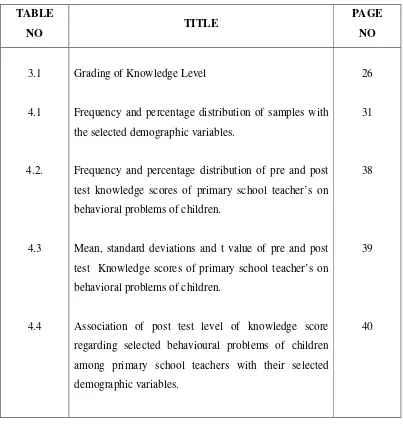
LIST OF TABLES
TABLENO TITLE
PAGE NO
3.1
4.1
4.2.
4.3
4.4
Grading of Knowledge Level
Frequency and percentage distribution of samples with the selected demographic variables.
Frequency and percentage distribution of pre and post test knowledge scores of primary school teacher’s on behavioral problems of children.
Mean, standard deviations and t value of pre and post test Knowledge scores of primary school teacher’s on behavioral problems of children.
Association of post test level of knowledge score regarding selected behavioural problems of children among primary school teachers with their selected demographic variables.
26
31
38
39
[image:13.612.122.525.86.511.2]LIST OF FIGURES
FIGURE NO
TITLE PAGE
NO 1.1 3.2 3.3 4.1.1 4.1.2 4.1.3 4.1.4 4.1.5 4.1.6
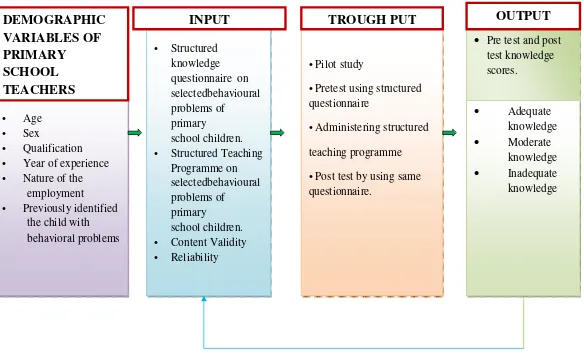
Conceptual Framework based on general system theory by Ludwig Von Bertalanffy, (1968)
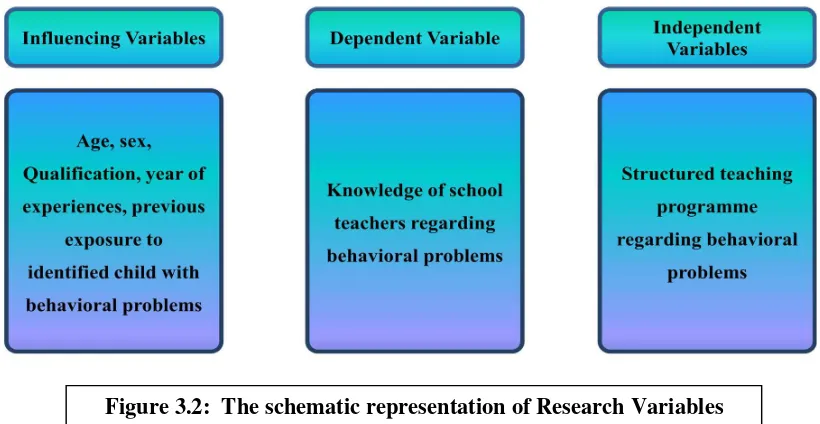
Schematic Representation of Research Variables Schematic Representation of Research methodology Bar diagram showing frequency and percentage distribution of school teachers with age in years Bar diagram shows the frequency and percentage distribution of school teachers with sex.
Bar diagram shows the frequency and percentage distribution of school teachers with educational qualification
Bar diagram shows the frequency and percentage distribution of school teachers with years of experience.
Bar diagram shows the frequency and percentage distribution of school teachers with the nature of the employment.
Bar diagram shows the frequency and percentage distribution of school teachers with previously identify children with behavioral problems.
LIST OF APPENDIX
APPENDIX TITLE
I Letter seeking and granting permission to conduct the study
II Letter requesting expert’s opinion for content validity. III List of experts given opinion for content validity IV Evaluation criteria check list for content validity
V Evaluation criteria check list content validity- Tool-II- Demographic variables
VI Letter seeking consent for participants in this study VII Certificate for English Editing
VIII Tool-I Demographic variables& background information
IX Tool- II Structured questionnaires in English and Scoring key for knowledge variables
1
CHAPTER - I
INTRODUCTION
“Children are the wealth of tomorrow;
Take care of them if you wish to have a strong India”
-Pandit Jawaharlal Nehru
Behavior means all the convert and overt activities of human beings that can be observed. Behaviors may be classified as cognitive, affective and psychomotor, cognitive refers to knowing, effective refers to feeling and psychomotor relates to doing (Bimla Kapoor, 1996).
Behavioral problems can be more challenging than attendance or performance problems with these types of problems a gradual or progressive process to get improvement can be successful. The emotional environment of a young child consists of an entire relationship of the child with their parents and family members. Behavioral problems are less common when the child is loved, accepted and who is living in favorable environmental conditions (K.P. Neeraja, 2000).
Behavioral problems are the reactions and clinical manifestations which are resulting due to emotional disturbances or environmental maladjustments. The term behavior problems cover a range of workplace issues, including the emotional appearance of hygiene problems, insubordination verbal abuse, physical abuse or violence (K.P. Neeraja, 2000).
School age is the period of 6-12 years. Young scholars are emerging as creative persons who are preparing for their future role in society. The school years are a time of new achievement and new experiences. Individual children’s needs and preferences should be respected.
Danger Signs of Behavioral Disorders Include
2
• Damaging or destroying property • Lying or stealing
• Not doing well in school, skipping school (Saraswathi. K.N)
The main behavioral problems in the primary school children are thumb sucking, nail biting, sleepwalking, temper tantrums, attention deficit hyperactivity disorders, encopresis, enuresis, nightmares, night terrors, antisocial personality, etc. One can notice behavior like this beginning around the child first year; it may happen more and more before the second year. At this age, most children do not yet have good language skills. (BimalaKapoor, 2000).
A teacher is a person who provides student direct classroom teaching, or classroom setting, or educational services directly related to classroom teaching. Teachers play an influencing role in the development of personality, listening to a child’s problem is an important skill of a teacher (Saraswathi. K. N, 2013).
Teachers play the very important role in the early diagnosis of mental health problems, giving reference to medical personnel and also the promotion of mental health among children in their schools. School children will spend their most time with their respective school teachers. The early detection and treatment of children with behavioral problems at an early age may reduce treatment costs and improve the quality of life of those children. An effective way of reducing behavioral problems can be through behavior plan developed by parents, teachers, children administrators and school staff (Saraswathi. K. N, 2015).
1.1. BACKGROUND OF THE STUDY
3
Besides the increase in the number of children seeking help for emotional problems, over the years, the type of problems has also undergone a tremendous change.
Children are mirrors of a nation. They are our future and our most precious resources. The quality of tomorrow’s world and perhaps even its survival will be determined by the well-being, safety and the physical and intellectual development of children today. To predict the future of a nation, it has been remarked, one need not consult the stars; it can more easily and plainly be read in the faces of its children.
The planned teaching programme will be positively influenced on primary school teachers to know more about the behaviour indicating emotional problems among children who manifest complex psychopathology characterized by attachment difficulties, relationship insecurity, sexual behavior, trauma-related anxiety, conduct problems, defiance, inattention/hyperactivity, and less common problems such as self-injury and food maintenance behaviors.
Behavioral and emotional problems in primary school-aged children can cause significant difficulties in children's healthy development. For many children, they are also predictive of long-term antisocial behaviors and mental health problems. Some children show symptoms that are consistent with diagnoses of Anxiety, Depression, Oppositional Defiant Disorder (ODD), Attention-Deficit Disorder (ADHD), and Conduct Disorder (CD) (American Psychiatric Association, 1994). As well as causing significant distress for children and families during their childhood, children with emotional and behavioral problems face an increased risk of low self-esteem, relationship problems with peers and family members, academic difficulties, early school leaving, adolescent homelessness, the development of substance abuse issues and criminality. A child’s personality is considerably influenced by the character and conduct of their parents. Surveys reveal that the parents are often more concerned about their behavior than about their physical well being (Robbinowits, 2011).
4
socially, culturally and developmentally appropriate. Knowing what to expect from the child at each will help to decide whether his or her behavior is normal.
During childhood, the child undergoes a remarkable transformation from a helper, dependent infant to an independent self-sufficient individual with his own views and outlooks. Everyone wishes their children to be well behaved. But some amount of behavior problems occurs among children in the age group of 6-12 years. These psychological disturbances in the childhood are usually defined as an abnormality in at least one of these areas, emotions, behavior or relationship
(Roberts, 2002).
David (2016) stated that behavioral problems commonly occur duringchildhood. It is defined as thoughts or feelings which differ quantitatively from the normal and as a result of this difference the child is either suffering significantly or development is being significantly impaired.
All children misbehave sometimes, but behavioral disorders go beyond mischief and rebellion. Warning signs can include harming or threatening themselves, other people or pets, damaging or destroying property lying or stealing, not doing well in school, skipping school, early smoking, drinking or drug use, and frequent tantrums and arguments (Haydon, 2005).
Jacoby (2016) conducted a study in Ethiopia and revealed that the prevalenceof childhood behavioral problems is 17.7%. behavior problem is found to be more common in boys than in girls. The prevalence increases with age.
5
1.2 NEED FOR THE STUDY
Health Promotion of India (2000) stated that one-third of the population inIndia are school-age children; out of this 14% belong to the age group of 6-10 years of which 99% is primary education.
Conduct disorder is seen inappropriate 5-8% of the general child population. In that review of prevalence indicated that the estimated rate of conduct disorder in children aged 4-18 years have ranged from 2-6% conduct disorder in youth under the age of 18. And school refusal also occurs at all ages appropriately 1-5% of all school-aged children. The average age of onset is 7.5 years and 10.5 years (American PsychiatryAssociation, 2000).
According to Erikson the developmental needs of the children between 6-12 years is industry Vs inferiority. Active participation in the daily activities helps the child to fulfill the developmental tasks.If the developmental task is not attained; there is a risk for behavioral problems (Health promotion of India, 2017 ).
Studies conducted on the prevalence of behavioral problem in India and neighboring countries showed that there are behavioral problems existing among school children and are quite common. These behavioral problems are not often identified in school setting due to lack of awareness of school teachers on a behavioral problem or lack of awareness of mental health service. The disturbed characteristics in their behavior are through not affecting much presently, it will, of course, affect individual, family, and society as a whole later. The early identification and management is the best way to present them from harming self and society.
Statistical Information regarding Behavioral Problems:
• Night terrors will be observed in 3% of children up to 1-8 years of age.
• Nightmares occur 10-50% of children who have ages between 3-5 years • Temper tantrums occur in 20-25% in 2-12 years of age. It is common up to
6
• 15 % of children between the age of 5-10 years are known to be enuretic
wet only during the night while 15% during night and rest during the day only.
• The prevalence of encopresis among children is 4 to 8 %. There is
important to identify certain cases, mental illness is exhibited in the form of behavioral problems (M.S. Bhatia 2004).
A report prepared by the National Institute of Mental Health and Neurological Sciences (NIMHANS) on District Mental Health Programme highlights the need for the school mental health programme along with teaching school teachers regarding identifying and managing the behavioral problem.
Behavioral problems in the classroom can interfere with instruction, child development, and academic achievement. Yet, many teachers do not have the training they need to deal with behavior problems. Now, University of Missouri researchers will use a $2.9 million grant from the U.S. Department of Education's Institute of Education Sciences to evaluate the effectiveness of a video training program designed to help teachers understand and react effectively to behavior issues (Barbara, 1995).
Every individual has the right that his physical, social and emotional needs should be satisfied in society as well as in classroom environments. The desire to be accepted and protected during childhood is natural. He or she needs help for adjusting. This is his/her right that s/he should be provided with an environment in which his/her natural capabilities flourish so that she may become a useful member of the society.(Nabi Bux Jumani, 2012)
7
can contribute to the promotion of the learning process and develop student’s personalities positively by understanding individual behavior (Nabi Bux Jumani, 2012).
Students with emotional disturbance and behavioral problems exhibit a wide range of characteristics. The intensity of the disorder varies, as does the manner in which a disability or problem presents itself. While some students have mood disorders, such as depression, others may experience intense feelings of anger or frustration. Further, individual students react to feelings of depression, anger or frustration in very different ways. For example, some students internalize these feelings, acting shy and withdrawn; others may externalize their feelings, becoming violent or aggressive toward others (Mary Magee Quinn, 1996).
School teacher is the second mother to every child. So children listen to every point that the teacher teaches, the unhealthy child cannot be expected to take full advantage of schooling. Health education must remain mainly in the hands of the teacher and the school health workers. Health education is a part of general education. A growing understanding of the physical, mental, emotional and normal nature of the children is the essence of professional teaching ability. Behavioral problems are widely prevalent in some school children (Bhatia M.S, 1996).
8
It is estimated that the prevalence of behavioral problems in children has increased over the past two decades to more than 10%.this number is considerably higher among school-age children that live in an at-risk environment (Holland, 2013)
Taylor (2014) described that sleep problems, temper tantrums, hyperactivedisorder and toilet training are the most prevalent behavior problems among school going children. The parents and caregivers who have difficulties can be empowered to promote their self-confidence by conducting various education programs.
Kaufman (2013) revealed that childhood maltreatment is a nonspecific riskfactor for a range of different emotional and behavior problems. A three-generation longitudinal study of the interthree-generational transmission of child abuse was also highlighted and it was found the association of genetic, environmental risk and protective factors at home and school with childhood behavior.
Early recognition can prevent behavioral problems from severe what’s more, considering the strong relationship between childhood social and emotional problems and later delinquency and criminality, early interventions may reduce the staggering social costs associated with criminal behavior (Mendez, 2016).
Behavioral problems are first brought to the attention of parents by teachers or school officials. Children who are easily distracted, unwilling or unable to cooperate with school rules, or are disruptive to classroom activities can make it difficult not only for teachers but also for other students. Parents of children with behavioral problems can work with teachers, child psychologists, and their child to help formulate a plan to help children get the most benefit from the educational process
(Beharmann, 2000).
9
1.3 STATEMENT OF THE PROBLEM
A study to assess the effectiveness of structured teaching programme on knowledge regarding behavioral problems of children among primary school teachers in selected schools at coimbatore.
1.4 OBJECTIVES
• To assess the level of knowledge regarding behavioral problems of
school children among primary school teachers.
• To deliver a structured teaching program on knowledge regarding
behavioral problems of children among primary school teachers.
• To evaluate the effectiveness of structured teaching program on
knowledge regarding behavioral problems of children among primary school teachers.
• To find out the association between the knowledge regarding behavioral
problems of children among primary school teachers with selected demographic variables.
1.5 HYPOTHESIS:
• H1: There will be a significant difference between pretest and post-test
knowledge scores on knowledge regarding behavioral problems of children among primary school teachers in selected schools.
• H2: There will be a significant association between post-test
knowledge scores and selecteddemographic variables.
1.6 OPERATIONAL DEFINITIONS
1.6.1 Assess
10
1.6.2 Effectiveness
In this study, it refers to find out a desired or intended result of structured teaching programme regarding behavioral problems among primary school teachers.
1.6.3 Structured Teaching Programme
It refers to a systematically planned group of instructional design to provide information regarding behavioral problems among primary school teachers.
1.6.4 Behavioral Problems
In this study, behavioral problems mean abnormal developmental characteristics of children. It includes habit problem, problems of movements, problems of speech, problems of sleep, problems of toilet training, conduct disorder, problems of schooling and psychosomatic problems
.
1.6.5 Primary School Teachers
This refers to the professionals who have completed the diploma or related degree in education, certified by the Tamilnadu government who imparts knowledge from 1st to 5th standard.
1.7 ASSUMPTIONS
• Primary school Teachers have inadequate knowledge regarding the
management of behavioral problems of school children.
• Primary School teacher’s knowledge regarding behavioral problems
will help them to recognize and detect the disorders among the school children at an early stage.
11
1.8 DELIMITATIONS:
• Teachers who are working at St Mary’s Public School and Saran
Public School.
• Who are willing to participate in the study. • Who are available at the time of data collection.
1.9 LIMITATIONS:
• The size of the sample only 40 hence the finding should be
generalized with caution.
• The study was limited to one month, improvement in knowledge takes
place slowly.
• The study can be generalized was limited to the teachers of a selected
school, hence, the findings can be generalized only to the selected schools.
• The study did not use any control group. There was a possibility of a
threat to internal validity, such as events occurring between pretest and posttest session like mass media or other people can influence the primary school teacher’s knowledge.
1.10 PROJECTED OUTCOMES
The study will enable the investigator to know :
• How to improve the knowledge of school teachers regarding the management of behavioral problems of school children other than Structured teaching programme.
• How to give training to the teachers related to the management of children with behavioral problems.
12
1.11 CONCEPTUAL FRAMEWORK
The conceptual framework enables the researcher to create a distinctrelationship between theoretical and empirical literature in addressing spiritual care in nursing practice (Christenson, 2007)
The present study aims at developing and evaluating structured teaching programme in improving the knowledge regarding behavioural problems of primary school children.
The conceptual model for the study was based on the general system theory by Ludwig Von Bertalanffy (1969). In this theory, the main focus is on the discrete parts and their interrelationship. Which consist of input, throughput and output.
Input
It is the first phase in the system. Based on Ludwig Von Bertalanffy input canbe an information, material or energy that enters the system. In this study input is considered to be information related to selected behavioural problems among primary school children. It includes,
• Development of the structured questionnaire regarding selected behaviouralproblems among primary school children.
• Development of the structured teaching programme on selected behaviouralproblems.
• Validity, Reliability.
Throughput
It refers to the process by which the system processes input and release an output. In this study the throughput considered for the processing the inputs are,
• Pilot study
• Pretest by using the structured questionnaire
• Administering a structured teaching programme on selected behaviouralproblems
13
Output
It refers to energy, matter and information that leave a system. In the present study out put is considered to be the gain in knowledge obtained through the processing of the post test. It will be received in the form of post test knowledge scores.
14
CHAPTER – II
• Pre test and post test knowledge scores.
• Pilot study
• Pretest using structured questionnaire
• Administering structured teaching programme • Post test by using same questionnaire.
• Structured knowledge questionnaire on selectedbehavioural problems of
primary
school children. • Structured Teaching
Programme on selectedbehavioural problems of
primary
school children. • Content Validity • Reliability • Age
• Sex
• Qualification • Year of experience • Nature of the
employment
• Previously identified the child with behavioral problems
INPUT
TROUGH PUT
OUTPUT
[image:29.792.99.683.132.490.2]DEMOGRAPHIC
VARIABLES OF
PRIMARY
SCHOOL
TEACHERS
• Adequate knowledge • Moderate knowledge • Inadequate knowledge15
CHAPTER II
REVIEW OF LITERATURE
Review of literature is a critical summary of research on a topic of interest generally prepared to put a research problem is content to identify gaps and weakness is prior studies so as to justify a new investigation (Polit and Beck, 2010)
The researcher presents the review of related literature which helps the studying of problems in depth. It also serves as a valuable guide to understanding what has been done, what is still unknown and untested.
Review of literature is a critical summary of research on a topic of interest generally prepared to put a research problem is content to identify gaps and weakness is prior studies so as to justify a new investigation (Polit and Beck, 2010)
The literature review is discussed as under the following headings:
2.1 Section – A: Review related to behavioral problems
2.2 Section – B: Review related to the school teacher’s knowledge regarding behavioral problems
2.3 Section – C: Review related to structured teaching programme regarding behavioral problems
2.1 SECTION – A:LITERATURE REVIEW RELATED TO BEHAVIORAL PROBLEMS:
16
disorders using the Rutter scale for teachers (Scale B (2) and their matched-controls were selected. Their academic performance was assessed and compared using the overall scores achieved in the first and second term examinations in the 2005-2006 academic sessions, as well as the scores in individual subjects. The number of days absent from school was documented. While 26.5% and 12.9% of pupils with behavioral disorders had high and poor academic performance respectively, 38.6% and 9.1% of pupils without such disorders had high and poor performances respectively. Behavioral disorders are associated with poor academic performance in school children in the USA.
N C Niranjan (2012) a cross-sectional study was carried out among 572people from six primary schools selected randomly from private and government schools in the USA. Peoples with a normal IQ were selected using a systematic sampling method. The Rutter behavioral scale for teachers (b2) was completed by their teachers, to determine the prevalence and pattern of behavioral problems among children living in the USA, a town in south-south Nigeria methods. According to the ‟
scale 132 pupils (23.1%) had scored within the range indicating behavioral problems. She finds out that there is a high prevalence of behavioral problems among primary school children in the USA.
17
systematic random sampling. At Saudi Arabia. Data were collected using two types of questionnaires: the modified Arabic version of the Attention Deficit Disorders Evaluation Scale (ADDES) school version, and Parents' questionnaire to diagnose the three main subtypes of ADHD namely: inattention, hyperactivity-impulsivity, and combined ADHD. The majority of the boys were from government schools (83.0%), were of age 6-<9 years (40.5%) and of Saudi nationality (80.7%). The overall prevalence of combined ADHD was 16.4%, with a prevalence of 12.4% of hyperactivity-impulsivity and 16.3% for inattention disorders respectively. The study also revealed a variety of family factors to be significantly associated with the development of ADHD. The prevalence of each subtype of ADHD was higher if the child was the 6th one in the family.
Woo BS, et, al (2015) conducted a study in Singapore on Emotional andbehavioral problems in Singaporean children based on parent, teacher and child reports. The Child Behavior Checklist (CBCL), Teacher Rating Form (TRF) and child report questionnaires for depression and anxiety were administered to a community sample of primary school children. 60 Parents of a sub-sample of 203 children underwent a structured clinical interview. The result was that the higher prevalence of emotional and behavioral problems was identified by CBCL (12.5 percent) than by TRF (2.5 percent). According to parent reports, higher rates of internalizing problems (12.2 percent) compared to externalizing problems (4.9 percent), were found. Correlations between child-reported depression and anxiety, and parent and teacher reports were low to moderate but were better for parent reports than for teacher reports.
18
are selected, and 1,541 students (77.1%) give consent to participate in this study. The aim of this study is to identify Attention Deficit Hyperactivity Disorders among primary school children in the State of Qatar An Arabic questionnaire is used to collect the socio-demographic variables and a standardized Arabic version of the Conners' Classroom Rating Scale for ADHD symptoms of the students surveyed, 51.7% are males and 48.3% females. The data reveal that 112 boys (14.1%) and 33 girls (4.4%) scored above the cutoff for ADHD symptoms, thus giving an overall prevalence of 9.4%. The study reveals that ADHD is found to be a common problem among school children in Qatar.
PP Panda (2016) a cross-sectional observational study was carried out inprimary school children of the slum-dwelling area of Kathmandu Valley which included 454 students. The aim of the study was to find out morbidity inhabit disorders in the age group of 6-10 years, so that early detection will be helpful to correct them to prevent it from further personality maladjustment. There was no statistical difference in gender wise habit disorders. The morbidity is due to multiple factors of physic- social environment. However, the severity of disease is not more here in this area.
19
(17%), and enuresis (20.3%) were detected to be the main behavioral problems in children. Close co-operation between school teachers, parents, and healthcare providers is suggested to ensure the healthy development of children.
Bose, V.S. (1999) study was to examine the nature of behavioral problemsmanifested by children at each class level. 837 children (410 girls and 427 boys) between the age of 6-11 years from Classes I - V studying in an English medium school were the subjects of the study. A behavioral problem checklist including Attention, Disciplinary, Academic and Emotional problems, etc. was developed for use by teachers in a classroom setting. The average occurrence of each problem was calculated by dividing the frequency of occurrence by the sample size. Results revealed that the most prevalent types of problems that were faced by teachers at the primary school level were those related to attention, study, discipline and emotional problems.
20
2.2 Literature review Related to Teachers Knowledge Regarding Behavioral Problems
Lindsay G, et.al, (2017) conducted a study in the UK on Longitudinal patterns ofbehavioral problems in children with specific speech and language difficulties A sample of children with SSLD was assessed for BESD at ages 8, 10 and 12 years by both teachers and parents. Language abilities were assessed at 8 and 10 years. Results showed: High levels of BESD (Behavioral, emotional and social difficulties) were found at all three ages, but with different patterns of trajectories for parents' and teachers' ratings. Language ability predicted teacher- but not parent-rated BESD. So study result that there is a need of education for care of children with behavioral problems.
21
Parathasarathy R (1994) conducted a study on school teacher’s knowledge,attitudes and practices on childhood developmental and behavioral disorders in Singapore. 503 preschool teachers are evaluated, most aged 30-44 years with experience of‟ 6years. As a result, a pass rate in know1edge achieved in 50%with overall median total scores of 50. Antis tic spectrum disorder, 6% attention deficit, 68% and hyperactive disorder, 32%, at last, they concluded that this study demonstrated an educational deficit in childhood developmental and behavioral disorder among our - school teachers.
2.3 Literature review Related to Structured Teaching Programme Regarding BehavioralProblems
Deelip Natekar (2013) conducted a study to assess the knowledge of primaryschool teachers regarding behavioral problems and their prevention among children in Bangalore. The self-administered structured questionnaire was prepared and administered to 50 primary school teachers between 1-7th standard based on purposive sampling technique. The outcome of this study was shown that the teachers are getting the adequate knowledge regarding behavioral problems.
Priyesh Bhanwara (2015) described that the planned teaching is effective inincreasing the knowledge regarding behavioral problems. The study was conducted in selected schools in Pune city. The samples were teachers, both male and the female sample size was 60.non convenient purposive sampling technique was used.The results were teachers are getting the adequate knowledge regarding behavioral problems.,
22
mental health referral, and 88% reported that the education programme reduces the likelihood suspensions and expulsion.
Syed, et.al, (2016) conducted a community study based on developinga programme to train sensitize and mobilize the parents to manage a child’s psychological emotional and behavioral problems. A total of 675 parents participated in that study and he found that the training programme was effective for reducing behavioral problems.
23
CHAPTER - III
RESEARCH METHODOLOGY
3.1 INTRODUCTION
This chapter explains the methodology adopted by the researcher to assess the effectiveness of structured teaching programme on behavioral problems among primary school teachers of selected schools at Coimbatore. It deals with research approach, research design, a setting of the study, population, sample size, sampling technique, criteria for selection of the sample, description of tools, testing of the tool, pilot study, data collection procedure and plan for data analysis.
3.2 RESEARCH APPROACH
A quasi-experimental approach, a subtype of quantitative approach was used for the study. Quasi-experiment involves the manipulation of independent variables that are implementing an intervention.
3.3 RESEARCH DESIGN
One group pre-test post-test research design was adapted for this study. It involves the randomization, manipulation of independent variables that is by implementing an intervention.
Q1 Pre-test assessment X Intervention
24
3.4 RESEARCH VARIABLES
[image:39.612.126.557.61.221.2]The Independent variables were structured teaching programme on behavioral problems among primary school teachers. The dependent variable is the knowledge among primary school teachers regarding behavioral problems and the influencing variable is demographic variables.
Figure 3.1: The schematic representation of Research design
[image:39.612.127.537.388.600.2]25
3.5 SETTING OF THE STUDY
The study was conducted in Mews Matriculation School located at Podanur, Coimbatore and which have a total strength of 469 students in primary classes and 45 teachers.
3.6 POPULATION
The accessible population includes the primary school teachers at selected schools in Coimbatore.
3.7 SAMPLES AND SAMPLE SIZE
The sample size included in the study consists of 40 primary school teachers.
3.8 CRITERIA FOR SELECTION OF SAMPLES
3.8.1 Inclusion Criteria
Both male and female teachers.
Teachers who are willing to participate in this study
3.8. 2 Exclusion Criteria
Teachers who have attended previous behavioral classes
The teachers who are not available at the time of data collection
3.9 SAMPLING TECHNIQUE
The samples were selected by using Purposive Sampling Technique; it is a type of probability sampling method.
3.10 Description of the Tool
26
Section –A Demographic Variable
It includes age, sex, nature of employment, years of experience, qualification, previous children identified with behavioral problems
Section – BStructured Questionnaire
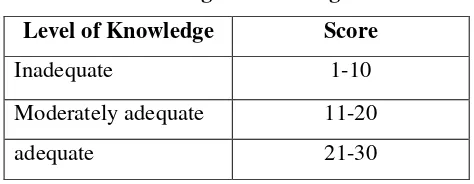
[image:41.612.216.453.332.424.2]To assess the knowledge regarding behavioral problems. It contains 30 multiple choice questions to assess knowledge regarding behavioral problems among primary school teachers. Each question has 4 options in which one option is correct and the other three options are wrong. Each correct answer carries one mark, the wrong answer carries a zero mark, the possible maximum mark is 30 and the minimum score is zero.
Table 3. 1: Grading of Knowledge Level Level of Knowledge Score
Inadequate 1-10
Moderately adequate 11-20
adequate 21-30
3.11 TOOL VALIDITY AND RELIABILITY
3.11.1 Content Validity
The tool was given to five experts in the field of psychiatric nursing and psychiatrist for content validity. All the comments and suggestions given by the expert were duly considered and correction was made after discussion with the research guide.
3.11.2 Reliability
27
3.12 PILOT STUDY
The pilot study was a trial run for a major study to test the reliability, practicability, appropriateness, and flexibility of the study and the tool. A pilot study was conducted from 11/12/17 to 1/12/17 in St Mary’s Public school, which is located at Pour. The sample size was 5 of primary school teachers. Prior to the study, formal permission was obtained from the principal of the school of St Mary. Knowledge of primary school teachers was assessed by using a structured questionnaire. Structured teaching programme was given for three days from 12/12/17 to 15/12/17. The post-test assessment was carried out from 18/12/17 to 20/12/18 by using the same questionnaire. The pilot study finding revealed that there was a significant increase in the knowledge of primary school teachers after the structured teaching programme. Pilot study shows there is a feasibility of the research project.
3.13 DATA COLLECTION PROCEDURE
The study was conducted for a period of four weeks from 01.01.2018 to 30.01.2018.
The researcher explained the purpose of the study in a compassionate manner and informed consent was taken from the teachers 40 samples were selected from the school by using purposive sampling technique. The first phase of data collection was conducted in St Mary’s Public School with 20 samples. The knowledge was assessed by using a structured questionnaire.After that structured teaching programme was given to the primary school teachers regarding behavioral problems. After a period of 14 days, the post-test was conducted using the same questionnaire to determine the extent of the effects of STP.
28
3.14 PLAN FOR DATA ANALYSIS
The data analysis was done by using descriptive statistics and inferential statistics.The demographic variables were analyzed by using the frequency and percentage.The effectiveness of structured teaching programme regarding behavioral problems and an association between demographic variables was analyzed byusing “t’’ test and X2test respectively.
3.15 ETHICAL CONSIDERATION
29
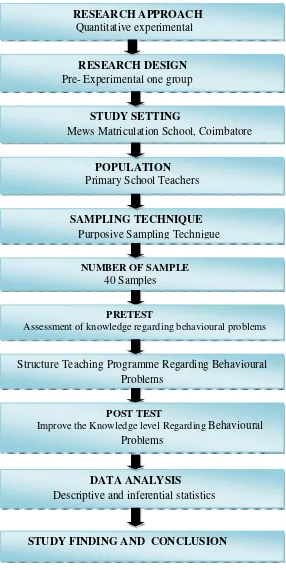
[image:44.612.232.518.69.639.2]Fig: 3.3 SCHEMATIC REPRESENTATION OF RESEARCH METHODOLOGY
RESEARCH APPROACH
Quantitative experimental
SAMPLING TECHNIQUE
Purposive Sampling Technigue STUDY SETTING
Mews Matriculation School, Coimbatore
Structure Teaching Programme Regarding Behavioural Problems
DATA ANALYSIS
Descriptive and inferential statistics POPULATION
Primary School Teachers
NUMBER OF SAMPLE
40 Samples
STUDY FINDING AND CONCLUSION
RESEARCH DESIGN
Pre- Experimental one group
PRETEST
Assessment of knowledge regarding behavioural problems
POST TEST
30
CHAPTER – IV
DATA ANALYSIS AND INTERPRETATIONS
This chapter deals with the analysis and interpretation of the data collected from the primary school teachers regarding the knowledge on behavioral problems of children in selected schools at Coimbatore.Analysis and interpretation of data were tested based upon the objectives and hypothesis of the study.
The findings, based on the description an inferential analysis are tabulated as follows
Section – I: Distribution of demographic variables of primary school teachers
Section - II: Description regarding the knowledge of primary school teacher’s on behavioral problems of children.
Section-III: Comparison of Statistical value of pre-test and post-test knowledge scores of primary school teacher’s on behavioral problems of children.
31
Section I: Distribution of demographic variables of primary school
teachers
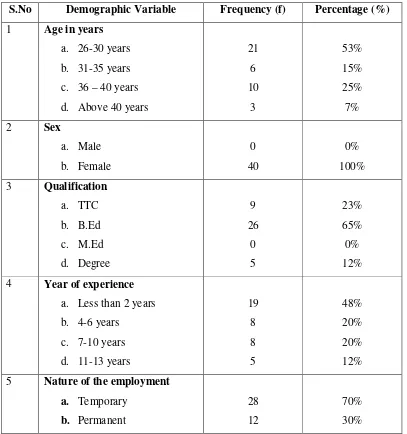
Table: 4.1 Frequency and percentage distribution of samples with the selectedDemographic variables
n= 40 S.No Demographic Variable Frequency (f) Percentage (%)
1 Age in years
a. 26-30 years b. 31-35 years c. 36 – 40 years d. Above 40 years
21 6 10 3 53% 15% 25% 7%
2 Sex
a. Male b. Female 0 40 0% 100% 3 Qualification
a. TTC b. B.Ed c. M.Ed d. Degree 9 26 0 5 23% 65% 0% 12% 4 Year of experience
a. Less than 2 years b. 4-6 years
c. 7-10 years d. 11-13 years
19 8 8 5 48% 20% 20% 12% 5 Nature of the employment
[image:46.612.121.528.275.709.2]32
6 Previously identified the child with behavioral problems
[image:47.612.154.553.162.531.2]a. Yes b. No 14 26 35% 65%
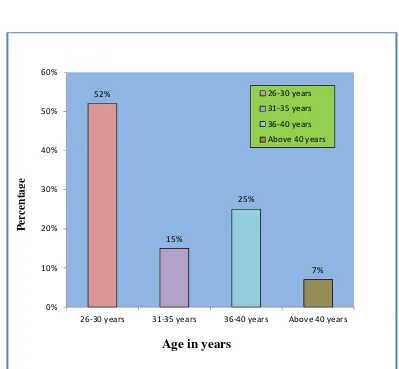
Fig: 4.1.1 Bar diagram shows the frequency and percentage distribution of school teachers with age in years.
The given bar chart reveals that with regard to the distribution of age of school teachers, 21 (52.5%) belongs to 26-30 years, 6 (15%) belonged to 31-35 years 10 (25%) were belongs to 36-40 years, 3 (7.5%) belonged to <40 years.
52% 15% 25% 7% 0% 10% 20% 30% 40% 50% 60%
26-30 years 31-35 years 36-40 years Above 40 years
Age in years
26-30 years
31-35 years
36-40 years
Above 40 years
P
er
ce
n
33
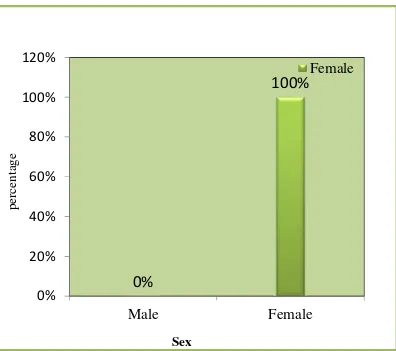
Fig: 4.1.2 Bar diagram shows the frequency and percentage distribution of school teachers with sex.
This bar diagram shows that while considering the sex of all primary school teachers who had participated in this study 40 (100%) were female.
0%
100%
0%
20%
40%
60%
80%
100%
120%
Male
Female
Sex
Female
p
er
ce
n
ta
g
34
Fig: 4.1.3 Bar diagram shows the frequency and percentage distribution of school teachers with educational qualification.
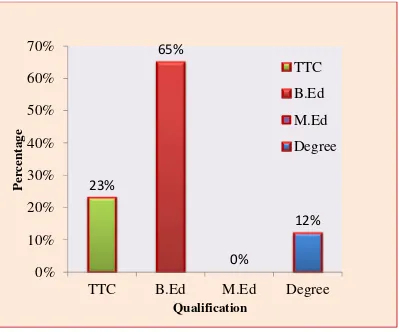
This bar chart shows that about qualification of teachers 9 (22.5%) teachers were completed TTC, 26 (65%) were completed B.Ed, and 5 (12.5%) were completed degree.
23%
65%
0%
12%
0%
10%
20%
30%
40%
50%
60%
70%
TTC
B.Ed
M.Ed
Degree
[image:49.612.130.529.66.398.2]35
Fig: 4.1.4 Bar diagram shows the frequency and percentage distribution of school teachers with years of experience.
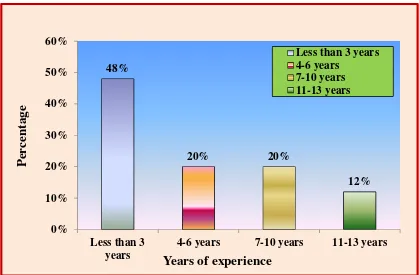
Looking to the years of experience, this bar char shows that 19 (47.5%) were having below 3 years of experience, 8 (20%) were having 4 bytes of experience, 8 (20%) were having 7-10 years and 5 (12.5%) were having 11-13 years of experience.
48% 20% 20% 12% 0% 10% 20% 30% 40% 50% 60%
Less than 3 years
4-6 years 7-10 years 11-13 years
Years of experience
[image:50.612.129.548.104.379.2]36
Fig: 4.1.5 Bar diagram shows the frequency and percentage distribution of school teachers with nature of the employment.
In the nature of employment the bar diagram reveals that 28(70%) of the teachers are temporary and 12(30%) of the teachers are permanent employees of the school.
70%
30%
0% 10% 20% 30% 40% 50% 60% 70% 80%
Temporary Permanent
Nature of the employment
Tempor aryP
er
ce
n
ta
g
37
Fig: 4.1.6 Bar diagram shows the frequency and percentage distribution of school teachers with previously identify children with behavioral problems.
This bar diagram explains with regard to the teachers who previously identified the child with behavioral problems were 14 (35%), and 26 (65%) teachers did notpreviously identify children with behavioral problems.
35%
65%
0% 10% 20% 30% 40% 50% 60% 70%
Yes No
Previously identified child with behavioural problem
YesNo
P
er
ce
n
ta
g
[image:52.612.125.521.107.417.2]38
SECTION – II
[image:53.612.138.509.191.310.2]Description regarding the knowledge of primary school teacher’s on
behavioral problems of children.
Table: 4.2 Frequency and percentage distribution of pre and post test knowledge scores of primary school teacher’s on behavioral problems of children.
n =40
Level of Knowledge
Inadequate Moderately adequate Adequate
F % F % F %
Pre test 3 7.5 35 87.5 2 5
Post test 0 0 4 10 36 90
39
SECTION - III
[image:54.612.146.524.232.335.2]Comparison of pre-test and post-test knowledge scores of primary
school teacher’s on behavioral problems of children.
Table 4.3 Mean, standard deviations and t value of pre and post test Knowledge scores of primary school teacher’s on behavioral problems of children.
n = 40
S.NO KNOWLEDGE MEAN SD t’ VALUE
1 Pretest 14 3.72
14.02*
2 Post-test 25.29 3.12
*significant at 0.05 level
40
SECTION – IV
[image:55.612.122.529.233.685.2]Association of demographic variables with the post-test score of knowledge regarding behavioral problems of children among primary school teachers.
Table-4.4: Association of post test level of knowledge score regarding selected behavioural problems of children among primary school teachers with their selected demographic variables.
n=40
S.No Demographic Variables Above Mean Below Mean X2
1 Age in years
e. 26-30 years f. 31-35 years g. 36 – 40 years h. Above 40 years
5 7 12 1 9 1 3 2 8.55*
2 Sex
c. Male d. Female 25 0 15 0 1.25
3 Qualification
e. TTC f. B.Ed g. M.Ed h. Degree 8 15 0 2 2 9 0 4 2
4 Year of experience
e. Less than 2 years f. 4-6 years
g. 7-10 years h. 11-13 years
12 4 4 5 7 3 3 2 0.74
41
6 Previously identified the child with behavioral problems
c. Yes d. No
15 9
11 5
4.02*
* significant
The study shows that there is a significant association between the age of the primary school teachers and previously identified child with behavioral problems with the knowledge of the post-test score is significant at 0.05 level.
42
CHAPTER – V
RESULTS AND DISCUSSION
This is a pre-experimental study indented to evaluate the effectiveness of structured teaching programme regarding behavioral problems among primary school teachers at selected schools in Coimbatore. The results of the study are discussed according to the objectives.
The First Objective of the Study to assess the level of knowledge regarding behavioral problems of children among primary school teachers.
Structured questionnaire was used to assess the pretest score of knowledge regarding behavioral problems among primary school teachers. During the pre-test 3 (7.5%) teachers showed inadequate knowledge, most of the teachers 35 (87.5%) demonstrated moderately adequate knowledge and 2 (5%) adequate knowledge regarding behavioral problems.
Joshua Yeldose (2010) conducted a study to assess the effectiveness of structured teaching programme regarding behavioral problems among primary school teachers. The study conducted among 40 teachers. The study revealed that teaching was effective in increasing the level of knowledge and practice of teaching.
The Second Objective of the Study was to deliver a structured teaching program on knowledge regarding behavioral problems of children among primary school teachers.
43
Vekidesh K (2015) conducted a study to assess the knowledge of primary school teachers regarding behavioral problems and their prevention among children in Kolkata. The self-administered structured questionnaire was prepared and administered to 50 primary school teachers between 1-7th standard based on purposive sampling technique.
The Third Objective of the Study was to evaluate the effectiveness of structured teaching program on knowledge regarding behavioral problems of children among primary school teachers.
Structured questionnaire method was used to assess the knowledge among school teachers in selected schools after the structured teaching programme. The mean pretest of score knowledge was 14, SD (3.6) and the mean post-test score of knowledge was 24.35, SD (2.89) for 39 degrees of freedom at the 5% level of significance, the calculated t value 14.02. Hence the calculated t value was more than the expected table value (2.064). It revealed that there was a significant difference between the pre-test and post-test level of knowledge and the hypothesis is accepted.
Pradeesh Bhanwara (2014) described that the planned teaching is effective in increasing the knowledge regarding behavioral problems. The study was conducted in selected schools in Banglore city. The samples were teachers, both male and female. The sample size was 60. The non-convenient purposive sampling technique was used.
The Fourth Objective of the Study was to find out the association between the knowledge regarding behavioral problems of children among primary school teachers with selected demographic variables.
44
CHAPTER - VI
SUMMARY, CONCLUSION, NURSING
IMPLICATIONSLIMITATIONS AND RECOMMENDATION
S
6.1 SUMMARY
The purpose of the study was to help the teachers to improve the knowledge regarding the behavioral problems.
6.1.1 Objectives:
• To assess the level of knowledge regarding behavioral problems of school
children among primary school teachers.
• To deliver a structured teaching program on knowledge regarding behavioral
problems of children among primary school teachers.
• To evaluate the effectiveness of structured teaching program on knowledge
regarding behavioral problems of children among primary school teachers.
• To find out the association between the knowledge regarding behavioral problems of children among primary school teachers with selected demographic variables.
6.1.2 Hypotheses
• H1: There will be a significant difference between pretest and post-test
knowledge scores on knowledge regarding behavioral problems of children among primary school teachers in selected schools.
45
6.1.3 Major Findings of the Study
• The pretest means a score of knowledge was 14.
• The post-test mean score of knowledge among school teachers was 24.35 • The calculated “t” value for knowledge score was 14.02 at 29 degrees of
freedom at 0.05 levels of significance
• There was a significant association between post-test knowledge with age,
previously identified children with behavioral problems.
• There was no significant association between post-test knowledge with sex,
qualification year of experience, the nature of employment.
6.2 CONCLUSION
The calculated “t” value of knowledge score was 14.02 at 29 degrees of freedom at 0.05 levels of significance which indicates the structured teaching programme was effective in improving the knowledge regarding behavioral problems. There was a significant association between post-test knowledge with age, previously identified children with behavioral problems. There was no significant association between post-test knowledge with age, sex, qualification year of experience, qualification year of experience.
6.3 NURSING IMPLICATIONS
46
6.3.1 Nursing Practice
• This study emphasis on improving the knowledge regarding behavioral
problems through educative measures.
• Teaching programme can be conducted for primary school teachers. • More knowledge regarding behavioral problems will help in early
identification of the children with behavioral problems.
• Health education can also provide with media, pamphlets which will help
the client to increase the knowledge regarding behavioral problems among primary school teachers.
• Nurses, active participation in school health programmes by providing
direct and indirect care helps to achieve the goals of health services.
• Teachers deficits in knowledge regarding behavioral problems indicate the
needs for arranging health education session on related topics.
• Nurses should focus on psychiatric rehabilitation in the community setting
by using health teaching regarding behavioral problems.
6.3.2 Nursing Education
• Nurse educator should emphasize more on preparing students to impact
health information to the public regarding behavioral problems.
• The study has clearly proved that a structured teaching programme was
effective in improving the knowledge regarding behavioral problems. To practice this, nursing, personal needs to be equipped with adequate knowledge and practice regarding structured teaching programme.
• The curriculum of nursing education should enable student nurses to equip
themselves with the knowledge of behavioral problems.
• The nursing education should give more importance to the application of
47
6.3.3Nursing Administration
• Nurse as an administrator should take limitation in formulating policies
and protocols for short and long-term health teaching.
• The nursing administration should motivate the subordinate for
participating in various educational programmes and improve their knowledge and skills.
• The administrator serves as a reserved person for young nursing students,
parents and school teachers for proving guidance and counseling for children with behavioral problems
• The nurse administrator has the power to formulate pamphlet and
flashcards for the awareness of behavioral problems among school teachers.
• Cassettes of behavioral problems could be made available to nurse educator in a nursing education institution.
6.3.4Nursing Research
• There is a good scope for the nurse to conduct research in this area, to find
out the effectiveness of various teaching strategies to educate the teachers and the parents
• The effectiveness of the research study can be made by further implication
of the study.
• Can be used for evidence-based nursing practice as a rising trend
6.4 LIMITATIONS
• The study can be generalized was limited to the teachers of a selected
school, hence, the findings can be generalized only to the selected schools.
• The size of the sample only 40 hence the finding should be generalized with caution.
• The study was limited to one month, improvement in knowledge takes
48
• The study did not use any control group. There was a possibility of a
threat to internal validity, such as events occurring between pretest and posttest session like mass media or other people can influence the primary school teacher’s knowledge.
6.5 RCOMMENDATIONS
• A similar study can be conducted in a large group to generalize the study
findings.
• The study can be conducted to assess the attitudes and coping strategy of
school teachers towards children with behavioral problems.
• A comparative study can be done between urban and rural areas.
• A quasi-experimental study can be conducted with a control group for the
effective comparison.
• This study can be conducted as a descriptive study to assess the extent
nature of behavioral problems of primary school children.
• A study can be conducted in term of knowledge, attitude, and practice of behavioral modification among school teachers of primary school children.
• A study can be conducted in the community about the prevalence and
49
REFERENCES Books
Abraham, (2001). Pediatrics. (1st edition). Singapore: Mc. Graw Hill international company.
Alphonsa, Jacob. (1994). Handbook of psychiatric Nursing. (2nd edition). Pune: Vera population
Ann, W (1995). Psychiatric nursing to the hospital and the community.(1st edition). California: Application and large company.
Bahtia, M S. Essentials of psychiatry. (5th editon). New Delhi: CBS Publishers.
Barbara, Johnson. (1995). Child, Adolescent and Family Psychiatric nursing.(2nd edition). Philadelphia: J.B Lippincott publication.
Basavanthappa, B.T (2003). Nursing research. (1st edition). New delhi: jaypee
publishers.
Beharmann, (2000). Text Book of pediatrics. (1st edition) Singapore: Harcouret Are Pvt.Ltd.
Behman, khighan(1998). Essential pediatrics. (2nd edition). Singapore : Harcourt Brace Publishers.
Bhaskar Rao. (2000). Methods of Biostatistics. (2nd edition). Hydrabad: paras publishers.
Bhatia M.S, (1996) A Comprehensive Text book of child and adolescent Psychiatry, New Delhi .CBS publishers and Distributors.
Bimla Kapoor.(2004).Text book of Psychiatry Nursing (II) ; 1st edition. Kumar