City, University of London Institutional Repository
Citation: Li, C.W. (1990). On-line distributed hierarchical control and optimisation of large scale systems. (Unpublished Doctoral thesis, City University London)
This is the accepted version of the paper.
This version of the publication may differ from the final published version.
Permanent repository link: http://openaccess.city.ac.uk/7528/
Link to published version:
Copyright and reuse: City Research Online aims to make research outputs of City, University of London available to a wider audience. Copyright and Moral Rights remain with the author(s) and/or copyright holders. URLs from City Research Online may be freely distributed and linked to.
City Research Online: http://openaccess.city.ac.uk/ [email protected]
On-Line Distributed Hierarchical control and optimisation of Large Scale Systems
By
Chung Wai LI
Thesis submitted for the award of the degree of
Doctor of Philosophy
City University London
Control Engineering Centre
BEST COpy
AVAILABLE
TEXT IN ORIGINAL
IS
1.
2.
3 .
CONTENTS
ACKNOWLEDGEMENTS
DECLARATION
ABSTRACT
SYMBOLS AND/OR ABBREVIATIONS
Introduction
Hierarchical Control and Optimisation of Large Scale
Systems
2.1 Introduction
2.2 Basic Types of Hierarchical Structure
Page
5
6
7
8
9
14
14
15
2.2.1 Multi-strata Hierarchical Structure 16
2.2.2 Multi-layer Hierarchical Structure 18
2.2.3 Multi-echelon (Multi-level) Hierarchical 21
Structure
2.3 Coordination Methods
2.3.1 Interaction Prediction Method (IPM)
2.3.2 Interaction Balance Method (IBM)
2.4 Optimisation Methods
2.5 Summary
Distributed Hierarchical Computer System (DHCS)
3.1 Introduction
3.2 Coordinator (LSI-11/23)
3.3 Local Decision unit (I-MIC)
3.4 Simulated Interconnected ·Process (TR48)
3.5 Summary
24
25
26
27
28
29
29
31
32
33
4 •
5.
6.
Formulation of Control Problem
4.1 Control Problem Formulation
35
35
4.2 Mathematical Model of the Hierarchical Control 40
structure
4.3 Summary 41
On-line Coordination methods
5.1 Introduction
42
42
5.2 Closed-loop Coordination Methods 42
5.2.1 Interaction Prediction Method with Global 43
Feedback (IPMGF)
5.2.2 Interaction Prediction Method with Local 44
Feedback (IPMLF)
5. 2 . 3 Interac::'ion Balance Method with Global 47
Feedback (IBMGF)
5. 2 . 4 Interaction Balance Method with Local
Feedback (IBMLF)
48
5.3 Synchronisation and Interprocess Communication 51
5.4 Asynchronous Iteration for Closed-loop 53
Hierarchical control and Optimisation of
Interconnected Systems
5.5 Summary
Software Development
6.1 Introduction
6.2 Coordinator (LSI-11/23) Software
6.2.1 Program Units
6.2.1.1 Foreground Routines
6.2.1.2 Background Rountines
6.2.1.2.1 Main Program
6.2.1.2.2 Subroutine IBMF23
6.3 Local Decision unit (I-MIC) Software
6.4 Simulated Interconnected Process
6.5 Summary
3
55
57
57
57
58
60
60
61
63 63
68
7 .
8.
simulation Results and Discussion
7.1 Introduction
71
71
72
7.2 Synchronous Local Decision Iteration
7.2.1 Interaction Prediction with Global Feedback 72
7.2.2 Interaction Prediction with Local Feedback 76
7.2.3 Interaction Balance with Global Feedback 77
7.2.4 Interaction Balance with Local Feedback 79
7.3 Asynchronous Local Decision Iteration 81
7.3.1 Interaction Prediction with Local Feedback 81
7.3.2 Interaction Balance with Local Feedback
7.4 Summary of Simulation Results
83
85
86
7.5 Graphical Output of Simulation Results
Conclusions 105
References and Bibliography 109
Appendices 115
A. Local Decision Feasibility set under Constraints 115
B. Coordinator (LSI-11/23) Software Listings 120
C.
B1. Foreground Routines 120
B2. Background Routines 130
B2.1 Interaction Balance with Local Feedback 130
B2.2 Interaction Balance with Global Feedback 147
B2.3 Interaction Prediction with Local Feedback 160
B2.4 Interaction Prediction with Global Feedback 173
Local Decision units (I-MICs) Software Listings 188
C1. Interaction Prediction with Global Feedback 188
C2. Interaction Prediction with Local Feedback 198
C3. Interaction Balance with Global Feedback 207
ACKNOWLEDGEMENTS
I would like to express my greatest appreciation to
my project supervisor, Professor P.D. Roberts for his
inval uable adv ice, guidance and support throughout the
course of my research.
I am also indebted to Mr. D. S . Wadhwani, Dr. I. A.
Stevenson and Dr. J.E. Ellis for their help and valuable discussions in the Computer Control Laboratory.
Also, I would like to thank all members of staff and
friends in the Control Engineering Centre who have contributed to this research.
Finally, I am grateful for the financial support from
the Science and Engineering Research Council.
DECLARATION
ABSTRACT
This research is concerned with the application of closed-loop coordination techniques for on-line steady state optimisation and control of large scale systems
using a micro-computer based system. A two-level
hierarchical computer structure consisting of a
coordinator at the supremal (upper) level and two local decision units at the infimal (lower) level had been
established. Parallel computation were performed at the
local decision unit level once the coordination parameters had been received from the supremal level. A steady state
system model consisting of two interconnected
subprocesses, simulated oy an analogue computer, was used
to investigate the coordination methods for closed-loop
hierarchical control. First-order time constants were introduced to the interaction inputs and the controls within the simulated subprocesses.
Investigations had been carried out to study
closed-loop control using the Interaction Prediction and
Interaction Balance coordination method. Special
attention was given to the study of the problems
associated with synchronisation of the local decision units for closed-loop control. Stability aspects of both coordination methods when subjected to disturbances in the
controls and interconnections had been investigated~
Problems relating to system transient and local. decision asynchronisation, as well as their effects on system stabil i ty and convergence of the two tasks, namely the local decision task and the coordinator task had also been investigated. Methods for dealing with these problems had
been suggested. The sub-optimal i ty, convergency and
robustness properties of each coordination method had been
discussed. This research has demonstrated that the
Interaction Prediction coordination methods are best suited for on-line distributed optimising control of large scale interconnected systems. Using the local feedback scheme, complete decentralisation at the local decision level operated asynchronou.sly can be achieved with the Interaction Prediction coordination method.
c COP DHCS
F
F.
G H
IBM IBMGF IBMLF I-MIC IPM IPMGF
IPMLF
K, (;
L,A
LDU LOP
Q
u
u.
v
y
y. z
SYMBOLS AND/OR ABBREVIATIONS
Control input
Coordinator Optimisation Problem
Distributed Hierarchical Computer System Input/output mapping (model)
Input/output mapping (real system) Constraint set
Interconnection matrix
Interaction Balance Method
Interaction Balance Method with Global Feedback Interaction Balance Method with Local Feedback Industrial MIcro-Controller
Interaction Prediction Method Interaction
Feedback
Prediction Method with Global
Interaction Prediction Method with Local Feedback System gain matrix
Lagrangian
Local Decision Unit
Local Optimisation Problem
Performance index (model)
..
Performance index (real system) SUboptimility
Shift vector
Interaction input (model)
Interaction input (real system) Coordination variables for IPM Interaction output (model)
CHAPTER 1 INTRODUCTION
There has been a growing attention paid to the subj ect area of large scale systems. This comes quite
naturally as many real-life problems of socio-economic,
environmental and technological nature are highly complex,
large in dimension and stochastic in nature. Despite its
generali ty and usefulness, the mul tivariable system
approach is severely limited when applied to problems of high dimension and complex interconnecting structure. For
this reason it is frequently advantageous to view high
order systems as being composed of several lower order subsystems which when interconnected in an appropriate
fashion, yield the original composite or interconnected
system.
Many viewpoints have been put forward to define and
quantify a system as 'large scale'. One viewpoint
considers 'large scale systems' as those whose dimensions
are so large that conventional techniques of modelling,
analysis, control and optimisation are extremely diff~cult
or impossible to give a reasonable solution. Another
.
viewpoint suggests that if a system can be decomposed into a number of interconnected subsystems for computational
and· practical purposes, then such systems are termed as
large scale systems. The latter viewpoint is adopted to
define large scale systems.
Theoretical investigations and researches to develop conceptual framework and mathematical theory to model,
analyse and control these structured, complex, large scale
systems have been carried out since early sixties.
Basically, the main idea behind this approach is the
recognition that complex systems are structured In a
hierarchical order. This approach in fact recommends that
for a mathematical theory to claim to be dealing with
large scale complex systems, the complexity of the real
systems must be reflected in the structure of the model.
Many research papers concerning the theory and methodology
of large scale systems were published throughout the
sixties. In 1970, Mesarovic, Macho and Takahara presented
one of the earliest formal quantitative treatments of
hierarchical (multi-level) systems. Since then, a great
deal of work has been done in this field and many papers
which are based upon these theoretical works have been published and presented in many conferences from different
fields. Many researchers have addressed themselves to
various problems concerned with large scale systems.
Excellent survey papers on the topic of hierarchical
(multi-level) control and optimisation of large scale
systems were given by Mahmoud (1977), Singh (1981,1982).
Roughly speaking, problems concerned with large scale systems may be divided into two broad areas: static
problems and dynamic problems. However, this research is
focussed only on hierarchical optimisation and control of
large scale systems operating at steady state condition.
Because of economic reasons and intensive competition
within the market sector, increasing pressure is stressed
upon industry to improve efficiency and productivity of
in.dustrial plants. A method for the practical
.
implementation of an on-line optimisation and control scheme for an industrial process considers the overall
design as a two layer hierarchical system. This is a form
of optimising control where the lower layer contains
regulatory feedback controllers used to maintain the
system at a steady state operating condition specified by
controller set points. Optimisation is performed in the
upper layer, where a steady state mathematical model 1S
used to compute the optimal values of the controller set
points to maximise the operational efficiency.
Recent techniques specifically consider a large scale
industrial system as a collection of interlinked
sub-systems. Modern computer technology which has resulted in
low cost computer power may then be employed with the
advantage 1n order to employ m1cro or mini-computers,
structure, to coordinate, optimise and regulate individual
decision task and sub-process. When designed carefully
this control strategy has the advantages of reducing
computer storage and computation time accomplished through
parallel processing, increased system flexibility and
reliability, and cheap hardware cost. Furthermore, i t
identifies and organises the information flow through the
system. Thus provides effective use of feedbacks for
control and decision making process which 1.S attractive
for on-line control purposes.
Three problems associated with on-line hierarchical optimisation and control of industrial processes are
considered. Firstly, the behaviour of each process under
control lS not known and the mathematical model
representing the real process is only an approximation.
Secondly, the nature and magnitude of disturbances affecting the real process are stochastic. Lastly, timing problems arise because the real process, the sUb-system
decision units and the coordinator are processing at different speeds. One way to reduce the first two problems
is to use feedback information from real process
measurements. For timing problems, the local decision units at the infimal level should be synchronised with the
coordinator and a simple synchronisation method
"semaphore" has been used.
Since late seventies, several hierarchical control schemes have been suggested for on-line control of steady
state systems by Findeisen (1978,1979), Brdys
(1978,1979), Roberts (1983), Shao (1983). These proposed
schemes were investigated by off-line simulations of
interconnected hierarchical systems. The objective of this
research 1.S to implement some of the proposed schemes
through a distributed control system in order to
investigate the closed-loop hierarchical control of a
simulated interconnected industrial process. The on-line
closed-loop hierarchical control schemes used in this
research are the well-known Interaction Prediction Method
and the Interaction Balance Method wi th local or global
feedback. Implementation problems that may arlse for
different closed-loop hierarchical control and
optimisation of an interconnected system were examined.
study of on-line distributed hierarchical control with the
local decision units operating asynchronisely had also
been performed and implementated with the distributed
hierarchical computer system.
The major contributions of knowledge of this thesis can be summarised as follows. This is the first time that
hierarchical control algorithms (the Interaction
Prediction Method and the Interaction Balance Method with
local or global feeback) have actually been investigated
in a real-time environment. with a suitable
synchronisation scheme, parallel processing at the infimal
level within the hierarchical structure has been achieved.
This greatly reduces the computation time required by the local decision units which again reduces the overall computation time required.
Investigation of the problems relating to on-line
hierarchical control and optimisation of interconnecting
systems have been carried out. These problems are the
transfer lags, measurement errors, subprocess and decision unit failures. An analogue computer was used to simulate
these problems. The transfer lags were simulated by means
of introducing a first order time constant in the controls
and interaction variables. The measurement errors,
subprocess and decision unit failures were simulated by
varying the potentiometers wi thin the analogue computer
that correspond to the controls and the interaction
variables. The stability, convergence and the system
response of the decision problems when subjected to these
problems were examined.
Coordinated by Interaction Prediction Method and the
Interaction Balance Method with local feedback, simulation
studies had been made concerning synchronisation of
subsystem decision units and the effects of
coordinator and local decision optimisation problems.
Interaction Prediction Method with local feedback offers a
stable and converging decision problems while the
Interaction Balance Method with local feedback is very sensitive and becoming unstable when local decision units
are operating asynchronously.
CHAPTER 2 HIERARCHICAL CONTROL AND OPTIMISATION OF LARGE SCALE SYSTEMS
2.1 Introduction
Hierarchical, multi-level system theory was introduced by Mesarovic and his associates (1970) with an objective of establishing a conceptual framework to mathematical theory in order to tackle complex multi-goal decision makir.g
systems. The basic idea behind this theory lS the
recognition
that
many real-life large scale complex systemsare structured in a pyramid-like form. It lS therefore
natural to develop a mathematical model of the structural approach to control these complex systems.
Some key properties associated with hierarchical
systems can be summarised as follows:
a) The decision making units are arranged In a pyramid-like structure;
b) Information flow between varlOUS levels of hierarchy are exchanged' iteratively and (usually) vertically;
c) The objectives of local decision units may be In
conflict which have to be resolved by the coordinator:
d) Time horizon increases as the level of hierarchy goes
up;
e) Existence of a supremal unit.
the
optimisation of large
fact that there is
scale systems
a possibility
lS motivated by
of SUbstantial
economic sav ings which may happen in both the des ign and
operational phases. Both static optimisation (f ini te
dimensional) and dynamic optimisation (infinite
dimensional) techniques are involved In the control of
An essential concept of the hierarchical control and
optimisation approach for complex large scale systems
control is the consideration of the overall control system
as replaced by a set of smaller interdependent sUbsystems.
Each subsystem has to serve a particular function, shares
resources, and is governed by an interrelated objective and
a set of constraints. Subsystems which are in the lowest
(infimal) level of the hierarchy are often called infimal
or local decision units while those in the higher
(supremal) level are referred as coordinator or supremal
units. The obj ecti ves of the subsystems in the inf imal
level are then solved independently under the intervention of a coordinator in the supremal level. The task of the
coordinator is to account for the interconnections and
constraints between the infimal units such that the overall
system obj ecti ve can be represented by the collection of
individual subsystem objectives. Thus, the successful
operation of hierarchical systems is best described by two
processes: decomposition or infimal generation and
coordination or overall objective synthesis.
section 2.2 outlines the basic types of hierarchical
structures. sections 2.3 and 2.4 are concerned with
alternative methods of coordination and optimisation
respectively. Finally, a short summary is given in section
2 • 5.
2.2 Basic Types of Hierarchical structures
Based on the hierarchical systems approach, an overall
complex large scale problem may be decomposed into a
collection of interconnected smaller subproblems arranged
in a hierarchical structure. There are three basic types of
hierarchical structure (Mesarovic 1970), namely,
1) Multi-strata hierarchical structure;
2) Multi-layer hierarchical structure;
3) Multi-echelon (Multi-level) hierarchical structure.
The classification of these hierarchical structures is
based on the decomposition criterion chosen for the overall
complex problem. It should be noted that many real-life complex systems may belong to more than one class of these
hierarchical structures. Also, the operation of each of
these types of hierarchy depends heavily on the information
exchange mechanism between adj acent levels, the explicit
specification of the subproblems and their objectives, and
the proper manipulation of the subsystems activities. The
hierarchical structures and their characteristics will be
outlined in the following sUbsections.
2.2.1 Multi-strata Hierarchical structure
The multi-strata type of hierarchical structure
describes the system by a family of models each concerned
with the behaviour of the system as viewed from a different level of abstraaion. The levels of this type of structure
are often called strata. For each level, there is a set of
relevent features and variables, laws and principles in
terms of which the behaviour of the system is described. It
is necessary that the functioning on any level be as
independent as possible of the functioning on other levels.
The partitioning into strata has the objective of
simplifying the overall complex problem by separating the
problem into a number of smaller, better defined
subproblems each of which is solved separately.
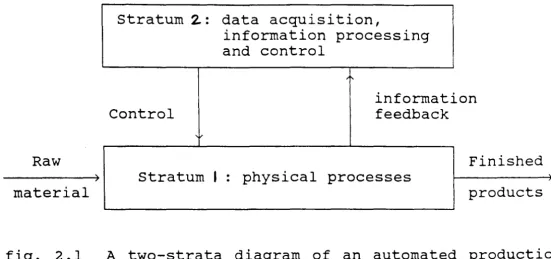
Let us illustrate the stratified description of a
hierarchical structure by an automated production process
Raw
)
material
fig. 2. I
stratum 2: data acquisition,
information processing and control
Control
information feedback
Finished
stratum I : physical processes
products
A two-strata diagram of an automated production
process
These strata are used to deal with the same item, i.e.
the finished product. On the first stratum, the.product is
viewed as a physical obj ect to be changed in accordance
with physical laws. On the second stratum which deals with data acquisition, information processing and control, the same item is viewed as a variable to be controlled and
manipulated. A different model is used for each of these
views of the system.
A Multi-strata hierarchical structure has the
following characteristics,
a) The selection of strata depends upon the observer, his
knowledge and interest in the operation of the system;
b) In general, contexts in which the operation of a system
on different strata described are not mutually related;
the principles used to describe the system on any
stratum cannot generally be derived from the principles
used on other strata;
c) There exists an interdependence between the
functioning of a system on different strata;
d) Comprehension of a system increases by crosslng
.
thestrata: the lower strata are assigned with more detailed
and specialised descriptions while higher strata have a
deeper understanding of its significance.
[image:19.726.79.630.58.317.2]Decomposition on the basis of stratum is not based on
the decomposition of a well-formulated mathematical
programming problem. Therefore, there is no rigorous theory
to justify its performance. This method partitions the
control problem in such a way that it can be solved
sequentially in strata with the result of one stratum
serving as partial input to the other stratum below. Thus
the decision making process possesses the characteristics
of a staged process rather than those of a completely
interacting one.
2.2.2 Multi-layer Hierarchical structure
Mul ti-layer description of a hierarchical system 1S
concerned with levels of decision complexity. The levels of this hierarchy are called layers. Essentially, the idea
behind this hierarchical approach is that one defines a set
of control problems whose solution is attempted 1n a
sequentially manner. The overall control problem is
substituted by a set of sequentially arranged simpler
subproblems so that the solution of all the subproblems in
the set implies the sclutionof the original problem. Within the hierarchy each layer operates at different time
horizons, therefore, multi-layer description may be viewed
as vertical decomposition of control structures.
Multi-layer hierarchical system may further be divided into
two different classes depending on the decomposition
criteria, these are:
a) Functional multi-layer structure decomposition
according to control function;
b) Temporal multi-layer structure decomposition
according to time scale.
As an example of functional mul ti-layer hierarchies,
we consider a functional four-layer control hierarchy under
uncertainties. The four functional control layers are,
self-organisation.
A schematic diagram of a functional four-layer control structure is shown in fig 2.2.
Self organisation
v
Adaptation
,,,
v
optimisation
Regulation
,
,l,-) Industrial process
Flq.2.2 schematIc diagram of a fU[lctioIlal four-layer control structure
Now let us look into the functional aspects of each
layer within the hierarchy.
First layer: This is the regulation or direct control
layer whose task is to maintain the process
variables at prescribed set-point values
under the influence of disturbances. This
layer incorporates the functions of data
acquisition, event monitoring and
control.
direct
Second layer: The optimisation or supervisory layer whose
objective is to specify set-point values for
the regulation layer. The set-point values
are determined by optimising a mathematical
model which approximates the real process
under control.
Third layer: The adaptation or learning layer is concerned
with specifying or updating the uncertain
parameters of the mathematical model used by
the supervisory layer in order to simplify
the task of the second layer.
Fourth layer: The self-organising layer whose task 1S to
select the structure, functions and
strategies which are used on the lower layers
so that an overall objective is being pursued
as closely as possible. It can
parameters of the models used by
layers if either the control
unsatisfactory or the overall goal
The characteristics of a functional
hierarchical structure are:
a) A natural hierarchy in which each layer has a
of action over the layer below;
change the
the lower
action 1S
changes.
multi-layer
priority
b) The layers of the hierarchy represent different kinds of control functions, therefore, require different kinds of
information processing and computation algorithms;
c) The layers of the hierarchy can be designed to respond
to disturbance inputs having different frequency
characteristics.
Thus, functional multi-layer hierarchical approach
provides a rational and systematic procedure for resolving
complex large scale problems.
For temporal multi-layer control structure, the
partition of the control problem into subproblems is based
on different time scales relevant to the associated action
(a) Minimum information acquisition time;
(b) Bandwidth properties or mean time between discrete
changes in disturbance inputs;
(c) Minimum time horizon associated with the control
action;
(d) Cost-benefit trade-off considerations.
Within a temporal multi-layer control structure, the . th 1
1 ayer controller generates a control action, on an
average, every T seconds, with T > T
i i +1 i ' i=1,2, .. , based
on
(a) Current input information;
(b) Targets and/or constraints provided by a
layer controller;
(i+1) th
(c) Feedback information provided by a (k_1)th controller.
The advantages of using temporal multi-layer
decomposition approach for large scale system analysis are:
(a) Reducing the effects of uncertainty;
(b) Introduction of feedback of experience;
(c) Aggregating variables and simplifying ~odels;
(d) Implementing systems integration through well-defined
assignments of tasks and responsibilities.
An example of a temporal multi-layer structure
considers a mUlti-time scale production planning and
scheduling system whereby the planning may be on a yearly plan, monthly plan, daily schedule etc. Therefore each
layer of the hierarchy generates the targets/constraints
for the layer below and tries to maintain the prior plan or
schedule using the feedback information.
2.2.3 Multi-echelon (Multi-level) Hierarchical structure
This is the most general type of hierarchy which uses
a structural or organisational approach to decouple a
system. The basis of this hierarchical decomposition
considers the partitioning of a system into separate
subsystems each with its own and perhaps conflicting goals and interaction among the subsystems. The subsystems are
positioned on different levels wi thin the hierarchy such
that each one can coordinate lower level units and be
coordinated by a higher level one. Each subsystem pursues
its own assigned goal independently. Since the subsystems
are coupled and interacting, a higher level uni t
(coordinator) is used to coordinate the subsystems in the
lower level to account for the disturbances introduced by
the interacting sUbsystems. The levels of this
hierarchical structure are called echelons.
Basically, there are three categories concerned with
decision making systems with respect to hierarchical
arrangements 9f decision units. They are single-level
single-goal systems, single-level mul ti-goal systems and multi-level multi-goal systems which are shown in fig.2.3.
Decision Making unit
,
'v
-" Process -"
Fig.2.3a Single-level single-goal system
Decision unit 1 I- - - Decision unit N
I'
,
....lo. Process
I
01
1
SP 1
~
?I
'"
I.C ~
02
~~
021 m
...
01 01
2 n - 1
.... ··· ... u_ .... _. ••.• . ... __ ... .
SP
2
1 . . -_ _ --1
SP
~---l n - 1 Process
D1
n
SP n
...
Fig.2.3c Multi-level multi-goal system
For single-level single-goal system, a goal is defined for the overall system, and all decision variables are selected in order to satisfy this goal. This centralised
decision making system has an advantage of conceptual
simplicity but technically it is very difficult to be
implemented for large scale complex problem.
Single-level ~ulti-goal system consists of a family of
decision units, each with its own goals. The goals are not
necessarily conflicting. This lS a decentralised decision
making system with the advantage of problem sharing.
Multi-level multi-goal system lS the general
representation of large scale system where the decision
units are arranged In a pyramid-form structure. Each level
consists of a number of decision units, each with its own
goal. Some of these decision units are coordinated by
another decision unit in the level above. There exists a
suprema 1 unit at the top level which characterised this
decision making system.
The multi-level approach for the decomposition of large scale systems has the following advantages:
(a) Reduction in development costs;
(b) Reduction in total computation effort;
(c) Reduction in data/information exchange;
(d) Increase system reliability.
2.3 Coordination Methods
In order to solve complex large scale systems, it 1S necessary to decompose the system and/or its control into a
set of smaller subsystems, and 1n addition to provide a mechanism for coordination of the subsystems so as to
achieve the overall system objective. The transformation of
a given integrated system into a hierarchical one can be
achieved by different ways as outlined in the preceding
sections. However, the problem of coordinating these
subsystems is not always straight forward and places a
practical limitation on the decomposition. This is
especially true 1n an on-line system because the response
constraint in real time may hinder many coordination
algorithms which are theoretically possible (e.g.
unfeasible methods). Therefore it is important to determine
techniques for coordination 1n each type of multi -level
structures and to consider the methods by which each
structure handles physical disturbances 1n the system
together with interaction disturbances introduced by the
decomposed nature of the system.
Coordination between the supremal and the infimal
levels within the hierarchy can be achieved by transmitting
coordination signals from the suprema 1 coordinator to each
infimal unit and, 1n turn, receives performance information
from the inf imal units. Most of coordination schemes are
Interaction Balance Method (IBM) and Interaction Prediction
Method (IPM). These coordination method are similar in the
sense that they initiate local decision optimisation
computation in the infimal level by specifying intervention
parameters from the supremal level. The method by which the
supremal level calculates the coordination parameters and
intervenes the in·fimal level defines the coordination
strategy.
In the following subsections, these coordination
methods are briefly described. A detailed treatment on
on-line coordination methods suitable for closed-loop
control and optimisation of interconnected system can be found in chapter 5.
2.3.1. Interaction Prediction Method (IPM)
This coordination method lS
.
also known as modelcoordination, primal coordination, method of projection and parametric decomposition.
The "main feature of this method lS that the supremal
unit prescribes the interaction variables of the
sUbsystems. At each iteration, the coordinator specifies
the interaction variables, and the infimal units proceed to solve their model based local decision problems on the
assumption that the interaction variables are as exactly as
predicted by the suprema 1 unit. Based on the measurement
taken from the real process (real interaction variables)
and the solution information from the local decision units,
the coordinator employs an iterative procedure which
adjusts the specification of the interaction variables
until the global optimum lS obtained, l.e. the real
interaction variables are identical to the predicted ones.
Interaction Prediction method is inherently sui table
for on-line application since all the intermediate results
of the i terati ve optimisation can be appl ied directly to
the real process because all interconnection contraints are
always satisfied. Hence, this method 1S classified as
feasible coordination strategy.
One of the disadvantagesof this coordination method is the overdetermined subsystem optimisation problems at the
infimal level. This overdetermined problem can be eased by
either reducing the effective number of interconnections
between subsystems or relaxing the interconnection
constraints on the expense of losing the feasibility
property which this coordination method posesses. Another source of difficulty is that, 1n general, the gradient of
the objective function is not easy to compute and may not
even exist. Therefore, this 1S not really possible to solve
the coordinator problem effectively without gradient
information. Furthermore, it is important to ensure that
the coordination variables are such that the local decision
solutions lie in the feasible region within the constraint
boundaries.
2.3.2 Interaction Balance Method (IBM)
Alternative names of this coordination method are goal
coordination, price coordination and dual coordination.
This coordination method considers the
interconnections between subsystems as additional
constraints on the local optimisation problem. Sui table
modification of the infimal objective functions is made to
take account of the interactions between subsystems. A
decomposable Lagrangian may be formed to provide the
modified objective function for each subsystem optimisation
problem. The task of the coordinator 1S to select
interaction inputs to the infimal units such that all
interconnection constraints are satisf ied (i. e. In
balance). This means that the final optimum solution of the
Since the interconnection constraints are not
satisfied during the early stages of the iterative
optimisation procedure and only the final 'balanced'
solution can be applied to the real process, interaction
balance method is termed as non-feasible coordination
strategy.
Analytically, coordination by Interaction Balance
Method is more appeal ing than the Interaction Prediction Method as the formulation of the former method is based on the well-known Lagrangian theory. Only mild assumptions of continuity and convexity are needed to ensure existence of
solution of the optimisation problem. If the solution of
the Lagrangian function is unique, the gradient of the dual
function exists. Then reasonably fast gradient-type
optimisation algorithm can be implemented to solve the dual
(coordinator) problem. However, if the problem lS not
convex, duality gap problem may occur. Then the solution
obtained by the dual formulation mayor may not be the correct optimum.
2.4 Optimisation Methods
Having decomposed the overall control problem into
subproblems,
and suprema 1
optimisation is performed in both the infimal
levels within the hierarchy. The local
units compute the optimal controller set-point decision
values for the subprocesses under control and the
coordinator determines the intervention parameters to
account for the constraints and interaction between
subsystems such that the overall performance requirements
are achieved.
A number of numerical methods based on mathematical
programming are available for solving these optimisation
problems. The choice of the method depends upon its
numerical properties and the nature of the problem under
investigation. The optimisation problem may be linear or
non-linear, unconstrained or constrained, mono-variable or
multi-variable. The numerical properties of an optimisation
algorithm are the existence of the numerical solution
approach, the convergence of the algorithm and computation
time required. For steady-state optimisation problems,
direct and gradient methods are commonly used for
unconstrained problems. The simplex method is ideal for
linear constrained problems. Primal and dual methods
incorporating augmented Lagrangians may be employed for
non-linear constrained optimisation problems.
Details of these optimisation algorithms are well
documented in the mathematical programming literature. Each
has its advantages and disadvantages. Enough experlence
with these numerical algorithms enables proper selection of algorithm or combination of algorithms to suit the nature
of a particular problem.
2.5 Summary
This chapter introduces the basic concept of
hierarchical control and optimisation of large scale
systems using the decomposition and coordination approach.
Decomposition of complex system into one or a mixture of the three basic types of hierarchical structure, namely,
the muti-strata, multi-layer, and multi-level, depends on
the nature of the system under study. The characteristics
of the three basic hierarchical structures have been
briefly described. Then, methods of coordinating the
decomposed system using the Interaction Prediction and the
Interaction Balance principles are briefly outlined.
Finally, a brief description of optimisation methods that
CHAPTER 3 DISTRIBUTED HIERARCHICAL COMPUTER SYSTEM (DHCS)
3.1 Introduction
within the Computer Control Laboratory of City University there is a distributed two-level hierarchical computer system. The infimal level of the hierarchy contains four I-MIC micro-computers and a LSI-11/02 mini-computer, which are used as local decision units for direct control of pilot plants and a small analogue computer system operating at steady state conditions. A DEC LSI-11/23 mini-computer with a time shared operating system is employed at the supremal level which acts as a host machine to coordinate and supervise computers (local decision units) at the lower level. There is also a BBC micro-computer system with a visual display, a disk drive
and a printer.
At present the I-MICs control a pilot scale freon vaporiser, a mixing process and simulated interconnected dynamic processes on the analogue computer. The LSI-ll/02 controls a pilot-scale eight zone electrically heated travelling load furnace. A schematic diagram of the
distributed hierarchical computer system lS shown in
fig.3.1
I II I. 2J1 bvW F l CIf>P'J
LSI II~
~
I
,. ... •
...
.-•
1tS-2:!2 I I YOU
",.1_,50 Jt----1ACra
(I,. Lab)
I
1 - - - - / LIM ,.,.Inw.- LA II~
L 1,.t..coL .... &0810
FLoppJl 2 II . . ~.
---~ FLoppJl
-1
I
YOUAOnl2
c...vol.
. .. 1
FIll. l .
I
YOU AOr122 2112:!01C bo,ihl ().,YOU LSI
ACra 1 - - - 1 11,.2
::IGX1W1 1-nIC I Cl( IIlAn v.,..,...
,
..
,. I-MIC 1Cl( IW1 M'.lno ItII1 1-nIC IQC RAIl l-nle: ICIC IIlAnSc·hl~IIl .... i t i c d,,-h:{ram of tht' distributed hlt'rarchica]
computpr syst.PIll
In order to investigate the decomposi tion-coordination methods used for on-line optimisation and
control of interconnected system a two-level hierarchical
structure was established. At the infimal level of the
hierarchy two I-MIC micro-computers are used
decision units whose task is to determine the
controller set point values from a given
as local
optimal
set of coordinator intervention variables. The LSI-ll/23
mini-computer which acts as the coordinator supervises the
I-MICs in order to achieve the overall optimal solution. The
coordinator is also used to synChronise ~he local decision
units before optimal controls are applied to the simulated interconnected dynamic real process.
A EAL Pace TR48 analogue computer is used to simUlate
an interconnected dynamic real process with first order
transfer lags introduced in the controls and
interconnected inputs. The existence of disturbances and
model-reality differences cause the real process under control to deviate from its desired optimal steady state
condition. Corrective action can be made using feedback based on measurements by which the current· state of the
real process is inferred relative to an assesssment of the
desired state. Feedback information from the analogue
computer is implemented globally or locally within the
hierarchy. The two level hierarchical structure is shown
in fig.3 2
. .
COORDINATOR
LS111-23
£1
Ii~
ILOCAL DECISION I I LOCAL DECISION
UNIT 1 r--~-I
L--_
UNIT 2I-MIC 1 I I I-MIC 2
I I
I I
C'L. I I ClI Cu C1J
CII' I I
I
I 1
I I
DIRECT CONTROL I I DIRECT CONTROL
'ill J I V 11
A brief description on the computers used as
coordinator, the local decision units and the simulated real process, i.e. the LSI-11/23, the I-MIC and the TR48, can be found in the following sections.
3.2 Coordinator ( LSI-11/23 )
The LSI-11/23 has a full complement of 256K bytes RAM
and runs the TSX-PLUS time shared operating system. It is
a general purpose time shared operating system which can provide computing facilities, both off-line and real-time,
for up to twenty users working concurrently. The TSX-PLUS
operating system is based on the DEC RT-11 single job
monitor with some extended features such as a transparent
line-printer spooling system, a shared file record locking
facility, an inter-job message communication facility, a program performance monitor system, command files with
parameters and a logon and usage accounting system. Such
features greatly enhance the system performance,
particularly in real-time applications. Having logged on, each user is allocated with 20K bytes of memory which can
be extended up to 56K bytes. This is more than the
~previous single job operating system RT-11 can provide.
Programs and data are stored on two 2 OM bytes
Winchester disks and a 1.2M bytes floppy disk drive. The
peripherals which are available to the LSI-11/23 include
one ADM5 and two ADM22 visual display units, a Tektronix
(T4010) storage- tube graphics terminal, a hard copy unit
and an Intecolor (8001G) colour graphics terminal. The
latter is used to display the current measurements from
any process on a mimic diagram.
Al though several high-level languages ( BASIC,
FORTRAN, PASCAL, COBOL-PLUS, APL etc. ) are available for
programming on the LSI-11/23, FORTRAN is used slnce, at
present, this is the only one which can provide the
real-time support required ( timer functions, interrupt
handling etc.).
3.3 Local Decision Unit ( I-MIC )
An I-MIC is a micro-processor based industrial
controller by KRATOS Instem Limited which may be
programmed either in interpretive CONTROL BASIC or in
machine code via the I-MIC monitor. An Intel 8085 mlcro-processor is the heart of this industrial controller. The controller uses a 10 inch rack-mountable bin where the
processor module (F030), memory module (F043), removable
power supply module, industrial interface (data highway ) and input/ouput modules are resident.
The F030 processor module has an on-board memory
capacity of 2K bytes of static CMOS RAM and 8K bytes of EPROM. The first 4K bytes of EPROM contain the CONTROL BASIC interpreter, the monitor occupies the next 2K bytes
with the last 2K bytes unused. Two serial data
communication links are available on this board. An Intel
8251 USART (Universal Asynchronous Receiver/transmitter)
driven serial output port, interfaced with a RS232 serial
link cable, is used to connect a teletype. The other
serial communication link is software driven which links
the I-MIC and the LSI-11/23 via a 20mA current loop cable.
The objective of the F043 memory module is to extend
the memory capacity of both the RAM and EPROM area by 16K
bytes. This module also has on-board programming
facilities using different accessory modules. Both the
F030 and F043 are DEC quad-height modules.
The I-MIC can accommodate up to 14 industrial
input/output modules of different functions. These are all
"memory mapped" modules which communicate with the CPU
through the industrial interface. The following modules are used for transmitting and recelvlng data from the
simulated real process:
G230 : This is a 2 channel DAC interface module which
converts the digital output from the I-MIe to
G226/G266 This is a 12 bit ADC/16 channel multiplexer
interface module which is used to convert the
output from the analogue computer to digital
form ready to be used by the I-MIC.
3.4 Simulated Interconnected Process ( TR48 )
The computer used to simulate the interconnected industrial
analogue
computing
different
process is a EAL Pace TR48 general purpose
computer which is composed of sol id state
components. It is of modular design with eight
computing components : operational amplifiers, dual integrators, quarter-square and bi-polar multipliers,
x 2 diode function generators, log x and 1/2 log x diode
function generators, sine-cosine diode function generator, variable diode function generators and signal comparators.
The front of the analogue computer contains three
panels, a removable pre-patch panel, a monitoring and
control panel and a panel containing attentuators and
function switches. Each component module is pre-wired to
accept a combination of computing components so that the computer configuration can be altered very easily. Located to the left of the pre-patch panel is the monitoring and
control panel. A digital voltmeter, a multi-range
vol tmeter and a push button signal selector provide the
necessary monitoring facilities. The control section
contains a power switch, a computer mode of operation
selector and a pre-patch panel engaging and disengaging
switch. The attentuators and the function switches panel
is situated to the right of the pre-patch panel. There are
fifty coefficient potentiometers and five function
switches mounted on this panel. All the potentiometers and
function switches are terminated on the pre-patch panel.
There are also three trunk patch areas on the
pre-patch panel, each of which is terminated at a connector on
the rear of the TR48. These connectors can be used to link
external equipment such as an oscilloscope and x-y plotter.
3.5 Summary
The distributed hierarchical computer system used to investigate on-line closed-loop hierarchical control and
optimisation of an interconnected process has been
outlined. A brief description of various components of the
computer system, namely, the LSI-ll/23 mini-computer, the I-MIC industrial micro-controller and the TR48 analogue
computer that formed the hierarchical two level structure
CHAPTER 4 FORMULATION OF CONTROL PROBLEM
4.1 Control Problem Formulation
This chapter is concerned with the mathematical
formulation of the steady state control problem. Particular
attention is paid to the formulation of subsystems and
system equations, the kinds of constraints imposed on the
system, and the formulation of the performance index of
the system.
Using the hierarchical control approach, the overall
control system is decomposed into an assemblage of
interconnected subsystems. Each subsystem has its own
goal and optimisation task. The ith subsystem is shown in
fig.4.1,
u. ) ) y.
1 1
Subsystem model, 1
.
c. )
~
1
Z.
1
Fig.4.1 The 1 .~ subsystem model
where the vectors c , u, y i i i and z i are the
control interaction input, interaction output
disturbances with appropriate dimension
c E ~, U E 11 and y E Y, where ~, 11
1 1 I i i 1 i 1
. th b
1 su system
and external
respectively.
and Yare
i
finite dimensional spaces. It is assumed that external
disturbances affecting the system are constant over the considered time interval and therefore can be omitted from
the system equations. We assume that each subsystem,
including its control system, is described by,
F (c u) -1 1 ' 1
.
1 E 1,N ( 4 . 1)
The subscript
"*"
denotes all mapping related to thereal subsystems (not models). The ith subsystem input-ouput mapping is defined as,
F : ~ x 11
·1 1 1 --~) Y 1
.
1. E 1,N ( 4 .2)
The interconnection between subsystems are defined by the linear coupling equations,
N
u - H y - \' H Y 1 i L i j j '
j = 1
i E 1,N ( 4 • 3)
We denote c 11 (c, ... ,c) E ~ x ... x ~ 11 ~
1 N 1 N
U 11 (u , ... , u ) E 11 x ... x 11 11 11
1 N 1 N
-Y 11 (y , ... , y ) E Y x ... x Y 11 Y
1 N 1 N
-where H, H are the interconnection matrices composed of
1 1 J
zeros and ones.
Then the subsystem equations and system structure
equations can be written jointly as,
y= F.(c,u), u - Hy ;
F
.
~ x 11 ) Y,•
.
( 4 .4)
F (c u ) H
·1 l ' N 1
F.(c,u) 11
,
• H 11-F (c u ) H
.N 1, N N
It is assumed that for each overall control vector
c E ~ applied to the system, there exists a unique overall
output vector y. Thus the system as a whole may be
described by the mapping,
i.e. y
=
K. ( c )=
[K.1 (C) , ••• , K.N ( C) ] (4 • 6)
since the (real) system relationships are not known exactly, mathematical models are used to approximate the real subsystems under consideration. Similar to the real
system relationships as shown in equations (4.1), (4.2),
(4.5) and (4.6) the following model equations can be
written as,
Y -i i i i F (c , u), i E 1,N
F : r; x 11
i I i
--~) y
i
(4.7)
(4.8)
where F is the ith subsystem model input-output mapping,
i
y - F(c,u), 1 E
.
1,N (4.9)F: r; x 11 - - - 4 ) Y (4 • 10)
where F is the system model input-output mapplng,
y - K(c) (4.11)
K : r; - - - 4 ) Y (4.12)
where K is the model output mapplng corresponding to
equation (4.5) of the real system mapping.
Having formulated the subsystem and system equations,
we look into the kinds of constraints imposed on the
sUbsystems. It is assumed that the local constraints are given explicitly as,
(c ,u ) E CU - {( c u) E r; x 'U : G (c ~ u ) ::s 0, pE P },
1 i I I , 1 i i Ip i I I
i E 1,N
where G is the local constraint mapplng defined by
ip
37
G : ~ x U
ip i
m
R i
)
and Pi denotes a set of integer indices.
(4.14)
If output variables are also involved in the local constraint set, equations (4.13) and (4.14) will be in the form,
i E 1,N
Y
and G : ~ x U x Y
Ip i i
m R i
)
(4.15)
(4.16)
where the mappings G and GY are assumed to be known
Ip ip
exactly. Consequently, the local constraints can be written joinly in the form
(c,u) E CU - {(c,u) E ~ x U : G(c,u) ~ O}, (4.17)
(c,u,y) E CUY={(c,u,y) E ~xUxY: GY(c,u,y) ~ O}. (4.18)
as before.
Finally, we assume that each subsystem is associated
with a scalar value of performance index expressed
explicitly in (c, u). The subsystem performance indices 1 i
have the form,
Q : ~ x U 1 1 i
1
--~) R, 1 E
.
1,NIf output is involved, the performance indices become
Q:~ xU xY
1 1 1 1
1
---~) R , 1 E 1,N
(4.19)
(4.20)
Q - 'l1 (Q , ••• ,Q)
1 N (4.21)
where 'l1 : RN ---~) R1 is some strictly order perserving
mapping. e.g., 'l1 is of additive form, i.e.
N
Q -
L {
Q1 } (4.21a)
1 = 1
Finally, we can incorporate the global control problem into the overall system performance index. The task of the global control problem is to optimise the overall system performance index subjected to the constraints, l.e.,
N
m~n {
L
Qi (c i ' u 1) }1=1
s.t. =F (c , u )
.
1,NYi 1 t 1
,
l E(4.22)
G (c ,u ) ~ 0
,
P E Plp 1 1 1
N .
U -
L
H Yj
1 1 j
j=l
If output lS
.
involved, the task of the overall controlproblem becomes
N
.
{
L
Qi (c , u , Y i) }
mln
c 1 i
i = 1
s.t. Y
l = F (c , u l ' Yt )
,
lE 1,N
i 1
(4.23)
G Y (c. , U ) ~ 0
,
P E Pip 1 i i
N
U -
L
H YJi 1 j
j = 1
4.2 Mathematical Model of the Hierarchical Control structure
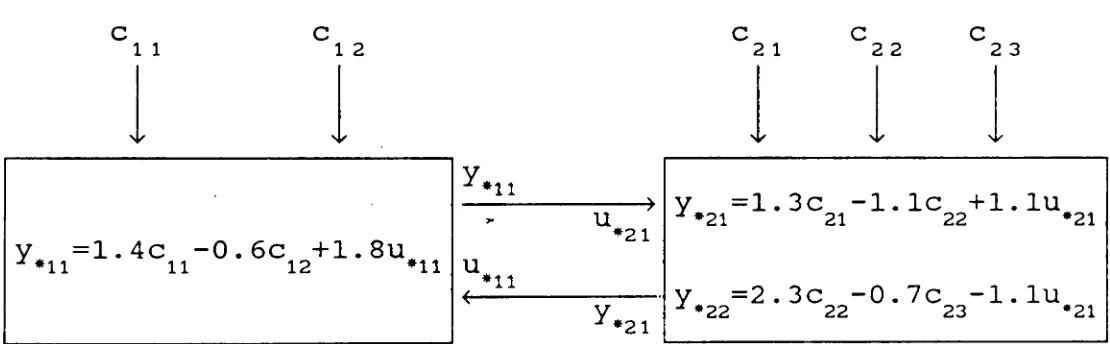
A steady state system
interconnected subprocesses,
computer, is used to
coordination methods for
model consisting of two
simulated by the analogue
investigate different
closed-loop hierarchical
control. The computer system structure used for
simulation is shown in fig.3.2.
First order time constants are introduced to the
interaction inputs and the controls. The
mathematical model of the subprocess output equations
.
1S:Yll f 11 (S:1 ' ~1) C 11
-
C 12 + 2u 11Y21 - f 21 (c , u ) -2 -2
-
c 21-
c 22 + U 21Y22 f 22 (c , -2 ~) 2c 22
-
c 23-
U 21The performance indices are:
Q (c , u , v ) - (Y11-1)2 + C
1 2
1 + C12 2 1 -1 -1 "1
The reality output equations are:
f (c u) 1.4c - O.6e + 1.8u
I
Y *11 :lt11 -1'-1 11 12 *11
f (c u) - 1.3e - 1.le + 1.lu
Y.21 *21 -2'-2 21 22 -21
f (e
u)
2.3c-
0.7c-
1.lu
J
The system constraints are:
The coupling equation is :
U 11
U
21
y ~o, (0. 8-c -0. 6u )~O}
11 12 11
o
o
1 o
o
1
The mathematical model of the interconnected sub~rocesses
trikpn from Robr-'.rts P.D. (1982).
4.3 Summary
Mathematical
problem using
formulation of large scale control
system approach was
the hierarchical
presented in this chapter. The original control
problem, with a pre-defined overall performance index
and system constraints, was decomposed into a collection
of smaller scale subproblems. Then, the model of each
subproblem was formulated with the task to optimise its
performance index subj ected to the constraints imposed.
Once all the subproblems were formulated, the global
control problem can then be formed by assuming that the
overall performance index
indices of the subproblems.
system model consisting
subprocesses, simulated by
included.
was the sum of performance
Finally, the steady state
of two interconnected
an analogue computer, was
41
CHAPTER 5 ON-LINE COORDINATION METHODS
5.1 Introduction
Different coordination methods have been suggested and
developed in the last two decades for steady state
optimisation and control of large scale systems (Mesarovic,
1970; Findeisen, 1978). Basically, there are two principal
coordination methods, namely, the Interaction Prediction Method (IPM) and Interaction Balance Method (IBM). These
coordination methods are similar in the sense that they start the local decision optimisation problem in the lower
level by specifying intervention parameters from the
supremal level. The method by which the supremal level
calculates the coordination parameters and intervenes the infimal level defines the coordination strategy. A variety
of feedback schemes have been suggested for on-line
optimising control using these coordination methods.
Feedback informations from the simulated real process used
by the coordinator (global feedback) or local decision
units (local feedba~k) have been
distributed hierarchical computer
implemented
system to
uSlng study
the
the
on-line coordination method the interaction balance
coordination
strategy.
and interaction prediction coordination
section 5.2 describes the closed-loop coordination
methods. Examination of these methods for on-line
closed-loop control of simulated interconnected industrial
processes has been performed and difficulties encountered
during the investigation will be discussed ln the
subsequent sections.
5.2 Closed-loop Coordination Methods
Using open-loop implementation of coordination methods