Control of Solar Sail Periodic orbits in the Elliptic
Three-Body Problem
James D. Biggs
∗Colin R. McInnes
†Thomas Waters
‡1.
Introduction
A Solar sail consists essentially of a large mirror, which uses the momentum change due to photons
reflecting off the sail for its impulse. Solar sails are therefore unique spacecraft as they do not require fuel
for propulsion.1 In this note we consider using the solar sail to continuously maintain a periodic orbit above
the ecliptic plane using variations in the sail’s orientation. Positioning a spacecraft continuously above the
ecliptic would allow continuous observation and communication with the poles.
In Waters and McInnes2the authors identify families of periodic orbits in the solar sail Circular Restricted
Three-Body Problem (CRTBP). In this note we model the solar sail in the context of the Elliptical Restricted
Three-Body problem (ERTBP) with the Earth and Sun as the two primaries and where the solar sail is the
third massless body. The generalization to the solar sail ERTBP is considered in Baoyin and McInnes.3 This
highlights that a study of the elliptic case is necessary, firstly because it is a more realistic model than the
circular case and secondly because there are fundamental differences between the two cases. To begin with
there are no equilibrium points above the ecliptic in the solar sail ERTBP.3 Additionally, the equations of
motion contain the time explicitly i.e. through the true anomalyf and are therefore non-autonomous. This
implies that any periodic solution of the solar sail ERTBP must have a period which is an integer multiple
of 1 year.
In this note we illustrate that a periodic orbit above the ecliptic in the circular case2 is not adequate for
tracking in the solar sail ERTBP model. For this reason we illustrate two methods for obtaining “better”
periodic reference trajectories above the ecliptic for the solar sail ERTBP. The two methods we use are based
on (i) a numerical continuation, with the eccentricityeas the perturbation parameter to find a natural orbit
in the ERTBP and (ii) a time-delayed feedback mechanism, which can be used when a differential corrector
fails to converge.
∗, [email protected], Research Fellow, Department of Mechanical Engineering, University of Strathclyde, Glasgow.
†[email protected], member AIAA, Professor, University of Strathclyde, Glasgow.
1.A. Equations of motion for the elliptic solar sail
The classical Elliptical Restricted Three-Body Problem (ERTBP) can be modeled conveniently using a
pulsating-rotating frame6 and in this note we follow the same convention to model the solar sail ERTBP.3
We choose our units to set the gravitational constant, the sum of the primary masses, the Earth’s semimajor
axis about the Sun, and the magnitude of the angular velocity of the rotating frame to be unity. We shall
denote byµ= 3×10⁻⁶ the dimensionless mass of the smaller bodym2, the Earth, and therefore the mass of the larger bodym1, the Sun, is given by 1−µ. Denoting byr1andr2the position of the sail w.r.t. tom1
and m2, the solar sail’s equations of motion in the rotating frame in pulsating-rotating coordinates x, y, z
are:
x′′
−2y′
=1+e1cosf¡∂Ω
∂x +accx
¢
y′′
+ 2x′
= 1
1+ecosf
³
∂Ω
∂y +accy
´
z′′
+z= 1 1+ecosf
¡∂Ω
∂z +accz
¢
(1)
where (·)′
denotes differentiation with respect to the true anomalyf ande= 0.0167 is the eccentricity with
Ω =1 2(x
2+y2+z2) +(1−µ)
kr1k +
µ
kr2k
andacc= (accx, accy, accz)T is the solar sail acceleration defined by:
acc= β(1−µ)
kr2 1k
(ˆr1·nˆ)2nˆ (2)
whereβ is the solar sail lightness number and is the ratio of the solar sail radiation pressure acceleration to
the solar gravitational acceleration, the ‘hat’ notation denotes the unit vector and ˆnis the unit normal of the
sail with respect to the Sun. We define ˆnin terms of two anglesγ andδ(radians) in the rotating-pulsating
frame:
ˆ
n= (cosγcosδ,cosγsinδ,sinγ)T (3)
While aβ value of order 0.3−0.4 is considered within the realm of possibility, to put the analysis in this
paper well within the near-term we will consider very modestβ values of order 0.05. Note that the
rotating-pulsating coordinates are related to the rotating coordinatesX, Y, Zvia the equationsX =ρx,Y =ρyand
Z=ρz, with the semi-latus rectumρ= (1−e2)
1+ecosf. It follows that whene= 0 the equations (1) reduce to the
circular case with the rotating-pulsating coordinates equal to the rotating coordinates.
2.
Tracking the reference trajectory given in the solar sail CRTBP
In this section we use a continuous LQR controller in the solar sail ERTBP to track a periodic reference
orbit using variations in the sail’s orientation. We show that a reference orbit from the solar sail CRTBP
is not adequate for tracking in the elliptical case. To measure the quality of the reference orbit given the
maximum deflection (radians)−π/2≤ γ, δ≤ π/2 (the sail has only one reflective side) and its maximum
rate of deflection (radians per day) is −0.42 ≤γ,˙ δ˙ ≤0.42 (1 degree per hour). To begin we linearize the
equations of motion ˙X= f(X,u(t)) about the reference orbit Γ. Writing x =X−Γ and u= u(t)−ue
yields the linear system
˙
x=A(t)x+Bu (4)
where
A(t) = ∂f(X,u(t))/∂X|X=Γ, B= ∂f(X,u(t))/∂u(t)|u(t)=ue
From control systems theory the gain matrixK for the linear state feedback control lawu=−Kxwhich
minimizes the quadratic cost function J =
∞
R
0
xTQx+uTRudt where Q, R are symmetric positive
semi-definite weighting matrices and then K = R−1BTP(t) where P(t) is the unique, positive semi-definite
solution to the differential Riccati equation:
A(t)TP(t) +P(t)A(t)−P(t)BR−1BTP(t) +Q= ˙P(t) (5)
The weightsQandRare free to choose and for simplicity this freedom is reduced to one parameter by letting
Q=I6 andR=kI2, wherekis a constant. Therefore, the control effort will be penalized ifk is large and
the distance from the orbit will be penalized if k is small. The procedure for defining the time-dependent
K =Kij matrix is to numerically compute it about the reference orbit and then fit a Fourier function to
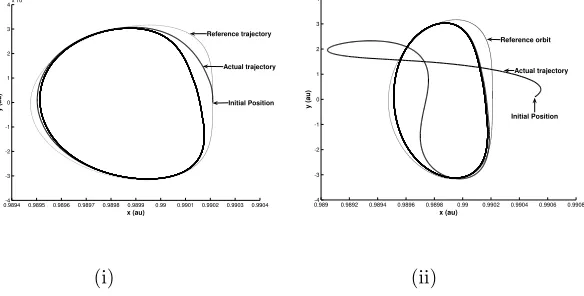
each component ofK. The simulation is run for the equivalent of 20 years real time (20 orbits). Although
this length of time is longer than the mission time for conventional spacecraft, the solar sail has the ability to
perform much longer missions. The results of this are illustrated in Figure 1. When the trajectory begins on
0.9894-4 0.98950.9896 0.98970.9898 0.9899 0.99 0.9901 0.9902 0.99030.9904 -3
-2 -1 0 1 2 3 4x 10
-3
x (au)
y
(
a
u
)
Initial Position Actual trajectory Reference trajectory
0.989 0.9892 0.9894 0.9896 0.9898 0.99 0.9902 0.9904 0.9906 0.9908 -4
-3 -2 -1 0 1 2 3 4 x 10⁻³
x (au)
y
(
a
u
)
Reference orbit
Initial Position Actual trajectory
[image:3.595.159.451.456.604.2](i) (ii)
Figure 1. LQR control: the thick line is the controlled trajectory and the thin dotted line is the reference orbit
(i) initial condition begins on the reference trajectory. (ii) large errors in the initial conditions are included
the reference orbit Figure 1 (i) the solar sail’s mean tracking error over 20 years is 1.5556×10⁻⁴au (23271 km). In Figure 1 (ii) we consider initial condition errors of approximately 25000 km with velocity errors of
tracking error is 2.1985×10⁻⁴ au (32889 km). These tracking errors are large and in this note we aim to obtain “better” reference trajectories for the elliptic case.
3.
Methods to obtain reference trajectories in the Solar Sail ERTBP
In this section we propose two methods to obtain suitable periodic reference trajectories above the ecliptic
for the solar sail ERTBP. One obvious choice for a reference trajectory would be to use a natural orbit above
the ecliptic in the solar sail ERTBP. Therefore, our first method is based on a numerical continuation with
the eccentricity,e, as the continuation parameter. The second method is based on a time-delayed feedback
mechanism which is useful when a trajectories error in periodicity is too large for a differential corrector to
close it. We begin here with a description of the numerical continuation.
3.A. Numerical continuation
The continuation algorithm is based on a monodromy variant of Newton’s method.4 The Newton method
starts with a trajectory X(t) = (x, y, z,x,˙ y,˙ z˙) initialized att = 0 on a surface of section and provides an
iterative improvement to the choice of initial conditions for a periodic orbit:
X∗
(0) =X(0) + (I−M)−1[X(T)−X(0)] (6) where X∗
(0) is the improved initial condition and M is the monodromy matrix. We begin with a known
periodic orbit ate= 0 in the solar sail CRTBP2 and continue the parameterein small increments until the
required valuee= 0.0167. The monodromy matrix required for its implementation is derived by recasting
the variational equations ((4) withu= 0) in terms of the state transition matrix (or principle fundamental
6×6 matrix) Φ = ∂X(t)/∂X(0), we have ˙Φ = A(t)Φ, Φ(0) =I. The monodromy matrix M is then
defined asM = Φ(T). Using Newton’s method we obtain initial conditions that yield a 1 year periodic orbit
above the ecliptic in the Solar Sail ERTBP:x(0) = 0.99026089327975, y(0) = 0.00000002531557, z(0) =
0.01497820748971, x′
(0) = 0.00000000062302, y′
(0) = 0.00306117310561, z′
(0) =−0.00000003900302 f(0) =
0, γ = 0.809196, δ = 0. We note that this periodic orbit is unstable and will require active control to
stabilize the solar sail on the orbit. This active control will be implemented using variations in the sail’s
orientation.
3.B. Computing reference orbits using a time-delayed feedback mechanism
In this subsection we propose a novel method for designing reference orbits based on time-delayed feedback
control.5 This method is particularly useful when the error in periodicity of the initial trajectory is too large
for a differential corrector to close the orbit. To illustrate this we use a Monte Carlo simulation of initial
conditions (in a small region close to the initial conditions that yield a periodic orbit in the circular case) to
note that a differential corrector failed to close this trajectory. To compute a periodic reference trajectory
for the nonlinear system ˙X(t) =f(X(t), t) we use a time-delayed feedback mechanism of the form:
˙
X(t) =f(X(t), t) +v(t)
v(t) =−K(X(t)−X(t−τ))
(7)
whereτ is the delay time, which will be 2πin order to obtain a 1 year orbit andK is a 6×6 matrix which
is computed experimentally. By inspection of the time-delayed feedback function v(t) (7) it can be seen
that as the trajectory X(t) approaches periodic i.e. kX(t)−X(t−τ)k →0, thenv(t)→0. The nonlinear
equations (7) were simulated until the resulting trajectory satisfied the properties kX(T)−X(0)k< ε and
kv(t)k< ∂ for some pre-specified tolerance parametersεand∂.
We note that this method can be implemented using either forward integration or backwards integration
and that backward integration worked better in this case. Using the preceding method we obtained the
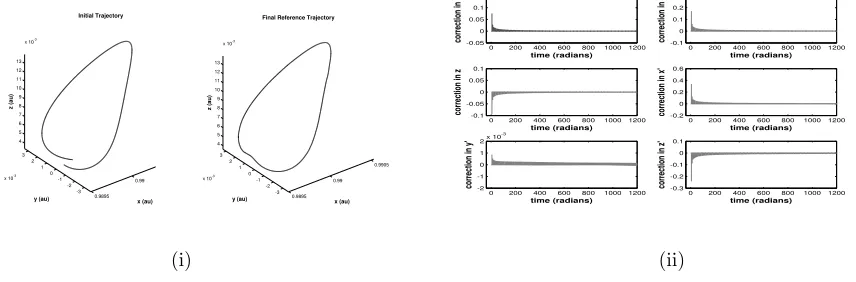
closed reference trajectory in Figure 2 (i). From Figure 2 (ii) it can be seen that the initial orbit requires
a large impulse (correction) to close the trajectory but this reduces in magnitude with time. Finally, we
0.9895 0.99 0.9905 -3 -2 -1 0 1 2 3
x 10-3
4 5 6 7 8 9 10 11 12 13 x 10-3
x (au) Initial Trajectory y (au) z (a u ) 0.9895 0.99 0.9905 -3 -2 -1 0 1 2 3
x 10-3
4 5 6 7 8 9 10 11 12 13 x 10-3
x (au) Final Reference Trajectory
y (au)
z
(a
u
)
0 200 400 600 800 10001200 -0.05 0 0.05 0.1 0.15 time (radians) co rr ec tio n in x
0 200 400 600 800 10001200 -0.1 0 0.1 0.2 0.3 time (radians) co rr ec tio n in y
0 200 400 600 800 10001200 -0.1 -0.05 0 0.05 0.1 time (radians) co rr ec tio n in z
0 200 400 600 800 10001200 -0.2 0 0.2 0.4 0.6 time (radians) co rr ec tio n in x '
0 200 400 600 800 10001200 -2
-1 0 1 2x 10
-3 time (radians) co rr ec tio n in y '
[image:5.595.92.520.324.465.2]0 200 400 600 800 10001200 -0.3 -0.2 -0.1 0 0.1 time (radians) co rr ec tio n in z' (i) (ii)
Figure 2. Time-delay feedback: (i) this illustrates the initial trajectory and final closed trajectory (ii) the
corrections required to close the initial orbit is large but these decrease to small values as time increases.
test the quality of the reference orbits given by the numerical continuation and the time-delayed feedback
mechanism in simulation using the LQR method described in Section 2. The results show that there is a
vast improvement in the sail’s ability to track these reference orbits compared to the reference orbit in the
circular case. For the reference orbit computed using the time-delayed feedback method the mean tracking
error (without initial condition errors) is 1.522×10⁻⁵ au (2278 km). Using the same magnitude of errors in initial conditions as the circular case, the mean tracking error is 1.9288×10⁻⁵ au (2885 km). For the reference orbit found using the numerical continuation the mean tracking error (without initial condition
errors) is 4.6733×10⁻⁸
au (7 km). This error is small as it is a natural orbit and control is required only to
4.
Conclusions
This note considers the problem of maintaining a solar sail on a periodic orbit above the ecliptic in
the Elliptical Restricted Three-Body Problem (ERTBP). We illustrate that the solar sail does not track a
periodic reference orbit obtained from the solar sail Circular Restricted Three-Body Problem adequately. We
proceed to illustrate two methods for constructing “better” reference trajectories based on (i) a numerical
continuation, with the eccentricitye as the perturbation parameter to find a natural orbit in the ERTBP.
(ii) a time-delayed feedback mechanism, which can be used when a differential corrector fails to converge.
Both these methods yield reference orbits that significantly improve the tracking error of the solar sail.
Acknowledgments
This work was funded by grant EP/D003822/1 from the UK Engineering and Physical Sciences Research
Council (EPSRC).
References
1
McInnes, C. R., ‘Solar sailing: technology, dynamics and mission applications’. Springer Praxis, pp. 17-19, 1999.
2
Waters, T. J., McInnes, C. R., ‘Periodic Orbits above the Ecliptic in the Solar sail Restricted Three-body problem’. Journal
of Guidance, Control and Dynamics, Vol. 127, pp. 1947-1960, 2007.
3
Baoyin, H., McInnes, C.R., ‘Solar sail equilibria in the elliptical restricted three-body problem’. Journal of Guidance,
Control and Dynamics, Vol. 29, No. 3, pp. 538-543, 2006.
4
Marcinek, R., Pollak, E., ‘Numerical methods for locating stable periodic orbits embedded in a largely chaotic system’.
Journal of Chemical Physics, 100, 8, pp. 5894-5904, 1994.
5
Pyragus, K., ‘Continuous control of chaos by self-controlling feedback’. Physics Letters A, Vol. 170, pp. 421-428, 1992.
6
Szebehely, V., ‘Theory of Orbits: The restricted problem of three bodies’. Academic Press, New York, pp. 587-595, 1967.