0022-538X/90/125883-08$02.00/0
Copyright C 1990,American SocietyforMicrobiology
Engineered
Herpes
Simplex Virus
DNA
Polymerase Point
Mutants:
the Most
Highly Conserved Region Shared
among
oL-Like
DNA Polymerases
Is
Involved in Substrate Recognition
ALICE I. MARCY,t CHARLES B. C. HWANG, KATHERINE L. RUFFNER, ANDDONALD M. COEN*
Departmentof Biological Chemistry andMolecularPharmacology, HarvardMedical School,
Boston, Massachusetts 02115
Received 12 July 1990/Accepted 13 September 1990
Eucaryotic, viral, and bacteriophage DNA polymerases of the a-like family share blocks of sequence
similarity,themostconservedofwhichhas been designated regionI.Region IincludesaYGDTDS motif that
is almost invariant within the a-like family and that is similar to a motif conserved among RNA-directed
polymerases and also includes adjacent amino acids thatare moremoderatelyconserved. To study the function of these conserved amino acids in vivo, site-specific mutagenesis wasused to generate herpes simplex virus region Imutants.A recombinant virus constructedtocontainamutationwithin the nearly invariantYGDTDS motifwasseverely impaired forgrowthonVero cells which do not containaviral polymerasegene.However,
three recombinants constructed tocontain mutations altering moremoderately conserved residues grew on Verocells and exhibited alteredsensitivitiestonucleoside and PP1 analogsandtoaphidicolin. Markerrescue and DNAsequencingofonesuch recombinantdemonstrated that theregion I alteration confers the altered drug sensitivity phenotype. These results indicate that this region hasanessentialrole in polymerase function invivo and isinvolved directlyorindirectlyin drug and substrate recognition.
The mechanismsby which polymerases recognize nucleic
acidtemplates andnucleotide substrates and catalyze
faith-ful replicationarelargely unknown.Cluestocommon
strat-egies among polymerases can be discerned in
structure-function relationships among these enzymes. Eucaryotic
DNApolymerases a and 8 andmany other DNA
polymer-asesof viruses andbacteriophages share at leastsix discrete
regions ofsequence similarity thatdefine afamilyof a-like
polymerases (7, 48). These regionsoccur in the samespatial
order in the various family members and have been
desig-natedIthrough VI,indecreasing orderof similarity(32,45).
Region I, whichwasfirst notedamong DNApolymerases of
herpes, pox, and adenoviruses (2, 18, 22, 38), is
character-izedbothbyaTyr-Gly-Asp-Thr-Asp-Ser motifthatis almost
invariant within the a-like polymerase family and by
adja-centresidues that are more moderately conserved (Fig. 1).
Region I shares similarity with a sequence motif found in
RNA-directed RNA and DNApolymerases (2). The
exten-sive conservation at this site strongly suggests functional
importanceand asimilarityin themechanismsof replication
byawidevariety of polymerases, but thefunction ofregion
Iremains unknown.
The DNA polymerase (Pol) encoded by herpes simplex
virus(HSV) serves as anexcellent prototypeforthe a-like
polymerase family
especially
becauseof theability
to studypolymerase functionsinvivoin the authentic contextofthe
virus-infected cell by using genetic and pharmacological
tools. HSV is sensitive to a number of nucleoside and
PP,
analogsand to aphidicolin, allofwhich act via inhibitionof
HSV Pol (16, 19, 20, 30, 35, 37, 40). This has allowed the isolation of HSV DNA polymerase
(pol)
mutants withal-*Correspondingauthor.
tPresentaddress: DepartmentofBiophysical Chemistry,Merck Sharp& Dohme ResearchLaboratories, Rahway, NJ 07065.
tered sensitivities to these inhibitors. Since these drugs
mimic natural deoxynucleoside triphosphate or
PPi
sub-strates and/or inhibit Pol competitively with these sub-strates, pol mutations that confer altered drug sensitivity
change amino acids involved directly orindirectlyin
inter-actionswith thedrugsand cognate substrates. Sincecertain
of these drugs, such as the nucleoside analog
acyclovir
(ACV),arevaluable intreatingherpesvirus infections,
stud-ies ofdrug-resistant mutants can also haveclinical
implica-tions. Indeed, such polmutants are aproblem ofincreasing
importance inthe clinic(15, 41).
To date, mappingand sequencing ofHSV pol mutations
conferring altered drug sensitivity (21, 22, 24, 27, 32, 44)
haveprovidedthe mostinformationregardingthefunction of
certain regions ofsequence similarity shared by a-like
po-lymerases. One mutation alters anamino acid in sequence
similarity
region V (Fig. 1 and 2). Three mutations alter aportion ofHSV Pol termedregion A, whichshares
similarity
with viralpolymerases that are sensitive tocertain antiviral
drugsbut does notshare
similarity
with DNApolymerase
a.Byfar,however, most ofthemutationsalteramino acidsin sequence similarity regions II and
III,
whichhas ledto theproposal that these regions directly participatein drug and
substrate
recognition
(21).Ontheother
hand,
nospontaneousdrug-resistant
mutantswere recovered with alterations in region I. We therefore undertook
experiments
toengineerregionI mutantsof HSV.Analysis ofthesemutantshas shedlighton
region
Ifunction.MATERIALSANDMETHODS
Cellsand viruses.Verocellsweregrown and maintainedas
described
previously (47).DP6cellswerederived from Verocells andcontaintheHSV
pol
gene. Virus HP66wasderivedfromwild-type strainKOS andcontainsa2.2-kbpol deletion
and an insertion
containing
the Escherichia coli lacZ gene5883
on November 10, 2019 by guest
http://jvi.asm.org/
Anmin 1
Acid 437-479 577-637 694-736 772-791 555- ul8.39 94-963
IV
NH2-
FA 11 VI III I
-M _-m_
1235
v
-COOH
HSV 881 RIUGDTDSIFVLCRG
EBV 750 XV GD1DSIFVLCRG
CMV 905 YGDDG
VAC 724 GDS IDS
POLS
754 GVT GTPOL a 997 3iGDT IDTGC
ADV 865 G5L
T4 613 F 'VDK
029
451 HLTGTEHSV 881
G885A F8 91C F891Y V892M
RIIYGDTDSIFVLCRG
A
C
y
H
FIG. 1. RegionIofsequencesimilarityamong DNApolymerases.The top line isaschematicof thepredictedHSV Polpolypeptidewith thelocations ofregionsofsequencesimilarityshown. Below are shown theaminoacid sequencesofregionIfromvariousDNApolymerases. Amino acidsshared betweenHSVand other polymerases areshaded.Thefollowing polymerasesarerepresented:HSV(22, 38);Epstein-Barr
virus(EBV) (3); humancytomegalovirus(CMV)(29);vaccinia virus (VAC)(18); yeast Pol III, theanalog of mammalianDNApolymerase
8(POLf) (7); human DNApolymerase a (POLa) (48); adenovirus (ADV)(23);T4(42);and+29 (50). Atthebottom of thefigure arethe
alterations inregionIdiscussedinResults.
under the control ofthe HSV thymidine kinase promoter.
The derivation of the DP6 cell line and theuseof virus HP66
for identifying pol recombinants are described in detail
elsewhere (36).
Mutagenesis. Site-specificmutagenesis was performed by
using the method of Taylor et al. (43) with an M13 clone
containingaportionof pol. Thephage vectorM13mpl8(49)
wasmodified as follows to include a unique NcoI site in the
polylinker region. Replicative form M13mpl8 was digested
withSalI,treated with theKlenow fragment of E. coli Pol I,
and thenligatedtoNcoIlinkers. Afterdigestion with NcoI, thevector wastreatedwithligaseandwasusedtotransform
E. coli. The resulting replicative form DNA was digested
with KpnI and NcoI and ligated to the 623-bp KpnI-NcoI
fragment frompDP1, which encodes Pol amino acids 696 to
907(Fig. 2). Two oligonucleotide preparations (bases 2976 to 2993 and 2997 to 3014 [22]) were used for site-specific
mutagenesis. Oligonucleotides 5'-GTGTCCCCGIAGATGA
TG-3' and5'-CACAGCACAAATATGGAG-3' bound to the coding strand of pol and the underlined bases were synthe-sized with a phosphoramidite mixture containing 50% of the
correct base and 50% of an equimolar mixture of the remaining three incorrect bases. Clones containing region I mutations but no others were identified directly by DNA
sequencing by using previously described procedures (21).
The 511-bp
Bsu36I-NcoI
fragments containing the region Imutations were recovered and ligated to the 6-kb
Bsu36I-NcoI fragment from pDP1 to generate full-length clones
containing altered pol genes.
Marker rescueconstructionof mutants and mutation map-ping. Markerrescue wasperformedasdescribed previously (8) by using infectious HP66 DNA and region I mutant
plasmid DNAs orby using infectious F891C DNA and the indicated fragments from plasmid pDP1 (36) containing
wild-type strain KOS pol sequences. To determine the
sequence alteration conferring altered drug sensitivity in
mutantF891C,theBamHIQ fragmentfrom thisvirus,which
correspondstothelargest BamHI fragment depicted in Fig.
2 (encoding amino acids 1 to 1072), was cloned into
pGEM7Zf (+) (Promega Biotec), and the pertinent region within the resulting double-stranded plasmid DNA was
sequenced with a universal sequencing primer and
pol-specific oligonucleotide primers (21) and Sequenase (U.S.
Biochemicals) accordingtothemanufacturer's instructions.
Drug assays.Plaque reduction assaystodeterminerelative sensitivities of recombinant andwild-type viruses to antivi-raldrugs were performed as described by Coen etal. (11).
ACV was kindly provided by D. Barry, Burroughs
Well-come Co., and was prepared as described previously (14).
Phosphonoaceticacid(PAA)wasgenerouslyprovidedbyS.
Schmidt,AbbottLaboratories, and preparedasdescribed by
Coen etal. (13). Aphidicolinwas provided by M. Suffness,
National CancerInstitute,andprepared asdescribed previ-ously (12).
RESULTS
Strategy for engineering recombinant HSV with region I
mutations. To examine the role of region I, we initiated
on November 10, 2019 by guest
http://jvi.asm.org/
[image:2.612.79.532.72.365.2]Ammo I
Acid
HSVPolOpen Reading Fram,with regions of SequenceSimilaity
437. 577 *4- m7 m0- Ut. OW
479 637 736 791 U5 56 963
IV A U VIlm I v
_~~~~~~~~= _ __* Nt2.-
1-HP66
dt PROMOTER acZ
pDPI Fragm-entsUsedfor MarkerRescue of F891C
Restriction Sites
1.1 KbKpn
1.2Kb Xho
K E X KBs
I H I I I
B
1.8 Kb Kpn
I 1.1 KbXho
X B B K
I I I I
N 0.2LJKb
FIG. 2. HSVpollocus. Thetopline indicates the major HSVpolopenreading frame with the location of regions ofsequencesimilarity
(21, 48) shown. Lower lines show thestructuresofvirus HP66,plasmid pDP1, and DNA fragments used for markerrescue.B, BamHI; Bs, Bsu361; E, EcoRI; K, KpnI; N, NcoI; X, XhoI; tk, thymidine kinase. The1.1-kbXhoIfragmentwasgenerated by cutting pDP1 with XhoI
andwithUcoRI, whichcutsin theplasmid polylinker just outside the HSV insert.
studiestorecoverHSVmutantscontaininglesions inregion
Iofthepolgene.Abacteriophage M13vectorcontaining the 623-bp KpnI-NcoI fragment that encodes Pol amino acids 623 to 907, including region I (Fig. 2), was used for
site-specific mutagenesiswitholigonucleotide poolsthatencoded
alterations in region I. Four alterations in region I were chosenfor furtherstudyandaredesignated bytheone-letter amino acid code for the wild-type residue, the amino acid
number, and the new amino acid. The mutations were G885A (GGG-GCG), F891C (TTT-TGT), F891Y (TTT-TAT),andV892M(GTG-ATG). TheM13phageDNAswere
sequenced to ascertain that these mutations were the only
ones created within the 623 bp of HSV sequences, and the mutantfragmentswereinserted intootherwisewild-typepol
sequencesfrom plasmid pDP1 (36) (Fig. 2).
HSV recombinants were then engineered tocontain the
mutations byusingtheseregion Imutantplasmidsinmarker
rescue experiments with HSV mutant HP66 (36) (Fig. 2).
HP66 lacks 2.2 kb ofpol sequences, which have been
replaced by a lacZ gene under the control of the HSV
thymidinekinase promoter. Asaresult,HP66 doesnotgrow onVero cells butcangrowonDP6cells, which containthe
wild-type HSV polgene. On DP6 cells, HP66 forms blue
plaques in the presence of X-Gal
(5-bromo-4-chloro-3-in-dolyl-p-D-galactopyranoside)
because of the lacZ insertion.Recombinant viruses can then be generated by marker
rescueinwhichmutantpolsequencesreplacethe lacZgene.
Therecombinants areidentified bythe abilitytoform white
plaquesin thepresenceof the indicatorX-Gal, indicatingthe loss oflacZ.
HSV mutant G885A contains a lethal polmutation. DP6 cells were transfected with infectious HP66 viral DNA
alone, in combination with aplasmid containing wild-type
pol (pDP1), orincombination withaplasmid containingthe mutation G885A. Theprogenywereplatedonboth Vero and DP6cells (Table 1). PlasmidpDP1 rescued the lethal
muta-tion in HP66 efficiently; 7.6% of theprogeny grewon Vero cells. The plasmid with the G885A alteration failed to achieve markerrescue efficiencies greater than those found
with HP66 viral DNAalone(<0.002%). However, 1.5% of theprogenyfrom this transfectionformed white plaques in the presence of X-Gal on DP6 cells (data not shown), indicatingthat recombination had occurred and resulted in the loss oflacZ. Severalof these whiteplaques werepicked
and screened for thereplacement of lacZsequencesbypol
sequencesbySouthern blothybridization. One such recom-binantwastestedfor itsabilitytogrowonVero cellsversus DP6 cells. It formed plaques on DP6 cells atleast 620-fold
more efficiently than on Vero cells (data not shown).
Be-causeDP6 cellscontainnointact HSVgene otherthanpol, this demonstrates that HSVmutantG885A containsalethal
polmutation and indicates that the G885A mutationaltering regionI inactivatesanessentialpolfunction.
Alterations at residues 891 and 892 are not lethal. In
contrast tothe results with the G885Aplasmid, transfection of DP6 cells with HP66DNA incombinationwithanyofthe three plasmids encoding alterationsin amino acids 891 and
TABLE 1. MarkerrescueofHP66
Plasmid Markerrescue
efficiency'
None... 0.004
pDP1... 7.6
pG885A... <0.002
pF891C... 0.67
pF891Y... ... 1.1
pV892M... 1.9 "Results are theaverage of twoexperimentsandareexpressedas(titeron
Verocells/titeron DP6cells) x 100. Numbers in boldfaceareregardedas
positive formarkerrescue.
1235
'WI
do. 1%
ov %
do. %
.0 1%
dop 1%
.- ....I...-...
..
.%... i
m a I a I I a I I
on November 10, 2019 by guest
http://jvi.asm.org/
892 resulted inatleast a170-fold increase in the percentage
of viruses ableto growon Verocells
compared
withtrans-fectionwith HP66 DNAalone
(Table 1).
Similar percentagesofthe progeny couldform white
plaques
in the presence of X-GalonDP6 cells(not
shown). Progeny
fromthetransfec-tions with
F891Y,
F891C,
and V892M that formed whiteplaques
on DP6 cellswerepicked
andplaque
purified
threetimes for further
analysis. They
exhibitedplating
efficienciesonVero cells relative toDP6cells
ranging
from40to100%,
whichwassimilartothatof
wild-type
strainKOS.Thus,
themutations in theseviruses didnot
meaningfully impair
HSVgrowth
incell culture.The
F891C, F891Y,
and V892M mutants exhibit altereddrug sensitivities, including
resistance to ACV. Sincepol
mutations can result in altered
sensitivity
to inhibitors ofDNA
replication,
weexamined the sensitivities of theviableregion
Irecombinant virusestoPAA,
ACV,
andaphidicolin.
We
compared
thedrug
sensitivities oftherecombinants withthose of
wild-type
KOS virus inplaque
reductionassays inwhich virus is
plated
onVerocellsatvarious concentrationsof
PAA, ACV,
andaphidicolin
andthenumber ofplaques
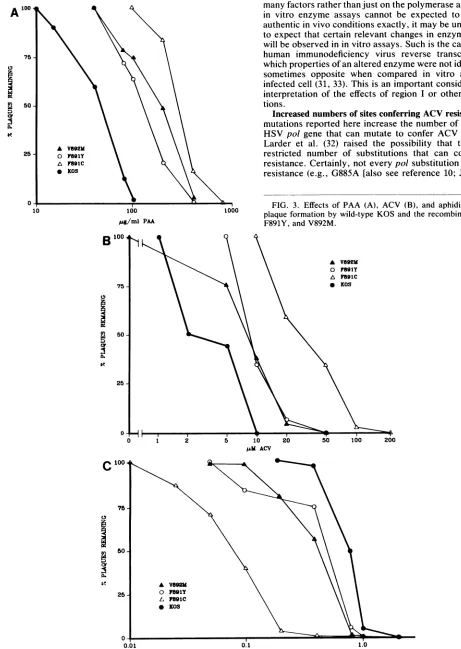
iscounted at each concentration. The concentration ofPAA
that reduced
plaque
formationby
50%forvirus F891Cwassixfoldgreaterthan thatfor
wild-type
strain KOS(Fig.
3A).Recombinants F891Y and V892M exhibited intermediate
levels of resistance. Results with ACV
(Fig. 3B)
showed asimilar
trend;
virus F891C wasagain
sixfold more resistanttothe
drug
thanwild-type
KOS,
whereas F891Y andV892Mwere
slightly
less resistant. F891C was 10-fold moresensi-tiveto
aphidicolin
thanwild-type KOS,
whereas F891Y andV892M hadsensitivitiesclosertoyetdistinct from thatofthe
wild type
(Fig.
3C). On the basis of these assays andpreviously
established criteria foraltereddrug
sensitivities(8, 11),
we concludethatrecombinantsF891C, F891Y,
andV892M are resistant to PAA
(PAAr),
resistant to ACV(ACV'),
andhypersensitive
toaphidicolin
(Aphhs).
Demonstration thata
region
Imutation confersaltereddrugsensitivity.
We wished toverify
that thealtereddrug
sensi-tivitiesweredueto a
region
Ipol
mutation.Asafirsttest,weexamined
independent
recombinants that arosefromtrans-fections with the
region
I mutantplasmids
F891C andV892M and foundthat
they
wereindistinguishable
interms oftheirresistancestoPAAandACVandhypersensitivity
toaphidicolin
from mutants F891C and V892M(not
shown).
Thisensures that their
phenotypes
were notduetoadventi-tious mutations.
As a second test, we
performed
marker rescueexperi-ments
using
DNAfragments
fromplasmids containing
wild-typepolsequencesandinfectiousDNAfrommutantF891C. Thismutant waschosen because its
aphidicolin
hypersensi-tivity
wasgreatenough
topermit
markerrescuemapping
ofthe
Aphhs
mutation. Thewild-type
fragments
tested formarkerrescueincluded
region
I ofpolas wellassequences outsideof this site(Fig. 2).
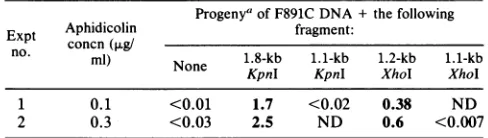
The progenyoftransfections withmutantF891C DNA alone formedno
plaques
in the presence of 0.1 or 0.3 ,ug ofaphidicolin
per ml.Reproducibly,
the 1.8-kbKpnI
and the 1.2-kbXhoIfragments
that spanregion I were able to rescue F891Cefficiently
for growth in the presenceof 0.1or0.3 ,ugofaphidicolinper ml(Table2). The 1.1-kbKpnI
and 1.1-kb XhoI fragments, which do notinclude
region I,
were not ableto rescuetheAphhs
marker.Thus,
themarkerconferring
increasedsensitivity toaphidi-colinin F891C
mapped
tothe 683bp
between theKpnI
and XhoIsites thatincludesregion
I.Recombinant viruses
resulting
from the marker rescueexperiments using
either the 1.8-kbKpnI
orthe1.2-kb XhoIfragments wereplaquepurified and tested for their sensitiv-ities toPAA, ACV, and aphidicolin. These viruseswere no
longer resistant to PAA and ACV or hypersensitive to
aphidicolin and instead showed sensitivitiesto these drugs
indistinguishable from those of wild-type virus (data not
shown).
These results localized the PAAr, ACVr, andAphhs
mark-ers of mutant F891C to the 683 bp between the KpnI and XhoI sites of pol that include region I. The BamHI Q
fragment of virus F891C that includes this region was
cloned, and the 683bp were sequenced. The only alteration from thewild-type sequencewasthe TtoGchangeresulting
in the F891C mutation. We conclude that the F891C
muta-tion altering region I confers resistance to PAA and ACV
andhypersensitivity to
aphidicolin.
DISCUSSION
Our results show that a virus engineered to contain a
G885A alteration in region I was severely impaired for growth on Vero cells, whereas viruses engineered to contain the alterations F891C, F891Y, and V892M could grow on
Verocells but had drug sensitivities different from those of
wild-type virus. For mutant F891C, mapping of the Aphhs
mutation and sequencing of the relevant pol region showed unambiguously that the altered drug sensitivityphenotypes
are due to the region I alteration. These in vivo results extend and broaden results from studies of similar mutations invitro and haveimplications specifically for drug resistance
and replication in HSV and generally for the function of
region I in nucleic acid polymerases in a wide variety of organisms.
Comparisons with studies of region Imutantsin vitro. We
are aware of two studies examining the effects of in vitro enzyme activities of alterations in region I of DNA poly-merases,both of whichappeared after the present study was
completed (6, 17), and of similar studies ofan equivalent
region inanRNA-directed polymerase (33, 34). Bernad et al.
(6) found that various alterations in region I of 429 DNA
polymerase decreased one or more polymerase activities
without affecting 3'-5' exonuclease activity. Dorsky and
Crumpacker (17) reportedthat variousalterations in region I
of HSV Pol including a G885 to Arg substitution also decreased polymerase activity when the pol gene was ex-pressed by in vitro transcription-translation. These results
areconsistent with thefindingsinvivo with our HSV G885A mutant, butnone of the mutantenzymes was examinedfor alteredsensitivityto inhibitors.
Fiveof sixmutanthumanimmunodeficiencyvirus reverse
transcriptases with alterations in the portion thought to
resembleregion I (1), including onewith an alteration at a site thatcanbeconsideredequivalenttoG885,wereinactive in vitro (33, 34). The singlehumanimmunodeficiency virus
mutantthatwas activeenough to examine was alteredata residue thatcanbe considered to be equivalent to Val-892. Its enzyme exhibited two- to threefold increases in 50% inhibition values for azidothymidine triphosphate and
phosphonoformic acid in vitro; however, the mutant was
describedasresemblingthewild-type enzyme in sensitivity
(34).
Although none of the aforementioned resultsusing an in
vitro approach are necessarily inconsistent with ours, we
wouldemphasize that the mutations described in this report
were analyzed in the authentic in vivo context of virus-infected cells. Because DNA replication is dependent on
on November 10, 2019 by guest
http://jvi.asm.org/
100 manyfactors rather thanjustonthepolymerase and because
A in vitro enzyme assays cannot be expected to reproduce
authentic in vivoconditionsexactly, itmaybeunreasonable to expect that certain relevant changes in enzymefunction will beobserved in in vitro assays. Such is the case with the
75 human immunodeficiency virus reverse transcriptase, in
C, \ \ \ \whichproperties ofanalteredenzyme werenotidentical and
sometimes opposite when compared in vitro and in the
infected cell (31, 33). This is an importantconsideration for
interpretation of the effects ofregion I or other pol
muta-50 tions.
cr | \ \ + \ Increased numbers of sites conferring ACV resistance. The
X.\1
mutationsreported
here increase the number of sites inthec \ \ \ \ HSV pol gene that can mutate to confer ACV resistance.
A V892M Larder et al. (32) raised the possibility that there are a
25 0 F891Y restricted number of substitutions that can confer ACV
& F891C resistance. Certainly, not everypol substitution can confer
0 KOS0 resistance (e.g., G885A [also see reference 10; J. S. Gibbs
0 FIG. 3. Effects ofPAA (A), ACV (B), and aphidicolin (C) on
10 100 1000 plaque formation by wild-type KOS and the recombinants F891C,
j4g/ml
PM F891Y, and V892M.B 100
A V82M o F891Y
75 \ \OS
50
25
0
0 1 2 5 10 20 50 100 200
1M ACV
50
0.
V ~~~AV892M
/Ag/ml Aphidicolin
on November 10, 2019 by guest
http://jvi.asm.org/
[image:5.612.49.510.80.729.2]TABLE 2. Marker rescueofAphhsmarker inF891C Progenya of F891CDNA + thefollowing
Expt Aphidicolin fragment:
n. concn(,ug/
no.
mo)
None 1.8-kb 1.1-kb 1.2-kb 1.1-kb KpnI KpnI XhoI XhoI1 0.1 <0.01 1.7 <0.02 0.38 ND
2 0.3 <0.03 2.5 ND 0.6 <0.007
aResults areexpressedaspercentageofprogenyplating attheindicated concentration of aphidicolin.Values inboldfaceare regardedaspositive for markerrescue. ND, Notdetermined.
and D. M. Coen, unpublished results]); nevertheless, in
combination with earlier studies (21, 24, 27, 32, 44), there
have now been reported at least 10 andperhaps as many as
17that do. How manysuch substitutions wouldbe likelyto
cause ACV resistance in a clinical setting (15, 41) is
un-known. Certain of the mutations confer only a modest
degree ofresistance (Fig. 3). It will beinteresting to
deter-minethe effects of theregionImutationsonreplication and
pathogenicity ofHSV in amammalian host.
The failure to uncover region I mutations during earlier sequencing studies seemslikelytohave resulted simplyfrom
nothaving examined enoughdrug-resistant mutants.
Anessential role for region Iinvivo. Ourresults indicate
thatG885A isalethalsubstitution. Thisinturnindicatesthat
Gly-885andregion I as a wholeserve anessential function in
vivo during viral replication, as would be expected from the high degree of sequenceconservation. SinceGlytoAlaisa
conservative alteration, one explanation forthedetrimental
effect of this mutation is that it affects theconformation of
Pol at a site important for catalysis. Indeed, secondary
structure predictions made by using a variety of programs arguethatthisconservedregionislikelytoincludea turn(2, 4, 18, 25, 28) to yield a beta-hairpin withaloop containing
the conserved Asp and Thrresidues (1). TheGly-Ala
alter-ationcoulddisruptthisstructure astheGlyandCys residues
found at the position equivalent to Gly-885 in other DNA
polymerase sequences haveincreased probabilitiesfor
par-ticipating in turn structures, whereas Ala has a decreased
probability(9). Althoughwe have ruled outmajor effects of
theG885A mutation onpolypeptide stabilityon thebasisof
Western immunoblot analysis of G885A-infected cells
(un-publishedresults), we cannotexclude several other
alterna-tiveexplanations forthelethal effects of this mutation. For
example, it has been proposed that the role ofregion Iis in
interactionswith conserved host cell factors (32, 37).
How-ever,the resultswithourotherregion I mutants (see below) lead us to favor a role in polymerase catalysis, as we and others originally proposed (2, 18, 22).
RegionIand substraterecognition.Thedemonstration that region I alterations confer altered drug sensitivities sheds
lightonthe roleof this region in Polfunction. Since the drugs
have structures similar to those of natural
PP1
and dNTP substrates or can compete with these substrates, we infer that region I is involved in substrate recognition. Results from two bacteriophage systems are consistent with this conclusion. Inokuchi and Hirashima (26) have suggested thataregion in
Q13
replicase similar to region I is important forcatalysisbut nottemplate activity, on the basis of
interfer-enceofwild-type
Qp
replication by plasmids bearingmuta-tions in these sequences. After the present study was
com-pleted, Bernad et al. (6)found that
429
region I mutationscaneliminate initiation activity (adding 5'-dAMP to the
4)29
terminalproteinboundto
429
DNA) without effectson3'-5'exonuclease activity or interactions with the terminal
pro-tein. Although effects on DNA bindingwere not excluded, Bernad et al. proposed that region I is part of the
dNTP-binding site. Thus, these studies (largely by process of
elimination)andourstudiesthroughaltereddrug sensitivity
phenotypessupportthe involvement ofregionI in substrate
recognition.
Region Itherefore joins
regions
II, III, V, and Aas sitessharingthis involvement (21, 24, 27, 32, 44) (Fig. 1 and 2).
ThefindingthatregionImutations conferphenotypes
simi-lartothose conferredby mutationsin other
regions
supports themodel(21)inwhich these variousregionsfoldtogethertohelp form the
binding
sites forPPi
and dNTP substrates.Indeed, it is tempting to speculate that this
portion
ofthepolymerasedefinesapolymerizing domain,whereas studies
of bacteriophage DNA polymerases (5, 39) indicate that
region IVdefines anactive site fora moreN-terminal3'-5'
exonuclease domain and in vitro studies ofHSV Pol have
identifieda moreC-terminal
binding
site for thepolymeraseaccessory
protein,
UL42(P.Digard
and D.M.Coen,
J. Biol.Chem., inpress).
As yet, there are toofew
region
I mutations to say thatregion Iparticipates directlyin substrate
recognition,
as wehave proposed for regions II and III (21). Rather,
region
Imutations may exert their effects on drug
sensitivity
indi-rectly. Argos(1)hasemphasizedthe
likely importance
ofthetwo
region
I Aspresidues; perhaps,
thenearby
residuesalteredin F891C,F891Y, and V892Malter thereactivities of
these Aspresidues. Detailed
enzymological
studiescoupled
with X-ray
crystallographic
solutions ofpolymerasestruc-turewill
probably
berequired
todetermine theprecise
roleofregionI inpolymerasefunction.
ACKNOWLEDGMENTS
We thank D. Barry, S. Schmidt, andM. Suffness forgenerous
provisionofACV, PAA, andaphidicolin, respectively; P. Digard
and E. Zylstra for preparing figures; and J. Gibbs for helpful discussions.
A.M. was the recipient of a postdoctoral fellowship from the American CancerSociety, andC.H. was apostdoctoraltraineeon
traininggrantA107245 fromtheNational Institutes of Health. This workwassupported by PublicHealth ServicegrantsRO1 A119838
andBRSG S07RR05381fromthe National Institutes of Health. LITERATURECITED
1. Argos,P. 1988. Sequencemotif in manypolymerases.Nucleic AcidsRes. 16:9909-9915.
2. Argos,P.,A. D.Tucker,and L.Philipson. 1986.Evidence fora
repeated domain in type I restrictionenzymes. Virology 149:
208-216.
3. Baer, R.,A. T. Bankier,M. D. Biggin, P. L. Deininger, P.J. Farrell,T.J. Gibson,G.Hatfull,G. S.Hudson,S. C.Satchwell,
C. Seguin, P. S. Tuffnell, and B. G. Barrell. 1984. DNA sequence andexpression ofthe B95-8 Epstein-Barr virus ge-nome. Nature(London)310:207-211.
4. Becker, Y. 1988. Computer-assisted primary and secondary
structure analyses of DNA polymerases of herpes simplex,
Epstein-Barr and varicella zoster viruses reveal conserved domains with somehomologyto aDNA-bindingdomain in E. coliDNApolymeraseI. VirusGenes1:351-367.
5. Bernad,A.,L.Blanco, J.M. Lazaro,G.Martin, andM.Salas. 1989. A conserved 3'-5' exonuclease active site inprokaryotic
andeukaryoticDNApolymerases. Cell 59:219-228.
6. Bernad, A., J.M. Lazaro,M. Salas,and L. Blanco. 1990. The
highlyconserved amino acid sequence motif
Tyr-Gly-Asp-Thr-Asp-Serina-like DNA polymerases isrequired by phage 429 DNApolymerase forprotein-primedinitiation and
polymeriza-tion. Proc. Natl. Acad. Sci. USA 87:4610-4614.
7. Boulet, A., M. Simon, G. Faye, G. A. Bauer, and P. M. J.
on November 10, 2019 by guest
http://jvi.asm.org/
Burgers. 1989. Structure and function of the Saccharomyces cerevisiae CDC2 gene encoding the large subunit of DNA polymerase III. EMBO J. 8:1849-1854.
8. Chiou, H. C., S. K. Weller, and D. M. Coen. 1985. Mutations in the herpes simplex virus major DNA-binding protein gene leading to altered sensitivity to DNA polymerase inhibitors. Virology145:213-226.
9. Chou, P. Y., and G. D. Fasman. 1978. Predictions of the secondary structure of proteins from their amino acid se-quences. Adv. Enzymol. 47:45-148.
10. Coen, D. M., D. P. Aschman, P. T. Gelep, M. J. Retondo, S. K. Weller, and P. A. Schaffer. 1984. Fine mapping and molecular cloning of mutationsin theherpes simplexvirus DNA polymer-aselocus. J. Virol.49:236-247.
11. Coen, D. M., H. E. Fleming, Jr., L. K. Leslie, and M. J. Retondo. 1985. Sensitivity of arabinosyladenine-resistant mu-tants of herpes simplex virus to other antiviral drugs and mapping of drug hypersensitivity mutations tothe DNA poly-meraselocus. J.Virol. 53:477-488.
12. Coen, D. M., P. A. Furman, D. P. Aschman, and P. A. Schaffer. 1983. Mutations in theherpes simplex virusDNA polymerase gene conferring hypersensitivity toaphidicolin. Nucleic Acids Res. 11:5287-5297.
13. Coen, D. M., P. A. Furman, P. T. Gelep, and P. A. Schaffer. 1982. Mutation in the herpes simplex virus DNA polymerase gene canconfer resistanceto9-,3-D-arabinofuranosyladenine.J. Virol. 41:909-918.
14. Coen, D. M., and P. A. Schaffer. 1980.Twodistinctloci confer resistance to acycloguanosine in herpes simplex virus type 1. Proc. Natl. Acad. Sci.USA77:2265-2269.
15. Collins, P., B. A. Larder, N. M. Oliver, S. Kemp, I. W.Smith, and G. Darby. 1989. Characterization ofa DNA polymerase mutant ofherpes simplex virus froma severely immunocom-promised patient receiving acyclovir.J. Gen. Virol. 70:375-382. 16. DiCioccio, R. A., K. Chadha, and B. I. S. Srivastava. 1980. Inhibition of herpes simplex virus-induced DNA polymerase, cellular DNA polymerase a, and virusproduction by aphidi-colin. Biochim. Biophys.Acta609:224-231.
17. Dorsky, D. I., and C. S. Crumpacker. 1990.Site-specific muta-genesis ofahighly conserved region oftheherpessimplexvirus type 1 DNApolymerasegene.J. Virol.64:1394-1397. 18. Earl, P. L., E. V. Jones, and B. Moss.1986.Homology between
DNA polymerase ofpoxviruses, herpesviruses, and adenovi-ruses: nucleotidesequenceof the vacciniavirus DNA polymer-asegene. Proc. Natl.Acad. Sci. USA83:3659-3663.
19. Frank, K. B., D. D. Derse, K. F. Bastow, and Y.-C.Cheng.1984. Novelinteraction ofaphidicolin with herpes simplexvirus DNA polymerase and polymerase-associated exonuclease. J. Biol. Chem.259:13282-13286.
20. Furman, P. S., M. H. St.Clair,J. A.Fyfe,J.L.Rideout,P. M. Keller, and G. B. Elion. 1979. Inhibition of herpes simplex virus-inducedDNApolymeraseactivityandviralDNA replica-tionby9-(2-hydroxyethoxymethyl)guanine and itstriphosphate. J. Virol.32:72-77.
21. Gibbs, J.S.,H.C.Chiou, K. C. Bastow, Y.-C.Cheng,and D. M. Coen.1988. Identification of amino acidsinherpes simplexvirus DNA polymerase involved in substrateand drugrecognition.
Proc. Natl. Acad.Sci. USA85:6672-6676.
22. Gibbs, J. S., H. C. Chiou, J. D. Hall, D. W. Mount, M. J. Retondo, S. K. Weller, and D. M. Coen. 1985. Sequence and mapping analysis oftheherpes simplexvirus DNApolymerase genepredictaC-terminal substratebindingdomain.Proc.Natl. Acad. Sci. USA 82:7969-7973.
23. Gingeras, T.R., D.Sciaky, R. E. Gelinas, J. Bing-Dong, C. E. Yen, M. M.Kelly,P. A. Bullock,B. L.Parsons,K. E. O'Neill, andR.J. Roberts. 1982. Nucleotide sequences from the aden-ovirus-2 genome. J. Biol. Chem.257:13475-13491.
24. Hall, J. D.,Y.Wang, J. Pierpont,M.S.Berlin,S.E.Rundlett,
andS.Woodward. 1989. Aphidicolin resistance inherpes sim-plexvirus type 1 revealsfeaturesof the DNApolymerasedNTP binding site. Nucleic Acids Res. 17:9231-9244.
25. Hodgman, T. C. 1986. An amino acid sequence motiflinking
viral DNA polymerases and plant virus proteins involved in
RNAreplication. Nucleic Acids Res. 14:6769.
26. Inokuchi, Y., and A. Hirashima. 1987. Interference with viral infectionbydefectiveRNAreplicase.J. Virol. 61:3946-3949. 27. Knopf,C.W.1986. Nucleotidesequenceofthe DNA
polymer-asegeneofherpes simplexvirustype 1strainAngelotti.Nucleic Acids Res. 14:8225-8226.
28. Knopf,C.W.,and K. Weisshart.1988. Theherpessimplexvirus DNApolymerase:analysisof thefunctional domains. Biochim.
Biophys. Acta951:298-314.
29. Kouzarides, T., A. T. Bankier, S. C.Satchwell, K. Weston, P. Tomlinson,and B.G. Barrell.1987.Sequenceandtranscription analysisofthe humancytomegalovirusDNApolymerasegene. J.Virol. 61:125-133.
30. Krokan, H., P. Schaffer, and M. DePamphilis. 1979. Involve-ment ofeucaryotic deoxyribonucleic acid polymerases alpha
and gamma inreplicationofcellular andviraldeoxyribonucleic
acid. Biochemistry18:4431 4443.
31. Larder,B. A.,G. Darby,and D. D. Richman. 1989. HIVwith reduced sensitivity to zidovudine (AZT) isolated during pro-longed therapy. Science243:1731-1733.
32. Larder, B. A., S. D. Kemp, and G. Darby. 1987. Related functionaldomains in virusDNApolymerases.EMBOJ. 6:169-175.
33. Larder, B. A., S. D. Kemp, and D. J. M. Purifoy. 1989. Infectious potential ofhuman immunodeficiency virus type 1 reversetranscriptasemutantswith altered inhibitorsensitivity.
Proc.Natl. Acad. Sci. USA86:4803-4807.
34. Larder,B. A.,D.J. M. Purifoy,K. L. Powell, and G. Darby.
1987. Site-specific mutagenesis of AIDS virus reverse
tran-scriptase.Nature(London)327:716-717.
35. Mao, J. C.-H., E. E. Robishaw, and L. R. Overby. 1975. Inhibition of DNA polymerase from herpes simplex virus-infected Wi-38 cellsbyphosphonoaceticacid.J.Virol. 15:1281-1283.
36. Marcy,A.I.,D. R.Yager,and D. M.Coen.1990. Isolationand characterization of herpes simplex virus mutants containing
engineeredmutationsatthe DNA polymerase locus. J. Virol. 64:2208-2216.
37. Pedrali-Noy, G.,andS.Spadari.1980. Mechanism ofinhibition ofherpessimplexvirus andvaccinia virusDNApolymerasesby
aphidicolin, ahighly specific inhibitor of DNA replication in eucaryotes. J. Virol.36:457-464.
38. Quinn,J.P., and D.J. McGeoch. 1985. DNA sequence of the
regioninthe genomeofherpes simplexvirustype 1containing the genes for DNA polymerase and the major DNA binding
protein.Nucleic Acids Res. 13:8143-8163.
39. Reha-Krantz,L.1989. Locationsof amino acidsubstitutions in
bacteriophageT4 tsL56 DNApolymerasepredictanN-terminal exonucleasedomain.J. Virol.63:4762-4766.
40. Reno, J. M., L. F. Lee, and J. A. Boezi. 1978. Inhibition of
herpesvirus replication and herpesvirus-induced deoxyribonu-cleic acid polymerase by phosphonoformate. Antimicrob.
Agents Chemother. 13:188-192.
41. Sacks, S.L., R. J. Wanklin, D. E. Reece, K. A. Hicks, K. L. Tyler, and D. M. Coen. 1989. Progressive esophagitis from
acyclovir-resistant herpessimplex:clinicalrolesforDNA
poly-merase mutants and viral heterogeneity? Ann. Intern. Med. 111:893-899.
42. Spicer,E.K.,J.Rush,C.Fung,L.Reha-Krantz,J.D.Karam,
and W. H. Konigsberg. 1988. Primary structure of T4 DNA
polymerase: evolutionary relatedness to eucaryotic and other
procaryoticDNApolymerases. J. Biol. Chem. 263:7478-7486. 43. Taylor, J.W., J.Ott, and F.Eckstein.1985. Therapid
genera-tion of oligonucleotide directed mutations at high frequency
using phosphorothioate-modified DNA. Nucleic Acids Res. 13:8765-8785.
44. Tsurumi, T.,K.Maeno,andY.Nishiyama. 1987. A single-base
change within the DNA polymerase locus ofherpes simplex virus type 2 can confer resistance to aphidicolin. J. Virol. 61:388-394.
45. Wang,T.S.-F.,S.W.Wong,and D.Korn.1989. Human DNA
polymerase a: predicted functional domains and relationships with viral DNApolymerases. FASEB J. 3:14-21.
on November 10, 2019 by guest
http://jvi.asm.org/
46. Weissbach, A.,S.-C. L. Hong, J. Aucker, and R. Muller. 1973. Characterization of herpes simplex virus-induced deoxyribonu-cleic acid polymerase. J. Biol. Chem. 248:6270-6277.
47. Weller, S. K., D. P. Aschman, W. R. Sacks, D. M. Coen, and P. A.Schaffer. 1983. Genetic analysis of temperature-sensitive mutants of HSV-1: the combined useof complementation and
physical mapping for cistron assignment. Virology 130:290-305.
48. Wong, S.F., A. F.Wahl,P.-M. Yuan, N. Arai, B. E. Pearson, K. Arai, D. Korn, M. V. Hunkapiller, and T. S.-F. Wang. 1988.
HumanDNApolymeraseotgeneexpression iscell proliferation
dependent and its primarystructureis similartoboth prokary-otic and eukaryprokary-otic replicative DNA polymerases. EMBO J. 7:37-47.
49. Yanisch-Perron, C., J. Vieira, and J. Messing. 1985. Improved M13 phage cloning vectors and host strains: nucleotide
sequences of M13mpl8 and pUC19 vectors. Gene 33:103-119.
50. Yoshikawa, H., and J. Ito. 1982. Nucleotide sequence of the
major early region of bacteriophage +29. Gene 17:323-335.