
Age-related differences in verbal, visual and spatial memory: the same or different?
210
0
0
Full text
(2) ii. STATEMENT OF ACCESS. I, the undersigned, the author of this work, understand that James Cook University will make this thesis available for use within the University library and, via the Australian Digital Theses network, for use elsewhere.. I understand that as an unpublished work, a thesis has significant protection under the Copyright Act, and I do not wish to place any further restriction on access to this work.. Signed: ______________________. Dated: _______________________.
(3) iii. STATEMENT OF SOURCES. DECLARATION. I declare that this thesis is my own work and has not been submitted in any form for another degree or diploma at any university or other institution of tertiary education. Information derived from the published or unpublished work of others has been acknowledged in the text and a list of references is given.. Signed: _______________________. Dated: ____________________.
(4) iv. DECLARATION ON ETHICS. The research presented and reported in this thesis was conducted within the guidelines for research ethics outlined in the National Statement on Ethics Conduct in Research Involving Human (1999), the Joint NHMRC/AVCC Statement and Guidelines on Research Practice (1997), the James Cook University Policy on Experimentation Ethics. Standard Practices and Guidelines (2001), and the James Cook University Statement and Guidelines on Research Practice (2001). The proposed research methodology received clearance from the James Cook University Experimentation Ethics Review Committee (Approval numbers: H1718, H1947 and 2137).. Signed: _______________________. Dated: ____________________.
(5) v. ACKNOWLEDGEMENTS There are a number of people who need to be thanked because without their assistance this thesis would never have been completed. First, and foremost, I need to thank my principal supervisor, Professor Edward Helmes. The support that you have provided over the past four years has been above what would have been expected. The advice has been invaluable and the encouragement appreciated. I have come to consider you a friend rather than just a supervisor and I hope this friendship can continue far into the future. I would also like to thank my co-supervisor, Dr David Mitchell, for his assistance over the past four years. Although we have not always agreed on certain issues, I value your advice and opinion. Thanks must be given to Peter Marendy who kindly wrote the code for the program that generated the tasks used in this thesis. Also, Alistair Campbell for creating the program for the spatial memory task which was needed to replace one of the original tasks. I also need to convey my thanks to Alan Baddeley and Gerry Quinn for the helpful comments they provided on my thesis at the 4th International Conference on Memory held in Sydney, 2006. Of course, none of this would have been possible without the support and encouragement provided by my very dear family and friends. Particular mention must go to my daughter Teena, my son Richard, and to my beautiful granddaughters Jasmine and Ulani. Life certainly has been less stressful.
(6) vi. knowing that you were all there for me if needed. To Janice, Glenda, Rochelle, Kellie, Donna and Debbie thank you for providing the friendly ears to listen to my endless complaints. Finally, a very special thank you must go to the residents of Carlyle Gardens retirement village in Townsville, Queensland, who participated in the third study of this thesis. These residents are a very special group of people who were keen to assist in any way they could..
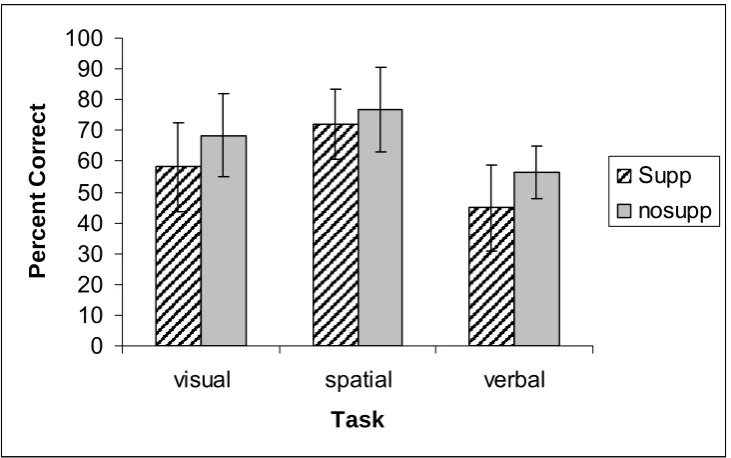
(7) vii. ABSTRACT Working memory comprises a number of components, each responsible for the processing of different types of information. The phonological loop is responsible for processing verbal information while the visuo-spatial sketchpad is responsible for processing visual and spatial information. Agerelated differences in verbal working memory are well documented with older adults consistently shown to have shorter memory spans than younger adults. Declines in spatial memory have also been reported. The data for visual memory performance however is less clear, with some researchers reporting decline across the adult lifespan and others reporting no difference. The purpose of the current thesis was to examine performance on a number of verbal, visual and spatial memory tasks in an effort to determine whether each type of memory declined with increased age and if so, whether they were affected by age to the same extent. Three studies were conducted to achieve these aims.. The first study explored the role of articulatory suppression, which has been shown to disrupt performance on verbal memory tasks; the effect on visual and spatial memory tasks is not so clear however. Fifty university undergraduates (12 men, 38 women) aged between 18 and 53 years (M = 24.38; SD = 8.62) completed verbal, visual and spatial memory tasks of differing memory set sizes under suppression and no suppression conditions in Study One. Results show that performance on all the tasks at each set.
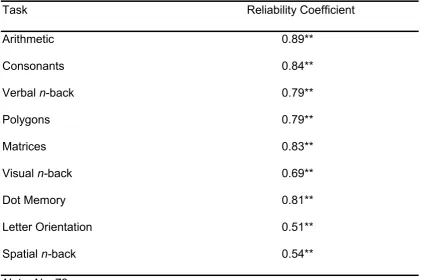
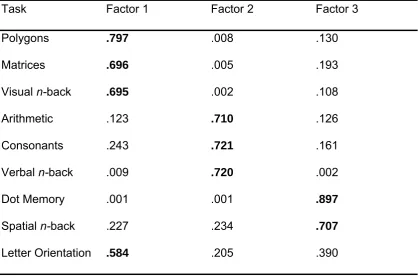
(8) viii. size was significantly affected by concurrent verbal suppression. It was concluded that articulatory suppression prevents participants from verbally encoding visual and spatial stimuli, leaving them to rely on purely visual or spatial representations. As a result articulatory suppression may provide researchers with an effective means to examine these types of memory with minimal contributions from the verbal system.. Study Two examined the reliability and validity of nine working memory tasks. One hundred and two first and second year psychology undergraduates aged between 18 and 56 years (M = 23.96, SD = 9.78) completed three verbal, three visual and three spatial working memory tasks. Seventy-three of these participants returned for retesting 14 days later. Results show that the testretest reliability of the tasks was adequate to good with reliabilities ranging from 0.51 for letter orientation to 0.89 for the arithmetic task. Three factors, interpreted as verbal, visual and spatial factors, emerged from the data, accounting for a total of 58.8% of the variance. The tasks, with the exception of letter orientation, appeared to be reliable and valid indicators of the constructs they were designed to measure and were therefore used in Study Three of the current thesis. However, it is suggested that the psychometric properties of the tasks be examined in additional and preferably larger samples and using a smaller memory set size and different age groups.. Study Three examined age-related differences in verbal, visual and spatial memory using all of the tasks from Study Two except for letter orientation..
(9) ix. Letter orientation was replaced with a letter location memory task, which was similar in design to the dot memory task used in Study Two. Two hundred and one university undergraduates and community dwelling residents aged between 18 and 80 years, 139 females and 62 males (M = 44.95; SD = 21.08) completed three processing speed tasks, three verbal, three visual and three spatial memory tasks. Results of a 3 (task: verbal, visual, spatial) × 3 (age group: young middle, older) mixed ANOVA with Bonferroni corrected comparisons revealed that there were no significant differences between young and middle aged adults performance on the verbal, visual or spatial memory tasks. Significant differences were revealed between the young and older adults’ verbal and spatial memory performance but not for visual memory performance. The differences between the middle and older age groups’ verbal, visual and spatial memory scores were significantly different.. The relationship between age and each type of memory was examined using a series of regression analyses. The first, using age as a predictor of each type of memory, showed that age explained a significant amount of the variance in verbal (11%), visual (3%), and spatial (16%) memory. After controlling for processing speed, the amount of age related variance on each type of memory decreased (verbal 5%, visual 0.08% and spatial 9%). Speed acted as a partial mediator of verbal memory variance and a full mediator of visual memory variance but not of spatial memory variance. Regression models using age, number of medications and processing speed explained a significant 15% of the variance in verbal memory, 17% of the visual memory.
(10) x. variance and 17% of the spatial memory variance. Age made significant contributions to verbal and spatial memory variance but not to visual memory variance. Processing speed made significant contributions to the variance in verbal and visual memory but not in spatial memory. The number of medications taken per day was the strongest contributor to visual memory variance.. Because the n-back tasks used in this study may have been tapping central executive processes, further models were examined using these tasks as a central executive variable along with age, number of medications, and processing speed. The results of these analyses revealed that the model explained a significant 36% of the variance in verbal memory, 32% of the visual memory variance and 28% of the spatial memory variance. The central executive variable was the strongest contributor to the variance in verbal memory (25%) and visual memory (11%); however age remained the strongest contributor to spatial memory variance (12%). Processing speed no longer made a significant contribution to verbal memory variance when the central executive variable was included in the model.. It was concluded that verbal, visual and spatial memories do decline with age but only after middle age; there appears to be little difference between young and middle aged adults. It was also concluded that verbal, visual and spatial memories are differentially affected by age with age explaining more of the variance in spatial memory than in verbal and visual memory. Age does.
(11) xi. make a significant contribution to verbal memory variance but it is not a significant predictor of visual memory performance. Hence, the decline in visual memory performance after middle age is not age-related but appears to be related to other variables such as the number of medications a person takes each day and to the efficiency of central executive functioning. The relationship between verbal, visual and spatial memory performance and processing speed is also not the same across the lifespan, with processing speed mediating the variance between age and verbal and visual memory, but not spatial memory. Finally, it appears that the central executive plays an important role in performance levels on each of the different types of memory but not to the same extent in each subsystem..
(12) xii. TABLE OF CONTENTS Statement of Access………………………………………………………………...ii Statement of Sources………………………………………………………………iii Declaration on Ethics……………………………………………………………….iv Acknowledgements………………………………………………………………….v Abstract……………………………………………………………………………...vii List of Figures……………………………………………………………………..xvii List of Tables……………………………………………………………………...xviii. Chapter 1: Introduction, Aims, and Outline……………………………………….2 1.1 Introduction………………………………………………………………………3 1.2 Definitions………………………………………………………………………..5 1.2.1 Working memory……………………………………………………...5 1.2.2 Age……………………………………………………………………..6 1.3 Aims and Significance………………………………………………………….8 1.4 Research Overview…………………………………………………………….9 1.4.1 Research questions……………………………………………………...9 1.5 Limits of the Research………………………………………………………..10 1.6 Thesis Outline………………………………………………………………….10. Chapter 2: A Model of Working Memory………………………………………..13 2.1 Chapter Introduction…………………………………………………………..14 2.2 Working Memory………………………………………………………………16 2.2.1 The central executive……………………………………………….16.
(13) xiii. 2.2.2 The phonological loop………………………………………………19 2.2.3 The visuo-spatial sketchpad……………………………………….21 2.2.4 The episodic buffer………………………………………………….22 2.3 Converging Evidence…………………………………………………………25 2.3.1 Behavioural evidence……………………………………………….25 2.3.2 Neuropsychological evidence……………………………………...29 2.3.3 Neurophysiological evidence………………………………………31 2.4 Conclusion……………………………………………………………………..34. Chapter 3: Working Memory and Aging…………………………………………36 3.1 Chapter Introduction…………………………………………………………..37 3.2 Cognitive Aging………………………………………………………………..38 3.2.1 Speed of information processing………………………………….39 3.3 Working Memory and Age……………………………………………………42 3.3.1 Age and verbal memory……………………………………………43 3.3.2 Age and visuo-spatial memory…………………………………….45 3.4 Differential Rate of Decline?.....................................................................51 3.5 Conclusion……………………………………………………………………..57. Chapter 4: Working Memory and Articulatory Suppression - Study One………………………………………………………………………………….59 4.1 Chapter introduction…………………………………………………………..60 4.2 Working Memory and Articulatory Suppression……………………………60 4.2.1 Articulatory suppression and the phonological loop…………….60.
(14) xiv. 4.2.2 Articulatory suppression and the visuo-spatial sketchpad……...62 4.3 Research Question and Hypotheses………………………………………..65 4.4 Methods………………………………………………………………………...66 4.4.1 Participants…………………………………………………………..66 4.4.2 Materials……………………………………………………………..66 4.4.3 Memory tasks………………………………………………………..67 4.4.4 Procedure……………………………………………………………69 4.5 Results………………………………………………………………………….70 4.6 Discussion……………………………………………………………………...74 4.6.1 Conclusion…………………………………………………………...77. Chapter 5: Task Reliability and Validity - Study Two……………………79 5.1 Chapter Introduction…………………………………………………………..80 5.2 Measuring Verbal, Visual and Spatial Working Memory………………….81 5.3 Methods………………………………………………………………………...85 5.3.1 Participants…………………………………………………………..85 5.3.2 Materials……………………………………………………………..85 5.3.3 Verbal memory tasks……………………………………………….86 5.3.4 Visual memory tasks………………………………………………..88 5.3.5 Spatial memory tasks……………………………………………….89 5.3.6 Procedure……………………………………………………………90 5.4 Results………………………………………………………………………….91 5.5 Discussion……………………………………………………………………...96 5.5.1 Conclusion………………………………………………………….100.
(15) xv. Chapter 6: Age-Related Changes in Verbal, Visual and Spatial Working Memory Processes - Study Three……………………………………….102 6.1 Chapter Introduction…………………………………………………………103 6.2 Age-Related Changes in Verbal, Visual and Spatial Working Memory..103 6.2.1 Summary and aims………………………………………………..108 6.3 Methods……………………………………………………………………….109 6.3.1 Participants…………………………………………………………109 6.3.2 Materials……………………………………………………………109 6.3.3 Memory tasks………………………………………………………110 6.3.4 Processing speed tasks…………………………………………..111 6.3.5 Procedure…………………………………………………………..113 6.4 Data Analyses………………………………………………………………..114 6.5 Results………………………………………………………………………..116 6.6 Discussion…………………………………………………………………….134 6.6.1 Conclusions………………………………………………………...140. Chapter 7: General Discussion and Conclusions…………………………….144 7.1 Chapter Introduction…………………………………………………………145 7.2 Overview of the Results……………………………………………………..145 7.3 Limitations.…………………………………………………………………...150 7.4 Implications…………………………………………………………………..152 7.5 Recommendations for Future Research…………………………………..154 7.6 Conclusions…………………………………………………………………..155.
(16) xvi. References………………………………………………………………………159 Appendix…………………………………………………………………………186.
(17) xvii. LIST OF FIGURES. Figure 4.1…………………………………………………………………………...68 Example of some of the patterns used in the matrix pattern condition. Figure 4.2…………………………………………………………………………...73 Comparison of suppression and no suppression conditions for verbal, visual and spatial memory performance. Figure 6.1………………………………………………………………………….113 Example of types of stimuli used in pattern comparison task. Figure 6.2………………………………………………………………………….120 Comparison of processing speed between young, middle and older age groups. Figure 6.3………………………………………………………………………....123 Comparison of performance levels on the verbal, visual and spatial memory tasks between young, middle and older age groups. Figure 6.4………………………………………………………………………….128 Standardised regression coefficients for the relationship between and age and verbal memory as mediated by speed of processing. Figure 6.5………………………………………………………………………….129 Standardised regression coefficients for the relationship between and age and visual memory as mediated by speed of processing..
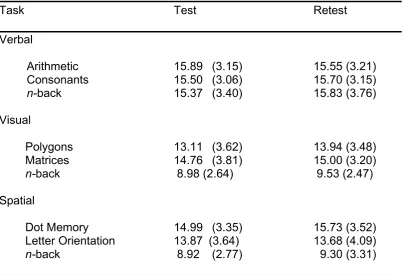
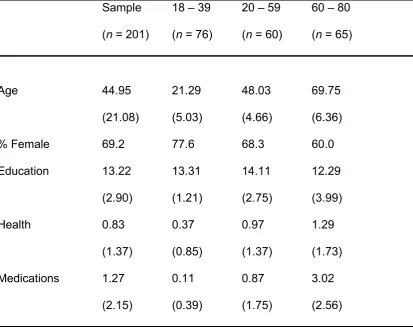
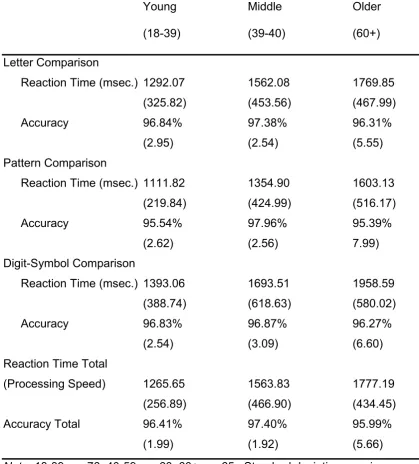
(18) xviii. LIST OF TABLES. Table 4.1……………………………………………………………………………71 Mean Percentages and Standard Deviations for Performance on Verbal, Visual and Spatial Memory Tasks Set Sizes Three, Four and Six during Suppression and No Suppression Conditions Table 5.1……………………………………………………………………………92 Means and Standard Deviations for Verbal, Visual and Spatial Memory Tasks at Test and Retest Table 5.2……………………………………………………………………………93 Correlations between Verbal, Visual and Spatial Memory Tasks Table 5.3……………………………………………………………………………94 Verbal, Visual and Spatial Memory Tasks Test-Retest Reliability Coefficients Table 5.4……………………………………………………………………………96 Factor Solutions from Principal Components Analysis with Varimax Rotation Table 6.1…………………………………………………………………………..117 Demographic Characteristics of Total Sample and Age Groups Table 6.2…………………………………………………………………………..119 Means and Standard Deviations for Reaction Times and Accuracy on Processing Speed Tasks, and Total Processing Speed and Accuracy Means and Standard Deviations for Young, Middle and Older Age Groups Table 6.3…………………………………………………………………………..121 Means and Standard Deviations for Verbal, Visual and Spatial Memory Tasks by Age Group.
(19) xix. Table 6.4…………………………………………………………………………..125 Correlations Between, Age, Health Status, Level of Education, Number of Medications, Processing Speed and Accuracy, and Verbal, Visual and Spatial Memory Table 6.5…………………………………………………………………………..126 Results of Regression Analyses using Processing Speed and Age as Predictors of Verbal, Visual and Spatial Memory Table 6.6…………………………………………………………………………..130 Results of Regression Analyses using Age, Number of Medications and Processing Speed as Predictors of Verbal, Visual and Spatial Memory Table 6.7…………………………………………………………………………..132 Correlations between Verbal, Visual and Spatial n-Back Tasks for Young, Middle and Older Age Groups. Table 6.8…………………………………………………………………………..133 Results of Regression Analyses using Age, Number of Medications, Processing Speed and a Central Executive Measure as Predictors of Verbal, Visual and Spatial Memory.
(20) 1. CHAPTER 1. Introduction, Aims and Outline. 1.1 Introduction 1.2 Definitions 1.2.1 Working memory 1.2.2 Age 1.3 Aims and Significance 1.4 Research overview 1.4.1 Research questions 1.5 Limits of the Research 1.6 Thesis Outline.
(21) 2. 1.1 Introduction Life expectancy for non-Indigenous Australians in 1999 was 76.2 years for males and 81.8 years for females (Australian Bureau of Statistics [ABS], 2000). These figures are consistent with those from a number of other Western nations including, the United States of America (USA), France, Canada, the United Kingdom, and New Zealand. Globally the figure is approximately 67 years and rising (Riley, 2001). Life expectancy for Indigenous Australians is lower than for non-Indigenous Australians, 56 years for males and 76 years for females (ABS, 2000). Compare these figures with those of the 1800s when the average lifespan at birth was only about 30 years (Riley, 2001). Increases in life expectancy can be attributed to improvements in a number of areas, including: public health, medicine, wealth and income, nutrition, behaviour, and education (Riley, 2001). People are living longer and as a consequence the world’s population is becoming older as the birth rate declines in most countries of the world. The fact that people are living longer is of course good news. However, a number of questions about potential problems that people may face as a result of living longer also come to the fore. Such problems could be of a personal, social, medical, or economical nature (Stokes, 1992). Further problems could be related to cognitive functioning and indeed there is a growing extant literature reporting how cognitive processes are affected by age. Some researchers have focused on increased knowledge and experience that comes with increased age, however, more attention has been.
(22) 3. given to declines that occur in cognitive ability (Park, 2000) including declines in memory functioning. How often do we hear older people declare that their memory is not what it used to be? Our ability to remember indeed does deteriorate as we grow older. There are, of course, a number of different types of memory (for example, sensory, semantic, short-term, working, long-term) that may, or may not, be affected by age or that may be affected to differing extents. For instance, sensory (Walsh & Thompson, 1978) and semantic (Hultsch & Dixon, 1990) memory have been shown to be affected by increased age, but not to the same extent as working memory, which is particularly sensitive to changes with increasing age (Stokes, 1992). Working memory is a memory system that enables the simultaneous storage and processing of information and which is important for everyday cognitive functioning. It enables us to perform complex cognitive tasks such as problem solving and reasoning. It has also been found to be important for everyday tasks such as making decisions of a medical nature, including remembering to take medications (Park, Morrell, Frieske, & Kincaid, 1992). Baddeley and Hitch (1974) developed a model of working memory (described in detail in Chapter 2) that comprised a domain-general controlling system referred to as the central executive and two domain-specific slave systems – the phonological loop and the visuo-spatial sketchpad. The phonological loop is responsible for verbal-based information while the sketchpad is responsible for both visual and spatial information. While age-related decline in the verbal component of the working memory model has been well studied, there are a.
(23) 4. number of inconsistencies and methodological problems in research examining age differences in visual and spatial memory. The current thesis aims to address some of these issues. But, before the aims and significance of the present thesis are discussed it is important to provide definitions for some important concepts that will be used throughout the current thesis. 1.2 Definitions 1.2.1 Working memory Throughout this dissertation working memory will be defined as a memory system that provides the ability to simultaneously maintain and process information. This definition also allows information to be stored for a brief period of time. Information may be verbal, visual or spatial in nature, with each different type of memory likely to involve activation of different areas of the brain (Smith & Jonides, 1997). There are likely to be other types of information that can be processed by working memory, for example temporal, source, or tactile; the current thesis is however only concerned with verbal, visual and spatial memory. A working memory task is a task that requires the storage and manipulation of information. For example, mental arithmetic requires both the storage and manipulation of information and therefore requires working memory functioning (see for example, Oberauer, Demmrich, Mayr, & Kliegl, 2001). This type of task can be distinguished from storage only tasks. The difference between these two types of tasks is an important one. Storage only tasks are often referred to as short-term memory tasks and only tap phonological loop and visuo-spatial sketchpad functioning. Storage plus.
(24) 5. manipulation tasks, on the other hand, presumably require additional central executive processes (Miyake, Friedman, Rettinger, Shah, & Hegarty, 2001; Oberauer, Süss, Schulze, & Wittman, 2000). It is also thought that the distinction between the two types of tasks is more pronounced for verbal working memory than for visual or spatial memory. As a consequence, visual and spatial short-term tasks may be equivalent to visual and spatial working memory tasks; both are thought to require central executive processes. 1.2.2 Age One of the problems faced by cognitive aging researchers is that providing a clear definition for age is difficult. Different researchers define age in different ways (Kermis, 1984). Chronological age, the most common measure of age, refers to the number of years from a person’s date of birth (Stuart-Hamilton, 1994). Another form of age is social age, or how one is expected to act at a specific chronological age. Age can also be defined in terms of biological or psychological factors. Biological age refers to the actual physical state of one’s body in comparison to standards for that chronological age, while psychological age refers to personality development and to the degree of cognitive competence a person maintains across the lifespan (Stuart-Hamilton, 1994). For present purposes age will be defined, and measured, as the number of years from birth, or chronological age. While it is acknowledged that chronological age does not tell us much about how an individual person may be functioning at a particular age, it allows us to gauge how a group of people within a particular age range perform on a number of memory tasks.
(25) 6. and how performance may change as a result of increased age. Moreover, the different types of age are not totally independent; cognitive functioning can be affected by a person’s physical and psychological wellbeing (StuartHamilton, 1994). It is also acknowledged that the boundaries for different age groups are often blurred, inconsistent, and arbitrary; there is no clear cut distinction between being considered young and being considered middle aged for example (Lachman, 2004). Furthermore, different individuals have different views on at what age one becomes middle aged or old. A person in their late 60s, who is physically and psychologically healthy, may consider themselves to be middle aged, not old aged. That being said, it is necessary when conducting research that clear boundaries be set when defining different age groups. Therefore, the age groups used in the current thesis were based on those that have been previously commonly used in the cognitive aging literature (see for example, Meguro, et al., 2000; Salthouse, 1996b). Participants between the ages of 18 and 39 years formed the young age group, those between 40 and 59 years the middle age group, and those between 60 and 80 years the older age group. Because the number of older adults living beyond 75 years of age is increasing, some researchers often distinguish between the “young-old” (65 to 74 years) and the “old-old” (75 years and above) (Stokes, 1992). No such distinction was made here and all participants above 60 years of age were considered part of the old age group..
(26) 7. 1.3 Aims and Significance There are very few studies that have directly compared age-related differences in verbal, visual and spatial memory. The main aim of the present thesis was to examine whether the verbal, visual and spatial components of working memory all decline with age and, if so, to examine whether that decline is the same or different across the different types of memory. Three studies were conducted to achieve this aim. The first examined how verbal, visual and spatial working memories were affected by articulatory suppression. Verbal, visual and spatial working memories were then assessed using multiple tasks designed to measure each type of memory with minimal contribution from the other systems. In other words, the reliability and validity of each of the tasks was examined to ensure that they were measuring the constructs they had been designed to measure. Finally, an examination of the nature of change as a function of chronological age for each type of working memory was undertaken to determine whether they all changed with age and whether they changed at the same, or different, rates. Our population is aging and it is important that researchers attempt to gain an understanding of any changes that may occur as a function of age and how these changes may affect older adult’s daily lives. Understanding the changes that may, or may not, occur in working memory processes can be of benefit not only to cognitive aging researchers, but also to older people themselves. Such research may help guide decisions made by policy makers in a direction that would be of greatest benefit to older adults. It would also.
(27) 8. add valuable information to existing knowledge about age-related changes in cognitive functioning. 1.4 Research Overview Each of the three studies that make up the current thesis was based on the need to undertake a number of steps before the overall aims of the thesis could be addressed. Each study was developed around individual research questions which will now be discussed. 1.4.1 Research questions Articulatory suppression is a technique (see Chapter 4) that is often used by cognitive researchers to help minimise verbal encoding strategies in visual and spatial memory tasks. However, there is no clear evidence of the effects articulatory suppression has on performance on visual and spatial working memory tasks. A number of researchers have found no impairment in performance with the inclusion of a verbal suppression task (see for example Pickering, Gathercole, Hall, & Lloyd, 2001), while others (Miles, Morgan, Milne, & Morris, 1996) have found that performance is impaired. If articulatory suppression does impair performance on visual and spatial tasks then one could assume that participants are using verbal labels in an attempt to remember these stimuli. Performance on these tasks without suppression may involve phonological loop functioning as well as visuo-spatial sketchpad functioning. As a result of the inconsistencies in the previous literature, and because the tasks used in this thesis are quite different from those that have been used in previous research, Study One was designed to answer the.
(28) 9. question: What effect does articulatory suppression have on verbal, visual and spatial memory performance. Study Two was designed to determine the reliability and validity of the nine tasks designed to assess verbal, visual and spatial working memory. These tasks were then used in Study Three which asked: Do verbal, visual and spatial memory change with increased age? And if so, is the rate of change in each of the different types of memory equivalent or different? 1.5 Limits of the Research The current thesis looks at memory differences in physically healthy, non-demented participants only. The memory loss that occurs with dementia may not be the result of the same mechanisms that underlie memory loss that accompanies normal aging. Research has shown that there may be a difference between the mediation of variables in dementia-related memory loss as compared to normal aging. For example Sliwinski and Buschke (1997) found that statically controlling for processing speed significantly weakened age-related variance in a number of memory tasks in a sample of non-demented participants. However, they found no significant reduction in dementia-related memory decline when controlling for processing speed, leading to the conclusion that processing speed is not important in the memory loss that accompanies dementia (see also Luszcz & Bryan, 1999). 1.6 Thesis Outline An important concept for present purposes is working memory; hence, Chapter 2 provides an introduction to a model of working memory that provided the theoretical impetus for this dissertation. Behavioural,.
(29) 10. neuropsychological, and neurophysiological data supporting the multicomponent nature of the model is reviewed. Chapter 3 provides a broad overview of the literature on working memory and cognitive aging. The chapter defines cognitive aging and provides evidence that shows how the speed at which one processes information and working memory play important roles in performance on a variety of cognitive tasks. The literature on working memory and aging from behavioural and neurophysiological perspectives is reviewed. It shows that although there is considerable evidence for an age-related decline in verbal working memory, and some evidence for age-related change in spatial memory, there is little research examining changes in visual working memory. It is also unclear from previous research whether verbal, visual and spatial memories change at the same, or differential rates. Chapter 4 is organised with a review of literature highlighting inconsistencies as to the effects of articulatory suppression on visual and spatial memory performance. The review is followed by details of the methodology adopted to undertake Study One, which was designed to examine the effect of articulatory suppression on verbal, visual and spatial working memory. The results of the study are presented followed by a discussion of the results. Chapter 5 provides a discussion on the need to use reliable and valid measures when examining hypothetical constructs like working memory. This is followed by the details of Study Two. Study Two was designed to determine whether the tasks designed to measure verbal, visual, spatial.
(30) 11. working memory in the present thesis are indeed reliable and valid measures of these constructs. The results of Study Three, which examined age-related changes in verbal, visual and spatial memory, are reported in Chapter 6. The issue of differential or equivalent rates of decline is also addressed in Chapter 6. Finally, Chapter 7 provides a general discussion of the results of the three studies reported in this thesis and what they mean in relation to the aims of the thesis and to the study of working memory and aging in general. Limitations of the research and implications of the results of the four studies are discussed and some future research directions are suggested. But first, a detailed discussion of working memory is provided in Chapter 2..
(31) 12. CHAPTER 2. A Model of Working Memory. 2.1 Chapter Introduction 2.2 Working Memory 2.2.1 The central executive 2.2.2 The phonological loop 2.2.3 The visuo-spatial sketchpad 2.2.4 The episodic buffer 2.3 Converging Evidence 2.3.1 Behavioural evidence 2.3.2 Neuropsychological evidence 2.3.3 Neurophysiological evidence 2.4 Conclusion.
(32) 13. 2.1 Chapter Introduction Humans have the ability to store and subsequently retrieve information that is acquired from the environment via our senses. This ability is referred to as human memory and is fundamental to our very existence. Groome et al. (1999, p. 96) captured the importance of human memory when they stated “In a sense it can be said that our very identity relies on an intact memory, and the ability to remember who we are and the things that we have done.” Traditionally models of memory distinguish between sensory memory, shortterm memory, and long-term memory (Atkinson & Shiffrin, 1968). Sensory memory refers to the very brief retention of sensory information such as auditory, visual, tactile, olfactory, taste information. Traces from sensory memory will decay very quickly (in milliseconds) unless the information is attended to. Long-term memory is memory for events that have been maintained over a long period of time, days, weeks, or years. Short-term memory, on the other hand, refers to a memory system that can hold a small amount of information, of which we are consciously aware, for a short period of time (seconds to minutes) (Atkinson & Shiffrin, 1968). William James (1952) originally distinguished between short-term and long-term memory, although he used the terms “primary” and “secondary” memory, terms that are still used today. Evidence for distinct short-term and long-term stores was provided by research with brain damaged patients who had impaired long-term memory but intact short-term memory (see for example, Baddeley & Warrington, 1970) and those with impaired short-term memory but intact long-term memory (Warrington & Shallice, 1969). One of.
(33) 14. the earliest models to highlight the distinction between the different memory stores was the modal model proposed by Atkinson and Shiffrin in 1968. The modal model posits that input is received by the sensory stores and will be transferred on to short-term storage if it is attended to. A small amount of information can be held in short-term memory by a process of rehearsal. Rehearsal will also enable the information to be passed on to long-term memory. The model also allows for information loss, either by decay or interference (Goldstein, 2005). Because of the sequential structure of the modal model, the only means for sensory information to pass on to long-term memory is via the short-term store. However, as was previously mentioned, research has found that some brain damaged patients have impaired shortterm memory but still retain their long-term memory (Warrington & Shallice, 1969); therefore the short-term store cannot be the only avenue to the longterm store. In 1974 Baddeley and Hitch proposed a model of short-term memory that attempted to account for a variety of data that the modal model could not account for and to address the shortcomings of the model. For example, research by Baddeley and Hitch found that it was possible for a person to complete two tasks at the same time, reading and remembering a string of digits. According to the modal model, this should not be possible because short-term memory is limited in the amount of information it can hold at a given time. Capacity of the system would be reached by reading a passage and as a result, a person should not be able to remember the string of digits as well. At least, they should have impaired memory for the digits; however,.
(34) 15. this was not the case. Participants were able to recall all the digits. Based on these findings Baddeley and Hitch concluded that rather than being a unitary system, short-term memory likely contained a number of components that functioned separately. Baddeley and Hitch’s model, referred to as the working memory model, provided the theoretical framework for the present dissertation and will be described in detail in the present chapter. Behavioural, neuropsychological, and neurophysiological data showing that working memory comprises a number of subcomponents each of which represents a specific type of memory will also be reviewed. 2.2 Working Memory Working memory is a system that enables the temporary storage and processing of information and as such it is important for the execution of complex cognitive processes (Baddeley, 1992). According to Miyake and Shah (1999, p. 450), “Working memory is those mechanisms or processes that are involved in the control, regulation, and active maintenance of taskrelevant information in the service of complex cognition.” Although a number of working memory models have been proposed (e.g., Engle, et al., 1992; Jones, Farrand, Stuart, & Morris, 1995; Just & Carpenter, 1992; Macken & Jones, 1995, 2003), perhaps the most well developed and influential model is that of Baddeley and Hitch (1974). Baddeley and Hitch, and later Baddeley (1986), proposed a tripartite model that comprised a controlling system referred to as the central executive and two domain-specific, limited capacity slave systems, the phonological loop and the visuo-spatial sketchpad..
(35) 16. Recently, Baddeley (2000) added another component, the episodic buffer, to the model. A discussion of each of these components follows. 2.2.1 The central executive The central executive is the least specified component of the model, apart from the recently included episodic buffer. Part of the difficulty in specifying the central executive comes from uncertainty about what it actually does (Towse & Houston-Price, 2001). What it can, or may, do, of course is related to how one defines it. For instance, some consider the central executive as a general purpose processor responsible for the processingstorage trade off found in working memory span tasks (Daneman & Carpenter, 1980). Others consider that it is important for performance on dual tasks; more resources are needed when one performs two tasks at the same time than when one performs them individually (Baddeley, Bressi, Della Sala, Logie, & Spinnler, 1991). Baddeley (1986) suggested that Norman and Shallice’s Supervisory Attentional System (SAS) could act as a model for the central executive mainly because of its role as an attentional controller. As a consequence, recent attempts at understanding central executive functioning have proceeded on the assumption that it is responsible for the attentional control of the working memory system (Baddeley, 2001). The latter assumption can be seen to be related to the two previous definitions in that performance on working memory span tasks, and on dual tasks, requires attentional control. Explorations of a range of functions, including the capacity for divided attention (Baddeley, Baddeley, Bucks, & Wilcock, 2001), focused attention.
(36) 17. (Baddeley, Emslie, Kolodny, & Duncan, 1998), and the integration of information between the two slave systems and long-term memory (Baddeley, 1996), have been undertaken. Task switching may involve some executive capacity, however, recent work by Baddeley, Chincotta and Adlam (2001) suggests that the phonological loop may be more crucial for task switching than the central executive. Moreover, there exists some doubt as to whether task switching is distinct from dual task coordination (Hartley & Little, 2000). Indeed, it has been shown that both processes activate similar regions of the brain (Collette & Van der Linden, 2002). A further process attributed to the central executive is updating, which involves modifying the contents of working memory to incorporate incoming information (Morris & Jones, 1990). The role of the central executive in each of these different functions has led to the suggestion that the central executive may be fractionated according to function (Baddeley, 1996a; Collette & Van der Linden, 2002). It also shows that the central executive is strongly involved in the allocation and coordination of attentional resources of the working memory system. Engle, Kane, and Tulholski (1999) also stressed the importance of controlled attention in working memory, particularly in complex working memory tasks such as the reading span task, arguing that individual differences in working memory capacity reflect individual differences in the ability to control attention. However controlled attention is not the only factor that affects the capacity limits of working memory. Capacity may also be constrained by a variety of other factors such as processing speed, lack of.
(37) 18. knowledge, similarity-based interference, and information decay (Miyake & Shah, 1999). The lack of specification of the central executive continues to pose a problem for the working memory model. While recent neuroimaging research is providing some clarification of the processes under central executive control (for a review see Collette & Van der Linden, 2002), much more research is needed before we can clearly state the functions of the executive. However, for present purposes, the central executive will be considered a component of the working memory model responsible for enabling performance on tasks that require capacity above that available to the slave systems. 2.2.2 The phonological loop The first slave system of Baddeley and Hitch’s (1974) working memory model, the phonological loop, is the most well developed component of the model. The phonological loop is assumed to be important for learning to read and to speak, and for language comprehension. It comprises two components – the phonological store and the articulatory control process. The phonological store is responsible for holding verbal-based information for a brief period. The articulatory control process is assumed to be responsible for maintaining a small amount of verbal information in the store by a process of subvocal rehearsal (Baddeley, 1990). Auditorally presented material has direct access to the phonological store, while visually presented material needs to be recoded into phonological form by the articulatory rehearsal component before it can gain access to the store (Baddeley, 2001)..
(38) 19. Research with patients with short-term memory deficits has provided evidence for the existence of the separate storage and rehearsal processes attributed to the phonological loop. For example, Vallar and Baddeley (1984; see also Vallar & Papagno, 1986) found impairment of the phonological store in a patient referred to as P.V. Patient P.V. had intact verbal memory for items presented visually, but impaired memory for auditory presentation. In contrast, Belleville, Peretz, and Arguin (1992) found specific impairment of the articulatory control process in a different patient, Ro.L. Ro.L had intact visuo-spatial memory, central executive functioning and phonological store. However, processes requiring articulatory control process functioning were disrupted. For example, the word-length effect was absent for both visual and auditory modalities and there was no evidence of the typical effects of articulatory suppression on subsequent memory performance. The limited capacity of the phonological loop is reflected in performance on tasks that require participants to recall a sequence of digits or words of increasing length in order of presentation, for example, digit and word span (Torgesen, 1996). As the number of to-be-remembered items increases, items presented first are likely to fade from memory before the last item can be processed, or the processing of the later items is likely to interfere with the recall of the earlier items. The length of a sequence that can be remembered is thought to be a function of the spoken duration of the items. The time it takes to articulate each item will determine how many items will be maintained by the phonological store. Also, the longer it takes to reproduce the words at recall can affect the number of items that can be.
(39) 20. remembered (Cowan, et al., 1992). The number of items that can be maintained at any one time will also vary depending on the language being spoken, because of a difference in articulation time of words between languages (Naveh-Benjamin & Ayres, 1986). The number of items that can be correctly recalled also reflects the individual’s verbal memory span, which may also be influenced by factors such as acoustic similarity, unattended speech, and articulatory suppression (Baddeley, 1996b). Indeed these factors provided the empirical impetus for the theoretical development of the phonological loop. 2.2.3 The visuo-spatial sketchpad Development of theory related to the visuo-spatial sketchpad proceeded without the empirical underpinnings afforded the phonological loop. Most researchers conceded that a visuo-spatial system similar to the phonological loop existed, but were unclear about how it should be specified (Pearson, 2001). Researchers originally assumed that the sketchpad was responsible for the generation and manipulation of visuo-spatial images. As a result, development of the system was similar to that of models of visual imagery (Logie & Pearson, 1997). More recent research, however, suggests that the visuo-spatial sketchpad represents a multi-faceted system with both visual and spatial dimensions, each with their own separate maintenance, manipulation, and storage mechanisms (Salway & Logie, 1995). Visual and spatial information may be stored in two separate, but related components, a ‘visual cache,’ which is linked to the visual perception system, and an ‘inner scribe,’ which is linked to the planning and execution of movement in three.
(40) 21. dimensional space (Logie & Pearson,1997). Visual memory deals with an object’s appearance while spatial memory deals with location or direction (Baddeley & Hitch, 1994). Investigations into the workings of the visuo-spatial sketchpad are made particularly difficult because of the natural tendency people have to attach verbal labels to visual and spatial stimuli (Bahrick & Boucher, 1968; Washburn & Astur, 1998). If visual and spatial stimuli are being verbally encoded, then both the visuo-spatial sketchpad and the phonological loop are contributing to performance on visual and spatial tasks. One method of preventing verbal encoding on visual and spatial tasks is to use an articulatory suppression task. Articulatory suppression, repeating a word or a syllable out loud during presentation of to-be-remembered items, interferes with the functioning of the articulatory control process (Baddeley, 1990). As was previously mentioned, the articulatory control process recodes visually presented items into phonological form, thereby allowing the items to gain access to the phonological store. Including an articulatory suppression task during the encoding stage of visual and spatial memory tasks helps prevent this recoding process from taking place. There is, however, some conjecture as to the effect of suppression on visual and spatial memory performance. Some researchers (e.g., Pickering, et al., 2001; Vandierendonck, Kemps, Fastame, & Szmalec, 2004; Vogel, Woodman, & Luck, 2001) have found that visual and spatial memory performance is not affected by a concurrent verbal task. Others (Miles, et al., 1996; Steward, 2002) have shown that articulatory.
(41) 22. suppression does impair subsequent performance on visual and spatial memory tasks. The effect of suppression on verbal, visual and spatial memories will be examined in Study One (Chapter 4) of the present dissertation. 2.2.4 The episodic buffer Recently Baddeley (2000) added a further component to the working memory model to help account for a number of phenomena that the original model could not explain. For example, according to the original model, articulatory suppression should impair serial recall of visually presented verbal material because it prevents the items from being recoded into their phonological form. While recall is impaired by suppression it is not totally eliminated, suggesting that the material is being stored somewhere other than in the phonological store. A similar situation is found with patients who have impaired phonological memory. These patients have severely impaired memory when items are presented auditorally, but their memory span when items are presented visually increases (Baddeley, 2000). To help address these inconsistencies, Baddeley proposed another component for the model capable of storing and integrating multimodal information. The new component has been named the episodic buffer, “a limited-capacity temporary storage system that is capable of integrating information from a variety of sources” (Baddeley, 2000, p. 421). Information from the two slave systems and long-term memory can be bound into a single episodic representation. There is some recent research suggesting a role for the episodic buffer in storing integrated visual information (Baddeley & Andrade,.
(42) 23. 2000; Zimmer, Speiser, & Seidler, 2003), information about the combined feature of objects including colour, orientation, and so on. The discussion of the episodic buffer offered here is necessarily short because the component is still in its developmental phase. As a result the component is not yet fully specified. Also, while there may be some advantages to adding another component to the existing model (for example, it enables information from the slave systems to be used in conjunction), there are also disadvantages. Perhaps the main disadvantage is that the inclusion of an extra component to account for troublesome phenomena adds to the complexity of the model. One of the appealing features of Baddeley and Hitch’s model over the years has been its simplicity (Andrade, 2001). The episodic buffer may become an important part of the working memory model once its hypothesised functions have been tested experimentally using both behavioural and neurophysiological approaches. In the interim there still remain many unanswered questions about the functioning of the original components of Baddeley and Hitch’s model, especially in relation to the effects of age on verbal, visual and spatial working memories. The present thesis aims to answer some of these questions. But first, I provide a discussion of the behavioural, neuropsychological, and neurophysiological research that has provided evidence for the dissociation of the verbal, visual and spatial components of working memory. Dissociations as discussed here are typically reported to provide evidence for separate mental processes underlying different cognitive tasks. A number of different types of dissociations have been posited (see for.
(43) 24. example, Dunn & Kirsner, 1988; Shallice, 1988), however, most research reports either single or double dissociations. Dunn and Kirsner (2003, p. 1) explain dissociations in the following way: Let A and B be two tasks and let a and b be two manipulations, variables or factors. A single dissociation is observed if a affects performance on A but not on B. A double dissociation is observed if, in addition, b affects performance on B but not on A. 2.3 Converging Evidence Baddeley and Hitch’s (1974) model is by no means the only model of working memory to be developed. Indeed a number of researchers have argued that working memory is a unitary rather than a multicomponent system (e.g., Engle, et al., 1992; Jones, et al., 1995; Just & Carpenter, 1992; Macken & Jones, 1995, 2003). Proponents of unitary models often exclude the slave systems from their models and distinguish between working memory and short-term memory. For example, Just and Carpenter’s theory of working memory only considers a component similar to the central executive that is involved in language comprehension. They do not include separate verbal and visuo-spatial components. Engle et al. consider working memory as a single, domain-general system that controls attention and is separate from short-term memory. Close inspection of these competing models, however, reveals that they are, in fact, quite similar to Baddeley and Hitch’s model. If one considers Engle and colleague’s model, for instance, it can be argued that what they refer to as working memory reflects the central.
(44) 25. executive component of Baddeley and Hitch’s model, while what they term short-term memory is reflected in the phonological loop and the visuo-spatial sketchpad. Moreover, behavioural, neuropsychological, and neurophysiological data converge in providing compelling evidence for the multicomponent nature of working memory. 2.3.1 Behavioural evidence Interference paradigms have provided a crucial source of evidence for dissociable working memory components. Dual task, or selective interference, experiments combine a memory task with a secondary task, both of which are assumed to tap similar cognitive processes. Evidence that similar processes are involved in the tasks is provided if performance on the memory task is significantly impaired when the two tasks are combined (Baddeley, 1990). A number of studies have adopted this approach to provide evidence for a single dissociation of visual and spatial working memory processes. According to Shallice (1988, p. 34), “a dissociation occurs when a patient performs poorly on one task … and at a normal level or at least at a very much better level on another task.” In selective interference studies the same principle applies. The researcher looks to see if the interference affects performance on one type of task more than it does on another. For example, Quinn (1994) found that performance on the Brook’s matrix task, a task considered to tap spatial working memory, was disrupted by concurrent arm movements. Conversely, McConnell and Quinn (2000) used selective interference to show that performance on a visual memory task was disrupted by concurrent visual noise..
(45) 26. Della Sala, Gray, Baddeley, Allamano, & Wilson (1999) combined a Corsi block task and a visual pattern memory task with spatial and visual secondary tasks. The spatial secondary task involved tapping pegs, while the visual secondary task involved viewing irrelevant pictures. Corsi block performance was significantly disrupted by spatial tapping but not by irrelevant pictures. In contrast, pattern memory was impaired by irrelevant pictures but not by spatial tapping. Similarly, Tresch, Sinnamon, and Seamon (1993) found a movement discrimination task interfered with a task that required remembering the location of a dot, while a colour discrimination task disrupted performance on an object memory task. These results provide evidence of a double rather than a single dissociation of spatial and visual working memory. In other words, performance on one memory task is impaired by one type of interference but not another, while the opposite is true of the second memory task. Experimental double dissociations have also been used to provide evidence for a verbal system separate from both the spatial and visual systems. For instance, Logie, Zucco, and Baddeley (1990) paired visual and verbal memory tasks with visual and verbal suppression tasks. Visual suppression involved visual imagery while verbal suppression involved mental arithmetic. Visual memory performance was significantly impaired by concurrent visual imagery but not by concurrent mental arithmetic. Performance on the verbal task, however, was impaired by concurrent arithmetic but not by concurrent visual imagery. A similar approach was adopted by Farmer, Berman, and Fletcher (1986) using verbal and spatial.
(46) 27. tasks. Articulatory suppression impaired performance on the verbal reasoning task but had little effect on the spatial reasoning task. Spatial tapping, on the other hand, disrupted performance on the spatial reasoning task but not the verbal reasoning task. The results of these studies suggest that working memory comprises dissociable verbal, visual and spatial components. But because other researchers provide evidence that articulatory suppression can impair performance on visual and spatial tasks, this source of evidence, on its own, is not totally convincing (see for example, Jones et al., 1995; Miles et al., 1996; Simons, 1996). Further evidence for dissociable systems has been provided by developmental fractionation experiments. Developmental fractionation is based on the premise that different cognitive functions develop at different rates. Differential rates of performance with age on tasks that tap the different types of working memory suggest that the tasks are drawing on different cognitive processes. Logie and Pearson (1997) examined the developmental path of the Corsi block task, a task that is assumed to rely on spatial working memory, and a matrix pattern task, a task assumed to rely on visual working memory. Visual memory was found to develop at a significantly faster rate than spatial memory, suggesting two distinct components. However, Pickering et al. (2001) argued that the distinction was not a visual/spatial one but rather a static/dynamic one. According to Pickering et al. (2001), the tasks used by Logie and Pearson differed, not only in relation to content, but also in relation to the.
Figure


+7

Related documents
The growth factors were included in the analysis, as previous research has found that management control systems are important in supporting and controlling growth
If you have attached a government form for an item, check the box and do not enter a 2020 amount..
Kushalappa, Effect of Basketball Specific Training on Selected Physical Fitness Variables among the Inter Collegiate Men Basketball Players of Mangalore
At the same time, map out your estate plan, and make sure your family and financial professionals understand your intentions should something happen to you. We
We conducted a cohort study followed up TB and MDR-TB patients nine years after diagnosis with the disease in Henan Province, China..
The adjudicating administrators bring in their own experiences and knowledge of the university environment and campus community to help them navigate what policies and procedures
used fuzzy c-means for medical image segmentation. In this chapter, we had the focus on a par- ticular statistical model which is finite mixture. The main problems faced were
Our extensive simulations and analysis of real gene expression and case–control data indicate that for randomly ascertained individuals such as those in a cross-sectional study,
