Evaluation of Work-Based Learning
Programme 2011-14: Apprenticeships
SOCIAL RESEARCH NUMBER:
30/2016
PUBLICATION DATE:
Philip Wilson, Amy Woolger, Matthew Cutmore
(York Consulting)
Huw Bryer, Nia Bryer (Old Bell 3)
Mark Winterbotham (IFF Research)
Rhys Davies (Cardiff University)
Views expressed in this report are those of the researchers and not necessarily those of the Welsh Government.
For further information please contact: Siân Williams
Knowledge and Analytical Services Welsh Government
Cathays Park Cardiff
CF10 3NQ
Tel: 029 2082 3991
Email: [email protected]
Table of Contents
Glossary ... 3
List of Tables ... 5
List of Figures ... 6
1 INTRODUCTION ... 14
2 POLICY CONTEXT ... 17
3 PROGRAMME DESIGN ... 33
4 PERFORMANCE ... 42
5 STAKEHOLDER/PROVIDER PERSPECTIVES ... 57
6 EMPLOYER EXPERIENCES ... 86
7 CURRENT APPRENTICESHIP LEARNER EXPERIENCES ... 111
8 APPRENTICESHIP LEAVER EXPERIENCES ... 128
9 IMPACT MEASUREMENT ... 157
APPENDICES:
A: EVALUATION METHODOLOGY
B: BIBLIOGRAPHY
C: ESF DATA BY CONVERGENCE AND COMPETITIVENESS AREAS
D: STAKEHOLDER/PROVIDER TOPIC GUIDE
E: EMPLOYER SURVEY QUESTIONNAIRE
F: EMPLOYER SURVEY TABLES
G: CURRENT APPRENTICESHIP QUESTIONNAIRE
H: CURRENT APPRENTICESHIP TABLES
I: APPRENTICESHIP LEAVER QUESTIONNAIRE
J: APPRENTICESHIP LEAVER TABLES
K: EMPLOYER CASE STUDY TOPIC GUIDES
Glossary
AMS Apprenticeship Matching Service
APS Annual population Survey
BIS Department for Business, Innovation and Skills (England) BME Black and Minority Ethnic groups
CIE Counterfactual Impact Evaluation CPD Continuous Professional Development
CW Careers Wales
DEL Department for Employment and Learning (Northern Ireland) DWP Department for Work and Pensions
EDI Equality, Diversity and Inclusion
ES Essential Skills
ESDGC Education and Sustainable Development and Global Citizenship
ESF European Social Funding
ESOL English for Speakers of Other Languages ESW Essential Skills Wales (Qualification)
EPS Employer Perspectives Survey
FA Foundation Apprenticeship (Level 2)
FE Further Education
HA Higher Apprenticeship (level 4+) HMRC Her Majesty’s Revenue and Customs
ICT Information and Communication Technology
JGW Jobs Growth Wales
L3 Level 3
LMI Labour Market Information
NOS National Occupational Standards NTFW National Training Federation for Wales
PSM Propensity Score Matching
SDS Skills Development Scotland
STEM Science, Technology Engineering and Maths UKCES UK Commission for Employment and Skills
WBL Work-Based Learning
WCA World Class Apprenticeships
WEFO Wales European Funding Office WEST Wales Essential Skills Test
List of tables
Table 4.1: Apprenticeship numbers of learners in each year 2011-2014... 42
Table 4.2: Apprenticeship framework success rates 2011-2014 (per cent) ... 46
Table 4.3: Apprenticeship framework success rates, by sector, 2013-14 ... 47
Table 4.4: Apprenticeships Framework Success Rates by Provider ... 48
Table 4.5: Funded participants by area, 2011 - 2014 ... 49
Table 4.6: Performance against the ESF convergence targets ... 50
Table 4.7: Learners’ previous qualifications ... 52
Table 4.8: WCA participants by local authority compared with those in employment 54 Table 7.1: Reasons for doing the apprenticeship ... 113
Table 7.2: How respondents selected the apprenticeship ... 114
Table 7.3: Respondents feelings about apprenticeships ... 115
Table 7.4: Respondents situation before starting the apprenticeship ... 119
Table 7.5: Skills that apprentices feel that they have gained or improved whilst being on the course ... 120
Table 7.6: Ways in which the apprenticeship has benefitted respondents so far .... 122
Table 7.7: Welsh language offered as part of the apprenticeship ... 126
Table 8.1: Number of respondents satisfied with the following aspects of their job prior to apprenticeship ... 130
Table 8.2: Reasons and main reason for doing the apprenticeship ... 132
Table 8.3: Reasons for choosing their apprenticeship over an alternative ... 134
Table 8.4: Number of respondents that agreed with the following statements ... 136
Table 8.5: Number of respondents satisfied with the following aspects ... 137
Table 8.6: Number of respondents satisfied with the following aspects of their job . 141 Table 8.7: Benefits of the course ... 143
Table 8.8: Skills improved or gained as a result of the course ... 146
Table 8.9: Features of their new job, in comparison to the job they had before their apprenticeship ... 153
Table 9.1: Number of apprenticeship leavers saying improvements could be attributed* to their apprenticeship ... 158
List of Figures
Figure 5.1: Number of individuals within each company participating in
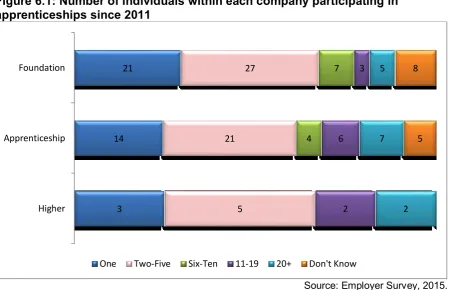
apprenticeships since 2011 ... 90
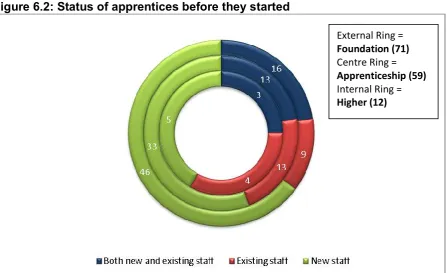
Figure 5.2: Status of apprentices before they started ... 91
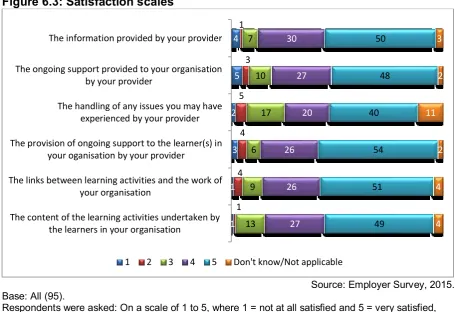
Figure 5.3: Satisfaction scales ... 92
Figure 5.4: How clear were employers about what was expected of their organisation’s involvement with foundation apprenticeships/apprenticeships /higher apprenticeships? ... 93
Figure 5.5: Satisfaction scales ... 96
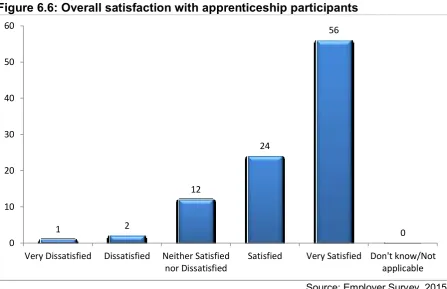
Figure 5.6: Overall satisfaction with apprenticeship participants since 2011 ... 97
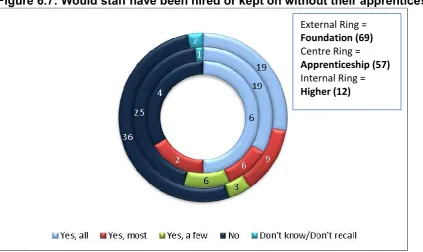
Figure 5.7: Would staff have been hired or kept on without their apprenticeship ... 98
Figure 5.8: To what extent has the organisation’s involvement in the programme led to any of the following impacts? ... 105
Figure 5.9: Satisfaction with recent experience of the WBL programme ... 107
Figure 5.10: Likelihood that employer will offer apprenticeships in the future, given their recent experience ... 108
Figure 6.1: Use, awareness and usefulness of the AMS ... 116
Figure 6.2: How respondents found out about their apprenticeship ... 117
Figure 6.3: How much can you attribute these benefits to the apprenticeship?... 123
Figure 6.4: Who would you like employment with? ... 125
Figure 7.1: Gross annual pay in job prior to apprenticeship (per cent) ... 131
Figure 7.2: Gross annual pay in job following apprenticeship ... 142
Figure 7.3: Have you had a promotion? Do you think this improvement was…? .... 147
Figure 7.4: Has your pay rate, salary or income increased? Do you think this improvement was…? ... 148
Figure 7.5: Have your future pay and promotion prospects improved? Do you think this improvement was…? ... 149
Figure 7.6: Are you getting more job satisfaction? Do you think this improvement was…? ... 150
Figure 7.7: Do you have better job security? Do you think this improvement was…? ... 151
EXECUTIVE SUMMARY
1. The Welsh Government commissioned York Consulting, in association with Old Bell 3, the University of Cardiff and IFF Research to carry out an evaluation of the work-based learning (WBL) Programme 2011-14.
2. The key elements of the methodology included: interviews with Welsh
Government officials, external stakeholders and learning providers; a review of apprenticeship management information and programme performance data; a telephone survey of 95 employers involved with apprenticeships delivery; an e-survey of current apprentices; a telephone e-survey of apprenticeships leavers; case studies of employers involved with apprenticeships and their apprentices (where available); and, counterfactual impact evaluation (CIE) analysis
comparing the apprenticeship quantitative survey data to a sub-sample of the Annual Population Survey (APS).
Key findings
3. A review of literature highlighted that similar developments in apprenticeship policy have been taking place across the UK. All UK governments have seen the value of apprenticeships to their economies and in particular are keen to spread the level of investment between government and employers. However, there are some clear differences in terms of timeframes and in policy detail. 4. Some of these divergences may have longer term implications for the UK and
consequently for Wales. For example, as approaches to apprenticeship specification change then larger employers will face a widening gulf between systems operating across areas of the UK. Whilst we cannot quantify the effect of this it is expected that it could result in dilemmas and decisions which may influence the location of apprenticeship training to avoid multiple systems within single employers.
expectations of providers were clearly set out following previous versions of the apprenticeship programme.
Programme performance
6. The total number of unique learners between August 2011 and December 2014 was 99,773. Annual apprenticeship learner numbers had risen to 54,350 in 2013-14 but fell by 11 per cent in 2014-15 to 48,335. Numbers of learners fell in foundation apprenticeships by 21 per cent and apprenticeships (L3) by 13 per cent; although learners involved in higher apprenticeships rose by 47 per cent. 7. The biggest sectoral change was the increase in share of apprentices in Health
Care and Public Services (increased from 30 per cent in 2011/12 to 35 per cent in 2013/14).
8. Generally learners had a prior qualification equal to or higher than their level of study when compared with the level of learning that they were working towards. 9. Data from the Employer Perspectives Survey suggests that there is room for
apprenticeships to develop further beyond the current 15 per cent of employers, especially among smaller employers.
10. Generally, apprenticeship success rates have been rising and are high at 84 per cent. However, success rates among higher apprenticeships (HA) are measurably lower at 67 per cent.
11. The programme exceeded all ESF targets with the exception of Level 2 qualifications (only narrowly missed) and older people.
12. Just over half of all participants (51 per cent) achieved a qualification (although this may rise as some apprentices are still in learning).
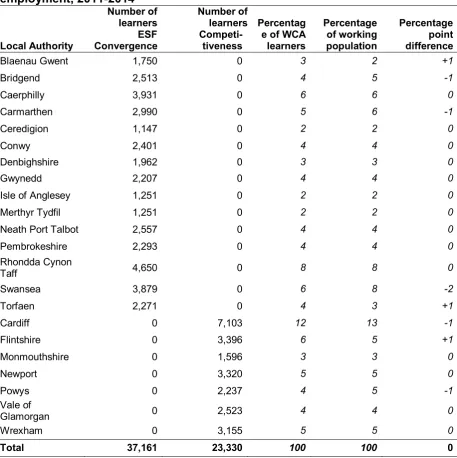
13. Just over two-fifths of participants (61 per cent) were from Convergence areas of Wales. The proportion of all participants that achieved qualifications in Convergence areas was even higher (68 per cent). The rate at which
than those in Competitiveness areas (43 per cent). Over half of all participants were female (57 per cent).
Stakeholder and provider perspectives
14. Overall, the demand for apprenticeships was regarded by all stakeholders and providers as consistently high and the programme was believed to be gaining credibility.
15. There was unanimous agreement that the WBL programme generally fitted in well with wider Welsh Government policy objectives and also met local training needs.
16. In terms of awareness there remained concerns about parents’ knowledge of apprenticeships. There were also mixed views about how informed employers were.
17. There remained concerns that schools were not providing sufficient impartial information to young people to enable them to make informed choices about apprenticeships compared with other options.
18. The main forms of recruitment to apprenticeships were: from the Apprenticeship Matching Service (AMS) website; through direct recruitment by
employers/providers and through conversion of existing staff to an
apprenticeship. Providers’ views of the AMS system were generally critical, with a sense of dissatisfaction.
19. A number of benefits were identified that were associated with the emerging higher apprenticeships. However, a few stakeholders and providers expressed concern that HAs might be having the effect of trying to force some employees into more senior roles than they really want to undertake. Providers felt that HAs had probably engaged some employers that would not have traditionally taken apprentices on. This suggests that progress has been made to encourage more employers to invest in training in the future.
medium of Welsh. Many said their documentation was bilingual. Taking a ‘blended’ approach to the Welsh language – promoting bi-lingualism – was enabling apprentices to talk in Welsh with their assessors if they so wished but to undertake their assessment/course work in English if this was their preferred option. A number of providers used this ‘blended approach’.
21. All providers were aware of the importance of addressing gender stereotyping, however, there was not a great deal of evidence of proactive responses or challenging employers.
22. On the subject of competition between providers for learners there were mixed views. Some providers felt there was no internal competition within their group of sub-contractors, while others recognised there was.
23. Probably the biggest issue for providers was underspend. Some providers were not highlighting under-spend or under-utilisation at an early enough stage for the places to be re-allocated.
Employer experiences
24. The majority (56) of employers were very satisfied with their apprenticeship participants since 2011, and nearly all (72) apprenticeship employers said that the overall efficiency of the workforce had been positively impacted because of the organisation’s involvement with the apprenticeship programme.
25. The majority of employers were satisfied with most aspects of their relationship with their provider. Employers were clear about what was expected of their organisation’s involvement with apprenticeships.
26. The majority of employers were very satisfied with their recent experience of the WBL programme (51) and said that it was very likely that they would offer
placements in the future, given their recent experience (58), while 18 said that it was likely.
Experiences of apprentices
28. The top three reasons for doing their apprenticeship were ‘to develop a broader range of skills and/or knowledge’, ‘to improve or widen their career prospects’ and ‘to develop more specialist skills and/or knowledge’.
29. Nearly three-quarters of past participants were not aware of the AMS. Of those that were aware, 43 of them (30 per cent) used the AMS when thinking about doing an apprenticeship. Of these 43 respondents, nearly all of them (98 per cent) found the service a useful tool.
30. Nearly three-quarters of past participants were working for the same employer before starting their apprenticeship that they were working for during their apprenticeship. Approximately one-quarter of respondents were recruited specifically as an apprentice or to undertake an apprenticeship.
31. The majority of respondents agreed that apprenticeships were ‘good for getting experience and skills’, ‘a good stepping stone towards getting employment’, and ‘help you progress in employment’.
32. Of the 144 respondents that said that they could speak Welsh: over fourth-fifths were given the opportunity to complete some or all of their learning and
assessment in Welsh (85 per cent) and to use Welsh during their course (86 per cent); nearly three-quarters (74 per cent) were given the opportunity to use Welsh in the workplace; and almost three-fifths (58 per cent) were given the opportunity to work towards a Welsh medium qualification.
33. The majority of respondents were satisfied with their provider overall (88 per cent) and with their employer overall (85 per cent).
34. Of those that were working as an employee for the same employer as before the apprenticeship (267 respondents), just under a third (31 per cent) had had a promotion since doing their apprenticeship. The majority of respondents (86 per cent) felt that they had been able to apply what they learnt on their
apprenticeship. Just under half of the apprentices surveyed felt that their
Recommendations
35. The following recommendations were identified as a result of this evaluation: Given the high level of demand for apprenticeships there would be merit in
considering more careful targeting of the funded support in the future. Key target areas might include: smaller employers, learners with lower prior qualifications and priority sectors.
A review of the AMS should be undertaken to assess its value for money, given the relatively low proportion of apprentices using it. We understand it was designed in a way that it should be relatively low cost to administer but providers indicate that the cost of maintaining the data outweighs the benefits. This needs to be balanced against the marketing effect, as it may also be a ‘lightening rod’ to support awareness of apprenticeships, especially among young people and their parents.
Developing more effective forms of communication about apprenticeships in general and specific opportunities in particular should be explored. These should consider youth-friendly forms of communication such as Facebook and similar social networking mechanisms.
More detailed research and understanding is required specifically about higher apprenticeships. The HA share of all apprenticeships is rising but concerns about widely varying success rates and some differences in expectations among employers, providers and participants indicate that more attention is required to ensure effective development.
Identify improved management of provider learner numbers to avoid the compound risks associated with providers hanging on to apprenticeship places and then releasing them at too late a stage to enable other providers to react.
From a research point of view improving the levels of consent to
1
Introduction
1.1 The Welsh Government commissioned York Consulting, in association with Old Bell 3, the University of Cardiff and IFF Research to carry out an evaluation of the WBL Programme 2011-14. The evaluation commenced in early November 2013.
1.2 In summer 2010, the (then) Welsh Assembly Government issued an invitation to tender to deliver its WBL programmes between August 2011 and July 2014. WBL 2011-14 covered three main areas, elements of which received funding from the European Social Fund:
Apprenticeships - Foundation Apprenticeships, Apprenticeships, Higher Apprenticeships and Flexible Learning.
Traineeships - Engagement Traineeships and Level 1 Traineeships.
Steps to Employment - withdrawn for new entrants on 31 July 2013 and replaced with the Work Ready programme, therefore not part of this evaluation.
1.3 There were a number of other projects related to the WBL programme that provided opportunities for young people to gain skills and/or progress towards employment: Jobs Growth Wales, Pathways to Apprenticeship, Shared
Apprenticeships and Young Recruits. These were subject to separate evaluations but are examined in this evaluation in terms of linkages. Evaluation Overview
1.4 The aims of the evaluation were to:
Assess the effectiveness of the contracting and delivery for WBL 2011-14;
Satisfy WEFO’s evaluation requirements for projects receiving ESF funding;
Assess the delivery of outputs, outcomes and impacts;
Assess the extent to which the programme had secured the participation of individuals according to protected characteristics;
Review how Essential Skills Policy has been embedded in the delivery of WBL and how this has contributed to the achievement of WBL 2011-14 objectives.
1.5 An evaluation report in relation to the Traineeships programme will be published separately.
1.6 This current phase of evaluation took place between January 2014 and December 2015. It included the following elements (detailed further in Appendix A):
Interviews with five Welsh Government officials responsible for different aspects of apprenticeships provision between 2011 and 2015.
Interviews with five external stakeholders to the programme.
Interviews with ten learning provider consortia leads/lead contractors. A review of apprenticeship management information and programme
performance data.
A telephone survey of 95 employers involved with apprenticeships delivery.
An e-survey of 559 current apprentices.
A telephone survey of 520 apprenticeships leavers.
Case studies of ten employers involved with apprenticeships and their apprentices (where available).
Counterfactual impact Evaluation (CIE) analysis comparing the
Reporting phases of this evaluation study
1.7 The key reporting stages of this evaluation are as follows: Initial phase (focused on WBL contracting) [March 2014]. Traineeships report [July 2016].
Apprenticeship evaluation report (this report) [March 2016].
Report Structure
1.8 In the remainder of this report, we discuss the:
policy context within which Welsh apprenticeships exist and a comparison with systems in other UK counties
current arrangements for apprenticeships
performance of apprenticeships
stakeholder and provider perspectives of apprenticeships employer experiences of apprenticeships
current apprenticeship learner experiences
apprenticeship leaver experiences counterfactual analysis
2 Policy Context
Introduction
2.1 This review covers policy developments before and during the period 2011 to 2014 which have directly influenced delivery of apprenticeships up to the end of 2014.
2.2 Driven by the desire to better meet the demands of the local labour market and anticipated growth in key sectors of the national economies, Wales, Northern Ireland, England and Scotland have undertaken the task of reforming
apprenticeships.
2.3 The aim of this chapter is to investigate how the structure has looked in Wales over the last 4 years in comparison to Northern Ireland, England and Scotland, in order to offer policy context.
2.4 Apprenticeships have a very long history in the UK and Wales as a recognised mechanism for training people to learn and become competent in a trade or occupation and, importantly, ready for work. Originally based around a few specific traditional sectors of the economy, over the centuries, the range of trades has grown to encompass emerging sectors.
2.5 While governments have taken an interest in apprenticeships and recognise their potential for supporting individual and business returns and, therefore, economic growth, direct or indirect intervention has varied. More recently, successive governments raised the investment in and volume and profile of apprenticeships originating from a response to concerns about skills shortages in 1994. This also led to a series of reforms (UK Parliament 2012).
Wales
2.7 Vocational skills development has been increasingly prioritised by successive governments, in Wales and across the UK. At an economic level, skills are seen as underpinning national competitiveness, hence the Welsh Government has emphasised raising the volume of skills in the workforce as a key economic priority (Wiseman, 2014; Welsh Assembly Government, 2008).
2.8 At the level of the firm improved skills can raise productivity and efficiency. For individuals, skill development can increase chances of a rewarding career with improved financial returns. For society, skills investment increases social inclusion and social mobility and can contribute to reduced poverty. However, concerns have been raised about over-supply of skills (Wolf, 2011) and limited returns on investment (Keep, 2008).
2.9 There has been increased recognition of the value of work experience alongside skills development to help create work-ready individuals (Webb 2007). Although, there remain differing views on who should be responsible for funding the training of young people; the government or employers?
2.10 The general approach across the UK for the past 30 years has seen governments fund training providers to implement various national
apprenticeship programmes. However, the expectation that employers should take greater responsibility through investment in and development of young people, has been an increasing feature of government policy (for example, the BIS/UKCES Employer Ownership Pilots, the Framework for Co-investment in Skills1 (2014) and to a lesser extent Welsh Government ESF programmes such as the Sector Priorities Fund Pilots).
2.11 Increased attention has been focused on raising businesses’ awareness of the importance of skills development and integrating it into business strategies (such as High Performance Skills explored by UKCES and WESB). However, the pressure of the financial crisis and recession of 2008 led to reduced
recruitment of young people (Hasluck, 2011) and reduced training budgets (UKCES, 2013).
2.12 Over the past ten years successive governments in Wales have focused on reducing complexity and management costs through reducing numbers of providers (Welsh Assembly Government, 2008).
2.13 The Welsh Government also published their ‘Policy Statement on Skills’ in July 2014, the purpose of which was to provide a ‘long-term and strategic view of how the skills system in Wales will need to evolve over the next decade.’ The statement identified their current and future actions in regard to post-19 skills and employment policy, including apprenticeships, within four key areas: ‘Skills for jobs and growth’.
‘Skills that respond to local needs’. ‘Skills that employers value’. ‘Skills for employment’.
2.14 At the time of publication of this report, the Welsh Government had: committed an additional £20 million per annum to support apprenticeship training up until 2016, allowing a range of higher apprenticeships to be delivered in Wales; defined the minimum requirements for a recognised Welsh apprenticeship framework in their ‘Guidance for the Specification of Apprenticeship Standards for Wales’ (Welsh Government, 2013a) to ensure that ‘only high-quality
2.15 The Welsh Government’s key actions for the future included:
‘Continue to work with employers in managing the development and review of National Occupational Standards (NOS) as the basis for adult vocational qualifications and apprenticeship frameworks, and ensure that these standards align with the skills individuals need for future
employment and career progression’
‘Enable employers to fully utilise the skills of their workforce by embedding High Performance Working (HPW) practices which strengthen leadership and management skills’
‘Support employers to recognise the value of the skills across their workforce and underpin this cultural shift with a clear set of principles for cost sharing alongside government’
2.16 Subsequent consultation on apprenticeships in Wales was due to take place in 2015, but falls outside of the remit of this analysis.
Northern Ireland
2.17 The ‘Skills Strategy for Northern Ireland’, published in draft in 2004, set out the ‘rationale for putting in place an overarching framework for the development of skills.’ It defined three different types of skills:
‘the essential skills of literacy and numeracy, and increasingly information and communications technology (ICT)’,
‘employability skills, including the key skills of team-working, problem solving and flexibility’,
2.18 The resulting implementation plan, ‘Success through Skills - The Skills Strategy for Northern Ireland: A Programme for Implementation’, (Department for
Employment and Learning 2006), set out how the government intended to take these proposals forward ‘in partnership with employers and their representative bodies; individuals and trade unions; training and education providers; the community and voluntary sector and other Government departments and
agencies, in order to deliver on a long-term vision for skills in Northern Ireland.’ 2.19 The Implementation Plan consisted of individual projects across four themes:
‘understanding the demand for skills, ‘improving the skills levels of the
workforce’, ‘improving the quality and relevance of education and training’, and ‘tackling the skills barriers to employment and employability.’
2.20 The main outcome of this first phase was a ‘skills delivery system which is becoming increasingly flexible and better able to respond to the changing needs of individuals and employers.’
2.21 In May 2011, DEL published ‘Success through Skills – Transforming Futures’, which suggested that their focus would be on qualifications as a measure of skills; they describe qualifications as ‘the internationally accepted ‘currency’ for measuring skills, noting that ‘they can be seen to be both valuable to individuals (in terms of providing mobility in the labour market and enhancing self-esteem), employers (for providing information when recruiting workers) and for
measuring the skill levels of the workforce.’
2.22 DEL identified that they would invest in ‘those entering the labour force for the first time, up-skilling the existing workforce and ensuring those currently
excluded from the labour force are provided with the skills to compete for jobs, retain jobs and progress up the skills ladder.’ Their key strategic goals focussed on increasing the proportion of people in employment with Level 2-8 skills, and those qualifying from NI Higher Education Institutions with graduate and post graduate level courses in STEM subjects, from their 2008 baselines.
2.24 In June 2014, DEL published ‘Securing our Success: The Northern Ireland Strategy on apprenticeships’, which articulated ‘a blueprint for Northern
Ireland’s future apprenticeship programme: a model which is driven by strategic partnership; puts employers at its very heart; matches better supply with
demand; affords opportunities in a much wider range of occupations and offers a flexible progression pathway across vocational and professional education and training (VET/PET).’
2.25 At the heart of this blueprint of apprenticeships for the future was ‘quality, breadth, progression and portability.’
2.26 The core aspects of the future apprenticeship system included: a 2 year
minimum duration, it must take the form of a new job role, ‘a breadth of training beyond the specific needs of a particular job through on and off-the-job training’, ‘a single award/qualification for each occupation at each level’, ‘will support progression beyond the initial apprenticeship through a variety of pathways including to higher level apprenticeships and to further and higher education’, and ‘facilitate portability within a sector and mobility within the wider economy.’ 2.27 ‘Securing our Success: The Northern Ireland Strategy on apprenticeships’ also
detailed the introduction of a central service, to ‘promote and support apprenticeship provision, by engaging with employers and potential
2.28 Ensuring quality was also a key focus, with the content, duration and assessment of each apprenticeship being established by employers and industry specialists, in partnership with other key stakeholders, and subject to ‘rigorous assurance by inspectors who have up-to-date experience in the professional and technical areas, supported by industry experts.’ There was a desire to ensure that those delivering the training remained ‘expert in their field’ through stringent conditions, including ‘minimum qualification requirements in the subject area and related pedagogy, as well as significant and up-to-date experience in industry’ and ‘that all involved in the delivery of the off-the-job training will undertake professional training in pedagogy.’ It was noted that ‘only those providers who meet the minimum quality standards, as determined by the Department will be funded to deliver apprenticeship training.’
England
2.29 ‘The Richard Review of apprenticeships in England’ (Richard 2012) sought to ‘redefine the shape of the system itself’ and asked ‘how an apprenticeship system must work in a future economy.’
2.30 The Richard Review clarified that an apprenticeship must be ‘linked to a real job’, ‘must deliver transferable skills’, involve ‘a new job role’, and ‘require
2.31 Richard encouraged a focus on the outcome of an apprenticeship. He promoted the use of ‘performance and real world based, rather than just theoretical’
testing to assess the apprentice’s knowledge and expertise at the end of the apprenticeship, and insisted that apprenticeships should include Maths and English, for those that had not already reached a good level at the time of starting. He claimed that ‘for each category of occupation associated with an apprenticeship, there should be just one clear and credible qualification that describes the level of skill and competency required to do the job well and to operate confidently in the sector.’ He referenced university degrees, as ‘we infer from its award that the student met and exceeded a clear standard’, which is not the case for apprenticeships, and should be.
2.32 Richard suggested that employers should have a much greater influence in the design and development of apprenticeship qualifications, whilst the Government clearly defined what a good quality standard meant; he sought to achieve this outcome through encouraging employers to compete for the ‘best’ qualification, whilst the Government ‘set the judging criteria, and ensure a process which minimises the risks of politicisation and maximises rigour, trust and
transparency.’ These qualifications needed to be ‘widely accepted and recognised amongst a broad set of employers within the industry, especially smaller businesses’, whilst creating ‘a standard that is adequately transferable within the relevant sector, and of a sufficiently high level of skill to merit
inclusion as an apprenticeship and attract Government funding.’
2.33 From the review, the Government was offered 10 key recommendations: ‘apprenticeships should be redefined’
‘The focus of apprenticeships should be on the outcome’
‘The Government should set up a contest for the best qualification’
‘All apprentices should have achieved Level 2 in English and maths before they can complete their apprenticeship’
‘The Government should encourage diversity and innovation in delivering apprenticeships’
‘The Government has a role in promoting good quality delivery’
‘Government funding must create the right incentives for apprenticeship training’
‘Learners and employers need access to good quality information’ ‘Government must actively boost awareness of the new apprenticeship
model’
2.34 Following the review, the Department for Business, Innovation and Skills (BIS) published ‘The Future of apprenticeships in England: Next Steps from the Richard Review’ in 2013. BIS offered support to Richard’s recommendations, outlining steps they had already taken and forthcoming plans, including the development of Traineeships.
2.35 They identified the need for apprenticeships to focus on ‘what is needed to demonstrate the mastery of an occupation, not competence in a series of narrowly defined tasks.’ This differed from the approach in place at the time, with apprenticeship frameworks listing qualifications based on the National Occupational Standards (NOS) that apprentices had to work through. 2.36 BIS also agreed that the responsibility for designing standards sits with
2.37 BIS introduced, as of August 2014, a new requirement in terms of English and Maths qualifications; those who began their apprenticeship with only Level 1 qualifications in English and/or Maths were required to work towards a Level 2 qualification during their apprenticeship, although they would not need to complete it in order to complete their apprenticeship.
‘The shape of every apprenticeship journey should be different. An
apprenticeship should not be something taken ‘off the shelf’ by a provider, or something prescribed by government. Every job, every workplace, and every individual learner is different. So it should be up to employers,
together with training providers and learners, to shape the learning journey themselves, and we should minimise the things that get in their way.’ (Department for Business, Innovation and Skills, 2013)
2.38 Throughout the review, BIS invited views on a range of questions, and stated that they would confirm their broader approach and future timetable in autumn 2012.
2.39 ‘The Future of apprenticeships in England: Implementation Plan’ (BIS 2013) outlined the plans for Trailblazers; which were early adopters in a range of sectors, who led the way in terms of development of the ‘new apprenticeship standards and the high-level assessment approaches that sat alongside them.’ 2.40 On publication of this review, employers and professional bodies in eight
sectors had already signed up to the Trailblazers project, with the aim of
2.41 BIS identified that employers must meet the following criteria when designing their apprenticeship standards: ‘New apprenticeship standards must be short, concise and accessible documents; they must describe the level of skill, knowledge and competency required to do a specific occupation well and operate confidently within the sector.’
2.42 Trailblazer apprenticeships were set to have a stronger focus on English and Maths, with it being mandatory that tests at Level 2 in these subjects were taken prior to the end of the apprenticeship. Those who did not pass were supported to achieve a Level 2, where possible. For Higher and Advanced apprenticeships, the Level 2 English and Maths qualifications had to be achieved prior to the end of the apprenticeship.
2.43 As part of the Trailblazer project, BIS stated that they would test the most cost-effective methods for assessment delivered by an independent third party, ensuring that employers could be confident in the standards of apprentices across the country. BIS vowed to ensure quality and consistency across apprenticeships, with a synoptic, end-point assessment and grading of apprenticeships, with either a pass, merit or distinction.
2.44 As part of the reform, apprenticeships were required to last a minimum of 12 months, with no flexibility, and had to contain a minimum of 20 per cent genuine off-the-job training. The Government insisted on a drive in advertising of
apprenticeships, both through themselves and employers, and expressed a desire for employers, colleges and school to work more closely together in inspiring children and young people.
Scotland
2.45 ‘Education Working for All’, published in June 2014, sought to ‘to make
recommendations towards Scotland producing better qualified, work ready and motivated young people with skills relevant to modern employment
2.46 Within the report, Modern apprenticeships were described as a ‘unique’ opportunity within the education system, and as ‘a vehicle for workforce development.’ The report noted the growth in Modern apprenticeships over recent years and that they were at ‘an important stage in their development.’ Key elements to their further development include: ‘alignment with the
opportunities of economic growth, the creation of progression routes, quality improvement and increasing the number of employers offering Modern apprenticeships.’
2.47 Some of the key recommendations from this report revolved around Modern apprenticeships, and included:
Aligning them ‘with the skills required to support economic growth’
Prioritisation of the development of the ‘access processes and progression pathways’, including the introduction of an online Modern apprenticeship application service, Skills Development Scotland (SDS) actively working with and challenging employers to ‘develop new models to deliver higher level Modern apprenticeships up to and including degree level on a more significant scale across the economy’, and assisting young people and employers in their understanding of Modern apprenticeships, through clear branding of different levels, ‘while continuing to be operated and regulated as part of the single programme’
The introduction of an ‘industry-led quality improvement regime’ to
‘oversee the development and promotion of Modern apprenticeships’, with the introduction of a ‘Scottish Modern apprenticeship Supervisory Board’ overseeing ‘the detailed strategic development and promotion of Modern apprenticeships’, and a ‘Modern apprenticeship Group’, that reports to the board and whose role is to approve frameworks; ‘Education Scotland’s remit should be extended to include inspection and quality improvement of the delivery of Modern apprenticeships’
managed expansion of the annual number of Modern apprenticeship starts.’
2.48 Reflecting on employer engagement, the report suggested the development of a ‘recruitment incentive package’ to ‘equip and support smaller and micro businesses to recruit and train more young people.’ The report also suggested that young people could complete some of the ‘early non-workplace content of Modern apprenticeships’, whilst at school so that they could go straight into the workplace-based content subsequently; the report noted that this may be more appealing to SMEs that don’t currently take on apprentices, and would also ensure young people better understood the apprenticeship opportunity before leaving school.
2.49 ‘Education Working for All’ commented on advancing equalities, noting gender disparities within Modern apprenticeships, which needed addressing by Skills Development Scotland with realistic, but stretching improvement targets. The report reflected on young people from black and minority ethnic (BME) groups, and suggested the development of a ‘targeted campaign to promote the full range of Modern apprenticeships to young people and parents from the BME community’ in order to ‘present the benefits of work-based learning as a respected career option and alternative to university’, with a ‘realistic but stretching improvement target to increase the number of young people from BME groups starting Modern apprenticeships.’ Similarly, a realistic, but
stretching improvement target to increase the number of young disabled people starting Modern apprenticeships was also cited, with encouragement that
funding levels should be reviewed and adjusted, and age restrictions relaxed for those who may take longer to complete their course.
2.51 The report made reference to ‘Opportunities for All’ and suggested that SDS ‘develop a meaningful national access to apprenticeships programme for young people who are not in education or employment’, linking volume of places to anticipated employer demand, ‘with guaranteed interviews for successful participants.’
2.52 Although there was no official review of Modern apprenticeships envisaged in Scotland, there was ongoing work within the Government and SDS to ‘consider how higher level Modern apprenticeships can be developed over a wider range of occupations and professions in Scotland’ and to introduce a foundation apprenticeship option ‘which offers the first year of a 3-4 year apprenticeship in the school senior phase.’
Conclusions
2.53 Similar developments in apprenticeship policy have been taking place across the UK. All UK governments have seen the value of apprenticeships to their economies and in particular are keen to spread the level of investment between government and employers. However, there are some clear differences in terms of timeframes and in policy detail.
2.54 Common aspects included:
Ensuring that apprenticeships are relevant to the workplace and are employed status only.
Ensuring that apprenticeships are high quality incorporating minimum thresholds for English and Maths.
Developing common application platforms (apprenticeship matching services) to improve the efficiency of recruitment.
Addressing priority sectors.
Addressing market imbalances such as representation of minority groups and gender stereotypes (especially STEM subjects for females).
2.55 These common aspects serve to confirm many attributes that have developed in the Welsh apprenticeship system. Another major commonality is a frustration about schools not providing impartial advice and guidance to young people which included apprenticeships as a credible route alongside academic learning routeways.
2.56 However, there are some areas where approaches across the home countries have started to diverge:
Extent of framework redesign. In England the Trailblazer process has led to greater involvement of employers and a re-specification of
apprenticeships based on apprenticeship standards rather than NOS. Type of assessment. In England there are moves towards some
apprenticeships which are not underpinned by a current qualification but use a single synoptic assessment process.
Extent to which apprenticeships at level 2 are considered a priority, with increasing focus on level 3 upwards in England and Northern Ireland. There are some differences in the minimum length of an apprenticeship.
Defined in England as a least one year long, but a minimum of two years was set in Northern Ireland. Length is not defined in Wales.
Some differences in support at school. For example, in Scotland young people could complete some of the early non-workplace content of Modern apprenticeships, whilst at school, so that they could go straight into the workplace-based content subsequently.
3
Programme Design
Project Aim
3.1 The project addressed the ESF Framework Priority 3 Theme 1 aims, which included: raising levels of basic literacy and numeracy in the workforce; supporting the acquisition of ICT, generic and occupational skills in the
workforce; supporting progression in employment through flexible training and learning provision; and helping low skilled workers to gain the additional skills and qualifications needed to sustain their employment, improve productivity and increase earnings via career progression.
3.2 According to the project Business Plan (Welsh Government 2014d), the World Class Apprenticeships ESF project 'supplements domestic funding to increase the number of apprenticeship opportunities available to potential participants in the Convergence areas of Wales’. The project aimed to increase the number of apprentices who successfully undertook job related learning and to raise the attractiveness, awareness of and availability of apprenticeships.
3.3 Apprenticeships were a mechanism for improving employability and skills of individuals, which in turn improves productivity and provides economic value. 3.4 The following objectives were articulated in the Version 1 Business Plan for the
period 2011 – 2014 and its supplementary version regarding the Convergence area:
Support a total of 29,671 participants for all or part of their apprenticeship journey. Opportunities will be generated across the full spectrum of subject areas that are typically in demand by the Welsh economy, and in all fifteen Convergence Unitary areas.
Enable 19,880 individuals to gain at least one qualification during project lifetime.
completion of their ESF funded apprenticeship, including to a level 3 or 4 apprenticeship.
Commission approximately 24 training providers who have sufficient experience, systems, and track record to provide quality apprenticeship opportunities. (including via consortia arrangements)
Use the £38m in ESF Funding to increase the number of apprenticeships opportunities in the Convergence area from 7,394 to 21,071 (equivalent of an extra 13,677 participants)
Secure full apprenticeship framework attainment2 of 80% (of starters) during the contract lifetime.
Funding
3.5 Apprenticeship funding was planned to be just under £125 million (Table 3.1) as revised in the supplementary business plan.
Table 3.1: Planned Apprenticeship Funding (£)
Gross Eligible ESF Public Match Private Match (revenue)
Grant Rate (per cent)
124,471,045 55,700,000 68,771,045 0 44.75
Source: Welsh Government (2014) Project Business Plan (Supplementary) 80660 World Class Apprenticeships for Economic Renewal v1.3
Tendering
3.6 Using the guidelines stipulated in the Apprenticeship, Skills, Children and Learning Act 2009, and the Specification for Apprenticeship Standards for Wales (SASW), the project commissioned via tender, twenty training providers from the public, private and third sector, including consortia, to operate
Foundation Apprenticeships (at level 2) and Apprenticeships (at level 3) and a small number of Higher Apprenticeships for Convergence area based learners. 3.7 In the previous WBL (2007-11) programme, the Welsh Government held
contracts with 64 providers, with a minimum contract value of £99,000.
3.8 The delivery of WBL 2011-14 was undertaken through three models of contracting:
Delivery consortia.
Lead contractors with sub-contractors.
Lead contractors with no sub-contractors.
3.9 During 2011-14 there were six delivery consortia and 18 lead contractors, with minimum contract values of £350,000 for apprenticeships. Approximately 120 consortia members and sub-contractors were involved in delivering the
programme. This subsequently changed with the most recent procurement round (known as WBL4, see below).
3.10 Generally providers felt that the consortia approach adopted in 2011 had
worked well and was an improvement on previous approaches. Providers were critical of the largely electronic processes, as they felt it limited communication, although the Welsh Government tried to address this with more effective
communication (Turner, 2014). WBL4 procurement round
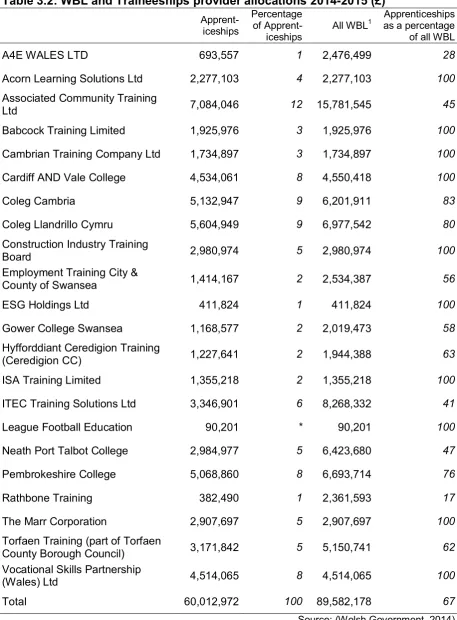
3.11 Allocations for apprenticeships from 1 August 2014 to 31 March 2015 totalled just over £60 million, which was around two thirds of the total WBL allocation (Table 3.2).
3.12 Amounts for individual lead providers ranged from the largest at £7,084,046 to the smallest at £90,000. Ten lead providers specialised in apprenticeships over other WBL delivery, with a further three lead providers where
Table 3.2: WBL and Traineeships provider allocations 2014-2015 (£) Apprent-
iceships
Percentage of Apprent-
iceships All WBL
1 as a percentage Apprenticeships
of all WBL
A4E WALES LTD 693,557 1 2,476,499 28
Acorn Learning Solutions Ltd 2,277,103 4 2,277,103 100 Associated Community Training
Ltd 7,084,046 12 15,781,545 45
Babcock Training Limited 1,925,976 3 1,925,976 100
Cambrian Training Company Ltd 1,734,897 3 1,734,897 100
Cardiff AND Vale College 4,534,061 8 4,550,418 100
Coleg Cambria 5,132,947 9 6,201,911 83
Coleg Llandrillo Cymru 5,604,949 9 6,977,542 80
Construction Industry Training
Board 2,980,974 5 2,980,974 100
Employment Training City &
County of Swansea 1,414,167 2 2,534,387 56
ESG Holdings Ltd 411,824 1 411,824 100
Gower College Swansea 1,168,577 2 2,019,473 58 Hyfforddiant Ceredigion Training
(Ceredigion CC) 1,227,641 2 1,944,388 63
ISA Training Limited 1,355,218 2 1,355,218 100
ITEC Training Solutions Ltd 3,346,901 6 8,268,332 41
League Football Education 90,201 * 90,201 100
Neath Port Talbot College 2,984,977 5 6,423,680 47
Pembrokeshire College 5,068,860 8 6,693,714 76
Rathbone Training 382,490 1 2,361,593 17
The Marr Corporation 2,907,697 5 2,907,697 100 Torfaen Training (part of Torfaen
County Borough Council) 3,171,842 5 5,150,741 62 Vocational Skills Partnership
(Wales) Ltd 4,514,065 8 4,514,065 100
Total 60,012,972 100 89,582,178 67
Source: (Welsh Government, 2014) Note 1: WBL includes Traineeships, apprenticeships, Work ready and Bespoke delivery
3.13 The activities expected of providers included3:
Work with employers (including self-employed) to encourage them to offer new apprenticeship opportunities as well as apprenticeships to the
employers’ existing staff;
Undertake initial assessments including of prior learning and of essential skills;
Confirm the appropriateness of the apprenticeship option and discuss options linked to the individuals’ job role and suitability;
Undertake a health and safety assessment;
Register participants on the apprenticeship programme;
Operate the qualifications accreditation process involving on the job assessments to a defined industry standard;
Arrange or deliver underpinning technical knowledge for the learners (technical certificates/college courses – as required by their individual apprenticeship framework);
Provide Essential Skills Wales qualifications (as required by the framework) covering communication, numeracy and ICT;
Support apprentices through completion (often over three year period or more) and ensure next step options are considered.
3.14 Providers were made responsible for reporting all learning activity into data fields on the Lifelong Learning Wales Record (LLWR) database, which was, on a monthly basis, converted into funding values based on learners recruited, activity undertaken, and qualifications/framework components achieved. 3.15 Key criteria relating to the operation of the programme were:
All Participants starting were stipulated as being employed status
(including; self-employed / with a single employer / shared apprenticeship or Group Training Association).
Funding prioritisation by age group, (16-18 age group as the highest priority, followed by 19-25 yrs old, and finally 25+).
Specified priority sectors and a set of non-priority sectors.
3.16 Aspects of national level marketing included:
Apprenticeship Week. A national week for apprenticeships was an opportunity to celebrate and recognise the essential role that
apprenticeships played. This was be conveyed through print media, broadcast, networking events, seminars and advertisements.
Apprenticeship Matching Service (AMS). After a pilot phase it, it was subsequently launched pan Wales, as a fully bilingual service, in Apprenticeship Week 2012. This was supported by direct mail and periodic e-newsletters (ezines) to learning providers and employers. Further marketing campaigns such as 100 Apprentices in 100 days
project.
Apprenticeship Awards. A promotional vehicle which identified, showcased and rewarded apprentices, learning providers and employers who excelled in contributing to the development of the apprenticeship programme
across Wales. There were a number of individual awards.
Skillscymru. A highly interactive careers and skills event which has evolved to take place in two locations (North and South Wales), which motivated, inspired and encouraged people by helping them to explore career options.
3.18 Providers were expected to increasingly work together hence the Welsh Government encouraged the role of National Training Federation of Wales (NTFW) to provide a vehicle for provider dialogue and to support sharing of best practice. Providers and stakeholders views of this are explored further in the next section.
3.19 Key elements of the programme regarded as innovative according to the Business Plan (2014) included:
Consortia arrangements: aimed to give lead contractors the critical mass to respond in a timely way to changes in local priorities and centralised ‘back-room’ functions.
Part of the budget utilised to support apprenticeship delivery with Anchor and Regionally Important Companies through bespoke call-off contracts. Prioritising towards nominated priority sectors encouraged HAs as these
tended to be the minimum industry requirement in many sectors. Exploring innovative solutions to engaging with micro business via
mentoring support for business, shared apprenticeships, etc. to expand the breadth of sector engagement with apprenticeships.
Exploring innovative solutions to effectively engage with large national, UK wide and multi-national companies to expand the breadth of
apprenticeship opportunities. Cross Cutting Themes
3.20 Part of the project definition included a clear focus on cross cutting themes: Environmental sustainability
Awareness raising by providers to employers of the European Guidance to on the NETREGS web based Government guidance and the ECOCODE system (for internal organisation management of day to day energy use and recycling).
Equality and Diversity - providers were asked to demonstrate that:
They had formal policies and procedures in place to ensure that equal access to learning delivered equality of opportunity, irrespective of disability, gender, race, age, religion or sexual orientation and that they took action to tackle discriminatory behaviour by learners, staff or managers.
They had formal equal opportunities strategies, that met equalities legislation requirements, including monitoring, benchmarking and positive action arrangements and were reviewed every two years. They had arrangements in place to address issues of bullying or
harassment, discrimination or victimisation.
They covered Employee Rights and Responsibilities as part of the Apprenticeship Frameworks.
Apprentices aged 16-18 were entitled to: Support of a Learning Coach; Access to Personal Support; Careers Information, Advice and Guidance; Careers and World of Work Framework as stated in the programme specification.
Apprentices had a Learning Agreement; an Individual Learning Plan; on/off-the-job training; a clearly defined Learning Process.
In addition there was a strong focus on:
Female Participation - All marketing materials aimed to recognise the equality agenda and Careers Wales aimed not to stereotype
opportunities based on gender. When vacancies were recorded on the Apprenticeship Matching Service it is not possible to offer opportunities in a discriminatory way.
Occupational Segregation/ Non traditional Roles.
Science, Technology Engineering and Maths (STEM): there was an ambition to focus on sectors that had low female numbers.
Summary
3.21 The project design aimed to build on successful aspects of the programme that had operated over the past five years.
3.22 ESF funding was accessed to extend the programme to more learners across Wales.
3.23 The project specification was clearly set out at the beginning of the programme and revised at appropriate points as further funds became available. During the period of the ESF project the Welsh Government identified Apprenticeships as critical to support economic recovery. It secured additional funding to enable the recruitment of additional apprentices.
3.24 The tendering processes known as WBL3 and WBL4 were regarded by stakeholders to have been effective and to have secured a good range of providers. It achieved a blend of colleges, private WBL providers and third sector WBL providers. The expectations of providers were clearly set out following previous versions of the apprenticeship programme.
4 Performance
4.1 This section explores the performance of the apprenticeship programme
covering the three levels: foundation apprenticeships (level 2), apprenticeships (level 3) and higher apprenticeships (level 4).
Volumes
4.2 The total number of unique learners between August 2011 and December 2014 was 99,7734 according to Welsh Government LLWR data.
4.3 Annual apprenticeship learner numbers had risen to 54,350 in the academic year 2013-14 but fell by 11 per cent in 2014-15 to 48,335 (Table 4.1). Numbers of learners fell in foundation apprenticeships by 21 per cent and apprenticeships (L3) by 13 per cent; although learners involved in higher apprenticeships rose by 47 per cent.
Table 4.1: Number of apprenticeship learners in each year 2011-2015
2011/12 2012/13 2013/14 2014/15 (p) Foundation Apprenticeship 20,215 25,120 27,530 21,790 Apprenticeship (Level 3) 16,110 19,285 21,425 18,620
Higher Apprenticeship 280 2,480 5,395 7,925
All Apprenticeships 36,605 46,885 54,350 48,335
Source: Lifelong Learning Wales Record, Welsh Government. Note p= provisional
4.4 The gender balance overall is 57 per cent female; although this varies
considerably across the apprenticeship levels from 53 per cent for FAs, 55 per cent for apprenticeships (L3) and 74 per cent for HAs.
4 This represents the total number of learners who participated. The figure of 60,495 used later in the report
4.5 In terms of the age profile (Figure 4.1) the pattern for FAs and apprenticeships (L3) is similar although more of those aged 16 to 24 are FAs. Most
apprenticeships (L3) are aged between 20 and 39, whereas most HAs are aged between 25 and 49.
Figure 4.1: Apprenticeship numbers by age, 2013/14 [1]
Source: Lifelong Learning Wales Record, Welsh Government. Note: 2013/14 was the most recent date that data was available through Stats Wales
4.6 The spread across sectors has been changing over the longer term (Figure 4.2). Many of these changes continued through the period of this evaluation: The biggest change has been the increase in share of apprentices in
Health Care and Public Services (increased from 30 per cent in 2011/12 to 35 per cent in 2013/14).
There was an increase in Management and Professional, but most other areas contracted or stayed at a similar relative size.
2,000 4,000 6,000 8,000 10,000 12,000 14,000 16,000 > 1
6 16 17 18 19
20 2 4 2 5 3 9 4 0 4 9 5 0 5 9 60 6 4 6 5 + Higher Apprenticeship / MSD (Level 4+)
Apprenticeship (Level 3)
Figure 4.2: Apprenticeship numbers by sector, 2006-2014
Source: Lifelong Learning Wales Record, Welsh Government.
4.7 The proportions of learners on the programme in 2013/14 varied by gender with males most likely to be on programmes in Construction (21 per cent of all
males), Engineering (18 per cent) and Health Care and Public Services (15 per cent). This compares starkly with females where half were on programmes in Health Care and Public Services (50 per cent).
Prior qualifications
4.8 Generally learners were well qualified compared with the level of learning that they were working towards:
Two thirds (67 per cent) of FA learners during 2011-2014 had a prior qualification equal to or higher than their level of study (LLWR, 2014). Just over a third (36 per cent) of apprenticeship (L3) learners had a prior
qualification equal to or higher than their level of study.
Over two-fifths (44 per cent) of HA learners had a prior qualification equal to or higher than their level of study.
0% 10% 20% 30% 40% 50% 60% 70% 80% 90% 100%
2006/07 2007/08 2008/09 2009/10 2010/11 2011/12 2012/13 2013/14 Health Care and Public Services
Retailing and Customer Service
Business Administration
Management and Professional
Employers
4.9 Over a third of apprentices work for employers with 250 or more employees (35 per cent)5. The rest are spread broadly across other employer sizes: 50-249 employees (19 per cent); 10-49 employees (25 per cent) and 0-9 employees (21 per cent).
4.10 Employer perspectives survey6 findings indicated that in 2014 around 15 per cent of employers had or offered an apprenticeship, rising to 29 per cent that planned to offer an apprenticeship in the future. This would indicate that there is scope to increase the numbers of employers utilising apprenticeships. 4.11 There appears room for apprenticeships to develop further beyond the current
15 per cent of employers, especially among smaller employers. Apprenticeship success rates
4.12 Generally, apprenticeship success rates have been rising and are high (Table 4.2). However, data for 2013/14 indicates a decrease on previous years.
Comparison with similar data from England7 for all apprenticeships (69 per cent) shows that Welsh programmes are considerably higher with a difference of 15 percentage points. However, success rates among HAs are measurably lower.
5 Based on analysis of LLWR data covering 2011 to 2014
6https://www.gov.uk/government/publications/employer-perspectives-survey-2014-wales-data 7 BIS (2015) SFR Further Education and Skills: Learner Participation, Outcomes and Level of Highest
Table 4.2: Apprenticeship success rates 2011-2014 (per cent)
2010/11 2011/12 2012/13 2013/14
Foundation Apprenticeship 81 84 85 84
Apprenticeship (Level 3) 83 86 87 85
Higher Apprenticeship* - - - 67
All Apprenticeships 82 85 86 84
Source: Lifelong Learning Wales Record, Welsh Government. Note: * = 2013/14 was the first year that framework success rates were published, the Statistical First release identified “apparent data-quality issues at a small cohort of learning providers” and advises “caution …. when using this data”. Note: dash (-) means no data available
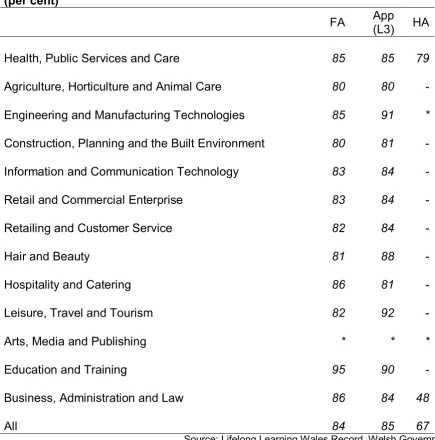
4.13 Average apprenticeship success rates did not fall below 80 per cent by sector; although some sectors achieved success rates as high as 95 per cent (Table 4.3).
4.14 Particular performance variations across sectors and levels included: Foundation apprenticeships range from 95 per cent for Education and
Training to 80 per cent for Agriculture, Horticulture and Animal Care, and Construction, Planning and the Built Environment.
Table 4.3: Apprenticeship success rates, by sector, 2013-14 (per cent)
FA App (L3) HA
Health, Public Services and Care 85 85 79
Agriculture, Horticulture and Animal Care 80 80 - Engineering and Manufacturing Technologies 85 91 * Construction, Planning and the Built Environment 80 81 -
Information and Communication Technology 83 84 -
Retail and Commercial Enterprise 83 84 -
Retailing and Customer Service 82 84 -
Hair and Beauty 81 88 -
Hospitality and Catering 86 81 -
Leisure, Travel and Tourism 82 92 -
Arts, Media and Publishing * * *
Education and Training 95 90 -
Business, Administration and Law 86 84 48
All 84 85 67
Source: Lifelong Learning Wales Record, Welsh Government. Note: dash (-) = no data available, 2013/14 was the first year that framework success rates were published, the Statistical First release identified “apparent data-quality issues at a small cohort of learning providers” and advises “caution …. when using this data”. Note *=sample too small
4.15 Success rates by provider indicated a variation in performance (Table 4.4): FAs ranged from 70 to 88 per cent, five providers were below the 80 per
cent target.
Apprenticeships (L3) ranged from 79 to 92 per cent, one provider was below the 80 per cent target.
Table 4.4: Apprenticeships Success Rates by Provider
FA Apprenticeship HA
Provider Leavers
Positive Progression
Percentage Leavers
Positive Progression
Percentage Leavers
Positive Progression Percentage
A4E Wales Ltd 176 82 67 84 27 81
Acorn Learning Solutions Ltd 458 76 447 79 27 56
ACT Ltd 1,760 83 1,217 83 192 73
Babcock Training Ltd 640 82 383 85 0 n/a
Cambrian Training Company 403 85 239 87 87 79
Cardiff and Vale College Consortium 502 85 488 86 25 64
Coleg Cambria 868 87 740 90 65 88
Construction Skills 463 82 275 86 0 n/a
Gower College Swansea 148 87 131 84 41 73
City and County of Swansea Employment Training 337 78 165 81 11 55
Grwp Llandrillo Menai Consortium 1,174 88 811 87 60 65
ISA Assessment & Training Ltd 374 79 151 85 0 n/a
ITEC Training Solutions Ltd 890 84 543 82 65 75
Mid Wales Work-based Learning Consortium 198 78 164 80 14 57
Rathbone Training 37 70 * n/a 0 n/a
Skills Academy Wales @ Grwp NPTC 463 83 415 86 15 60
Skills Academy Wales (South West) 810 84 705 89 60 68
T2 Business Solutions 187 85 38 92 175 5
Torfaen Training 750 86 610 88 125 94
Vocational Skills Partnership 1,055 86 518 84 137 89