Terzis, S. and Wagealla, W. and English, C. and McGettrick, A. and Nixon, P.
(2003) The SECURE collaboration model. Technical Report.
University of Strathclyde, Glasgow, United Kingdom.
http://eprints.cdlr.strath.ac.uk/2
584
/
Strathprints is designed to allow users to access the research
output of the University of Strathclyde. Copyright © and Moral
Rights for the papers on this site are retained by the individual
authors and/or other copyright owners. Users may download
and/or print one copy of any article(s) in Strathprints to facilitate
their private study or for non-commercial research. You may not
engage in further distribution of the material or use it for any
profitmaking activities or any commercial gain. You may freely
distribute the url (http://eprints.cdlr.strath.ac.uk) of the Strathprints
website.
The SECURE Collaboration Model
S. Terzis, W. Wagealla, C. English, A. McGettrick, and P. Nixon
The Global and Pervasive Computing Group Dept. of Computer and Information Sciences
University of Strathclyde
Abstract. The SECURE1 collaboration model builds upon the previ-ously developed theoretical trust and risk models and addresses the is-sues of managing the trust lifecycle. The theoretical aspects of the model concentrate on the following issues:
1. The interpretation of trust values in context for decision making pur-poses, namely trust exploitation. This process relies on the definition of context and the use of contextual parameterisation of collabora-tion requests.
2. The revision of trust values in the light of evaluated evidence about principals’ behaviour, starting from complete lack of evidence in the case of unknown principals, namely trust formation and evolution. These processes rely on the separate processing of direct and indi-rect evidence and the introduction of the notion of attraction, which determines the effects that evidence has on the trustworthiness of a principal.
Trust exploitation, formation and evolution all are centered around a close relationship between trust and risk. In order to operationalise the theoretical collaboration model:
1. A trusting collaboration architecture is described. The architecture supports the decision making, the trust evaluation and the risk eval-uation processes. It also places particular emphasis on the collection of evidence, requiring anevidence gatherer and anevidence store. 2. A layered model for the organisation of trust related information
is introduced, namely the trust information structure. The struc-ture enables processing of indirect evidence in a way that avoids the problems documented in literature.
Finally, the collaboration model is applied to two case studies, a smart space scenario and a e-purse scenario in order to demonstrate its vari-ous concepts. A comparison of the model to the state of the art and a discussion of areas for future work concludes this appendix.
1
Introduction
Global computing is characterised by large numbers of roaming entities and the absence of a globally available fixed infrastructure [47]. In such an environment
1 SECURE (Secure Collaboration among Ubiquitous Roaming Entities,
entities meet and need to collaborate with little known or even unknown entities. Entering any kind of collaboration requires entities to make security decisions about the type and level of access to their resources they will provide to their collaborators. In traditional environments with clearly defined administrative boundaries and limited entity movement security decisions are usually delegated to a centralised administrative authority [48, 34, 38]. In the global computing en-vironment no single entity can play this role and as a result traditional techniques that statically determine the access rights of the entities are not an option. En-tities are required to make their own security decisions. Moreover, the absence of a globally available security infrastructure means that these decisions need to be made autonomously. At the same time the sheer number of the roaming entities means that it is not feasible to gather and maintain information about all of them. Consequently, in the global computing environment decisions have to be made in the absence of complete knowledge of the operating environment.
Autonomous decision making with partial information is something that humans have to deal with on a day-to-day basis. To help them with the complexity of such a task humans have developed the notion of trust [18]. Although trust is an elusive concept and a number of definitions have been proposed for it, it is our belief that it can be modelled to adequate detail to facilitate security decision making in global computing.
The potential advantages of the notion of trust in dealing with security decisions have been recognised by a number of researchers as is demonstrated by research in Trust Management systems [1, 4, 6, 13, 27, 30, 42, 51, 52]. Although, this work is a move forward in security practice, most of it is based on the exchange of cer-tificates between entities [4, 6, 27, 30, 42], and does not address the fundamental issue of what trust is made of and consequently the related issue of how trust can be formed. Furthermore, this approach provides very limited support for the evolution of trust between entities in the form of certificate revocation. As a result, this work lacks the support for autonomous decision-making and for dynamism in trust evolution necessary for global computing.
Novel approaches have been proposed to address the weaknesses of certificate based trust management [1, 13, 51, 52]. These approaches model explicitly the trustworthiness of entities and support its formation and evolution based on information gathered through personal interactions. As a result they are funda-mentally different to other work in trust management. They no longer consider how to provide absolute protection against potential dangers, as is the case for all security decisions. Instead, they accept that dangers are an intrinsic part of any global computing system. Therefore, they attempt to use trust as a mecha-nism for managing these dangers and of learning from past interactions in order to improve protection. This fundamental change is reflected by the shift in the discussion from security decisions to trusting decisions.
risk (e.g. [16, 20]), and even in these cases the relationship between trust and risk is not made clear or is left for future consideration. Trust and risk are intrinsically related in the sense that there is no need for a trusting decision unless there is risk involved. Third, very few of these approaches model explicitly uncertainty, a consequence of decision making in the absence of total information. The SECURE approach addresses all these weaknesses by focusing on recognition rather than identification of entities, modelling explicitly risk (see section 2.2 below) and uncertainty in the trust domain (see section 2.1 below).
In this appendix we go one step further in the SECURE approach and we de-scribe its collaboration model. The collaboration model addresses issues of trust lifecycle management, in particular the processes of trust formation, evolution and exploitation. Its theoretical aspects are founded on the theoretical trust
model and the risk model. We introduce the notion ofattraction to model the
effects of new pieces of evidence on the trustworthiness of principals. Its oper-ational aspects include a high-level collaboration architecture for trust lifecycle management and the trust information structure for the organisation of trust related information. A preliminary formalisation of the operational aspects en-coded in the trust policy language provided by the formal trust model is also included.
In the rest of the appendix, we start with a brief overview of the SECURE the-oretical trust model in section 2.1 and the SECURE risk model in section 2.2. This is followed by the description of our theoretical collaboration model, which first explores the relationship between trust and risk in section 3.1 and then discusses in detail our approach to trust exploitation, trust evolution and trust formation in sections 3.2 and 3.3 respectively. We then describe the operational aspects of our collaboration model, focusing in turn on a collaboration architec-ture in section 4.1, a strucarchitec-ture for the management of trust related information in section 4.2 and a discussion on the issues of evidence gathering in section 4.3. Section 5 provides the formalisation of the operational aspect of our collabora-tion model. In order to facilitate the understanding of our proposed model in sections 6.1 and 6.2 we provide two case studies with the aim to demonstrate its application. Finally, we provide a comparison of our proposed model to the the state of the art in section 7 and conclude the appendix in section 8.
2
Trust and Risk in SECURE
2.1 The Theoretical Trust Model
The theoretical trust model [9–11] considers principals to be entities that either
have to make trusting decisions or are the subjects of these decisions.P is defined
as the set of all principals. Trust reasoning for principals has two aspects. On one hand decision making principals should be able to associate trust values to
other principals. T is defined as the set of all these trust values. On the other
evidence. So, given the set of principalsPand the set of trust valuesT the global
trust is defined as a functionm:P → P → T, wherem(a)(b)∈ T expressesa’s
trust inb.
Following an object-based model, the ability of each principal to reason about
trust is modelled as a trust box, which has some internal trust state S and
supports two operations:
– update:S × E −→ S, given a particular trust stateS and some evidenceE, an updated trust state is produced.
– trust:S × P −→ T, given a particular stateS and a principalP, the trust value for the principal is returned.
The operation of each principal’s trust box is described by a local policy function
π, which relates principals to trust values and supports references2. References
provide the ability for a principal to specify trust values as relations over the
trust values of other principals. This local policyπis defined as:
π: (P → P → T)→ P → T. (1)
The collection of all the local policies defines a global trust policy:
Π : (P → P → T)→(P → P → T). (2)
This global trust policy is interpreted in terms of complete partial orders. If
the set of trust values T given an ordering relation is a complete partial
order (c.p.o.) with a least element⊥(unknown), then the global trustmcan be
calculated as the least-fixed point of the global trust function Π. If Π is a
-continuous function then the existence of the least fixed point is guaranteed . The
ordering relationcould represent the preciseness of trust information according
to its definition in [9]. Alternatively, it can be viewed as describing the amount of trust information as is the case in the example of collecting observations, or even to reflect the level of certainty in the trust values as is the case in the simple trust setting example (see also [9]). From the point of view of the calculation
of the global trust function Π all these views are equivalent. The collection of
additional information, further iterations in the least fixed point calculation, is in fact reducing the uncertainty about the trust values of referenced principals and leads to more precise trust information. In contrast, from a point of view of trust evolution the different views are not equivalent. The main difference between them is that trust information is monotonically increasing as additional evidence becomes available, while certainty is not. This is the case because additional evidence contradicting our current opinion may in fact reduce our certainty in the trust values. In this document we take the view that this relation refers to 2 Note that in [9] the term delegation is used instead of reference to denote the same
level of certainty in the trust values and we refer to it ascertainty ordering. We will come back to this issue in section 3.3.
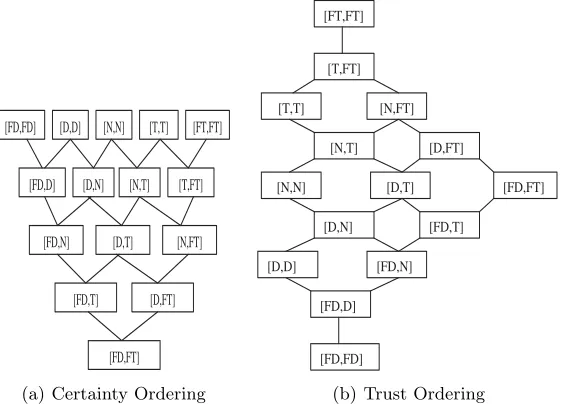
In addition to the , “more certainty” ordering relation onT, the model also
defines , “more trust”, which is equally essential. Therelation specifies for
two trust values t1 and t2, which one expresses more trust. According to the
theoretical trust model the set of trust valuesT given the orderingis complete
lattice.
In summary, the theoretical trust model requires that trust domain be defined
as (T,,), whereis an certainty ordering and is atrust ordering , such
that (T,) is a c.p.o. with a least element and (T,) is a complete lattice.
2.2 The Risk Model
The risk model [3, 17, 45] considers each collaboration between principals as con-sisting of a number of trust mediated actions. Each such action is an interaction
between two principals Pr and Pd, the requester and the decision-maker
re-spectively3, and has a set of possible results or outcomes. Each outcome has an
associated risk. Risk is defined as the likelihood of an outcome occurring and the cost or benefit this outcome incurs if it occurs. The risk of an outcome depends
on the trustworthiness of the requesterPr and certain parameters of the action
in question. Before each trust mediated action the decision-makerPd must make
a trusting decision. This decision is based on the overall risk of the action in question, which is some kind of combination of the risks of all its outcomes.
In the risk assessment of a particular action, the risk model takes the view
that the trustworthiness of the requesterPr affects the likelihood of the various
outcomes and not their associated costs or benefits. These in turn are determined by the parameters of the action. For example, in the case of financial transactions the trustworthiness of the principals determines the chances of them paying their debts, while the debt amount determines the specific costs or benefits. At the same time, the risk model recognises that the outcomes can be distributed over a space that has a range of potential costs with corresponding probabilities. For this purpose it introduces the concept of a cost-PDF to represent the risk of each outcome, which is a probability density function with cost on the x-axis. Note that in cost-PDFs, benefits are represented as negative costs. Since the trustworthiness of the principal affects the likelihood of each outcome, the risk of an outcome is represented by a set of cost-PDFs parameterised by the principal’s trustworthiness (a family of cost-PDFs). The family of cost-PDFs may be further parameterised by the parameters of the action.
At this point we should also point out a number of things:
1. The security decisions for each action are not necessarily binary, i.e. either accept or reject the action.
3 Note that in previous documents the two principals have been referred to as the
2. For each action a number of outcomes may occur at the same time and as a result the decision making process needs to consider the risk of all these outcomes.
3. It might take a significant amount of time before the real outcome of an action is known.
3
The Theoretical Collaboration Model
The aim of the collaboration model is to capture the dynamic aspects of the trust model. These aspects address issues like how trust is formed, how it evolves over time, how it is exploited in the decision making process and are collectively referred to as trust lifecycle management. Our model builds upon the theoretical trust model and the risk model described above. In particular, it exploits the relationships between trust and risk to both facilitate and evaluate the decision making process of the principals.
We define collaboration as a joint interaction between a set of two or more
principals P involving a set of one or more trust mediated actions A. Before
entering a collaboration each principal must make a trusting decision regarding the level of access to its resources it will permit to other principals. From this definition it should be clear that the collaboration and consequently the trusting decisions may be very complex. In this document we simplify our approach by only considering collaborations between two principals involving a single trust
mediated action. We call collaborations of this typesimple.
3.1 The Relationship between Trust and Risk
As it is observed in [3],“there is no need to trust someone unless there is a risk
involved”. So, it is our premise that not only trust and risk mutually require each other but in fact are so closely related that they reflect each other.
There are two alternative views of the relationship between trust and risk. On one hand, we can view risk “driving” trust. According to this view, risk reflects how vulnerable we are in a particular situation, or in other words how likely is our current situation to lead to an accident or mishap, combined with the severity or cost of this accident or mishap. In this case, our aim is to protect ourselves by only exposing serious vulnerabilities to highly trusted collaborators. In this context the trusting decision we have to make can be expressed as: in
a particular situations, or in the context of a simple collaboration a particular
actionawhich entails a level of riskr, how trustworthy should a principal be in
order to be allowed to enter situationsor carry out actiona? In this view the
level of risk determines the necessary level of required trustworthiness, i.e. risk drives the decision making.
In this case, our aim is to protect ourselves by only collaborating with principals that are likely to behave and as a result an interaction with them is not very risky. In this context the trusting decision we have to make can be expressed
as: in a particular situation s, or a particular action a, involving a particular
principal p, how much risk are we willing to accept by allowing principal p to
enter situationsor carry out actiona? In this view the level of trustworthiness
determines the level of acceptable risk, i.e. trust drives the decision making.
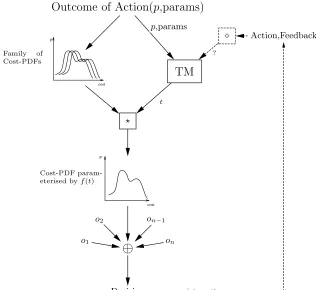
In particular situations one or the other of these alternative views seem more appropriate. More specifically, it seems to be the case that the former view is more natural in a safety critical systems setting, while the latter in a financial systems setting. The SECURE risk model has adopted the latter view. This is also demonstrated by Figure 1, which is taken from [3].
p
cost
p
cost
Outcome of Action(
p
,params)
TM
Family of
Cost-PDFs
Cost-PDF param-eterised byf(t)
p,params
t
⊕
Decision o1
o2 on−1
on
Action,Feedback
?
[image:8.612.150.466.271.561.2]interaction
Figure 1 shows a first attempt at determining the nature of the relation between trust and risk from the point of view of the risk model. According to this figure
for each outcome oi of a particular action A, a -function takes as input the
family of cost-PDFs associated with oi and the trust valuet associated with a
principal P and selects a single cost-PDF. The⊕-function takes as input these
selected cost-PDFs, one for each outcome oi, and produces a decision for the
action. If the decision was to go ahead with the action then after the completion
of the interaction some feedback is produced. A♦-function takes this feedback as
input and provides some information to the trust model. Although in this figure the relationship between trust and risk is not very clearly specified, there are
two important observations that we should note. First, the -function requires
the existence of a mapping between trust values and cost-PDFs. Second, the feedback loop requires that the results of any action carried out by a principal be used as feedback regarding its trustworthiness.
Looking at the decision making process as is depicted in figure 1 combined with the adopted view of risk, it is clear that the decision process relies on the ability of the decision-maker to associate each principal to a risk profile. The selected cost-PDFs of the outcomes for each action describe this risk profile. Moreover, this profile can also be seen as a profile of how good or bad the behaviour of a principal is expected to be in the context of the requested action. In this sense, the trust values can be viewed as classifiers of principals, where each principal is classified according to its expected behaviour in one of a number of groups. There is one group for each trust value and all principals within a group have the same trust value. This view of trust values as classifiers of principals has significant benefits for the scalability of the decision making process. It allows the decision-maker to keep only one risk profile for each group of principals instead of one for each principal. This is particularly important in a global computing setting, where the number of principals is expected to be particularly high.
This approach dictates a very close relation between trust values and risk profiles. In fact, every trust value must be associated to a single risk profile. Addition-ally, two different trust values should be associated to different risk profiles. If this is not the case, then from a decision making point of view the two trust values and subsequently the two sets of principals associated with them will be indistinguishable. As a result, keeping both trust values is questionable. This approach requires that the mapping between trust values and risk profiles is not only a function but an injective or one-to-one function. Note that according to the risk model (see section 2.2), the risk profile of a principal for a particular action is described as a set of cost-PDFs one for each outcome of the action. These cost-PDFs are selected from the family of cost-PDFs associated to each outcome. This injective function that maps trust values to risk profiles
corre-sponds to the-function of figure 1, which for each outcome of an action selects
define this function as4:
select:T →CP DF S (3)
At this point, we should point out that the number of trust values and con-sequently risk profiles is dependent on the required granularity of the decision making process. The larger the number of trust values the more able the decision-maker is to discern variations in the expected behaviour of principals. This allows finer differentiation on the way principals are treated. However, there is a trade-off between the granularity and the complexity of the decision making process. A decision making process that exploits the finer differentiation in the treatment of principals is likely to be more complicated.
In a global computing environment characterised by the lack of complete in-formation about principals, their classification into similarly behaving groups cannot be final. As additional information about the behaviour of individual principals becomes available the classification needs to be evolve. The results of this process may be twofold. It may lead to the re-classification of the principal into a different group whose associated risk profile is a more accurate predictor of the principal’s behaviour. Additionally, it may even lead to a reconfiguration of the classification scheme by updating the risk profiles associated to each group. In this context, the two aspects of the evaluation process can be captured by the following questions:
– Has each principal been classified to the correct group, i.e. is the trust value
for each principal correct?
– Is the risk profile associated to each group correct, i.e. are the cost-PDFs for
each trust value correct?
Note that the answer to both of the above questions is with respect to the cur-rently available evidence. Answering these questions in a general sense requires complete knowledge of a principal’s behaviour. This is not feasible in most cases in a global computing setting. The former aspect of the evaluation process can be associated to the feedback loop of figure 1. We refer to this aspect of the process as trust evaluation. Moreover, it becomes clear that a second feedback loop to cost-PDFs is necessary to represent the latter aspect of the evaluation process.
We refer to this aspect of the process asrisk evaluation. Since we only focus on
the dynamic aspects of trust and not of risk for the remainder of the discussion we will centre our attention on the trust evaluation aspect of the process.
Within this context, we can view the feedback collected from the multiple cases of an action as a profile of observed behaviour for the requester with respect to the action. This profile can in turn be described as set of cost-PDFs one for each outcome of the action, where the likelihood represents the proportion of the total occurrences where this outcome occurred. Then, we could rephrase the above trust evaluation question as follows:
4 An alternative view of this relationship is to view each cost-PDF as a function
– Which of the cost-PDFs predicts requester behaviour reflecting most closely the observed behaviour?
Being able to use the answer to this question to determine the appropriate trust value for the user requires an even stronger relationship between trust values and risk profiles. Not only should we be able given any trust value to select a risk profile, but we should also be able given any risk profile to select a trust value. This will enable us to calculate the trustworthiness conveyed by a profile of observed behaviour by finding the risk profile that most closely reflects it. This requirement implies that mapping from trust values to risk profiles should
also be surjective or onto function too. As a result, theselect function defined
by equation 3 must be a bijection.
Introducing structure to the risk domain. So far in the discussion of the relationship between trust and risk, we ignored the structure of the trust domain, the set of trust values. According to our trust model the trust domain is defined
as (T,,), a set of values together with a certainty and a trust ordering (see
section 2.1). This, in combination with the fact that both the decision making and trust evaluation processes require a very close relationship between trust values and risk profiles, implies that the set of the risk profiles should reflect the structure to the trust domain.
In the case of the trust ordering (), if we consider in the context of a particular
actionatwo trust valuest1, t2with respective risk profilesr1, r2such thatt1t2
thenr2must represent less risk thanr1. This means, according to our risk model,
that outcomes with lower costs and/or higher benefits are more likely in profile
r2 than in profile r1 (see section 2.2). Note though that this particular view is
the result of risk model’s premise that the trustworthiness of a principal only affect the likelihood of the outcomes. Instead, we can take the more general view that the trustworthiness of a principal can affect both the likelihood and/or the associated costs of the outcomes. In this case, we would expect that equally
likely outcomes will be associated with lower costs in profile r2 than in profile
r1. At this point we should note that in the current risk model, the case where
there are multiple costs possible for the same general outcome (e.g. failure) can only be modelled with the introduction of a number of specialised outcomes (e.g. disastrous failure and recoverable failure). However, as the variety of costs for the general outcome increases this modelling approach becomes more awkward.
In the case of the certainty ordering () things are more complicated. The
source of the complication is the lack of a notion of uncertainty in our current risk model. There are three ways of addressing these complications:
affect the trust dimension of the trust values leaving the certainty aspects either completely unaffected or managed through external procedures. 2. Consider the certainty dimension of the trust values only in the decision
making process and not in the trust evaluation process. Following this ap-proach the risk profiles reflect only the trust dimension of the trust values. As a result, the decision making process cannot rely exclusively on the risk pro-files. Instead it also requires the trust values themselves in order to consider their certainty dimension. At the same time, the trust evaluation process still only affects the trust dimension of the trust values. Similarly to the first approach, this leaves the certainty aspects either completely unaffected or managed through external procedures.
3. Introduce a notion of certainty to the risk model, which will allow considera-tion of both trust dimensions in both processes. In this approach in contrast to the second one, the risk profiles reflect both trust dimensions. As a result, the decision making process can rely exclusively on the risk profiles. At the same time, the trust evaluation process considers and affects both trust di-mensions. For example, as a result of the trust evaluation process the new trust value may be different only in terms of certainty and not in terms of trustworthiness.
The first approach is the least desirable of the three since it does not fully utilise the structure of the trust domain in either process. The second approach is a half way between the other two. On one hand, it does not ignore the certainty content of the trust values during decision making as the first one does. On the other hand, it still considers the certainty aspect as external to the trust evaluation process. As a result it still does not fully utilise the structure of the trust domain in the trust evaluation process. The third approach fully utilises the structure provided of the trust domain in both process. Moreover, it requires that the risk profiles reflect relationships between the respective trust values both in terms of trustworthiness and certainty. This requires a risk model that captures uncertainty.
From the three approaches, we consider the third one as the most desirable, mainly because of the requirements it places on the risk model. We believe that a risk model incorporating uncertainty is more in tune with the global computing setting that is characterised by high degrees of uncertainty about the collaborators. Consequently, we focus the rest of the discussion on the third approach.
Introducing uncertainty to the risk model. Our aim in this section is not to describe a full model for uncertain risks. It is more to suggest ways in which the current risk model can be extended to include uncertainty and to explain how some of these suggestions were applied in the case studies described in section 6.
number of distinct risk values, or provided that an ordering over set of risk
values is defined 5, as an interval containing all the values between an upper
and a lower bound. In either case, the higher the number of included risk values the more uncertain we are about the risk. As the number of included risk values is reduced our certainty about risk increases reaching complete certainty at the point when we have a specific risk value. In other words, we can compare risk ranges in terms of uncertainty using the set or interval inclusion operator on their
included risk values. So, a risk rangeRR1is more uncertain than risk rangeRR2
(RR2RR1), if the set or risk values inRR2is a subset of the set of risk values
in RR1.
Regarding the exact meaning of a risk range we could consider it to be that all the included risk values are equally likely while all other risk values are considered totally unlikely. Note that in the constructive method of defining trust values as intervals on a lattice of basic trust values, our trust model models certainty in a similar way, as inverse set inclusion (see section 2.3 in [9]). Moreover, it uses the same meaning for the intervals, i.e. considering all included trust values as equally likely. We can easily extend our current risk model to incorporate the above approach. We can associate a range of PDFs instead of a single cost-PDF to each outcome of each action for each trust value. In this way we can now easily reflect the full structure of the trust domain on the risk domain. We can see the certainty ordering of the trust domain as defining an inverse uncertainty ordering on the risk domain.
Following this approach results in some changes in the decision making and the trust evaluation processes. In the decision making process instead of considering a single risk profile for a principal we will have to consider a range of likely profiles. Any decision taken must acknowledge this fact. Furthermore, the trust evaluation process will have to decide on the appropriateness of the current trust value not only in terms of trustworthiness but also in terms of certainty. In terms of certainty the issue is whether any of the risk profiles of the range can be safely excluded (certainty increase) or if additional profiles need to be included (certainty reduction).
In section 2.2 we pointed out that risk is the combination of the likelihood of an outcome occurring and the cost it incurs. Taking this into consideration we can define two special cases of the above approach:
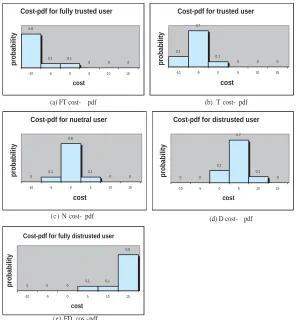
1. The case where the uncertainty is limited to the costs of the outcomes while their likelihoods are certain. In this case we could use a cost-PDF as defined in [3] to represent the range of likely costs of each outcome of an action for each trust value. This cost-PDF combined with the certain likelihood of the particular outcome give us the risk profile. In section 6.1 we apply this
spe-5 In contrast to the trust values it seems more natural to define a complete order of
cial case approach to a smart space application scenario. More specifically, we consider a single action, get user location information. This action has a single outcome, loss of user privacy. The range of costs and benefits of this outcome are determined by the cost or benefit of a meeting with this partic-ular user. We then follow the constructive method mentioned above to both determine the trust values and their associated risk profiles (cost-PDFs). The associated risk profiles of the trust value intervals are constructed by considering the corresponding risk profiles of the included basic trust values as equally likely, averaging of the respective cost-PDFs.
2. The case where the uncertainty is limited to the likelihoods of the outcomes while their costs are certain. In this case, we could represent the risk profile of each outcome of each action for each trust value as an interval of likeli-hoods, i.e. an interval within the (0, 1) interval, combined with the certain cost. In section 6.2 we apply this special case approach to an e-purse applica-tion scenario. More specifically, we consider a single acapplica-tion, e-cash payment, that has two outcomes, valid and invalid e-cash, each with a specific cost determined by the amount of the transaction. Users are considered reliable for transactions up to a certain amount. This means that there is no chance of invalid e-cash for any payments up to that amount. Users are considered unreliable for transactions above a certain amount. This means that there is no chance of valid e-cash for any payments above that amount. The trust values are intervals over the range of e-cash transactions determined by the thresholds of reliable and unreliable behaviour. The level of uncertainty is represented by the size of the interval. In the area of uncertain behaviour the likelihood of invalid and valid e-cash range from 0 to 1. In all cases the risk profile is parameterised by the amount of the transaction.
Concluding remarks. In conclusion, in order to support the decision making and the trust evaluation processes the relationship between trust values and risk profiles needs to be defined as a bijective function from trust values to
risk profiles. We call this function select() (see equation 3). In fact select() is
core to the decision making process, while its inverse select−1() is core to the
trust evaluation process. Such a close relationship between trust values and risk profiles requires that the risk profiles reflect the structure of the trust domain, both in terms of the trustworthiness and certainty. Specialised examples of how this requirement can be satisfied are provided in the two case studies of section 6.
3.2 Trust Exploitation
our trust in Bob differs. The important observation is that if the trustworthiness of a principal varies depending on the situation, then the decision making process should take the current situation into account. So, in this section we discuss how various situations/contexts can be captured in a way that allows the proper exploitation of trust in the decision making process.
Before we delve into the discussion we should first define context. There are a number of definitions of context in the literature [7, 2, 37, 40]. In fact context-aware computing is a research area receiving a lot of attention in recent years [12, 15, 22, 35, 36, 39]. Dey’s definition of context is one of the most widely used in the context aware computing literature. He defines context as:
Any information that can be used to characterise the situation of an entity. An entity is a person, place, or object that is considered relevant to the interaction between a user and an application, including the user and application them-selves[15].
From this definition it should be clear that there is a variety of different types of context we can consider. However, as Dey pointed out not all types of context are equally important [15]. The most important types are considered to be: location, identity, time and activity.
If we consider Dey’s definition from a SECURE point of view, we can see that from the four important types identity is central. The trust model identifies principals and assesses their trustworthiness separately. Taking this into account, in SECURE we define context as:
Definition 1 A situational modifier which affects the way principals behave.
In general, the decision making process depends on the expected behaviour of a principal as it is reflected in its risk profile (see section 3.1). According to definition 1 context affects the behaviour of principals. In order for this effect to be taken into account in the decision making process, context should in fact affect directly or indirectly the risk profiles on which this process depends. Con-sequently, the effect of context can be threefold:
1. Context affects the risk analysis changing the risk profiles associated to each trust value. This results to different expectations for principals’ behaviour. 2. Context affects the principals’ trustworthiness. Since according to the risk
model the trust values of principals parameterise the risk profiles, this results in context indirectly affecting the expectations for principals’ behaviour. 3. Context affects the mapping of trust values to risk profiles, changing the
risk profile selected by a trust value. This again results in context indirectly affecting the expectations for principals’ behaviour.
operation of theselect() function (see equation 3). In the first case the context affects the range of the function. In the second case it affects the domain of the function. In the third case it affects the calculation of the function. Second, since the risk model associates separate risk profiles to each trust mediated action, a separate family of cost-PDFs, actions already define a context for the principals’ behaviour. In fact actions can seen as defining the activity type of context mentioned above. As a result, although the trust and risk models do not incorporate explicit notions of context, they already implicitly take into consideration two of the four important types of it. Moreover, the presentation
of the select() function so far was in the single context of a single action. As
a result it provided quite a simplistic view of its role. If we try to extend this view to include multiple contexts of a single action then we are faced with the challenge of how to capture the contextual variations of trust in a way that facilitates the above mentioned three cases. The challenge becomes more serious if we want also to consider a number of actions, as would be the case in most applications.
The contextual variations within a single action can be easily captured through the parameterisation of actions in our current models. In this case, for each ac-tion the applicaac-tion developer will have to determine a set of parameters such that their values can capture the whole range of contextual variations. In the simplest case, there could be a single parameter whose values represent all the different contexts. Although simple, this approach becomes difficult to manage in situations where the number of different contexts is large. An alternative ap-proach would be to separate different types of context, e.g. time and location, and associate a parameter to each particular type. This approach is more man-ageable, since it separates the different contextual concerns.
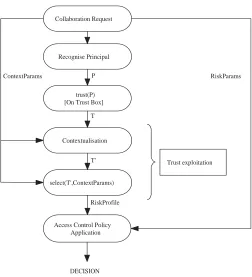
The parameterisation of actions can support all three of the above cases. In the first case where context affects the risk profiles, we could use the action parameters to parameterise the family of cost-PDFs or the range of risk profiles associated to each action. In this case, we can refer to the parameters as risk parameters. In the decision making process the risk parameters would determine the exact nature of the cost-PDF family or range of risk profiles before the
application of theselect() function. The rest of the process will remain the same
as was described in section 3.1. In the third case where the context affects the mapping of trust values to risk profiles, we could use the action parameters
to parameterise the select() function. In this case, assuming that CxtP arams
denotes the contextual parameters, the function will have to be redefined as follows:
select:T ×CxtP arams→CP DF S (4)
The second case, where context affect the trust values used by theselect()
1. Introduce context explicitly to the trust model. This approach requires each trust value to be contextualised, i.e. associated to a particular contextT[cxt].
Consequently, theupdatefunction of the trust box (see section 2.1) will have
to be redefined to take the context into account. In the decision making
pro-cess the trust values provided to the select() function would be
contextu-alised according to the action parameters, while the rest of the process will remain the same.
2. Exploit the internal structure of the trust values to capture context. In this approach the trust model is oblivious of context. Instead, the trust val-ues are multi-dimensional reflecting the contextual differences of principals’ trustworthiness. In the decision making process the trust values would have
to be contextualised before they are provided to theselect() function. Since,
the various dimensions of the trust values reflect contextual variations, the contextualisation process can be seen as a projection function that selects only the relevant dimensions. The action parameters determine the exact nature of the contextualisation. In the decision making process, the trust
values provided to theselect() function would be contextualised, while the
rest of the process will remain unchanged. Note that in the general case the contextualisation could be quite complex. For example, in the case where each dimension refers to different independent context, the contextualisa-tion funccontextualisa-tion will be a straight forward projeccontextualisa-tion picking the appropriate dimension. While in the case where different contexts are dependent on each other, the contextualisation function will not only pick the the appropriate dimensions but also apply different weights to them. These weights will re-flect how closely related the selected contexts are to the current one. Finally, each dimension may not reflect a particular context. Instead, it may reflect a particular aspect of principal behaviour, e.g. benevolence. These aspects will be relevant to different context with a different contribution. In this case the contextualisation will just apply different weights to the different dimensions reflecting their respective relevance for the current context.
These two approaches for the contextualisation of trust values can be extended to capture also contextual variations between actions. In fact, this only requires that the context considered for the contextualisation of the trust values includes the action too, and does not require any changes to the decision making process.
From the two approaches for the contextualisation of trust values we prefer the second one, since it does not require any changes to our trust model. However, the relative advantages and disadvantages of the two approaches are currently not very clear to us. This is an issue we are planning to investigate further in the future.
the relationship also dictates that the trust evaluation process must be con-textualised. This means, that if contextualised trust values are the input in the decision making process, i.e. only certain dimensions with a particular weight are considered, then the trust evaluation process should only affect these dimensions and to a degree that reflects their respective weights. This requirement intro-duces some serious complications to the trust evaluation process. So, in order to simplify matters the discussion in the following sections is restricted within the context of a single action and does not consider contextual variations with that action. The removing of these restrictions is an issue left for further investigation in the future.
The discussion so far, has been restricted within a single application context. If we consider multiple applications sharing trust information, then the appli-cations themselves define the context within which their trust values need to be interpreted. We refer to contextual variations in behaviour within a single
application asinternal context, while we refer to contextual variations between
applications asexternal context. In the case of external context, the transfer of
trust values from one application to the other requires their contextualisation. This is achieved through a mapping between their respective contexts. This con-text mapping can be taken into account during the concon-textualisation of the trust values as discussed above. In fact, the projection of relevant dimensions of the trust values combined with their weighting is a form of internal context mapping. Note though that transferring trust values between applications is not just an issue of contextualisation. In the general case it will also involve a translation of trust values from one trust domain to another.
In summary, our trust exploitation model considers context as situational varia-tions of principals’ behaviour. It considers two types of context, internal (intra-application) and external (inter-(intra-application). The current model focuses on in-ternal context, which it encodes by principal, action and action parameters. It considers the effects of context on the decision making process along three di-mensions: risk profiles, mapping between trust and risk, and trust values. The last of the three dimensions is referred to as contextualisation of the trust values and is the basis for the extension of the model to multiple actions and even multiple applications. The model approaches the contextualisation of the trust values by exploiting their internal structure and defining an internal context mapping.
3.3 Trust Formation and Evolution
principal actively seeks additional evidence. There is only one difference in the case of formation compared to evolution:
– The current trust value is “unknown”, i.e. the ⊥element of the certainty
ordering6.
If we look back into the theoretical trust model (see section 2.1) it should be clear that the update function of the trust box does in fact refer to the formation or evolution of the trust values. The state of the trust box is updated in the light of new evidence. Moreover, the trust evaluation process as described in section 3.1 illustrates also in part the trust evolution process.
Different types of evidence. In general, evidence refers to any kind of
infor-mation about principals’ behaviour. We call the principal in question thesubject
of the evidence. Evidence can be characterised as either direct or indirect. The
former refers to evidence about a subject’s behaviour that has been directly
witnessed by a principal, thewitness. The latter refers to evidence about a
sub-ject’s behaviour that has not been directly witnessed. In fact, it refers to third party information about a subject’s behaviour. From these definitions it should be clear that the characterisation of evidence as direct or indirect is relative, in other words direct evidence propagated to another principal becomes indi-rect. The distinction between direct and indirect evidence is quite important. The validity of direct evidence is unquestionable and should be treated as fact, while indirect evidence can be questionable and should be treated as an opinion about facts. Consequently the validity of indirect evidence depends heavily on the source of the information, the principal expressing the opinion. This differ-ence suggests that during trust evolution indirect eviddiffer-ence must be treated with caution, as different principals may evaluate differently the same facts. Moreover, some principals may be even distort the facts.
The trust management literature identifies three types of evidence:
1. Observations. They refer to direct evidence. They are personal
experi-ences usually gathered through interaction with a principal 7. The action
feedback of figure 1, refers in fact to the generation of observations that takes place at the completion of an interaction. According to our model, an interaction between two principals is in the form of trust-mediated ac-tions. Each of these actions has a set of possible outcomes, each with its own costs or benefits (see section 2.2). At the same time, our model prescribes
6 This does not have to be always the case. In the general case trust formation may
start from an initial trust valueT =⊥. In any case though, the initial trust value has to be quite uncertain, i.e. it has to be close to the bottom of the certainty ordering complete partial order.
7 An extended view of observations may also include observables, indications of a
that differences in the trustworthiness of principals represent differences in their expected behaviour profiles, i.e. their risk profiles. These differences demonstrate themselves as either differences in the likelihoods of the various outcomes and/or differences in the incurred costs or benefits. Hence, we take the view that an observation is the pair of the outcome that occurred at the end of the interaction and its observed cost or benefit. This approach allows us to distinguish between profiles of expected behaviour that produce the same outcomes with same likelihood, but incur different costs or benefits. For example, consider an email spam filtering application that decides if an email should be classified as spam or not depending on the trustworthiness
of the sender. In this scenario, we have two different principalsP1 andP2,
that send us spam messages with same likelihood, e.g. 1 in 4 messages is
spam. But principalP1 usually sends us small text messages a few bytes in
size, while principalP2 usually sends us messages with attachments many
megabytes in size. In this case, the risk associated to messages from principal
P2 is significantly higher to that associated to messages from principal P1.
So, in this scenario the evaluation of our interactions with each principal needs to consider both the outcome, spam or not, and its cost, message size. 2. Recommendations. They refer to indirect evidence passed between a
prin-cipalW, the witness, and a principalR, the receiver, describing a judgement
on principalS, the subject. In the general case, this evidence can take any
form, but in this document we only consider the case of a trust value ex-pressingW’s trust inS.
3. Reputation. It refers also to indirect evidence that takes the form of a
measure of the overall trustworthiness of a subjectS. This measure can be
expressed as:
r(S) =
Pi∈C
m(Pi)(s) (5)
Note that we only assume a community of principalsC, which is a subset of
the whole principal populationP. This is in line with the lack of complete
information characterising global computing.
At this point, it is imperative to clarify what do we mean by a shared under-standing of the trust values. A strict interpretation of shared underunder-standing would require that provided with the same trust value in the same context, all principals would make the same decision. Such an interpretation would require that besides the same format of trust values, all principals share:
– The same structure of the trust value domain.
– The same trust contextualisation process.
– The sameselect() function (see equation 3).
– The same risk analysis, i.e. risk profiles.
– The same access control policy.
We find such an interpretation unnecessarily over restrictive, particularly in the context of global computing, which is characterised by the autonomy of entities. In fact, it could be argued that the access control policy and the risk analysis are characteristic of the disposition of an entity and as a result should vary.
The argument regarding the contextualisation process and theselect() function
is not as clear cut. It should be clear however, that a shared structure for the trust value domain is the minimum requirement for the meaningful exchange of trust values between principals. Hence in this document we take the view that all principals share the same structure of the trust value domain. This means the following:
1. There is a single format of trust values.
2. Each dimension of the trust values represents the same thing for each prin-cipal. For example, if the trust values are (t1, t2), then t1 always refers to
the trustworthiness of a principal as a collaborator andt2 always refers to
the trustworthiness of a principal as a recommender.
3. The value range of each dimension of the trust values is the same for all principals. In the above example we could have that for all principals both
t1 andt2∈(0,1).
4. The trust and certainty orderings are the same for all principals. So, ift1t2
andt1t2 for principalPi thent1t2 andt1t2 for all other principals.
The above assumptions guarantee to a certain degree meaningful exchange of evidence in the form of trust values between principals within a particular appli-cation. Note, that in particular application scenarios the developer may want to provide stronger guarantees. In general, it is the case that the stronger the guar-antees the more meaningful the exchange of trust values becomes. In any case, it is imperative that the application developers are very clear about the pro-vided guarantees. Moreover, the exploitation, formation and evolution processes should not make any assumptions above these guarantees.
evidence due to its unquestionable character. This means that we would consider observations to be the most valuable type of evidence and as a result to carry the most weight in the evolution process. In fact, we could even see situations where observations would be the only type of evidence considered. The problem with observations is that they require the participation of the witness, making them the most difficult type to collect. It usually takes a lot of time before any principal acquires adequate personal experience.
The exchange of experiences between principals can enhance their perception of the world, especially in cases where personal experience is limited. In these cases recommendations and reputation can be particularly valuable. However, their value is predicated on the assumption that the subject is likely to behave similarly towards both the witness and the receiver. If the assumption does not hold, then the exchanged experiences are worthless. In the general case, there are no guarantees that this assumption holds. Identifying which principals witness similar behaviour from certain subjects is in most cases very difficult. In any case, the fact that exchanged experiences are indirect types of evidence means that the trustworthiness of their source affects their validity and as a result their value. This is acknowledged in the literature and has led to the introduction of the concept of discounting for recommendations [26, 28, 50]. Discounting usually takes the form of an operator which considers the receiver’s perception of the
integrity or trustworthiness of the witness, namely thetrust in the recommender.
We should note here that this type of trust is usually considered as separate from the trust that is normally associated to principals. It reflects how good the principal is as a source of recommendations, rather than how likely it is to behave well. The value of a recommendation as evidence depends on the certainty of our trust in the recommender. The more certain it is the more valuable the recommendations are. If we are completely certain about a recommender’s trust then its recommendations become as valuable as our observations.
There are two alternative approaches to modelling trust in the recommender:
1. As a proper trust value. According to this approach exchanging recommen-dations is just another form of interaction with a principal and as a result a similar decision making and trust evaluation processes should be followed. In this case, the trust in the recommender is maintained with similar ex-ploitation, formation and evolution processes to the main trust. This type of trust in the recommender could form either an orthogonal second trust value domain, or a separate dimension of the main trust value domain. In either case, these trust values should encode both trustworthiness and certainty and follow the same structure as the main trust value domain in terms of the orderings (see section 2.1).
viewing trust in the recommender as a proper trust value only introduces unnecessary complexity.
We believe that the former approach is more desirable since it allows us to consider trust in the recommender and main trust within a single framework. It also lets us to explicitly model certainty in the recommenders.
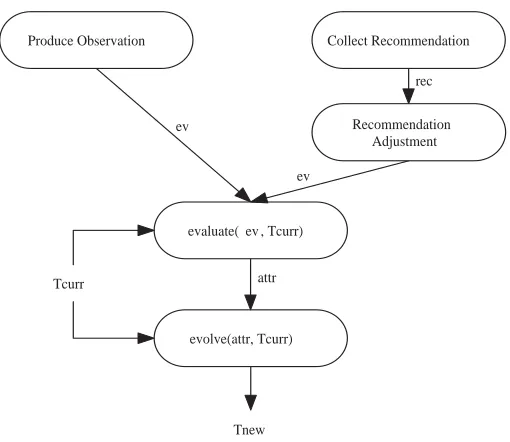
This approach, however, raises a number of issues regarding the discounting operator that should adjust recommendations in the light of the trust in their source. First, using the term discounting for such an operator is misleading. This operator aims to adjust the trust values we receive as recommendations, either by lowering or raising them. More specifically, if we notice that particular principals tend to be quite lenient in their evaluations of subject behaviour, then we should lower their recommendations. While, if we notice that they are quite strict, then we should raise them. Note that this is in line with the notion of semantic distance between recommendation and experience as defined in [1]. So,
we refer to such operator as anadjusting operator and to the process of applying
the operator as recommendation adjustment.
Second, the fact that the trust values and the trust in the recommender encode both trustworthiness and certainty, means that the adjusting operator should also work on both these dimensions. In this case the operator could also been seen as the means for making recommendations as valuable as observation. How-ever, at present the exact way in which the operator should work is not very clear. Consequently, this is an issue open for further research. We should note, though, that we incorporate the adjusting operator in our model. We introduce recommendation adjustment as the first step in their evaluation process.
Although, the use of an adjusting operator that takes into consideration the trust in the recommender may be used to increase the value of recommendations, in the case of reputation things are even more complicated. Since, reputation aggregates a number of recommendations in order to follow the same approach we need to adjust each constituent recommendation. This requires that we know exactly which opinions were combined to produce the measure of overall trustworthiness, who were the sources of these opinions and how much each of them contributed to the overall measure. If this is the case, then reputation has the same value as individual recommendations. However, in most cases, this level of detailed information is not available, and as such reputation is not very valuable for evolution. This is the main reason why reputation is not further considered in this document and the SECURE project as a whole.
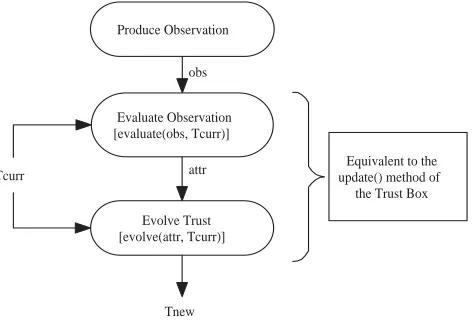
Evidence evaluation. Evidence evaluation is the first step of the trust for-mation and evolution process. In order to model the effects of new evidence on
our current trust value we introduce the notion of attraction. When new
evi-dence becomes available we expect the current trust valueTcurr to change to a
we expect the new evidence to attract the current trust value towards it. Thus, attraction is the measure of the impact evidence has on the current trust value.
In this context, we can view the evidence evaluation process as a function, which
assuming that Evd is the set of evidence, and Attr is the set of attractions, is
defined as follows:
evaluate:Evd× T →Attr (6)
Since, according to the theoretical trust model our trust values reflect both trust and certainty, we can express the impact of attraction in both trust and certainty terms. Therefore, we can view attraction as a two-dimensional measure
consisting of a trust dimension (τ) and an certainty dimension (σ). On each
dimension attraction can be characterised:
– In the certainty dimension as eitherreinforcing orcontradicting. In the
for-mer case, the new evidence cannot increase the certainty of the current trust
value, i.e.TcurrTnew. In the latter case, the new evidence cannot reduce
the certainty of the current, trust value,TnewTcurr.
– In the trust dimension as either positive or negative. In the former case,
the new evidence cannot reduce the trustworthiness of the current trust
valueTcurrTnew. In the latter case, the new evidence cannot increase the
trustworthiness of the current trust valueTnewTcurr.
We refer to the above characterisation of attraction as the direction of the
at-traction. The reason for this is that if we consider a trust domain (T,,),
then these characterisations are excluding a number of elements ofT producing
a subset of acceptable trust values in terms of certainty and trust respectively.
So, if we define Tσ, Tτ ⊆ T to be the set of acceptable trust values in terms of
certainty and trust respectively, then the characterisations dictate that the new
trust value must belong to the intersection of these sets, Tnew∈Tσ∩Tτ. Or in
other words, they determine the direction we should move on the trust ordering lattice or the certainty ordering c.p.o. (see section 2.1) to find our new trust valueTnew.
Recommendation evaluation. Firstly, we should remind the reader that recom-mendations are in the form of trust values. Note that we assume that in the case of recommendations, the adjustment process has already taken place. As
a result, we can evaluate a recommendation, Rec, by taking advantage of the
structure of the trust domain (T,,) and directly comparing it to the current
trust value in terms of certainty,, and trust,. This comparison will determine
the direction of its attraction as follows:
– In terms of certainty, we calculate the greatest lower bound (glb) ofTcurr
andRec. Note that because (T,) is a complete partial order with a least
element, the glb of any two trust values t1, t2 ∈ T is guaranteed to exist.
1. If the glb(Tcurr, Rec) = Tcurr, then the attraction of the evidence is reinforcing.
2. If the glb(Tcurr, Rec) = Rec, then the attraction of the evidence is still
reinforcing, but in this case Rec does not really add anything to our
current trust value and can be safely ignored.
3. Otherwise, the attraction of the evidence is contradicting.
In both the first and the third of these cases the new trust valueTnew must
have the properties:glb(Tcurr, Rec)Tnew andTnewTcurr.
– In terms of trust,Tcurr andRecare either comparable or incomparable.
1. If they are comparable, then:
• IfTcurrRec, then the attraction of the evidence is positive.
• IfRecTcurr, then the attraction of the evidence is negative.
Note that in this case the new trust valueTnewmust be inside the interval
[Tcurr, Rec] or [Rec, Tcurr] respectively.
2. If they are not comparable, then instead of comparingTcurrandRecwe
compareTcurr to either the glb or the least upper bound (lub) ofTcurr
and Rec. Note that because of the fact that the (T,) is a complete
lattice, both the glb and the lub of any two trust values t1, t2 ∈T are
guaranteed to exist. The choice between the glb and lub is a dispositional characteristic of the principals. According to this characteristic principals
are classified as either trusting, those selecting the lub, or distrusting,
those selecting the glb. Then there are the following two cases:
(a) If the glb was selected, then the attraction of the evidence is negative
and the new trust value Tnew must be inside the interval defined by
the glb and the current trust valueTcurr,Tnew∈[glb(Tcurr, Rec), Tcurr]. (b) If the lub was selected, then the attraction of the evidence is positive
and the new trust value Tnew must be inside the interval defined by
the current trust valueTcurrand the lub,Tnew∈[Tcurr, lub(Tcurr, Rec)].
The above determines the direction of the attraction, but it does not determine the value of attraction, attr. Our trust model does not provide us with a measure of distance between trust values, and as a result cannot be used for determining the value of the attraction. However, in section 3.1 we required a very close relationship between trust values and risk profiles. We also defined
a select() function (see equation 3), which maps trust values to risk profiles.
Here, we exploit the select() function combined with the definition of a notion
of risk profile distance to determine the value of attraction. More specifically,
assuming two discrete cost-PDFs C1 and C2, representing risk profiles R1 and
R2respectively we define their distance as:
dif f(C1, C2) =
∀x∈C
|Pr1(x)−Pr2(x)| (7)
where Pr1(x) and Pr2(x) are the probabilities of cost x according to C1 and
the value of a recommendation’s Rec attraction, must be proportionate to the
distance of the risk profiles, cost-PDFs, associated toTcurr andRec:
attr ∝dif f(select(Tcurr), select(Rec)) (8)
The exact function for the calculation of the value is up to the application developer to define.
In summary, the direction of the attraction determines the direction of movement on the trust ordering complete lattice and the certainty ordering c.p.o. While the value of the attraction determines the distance of movement. The bigger the attraction value is the bigger the movement has to be. In other words, the bigger the value of the attraction the more likely we are to move away from the current trust value.
Observation evaluation. At first, we should remind the reader that observations comprise of the observed outcome and its incurred cost or benefit. The evaluation of observations in general can take the following two forms:
1. Direct Evaluation. In this case the attraction of an observation is charac-terised as positive if the observed outcome incurred a benefit and negative otherwise. Further, it is characterised as reinforcing if the likelihood of the
observation, Obs, according to the risk profile of the current trust value,
Prselect(Tcurr)(Obs) ≥50%. Otherwise, it is contradicting. Its value should
be proportionate to the distance of the likelihood of the observation accord-ing to the risk profile of the current trust value from 50%,
attr ∝|Prselect(Tcurr)(Obs)−50%| (9)
This form of observation evaluation is demonstrated in the e-purse scenario (see section 6.2).
2. Indirect Evaluation. In this case, we first produce anevidential trust value,
Tevd, from the observation. Then we evaluate the attraction ofTevdfollowing
the approach described above in the evaluation of recommendations8. The
production of the evidential trust value exploits the close relation between
trust and risk, and in particular the fact thatselect() is a bijective function
(see section 3.1). More specifically, we choose as Tevd, the trust value, Ti
that is associated to the risk profile,Ri, in which the observation, Obshas
the highest likelihood:
Tevd=select−1(Rmax|PrRmax(Obs) =max
i (PrRi(Obs))) (10)
If we follow this approach, then it should clear that considering a single
observation means thatTevd does not offer significant insight into the
trust-worthiness of the principal in question. Therefore, it seems reasonable to
8 Note that we can take the view that the recommendation adjustment does in fact