Rochester Institute of Technology
RIT Scholar Works
Theses Thesis/Dissertation Collections
10-1-2011
A Search for MRI diffusion coefficient standards
Hongmei Yuan
Follow this and additional works at:http://scholarworks.rit.edu/theses
This Dissertation is brought to you for free and open access by the Thesis/Dissertation Collections at RIT Scholar Works. It has been accepted for inclusion in Theses by an authorized administrator of RIT Scholar Works. For more information, please [email protected]. Recommended Citation
A Search for MRI Diffusion Coefficient Standards
Hongmei Yuan
M.S. Physical Chemistry, Wuhan University, Wuhan, P.R.China, 2004 B.S. Chemical Education, Xinyang Normal University, Xinyang, P.R.China, 2001
A dissertation submitted in partial fulfillment of the
requirements for the degree of Master of Science in the
Department of Chemistry,
College of Science
Rochester Institute of Technology
October 2011
Signature of the Author _________________________________
DEPARTMENT OF CHEMISTRY COLLEGE OF SCIENCE
ROCHESTER INSTITUTE OF TECHNOLOGY ROCHESTER, NEW YORK
CERTIFICATE OF APPROVAL
________________________________________________________________________
M.S. DEGREE DISSERTATION
________________________________________________________________________
The M.S. Degree Dissertation of Hongmei Yuan has been examined and approved by the dissertation committee as satisfactory for the dissertation required for
the M.S. degree in Chemistry.
____________________________________________ Dr. Joseph Hornak, Dissertation Advisor
____________________________________________ Dr. Christopher Collison
____________________________________________ Dr. Lea Michel
____________________________________________ Dr. Thomas Smith
____________________________________________ Date
i Abstract
Diffusion coefficients (D) can be readily measured by nuclear magnetic resonance
(NMR) spectroscopy and magnetic resonance imaging (MRI) instruments. Operators of
these instruments often utilize standards with known diffusion coefficients to rapidly and
conveniently test the performance of the NMR or MRI system to measure diffusion. A
variety of these standards have been proposed in the scientific literature. This thesis
describes a diffusion standard based on water constrained by container geometry,
specifically water between tightly packed, parallel glass fiber filaments. The restricted
diffusion of water in this environment gives a diffusion coefficient which is selectable by
the choice of data acquisition parameters. Thus, one standard can be used to achieve
multiple diffusion coefficients and replaces the need for multiple diffusion standards.
Educational training was performed on a 300 MHz NMR spectrometer located at
Rochester Institute of Technology (RIT). As a part of this training, pulsed magnetic field
gradient strengths were calibrated and diffusion coefficients (D) measured for a series of
silicone oils of different viscosities.
Diffusion coefficient values for a small diameter test phantom were measured on a
600 MHz NMR spectrometer with stimulated echo pulse sequence at 25°C. A
predictable behavior between the apparent diffusion coefficient and gradient separation
() value in the sequence was observed. Diffusion coefficient values were measured for
a larger diameter phantom using a 1.5 T imager at 20°C using echo-planar imaging
sequence and confirmed to follow the same D vs. behavior. Based on these
observations, a hydrated fiber bundle can make a diffusion phantom with only water
ii
ACKNOWLEDGEMENT
My deepest thanks to Dr. Joseph Hornak, my research advisor. This thesis would
not have been possible without Dr. Hornak’s great assistance and encouragement. Thanks
also to Dr. Hornak’s wife, Elizabeth Hornak, whose enthusiasm and kindness makes me
feel like a part of an American family. Thanks to my other thesis committee members, Dr.
Thomas Smith, Dr. Christopher Collison, Dr. Andreas Langner, and Dr. Lea Michel, for
their assistance and encouragement during my studies at Rochester Institute of
Technology. I am especially thankful to Dr. Paul Rosenberg, Brenda Mastrangelo, and
Autumn Madden for their care and attention, as well to the RIT Chemistry Department
for supporting me.
I also wish to thank Dr. Scott Kennedy at the University of Rochester Biophysics &
Biochemistry, Dr. Edmund Kwok from the Imaging Science Department at the
University of Rochester Medical Center, Dr. Paul Keifer at Varian Inc., and Dr. Amy
Freund at Bruker Biospin Inc., who have supported instruments and measurements in this
work.
Special thanks should be given to my ESL teachers, Lisa Hoffmaster and Linda
Gamlen, to my student colleagues, Can Wang, Yuqiong Joan Wang, Yujie Qiu and her
husband, Wei Yao, Jennifer Swartzenberg, and Luticha A. Doucette, who helped me in
many ways in America. Finally, words alone cannot express the thanks I owe to my
family members in China and Shunxu Ge, my husband for their encouragement and
iii
Table of Contents
Abstract……….i
Acknowledgements………..ii
1.0 Introduction………1
2.0 Background and Theory……….4
2.1 Diffusion………...4
2.2 Nuclear Magnetic Resonance………...9
2.3 Pulse Sequences………..12
2.4 Magnetic Resonance Imaging……….20
3.0 Experimental Methods……….23
3.1 Sample Preparation……….23
3.2 NMR Spectroscopy……….25
3.3 Gradient Calibration………26
3.4 MRI Measurements……….28
4.0 Results and Discussion…...29
4.1 Gradient Calibration Results………...29
4.2 Diffusion Coefficient Checks……… 31
4.3 Diffusion Coefficient from the 600 MHz NMR……… 34
4.4 Diffusion Coefficient from the 1.5T MRI System………..35
5.0 Conclusion………...39
1
1.0 Introduction
In the last three decades, magnetic resonance imaging (MRI) has established itself
as the most diagnostically useful imaging modality in the medical imaging field. It is in
part because of the ability of MRI to distinguish between soft tissues in the body. The
last decade has seen the emergence of a new kind of MRI, quantitative MRI.
Quantitative MRI uses MRI to measure some specific property, such as the diffusion
coefficient, and relate it specifically to a disease state.
Some studies have related the diffusion coefficient of water in tissues to a disease
state such as ischemia [1-4], epilepsy [5-7], tumors [8-10], and strokes [11-13]. Magnetic
resonance imaging is capable of producing several forms of images yielding diffusion
information. These include diffusion weighted, diffusion, and diffusion tensor images.
Diffusion weighted images are magnetic resonance images where contrast is related to
the diffusion coefficient. Diffusion imaging produces images of the diffusion coefficient.
Diffusion tensor imaging (DTI) produces images of the diffusion tensor of water in each
location in the image. The technique has been especially useful in mapping the tracks of
nerve fibers in the brain, and therefore determining interconnectivity in the brain.
Quantitative magnetic resonance imaging studies of diffusion require a standard, or
phantom, to calibrate the imaging system. A phantom is an anthropogenic object used to
test the performance of the imaging system. The term phantom is more commonly used
by the MRI community. Several diffusion phantoms have been proposed in the literature.
These include liquids with an isotropic D value [14-17], plants [18-20], biological
2
Phantoms utilizing isotropic liquid consists of a set of hydrocarbon liquids with self
diffusion coefficients (D) between that of water and approximately 0.5x10⁻⁹ m2/s. [17]
Shipping constraints make commercializing phantoms containing flammable
hydrocarbons more costly. Plants and biological based phantoms are difficult to keep for
long periods of time as they degrade and the diffusion coefficient changes. Capillary
phantoms have a low signal, because a large amount of the phantom volume is the
capillary tube compared to the smaller amount of signal bearing liquid, which causes
large susceptibility artifacts in the images.
Phantoms based on fibers overcome many of the previously mentioned
shortcomings and have some notable advantages, namely the ability to calibrate and
characterize DTI. Several fiber phantoms have been reported recently [28-29] for
quantitative studies. Lorenz, et al. [28] reached the conclusion that the hydrophobic
fiber materials polyamide and Dyneema® (an ultra-high molecular weight polyethylene
[30]), showed greater anisotropy, as well as much higher alignment along the actual fiber
direction than the hydrophilic fiber materials hemp, linen, and viscose rayon. Fieremans,
et al. [29], introduced a fiber phantom made of ultrahigh-molecular-weight polyethylene
(micro dyneema). This kind of fiber phantom was proved to be suitable for the
quantitative validation of diffusion imaging because of the correspondence between the
simulations and the experimental results. The result of their three-dimensional Monte
Carlo simulation of random walker demonstrated that the diffusivity for the random
packing geometries with a fixed diameter was similar to the diffusivity for a random
3
there is intracellular and extracellular diffusion [31], but currently, fiber materials with
such exact diffusion properties are not available.
This thesis proposes a diffusion phantom based on the restricted diffusion of water
between tightly packed glass fibers. This form of phantom has been developed for
diffusion tensor imaging [28-29, 32-35], but not as a solution to the stated problem. This
phantom should yield a range of diffusion coefficients less than Dwater as a consequence
of restricted diffusion using only water as the nuclear magnetic resonance signal bearing
liquid. As a consequence, shipping of the phantom should be easier.
This thesis describes a project designed to test the hypothesis that a phantom based
on restricted diffusion can be used as a calibration standard for MRI. There are two parts
to the test. Restricted diffusion samples will be designed, prepared and tested on a
high-resolution NMR spectrometer capable of measuring diffusion coefficients. Once a
standard is developed on this system, it will be scaled up in size and tested on a clinical
system. I planned to use the Bruker DRX 300 MHz NMR spectrometer located in the
RIT Chemistry Department for the first phase of the project. The calibration of the
system was completed but, unfortunately, a series of maintenance problems with the
spectrometer forced us to look elsewhere for these measurements. Therefore all tests on
high resolution systems were performed on a 600 MHz system located at the University
of Rochester. The calibration results were included in this thesis to explain the process,
but the University of Rochester performed their own gradient calibration procedure. MRI
4
2.0 Background and Theory
2.1 Diffusion
Diffusion is the random movement of molecules or particles due to the kinetic
energy of the molecules and particles. This definition is broad and covers a great deal of
science. To help the reader see the connection of this research to the field of diffusion, a
broad overview of diffusion will be presented first, followed by a focus on aspects more
specific to this research.
The introductory student of diffusion will encounter several terms that should be
described first. These include self, mutual, counter, free, restricted, anisotropic, isotropic,
translational, and rotational diffusion; in addition to the true and apparent diffusion
coefficients. Self-diffusion is the motion of a particle when the concentration gradient is
zero. This motion is what we are familiar with when we say Brownian motion. Mutual
or Counter diffusion is the motion of a particle in the presence of a concentration (C)
gradient. Mutual or Counter diffusion is described by Fick’s laws [36] of diffusion.
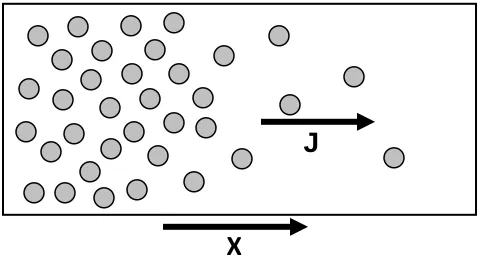
Fick’s first law of diffusion describes the diffusion of particles from a region of
high concentration to a region of low concentration. (See Fig. 2.1.) The flux (J) in the x
direction is a result of a concentration gradient (C/x). The flux goes from regions of
high concentration to regions of low concentration. J is proportional to C/x by a
constant called the diffusion coefficient (D) for the diffusing particles.
J = -D (C/x) (2.1)
Fick's second law of diffusion describes the change of concentration with respect to
time (t).
5
For spherical particles of radius r, the self diffusion coefficient in absence of a
concentration gradient at temperature T is directly related to the viscosity (η) of a
material through the Stokes-Einstein equation [37],
r 6
T k
D B
(2.3)
where kB is the Boltzmann constant. The diffusion coefficient is temperature dependent
and increases with increasing temperature. The diffusion coefficient in the international
system (SI) of units has units of m2/s. The self diffusion coefficient of water at 25 °C is
2.299×10⁻⁹ m2/s [38].
Diffusion can be classified as restricted and unrestricted. Unrestricted diffusion is
what occurs in outer space where there are no boundaries. Because most physical
experiments are performed on Earth and are constrained by boundaries of one form or
another, there is restricted diffusion. In practice, we can talk about both unrestricted and
restricted diffusion on Earth. Unrestricted or free diffusion is the diffusion unlimited by
J
[image:11.612.195.438.108.236.2]X
6
the size of the container, while restricted diffusion is the diffusion limited by the size of
the container. Diffusion can be restricted in one, two, or three spatial dimensions.
It is possible in ordered media to have diffusion vary with direction. Examples of
ordered media include nematic, smectic, cholesteric, columnar phases of liquid crystals;
water bound on a surface; and mono- and bi-layers of surfactant-like molecules. It is also
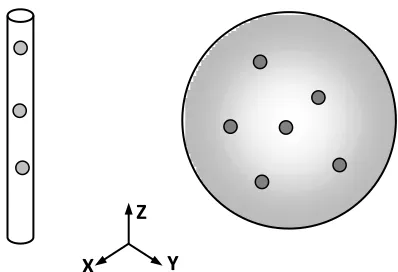
possible to have diffusion vary with the shape of a container. Figure 2.2 shows examples
of restricted and less restricted diffusion due to the shape of the container. Diffusion of
particles in a narrow cylinder with long axis along Z may experience unrestricted
diffusion in Z but restricted diffusion in X and Y. The diffusion of particles within a
large sphere will experience less restricted diffusion, especially on a short time scale.
This introduces the need to think of the diffusion timescale. In the case of any shaped
container, diffusion is unrestricted if the particles do not encounter the wall of the
container during the time of a measurement. If they do encounter a wall there is
restricted diffusion. The root-mean-squared distance traveled by a particle in time t is
given by Eqn. 2.4, where qi is a dimensionality constant which accounts for the
dimensionality of the container [37]. The constant takes on values of 2, 4, and 6 for
respectively 1, 2, and 3 dimensions.
<x>2 = qi D t (2.4)
It is worth mentioning at this point that the material composition of a container can
have an effect on the liquid within it. For example, a polar solvent such as water in a
hyrdophylic container will form a layer of bound water on the surface. This surface layer
of water has very different properties than bulk or free water far from the surface. The
7
larger in diameter, this bound layer is insignificant compared to the total volume of water.
At micrometer diameter dimensions and smaller, the volume of this layer becomes
significant. Therefore, water in small capillary tubes and between the fibers of a tightly
packed set of fibers will exist in two forms: bulk and bound. The bound water will
possess a diffusion coefficient different than bulk water. Measurements of water in these
environments can yield two values: a small D value for the bound water and a larger one
for the bulk water.
Diffusion, which is the same in all dimensions, is called isotropic, while anisotropic
diffusion is not the same in all directions. For anisotropic diffusion, D is not the same in
all directions, while for isotropic diffusion, D is independent of direction. A diffusion
tensor can be used to describe anisotropic diffusion.
A tensor is an abstract object used to express a multi-dimensional concept. It can be
used to represent the diffusion coefficient in three dimensions or six directions. The
Z
[image:13.612.219.418.298.434.2]X Y
Figure 2.2 A depiction of restricted and unrestricted diffusion in a narrow cylinder and a large sphere. In the cylinder, diffusion is restricted in X and Y while unrestricted in Z. In
8
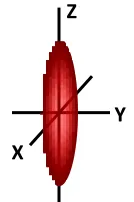
following three-dimensional tensor expresses the diffusion in a narrow cylinder as
depicted in Fig. 2.3.
Thus far, the presentation of diffusion has been restricted to translational diffusion
or the motion of the particles as a whole unit. Although not the subject of this thesis, it is
possible to discuss rotational diffusion. Rotational diffusion is the motion of part of a
molecule rotating around a bond. An example of this is the rotation of methyl hydrogens
when the methyl group rotates about the carbon bond. (See Figure 2.4.)
Scientists often distinguish between two diffusion coefficients: the true diffusion
coefficient (TDC) and apparent diffusion coefficient (ADC). The TDC is the diffusion
coefficient for free diffusion, while the ADC is the measured diffusion coefficient. For
restricted diffusion, the ADC is less than the TDC because the size of the container limits
the diffusion distance.
C H
H H
Figure 2.4 A schematic representation of rotational diffusion of the hydrogen atoms on a methyl group about a carbon bond.
Z
X
[image:14.612.299.366.133.234.2]Y
9 2.2 Nuclear Magnetic Resonance
Electrons, protons, and neutrons possess a fundamental, quantum mechanical
property of matter called spin. The spin of each of these particles can take on values of
+½ and –½ [38]. The property spin can be thought of as a magnetic moment possessed by
the particle. The spin of particles in close proximity can combine to give a net spin and
magnetic moment of zero or some higher value. For example, a molecule or atom with
two unpaired electrons in a triplet configuration will have possible spin values of +1 , 0,
and –1. A nucleus with a single unpaired proton, such as hydrogen, will have values of
+½ and –½, while the nucleus of sodium-23 with one unpaired proton and two unpaired
neutrons can have spin values of 3/2, 1/2, -1/2, and -3/2.
When placed in a magnetic field, matter with a non-zero spin can absorb
characteristic energies due to a splitting of the energy states of the spins [39-41]. Two
spectroscopies focus on this absorption of energy. Electron spin resonance (ESR)
spectroscopy focuses on matter with electron spin, while nuclear magnetic resonance
(NMR) spectroscopy focuses on matter with nuclear spin. This thesis focuses on the use
of NMR spectroscopy to measure diffusion, so the remaining theory will focus on NMR.
For a simple spin ½ nucleus, such as a hydrogen-1 nucleus, the spin has two energy
levels when placed in a magnetic field (Bo). The energy difference (E) between these
two levels is given by
E = h (2.5)
where h is Planck’s constant, and is the frequency of a photon. The value of can be
10
=Bo (2.6)
where is a proportionality constant called the gyromagnetic ratio for the nucleus. For
hydrogen, = 42.58 MHz / T [39-41]. In the classical picture of magnetic resonance, is
the rate at which a particle with spin precesses about the direction of the applied magnetic
field.
The relative populations of the two levels (N+ and N-) at temperature T is given by
Boltzmann statistics where k is Boltzmann’s constant.
N-/N+ = e-E/kT (2.7)
The net magnetization (M) from a group of spins is proportional to (N+ - N-). It is the
value of M that is probed in NMR spectroscopy. At equilibrium, the net magnetization
takes on a value Mo. The NMR experiment can perturb the value of M making it other
than the value Mo. Following the return of M to Mo can provide useful information about
a physical system.
If the population difference of the two spin states is not at equilibrium, the
distribution wants to return to equilibrium. The driving force returning the spins to
equilibrium is random molecular motions at and 2 which produce time varying
magnetic fields (photons) which cause transitions between the energy levels and hence
reestablish equilibrium. This process is called spin-lattice relaxation [39]. Spin-lattice
relaxation is a first order kinetic process which is governed by a first-order time constant
called the spin-lattice relaxation time (T1).
Since particles with spin are said to precess about the direction of an applied
11
perpendicular to the direction of Bo. This transverse magnetization does not exist at
equilibrium as there is no phase coherence of the precessional motion. If a transverse
component of magnetization is established in a sample, it will eventually be lost due to
spin exchange between nuclei and due to the spins existing in an inhomogeneous applied
magnetic field. The loss of transverse magnetization is referred to a spin-spin relaxation.
Spin-spin relaxation is characterized by a first order decay time constant called the
spin-spin relaxation time. Magnetic resonance scientists distinguish between spin-spin-spin-spin
relaxation processes caused by the intramolecular spin exchange (T2) and those caused by
an inhomogeneous magnetic field (T2Inhomo). The combined spin-spin relaxation is
referred to as T2 star (T2*) [39]
1/T2* = 1/T2 + 1/T2Inhomo (2.8)
A spin system can be caused to have an MMo and a transverse magnetization by
the application of an oscillating magnetic field (B1) (again photons) at . In magnetic
resonance we adopt a Cartesian coordinate system to describe this process. In this
example, B is applied along +Z and M can have an X, Y, and Z component. The system
of coupled differential equations which describe the classical behavior with respect to
time of magnetization from a spin system are called the Bloch equations. For simplicity,
the Bloch equations [39] are often presented for a frame of reference rotating at about
Z. This rotating frame is referred to as the (X’,Y’,Z) frame of reference.
dMX’/dt = 2(oMY’ – MX’/T2 (2.9)
dMY’/dt = – 2(oMX’ +2B1MZ –MY’/T2 (2.10)
12
The Bloch equations can be solved to show the behavior of magnetization after or
during any perturbation. For example, the application of a B1 field along X’ for a period
of time will rotate M about X’ by .
= 2 B1 (2.12)
If M is rotated from its equilibrium position along +Z to +Y’ by what is called a 90o
B1
pulse along X’, Mz will return to Mo according to
MZ = Mo(1-e-t/T1). (2.13)
Transverse Y’ magnetization at o behaves according to
MY’ = Mo e-t/T2 , (2.14)
while MX’ = 0 under these conditions. When o, transverse magnetization precesses
about Z at frequency (-o) and exponentially decreases to zero.
MX’ = -Sin(2(-o)t) e-t/T2 (2.15)
MY’ = Cos(2(-o)t) e-t/T2 (2.16)
2.3 Pulse Sequences
Equations (2.13) through (2.16) form the basis of a simple magnetic resonance
experiment and signal. Magnetization is perturbed from equilibrium and evolves back
toward equilibrium. The evolution towards equilibrium causes time varying magnetic
fields in the sample which can induce a current in a coil of wire placed in a transverse
place and adjacent to the sample. The signal generated by My’ and Mx’ is called a free
induction decay (FID) [37, 39]. The FID decays exponentially with time constant T2*
13
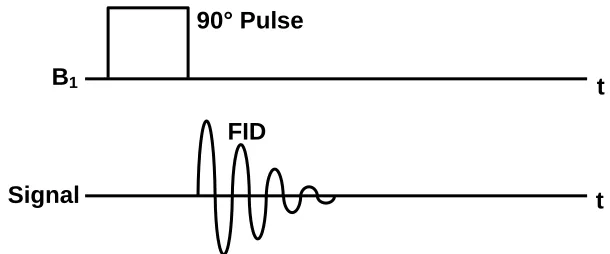
The previous example described a simple 90°-FID pulse sequence. (See Fig. 2.4.)
A pulse sequence is the application of one or more B1 pulses which generate a signal
from the sample. There are numerous pulse sequences. The 90°-FID pulse sequence
applies a 90° B1 pulses which creates an FID. The FID is a time domain signal which can
be Fourier transformed to produce a frequency domain representation of the frequencies
in the sample.
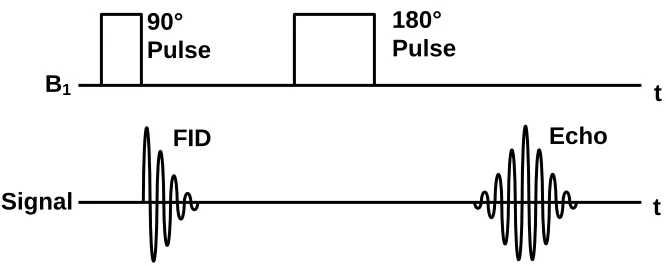
Another common pulse sequence is the spin-echo pulse sequence. (See Fig. 2.6.)
The spin-echo sequence consists of two B1 pulses, one 90° and one 180° pulse. The 90°
pulse rotates magnetization into the XY-plane where it dephases according to T2*. The
180° pulse refocuses the magnetization and creates a signal called an echo. The echo
grows and decays exponentially according to T2* [39, 41]. The echo amplitude (S)
decays from its maximum value (So) when the time between the 90° pulse and the 180°
pulse (TE) is zero.
2 E/T
T o e
S
[image:19.612.175.480.261.388.2]S (2.17)
Figure 2.5 A timing diagram for a 90°-FID pulse sequence.
t
t B1
Signal
90° Pulse
14
The spin-echo sequence is special because it allows the separation of spin-lattice
relaxation processes from molecular interactions and spin-lattice relaxation processes
from inhomogeneities in the magnetic field. The echo grows and decays according to T2*
while the echo amplitude decays exponentially with respect to TE with T2.
One additional aspect of the spin-echo sequence is worth noting because of its
relevance to diffusion. Assuming spins are located in an inhomogeneous magnetic field,
the signal from moving spins does not completely refocus at TE, while the magnetization
from stationary spins will. This forms the basis of the pulsed magnetic field gradient
diffusion measuring techniques.
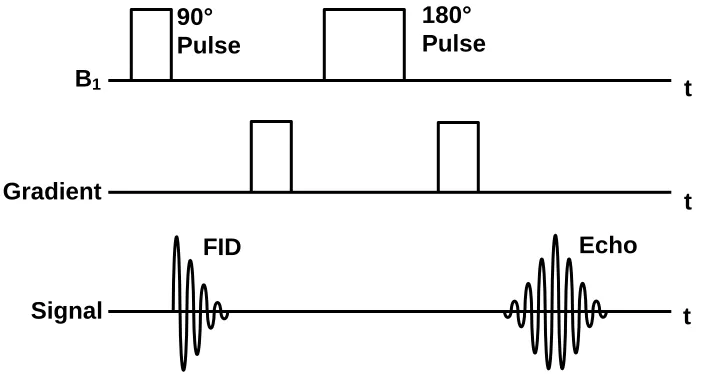
Consider the spin-echo pulse sequence of Fig. 2.7. It differs from that of Fig. 2.6 by
the addition of two periods of time when a linear one dimensional gradient in the Bo
magnetic field is turned on. The gradients in the Bo field are momentarily applied. The
first gradient pulse causes spins at different locations in the gradient direction to precess
at different rates according to their position in the gradient direction. The second
[image:20.612.154.487.335.468.2]gradient pulse allows reversal of any dephasing that occurred due to the first pulse when
Figure 2.6. A timing diagram of the spin-echo pulse sequence
t
t B1
Signal
90° Pulse
FID
180° Pulse
15
the spins are stationary. Spins that move to a new location between the first and second
gradient pulse are not refocused, and diminish the amplitude of the echo. Therefore, the
echo amplitude becomes a function of the diffusion coefficient of the spins. This pulse
sequence is referred to as a pulsed field gradient spin echo (PGSE) sequence [37, 39, 41].
The signal (S) in the presence of the gradient (GDiff) compared to the signal in the
absence of the gradient (So) is given by Eqn. 2.18 [41]
bD
o
e S
S
(2.18)
where 6 30 3 ) 2 ( 2 3 2 2
2
GDiff
b . (2.19)
The gradient pulse quantities , , and ζ refer to pulse separation, width, and risetime
[image:21.612.135.486.200.387.2]respectively, as defined in Fig. 2.8.
Figure 2.7. A timing diagram of the pulsed field gradient, spin-echo pulse sequence
t B1 90° Pulse 180° Pulse t Signal
FID Echo
16
The diffusion gradient must be one-dimensional (1D), linear, and well characterized. D
is often determined.
A detailed scientific description of the PGSE sequence can be very lengthy without
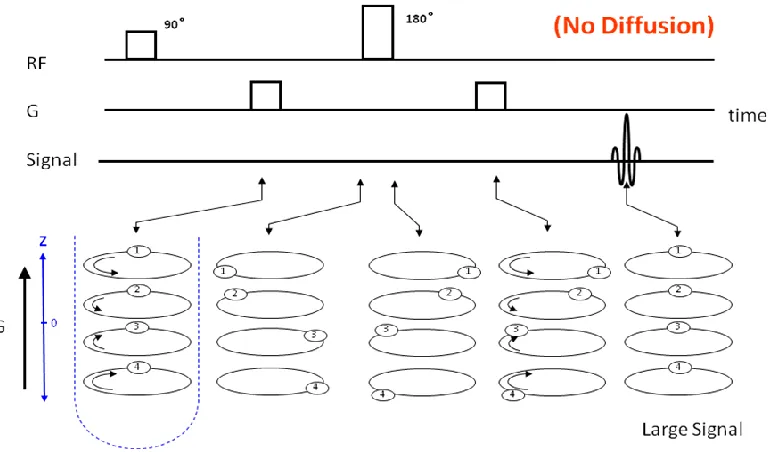
analogies. The race track analogy will be used to describe the effect of the PGSE
sequence on a spin system. The reader is instructed to refer to Fig. 2.9 while reading this
description. Figure 2.9 presents the timing diagram and pictures of a subset of four spins
in the NMR sample tube. The precessional frequency and phase of the magnetization
from the set of spins is depicted as runners on a race tract. The gradients in the PGSE
sequence are applied along the Z direction in this depiction such that the magnetic field at
any point along Z is (Bo + ZGz). The speeds of the spins in this description are relative to
the rotating frame frequency implying that spins experiencing Bo at Z=0 do not precess.
For this presentation the spin-spin and spin-lattice relaxation times are assumed to be
infinite.
If there is no diffusion between the application of the 90° RF pulse and the first
gradient pulse, spin #1 goes around the track with the fastest speed because the gradient
pulse speeds up the spin. The spin #4 goes fast in the opposite direction because of a
reverse magnetic field contribution from the gradient. Spins #2 and #3 go around the
G
Difft
[image:22.612.152.481.83.170.2]G
17
track at slower speeds in opposite directions. Each spin acquires a phase which is
proportional to its position Z. The spins reverse direction after the 180º pulse. Because
they experience the same magnetic field the gradient pulse before and after the 180º pulse,
the spins come back to their starting position at the peak of the echo. In reality, the spins
will not come back into phase completely due to spin-spin relaxation. The configuration
of all spins being aligned gives a large signal.
If diffusion occurs during the pulse sequence, the movement of the spins on the
racetrack looks different. (See Fig. 2.9b.) After the 90° RF pulse and during the first
gradient pulse, the spins rotate with the same speed and the same directions as they did in
Fig. 2.9a. Now we assume they can move randomly among the different tracks. Before
the 180° RF pulse the four spins are in different tracks. There is nothing specific about
the order presented in the figure, the important point is they are randomized. The 180°
pulse does the same thing as in Fig. 2.9a, it flips the four spins to the other side. The
gradient pulse is turned on again and spins move at specific rates around the tracks
depending on their position. Because of diffusion the spins can end up on different tracks
and they do not come back to the starting line in phase. We now see less signal than the
case without diffusion. In reality the spins are constantly diffusion. The lost signal is
related to the diffusion coefficient, the gradient strength, gradient length, and gradient
18
[image:24.612.132.516.413.648.2]Fig. 2.9a. The race track analogy for a PGSE sequence in the absence of diffusion.
19
There are several variants on the PGSE pulse sequence. These variations were
developed to compensate for eddy currents in the NMR system. Eddy currents are
electrical currents induced in a conducting surface when exposed to a changing magnetic
field. These eddy currents create their own magnetic field which distorts the desired
magnetic field.
Measurements of D as a function of with constant show the effects of restricted
diffusion when xc2 /qiD. Under these conditions, the measured diffusion coefficient
is less than the actual diffusion coefficient for the liquid in an unrestricted environment.
We have capitalized on restricted diffusion to create a phantom that will give selectable D
values through the choice of value and phantom orientation. An added feature of the
phantom is that D is anisotropic, also allowing calibration of diffusion tensor imaging
sequences. The concept is first demonstrated on small samples using the flexibility found
on a high-resolution NMR spectrometer, then scaled up in size to produce a phantom for
[image:25.612.125.522.257.394.2]a clinical instrument.
Figure 2.10 A timing diagram of the pulsed field gradient stimulated echo sequence.
t GDiff
t B1
90° 90° 90°
180° 180°
20 2.4 Magnetic Resonance Imaging
The basis of all MRI is Eqn 2.6 which states that the resonance frequency is
proportional to the magnetic field experienced by the nuclear spin [37, 39]. If a
one-dimensional, linear, magnetic field gradient Gi is applied along direction di, Eqn. 2.6
becomes
=Bo + diGi) (2.20)
Thus the frequency becomes dependent on the location of a spin. Fourier based
tomographic imaging sequences generally apply a slice selection (S) gradient followed by
phase () and frequency (f) encoding gradients to produce N×Nf pixel images of the
NMR signal in a slice of thickness (Thk) through an object. The field-of-view (FOV)
refers to the width of the image in distance units. All gradients and frequencies are
measured relative to a point referred to as the magnet isocenter where the distances in the
slice, phase, and frequency encoding directions, respectively dS, d, and df, equal zero and
the resonance frequency is o.
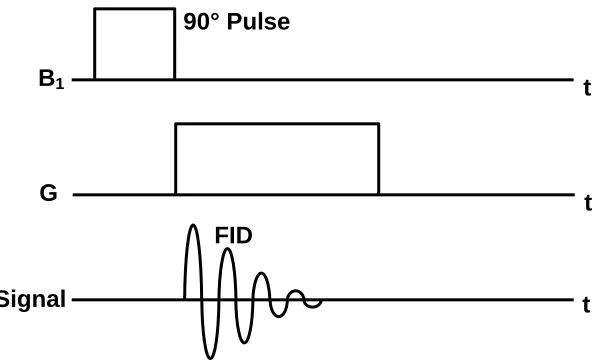
A simple 1D imaging sequence can be implemented by applying a 90º B1 pulse
followed by the application of a magnetic field gradient. (See Fig. 2.11.) This sequence
21
There are many imaging pulse sequences [41]. The echo-planar imaging sequence
will be presented because it was used in this work. The echo-planar sequence is similar
to a spin-echo sequence in that there are 90º and 180º B1 pulses of radio frequency (RF).
(See Fig. 2.12.) Positioning of a tomographic slice is achieved by the application of B1
pulses at the same time a slice selection gradient Gs is applied. Phase and frequency
encoding is achieved by the application of gradients, G and Gf respectively,
perpendicular to Gs. The signals produced by each reversal of Gf create the lines of
k-space which correspond to the image. This data is Fourier transformed to create the
[image:27.612.179.478.82.264.2]image.
Figure 2.11 A timing diagram for a simple one-dimensional imaging sequence utilizing a 90°-FID pulse sequence.
t B1
90° Pulse
t Signal
FID
22
The echo-planar imaging sequence can be utilized to create diffusion images by
adding the GDiff pulses of Fig. 2.8. These pulses are centered about the 180º pulse so that
the last GDiff pulse is completed before the succession of G and Gf pulses. The signal in
the form of an image created with GDiff (S) is compared with that in the absence of GDiff
(So) using Eqn. 2.18 to obtain D. GDiff can coincide with GS, G or Gf, thus D can be
[image:28.612.179.453.81.261.2]calculated along any direction.
23
3.0 Experimental Methods
3.1 Sample Preparation
Several samples of poly(dimethylsiloxane) (Sigma-Aldrich, St. Louis, MO, USA),
referred to as silicone oil, were used to gain experience measuring diffusion coefficients
on an NMR spectrometer. These samples ranged in average molecular weight yielding
viscosities of 5, 10, 20, 50, 100, 350, and 500 cSt.
Several samples of 18 M∙cm water in various restricted diffusion geometries were
studied. NMR sample geometries included a 1 mm ID capillary tube and a 3 mm
diameter hand-made bundle of 11 ± 2 m diameter, approximately parallel, glass fiber
rods held together with 0.42 cm OD shrunken heat-shrink tubing. Both samples were
centered in 5 mm OD NMR tubes. The 1mm tube was filled with water, while the fiber
bundle was hydrated by allowing water to be drawn up into the fibers. If fibers of
diameter d are perfectly aligned and hexagonally packed, the fiber bundle creates long
channels between the fibers with a maximum diffusion distance perpendicular to the long
axis of the fibers of 0.732d, With this packing geometry, the water percent in the bundle
is approximately 9%. Assuming a less efficient, square packing, the maximum diffusion
distance perpendicular to the long axis of the fibers is d and there is 20% water in the
bundle. Our packing is probably a mixture of the two packing geometries.
Anoptical microscope with digital camera (Eclipse E600PL, Nikon, Tokyo, Japan)
and image analysis software (analySIS, Olympus Soft Imaging System GmbH, Berlin,
Germany) was used to determine the diameters of the fibers in the samples.
The MRI sample geometry consisted of a 2.8 cm diameter, 9.5 cm long, hand-made
24
shrink tubing. The bundle was hydrated by allowing water to be drawn up into the
bundle and then it was supported in a water filled container.
The manufacturing flow chart of the 3mm diameter hand-made fiber phantom for
NMR measurements is shown in Fig. 3.1. First, a bundle of parallel fibers is pulled
through a piece of heat-shrinkable tubing. The tubing is shrunk to hold the fibers tightly
together. This is depicted for larger fiber rods in Fig 3.1a. Second, one end of the
hand-made bundle is glued together. The shrink tubing is removed once the glue is set. (See
Fig. 3.1b.) The next step is to insert the bundle into an NMR tube. Once inserted, 18
M∙cm water is allowed to absorb into the fibers. An ultrasonic bath and vacuum are
used to remove any bubble inside of the NMR tube. The diffusion is of the water
between solid fiber filaments.
A scaled-up glass fiber phantom with diameter of 2.8 cm was hand-made in the
similar way as that of the fiber phantom for the NMR measurements. It is used for the
MRI measurements. See Fig. 3.2.
[image:30.612.192.424.522.637.2]
a b c
25 3.2 NMR Spectroscopy
NMR measurements were performed on two different NMR spectrometers. Initial
measurements were performed on a 300 MHz NMR spectrometer (DRX-300, Bruker
Biospin, Billerica, MA, USA) with three axis gradients located at Rochester Institute of
Technology (RIT). This system became inoperable after these initial measurements
requiring measurements to be made on an alternative system.
A 600 MHz NMR spectrometer (UnityInova, Agilent-Varian Inc., Walnut Creek,
[image:31.612.193.455.164.394.2]CA, USA) with three axis gradients located at the University of Rochester was used for
26
all restricted diffusion measurements. Diffusion coefficients were measured at 25°C
parallel (D//) and perpendicular (D) to the long axis of the NMR tube using a stimulated
echo-pulse sequence. Each measurement of D was made from 13 b values where was
held constant with = 7 ms. The 13 values of b were achieved by varying G for the fixed
value to achieve b = 2, 50, 100, 150, 200, 300, 400, 500, 600, 700, 800, 900, 1000
s/mm2. The ζ of the gradient pulses was less than with 100 s, so ζ = 0 was used in the
calculation of b. D values were measured and plotted as a function of 7 ms < < 1.2s to
show the effect of restricted diffusion during .
3.3 Gradient Calibration
To create a diffusion standard, D must be measured accurately for the standard.
This in turn requires that G and timing be known. Timing is accurately controlled by the
spectrometer, but G must be measured and calibrated. There are several steps to calibrate
the magnetic field gradients. The first is to determine the linearity of the gradient. The
next is to determine the gradient per amp of gradient coil current. The exact procedure
used differs slightly for the Z and XY gradients.
The pulse sequence of Fig. 2.11 was used to calibrate the gradients on the Bruker
DRX-300 MHz NMR spectrometer at RIT. Two different sample geometries were used.
For the Z gradient a small sphere of water was used. The sphere fit inside a standard 5
mm outside diameter (OD) NMR tube and could be accurately positioned along Z in the
tube. (See Fig. 3.3a.) The water peak location in the spectrum was recorded and plotted
27
Calibrating the X and Y gradients is more challenging as there is only 4.5 mm of
inside diameter (ID) to work within. The following arrangement was developed to
calibrate both the X and Y gradients. A 1 mm ID capillary tube of water was secured to
the inside of an NMR tube as depicted in Fig. 3.3b. The tube was connected to a
goniometer located outside the NMR magnet. Finding the angles yielding the maximum
and minimum resonance frequency for the water in the presence of a gradient fixed the
orientation of the gradient. A series of other angles yielded a series of other locations in
the gradient direction and allowed calibration of the gradient.
Determining the magnetic field per meter per amp of gradient current requires
determination of the gradient at several different current values. This relationship should
be linear or have a linear range.
[image:33.612.146.492.403.525.2]
Fig. 3.1. Diagrams of the two samples used to calibrate the a) Z and b) XY gradients. The Z gradient was calibrated by moving a sphere of water along Z, while the X and Y gradients
were calibrated by rotating the NMR tube with a capillary tube fixed to the inside.
28 3.4 MRI Measurements
All MRI measurements were performed at 20 °C on a 1.5 T imager (Signa Excite
HDx, GE Healthcare, Waukesha, WI, USA) located at the University of Rochester. The
system was operated in the research mode and utilized a diffusion-weighted, echo-planar
imaging sequence, and a quadrature, bird-cage, knee RF coil. The fiber bundle was
oriented so the long axis of the fibers was approximately parallel to the applied static
magnetic field. An axial 5 mm thick, 15cm field-of-view imaging plane through the
fibers was chosen. The stated b values (300, 500, 1000 s/mm2) from the imager were
confirmed with measured values of , , and ζ using an oscilloscope and G taken from
the control variable table. Diffusion coefficients were calculated from region-of-interest
measurements from the image without the diffusion gradients yielding S and one with the
29
4.0 Results and Discussion
4.1 Gradient Calibration Results
Figures 4.1 and 4.2 present the results of the calibration of the Z and X magnetic
field gradients on the Bruker DRX-300 MHz NMR spectrometer at RIT. Gradient values
are described in terms of their percent of the maximum value that is programmable by the
spectrometer software. The Y and X gradients are assumed to be identical in geometry so
only the X direction gradient was measured. Figure 4.1 shows that Gz is linear over the 2
cm long active region of the NMR probe. The three %G values are presented in Table
4.1. The change in gradient with percent gradient parameter was also linear with a value
of 0.0052 T/m/%Gz. Figure 4.2 shows that Gx is also linear over 0.45 cm diameter of the
NMR tube. There was more variation in Gx than GZ, but this is attributed to the larger
uncertainty in positioning the NMR tube at the desired angle. The change in Gx with
30 -0.6
-0.3 0 0.3 0.6
-12 -8 -4 0 4 8 12
Z (mm)
B
(
m
T
)
[image:36.612.118.528.77.360.2]G=2% G=5% G=10%
31 -80
-40 0 40 80
-3 -2 -1 0 1 2 3
X (mm)
B
(
T)
[image:37.612.118.530.76.351.2]G=2% G=5% G=10%
Table 4.1. GX and GZ for various %G settings.
%G G (mT/m)
X Z
2 5.6 11.0
5 14.0 26.5
10 27.7 52.4
4.2 Diffusion Coefficient Checks
The diffusion coefficient of water was measured at 20°C using the PGSE sequence
on the Bruker DRX-300 MHz NMR spectrometer at RIT. Figure 4.3 is a plot of ln(S/So)
versus b with the solid line as the best fit to the data assuming Eqn. (2.18). The diffusion
[image:37.612.212.438.437.525.2]coefficient was found to be 2.32×10⁻⁹ m2/s, which validates the gradient calibration.
32
Water
-2.5 -2.0 -1.5 -1.0 -0.5 0.0
0 20 40 60 80 100 120
b (x107)
ln
(S
/S
o
)
The diffusion coefficient of the various molecular weight silicone oils was also
measured as an additional validation on the Bruker DRX-300 MHz NMR spectrometer at
RIT. These values are presented in Table 4.2 and plotted versus viscosity in Fig. 4.4.
The Stokes-Einstein theory (Eqn. 2.3) predicts a linear relationship between D-1 and
viscosity for spherical particles. The data deviated from this behavior at high molecular
weights. This might be attributed to two causes. First, the molecules may behave less
like spheres at higher molecular weights. The second is that the oils may contain a
broader distribution of molecular weights as the average molecular weight on an oil
[image:38.612.120.532.90.389.2]increases.
33
Figure 4.4. The relationship between the measured diffusion coefficient and inverse viscosity of various molecular weight silicone oils. Solid line indicates ideal
Stokes-Einstein behavior and dashed line is drawn through the data to guide the eye.
0.0 0.4 0.8 1.2 1.6 2.0
0.00 0.05 0.10 0.15 0.20 0.25
-1
(cSt)
D
(m
2 /s
)
Silicone Oil
Table 4.2. Viscosity and measured D values for Silicone Oils. Viscosity (cSt) D (×10-10 m2/s)
5 1.6
10 0.73
20 0.34
50 0.11
100 0.061
350 0.025
500 0.021
34
4.3 Diffusion coefficients from the 600 MHz NMR
Figure 4.5 demonstrates the behavior of D as a function of 0 < < 1.2 s for water in
a 1mm ID capillary tube and the 3 mm hydrated bundle. The capillary represents
unrestricted diffusion along its length (D//) and restricted diffusion perpendicular to the
length (D) of the tube. Unrestricted diffusion is demonstrated by a consistent D// value
of 2.2×10⁻⁹ m2/s over the values studied. Restricted diffusion is represented by a
decrease in D from the bulk water value to 1.9×10⁻⁹ m2/s with increasing .
The fibers show the same general trend as the capillary tube for D. The value of
Dstarts at the value for bulk water and decreases to approximately 0.39×10⁻⁹ m2/s. The
large decrease is attributed to the smaller distance that a water molecule can diffuse
perpendicular to the length of the fibers compared to the unrestricted diffusion in bulk
water. The value of D// also shows the same trend, but only decreases to 1.4×10⁻⁹ m2/s.
In perfectly aligned fibers, D// should remain constant at a value equal to DWater as is
increased. This tells us that the fibers in our hand-made bundle are not perfectly parallel
to each other along their length. There is most likely some twisting and cross over of
filaments causing the deviation from ideal behavior.
The NMR results from the glass fiber phantom are in accordance with the tendency
of the Monte Carlo simulations of Dapp() in Fieremans, et al. [29]. Their NMR
measurements for a Dyneema® fiber phantom only provided values of the ADC for 4 ms
< < 50 ms, while we measured the apparent D and D// for a larger range of 2 ms < <
1.2 s. Our results for two different tendency lines of D and D// with increasing make it
35
4.4 Diffusion Coefficients from the 1.5T MRI System
Magnetic resonance images of the scaled up, 2.8 cm diameter, glass fiber phantom
are shown in Fig. 4.6. These images are from a spin echo sequence with TR/TE=500/14
ms, 256x256 matrix, and 5 mm slice thickness. The images are of good quality with
surprisingly little susceptibility artifact from the large amount of glass present. A visual
inspection of the image also revealed there are no air bubble artifacts in fiber bundle. 0.0
0.5 1.0 1.5 2.0 2.5
0.0 0.2 0.4 0.6 0.8 1.0 1.2
(s)
D
(
x
1
0
-9
m
2s
-1)
D 11±2 m Fibers
D 1 mm Capillary
D 1 mm Capillary
[image:41.612.115.533.110.411.2]D 11±2 m Fibers
Figure 4.5. Measured D values as a function of for water in a capillary tube and hydrated glass fibers using a 600 MHz high resolution NMR spectrometer at 25 °C.
36
This endorsed the hydrating procedure for the bundle. Figure 4.7 shows an axial image
through the phantom using an echo planar imaging diffusion sequence. This image was
recorded with a 24 cm field-of-view, and TR/TE=4000/58.4 ms, and a 10 mm slice
[image:42.612.178.521.200.528.2]thickness.
Fig. 4.6 Axial (a) and longitudinal (b) spin-echo images through the 2.8 cm fiber bundle phantom recorded at 1.5 T. Images show a lack of
significant distortions despite the large amount of glass present.
a
37
Images such as that shown in Fig. 4.7 were used to calculate the magnetic
resonance signal of the bulk water and the water in the fiber bundle. This signal intensity
was used with Eqn. 2.18 to calculate D.
The D vs. dependency for the 2.8 cm diameter bundle (Fig. 4.8.) is similar to the
3 mm bundle, but not identical. Limitations on the b values on the imager allowed us to
only go to = 38 ms. The value of D// and D decreases from DWater to respectively
1.1×10⁻⁹ m2/s and 0.31×10⁻⁹ m2/s in this range of values. We attribute difference in D
between the phantom and the NMR tube fiber bundles to the ~5°C temperature difference
for the measurements, our limited ability to achieve identical packing of the two
hand-Fig. 4.7 An spin echo planar magnetic resonance image of the 2.8 cm fiber bundle phantom on a 1.5T MRI system.
Fiber
Bundle
[image:43.612.188.465.79.349.2]38
made fiber bundles, and that ROIs where used in the phantom measures while whole
sample measures were used in the NMR tube bundles.
The result demonstrated that a series of diffusion coefficient values, in a range of
Dwater and approximately 0.5×10⁻⁹ m2/s, can be obtained with selected data acquisition
parameter and a fully hydrated, tightly packed fiber bundle. The greatest challenge in
constructing the fiber bundle is keeping the fibers perfectly parallel to each other.
Perhaps machine packing will help achieve this.
0.0
0.5
1.0
1.5
2.0
2.5
0
10
20
30
40
50
(ms)
D
(
x
1
0
-9
m
2/s
)
D
, D
//Bulk Water
D
//11±2
m Fibers
[image:44.612.117.543.178.513.2]D
11±2
m Fibers
39
5.0 Conclusions
A simple, mathematical-based, multi-point method was used to calibrate the Z and
X magnetic field gradients on the Bruker DRX-300 MHz NMR spectrometer at RIT.
Results of both the Z and X direction gave, as expected, very linear gradients across the
space of a sample and very linear relationship between the prescribed and measured
gradient strength.
When this gradient calibration was used to measure the self diffusion coefficient of
pure water on the Bruker spectrometer, the measured value matched the literature value.
The similarity of these two diffusion coefficient values also validated the calibration of
the gradients.
The diffusion coefficient of silicone oil as a function of viscosity deviated slightly
from the ideal Stokes-Einstein linear relationship. This deviation is thought to be
attributed to the presence of a broader distribution of molecular weight values and a
deviation from spherical particles as the molecular weight increases.
The NMR results from the 3 mm diameter fiber bundle phantom show the behavior
of the restricted diffusion over a range two orders of magnitude in . This range is
greater than that reported previously in the literature. These results also demonstrate the
potential of using restricted water diffusion in fiber bundles to achieve diffusion
standards with a diffusion coefficient between DWater and 0.5 ×10⁻⁹ m2/s without utilizing
flammable hydrocarbons. The use of such phantoms as diffusion standards will reduce
shipping costs because of the absence of flammable hydrocarbons.
According to our experiments, the measured diffusion coefficient in the bundles of
40
bundles should provide high parallel alignment of the fibers as well as highly
reproducible diffusion properties within such glass fiber phantoms, despite some
variability of the measurements of the diffusion coefficient of water.
Future work on this topic might involve a study of D vs. for more perfectly
41 References
1. Bach, D. S.; Armstrong, W. F.; Donovan, C. L.; Muller, D. W., Quantitative
Doppler Tissue Imaging for Assessment of Regional Myocardial Velocities during
Transient Ischemia and Reperfusion. Am Heart J 1996,132 (4), 721-725.
2. Fox, R. J.; Cronin, T.; Lin, J.; Wang, X.; Sakaie, K.; Ontaneda, D.; Mahmoud, S. Y.;
Lowe, M. J.; Phillips, M. D., Measuring Myelin Repair and Axonal Loss with
Diffusion Tensor Imaging. AJNR Am J Neuroradiol 2011,32 (1), 85-91.
3. Heemskerk, A. M.; Drost, M. R.; van Bochove, G. S.; van Oosterhout, M. F.;
Nicolay, K.; Strijkers, G. J., DTI-based Assessment of Ischemia-reperfusion in
Mouse Skeletal Muscle. Magn Reson Med 2006,56 (2), 272-281.
4. Song, S. K.; Sun, S. W.; Ju, W. K.; Lin, S. J.; Cross, A. H.; Neufeld, A. H.,
Diffusion Tensor Imaging Detects and Differentiates Axon and Myelin
Degeneration in Mouse Optic Nerve after Retinal Ischemia. Neuroimage 2003,20
(3), 1714-1722.
5. Okumura, A.; Fukatsu, H.; Kato, K.; Ikuta, T.; Watanabe, K., Diffusion Tensor
Imaging in Frontal Lobe Epilepsy. Pediatr Neurol 2004,31 (3), 203-206.
6. Rugg-Gunn, F. J.; Eriksson, S. H.; Symms, M. R.; Barker, G. J.; Thom, M.;
Harkness, W.; Duncan, J. S., Diffusion Tensor Imaging in Refractory Epilepsy.
Lancet 2002,359 (9319), 1748-1751.
7. Winston, G. P.; Yogarajah, M.; Symms, M. R.; McEvoy, A. W.; Micallef, C.;
Duncan, J. S., Diffusion Tensor Imaging Tractography to Visualize the Relationship
of the Optic Radiation to Epileptogenic Lesions Prior to Neurosurgery. Epilepsia
42
8. Inoue, T.; Ogasawara, K.; Beppu, T.; Ogawa, A.; Kabasawa, H., Diffusion Tensor
Imaging for Preoperative Evaluation of Tumor Grade in Gliomas. Clin Neurol
Neurosurg 2005,107 (3), 174-180.
9. Li, X.; Yu, R. T.; Xu, K.; Li, F. C.; Fan, Y. C.; Gao, W. C.; Guo, K. Q.; Pan, X.;
Yang, C., Application of Diffusion Tensor Imaging in Preoperation and
Postoperation Patients of Glioma with 3.0 Tesla MRI. Zhonghua Yi Xue Za Zhi
2009,89 (19), 1300-1304.
10. Moffat, B. A.; Hall, D. E.; Stojanovska, J.; McConville, P. J.; Moody, J. B.;
Chenevert, T. L.; Rehemtulla, A.; Ross, B. D., Diffusion Imaging for Evaluation of
Tumor Therapies in Preclinical Animal Models. MAGMA 2004,17 (3-6), 249-259.
11. Lee, J. S.; Han, M. K.; Kim, S. H.; Kwon, O. K.; Kim, J. H., Fiber Tracking by
Diffusion Tensor Imaging in Corticospinal Tract Stroke: Topographical Correlation
with Clinical Symptoms. Neuroimage 2005,26 (3), 771-776.
12. Parmar, H.; Golay, X.; Lee, K. E.; Hui, F.; Sitoh, Y. Y., Early Experiences with
Diffusion Tensor Imaging and Magnetic Resonance Tractography in Stroke Patients.
Singapore Med J 2006,47 (3), 198-203.
13. Werring, D. J.; Toosy, A. T.; Clark, C. A.; Parker, G. J.; Barker, G. J.; Miller, D. H.;
Thompson, A. J., Diffusion Tensor Imaging Can Detect and Quantify Corticospinal
Tract Degeneration After Stroke. J Neurol Neurosurg Psychiatry 2000,69 (2),
269-272.
14. Delakis, I.; Moore, E. M.; Leach, M. O.; De Wilde, J. P., Developing A Quality
Control Protocol for Diffusion Imaging on A Clinical MRI System. Phys Med Biol
43
15. Laubach, H. J.; Jakob, P. M.; Loevblad, K. O.; Baird, A. E.; Bovo, M. P.; Edelman,
R. R.; Warach, S., A Phantom for Diffusion-weighted Imaging of Acute Stroke. J
Magn Reson Imaging 1998,8 (6), 1349-1354.
16. Matsuya, R.; Kuroda, M.; Matsumoto, Y.; Kato, H.; Matsuzaki, H.; Asaumi, J.;
Murakami, J.; Katashima, K.; Ashida, M.; Sasaki, T.; Sei, T.; Himei, K.; Katsui, K.;
Katayama, N.; Takemoto, M.; Kanazawa, S.; Mimura, S.; Oono, S.; Kitayama, T.;
Tahara, S.; Inamura, K., A New Phantom Using Polyethylene Glycol As An
Apparent Diffusion Coefficient Standard for MR Imaging. Int J Oncol 2009,35 (4),
893-900.
17. Tofts, P. S.; Lloyd, D.; Clark, C. A.; Barker, G. J.; Parker, G. J.; McConville, P.;
Baldock, C.; Pope, J. M., Test Liquids for Quantitative MRI Measurements of
Self-diffusion Coefficient in Vivo. Magn Reson Med 2000,43 (3), 368-374.
18. Boujraf, S.; Luypaert, R.; Eisendrath, H.; Osteaux, M., Echo Planar Magnetic
Resonance Imaging of Anisotropic Diffusion in Asparagus Stems. MAGMA 2001,
13 (2), 82-90.
19. Hills, B.; Knovel (Firm), Magnetic Resonance Imaging in Food Science; Wiley:
New York, 1998; p160, 342 p.
20. Lätt, J.; Nilsson, M.; Rydhög, A.; Wirestam, R.; Ståhlberg, F.; Brockstedt, S.,
Effects of Restricted Diffusion in A Biological Phantom: A q-space Diffusion MRI
Study of Asparagus Stems at A 3T Clinical Scanner. MAGMA 2007,20 (4),
44
21. Madi, S.; Hasan, K. M.; Narayana, P. A., Diffusion Tensor Imaging of in Vivo And
Excised Rat Spinal Cord at 7 T with An Icosahedral Encoding Scheme. Magn
Reson Med 2005,53 (1), 118-125.
22. Trudeau, J. D.; Dixon, W. T.; Hawkins, J., The Effect of Inhomogeneous Sample
Susceptibility on Measured Diffusion Anisotropy Using NMR Imaging. J Magn
Reson B 1995,108 (1), 22-30.
23. Lin, C. P.; Wedeen, V. J.; Chen, J. H.; Yao, C.; Tseng, W. Y., Validation of
Diffusion Spectrum Magnetic Resonance Imaging with Manganese-enhanced Rat
Optic Tracts and Ex Vivo Phantoms. Neuroimage 2003,19 (3), 482-495.
24. von dem Hagen, E. A.; Henkelman, R. M., Orientational Diffusion Reflects Fiber
Structure within A Voxel. Magn Reson Med 2002,48 (3), 454-459.
25. Yanasak, N.; Allison, J., Use of Capillaries in The Construction of An MRI
Phantom for The Assessment of Diffusion Tensor Imaging: Demonstration of
Performance. Magn Reson Imaging 2006,24 (10), 1349-1361.
26. Fieremans, E.; Delputte, S.; Deblaere, K.; De Deene, Y.; Truyens, B.; D'Asseler, Y.;
Achten, E.; Lemahieu, I.; Van de Walle, R., A Flexible Hardware Phantom for
Validation of Diffusion Imaging Sequences, Proceeding of the ISMRM 13th
scientific meeting, Miami, USA, 2005, p. 1301.
27. Perrin, M.; Poupon, C.; Rieul, B.; Leroux, P.; Constantinesco, A.; Mangin, J. F.;
Lebihan, D., Validation of Q-ball Imaging with A Diffusion Fibre-crossing
Phantom on A Clinical Scanner. Philos Trans R Soc Lond B Biol Sci 2005,360
45
28. Lorenz, R.; Bellemann, M. E.; Hennig, J.; Il'yasov, K. A., Anisotropic Phantoms for
Quantitative Diffusion Tensor Imaging and Fiber-tracking Validation. Applied
Magnetic Resonance 2008,33 (4), 419-429.
29. Fieremans, E.; De Deene, Y.; Delputte, S.; Ozdemir, M. S.; D'Asseler, Y.;
Vlassenbroeck, J.; Deblaere, K.; Achten, E.; Lemahieu, I., Simulation And
Experimental Verification of The Diffusion in An Anisotropic Fiber Phantom. J
Magn Reson 2008,190 (2), 189-199.
30. http://www.dyneema.com/en_US/public/dyneema/page/about/Material.htm.
31. Mulkern, R.V.; Zengingonul, H.P.; Robertson, R.L.; Bogner, P.; Zou, K.H.;
Gudbjatsson, H.; Guttmann, C.R.; Holtzman, D.; Kyriakos, W.; Jolesz, F.A.,;Maier,
S.E., Multi-component Apparent Diffusion Coefficients in Human Brain:
Relationship to Spin-Lattice Relaxation. Magn. Reson. Med. 2000, 44, 292-300.
32. Poupon, C.; Rieul, B; Kezele, I; Perrin, M; Poupon, F; Mangin, J.F., New Diffusion
Phantoms Dedicated to The Study and Validation of High-angular-resolution
Diffusion Imaging (HARDI) Models. Magn Reson Med2008, 60, 1276–1283.
33. Komlosh, M.E.; Horkay, F.; Freidlin, R.Z.; Nevo, U.; Assaf, Y.; Basser, P.J.,
Detection of Microscopic Anisotropy in Gray Matter and In A Novel Tissue
Phantom Using Double Pulsed Gradient Spin Echo MR. J Magn Reson2007, 189,
38-45.
34. Sadleir, R.J.; Neralwala, F.; Te, T.; Tucker, A., A Controllably Anisotropic
Conductivity or Diffusion Phantom Constructed from Isotropic Layers. Annal
46
35. Ogrezeanu, G.; Hartlep, A., Fiber Tracking Phantom. US Patent 7521931, April 21,
2009.
36. Smith, W. F.; Hashemi, J., Foundations of Materials Science and Engineering. 3rd
ed.; McGraw-Hill: Boston [Mass.], 2004; 908 p.
37. Price, W.S., Pulsed-field Gradient Nuclear Magnetic Resonance As A Tool for
Studying Translational Diffusion: Part 1. Basic theory. Concepts Magn Reson1997,
9, 299-336.
38. Stejskal, E.O.; Tanner, J.E., Spin Diffusion Measurements: Spin Echoes in The
Presence of A Time-dependent Field Gradient. J. Chem. Phys.1965, 42, 288-292.
39. Hornak, J. P., The Basics of MRI. Interactive Learning Software, Henrietta, NY.
http://www.cis.rit.edu/htbooks/mri/.
40. Akitt, J. W.; Mann, B. E., NMR and chemistry : An Introduction to Modern NMR
Spectroscopy. 4th ed.; S. Thornes: Cheltenham, U.K., 2000; 400 p.
41. Bernstein, M. A.; King, K. F.; Zhou, X. J., Handbook of MRI Pulse Sequences.