Int. J. Electrochem. Sci., 7 (2012) 1927 - 1936
International Journal of
ELECTROCHEMICAL
SCIENCE
www.electrochemsci.orgPermanganate Selective Nano-composite Electrode
Farnoush Faridbod1,*, Mohammad Reza Ganjali1, Morteza Hosseini2, Parviz Norouzi1
1
Center of Excellence in Electrochemistry, Faculty of Chemistry, University of Tehran, Tehran, Iran
2
Faculty of New Science and Technology, University of Tehran, Tehran, Iran
*
E-mail: [email protected]
Received: 24 January 2012 / Accepted: 9 February 2012 / Published: 1 March 2012
Fluorescence spectroscopic studies showed a selective interaction between a new modified SBA-15 and permanganate ion respects to a number of inorganic anions. Aluminum complex of 8-hydroxyquinoline was used for modification of the channels of SBA-15. Hence, modified SBA-15 was used as a selective sensing element in construction of a nano-composite carbon paste electrode for measurement of permanganate ions. The nano-compoite paste was composed of 5% Multi-walled Carbon Nanotube (MWCNT), 55% graphite powder, 20% room temperature ionic liquid (RTIL) and 20% of sensing element. Carbon paste electrode based on MWCNTs and RTILs show superior performance over traditional carbon paste electrodes. Addition of MWCNT to the composition of the carbon paste, owing to its high conductivity, improve the dynamic working range, detection limit, response time, lifetime, and stability of the nano-composite sensor. Replacement of paraffin oil with RTIL improved the sensitivity of the sensor from a near-Nernstian slope to Nernstian one. The sensor worked well with a Nernstian response of -58.7±0.5 mV decade-1 of MnO4- anion in a wide dynamic
concentration range of 1.0×10⁻⁶-1.0×10⁻¹ mol L-1. The electrode had relatively short response time (25 s), and it was found to produce stable responses for more than 8 weeks.
Keywords: Permanganate anion, Sensor, Ion selective electrode, Potentiometry, Multi-walled Carbon Nanotube, Room temperature ionic liquid
1. INTRODUCTION
Potassium permanganate, KMnO4, is a purplish-black crystalline solid in which manganese has
a valence of plus 7. It is an exceptionally strong oxidizer. It is used primarily to control taste and odors, remove color, control biological growth in treatment plants, and remove iron and manganese [1-3].
with a high physical stability, long lifetime, the versatility of chemical modification, miniaturization, and rapid renewal of the electrode surface [18-27].
In recent years, large-scale nano-structured materials such as SBA-15 and MCM-41 have attracted significant interest in development of the chemical sensors [28-30]. SBA-15, Among the mesoporous silica compounds, possessing hexagonal arrays of uniform pores with ultra large pore diameters, large surface area, high pore volume and thicker pore walls, excellent homogeneity and chemical/mechanical stability is a potential candidate for interacting with guest species on its surface [31,32].
Multi-walled carbon nanotubes (MWCNTs) have been also used in the compositions of carbon paste electrodes [20-27] due to their surprising physicochemical properties, such as ordered structures with high aspect ratios, ultra-light weight, high thermal conductivity, metallic or semi-metallic behavior, high surface area, high electrical conductivity and remarkable mechanical strength [33, 34].
Ionic liquids are as well a good choice as a binder in the composition of carbon paste electrodes due to their interesting properties, including stability, low vapor pressure, low toxicity, low melting temperature, ion-exchange properties, extraction and catalytic activity, high ionic conductivity and good electrochemical and thermal stability [20,21].
Carbon paste electrode based on MWCNTs and RTILs types of electrodes show superior performance over traditional carbon paste electrodes.
Previous fluorescent studies [35] shows a selective interaction between the modified SBA-15 (Scheme 1) and permanganate anion respect to a number of anions tested, thus, the compound was used as sensing material in construction of a MnO4- nano-composite carbon paste sensor based on
MWCNTs and RTILs.
Scheme 1. Chemical structure of modified SBA-15
2. EXPERIMENTAL SECTION
2.1. Equipments
2.2. Reagents
Graphite powder with a <50 μm particle size (Merck), and 2.2 g/cm3
density; along with the paraffin oil (Aldrich) of the highest purity, and 1-n-butyl-3-methylimidazolium tetrafluoroborate [bmim]BF4, were used for the preparation of the carbon pastes. The multi-walled carbon nanotubes
(MWCNTs) with 10-40 nm diameters, 1-25 μm length, core diameter: 5-10 nm, SBET: 40-600 m2/g,
Vtotal: 0.9 cm3/g, bulk density 0.1 g/cm3, true density 2.1 g/cm3 and with 95% purity were purchased
from a local company (Iran). The sensing element, modified SBA-15, was synthesized as described elsewhere [35].
2.3. Fabrication of nano-composite based permanganate sensor
Various amounts of modified SBA-15, graphite powder, paraffin (in case of traditional carbon paste) or 1-n-butyl-3-methylimidazolium tetrafluoroborate [bmim]BF4, and MWCNTs (in case of
nano-composite sensor) were thoroughly mixed. The resulting mixtures were transferred into a glass tube. The electrode body was fabricated from a glass tube of 5 mm i.d. and a height of 3 cm. After the mixture was homogenized, the paste was carefully packed into the tube tip to avoid possible air gaps, often enhancing the electrode resistance. A copper wire was inserted into the opposite end to establish electrical contact [20-27]. The external electrode surface was smoothed with soft abrasive paper to produce a new surface and replacing the carbon paste. The electrode was finally conditioned for 48 h by soaking in a 1.0×10⁻³
M KMnO4 solution.
2.4. Emf measurements
The electrochemical cell can be represented as follow:
Ag, AgCl(s), KCl (3 M) || sample solution | nano-composite carbon paste surface | copper wire
Calibration graph was drawn by plotting the potential, E, versus the logarithm of MnO4- ion
concentration.
3. RESULTS AND DISCUSSIONS
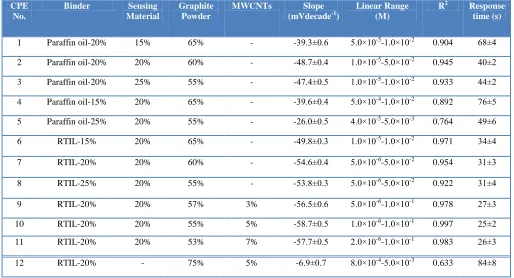
To find the performance of the electrode, different compositions were made according to Table 1. As it can be seen, paste composition no. 2 revealed that the optimum amount of modified SBA-15 should be 20%. In this case the traditional carbon paste electrode showed a near Nernstian slope of about -48.7 mV decade-1 in the absence of any modifier.
[image:4.596.42.556.371.649.2]Replacement of paraffin oil, which is an organic binder, with RTIL, improved the sensitivity of the sensor to a near-Nernstian slope (no. 7). Enhancement of the electrochemical behavior of RTIL based electrodes can be related to its enhanced conductivity. Because of the good solubility and high viscosity, the IL can form a layer on the carbon particles and can fill in the empty spaces between carbon particles, so the conductivity of the IL-based electrodes was greatly enhanced compared to the traditional CPE. Also, RTIL can be a better solvent and extract the analyte from the solution to the electrode surface. High conductivity of MWCNT increases the dynamic working range and response time of the sensor. Addition of 5% of MWCNT to the composition was found to increase the response to a Nernstian slope of about -58.7 mV decade-1 (no. 10).
Table 1. The optimization of the carbon paste ingredients
CPE No.
Binder Sensing Material
Graphite Powder
MWCNTs Slope
(mVdecade-1)
Linear Range (M)
R2 Response time (s)
1 Paraffin oil-20% 15% 65% - -39.3±0.6 5.0×10⁻⁵-1.0×10⁻² 0.904 68±4
2 Paraffin oil-20% 20% 60% - -48.7±0.4 1.0×10⁻⁵-5.0×10⁻² 0.945 40±2
3 Paraffin oil-20% 25% 55% - -47.4±0.5 1.0×10⁻⁵-1.0×10⁻² 0.933 44±2
4 Paraffin oil-15% 20% 65% - -39.6±0.4 5.0×10⁻⁴-1.0×10⁻² 0.892 76±5
5 Paraffin oil-25% 20% 55% - -26.0±0.5 4.0×10⁻⁵-5.0×10⁻³ 0.764 49±6
6 RTIL-15% 20% 65% - -49.8±0.3 1.0×10⁻⁵-1.0×10⁻² 0.971 34±4
7 RTIL-20% 20% 60% - -54.6±0.4 5.0×10⁻⁶-5.0×10⁻² 0.954 31±3
8 RTIL-25% 20% 55% - -53.8±0.3 5.0×10⁻⁶-5.0×10⁻² 0.922 31±4
9 RTIL-20% 20% 57% 3% -56.5±0.6 5.0×10⁻⁶-1.0×10⁻¹ 0.978 27±3
10 RTIL-20% 20% 55% 5% -58.7±0.5 1.0×10⁻⁶-1.0×10⁻¹ 0.997 25±2
11 RTIL-20% 20% 53% 7% -57.7±0.5 2.0×10⁻⁶-1.0×10⁻¹ 0.983 26±3
12 RTIL-20% - 75% 5% -6.9±0.7 8.0×10⁻⁴-5.0×10⁻³ 0.633 84±8
3.2. Calibration curve
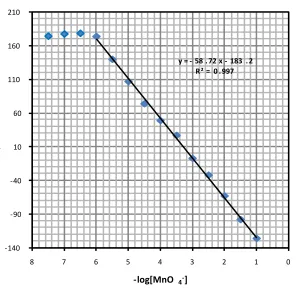
[image:5.596.157.464.247.542.2]The measuring range of ion selective electrodes refers to the linear part of the calibration graph. According to IUPAC definition, the measuring range of an ion selective electrode is defined as the activity range between the upper and lower detection limits [44-51]. The applicable measuring range of the modified electrode as shown in Fig. 1 was found to be between 1.0×10⁻⁶-1.0×10⁻¹ M. By extrapolating the linear parts of the ion selective calibration curve, the detection limit of an ion selective electrode can be calculated. In this work the detection limit of the sensor is 8.3×10⁻⁷ M which was calculated by the extrapolating of the two segment of the calibration curve in Fig. 1.
Figure 1. The calibration curve of the MnO4- nano composite based sensor with the sensor no. 10
3.3. pH effect on the electrode response
In order to investigate the effect pH on the potential response of the sensor, the potentials were measured at a fixed concentration of MnO4- ion (1.0×10⁻⁴ M) having different pH values. The pH was
altered from 4-10 by adding HNO3 or NaOH. The variations of the potential response of the best
sensor as a function of pH showed the potential of electrode is constant between pH values of 6.8-7.8. Thus, the electrode works satisfactorily in this pH range, and no interference from H+ or OH– is observed in the range. In this pH the permanganate ion species is dominant to the other form of manganese. The fluctuations above pH value of 7.8 might be due to the sensor response to OH– ions in
y =-58.72x -183.2 R² = 0.997
-140 -90 -40 10 60 110 160 210
0 1 2 3 4 5 6 7 8 E/mV
other form of manganese. The best performance of the electrode was achieved in pH of 7.
3.4. Response time
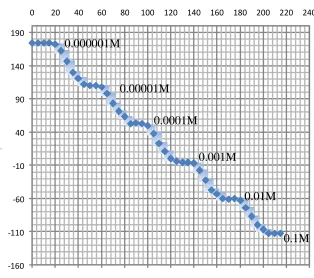
The response time of an ion-selective electrode is also an important factor for any analytical application. The average response time of the electrodes, defined as the required time for the electrodes to reach a cell potential of 90% of the final equilibrium values, after successive immersions in a series of solutions, each having a 10-fold concentration difference [35-40] was found to be 25±2 seconds. The resulting potential–time responses for the mentioned electrode were obtained by changing MnO4
-concentration from 0.000001 to 0.1 M (by fast injection of μL-amounts of a concentrated solution of KMnO4). Results in Fig. 2 showed that the potentiometric response time of the electrode was about 20
[image:6.596.143.457.337.615.2]s in whole concentration range.
Figure 2. Dynamic response time of the MnO4- nano composite based sensor with the sensor no. 10
3.5. Interference studies
The selectivity behavior, expressed as the relative response of the sensor to the primary ion over the other ions present in the solution. It is obviously one of the most important characteristics of a
-160 -110 -60 -10 40 90 140 190
0 20 40 60 80 100 120 140 160 180 200 220 240
E/mV
time (s)
0.000001M
0.00001M 0.0001M
0.001M
0.01M
selective sensor. Potentiometric selectivity coefficients, describing the preference of the suggested electrode for an interfering ion, X, with reference to MnO4-, were determined by the matched potential
method (MPM) [47-51]. The MPM is recommended by IUPAC to overcome the difficulties associated with the methods based on the Nicolsky–Eisenman equation.
According to this method, the specified activity (concentration) of the primary ion is added to a reference solution (0.000001 M MnO4- ion, in this case) and the potential is measured.
In a separate experiment, interfering ions (X) are successively added to an identical reference solution, until the measured potential matched that obtained before the addition of the primary ions. The matched potential method selectivity coefficient,
k
AMPM,X is then given by the resulting primary ion to the interfering ion activity (concentration) ratio,k
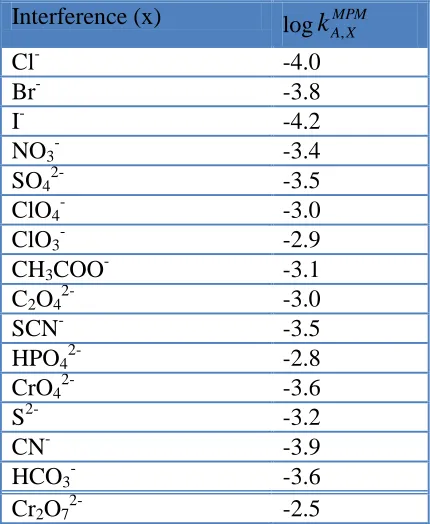
AMPM,X = ∆aMnO4-/aX.The resulting values for MnO4- sensor are listed in Table 2. As it can be seen from Table 2,
anions tested have not significance interfere in the monitoring of permanganate ion. Since the interaction between the modified SBA-15 with MnO4- is a kind of anion coordination to the metal
[image:7.596.191.406.411.673.2]center of the modifier (Aluminum complex of 8-hydroxyquinoline), it is not according to Hofmeister series (i.e. hydrophobicities of the anions).
Table 2. Selectivity coefficients of various interfering anions for the electrode no. 10
Interference (x) log MPM X A k ,
Cl- -4.0
Br- -3.8
I- -4.2
NO3- -3.4
SO42- -3.5
ClO4- -3.0
ClO3- -2.9
CH3COO- -3.1
C2O42- -3.0
SCN- -3.5
HPO42- -2.8
CrO42- -3.6
S2- -3.2
CN- -3.9
HCO3- -3.6
Cr2O72- -2.5
3.6. Lifetime
period of two months (the electrode worked one hour a day). Before eight weeks no significant change in the performance of the electrode was observed. This shows that the lifetime of the proposed electrode was about 8 weeks. After 8 weeks, the slope of the sensor decreases from -58.7 to -34.6 mV per decade and the detection limit reduces from 8.3×10⁻⁷ M to 4.7×10⁻⁵ M.
4. CONCLUSION
A new MnO4- nano-composite carbon paste electrode was introduced. Aluminum complex of
8-hydroxyquinoline was used for modification of the channels of SBA-15. Then, modified SBA-15 was used as a selective sensing element in construction of a nano-composite carbon paste electrode for measurement of permanganate ions. Carbon paste electrode based on MWCNTs and RTILs show superior performance over traditional carbon paste electrodes. Addition of MWCNT to the composition of the carbon paste, having high conductivity, improve the dynamic working range, detection limit, response time, lifetime, and stability of the nano-composite sensor. Replacement of paraffin oil with RTIL improved the sensitivity of the sensor from a near-Nernstian slope to Nernstian one. The electrode based on modified SBA-15, MWCNT and RTIL exhibits linear response over a wide concentration range with a Nernstian slope, and a short response time of about 25±2 s.
References
1. R. Banerjea, Ind. Med. Gaz. 85 (1950)214. 2. K. J. Ficek and J.E. Boll, Aque 7 (1980)153.
3. J. M. Montgomery, Water Treatment Principles and Design. John Wiley & Sons, Inc., New York, NY (1985).
4. Standard Methods. Standard Methods for the Examination of Water and Wastewater, nineteenth edition. American Public Health Association, AWWA, and Water Pollution Control Fed., Washington, D.C (1995).
5. H. A. Zamani, M. R. Ganjali and M.J. Pooyamanesh, J. Brazil. Chem. Soc., 17 (2006) 149. 6. J. Koryta and K. Stulik, Ion Selective Electrodes, Cambridge University Press, Cambridge (1983) 7. M. R. Ganjali, M. Rezapour, M. R. Pourjavid, and S. Haghgoo, Anal. Sci., 20 (2004) 1007. 8. M. R. Ganjali, M. Tahami, M. Shamsipur, T. Poursaberi, and S. Haghgoo, M. Hosseini,
Electroanalysis, 15 (2003) 1038.
9. M. R. Ganjali, P. Norouzi, F. S. Mirnaghi, S. Riahi and F. Faridbod, IEEE Sensors J., 7 (2007) 1138.
10.M.R. Ganjali, H.A. Zamani, P. Norouzi, M. Adib and M. Accedy, Acta Chim. Slov., 52 (2005) 309. 11.H. A. Zamani, G. Rajabzadeh and M. R. Ganjali, J. Brazil. Chem. Soc., 17 (2006) 1297.
12.F. Faridbod, M. R. Ganjali, R. Dinarvand, and P. Norouzi, Sensors, 8 (2008) 2331.
13.H. A. Zamani, G. Rajabzadeh, M. R. Ganjali and P. Norouzi, Anal. Chim. Acta, 598 (2007) 51. 14.H. A. Zamani, M. R. Ganjali, P. Norouzi, and S. Meghdadi, J. Appl. Electrochem., 37 (2007) 853. 15.A. S. Al Attas, Int. J. Electrochem. Sci., 4 (2009) 9.
18.M. Javanbakht, A. Badiei, M. R. Ganjali, P. Norouzi, A. Hasheminasab and M. Abdouss, Anal. Chim. Acta, 601 (2007) 172.
19.F. Faridbod, M. R. Ganjali, B. Larijani, M. Hosseini, K. Alizadeh and P. Norouzi, Int. J. Electrochem. Sci, 4 (2009) 1528.
20.M. R. Ganjali, N. Motakef-Kazami, F. Faridbod, S. Khoee, P. Norouzi, J. Hazard. Mater. 173 (2010) 415.
21.F. Faridbod, M. R. Ganjali, B. Larijani, P. Norouzi, Electrochim. Acta, 55 (2009) 234.
22.M. R. Ganjali, H. Khoshsafar, A. Shirzadmehr, M. Javanbakht and F. Faridbod, Int. J. Electrochem. Sci., 4 (2009) 435
23.F. Faridbod, M. R. Ganjali, B. Larijani, M. Hosseini and P. Norouzi, Mater. Sci. Eng. C, 30 (2010) 555
24.H. Yaghoubian, H. Karimi-Maleh, M. A. Khalilzadeh and F. Karimi, Int. J. Electrochem. Sci. 4 (2009) 993.
25.H. J. Wang, C. M. Zhou, J. H. Liang, H. Yu, F. Peng and J. Yang, Int. J. Electrochem. Sci. 3 (2008) 1258.
26.M. R. Ganjali, S. Aghabalazadeh, M. Rezapour, M. Hosseini and P. Norouzi, Int. J. Electrochem. Sci., 5 (2010) 1743.
27.F. Faridbod, M. R. Ganjali, M. Pirali-Hamedan and P. Norouzi, Int. J. Electrochem. Sci., 5 (2010) 1103.
28.L. Mercier, and T.J. Pinnavaia, Adv. Mater. 9 (1997) 500.
29.R. Metivier, I. Leray, B. Lebeau, and B.J. Valeur, Mater. Chem. 15 (2005) 2965. 30.T. Balaji, M. Sasidharan, and H. Matsunaga, Anal. Bioanal. Chem. 384 (2006) 488. 31.J. Li, T. Qi, L. Wang, C. Liu, and Y. Zhang, Mater. Lett. 61 (2007) 3197.
32.J.N. Zhang, Z. Ma, J. Jiao, H.F. Yin, W.F. Yan, E.W. Hagaman, J.H. Yu, and S. Dai, Langmuir 25 (2009) 12541.
33.K. Kostarelos, L. Lacerda, G. Pastorin, W. Wu, S. Wieckowski, J. Luangsivilay, S. Godefroy, D. Pantarotto, J. P. Briand, S. Muller, M. Prato and A. Bianco, Nat. Nanotechnol., 2 (2007) 108. 34.M. R. Ganjali, S. Aghabalazadeh, M. Khoobi, A. Ramazani, A. Foroumadi, A. Shafiee and P.
Norouzi, Int. J. Electrochem. Sci., 6 (2011) 52.
35.M. R. Ganjali, V. K. Gupta, M. Hosseini, Z. Rafiei-Sarmazdeh, F. Faridbod, H. Goldooz, A. R. Badiei, P. Norouzi, Talanta 88 (2012) 684.
36.M. R. Ganjali, Z. Memari, F. Faridbod, R. Dinarvand and P. Norouzi, Electroanalysis, 20 (2008) 2663.
37.M. R. Ganjali, H. Ganjali, M. Hosseini, and P. Norouzi, Int. J. Electrochem. Sci., 5 (2010) 965. 38.A. K. Jain, V. K. Gupta, L. P. Singh, P. Srivastava and J. R. Raisoni, Talanta 65 (2005) 716. 39.V. K. Gupta, R. Jain, M.K. Pal, Int. J. Electrochem. Sci., 5 (2010) 1164.
40.F. Faridbod, M. R. Ganjali, B. Larijani, E. Nasli-Esfahani, S. Riahi, and P. Norouzi, Int. J. Electrochem. Sci., 5 (2010) 653.
41.M. R. Ganjali, A. Rouhollahi, A. R. Mardan, M. Hamzeloo, A. Moghimi, and M. Shamsipur, Michrochim. J., 60 (1998) 122.
42.M. R. Ganjali, T. Poursaberi, M. Hosseini, M. Salavati-Niasari, M. Yousefi, and M. Shamsipur, Anal. Sci., 18 (2002) 289.
43.M. R. Ganjali, M. Emami, M. Rezapour, M. Shamsipur, B. Maddah, M. Salavati-Niasari, M. Hosseini, Z. Talebpoui, Anal. Chim. Acta,, 495 (2003) 51.
44.M. R. Ganjali, A. Daftari, P. Norouzi, M. Salavati-Niasari, Anal. Lett., 36 (2003) 1511.
45.M. R. Ganjali, J. Ravanshad, M. Hosseini, M. Salavati-Niasari, M. R. Pourjavid, M. R. Baezzat, Electroanalysis, 16 (2004) 1771.
48.M. R. Ganjali, R. Kiani-Anbouhi, M. Shamsipur, T. Poursaberi, M. Salavati-Niasari, Z. Talebpour, M. Emami, Electroanalysis 16 (2004) 1002.
49.H. Behmadi, H. A. Zamani, M. R. Ganjali, P. Norouzi, Electrochim. Acta, 53 (2007) 1870.
50.M. R. Ganjali, F. Aboufazeli, S. Riahi, R. Dinarvand, P. Norouzi, M. H. Ghasemi, R. Kiani-Anbuhi and S. Meftah, Int. J. Electrochem. Sci, 4 (2009) 1138.
51.M. R. Ganjali, R. Nemati, F. Faridbod, P. Norouzi, F. Darviche, Int. J. Electrochem. Sci, 3 (2008) 1288.