Chung Hun Baek, Jung Hee Cheon, and Hyunsook Hong
Department of Mathematical Sciences, Seoul National University, 1 Gwanak-ro, Gwanak-gu, Seoul 151-747, Korea
{love0116,jhcheon,hongsuk07}@snu.ac.kr
Abstract. White-box cryptography is an obfuscation technique for protecting secret keys in software implementations even if an adversary has full access to the implementation of the encryption algorithm and full control over its execution platforms. This concept was presented by Chow et al. with white-box implementations of DES and AES in 2002. The strategy used in the implementations has become a design principle for subsequent white-box implementations. However, despite its practical importance, progress has not been substantial. In fact, it is repeated that as a proposal for a white-box implementation is reported, an attack of lower complexity is soon announced. This is mainly because most cryptanalytic methods target specific implementations, and there is no general attack tool for white-box cryptography. In this paper, we present an analytic toolbox on white-box implementations in this design framework and show how to reveal the secret information obfuscated in the implementation using this. For a substitution-linear transformation cipher onn bits with S-boxes onmbits, ifmQ-bit nonlinear encodings are used to obfuscate output values in the implementation, our attack tool can remove the nonlinear encodings with complexityO( n
mQ2
3mQ). We should increasem
Qto obtain higher security, but it yields exponential storage blowing up and so there are limits to increase the security using the nonlinear encoding. If the inverse of the encoded round functionF onnbits is given, the affine encodingAcan be recovered inO(n
m·mA 323m) time using our specialized affine equivalence algorithm, wheremA is the smallest integerp such that A (or its similar matrix obtained by permuting rows and columns) is a block-diagonal matrix with p×p
matrix blocks. According to our toolbox, a white-box implementation in the Chow et al.’s framework has complexity at most Ominn22m
m ·n
m+4, nlogn·2n/2o within reasonable storage, which is much less than 2n.
To overcome this, we introduce an idea that obfuscates two AES-128 ciphers at once with input/output encoding on 256 bits. To reduce storage, we use a sparse unsplit input encoding. As a result, our white-box AES implementation has up to 110-bit security against our toolbox, close to that of the original cipher. More generally, we may consider a white-box implementation on the concatenation of t ciphertexts to increase security.
Keywords:white-box cryptography, white-box implementation, specialized affine equivalence algorithm, AES, block cipher.
1 Introduction
Traditionally, the security of cryptographic algorithms is studied in the black-box model—the end points are trusted and the attacker only has access to the input/output of the algorithm. Under this model, cryptographic schemes are designed to prevent attackers from obtaining secret information using only the input/output values of algorithm without any knowledge of its internal information. In the real world, however, untrusted hosts may access unapproved contents illegally, malicious software in user devices may access the memory used to execute a cryptographic algorithm, or internal information may be leaked during the process of communication. Actually, many attacks have been proposed, such as side channel attacks [10, 13, 14, 18, 19], which extract secret information by access to the internal states in the implementation of algorithm. The concept of white-box cryptography has been proposed to enhance security of cryptosystems under such hostile environment.
of protecting the internal information of the software implementation. Many commercial products can use white-box cryptography. One of the main applications is in the digital rights management. Suppose that some content is in encrypted form, and should only be decrypted by permitted devices. If an adversary obtains the decryption key for the content, she can use it in other devices and distribute illegal copies of the content. White-box cryptography aims to prevent attackers from obtaining the decryption key.
The first proposals to implement cryptographic primitives in white-box cryptography were made by Chow et al., who presented a white-box AES implementation [5] and a white-box DES implementation [6] in 2002. They are based on the basic strategy: the whole cipher is decomposed into round functions and the round functions are represented by summation of lookup tables with small size. Although Chow et al.’s implementations have been broken with complexity 214for DES [24] and 222for AES [15], their
strategy provided a framework, called “CEJO framework”, for designing white-box implementation of using table lookups. Most white-box implementations after Chow et al.’s proposal follow the CEJO framework: Xiao and Lai [25] proposed white-box AES implementation using wider linear encodings than Chow et al.’s. Karroumi [12] modified the algebraic operations in each AES round function using dual representations of the AES cipher and presented a white-box AES implementation. However all of these have been broken in the sense that the secret key can be recovered in the lower complexity than their claimed security when the full lookup tables are given (complexity of 232 and 222, respectively
[17, 15]).
On the other hand, researches for white-box cryptography have been proceeded in various ways: Some security notions for white-box cryptography have been studied in [8, 20, 23]. Independently, Biryukov et al. [2] proposed a new symmetric ASASA-based block cipher with secret S-boxes satisfying white-box security notion, whereas previous works focused on proposing white-box implementation of the existing cipher which is well-known and secure.
As we can see from previous implementations, it is very difficult to design a white-box implemen-tation with a security level similar to the black-box model. Hence, the practical objective of white-box implementations is to increase the complexity of cryptanalysis. All of the implementations mentioned above suffered unpredicted attacks soon after their designs were announced. This is mainly because there are no standard attack tools such as differential cryptanalysis and linear cryptanalysis for block ciphers.
Our Contributions: Throughout this paper, we focus on white-box implementations of SLT ciphers
following CEJO framework. Let E=M◦S be the round function of an SLT cipher onnbits, where
M is an invertible linear map and S is a concatenation of S-boxes on m bits with a fixed key. We define the input encoding asf =A◦P, whereA is an invertible linear map andP is a concatenation of small nonlinear permutations. If we letgbe the input encoding of the next round, then the encoded round functionF ofE is of the formF =g−1◦E◦f =QBSAP, whereB is an invertible linear map and Qis a concatenation of small nonlinear permutations.
Our contributions are two-folded.
1. We present an analytic toolbox for white-box implementations of SLT ciphers in the CEJO framework. Our toolbox consists of several algorithms to recover nonlinear and affine encodings used in this model.
First, by adopting the Biryukov–Shamir technique [4], we show that the nonlinear partQ can be removed up to an affine transformation in O n
mQ2 3mQ
when Q = (Q1,· · · , Qn/mQ) and each
Qi is a nonlinear bijection on mQ bits. For example, the nonlinear encoding in the Chow et al.’s implementation can be removed in 218 bit operations, whereas it takes 229 bit operations using
Billet et al.’s attack [1]. While Billet et al.’s method is only available when the input size of the
Second, whenF = B◦S◦A for affine mappings A, B, it is affine equivalent to S. Hence we can apply the affine equivalence algorithm in [3], which has a complexity ofO(n322n). We improve this algorithm for the case whereSconsists of small S-boxes of sizem. According to our specialized affine equivalence algorithm (SAEA), if theF−1oracle is given, we can findAandBinO n
m·mA
323m , wheremA is the smallest integerpsuch thatA (or its similar matrix obtained by permuting rows and columns) is a block diagonal matrix with p×p matrix blocks. In fact, mA is the minimal block size when consideringA as a block diagonal mapping. WhenF−1 oracle is not given, SAEA
requires O minn
m ·mAm+3·22m, n·logmA·2mA/2 , including the complexity of inverting F, to recover the affine encodings.
Our attack is universal in the sense that all known implementations based on the CEJO framework are susceptible to them. Furthermore, they could play a role of estimating the security of possible white-box implementation designs.
2. We propose a new design for a white-box implementation whose security level is close to that of the original cipher. Most variants of Chow et al.’s implementation [12, 25] attempted to increase the security by introducing new affine encodings. According to our toolbox, however, for any affine encoding the complexity for finding the secret key is upper bounded by the minimum of O(22m
m ·n
m+4) and O(nlogn·2n/2), which is much lower than 2n. This provides a negative perspective on secure white-box implementations of SLT ciphers using table lookups.
Our new approach is to use the encryption of multiple plaintexts: For AES-128, we consider the concatenation of two AES-128 ciphers. Let E be a round function of AES-128 and F = g−1 ◦
(E, E) ◦f be the encoded round function on 256 bits. Then we can take mA = 2n > n and hence accomplish higher security, up to 2110 for m
A = 256 and m = 8. This approach can be applied to any SLT cipher with mA = tn for suitable t ∈ Z and then the security level is large
up to 2·4mnnm+4
·tm+4. Therefore, this provides a new approach for the design of a secure
white-box implementation, regardless of the block length of the original cipher. One shortcoming of this approach is its large storage requirement. However, this is compensated by the use of special sparse encodings. We give an instance with storage requirements of about 16 MB and 64 MB for a single round when mA = 128 and 256, respectively, in Section 5. Our design does not have a security reduction to well known problems and needs to be scrutinized to get a confidence. However, it is still worthy in that it explains why the previous design trials have been failed and how to overcome this barrier in the current state. We expect our work inspires further research to design a secure white-box implementation.
Outline of the Paper: In Section 2, we introduce the basic strategy of Chow et al.’s
white-box implementation, and discuss its extension in previous works. We propose attack tools that can be applied to a white-box implementation in Section 3. An approach to the design of a white-box implementation based on the result of our toolbox is given in Section 4. In Section 5, we present an instance of such a the white-box AES implementation. We conclude the paper in Section 6.
2 Revisiting the Chow et al.’s implementation for the SLT Cipher
Mout◦E(r)◦f(r)
| {z }
table
◦(f(r))−1◦E(r−1)◦f(r−1)
| {z }
table
◦ · · · ◦(f(2))−1◦E(1)◦f(1)
| {z }
table
◦(f(1))−1◦Min | {z }
table
= Mout◦E(r)◦ · · · ◦E(2)◦E(1)◦Min
Fig. 1: The basic strategy of in the CEJO framework
In the white-box model, however, it is assumed that the adversary has full access to the implemen-tation of the encryption algorithm and full control over its execution platforms. In this context, the main objective of the adversary is to extract the secret key. That is, the purpose of secure white-box implementations is to prevent the encryption key from being revealed even when internal algorithm details are completely visible in the untrusted platform, and the adversary has full access to the execution of the encryption algorithm.
One approach for secure white-box implementation of a block cipher is to give a table of all input/output values of the encryption. In this case, the security of the implementation of an algorithm is equivalent to the security of the encryption in the black-box model, and hence depends on the security of the encryption scheme itself, regardless of implementations. Unfortunately, such an implementation is not practical, because the storage requirements of the table are prohibitive. For example, the size of the input/output table of AES-128 is 2128×128 = 2102 GB. Chow et al. suggested a white-box
implementations with an implementable table size for AES [5].
Chow et al.’s implementation In the Chow et al.’s implementation, the basic approach for reducing the table size is to decompose the table into small tables with a composition that composition is equivalent to the original input/output table. The most important factor in the table size is the size of the input affecting each S-box, because the S-boxes cannot be decomposed into smaller parts. In AES, one S-box in a single round is influenced by only 8 input bits, but in more than two rounds, each S-box is influenced by all input bits. Hence, Chow et al. decomposed the whole AES cipher into round functions, and represented these as the composition of small tables whose inputs are those corresponding to each S-box.
Because the round key can be exposed if the input/output values of a single round are provided, the input/output tables of each round must be obfuscated by input/output encoding functions. For equivalence with the original AES, the input encoding of the i-th round is offset by the output en-coding of the previous round, as in Fig 1 (where E(i) is the i-th round function, f(i) is an input
encoding function of the i-th round, and Min/Mout are external input/output encodings for security supplement).
The strategy used in the Chow et al.’s implementation can be summarized as follows:
1. The cipher is decomposed into round functions and the round functions are obfuscated by in-put/output encodings.
2. Each round function is decomposed into a network of lookup tables whose inputs are those corre-sponding to each S-box.
This strategy provided a framework for designing white-box implementation of block cipher using table lookups. We call it “CEJO framework”.
permutations,A, Bare block diagonal linear mappings with block size 8,Sis the bytewise operation of
S-boxes, and M is theMixcolumns operation on 32 bits. Note that anAddRoundKeyoperation can be merged to the nonlinear encodingP. Because the block size of the encodings is 8 which is the same as the input size of theS-boxes, theShiftRowsoperation can be omitted in the round function. (Thus, we consider the encoded round function as a concatenation of four parallel subround functions.) Hence,
F can be represented by the summation of four 8-bit to 32-bit lookup tables. For the “summation” of these tables, twenty-four 8-bit to 4-bit XOR tables are required additionally.1
BGE Attack BGE attack [1] exploited that the input encoding size is the same as that of the S-box in the Chow et al.’s implementation. It consists of three steps. First, they recover the nonlinear parts of the encodings. As the Chow et al.’s implementation only uses input encoding on 8 bits (composition of 8-bit mixing bijection and two 4-bit nonlinear encodings), it is easy to obtain the bijective subfunction of F on 8 bits by fixing three bytes of the input. Using this property, the BGE attack can recover nonlinear parts of the encodings (up to affine) in 224time. In the second step of the attack, the relations
between input/output of the table are found using a property of the Mixcolumns operation. Finally, the round key can be found using the result of the second step. The dominant part of this attack’s complexity is in the first step, and the total complexity of recovering a 128-bit AES key is 230.
Michiels et al.’s Cryptanalysis for SLT cipher The CEJO framework can be applied for
de-signing white-box implementation of any other ciphers, such as a generic class of substitution-linear transformation (SLT) ciphers. Michiels et al. [16] considered the white-box implementation of SLT ciphers based on the CEJO framework and presented the associated cryptanalysis. The SLT cipher defined in [16] is a type of iterated cipher with substitution layers and linear transformation layers. A more precise definition of the SLT cipher is as follows.
Definition 1. TheSLT cipher E is defined as follows. It consists of R rounds for some R≥1. For each r = 1,· · · , R, the r-th round function E(r)(x
1,· · · , xk) is a bijective function on n bits, where
n=k·m and xj is an m-bit value for each j and consists of the following three operations:
1. XOR-ing round key XOR the r-th round key K(r) = (K(r)
1 ,· · · , K (r)
k ) of n bits to the input (x1,· · ·, xk). This outputs yi =xi⊕Ki(r) for all i= 1,· · ·, k.
2. Substitution Computezi =Si(r)(yi) for all i= 1,· · · , k, where each Si(r) is an invertible S-box on
m bits in the i-th round.
3. Linear transformation For z= (z1,· · ·, zk), compute M(r)z where M(r) is an n×n invertible matrix over GF(2). Thisn-bit value is the output of the r-th round function.
Michiels et al.’s use input encodings whose input size is the same as the input size of the S-boxes, as for the original Chow et al.’s implementation. This means the first step of the BGE attack is available to recover the nonlinear parts of the encodings. However, because Michiels et al.’s setting is not only defined on AES, but on any SLT cipher, the other steps of the BGE attack that use the property of AES are not available. Instead, Michiels et al. transformed the encoded round function into a block diagonal mapping whose block size is the same as that of the S-boxes, and recovered the affine encoding of each block using an affine equivalence algorithm [3]. The reason for transforming the encoded round function into a block diagonal mapping is that the input encodings still have an input size that is the same as that of the S-boxes.
1
M
A
B
S
kS
2S
1..
.
Q1 Q2..
.
P1..
.
P2 mPmQ m
n n n
M
A
1A
2A
k..
.
S
kS
2S
1..
.
B
1B
2B
k..
.
Q1 Q2 Q3..
.
P1 P2 P3..
.
mP mQ m m m n PkPQkQ
Q2k P2k
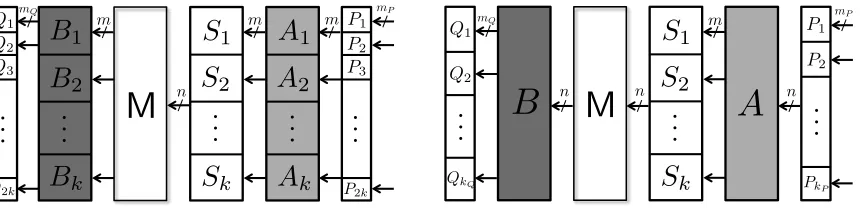
Fig. 2: Original encodings and extended encodings for the CEJO framework
CEJO framework with extended encoding In the Chow et al.’s implementation and Michiels et
al.’s modification, the reason for using the input encodings whose input size is the same as that of the S-boxes is to maintain the number of input bits affecting the S-boxes. However, this leads to weakness against BGE attack and Michiels et al.’s cryptanalysis. Therefore, the next step is to extend the form of the encodings for CEJO framework to satisfy both practical and security aspects.
Consider a white-box implementation of an SLT cipher, which follows the CEJO framework. Let
E = M ◦S be a round function of the SLT cipher on n = km bits, where M is a linear layer of the SLT cipher and S is a concatenation of S-boxes S1,· · · , Sk on m bits.2 Let f and g be input and output encoding functions, respectively, which are bijections on n bits. Clearly, g is the inverse function of the input encoding function of the next round. Thus, the encoded round function F is defined as F =g◦E◦f. We first consider an extended form of the encoding at f =A◦P, where A
is an invertible linear map on nbits and P is a nonlinear permutation. In the CEJO framework, the table size is mainly determined by the size of input affecting each S-box. Therefore, if A and P are arbitrary bijective linear and nonlinear mappings, respectively, the table size would be huge. Hence, we consider a special mappings that ensure the white-box implementation with reasonable size.
LetA= A1 .. . Ak
, whereAj is thej-th horizontal strip of sizem×n, and letP be a concatenation of
nonlinear bijective encodings P1,· · ·, PkP on mP bits, where n=kP ·mP. The output of fj =Aj◦P
is the input ofSj, and hence the net input3 size offj determines the table size related toSj. The net input size of fj is related to the net input size ofAj, and the net input size of Aj is the number of nonzero columns inAj. Therefore, if we can ensure a small number of nonzero columns inAj, the table size will be small. Furthermore, since these net input bits are affected by the corresponding Pjt, we
should aim for fewPjt, each with a small number of input bits. Therefore,P should be a concatenation
of small nonlinear permutations, and Ashould be an invertible linear map, where eachAj has a small number of nonzero columns.
Since the output encoding is the inverse of the input encoding of the next round, we can write the output encodingg asg=Q◦B, whereQis a concatenation of small nonlinear permutations and
B is an invertible linear map. Thus, the encoded round function is of the form F =QBM SAP. For simplicity, we write BM as B, becauseB, M are invertible linear maps, andM is known,i.e., we let
F =QBSAP.
We may consider the case f = P ◦A, where the encoded round function is of the form F =
BQM SP A. In this case, since the n×n linear map B follows the Q layer, the XOR tables should decode the encoding BQ, rather than Q. This will make the size of XOR tables huge, and hence we must decomposeF into two parts after theQlayer. That is, we letF =G◦H and make input/output
2
tables of GandH, whereG=B◦Q1 andH =Q2M SP AwithQ=Q1◦Q2. However, if we combine
H withGfrom the previous round, the function is of the formQ0M SP0, because the linear mappings
A and B (from the previous round) will be canceled out. Since this is covered by the casef =A◦P, we do not consider it further in this paper. Similarly, for a composition of more than two encodings, we just consider the casef =A◦P as a generalized form of the encoding.
Remark 1. In practice, mP cannot be much larger than m, because the use of a nonlinear encoding of size mP induces the use of a 2mP-bit to mP-bit XOR table. Hence, the choice of mP is limited. However, we need not be restricted to mP |m orm|mP. The nonlinear encodings of theP layer do not need to be aligned with the S-boxes because two differentfj can share some input bits and input encodings. For example, let n= 192, m= 8,mP = 6, andAbe a block diagonal linear mapping with block size 8. For allj= 1,· · ·,24, the number of net input bits offj is 12.f1,f2 share the same input
bits corresponding toP2 and f2,f3 share the same input bits corresponding toP3. The tables related
to each S-box are 12-bit to 192-bit tables and the total table size (including XOR tables) for a round is about 4.4 MB.
Notation In the remainder of this paper, we define E = M◦S to be a round function of the SLT
cipher with block sizen, whereM is a linear mapping onnbits andS is a layer ofkS-boxes onmbits. We let F =QBSAP be the encoded round function of E, where P, Q are layers of small nonlinear permutations,A, Bare layers of linear mappings onnbits, and eachAj has a small number of nonzero columns (Aj is thej-thm×nhorizontal strip of A). Note thatB containsM.
We also define variables for the input size of the mappings. For the encoded round functionF =
QBSAP on n bits, we let P, Q be layers of kP nonlinear bijective encodings on mP bits and kQ nonlinear bijective encodings on mQ bits, respectively. Furthermore, if A is a block diagonal map consisting of mixing bijections on each block, then we write mA to denote the size of the blocks and
kAfor the number of blocks (i.e.,n=k·m=kP ·mP =kQ·mQ=kA·mA).
3 General Attack Toolbox for White-Box Implementation
In white-box cryptography, the attacker’s objective is to extract the secret key information. Most block ciphers have key schedules, and so cryptanalysis focuses on recovering one round key. In order to extract the secret key, we find the encodings of consecutive two round functions. Using the relation between the output encodings and the input encodings of the consecutive two rounds, the secret key can be extracted efficiently. Therefore, the goal of this section is the extraction of the secret encodings used to obfuscate in the implementation.
We introduce general tools to recover encodings inF =QBSAP as defined in the previous section. We first recover nonlinear parts of encodings up to affine transforms and then we can letF =B◦S◦A, where A, B are invertible affine maps. Next, we propose attack tools to find A and B in general cases.
3.1 Recovering Nonlinear Encodings
divides m by regarding m
mP encodings in layer P,
m
mA mixing blocks in layer A and
m
mQ encodings in
layer Qas a single encoding in theP,A,Q layers, respectively.
How about the case that lcm(mP, mA, mQ) does not dividem? In this case, also the BGE attack can be applied to the implementation if lcm(mP, mA, mQ, m)< n, by considering lcm(mP, mA, mQ, m) as the size of encodings in the P,A,Qand S layers. The complexity of this attack is 23lcm(mP,mA,mQ,m),
and no longer depend only m. For example, consider the case that n = 192, mP = mQ = 6 and
mA=m= 8, the BGE attack has complexity 275. This gives the following theorem which is extended version of the BGE attack.
Theorem 1. Let F =QBSAP be an encoded round function of white-box implementation as defined
in Section 2. If l=lcm(mP, mA, mQ, m)< n, then one can recover a nonlinear part Q (up to affine transformation) in time nl ·23l.
In this subsection, we introduce a more efficient tool to recover nonlinear parts of encodings for the latter case, which is based on the multiset attack of Biryukov and Shamir [4]. Using this tool, we can recover nonlinear parts of encodings efficiently even if the size of linear mixing bijections is larger than the size of the S-boxes or the layer of the nonlinear encodings is not aligned with the layer of the S-boxes. This is first approach which provides a link between the technique in [4] and cryptanalysis of white-box implementation.
In order to explain this tool, we will use the multiset properties as in [4]. For more general attack, we add a subscript to each property symbol to denote the size of input. For a multiset M of m-bit values (m >1), the multiset properties are defined as follows:
– M has propertyCm (constant) if it contains only numbers of a singlem-bit value.
– M has propertyPm (permutation) if it contains all numbers of the 2m possible values exactly once.
– M has propertyEm (even) if each value occurs an even number of times or does not occur.
– M has propertyBm (balanced) if theXOR of all the values is 0m.
We extend this notation to denote combined properties. First, we define a projection map πI :
{0,1}n → {0,1}τ by π
I(x1,· · ·, xn) = (xi1,· · · , xiτ), for index set I ={i1,· · · , iτ} ⊆ {1,· · ·, n}. We
say a multisetM ofn-bit values has propertyPk
2mCn−2km, ifπ{2im+1,···,2im+2m}(M) has propertyP2m for each i= 0,· · · , k−1 andπ{2km+1,···,n}(M) has property Cn−2km.
Now let us consider how the multiset properties are transformed by an affine mapping, in the following two lemmas. See Appendix A for the proofs.
Lemma 1. LetA:Zn2 →Zm2 be an affine mapping andI ={i1,· · ·, iτ} ⊆ {1,· · · , n}withτ ≥m >1. For a multiset M of n-bit values, a multiset A(M) has property Pm or Em if πI(M) has property Pτ,
π{1,···,n}\I(M) has property Cn−τ.
Lemma 2. Let A : Zn2 → Zm2 be an affine mapping. For a multiset M of n-bit values, the multiset
A(M) of m-bit values has property Bm if M has property Bn and the size of M is even.
Using these lemmas, we obtain the following theorem, a generalized version of the result in [4]. This attack tool which can remove the nonlinearity of encodings is more efficient than Billet et al.’s attack.
For description of the theorem, we provide some definitions. We say a functionf :Zu2 →Zv2 with
u ≥ v is balanced if every output occurs 2u−v times. We define Fi,α :
Zi2·mP → Zn2 as Fi,α(x) :=
F(α1, x, α2) where α = (α1, α2) and α1 ∈ Z2t·mP, α2 ∈ Z2n−(i+t)·mP for some 0 ≤ t ≤ kP −i and
Fji,α := πj ◦Fi,α, where πj is a projection onto the j-th block of layer Q. Lastly, we define a set of
functions Λi,j ={Fji,α |α∈Z t·mP 2 ×Z
n−(i+t)·mP
P
1P
2P
kPS
1S
2Q
kQQ
2Q
1..
.
..
.
..
.
mP
mQ
n
A
B
Cj
mPPi·mPC
kP (i+j)
mP
BkQ
mQ
S
kBkm
m
(Pm or Em)k
M
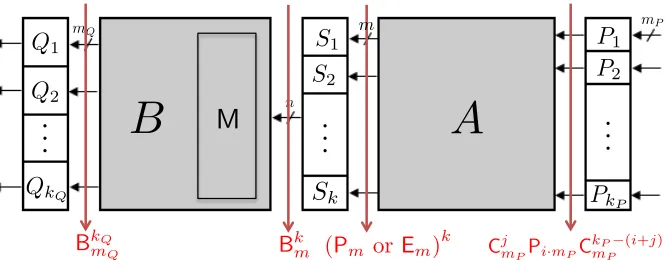
Fig. 3: The relations between multiset properties on QBSAP
Theorem 2. Let F =QBSAP be a round function of white-box implementations and Λi,j be a set of functions defined above wherei=d m
mPe. Assume the probability that a function in Λi,j is not balanced
is at least p > 0 for each j. If lcm(mP, mA, mQ) does not divide m, then one can recover nonlinear part Q (up to affine transformation) using 2i·mP+mQ·O(1/p) chosen plaintexts in about O(k
Q·23mQ) bit operations.
Proof. Letαbe an (n−i·mP)-bit value. For somet, takeMαto be a set with propertyCtmPP(i·mP)C
kP−(i+t)
mP
such that π{1,···,t·mP,(i+t)mP+1,···,n}(x) =α for each x∈Mα.
The propertyCt
mPP(i·mP)C
kP−(i+t)
mP is preserved by the layerP, and thus output multiset has also
property Ct
mPP(i·mP)C
kP−(i+t)
mP . SinceAcan be divided into kaffine mappings fromn-bit tom-bit and
i·mP ≥m, this property is transformed by the layer A into the multiset with property (Pm orEm)k by Lemma 1. Since the property (Pm orEm)k is preserved after layer S, the multiset after layer S has the property Bk
m and this property is equivalent to property Bn. By Lemma 2, the propertyBn is transformed by the layerB into the multiset with propertyBkQ
mQ by dividingBintokQaffine mappings
from n-bit to mQ-bit.
Now, consider thej-th nonlinear bijective encodingQj in the layerQand defineFj =πj◦F, where
πj is a projection onto thej-th block. Then we get a homogeneous equation
X
x∈Mα
Q−1j (Fj(x)) = 0mQ
and since we know the values of Fj(x) for allx∈Mα, this equation is a homogeneous equation of the unknowns Q−1j (y)’s for ally through mQ-bit values,i.e.,
X
y
cα,y·Q−1j (y) = 0mQ
where cα,y is the number of x∈Mα satisfying Fj(x) =y.
Since the number of unknowns is 2mQ, we need more than 2mQ equations. If we use different
constant α at the part correspond to property C from Ct
mPP(i·mP)C
kP−(i+t)
mP , we are likely to get a
different homogeneous equation of Q−1j (y)’s. By the assumption, we can obtain 2mQ equations from
2mQ·O(1/p) multisets, then we can solve the system of equations by Gaussian elimination. We can
do this process for allj’s and hence we needO(kQ23mQ) bit operations with 2i·mP+mQ·O(1/p) chosen
plaintexts to recover the layer Qup to affine transformation.
The BGE attack take 23lcm(mP,mA,mQ,m) bit operations, but our attack tool only takes 23mQ bit
operations. Reconsider example for n = 192, mP = mQ = 6 and mA = m = 8. In this case, our attack tool reduces the complexity from 275 to 223 to remove the layerQup to affine transformation.
Remark 2. To apply the method in Theorem 2, we require sufficiently many homogeneous equations of the form P
x∈MαQ −1
j (Fj(x)) = 0mQ. It is related to the probability p because if F i,α
j is balanced, the equation is a trivial equation. By the nonlinearity of S-boxes, if Fji,α is related to more than 2 S-boxes,Fji,α is likely to be not balanced. So, we have to take care of choosing multiset of plaintexts, so that Fji,α is related to more than 2 S-boxes and we note that if lcm(mP, mA, mQ) does not divide
m,Fji,α is related to more than 2 S-boxes. However, in the case thatmA,mP andmQ are equal tom, we can acquire only trivial equation, and hence we cannot use this method. Nevertheless, we can also recover the nonlinear parts of the encodings because the BGE attack can be applied to this case (the BGE attack has same complexity as the method in Theorem 2). Therefore, the toolbox to recover the nonlinearity of the encodings should include both methods with same complexities, considering all the cases.
Actually, we cannot recover Qexactly because we cannot get a system of equation with full rank of 2mQ, but we can recoverQup to affine transform. Furthermore, we can recoverP by attack for the
previous round. Therefore, if we assume kP =kQ, we can recover all nonlinear part of encoding of a round function in 2kQ·23mQ steps.
Applications In Chow et al.’s implementation [5], the input bit size of the linear encodings and the S-boxes is 8 and the size of input/output nonlinear encodings is 4: In our notations, m=mA= 8 and mP =mQ = 4. Thus, applying the result of Theorem 2, we can recover the nonlinear encodings in 2kQ·23mQ = 2·32·23·4= 218time and the complexity is much less than Billet et al.’s [1], 229. The only thing to be careful about is to take multiset of plaintexts. We have to take multiset of plaintexts, so that the function is related to two S-boxes, for example, the multiset of plaintexts of size 128-bit values that has the property C4P8C294 .
3.2 Affine Equivalence Algorithm with Multiple S-boxes
We say that two bijections F and S are linear/affine equivalent if there exist linear/affine mappings
A, B such that F =B◦S◦A.The linear/affine equivalence problemis to find invertible linear/affine mappings A andB such that F =B◦S◦A for given nonlinear bijections F and S.
Biryukov et al. [3] proposed algorithm for solving the linear equivalence problem for arbitrary permutations over Zn2 with complexityO(n32n). For the affine equivalence algorithm, they proposed
the concept of the representatives for the linear equivalence classes of permutations and solved the affine equivalence problem in O(n322n) time.
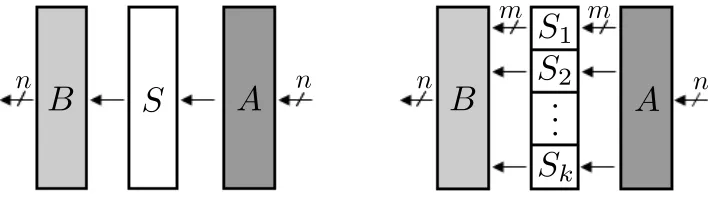
In this subsection, we consider the case that the nonlinear mapping S consists of k invertible S-boxes Si’s which map from Zm2 to Zm2 , where n = km, as shown in Fig. 4. The problem may be
considered to be a specific case of [3] and so called the specialized affine equivalence problem. The following theorem says the problem can be solved more efficiently when compared with the affine equivalence problem.
Theorem 3. Let F and S be two permutations on n bits where S = (S1,· · · , Sk) with nonlinear permutations Si on m bits for i = 1,· · · , k. Assume that we can easily access the inversion of F. Then, we can find all affine mappings A and B such that F = B◦S◦A in time O(kn323m) if they exist.
A
B
S
1
S
2
S
k
..
.
m
m
n
n
A
B
S
n
n
Fig. 4: Affine equivalence problem and specialized affine equivalence problem
strips of size m×n. Denote thei-th strip ofA and B−1 by A
i and Bi respectively. That is,
A= A1 .. . Ak
and B
−1 = B1 .. . Bk
. (1)
If one can obtain two sets{x1, x2,· · · , xn}and{Bi◦F(x1), Bi◦F(x2),· · ·, Bi◦F(xn)}such that
{F(x1), F(x2),· · ·, F(xn)} is linearly independent, then one can findBi from
Bi=
Bi◦F(x1) Bi◦F(x2) · · · Bi◦F(xn)
F(x1) F(x2) · · · F(xn) −1
, (2)
where we considerBi◦F(xj) andF(xj) as column vectors for 1≤j≤n. Hence, the main strategy is to find two sets {x1,· · ·, xn}and {Bi◦F(x1),· · ·, Bi◦F(xn)}such that {F(x1),· · · , F(xn)} is linearly
independent in order to recover Bi.
Suppose that we have two sets{x1,· · · , x`} and {y1=Bi◦F(x1),· · ·, y`=Bi◦F(x`)} such that
{x1,· · · , x`}is linearly independent. For anyx=P`j=1bjxj(bj ∈ {0,1}), we can computey =Bi◦F(x) from y1,· · · , y` by
y=Si◦Ai(x) =Si
` X
j=1
bjAi(xj)
=Si
` X
j=1
bjSi−1(yj)
. (3)
Since F is a nonlinear bijection, we can obtain another vector x such that F(x) ∈/ Z2F(x1) +· · ·+
Z`F(x`) with high probability. (Assuming F is random bijection, at least one of {F(x)|x ∈Z2x1+ · · ·+Z2x`} does not belong to Z2F(x1) +· · ·+Z2F(x`) with probability 1−
2d` 2n
2`−`
where d` = dimh{F(x1),· · · , F(x`)}i.)
On the other hand, suppose that we have two sets{F(x1),· · · , F(x`)}and{y1 =Bi◦F(x1),· · ·, y`=
Bi◦F(x`)}such that{F(x1),· · ·, F(x`)}is linearly independent. For anyx0 =F−1(P`j=1b0jF(xj)) (b0j ∈
{0,1}), we can compute y0=Bi◦F(x0) from y1,· · · , y` by
y0 =Bi◦F F −1 ` X j=1
b0jF(xj) = ` X j=1
b0jBi◦F(xj) = ` X
j=1
b0jyj. (4)
SinceF−1 is a nonlinear bijection then we can obtain a new vectorx0 such thatx0 ∈/Z2x1+· · ·+Z2x` with high probability by assumingF−1 is random bijection.
Set x0 = 0, y0 = Bi ◦F(x0), x1 = F−1(0) with F(x1) = 0. Then we have y0 = Si ◦A(x0) =
Si(0), y1 := Bi ◦F(x1) = 0. We need to make an initial guess y2 := Bi ◦F(x2) for some x2 ∈ {0,1}n\{x
x2+x1, thenF(x3) does not belong toZ2F(0) +Z2F(x2) becauseF is nonlinear andx3 ∈ {/ x0, x1, x2}.
By repeating above process in the equation (3) and (4) several times, we can successfully obtain n
vectors whose F values are linearly independent. For each successful guessing, we get anm×nlinear mapping Bi. We check whether the mapping Si−1◦Bi◦F is linear and reject the incorrect guesses. This process requiresn3 operations for each guessing, and thus the complexity becomeskn32m to find full matrix B.
Now, let us consider the affine equivalence problem. An affine case is very similar to the linear case. Since an affine mapping is the composition of a linear map and a translation, we can write
Bi◦F(x) +bi =Si(Ai(x) +ai),
form×nlinear mappingsAi, Bi and them-bit constant vectors ai, bi fori= 1,· · · , k.
For each pair (ai, bi)∈Zm2 ×Zm2 , we follow the above process with inputsF(x) andSi(x+ai) +bi and then we can solve the affine equivalence problem. Therefore, the total complexity is O(kn323m)
by additionally choosing two m-bit constant vectors.
We call the algorithm in the Theorem 3 thespecialized affine equivalence algorithm(SAEA). While the affine equivalence algorithm has the complexity O(n322n) to find the affine mappings A, B, the SAEA has only complexityO(kn323m). This algorithm gives that the dominant parts of the complex-ities depend on m, not on n even though A and B are random affine mapping over Zn2. Therefore,
the SAEA is more efficient whenever S is a concatenation of several S-boxes as in the white-box implementation.
Without the oracle of the invese of F The SAEA requires several evaluations of F−1 in
equation (4) and so we can not apply the SAEA directly when the oracle of inversion ofF is not given. In that case, we can use only the property in the equation (3). We have to guess about logmAvectors, instead of one vector, to obtain mA linearly independent vectors, which results in complexity
Okn32m(logmA+2)=O knm+322m
for finding the affine encodings. On the other hand, we can use the relation (4) if we evaluate the required inverse value of F in the equation (4). We will discuss about it in Section 4.2.
When A is split We may considerA∈(Z2)n×n as a ˜A∈(Zm2×m)k×k withn=km. If ˜A is of form
∗ 0 ∗ 0 A∗0
∗ 0 ∗
for some A∗ ∈ (Zm
×m
2 )k0
×k0 and k
0 ≥ 1, we say that A is split, and unsplit otherwise.
If A is split, we can recover the encoding that corresponds to A∗ with complexityk0(k0m)323m. For
more detail, refer to the appendix B.
Applications In Xiao and Lai’s implementation [25], they use only the linear mappings for
in-put/output encoding. The input bit size of the input encodings is twice of the input bit size of the S-boxes. By fixing input value on all but 2 bytes as a constant, one can obtain the bijection map F
on 16 bits of the following form:
F =B◦(S, S)◦(⊕K0,⊕K00)◦A
whereA,B are linear invertible maps on 16 bits. ThenF is affine equivalent to (S, S) with linear map
B and affine map (⊕k0,⊕k00)◦A.
Mulder et al. [17], 2n32n = 229 steps. However, our attack tool has some potential advantages over
Mulder et al.’s: (1) First, as n is larger than twice of m, i.e., n = km with k > 2, our attack has less complexity than Mulder et al.’s. For the case of m = 8 and n = 4m = 32, the complexity to recover one part of the secret encoding is n
mn
322m = 233 using our attack tool, while 2n32n = 248
using Mulder et al.’s method. (2) One additional advantage of our attack is that if we set Aand B to be affine mappings instead of linear mappings to increase security, our tool can be applicable to the scheme while Mulder et al.’s method cannot. For the affine case with samen and m, one can recover a secret encoding in mnn323m = 237 using our tool.
4 Approaches for Resisting Our Attack Tools
There have been many proposals for a new white-box implementation, but none appear to require more than 232 complexity to recover the whole secret key. Hence, the urgent subject of white-box
cryptography is to design a white-box implementation of higher security with reasonable storage. In this section, we explore why previous white-box implementations can be attacked with low complexity, and investigate several approaches that may overcome this barrier. Note that we consider an SLT-type block cipher ofn-bit inputs withm-bit S-boxes.
Recall thatmAis the size of the minimized blocks of block diagonal affine encodings. More precisely, consider the affine encoding of the form⊕a◦A, whereAis an invertible matrix inRk×kwithR =Zm2×m
and ais ann-bit value. Letk0 be the smallest integer such that there exist two permutation matrices
P1 and P2∈Z2km×km satisfying P1AP2 =
A1 0
0 A2
for someA1 ∈Rk0×k0. We define mA=k0·m.
4.1 Limitation of White-Box Implementation
Putting the above theorems together, we can summarize our attacks in the following theorem:
Theorem 4. (Main Theorem)Fori= 1,2,3,F(i)=Q(i)◦B(i)◦S(i)◦ ⊕
K(i)◦A(i)◦P(i), bijections
onnbits andS(i), a concatenation of n
m nonlinear bijections onm bits are given whereK(i) are secret keys of n bits, P(i) and Q(i) are concatenations of n
mQ nonlinear bijection on mQ bits, and A (i) and
B(i) are invertible linear mappings on n bits, satisfying Q(i)◦P(i+1)=id=B(i)◦A(i+1).
Then, one can find K(2) in time
O
3 n
max(mQ, m)·
23max(mQ,m)+ 2n
m ·lcm(mA, mQ)
323m
with O2nlog(lcm(mA,mQ))
lcm(mA,mQ)
calls of (F(i))−1 oracle, or in time
O
3 n
max(mQ, m) ·
23max(mQ,m)+ 2n
m·lcm(mA, mQ)
m+322m
without using (F(i))−1 oracle, where m
A is the size of minimized blocks of A(i)’s as difined above.
Proof. Note that m|mA by definition ofmA. Since lcm(mA, mQ)|m impliesl= lcm(mA, mQ, m) =m, one can recover Q(i) (up to affine transformation) in timeO( n
max(mQ,m)·2
3max(mQ,m)) by Theorem 1
and Theorem 2 and also can recoverP(1) andP(2) fromP(1) = (Q(0))−1 and P(2)= (Q(1))−1.
Now, fori= 1,2, the nonlinear effects ofP(i) andQ(i) can be removed inF(i) and henceF(i) can
be consideredF(i)= ˜B(i)◦S(i)◦⊕
K(i)◦A˜(i)for some affine mappings ˜A(i)and ˜B(i)onnbits. Note that
˜
A(i) can be considered block diagonal affine mappings with block size l = lcm(m
one can apply SAEA to each block of size l. When SAEA is applied to block of size l, it needs logl
calls of (F(i))−1 oracle or to guess about logm
Avectors, instead of one vector, without using (F(i))−1 oracle. It follows that one can recover ˆA(i) =⊕
K(i) ◦A˜(i) and ˜B(i) in timeO(mn ·l323m) with nl logl
calls of (F(i))−1 oracle or O(n m·l
32m(logl+2)) =O n m·l
m+322m
without using (F(i))−1 oracle.
From the relation betweenP(2) and Q(1), one can findK(2) by computing ˆA(2)◦B˜(1)(0) =⊕
K(2)◦
A(2)◦B(1)(0) =K(2).
All of the previous white-box implementations have common features: For n = 128, m = 8, (1) they use affine/linear encodings with mA ≤16, and (2) they do not use nonlinear encodings, or use nonlinear encodings with only mQ = 4. In these case, lcm(mA, mQ) ≤ 16, and so one can easily compute the inverse. By the result of Theorem 4, all previous implementations can be broken in less than 241time without using a specific attack.
To increase the complexity, we need to increase lcm(mA, mQ). IncreasingmQresults in large storage requirements for the XOR table; e.g., one XOR table requires 8 formQ= 16. Another approach is to increase mA. We may try to increasemA up ton. WhenmA=n≤128 and m= 8, the complexity is at most 250 if the F−1 oracle is given, whereF is an encoded round function.
4.2 Perspective of White-Box Implementation
In reality, however, the oracle of F−1 is not provided, and so we focus on this case. By Theorem 4,
when mA=n, the complexity of the SAEA is O mn ·mAm+322m
, which is a polynomial of mA with degreem+3. On the other hand, we could also use the SAEA by evaluating the required inverse values ofF. Using a meet-in-the-middle attack (MITM), one inverse evaluation ofF has a time complexity of
O(mA2mA/2) and memory requirement ofO(mA2mA/2), which can be reduced toO(mA2mA/4) using a
dissection-type technique [9] (See Appendix C). Because the SAEA requires about logmAevaluations of F−1, its complexity is
Omn ·m3A23m+mn
A ·logmA·mA·2
mA/2
which is dominated by the complexity of inversion when mA >6m. Therefore, when mA =n= 128 and m= 8, the SAEA complexity is
Ominnn m·mA
m+3·22m, n·logm
A·2mA/2 o
= 274.
A security level of 74 bits is higher than that of previous implementations [5, 12, 25], but is not sufficient considering the security level of the original cipher. This limitation arises because the com-plexity is heavily dependent on mA, but mA cannot exceed n. We must therefore examine another approach to further increase the security level of the white-box implementation.
Let us consider the case whereby we encrypt messages that are longer than the cipher’s block length or multiple messages. We investigate an approach in which multiple plaintexts are simultaneously encrypted by one white-box implementation. Then, we can take mA larger than n, such as mA = 2n,3n,· · ·, and hence the security level can be improved over that stated above. For example, the complexity of the SAEA can be large up to 2109 when m
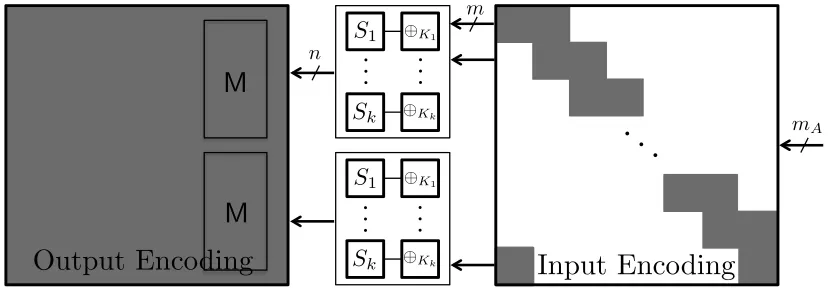
A = 2n, n= 128, and m = 8. However, this approach may lead to large storage requirement. To overcome this problem, we use special “sparse unsplit” encodings, as shown in Fig 5. In the next section, we present an instance of this white-box implementation for concatenations of AES-128 using sparse unsplit encodings that are bijections on
mA= 256.
5 A Proposal for a White-Box Implementation of the AES Cipher
Kk K1 Sk S1 Kk K1 Sk S1
M
M
Output Encoding
Input Encoding
mA m n
..
.
..
.
..
.
..
.
. ..
Fig. 5: The hard-to-invert encoded round function with mA= 2n
ShiftRows(SR),MixColumns(MC), and AddRoundKey(ARK). Each step is a bytewise operation on the 16 bytes. For efficiency, we set the round function AES(r) of AES as follows:
AES(r)= (
MC◦SR◦SB◦ARK, ifr= 1,· · ·,9 SR◦AK◦SB◦ARK, ifr= 10 .
Input and Output Encodings We use sparse unsplit encodings as input encodings like in
equa-tion (5) to reduce the storage: Let Ar ∈
Z256×2562 be an invertible linear map such that Ari,j is the zero matrix for all (i, j) 6= (i, i),(i, i+ 1) and (32,1), where Ar
i,j is (i, j)-th block of Ar when Ar is partitioned into 1024 blocks Ar
i,j of size 8×8 fori, j= 1,· · · ,32. We define an input encodingA(r) of
r-th round of the form⊕ar◦A
r for a 256-bit valuear= (ar
1,· · ·, ar32) whereari’s are 8-bit values. That is,
A(r)(x) =
Ar
1,1 Ar1,2 0 0· · · 0
0 Ar
2,2 Ar2,30· · · 0
..
. ... ... ... . .. ...
Ar
32,1 0 0 0· · · Ar32,32
x1 x2 .. . x32 ⊕ ar 1 ar 2 .. . ar 32 (5)
forx= (x1,· · ·, x32)∈ {0,1}256 with 8-bit valuesxi’s.
For the input encodingA(r+1) of the (r+ 1)-th round, we define the output encoding B(r) of r-th
round by B(r) = (A(r+1))−1◦(MC◦SR,MC◦SR), for r = 1,· · · ,9, where (MC◦SR,MC◦SR) is a
concatenation of MC◦SR on 128 bits. In general, the inversion (Ar)−1 has no sparse characteristics
despite the sparse structure ofAr. (One can easily check it using Gaussian elimination.) Therefore, the output encoding B(r) has no specific structure. Note that nonlinear encodings of small size are used
in the white-box implementation in general and the complexity of removing the nonlinear encodings is not higher than the complexity of finding the affine encodings. We have no consideration for the nonlinear encodings in this section.
Then, the encoded round functionF(r)of AES(r)is defined byF(r) = (A(r+1))−1◦(AES(r),AES(r))◦
A(r) =B(r)◦(S,· · · , S)◦ ⊕(
Kr,Kr)◦A(r) for r = 1,· · ·,9, where S is the S-box function on 8 bits in
theSubBytes step andKr is the secret key of r-th round on 128 bits in the AddRoundKeystep. Since the final round of AES is slightly different from the other rounds, the encoded round function of final round will be discussed later.
Construction of Lookup Tables LetBr
i be a linear mapping from 8 bits to 256 bits fori= 1,· · ·,32 andbrbe a 256-bit value vector such thatB(r)(x) = [Br1| · · · |Br
32](x)⊕brfor any 256-bit valuex. Choose
256-bit random value br
mA m Kr
i
S
2m mA Kr mi
S
2mh
(ir)h
(ir+1)Fig. 6: The lookup tables ofFi(r) and Ti(r)
Now, each 16-bit to 256-bit tableFi(r), depicted in Fig 6, is defined as follows:
Fi(r) =
⊕br i ◦B
r
i ◦S◦ ⊕Kr
i⊕ari ◦(A
r
i,i, Ari,i+1), if 1≤i≤16 ⊕br
i ◦B
r
i ◦S◦ ⊕Kr
i−16⊕ari ◦(A
r
i,i, Ari,i+1), if 17≤i <32 ⊕br
32◦B
r
32◦S◦ ⊕Kr
16⊕ar32◦(A
r
32,32, Ar32,1), if i= 32
whereKr= (Kr
1,· · · , K16r ) is ther-th round key forKir∈ {0,1}8. The affine mapping⊕ari◦(A
r
i,i, Ari,i+1)
from Z162 toZ82 is inserted before S◦ ⊕Kr
i and the affine mapping⊕bri ◦B
r
i from Z82 toZ2562 is inserted
after the S-box part. Then the encoded round function F(r) of AES(r) can be expressed as a sum of
Fi(r)’s:
F(r)(x1, x2,· · ·, x32) =F1(r)(x1, x2)⊕F2(r)(x2, x3)⊕ · · · ⊕F32(r)(x32, x1)
forr= 1,· · ·,9 and 8-bit valuesxi’s. Therefore, the encoded round function F(r)can be implemented
using thirty-two 16-bit to 256-bit lookup tables, instead of implementing a 256-bit to 256-bit table of huge size. However, since Fi(r)(x,0) = ⊕br
i ◦B
r
i ◦S◦ ⊕Kr
i⊕ari ◦A
r
i,i(x) is a 8 bit-to-128 bit function for 8-bit value x, it can be transformed to a bijection on 8 bits by some projection. Then, it is affine equivalent toS, Hence, the affine equivalent algorithm of [3] can be applied to each Fi(r)(x,0) and it has only 225 complexity to recover affine mappings. To prevent the individual attack, we modify the
functions Fi(r)’s. We replace Fi(r) by Ti(r) :Z162 →Z2562 such that
Ti(r)(x, y) = (
Fi(r)(x, y)⊕h(ir)(x)⊕h(ir+1) (y), ifi6= 32
F32(r)(x, y)⊕h(32r)(x)⊕h(1r)(y), ifi= 32
for any random function h(ir) from Z28 toZ2562 and 8-bit values x, y. The resulting lookup tableT (r)
i is depicted in Fig 6. Then, if we set x33:=x1,
32
X
i=1
Ti(r)(xi, xi+1) = 32
X
i=1
Fi(r)(xi, xi+1) =F(r)(x1,· · ·, x32)
for 8-bit valued xi’s. Furthermore, since the functions h(ir) have no certain structure unlike Fi(r), we cannot extract encodings from Ti(r)’s using the affine equivalence algorithm.
Therefore, we can express the encoded round function F(r) as a sum of 16-bit to 256-bit lookup
External Encoding Tables LetMinandMoutbe random affine functions on 256 bits. Then, external
input encoding function F(0) is defined by F(0) = (A(1))−1◦M
in and the encoded round function of
the final round is defined by F(10) =M
out◦(AES(10),AES(10))◦A(10), where AES(10) =⊕K11◦SR◦
(S,· · ·, S)◦ ⊕K10.
Since the external input encoding functionF(0) is an affine function on 256 bits, it is implemented
using a matrix of size 256×256 and a vector of length 256 bits. The external output encoding function
F(10) is split into thirty-two 16-bit to 256-bit lookup tablesT(10)
i by the above design technique.
Security Analysis Since the encoded round functionF(r) is a bijection on 256 bits, computing the
inverse value of F(r) is not an easy task for r = 1,· · ·,10. Therefore, we count the complexity of
computing the inverse of F(r) in the cryptanalysis of our proposed white-box implementation using
SAEA. The hardness of inverting F(r) for r = 1,· · ·,10, which has sparse unsplit encodings can be
considered as a special version of sparse subset sum problem (SSSP) used in [7, 11, 22] to design fully homomorphic encryptions.
If Ar is a block diagonal matrix (i.e., all off-diagonal blocks Ar
ij (i6=j) are zero matrices), then
F(r)is expressed by the summation of theF(r)
i ’s, whereF
(r)
i is a function fromZ82 toZ2562 . For a given
256-bit value y and sets{(x, Fi(r)(x))∈Z82×Z2562 |x∈ {0,1}8}32i=1, computing (F(r))
−1 ofy is to find
the 8-bit values xi such thaty=P32i=1Fi(r)(xi) =F(r)(x1,· · ·, x32). It is equivalent to a variant of the
SSSP problem to finding the coefficientsδi,x, such that
y =
32
X
i=1
X
x∈{0,1}8
δi,x·Fi(r)(x),
where
δi,x∈ {0,1},#{x∈ {0,1}8 |δ1,x= 1}=· · ·= #{x∈ {0,1}8 |δ32,x= 1}= 1.
In this case, if we regard F(r) as a bijection on m
A bits, this SSSP can be solved in Oe(2mA/2) time with Oe(2mA/4) memory using a variant of Schroeppel–Shamir algorithm [21]. This is the same complexity as for the proposed MITM attack. However, the presented implementation uses an unsplit encoding that is not a block diagonal mapping. As a result, the 8-bit value xi is used as the input value of several Tj(r)’s, and the computation of (F(r))−1 is slightly different from that in the SSSP.
Using the unsplit encoding instead of a block diagonal encoding makes the computation of (F(r))−1
from the subfunctions Tj(r) more difficult. Therefore, computing (F(r))−1 from the subfunctions T(r)
j seems as difficult as in the SSSP, and the subfunctionsTj(r) do not help determine the inverse of F(r).
More generally, if we use sparse unsplit input encodings that are affine mappings onmAbits, then the complexity of extracting the secret key in the proposed implementation is
OminnmA12·214,2mA·logmA·2mA/2 o
formA= 128,256,384,· · ·. Table 1 presents the security level and storage requirements of the proposed implementation for mA = 128,256,384. The attack complexity can be up to 2110 and 2117 when
mA
Security Storage
minnmA12·214,2mA·logmA·2mA/2 o
mA 8 ·mA·2
16 bits 128 2mA·logmA·2mA/2= 275 16 MB×(# of rounds) 256 mA12·214= 2110 64 MB×(# of rounds) 384 mA12·214= 2117 144 MB×(# of rounds)
Table 1:The security and storage of the proposed white-box AES implementation formA= 128,256,384
6 Conclusion
In this paper, we proposed a general analytic toolbox for white-box implementation, which can effi-ciently extract the secret encodings used to obfuscate in the implementation when its design follows CEJO framework. With our toolbox, it is very easy to evaluate the asymptotic complexity of any white-box implementation of SLT ciphers, and all previous designs belong to this model. Hence, our toolbox could be used to measure the security of white-box implementations.
Another advantage of our toolbox is that we can remove insecure designs at an early stage, and concentrate on more plausible approaches. We showed that the input size of the encodings is the most important factor in the security of a white-box implementation. In this sense, we presented a white-box implementation that uses sparse unsplit input encodings with an input size that is a multiple of the block length. This not only produces high level of security, but also has reasonable storage requirements. Thus, we have developed a good candidate design for a white-box implementation with practical security. We expect that this will lead to the design of a practically secure white-box implementation.
References
1. O. Billet, H. Gilbert, and C. Ech-Chatbi. Cryptanalysis of a White Box AES Implementation. In H. Handschuh and M. A. Hasan, editors,Selected Areas in Cryptography - SAC 2004, volume 3357 ofLNCS, pages 227–240. Springer, 2005.
2. A. Biryukov, C. Bouillaguet, and D. Khovratovich. Cryptographic Schemes Based on the ASASA Structure: Black-box, White-Black-box, and Public-key.IACR Cryptology ePrint Archive, 2014:474, 2014. To appear in ASIACRYPT 2014. 3. A. Biryukov, C. D. Canni´ere, A. Braeken, and B. Preneel. A Toolbox for Cryptanalysis: Linear and Affine Equivalence Algorithms. In E. Biham, editor,Advances in Cryptology - EUROCRYPT 2003, volume 2656 ofLNCS, pages 33–50. Springer, 2003.
4. A. Biryukov and A. Shamir. Structural Cryptanalysis of SASAS. In B. Pfitzmann, editor,Advances in Cryptology -EUROCRYPT 2001, volume 2045 ofLNCS, pages 395–405. Springer, 2001.
5. S. Chow, P. Eisen, H. Johnson, and P. C. V. Oorschot. White-Box Cryptography and an AES Implementation. In K. Nyberg and H. Heys, editors,Selected Areas in Cryptography - SAC 2002, volume 2595 ofLNCS, pages 250–270. Springer, 2003.
6. S. Chow, P. Eisen, H. Johnson, and P. C. van Oorschot. A White-Box DES Implementation for DRM Applications. In J. Feigenbaum, editor, Digital Rights Management - DRM 2002, volume 2696 ofLNCS, pages 1–15. Springer, 2003.
7. J.-S. Coron, D. Naccache, and M. Tibouchi. Public Key Compression and Modulus Switching for Fully Homomorphic Encryption over the Integers. InAdvances in Cryptology - EUROCRYPT 2012, volume 7237 ofLNCS, pages 446–464. Springer, 2012.
8. C. Delerabl´ee, T. Lepoint, P. Paillier, and M. Rivain. White-Box Security Notions for Symmetric Encryption Schemes. In T. Lange, K. Lauter, and P. Lison˘ek, editors,Selected Areas in Cryptography - SAC 2013, LNCS, pages 247–264. Springer, 2014.
9. I. Dinur, O. Dunkelman, N. Keller, and A. Shamir. Efficient Dissection of Composite Problems, with Applications to Cryptanalysis, Knapsacks, and Combinatorial search Problems. In R. Safavi-Naini and R. Canetti, editors,Advances in Cryptology - CRYPTO 2012, volume 7417 ofLNCS, pages 719–740. Springer, 2012.
11. C. Gentry and S. Halevi. Implementing gentry’s fully-homomorphic encryption scheme. InAdvances in Cryptology - EUROCRYPT 2011, volume 6632 ofLNCS, pages 129–148. Springer, 2011.
12. M. Karroumi. Protecting White-Box AES with Dual Ciphers. In K.-H. Rhee and D. Nyang, editors, Information Security and Cryptology - ICISC 2010, volume 6829 ofLNCS, pages 278–291. Springer, 2011.
13. P. Kocher. Timing Attacks on Implementations of Diffie-Hellman, RSA, DSS, and Other Systems. In N. Koblitz, editor,Advances in Cryptology — CRYPTO 1996, volume 1109 ofLNCS, pages 104–113. Springer, 1996.
14. P. Kocher, J. Jaffe, and B. Jun. Differential Power Analysis. In M. Wiener, editor, Advances in Cryptology — CRYPTO 1999, volume 1666 ofLNCS, pages 388–397. Springer, 1999.
15. T. Lepoint, M. Rivain, Y. D. Mulder, P. Roelse, and B. Preneel. Two Attacks on a White-Box AES Implementation. In T. Lange, K. Lauter, and P. Lisonˇek, editors,Selected Areas in Cryptography - SAC 2013, LNCS, pages 265–285. Springer, 2014.
16. W. Michiels, P. Gorissen, and H. D. L. Hollmann. Cryptanalysis of a Generic Class of White-Box Implementations. In R. M. Avanzi, L. Keliher, and F. Sica, editors,Selected Areas in Cryptography - SAC 2008, volume 5381 ofLNCS, pages 414–428. Springer, 2009.
17. Y. D. Mulder, P. Roelse, and B. Preneel. Cryptanalysis of the Xiao - Lai White-Box AES Implementation. In L. R. Knudsen and H. Wu, editors,Selected Areas in Cryptography - SAC 2012, volume 7707 ofLNCS, pages 34–49. Springer, 2013.
18. R. Novak. Spa-based adaptive chosen-ciphertext attack on rsa implementation. In D. Naccache and P. Paillier, editors,Public Key Cryptography - PKC 2002, volume 2274 ofLNCS, pages 252–262. Springer, 2002.
19. J.-J. Quisquater and D. Samyde. ElectroMagnetic Analysis (EMA): Measures and Counter-measures for Smart Cards. In I. Attali and T. Jensen, editors, Smart Card Programming and Security, volume 2140 of LNCS, pages 200–210. Springer, 2001.
20. A. Saxena, B. Wyseur, and B. Preneel. Towards Security Notions for White-Box Cryptography. In P. Samarati, M. Yung, F. Martinelli, and C. A. Ardagna, editors, Information Security, volume 5735 of LNCS, pages 49–58. Springer, 2009.
21. R. Schroeppel and A. Shamir. A TcS2 = 0 (2n) time/space tradeoff for certain NP-complete problems. InFoundations of Computer Science, 1979., 20th Annual Symposium on, pages 328–336, Oct 1979.
22. N. Smart and F. Vercauteren. Fully homomorphic SIMD operations. Designs, Codes and Cryptography, 71(1):57–81, 2014.
23. B. Wyseur. White-Box Cruptography. PhD thesis, Katholieke Universiteit Leuven, 2009.
24. B. Wyseur, W. Michiels, P. Gorissen, and B. Preneel. Cryptanalysis of White-Box DES Implementations with Arbitrary External Encodings. In C. Adams, A. Miri, and M. Wiener, editors, Selected Areas in Cryptography -SAC 2007, volume 4876 ofLNCS, pages 264–277. Springer, 2007.
25. Y. Xiao and X. Lai. A Secure Implementation of White-box AES. In Computer Science and its Applications -CSA 2009, pages 1–6. IEEE, 2009.
A Proofs of the Lemmas
A.1 Proof of Lemma 1
We may assume thatAis linear, because an addition by a constant preserves propertyPm orEm when
M has an even number of elements. Let A =
a1 · · · an
with column vectors ai’s and A∗ =
ai1 · · · aiτ
. Then we have A(M) =
{A∗(x0) +b | x0 ∈ πI(M)} for some constant vector b ∈ Zm2 . It is enough to show that the multiset
A∗(π
I(M)) has property Pm orEm.
If τ = m and A∗ has rank m, then the multiset A∗(πI(M)) of m-bit values has property Pm. Otherwise, the size of the kernel of A∗ is 2τ−rank(A∗) and hence the number of preimage of y ∈
A∗(π
I(M)) is 2τ−rank(A
∗)
. Since 2τ−rank(A∗)
is even, the multisetA∗(π
I(M)) has propertyEm. It follows
that A∗(πI(M)) has propertyPm orEm.
A.2 Proof of Lemma 2
We can write A(x) =L(x) +bfor some linear mapping Lfrom nbits to mbits and a mbits valueb. Then
X
y∈A(M)
y= X
x∈M
(Lx+b) =L X
x∈M
x
!
+ X
x∈M
b= 0
B The SAEA with split A
When we use the SAEA for the white-box implementation, we can reduce the complexity for the case where input encoding A is of some special form.
For convenience, let A and B be linear. Let’s consider A∈ (Z2)n×n as a ˜A ∈(Zm2 ×m)k×k, where
n=km. If ˜A is block-diagonal map, then we can perform separately the above attack on each block. If the size of the each block of block-diagonal map ˜A is ki with Piki = k, Ai ∈ Zk2im×kim is i-th
block ofA and Bi ∈Z2n×kim isi-th vertical strip ofB correspond toAi, we can find maps of the form
Fi=Bi◦(S,· · ·, S)◦Ai, where (S,· · · , S) is concatenation ofki S-boxes. Since image ofFi has rank
ki, we can find aki×n matrix Ci satisfying that Ci◦Fi is bijective. Then we obtain bijective maps of the following form:
˜
Fi= ˜Bi◦(S,· · · , S)◦Ai
where ˜Bi = Ci ◦Bi. Thus we can recover the encodings in complexity Piki(kim)323m, less than
kn323m.
More generally, if ˜A can be split into two or more bijective map, that is, A is split as defined in section 3.2, we can apply the above argument to ˜A. In detail, in the case that ( ˜A)i,j = 0m×m for (i, j)∈[k1+ 1, k1+k0]×([1, k]\[k2+ 1, k2+k0]) or (i, j)∈([1, k]\[k1+ 1, k1+k0])×[k2+ 1, k2+k0]
fore some k0, k1, k2 with k1+k0, k2+k0 ≤k,
i.e.,A˜is the form of
∗ 0 ∗ 0 A∗0
∗ 0 ∗
, one can obtain a bijective map onZk20m using small submatrix,A ∗
in the above.
C Computing Inverse of F
In order to use the SAEA, several number of evaluation of F−1 are required, so we need to check the complexity to compute the inverse of F. As in Section 3.2, we let F be a bijection on n bits. For simplicity, we assume F(x) = Pkj=1Fj(xj) for Fj :Zm2 → Zn2, where x = (x1,· · · , xk) and xj’s are m-bit values with n =km. A trivial approach to invert F is the exhaustive search, which takes 2n time complexity. One can improve it using the meet-in-the-middle (MITM) attack: By combining functions, we let F(x) =G1(x1,· · ·xbk
2c) +G2(xb k
2c+1,· · · , xk). Fory ∈Z
n
2, one can make a table of ⊕y ◦G1, sort it by the output values, and compare it with the value of G2. Then one can evaluate
F−1(y) in O(n2n/2) time complexity with O(n2n/2) memory. The size of required memory for the
MITM attack is quite large to implement - for example, 238GB are required for n= 128. We provide
another method requiring smaller memory while maintaining asymptotic time complexity. For convenience of notations, we letF(x) =P4
j=1Fj(xj) where x= (x1, x2, x3, x4) and eachxj is
an m0-bit value withm0 = n4. For a functionf whose value is on nbits, ˜f denotes the projection of
f on the first m0 bits. To evaluate F−1(y) for any n-bit valuey, we perform the following steps:
1. Guessm0-bit value ˜z for ˜F1(x1) + ˜F2(x2).
2. Perform the MITM attack using ˜F1(x1) + ˜F2(x2) = ˜z and store the list
L=n(x1, x2, F1(x1) +F2(x2) +y)|F˜1(x1) + ˜F2(x2) = ˜z
o
for the result of the MITM attack.
3. Perform the MITM attack using ˜F3(x3) + ˜F4(x4) = ˜y+ ˜z, where ˜y is the firstm0-bit of y.
4. For each (x3, x4) satisfying ˜F3(x3) + ˜F4(x4) = ˜y+ ˜z, compare F3(x3) +F4(x4) with the values in
Both the average number of elements inLand the number of (x3, x4) satisfying ˜F3(x3) + ˜F4(x4) =
˜
y + ˜z are 2n/4. For one guessing of n
4-bit value, we perform 3 times of MITM attacks on the sets
with 2n/4 cardinality. Therefore, we can evaluate F−1(y) inO(n2n/2) time complexity with O(n2n/4)