Abstract— "The Grid" means the substructure for the Advanced Web, for computing, assistance and correlation. Grid is a type of collateral and distributed system that enables the sharing, assortment, and aggregation of geographically varied "autonomous" resources dynamically at runtime depending on their availability, capability, performance, cost, and users' quality-of-service requirements. In simplest way grid computing is distributed computing taken to the next evolutionary grade. Having an objective to blueprint a delusion of simple yet large and dominant self managing virtual machine (computer) out of a large grid of linked heterogeneous systems sharing various assets.
Grid computing service allows grid users to do any sort of computation that needs any category of hardware or software resource, with restricted resources at the client side. The projected grid computing service takes into description both hardware and software necessities of the submitted computing task. On the other hand our grid system needs to make the most of the overall system throughput, play down the response time and all good resource exploitation. In grid computing we try to clump wide variety of geographically scattered resources, such as supercomputers, storage systems, data sources, and exceptional devices, that can then be used as a unified resource and thus form what is prevalently known as “Computational Grids”.
Index Terms—grid, self-managing, computational grid
Naveen Kumar*, 12071, Department of Computer Science Engineering, Dronacharya College of Engineering, (e-mail: [email protected]). Gurgaon, India, +91-9958919990
Naveen Kumar, 12070, Department of Computer Science Engineering, Dronacharya College of Engineering, (e-mail: [email protected]). Gurgaon, India, +91-9958919990
Rajbir Singh, Department of Computer Science Engineering, Dronacharya College of Engineering, (e-mail: [email protected]). Gurgaon, India, +91-9958919990
Vaibhav Arora, Department of Computer Science Engineering, Dronacharya College of Engineering, (e-mail: [email protected]). Gurgaon, India, +91-9718275095
Vikas Rohilla, Department of Computer Science Engineering, Dronacharya College of Engineering, (e-mail: [email protected]). Gurgaon, India, +91-9990787188
I. INTRODUCTION
The term Grid computing was born in the early 1990s as a allegory for making computer power to work as easy to access as an electric power grid in "The Grid: Blueprint for a new computing infrastructure".
The fame of the Internet as well as the availability of rich and powerful computing gears and high-speed network methodologies as low-cost commodity components is turning the table upside down the way we use computers in today’s world. These technology opportunities have led a path to the possibility of usage of distributed computers as a solo, unified computing resource, leading to Grid computing.
The grid approach to network computing is known by various names, such as metacomputing, scalable computing, global computing, Internet computing, and more recently
peer to peer (P2P) computing [1].
Grids enable the sharing, selection, and collectivity of wide & varied resources including supercomputers, data sources, and specialized devices which are geographically distinct and owned by separate organizations for solving large-scale data vehement problems in science & engineering. Thus creating virtual organizations as envisioned in as a temporary alliance of that come together to share core competencies, or resources in order to better respond to business opportunities or large-scale application processing needs, and whose cooperation is supported by networks.
Figure.1: Grid Computing
As in Fig. 1, the grid is a virtual platform for computing and data management substructure.
• Useful for society globally
Grid Computing
– Business
– Government
– Research
– Science and information
• Dynamically connect together resources
• Enables to operate on large scale , resource vehement,
and distinct applications
• One way -> Parallel and distributed ambience
• Apportion, selection, aggregation of geographically distinct independent resources at time relying on their accessibility, capability, efficiency, cost and final quality of service requirements.
II. SERVICES OFFERED BY GRID
Computational services: These are concerned with providing secure & powerful yet efficient services for operating application services on distributed computational resources individually or collectively. Resource brokers provide accessibility to the services for collective use of distributed resources. A Grid providing these services is often called a Computational Grid. Examples of Computational Grids include NASA IPG, the World Wide Grid, and the NSF TeraGrid [2].
Data services: These are concerned with providing access to distributed datasets securely and their management on a high end basis. To provide a scalable storage and access to the data sets, they may be duplicated and even different datasets stored in different portions to create an illusion of mass storage. The processing of datasets is carried out using Computational Grid services. Such a combo is popularly known as Data Grids. Sample applications that need such services for management and processing of huge datasets are high-energy physics and accessibility to distributed chemical databases for drug design.
Application services: These are mainly concerned with app management and providing accessibility to remote software and libraries transparently. The rising technologies such as
Web services are expected to play a lead role in defining application jobs. They build on computational services provided by the Grid. NetSolve can be used to develop such services.
Information services: These are concerned with the export and presentation of data by making use of the services of computational, data, and application services. Given its key role in many scientific arrangements, the Web is the obvious point of departure for this level.
Knowledge services: These are concerned with the way that knowledge is used, published, and maintained for the assistance of its users in achieving their goals. Knowledge is understood as information applied to achieve a goal, solve a problem, or execute a pending decision. An example of this is
data mining.
III. GRID CONSTRUCTION
Some of the general principles that governs the design features of the grid are:
Multiple administrative domains and autonomy: Grid resources are geographically dispensed across multiple domains and ownership partnered by several organizations. The independence of resource owners needs to be honored along with their resource management and usage policies.
Heterogeneity: A Grid involves a multiplicity of resources that are heterogeneous in nature and will enclose a good range of methods & technologies.
Scalability: A Grid might grow from a few integrated resources to millions. This risks the problem of performance degradation with the increasing size of the Grids. Subsequently, apps that need a large number of geographically located resources must be designed to be latent and bandwidth tolerant.
Dynamicity or Adaptability: Resource failure is the rule rather than the exception in a grid. With many resources in a Grid, the failure of resources is probable. Resource managers must execute their behavior dynamically and use the existing arsenal of resources efficiently and effectively.
Steps to realize a grid:
(i) Collection of individual software and hardware components into a solo unified network resource.
(ii) Unfurl the low level middleware and user level middleware to provide secure access to resources.
(iii) Optimization of distinct applications to take advantage of existing substructure.
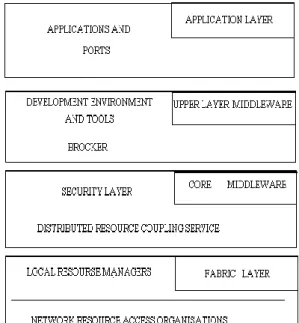
Basic architectural components required to construct a grid:
Grid Fabric: All the resources distributed globally that are accessible from anywhere on the Internet.
Core Grid Middleware: This offers core services such as remote process management, storage access, information registration, and security.
Grid applications and portals: Grid applications are typically developed using Grid-enabled languages such as
HPC++ or MPI. An example is a stricture simulation or a grand-challenge problem [3].
Figure 2: Grid Architecture
Security: A major constraint for grid computing is security. At the pedestal of any grid ambience, there must be methods to provide security, including authentication, authorization, data encryption, etc. The Grid Security Infrastructure (GSI) component of the Globus Toolkit provides high-end security mechanisms [4].
Broker: Once validated, the user will be launching an application. Based on the quality, and possibly on other parameters, the next step is to identify the appropriate resources to use within the grid out of the available ones. Although there is no broker realization provided by Globus, there is an LDAP-based information assessment. This service is called the Grid Information Service (GIS).
Scheduler: Once the resources have been acknowledged, the next rational step is to plan the individual jobs to run on them. If a set of stand-alone jobs are to be executed with no interdependencies, then a dedicated scheduler may not be mandatory. However, if you want to hold back a specific resource or ensure that diverse jobs within the application run in tandem (for instance, if they necessitate inter-process communiqué), then a job scheduler should be used to synchronize the execution of the jobs.
Figure 3: Scheduler
Data management: If any data -- together with application modules -- must be moved or made handy to the nodes where an application's jobs will execute, then there needs to be a safe and sound and unswerving method for moving files and data to various nodes contained by the grid.
Job and resource management: With all the other amenities, we now get to the hub set of services that help carry out actual work in a grid upbringing [5]. The Grid Resource Allocation Manager (GRAM) provides the services to actually commence a job on a fussy resource, check its condition, and regain its results when it is over.
IV. TYPES OF GRIDS
Computational Grid: high recital servers.
Scavenging Grid: A large number of desktops avail CPU cycles and other assets. Admittance is specified to use resources to chip in in the Grid.
Data Grid: Make available access to data transversely to compound organizations and users don't know where the data is sited. For example, two universities doing research with unique data [6].
Two types of grids are supported in the 2D Grid module: mesh-centered grids and cell-centered grids. With a mesh-centered grid, the data values are stored at the corners of the grid cells. With a cell-centered grid, data values are stored at the cell centers.
V. GRIDCOMPUTINGDISTINCTIVENESS
1. Miscellany 2. Decentralization 3. Vitality
1.Miscellany:
Storage guiding principle
Catalog Servers
Application Servers
Diverse kinds of servers
Venture Applications
System Services – Index Services – Safety
– Uniqueness – Executive Services
2.Decentralization:
Traditional Distributed systems managed from central admin peak [7].
Grid computing faces challenges to exercise resources graphically at scattered data centers inside an enterprise.
3. Vitality:
• Grid computing, applications supple and adopt to changing hassle.
• Apparatus of conventional application run in static situation
Ex: Components or administered from diverse nodes in a network arrangement.
• Supervision of resources in an active environment is a face up to.
VI. VANTAGES OF GRID COMPUTING
Easier to join forces with other organizations.
Make improved use of obtainable hardware.
Computers functioning jointly.
Idle computing capability is effectively used [8]
Wide and dispersed computing gives litheness.
Mainframes are idle for 40%, contribution,
collaboration, allotment resources gives more yield.
Large capacity job heaps can be effectively managed
in grid environments.
Drop in the computing expenditure.
Effective exploitation of bandwidth and outlay of
bandwidth.
The main lead of Grid computing is that it offers a customary interface to computing and storage resources. Resources all over the globe can be easily united together, and used by researchers ubiquitously [9]. This facilitates collaboration with other people, because resources can be joint and data communal.
VII. CONCLUSION
There is a natural union of grid services and Web services. This convergence is stirring right now, and it is incident in all industries. It can be practical in the evolutionary philosophy of those people who are a part of VOs and are participating in this renovation. The grid structural design and global principles serve a foremost role in shaping the acceptance rate of grids in the viable world. These principles are still evolving. Grid-service conventions are non-trivial in their functions; they crack some of the deep-seated issues in distributed computing [10].
These issues relate to the identification, creation, breakthrough, monitoring, and supervision of the duration of state full services. More in particular, these conventions bear very imperative distributed computing areas, as well as named service instances, a two-level naming format that facilitates conventional distributed system transparencies, a base lay down of service capabilities, including rich innovation amenities, and unambiguously state full services with lifetime executive capabilities.
There are at present a large number of projects and a diverse array of new and budding Grid expansion approaches being pursued. These systems range from Grid frameworks to application test beds and from collaborative milieus to set compliance mechanisms [11]. It is hard to foresee the future in a turf such as information technology where the technical advances are moving in haste. Hence, it is not an easy task to predict what will turn out to be the ‘dominant’ Grid loom.
REFERENCES
[1] Foster I, Kesselman C The Grid: Blueprint for a Future
Computing Infrastructure. Morgan Kaufmann: San
Francisco, CA, 1999.
[2] Computing & Information Systems
http://www.cs.mu.oz.au/index.php
[3] Melbourne C.L.O.U.D.S Lab
http://www.cloudbus.org/
[4] Introduction to Grid Computing, (IBM Redbooks)
http://www.redbooks.ibm.com/abstracts/
[5] Grid computing by Joshy Joseph
http://dl.acm.org/citation.cfm?id=995621
http://net.educause.edu/ir/library/pdf/DEC0306.pdf
[7] FSU Computer Science
http://www.cs.fsu.edu/research/
[8] Gridalogy
http://www.gridalogy.com/
[9] E.d.u.c.a.u.s.e: Things to be known about Grid
Computing
http://www.educause.edu/library/resources/7-things-y
ou-should-know-about-grid-computing
[10] HowStuffWorks: How Grid Computing Works
http://computer.howstuffworks.com/grid-computing.ht
m
[11] Attributes of Grid Computing
http://docs.oracle.com/cd/E19080-01/n1.grid.eng6/817
-6117/chp1-2/index.html
Naveen Kumar*, Enrollment No. 12071 is a final
year student pursuing B.Tech in Computer Science Engineering at Dronacharya College of Engineering, Gurgaon, India. His research interests include Grid Computing & Networking.
Naveen Kumar, Enrollment No. 12070 is a final
year student pursuing B.Tech in Computer Science Engineering at Dronacharya College of Engineering, Gurgaon, India. His research interests include Grid Computing & Robotics.
Rajbir Singh, Enrollment No. is a final year student pursuing B.Tech in Computer Science Engineering at Dronacharya College of Engineering, Gurgaon, India. His research interests include Grid Computing & Operating Systems.
Vaibhav Arora,
Enrollment No. 12122 is a final year student
pursuing B.Tech in Computer Science
Engineering at Dronacharya College of
Engineering, Gurgaon, India. His
research interests include Grid
Computing & System Architecture.