28
All Rights Reserved © 2012 IJARCSEEEfficient Deconvolution Algorithm
Mrs A.V.P.Sarvari, Mr P.S.S.Chakravarthy, Dr M.Venu Gopal Rao
Abstract— This thesis describes the design of a new deconvolution approach known as Efficient Deconvolution algorithm so that reconstruction image will be free from both blur and noise. This algorithm comprises two steps, a global blur compensation using generalized Wiener filter, followed by a pure local denoising algorithm using dual-tree complex wavelet transform (DT-CWT). The main advantage of this decomposition is that the deconvolution problem is converted into an easier non-white noise removal problem, at the likely price of losing global optimality. Given the increasingly high performance of current denoising methods, this approach has become an appealing practical alternative. Our algorithm has also exploited the properties of DT-CWT viz. nearly shift invariant, excellent directionality and explicit phase information to remove noise without the need for assuming a specific noise model. This algorithm is applicable to all ill-conditioned problems, unlike the purely wavelet based deconvolution algorithm WVD; moreover, its estimate features minimal ringing, unlike the purely Fourier based Wiener deconvolution. Also, the performance of this system is demonstrated based on some comparisons with the best available wavelet-based image denoising techniques.
Index Terms—Deconvolution,DT-CWT,Wiener and WVD
I. INTRODUCTION
In many computed imaging applications, the observed data
Y
can be related to the original imagef
, through a linear model of the formY = Rf + W
where W is an additive noise usually modeled as Poisson or Gaussian noise, and
R
is a linear operator. In image restoration, for example,R
is block Toeplitz and repre-sents the point spread function (PSF) of the imaging system. In Computed Tomogra-phy (CT),R
models the discrete Radon transform. The problem of interest consists in inverting the transform to recover the functionf
from the degraded dataY
. Indeed, this inverse problem is al ill posed since the solution isMrs A.V.P.Sarvari, ECE Department, Narasaraopeta Engineering College ., Guntur, India,09966011426
Mr P.S.S. Chakravarthy, Professor of ECE Department, Narasaraopeta Engineering College ., Guntur, India, 09885854901
Dr M.Venu Gopal Rao, Professor of ECE Department, KL University., Guntur, India, 09490442715
unstable with respect to small perturbations in the projection data. In practical applications, the data
R
f
are known with a limited accuracy (on discrete set only) and are typically and are corrupted by noise, so that some method of regularization for the inversion is needed in order to accurately recover the functionf
and control the amplification of noise in the reconstruction.Several methods have been introduced to deal with the inverse problem associated with the Radon transform, including Fourier methods, backprojection and singular value decomposition. A well known limitation of all these methods is that they usually yield reconstructions where high frequency features, such as edges, are smoothed away with the result that the reconstructed images are blurred versions of the original image. Hence an efficient deconvolution approach is needed.
Fourier domain filtering (Wiener) techniques are much popular and provide most economical representation of noise. However, the weakness of the Fourier transform is that it does not economically represent signals with singularities such as images with edges, because the energy of singularities spread over many Fourier coefficients. This has motivated the use of the Discrete Wavelet Transform (DWT) and its various extensions. The DWT has good energy compaction and decorrelation properties and simple shrinkage operations can be successfully applied to eliminate noisy coeffi-cients. The main limitation of the DWT is that it does not represent the noise econo-mically. Unfortunately, no single transform can sparsely represent both the noise and signals from a general smoothness class. To take advantage of both transform domain, it has been suggested to combine Fourier based deconvolution approaches with wavelet-based denoising methods, forming hybrid techniques which is a new class of restoration methods [1].
29
All Rights Reserved © 2012 IJARCSEEimproves the performance over WVD in some hyperbolic deconvolution problems, most important features in signal are lost during scalar shrinkage due to high noise variance.
Banham and Katsaggelos [4] have applied a multiscale Kalman filter to the deconvolution problem. Their approach employs an under regularized, constrained least square prefilter to reduce the support of the state vectors in the wavelet domain, thereby improving computational efficiency. While similar in spirit to the multiscale Kalman filter approach, Neealamani [1] proposed a hybrid algorithm named as Fourier Wavelet Regularized Deconvolution (ForWaRD) employs simple Wiener or Tikhonov regularization in the Fourier domain to optimize the MSE performance. Figueiredo and Nowak proposed a bound optimization approach to wavelet based image deconvolution [5]. Others techniques can be found in [6,7,8,9,10 ].
The classical DWT used in the above is a very powerful tool for many non-stationary signal processing applications, but suffers from major limitations such as oscillations, shift sensitivity, poor directionality, and absence of phase information. To overcome these limitations many researchers have developed real valued extensions. For example Kingsbury [11] introduced a very elegant computational structure, the dual tree complex wavelet transform (DT-CWT) which employs near-shift invariant and good directional selectivity with little redundancy.
By motivating these concepts, in this section we propose a new efficient and fast hybrid algorithm named Efficient Deconvolution Algorithm for CT. This algorithm comprises two steps (Refer Fig.1), a global blur compensation using generalized Wiener filter, followed by a pure denoising algorithm using dual-tree complex wavelet transform (DT-CWT). The main advantage of this decomposition is that the deconvolution problem is converted into an easier non-white noise removal problem, at the likely price of losing global optimality. Given the increasingly high performance of current denoising methods, this approach has become an appealing practical alternative. Our algorithm has also exploited the properties of DT-CWT viz. nearly shift invariant, excellent directionality and explicit phase information to remove noise without the need for assuming a specific noise model. This algorithm is applicable to all ill-conditioned problems, unlike the purely wavelet based deconvolution algorithm WVD; moreover, its estimate features minimal ringing, unlike the purely Fourier based Wiener deconvolution [12]. Also, the performance of this system will be demonstrated based on some comparisons with the best available wavelet-based image denoising techniques.
Fig. 1. Proposed Restoration Scheme
There exists a vast literature on iterative deconvolution techniques; [13,14 & 15] and the references therein. In this chapter, we focus exclusively on non-iterative techniques for the sake of implementation speed and simplicity. However many iterative techniques could exploit the ComForWaRD estimate as a seed to initialize their iterations; for example [16]. We briefly outline the fundamentals of Wavelet Transform in Section A and then the dual tree complex wavelet transform in Section B. The proposed two step algorithm is described in Section C. Computer simulations, results are discussed in section D.
A. Fundamentals of Wavelet Transforms
Wavelets are functions derived by shifts in position and scale from a single function
( )
t
called the basic (mother) wavelet. It is possible to construct orthonormal wavelet basis, from a so-called scaling function
( )
t
, which is the basic wavelet can be associated in a unique way. The function( )
t
generates a so called multi resolution analysis (MRA)represented by the basis functions
( )
2
j/2(2
j)
jk
t
t k
,and
jk( )
t
2
j/2
(2
jt k
), ,
j k
Ζ
where Z is a setof integers. The refinement equations of scaling and wavelet
functions are given by
( )
2
1/2 0[ ] (2
)
n
t
h n
t n
and1/2 1
( )
2
[ ] (2
)
n
t
h n
t n
, where0
[ ]
h n
and 1[ ]
h n
are a pair of digital low-pass and high pass quadrature mirror filters that are related through
h n
1[ ] ( 1)
nh
0[1
n
]
.Any finite energy analog signal
x t
( )
can be decomposed in terms of wavelets and scaling functions via
/2
0
( )
[ ] (
)
[ , ]2
j(2
j)
n j n
x t
c n
t n
d j n
t n
The scaling coefficients
c n
[ ]
and wavelet coefficients[ , ]
d j n
are computed via the inner products[ ]
( ) (
)
c n
x t
t n dt
and /2[ , ] 2
j( ) (2
j)
d j n
x t
t n dt
. They provide a time-frequency analysis of the signal by measuring its frequency content (controlled by the scale factor j) at different times (controlled by the time shift n).There exists a very efficient, linear time complexity algorithm to compute the coefficients
c n
( )
andd j n
( , )
from a fine-scale representation of the signal (often simply N30
All Rights Reserved © 2012 IJARCSEEtime support and fast frequency decay (to ensure the analysis is as local as possible in time frequency) and orthogonality to low-order polynomials (vanishing moments) [11].
0
[ ]
g n
andg n
1[ ]
are the corresponding synthesis filters and the reconstruction process is also shown in Fig.2.Fig 2 Multi scale representation (3 stage)(a) Analysis and (b) synthesis filter bank.
B. The Dual Tree Complex Wavelet Transform (DT-CWT)
In spite of its efficient computational algorithm and sparse representation, the classical Discrete Wavelet Transform suffers from four fundamental, intertwined short comings: oscillations, shift variance, aliasing and poor directionality. To overcome these limitations Kingsbury [11] proposed Dual Tree Complex Wavelet Transform which is briefly outlined as below.
The DT-CWT is a form of discrete wavelet transform, which generates complex coefficients by using a dual tree of wavelet filters to obtain their real and imaginary parts. The complex wavelet basis is exceptionally useful for denoising purposes, that it provides a high degree of shift-invariance and better directionality compared to the real DWT. The two trees are shown in Fig. 3 for 1-D signals, complex wavelet coefficients are estimated by dual tree algorithm and their magnitude is shift invariant. The DT-CWT can be used for a variety of applications such as denoising, edge detection, image restoration, enhancement, and image compression [17, 18].
Fig 3 The 1-D dual-tree wavelet transform is implemented with a pair of filter banks operating on the same data simultaneously.
2-D Dual-Tree Complex Wavelet Transform
To extend the transform to higher-dimensional signals, a filter bank is usually applied separable in all dimensions. To compute the 2-D DT CWT of images the pair of trees is applied to the rows and then the columns of the image as in the basic DWT. This operation results in six complex
high-pass sub bands at each level and two complex lowhigh-pass subbands on which subsequent stages iterate in contrast to three real high-pass and one real low-pass sub band for the real 2D transform. This shows that the complex transform has a coefficient redundancy of 4:1 or 2n : 1 in n dimensions. The price for high redundancy is a reasonable tradeoff for a shift-invariant, multireso-lution transform. The overall redundancy of the 2-D DT CWT is 4:1, i.e. 4 real num-bers are produced for every input pixel, regardless of how many levels are computed.
We implement the separable 2-D DWT, so that only 1D convolutions and downsampling are required. These results in three bandpass sub images and one lowpass subimage, on which the basic block is iterated. In case of real 2-D filter banks the three highpass subbands have orientations of 0
0
,0
45
and90
0 compared to the complex filters which have six high-pass subbands at each level which are oriented at0 0 0
0 , 15 ,
45 ,
and
75
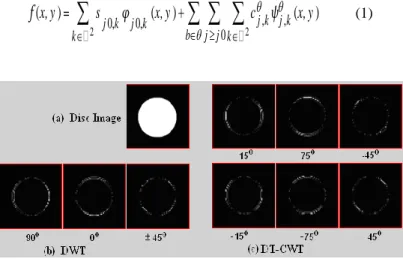
0 (Fig.4).The shift invariance of 2D DT-CWT is illustrated in Fig. 5 shown are the contributions of the different levels for a circular disk image. Reconstructed images are obtained from the respective details coefficients of the different levels of the DWT and DT-CWT. The classical wavelet transform shows aliasing compared to the DT-CWT with images which look better and almost free of the aliasing effect. In 2-D, the CWT decomposes an image
f
(
x, y
)
using dilation and translations of a complex scaling function and six complex wavelet functions
2 0, 0, 0 2 , ,
(
)
(
) +
j k j k(
)
j k j k
b j j
k k
x, y
s
x, y
c
x, y
f
=
φ
ψ
(1)Fig 4. Complex filter response showing the orientations of the complex wavelets (a) Original disc image, (b) DWT has three orientations of 00, 450,
900, and (c) DT-CWT has six directions oriented at 0 , 15 , 45 ,0 0 0 and
0
75
31
All Rights Reserved © 2012 IJARCSEEFig .5 Comparison of the shift invariance for (a) DWT and (b) DT CWT.
C Two Step Algorithm
With this back ground theory, the block diagram of proposed Efficient Deconvolution algorithm for Tomographic image reconstruction is shown inFig 6 described as follows.
Fig .6 Block diagram of ComForWaRD Algorithm.
Step1: Global Blur Compensation
This step provides a blur compensated image by applying a global filtering to the observed image. We use a generalized Wiener filter and defined as
2
( , ) *
( , )
|
( , ) |
( , )
z
f
H u v
P u v
H u v
P
u v
(2)
where
H
*
is complex conjugate ofH
,P
f andP
z are thepower density spectrum
of
f
andz
respectively, and
0
is commonly referred to as regularization parameter, that control the amount of shrinkage. Low values result in very noisy intermediate images (
0
is just an inverse filter) where as high values smooth out the high frequencies. For
1
the compensation is the Wiener filtering, which provides too smooth global restoration results. Therefore we will consider
values lying in the (0, 1) interval. Finally the deblurring estimation is given by,2
( , )*
( , ) ( , ) ( , ) ( , ) | ( , ) |
( , )
z
f H u v
F u v G u v G u v
P u v H u v
P u v
(3)
Selection of Regularization Parameter
Nowak and Thul [19] used an under regularized linear filter (
0
1
), followed by wavelet denoising. Neelamani studied the effect of the amount of regularization and found0.25
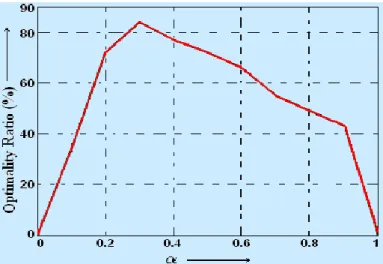
usually gave good results [1]. Other techniques can be found [20,21]. Due to lacking a proper model, we have done it empirically by training with a set of four medicalimages, Gaussian PSFs and various noise variances respectively in logarithmic steps. For each blur / noise combination the optimal
value is found to be approximately 0.3 (see Fig 7).Step.2 Local Adaptive Denoising of the compensated observation.
After step 1, the observation yields
F
H F
r
Z
1, whereH
r
H
and1
Z
Z
.We could approach the problem as another deblurring step, but in practice the residual
blur
H
r is small and can be neglected. Hence the blur compensation estimation is interpreted as deblurred, but noisy signal estimateF
F
Z
. The corresponding spatialdomain expression is
f
( , )
x y
f x y
( , )
z x y
( , )
. For the second step we have used the local adaptive denoising algorithm using dual tree complex wavelet transform (Fig. 6) which is described as follows.
Fig 7 Optimality ratio for each
value.Local Image Denoising
Among the wavelet-based noise reduction techniques, non-linear thresholding is simple yet very effective. One method applied by Donoho [22] and their collaborators, has been the use of transform based thresholding, working in three steps:
Transform the noisy data into an orthogonal domain, apply non linear thresholding andTransform back into the original space domain[23].
Selection of a thresholding technique and determining the corresponding threshold value are the key objectives in image denoising [24]. There are various types of thresholding techniques, two of these are: hard- and soft thresholding. The strategy for hard-thresholding is either to keep or to remove, based on absolute values of wavelet coefficients with respect to a fixed threshold. The soft thresholding method shrinks all the coefficients towards the origin [25,26]. (For complete details refer Appendix-A).
32
All Rights Reserved © 2012 IJARCSEEachieve near optimal minimax rate over a large range of Besov spaces [22]. Second, in practice, the soft thresholding method yields more visually pleasant images over hard thresholding because the latter is discontinuous and yields abrupt artifacts in the recovered images, especially when the noise energy is significant [23].
Level dependent thresholding:
Level-dependent thresholding has been proposed to improve the performance of wavelet thresholding method. Instead of using a global threshold, level-dependent thresholding uses a group of thresholds, one for each scale level. One popular level-dependent thresholding scheme [24] is to set the threshold as:
( )/2
,
2log( )
2
j J,
0,1,...,
j k n
T
k
j
J
(eq. 4)
where
k
is the total number of signal samples,J
is the number of decomposition levels,n
is the noise standard deviation andj
is the scale level. This scheme uses a larger threshold at finer scale levels. It can be interpreted as:1. Order the wavelet coefficients with respect to their magnitudes adjusted by scale level as multiplied by
/2
2
j , wherej
is the scale level associated with each coefficient.2. Apply global threshold
T
k
2 log( )
k
n2
J/ 2. This suggests that the level-dependent thresholding be viewed as a special case of more sophisticated importance ordering in model selection based denoising method. We use level dependent thresholding in our denoising algorithm. The actual denoising is achieved by thresholding the coefficients with thresholds that are scale wise adaptive. For a given blurred and noisy image, the proposed algorithm is summarized as below.Summary of the ComForWaRD algorithm Step1: Global Blur Compensation
Using regularized inverse or Wiener filter, obtain the deblurred but noisy signal estimate
F
F
N
or
f
( , )
x y
f x y
( , )
z x y
( , )
using eq(3).Step.2 Local Denoising of the compensated observation.
(i). For a chosen number of sub band level, perform Dual Tree Complex Wavelet
Transform on the noisy image to obtain both the real and complex wavelet coefficients.
(ii). Calculate both real and complex threshold values for each subband using eq(4).
(iii). Except the residual all the detail (horizontal, vertical and diagonal) coefficients in all sub bands are filtered in wavelet domain to give real and imaginary part of wavelet coefficients.
(iv). Perform the Inverse Dual Tree Complex Wavelet Transforms of the thresholded wavelet coefficients to obtain the denoised estimate.
D. Computer Simulations, Results and Discussion
Three blurring kernels (i)
h x y
( , ) 1/
x
2
y
2 , (ii) Boxcar blur and (iii) circular blur with radius 9 are used for blurring operation and Blur Signal to Noise Ratios (BSNR) of 20dB, and 40dB are used to obtain blurred and noisy image. The proposed method employs Daubechies nearly symmetric compactly supported wavelet with 8 vanishing moments with 4 scales of orthogonal decomposition for complex Wavelet transform [12]. We illustrate and compare the performance of the proposed method on noisy blurred phantom and CT images with existing methods such as ForWaRD of [96] in undecimated discrete wavelet transform (UDWT). The 3Dplot of
h x y
( , ) 1/
x
2
y
2 and corresponding 2D regularization filter is illustrated in Fig 8.The 2D Ramp filter performance for various alpha values is shown in Fig 9. Fig 10 shows the noisy sinogram (with
20
) and conventional FBP reconstruction. The results for proposed algorithm and comparison with various deconvolution techniques are illustrated in Fig 11. Corresponding horizontal intensity line profile comparison is shown in Fig 12. We also conducted experiments with box car blur and circular blur and corresponding results are demonstrated in Fig 13 and Fig 14 respectively.Quality Measure
Image quality measures play an important role in various image-processing applica-tions. A great deal of effort has been made in recent years to develop several image quality metrics in addition to visual analysis to predict the visible differences between a pair of images, the input image
( , )
33
All Rights Reserved © 2012 IJARCSEETable 1 Image Quality Assessment Metrics
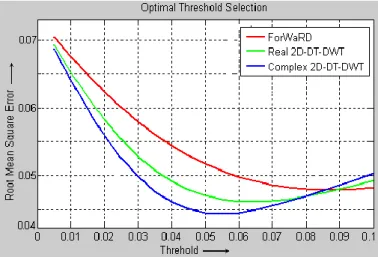
Fig 11,13and 14 illustrate the various signal to noise ratio comparison for three test images shown in Fig 15, and Logan Head phantom. The thresholding parameter for Shepp-Logan head phantom (BSNR = 40 dB) is selected in the optimal sense and is represented in Fig 16. For example we can observe that both SNR and PSNR improvement of praposed method over ForWaRD-DWT is 1.56 dB (Shepp-Logan phantom) for BSNR = 20. The proposed method takes around 2.61 seconds, much faster than the undecimated discrete wavelet transform (UDWT) which takes around 24.265 seconds for Pelvic image in Intel Pentium IV, 2.8 GHz PC with 512 MB RAM. The total computational complexity is
O(N log (N)) for the proposed algorithm where as for UDWT is O(N log(N))2. Over all, the simulation results show that the proposed algorithm demonstrates a good performance
Fig 15 Test images (a) Industrial Phantom (b) Pelvic Image (c) Thyroid Image
Fig 8 Blurring and Filter kernels plots (a) 3D plot of Point spread function or
blurring function h x y( , )1 / x2y2 (b) 2D regularization (ramp) filter in Frequency domain.
Fig 9 The 2D Ramp filter performance for various alpha values.
Fig 10 Noisy Sinogram and its FBP reconstruction (a) Original Shepp-Logan Head Phantom (b) Corresponding Sinogram (c) Noisy Sinogram with
20
. (d) Corresponding FBP reconstructed image
34
All Rights Reserved © 2012 IJARCSEEFig 11 Visual comparison for Shepp-Logan Head Phantom, various deconvolution methods (a) Original Shepp-Logan Head Phantom (b) Blur
and Noisy image with psf h x y( , )1 / x2y2 (c) Wiener filtered image (d) WVD (e) ForWaRD (f) Proposed Algorithm image.
Fig 12 Horizontal intensity line profile comparison for standard Shepp- Logan Head phantom.
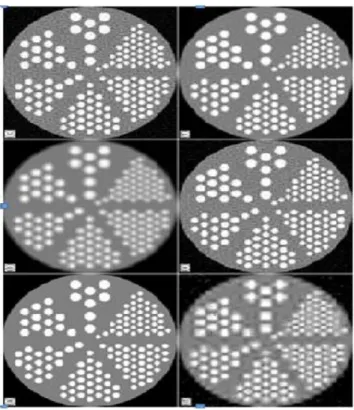
Fig 13 Visual comparison for Thyroid CT coronal image of size 128 X 128, Boxcar blur BSNR = 40 dB (a) Original image (b) Blur and Noisy image (c) Wiener filtered image (d) WVD (e) ForWaRD (f) Proposed Algorithm image.
Fig 14 Visual comparison for various deconvolution methods with circular blur and BSNR = 30 (a) Original Head photon of size 256 X 256image (b) Blur and Noisy image (c) Wiener filtered image (d) WVD (e) ForWaRD (f) Proposed algorithm image.
II. CONCLUSION
35
All Rights Reserved © 2012 IJARCSEEREFERENCES
[ 1 ]Neelamani R., Hyeokho Choi, and Richard Baraniuk,‗ForWaRD: Wavelet Regularized Deconvolution for Ill-Conditioned Systems‘,
IEEE Trans. Signal Processing,Vol. 52, No. 2, Feb. 2004.
[ 2 ]Donoho D. L, ―Nonlinear solution of linear inverse problems by Vaguelette Decomposition,‖ Appl. Comput. Harmon. Anal., vol.2, pp.
101- 126, 1995.
[ 3 ]Kalifa J. and Mallat S.,―Thresholding estimators for linear inverse
problems,‖ Ann. Statist. vol.31, No.1, Feb‘ 2003.
[ 4 ]Banham,M.R. & Katsaggelos, A.K. ―Digital Image Restoration,‖ IEEE
Signal Processing Magazine 14, 24-41, 1997
[ 5 ] Figueiredo M. and Nowak R.D, ― A bound optimization approach to
wavelet based image deconvolution,‖ in IEEE Int. Conf. on Image Proc,
Vol.2, pp 782 - 785, 2005.
[ 6 ] Chambolle A., DeVore R. A., Lee N., and Lucier B. J., ―Nonlinear
wavelet image processing: Variational problems, compression, and noise
removal through wavelet shrinkage,‖ IEEE Trans. Image Processing, vol.
7, pp. 319- 335, Mar.1998
[ 7 ]Demoment, G, ‖Image Reconstruction and Restoration:Overview of
Common Estimation Structures and Problems,‖ IEEE Transactions on
Acoustics, Speech and Signal Processing 37, 2024-2036. 1989.
[ 8 ]Starck J. L., Donoho D. L., and Candes E., ―Very high quality image
restoration,‖ Proc. SPIE, vol. 4478, pp. 9–19, August 2001
[ 9 ]Starck J., Candes E., and Donoho D., ―The curvelet transform for image
denoising,‖ IEEE Trans. Image Proc., vol. 11, no. 6, pp. 670 –684, 2002.
[ 10 ]Sterla V., ―Denoising via block Wiener filtering in wavelet domain,‖ in
Proc.3rd Eur. Congr. Math., Barcelona, Spain, July 2000.
[ 11 ]Kingsbury N. G.,‖ Complex wavelets for shift invariant analysis and
filtering of signals,‖ Applied and Comput Harmonic Analysis,
10(3):234-253, May, 2002.
[ 12 ]Selesnick I. W., ―A new complex-directional wavelet transform and its
application to image denoising,‖ in Proc. Int. Conf. Image Processing,
vol. 3, pp. 573-576, 2002.
[ 13 ]Figueiredo M. and Nowak R. D., ―Image restoration using the EM
algorithm and wavelet based complexity regularization,‖ IEEE Trs. on
Image Processing, July, 2003.
[ 14 ]Hillery A. D. and Chin R. T., ―Iterative Wiener filters for image
restoration‖ IEEE Trans. Signal Processing, vol. 39, pp. 1892–1899,
Aug. 1991.
[ 15 ]Lagendijk, R.L. & Biemond, J., ―Iterative identification and
Restoration of images,” Boston/Dordrecht/London, Kluwer Academic
Publishers., 1991.
[ 16 ]Rivaz P. de and Kingsbury N., ―Bayesian image deconvolution and
Denoising using complex wavelets,‖ in Proc. IEEE ICIP ‘01, vol. 2,
(Thessaloniki, Greece), pp. 273–276, Oct. 7–10, 2001.
[ 17 ]Venu Goapal Rao M., and Vathsal S.,‖ ComForWaRD: Complex
Fourier Wavelet Regularized Deconvolution in CT,‖ International
conference on Computational intelligence and Multimedia applications,
IEEE Computer Society, Vol.3, pp. 240-44. 2007.
[ 18 ]Venu Goapal Rao M., and Vathsal S., ―Complex Fourier Wavelet
Regularized Deconvolution Algorithm and Application to
Computerized Tomography,‖ Proceedings of CT-2008, American
Institute of Physics, USA, 2008.
[ 19 ]Nowak R. D., and Thul M.J., ―Wavelet-Vaguelette restoration in photon
limited imaging,‖ in Proc. IEEE ICASSP ‘98, (Seattle, WA), pp. 2869–
2872,1998.
[ 20 ]Leporini D., Pasquet J.C., and Krim H., ―Best basis representation with
prior statistical models,‖ in Lecture Notes in Statistics, P. Muller and B.
Vidakovic, editors, Springer Verlag 1999, pp.155–172.
[ 21 ]Nikolas P. Galatsanos and Aggelos K. Katasaggelos, ―Methods for
choosing the regularization parameter, and estimating the noise variance
in Image Restoration and their relation,‖ IEEE Trans. on Image
Processing, Vol. 1. No. 3, July 1992.
[ 22 ] Donoho D.L. and Johnstone I., ―Ideal spatial adaptation via wavelet
shrink age,‖ Biometrika, vol.81, pp.435-455, 1994
[ 23 ] Cai Z., Cheng T. H., Lu C., and Subramanian K. R., ―Efficient wavelet
base image denoising algorithm,‖ Electron. Lett., vol. 37,
no.11,pp.683-685, May 2002.
[ 24 ] Clyde M., Parmigiani G., and Vidakovic B., ―Multiple shrinkage and
subset selection in wavelets,‖ Biometrika 85(2), pp. 391–401, 1998.
[ 25 ]Johnstone I.M. and Silverman B.W, ―Wavelet threshold estimators for
data with correlated noise,‖ J. Roy. Statist. Soc. B., 59, 319-351, 1997.
[ 26 ]Venu Goapal Rao M., and Vathsal S., ―Wavelet methods for Noise
reduction in Computed Tomography,‖ at Belarus-Indian Scientific and
technical work shop, New Delhi, 24-26, Feb 2003.
Mrs A.V.P.Sarvari is currently pursuing M.Tech in the stream of Digital Electronics and Communication Systems(DECS) in the Narasaraopet Engineering college, Narasaraopeta, Guntur(Dist), Andhra Pradesh,India
Mr.P.S.S.Chakravarthi is currently working as professor in the department of Electronics and Communication Engineering(ECE) in the Narasaraopet Engineering college,Narasaraopeta, Guntur(Dist),Andhra Pradesh,India.