A Systematic Study of Neural Discourse Models for Implicit Discourse
Relation
Attapol T. Rutherford Yelp
San Francisco, CA, USA
Vera Demberg Saarland University Saarbr¨ucken, Germany
Nianwen Xue Brandeis University Waltham, MA, USA
Abstract
Inferring implicit discourse relations in natural language text is the most difficult subtask in discourse parsing. Many neu-ral network models have been proposed to tackle this problem. However, the com-parison for this task is not unified, so we could hardly draw clear conclusions about the effectiveness of various archi-tectures. Here, we propose neural net-work models that are based on feedfor-ward and long-short term memory archi-tecture and systematically study the effects of varying structures. To our surprise, the best-configured feedforward architecture outperforms LSTM-based model in most cases despite thorough tuning. Further, we compare our best feedforward system with competitive convolutional and recur-rent networks and find that feedforward can actually be more effective. For the first time for this task, we compile and pub-lish outputs from previous neural and non-neural systems to establish the standard for further comparison.
1 Introduction
The discourse structure of a natural language text has been analyzed and conceptualized under vari-ous frameworks (Mann and Thompson, 1988; Las-carides and Asher, 2007; Prasad et al., 2008). The Penn Discourse TreeBank (PDTB) and the Chi-nese Discourse Treebank (CDTB), currently the largest corpora annotated with discourse structures in English and Chinese respectively, view the dis-course structure of a text as a set of disdis-course re-lations (Prasad et al., 2008; Zhou and Xue, 2012). Each discourse relation (e.g. causal or temporal) is
grounded by a discourse connective (e.g. because
ormeanwhile) taking two text segments as
argu-ments (Prasad et al., 2008). Implicit discourse re-lations are those where discourse connectives are omitted from the text and yet the discourse rela-tions still hold.
While classifying explicit discourse relations is relatively easy, as the discourse connective itself provides a strong cue for the discourse relation (Pitler et al., 2008), the classification of implicit discourse relations has proved to be notoriously hard and remained one of the last missing pieces in an end-to-end discourse parser (Xue et al., 2015). In the absence of explicit discourse connectives, implicit discourse relations have to be inferred from their two arguments. Previous approaches on inferring implicit discourse relations have typ-ically relied on features extracted from their two arguments. These features include the Cartesian products of the word tokens in the two arguments as well as features manually crafted from vari-ous lexicons such as verb classes and sentiment lexicons (Pitler et al., 2009; Rutherford and Xue, 2014). These lexicons are used mainly to offset the data sparsity problem created by pairs of word tokens used directly as features.
Neural network models are an attractive alter-native for this task, but it is not clear how well they will fare with a small dataset, typically found in discourse annotation projects. Many neural approaches have been proposed. However, we lack a unified standard comparison to really learn whether we make any progress at all because not all past studies agree on the same experimental settings such as label sets to use. Previous work used four binary classification (Pitler et al., 2008; Rutherford and Xue, 2014) , 4-way coarse sense classification (Rutherford and Xue, 2015) , and in-termediate sense classification (Lin et al., 2009). CoNLL Shared Task introduces a unified scheme for evaluation along with a new unseen test set in English in 2015 (Xue et al., 2015) and in Chinese in 2016 (Xue et al., 2016). We want to
rate this new evaluation scheme by running more benchmark results and providing the output under this evaluation scheme. We systematically com-pare the relative advantages of different neural ar-chitectures and publish the outputs from the sys-tems for the research community to conduct fur-ther analysis.
In this work, we explore multiple neural ar-chitectures in an attempt to find the best dis-tributed representation and neural network archi-tecture suitable for this task in both English and Chinese. We do this by probing the different points on the spectrum of structurality from struc-tureless bag-of-words models to sequential and tree-structured models. We use feedforward, se-quential long short-term memory (LSTM), and tree-structured LSTM models to represent these three points on the spectrum. To the best of our knowledge, there is no prior study that investigates the contribution of the different architectures in neural discourse analysis.
Our main contributions and findings from this work can be summarized as follows:
• We establish that the simplest feedforward
discourse model outperforms systems with surface features and perform comparably with or even outperforms recurrent and con-volutional architectures. This holds across different label sets in English and in Chinese.
• We investigate the contribution of the
linguis-tic structures in neural discourse modeling and found that high-dimensional word vec-tors trained on a large corpus can compensate for the lack of structures in the model, given the small amount of annotated data.
• We collect and publish the system outputs
from many neural architectures on the stan-dard experimental settings for the community to conduct more error analysis. These are made available on the author’s website.
2 Model Architectures
Following previous work, we assume that the two arguments of an implicit discourse relation are given so that we can focus on predicting the senses of the implicit discourse relations. The input to our model is a pair of text segments called Arg1 and Arg2, and the label is one of the senses defined in the Penn
. . . w1 w2 wn
Arg1
. . . w1 w2 wn
Arg2 Word vectors
Arg vectors (Pooling) Hidden layer Output layer
. . .
w1 w2 wn
s1 s2 sn
Arg1
. . .
w1 w2 wn
s1 s2 sn
Arg2 Word vectors
LSTM Arg vectors
(Pooling) Hidden layer Output layer
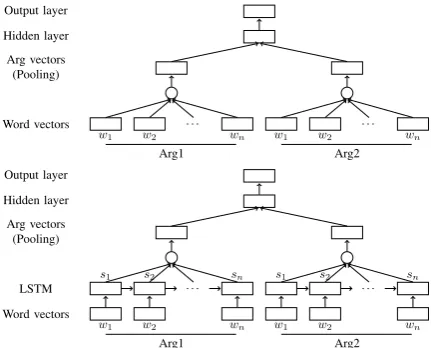
Figure 1: (Top) Feedforward architecture. (Bot-tom) Sequential Long Short-Term Memory archi-tecture.
Discourse Treebank as in the example below:
Input:
Arg1 Senator Pete Domenici calls this effort
“the first gift of democracy”
Arg2 The Poles might do better to view it as a
Trojan Horse.
Output:
Sense Comparison.Contrast
In all architectures, each word in the argument
is represented as a k-dimensional word vector
[image:2.595.310.526.62.236.2]trained on an unannotated data set. We use various model architectures to transform the semantics represented by the word vectors into distributed continuous-valued features. In the rest of the section, we explain the details of the neural network architectures that we design for the implicit discourse relations classification task. The models are summarized schematically in Figure 1.
2.1 Bag-of-words Feedforward Model
2014; Blacoe and Lapata, 2012; Mikolov et al., 2013b; Braud and Denis, 2015). The Arg1 vector
a1 and Arg2 vectora2 are computed by applying
element-wise pooling functionf on all of theN1
word vectors in Arg1w1
1:N1 and all of theN2word
vectors in Arg2w2
1:N2 respectively:
a1i =f(w11:N1,i)
a2i =f(w21:N2,i)
We consider three different pooling functions namely max, summation, and mean pooling func-tions:
fmax(w1:N, i) = maxjN=1 wj,i
fsum(w1:N, i) = N
X
j=1
wj,i
fmean(w1:N, i) = N
X
j=1
wj,i/N
Inter-argument interaction is modeled directly by the hidden layers that take argument vectors as features. Discourse relations cannot be deter-mined based on the two arguments individually. Instead, the sense of the relation can only be deter-mined when the arguments in a discourse relation
are analyzed jointly. The first hidden layerh1 is
the non-linear transformation of the weighted lin-ear combination of the argument vectors:
h1 = tanh(W1·a1+W2·a2+bh1)
whereW1 andW2 ared×kweight matrices and
bh1 is ad-dimensional bias vector. Further hidden
layershtand the output layerofollow the standard
feedforward neural network model.
ht= tanh(Wht ·ht−1+bht)
o=softmax(Wo·hT +bo)
where Wht is a d×dweight matrix, bht is ad
-dimensional bias vector, and T is the number of
hidden layers in the network.
2.2 Sequential Long Short-Term Memory (LSTM)
A sequential Long Short-Term Memory Recurrent Neural Network (LSTM-RNN) models the seman-tics of a sequence of words through the use of hid-den state vectors. Therefore, the word ordering does affect the resulting hidden state vectors, un-like the bag-of-word model. For each word vector
at word positiont, we compute the corresponding
hidden state vector st and the memory cell
vec-tor from the previous step, using standard formula for LSTM. The argument vectors are the results of applying a pooling function over the hidden state vectors.
a1
i =f(s11:N1,i)
a2
i =f(s21:N2,i)
In addition to the three pooling functions that we describe in the previous subsection, we also con-sider using only the last hidden state vector, which should theoretically be able to encode the seman-tics of the entire word sequence.
flast(s1:N,i) =sN,i
Inter-argument interaction and the output layer are modeled in the same fashion as the bag-of-words model once the argument vector is computed.
2.3 Tree LSTM
The principle of compositionality leads us to be-lieve that the semantics of the argument vector should be determined by the syntactic structures and the meanings of the constituents. For a fair comparison with the sequential model, we apply the same formulation of LSTM on the binarized constituent parse tree. The hidden state vector now corresponds to a constituent in the tree. These hid-den state vectors are then used in the same fashion as the sequential LSTM. The mathematical formu-lation is the same as Tai et al. (2015).
This model is similar to the recursive neural networks proposed by Ji and Eisenstein (2015). Our model differs from their model in several ways. We use the LSTM networks instead of the “vanilla” RNN formula and expect better results due to less complication with vanishing and ex-ploding gradients during training. Furthermore, our purpose is to compare the influence of the model structures. Therefore, we must use LSTM cells in both sequential and tree LSTM models for a fair and meaningful comparison. The more in-depth comparison of our work and recursive neu-ral network model by Ji and Eisenstein (2015) is provided in the discussion section.
3 Corpora and Implementation
Sense Train Dev Test Comparison.Concession 192 5 5 Comparison.Contrast 1612 82 127 Contingency.Cause 3376 120 197 Contingency.Pragmatic cause 56 2 5 Expansion.Alternative 153 2 15 Expansion.Conjunction 2890 115 116 Expansion.Instantiation 1132 47 69
Expansion.List 337 5 25
Expansion.Restatement 2486 101 190 Temporal.Asynchronous 543 28 12
Temporal.Synchrony 153 8 5
[image:4.595.76.286.62.197.2]Total 12930 515 766
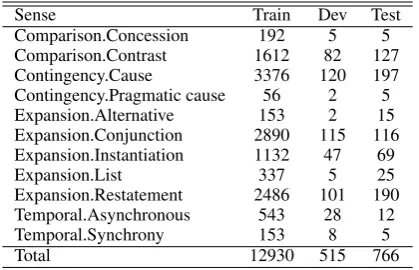
Table 1: The distribution of the level 2 sense labels in the Penn Discourse Treebank. The instances annotated with two labels are not double-counted, and partial labels are excluded.
annotation is done as another layer on the Penn Treebank on Wall Street Journal sections. Each relation consists of two spans of text that are minimally required to infer the relation, and the sense is organized hierarchically. The classifica-tion problem can be formulated in various ways based on the hierarchy. Previous work in this task has been done over three schemes of evalu-ation: top-level 4-way classification (Pitler et al., 2009), second-level 11-way classification (Lin et al., 2009; Ji and Eisenstein, 2015), and modi-fied second-level classification introduced in the CoNLL 2015 Shared Task (Xue et al., 2015). We focus on the second-level 11-way classification because the labels are fine-grained enough to be useful for downstream tasks and also because the strongest neural network systems are tuned to this formulation. If an instance is annotated with two labels (∼3% of the data), we only use the first
la-bel. Partial labels, which constitute ∼2% of the
data, are excluded. Table 3 shows the distribution of labels in the training set (sections 2-21), devel-opment set (section 22), and test set (section 23).
TrainingWeight initialization is uniform random, following the formula recommended by Bengio (2012). The cost function is the standard cross-entropy loss function, as the hinge loss function (large-margin framework) yields consistently in-ferior results. We use Adagrad as the optimiza-tion algorithm of choice. The learning rates are tuned over a grid search. We monitor the accuracy on the development set to determine convergence and prevent overfitting. L2 regularization and/or dropout do not make a big impact on performance in our case, so we do not use them in the final
re-sults.
Implementation All of the models are imple-mented in Theano (Bergstra et al., 2010; Bastien et al., 2012). The gradient computation is done with symbolic differentiation, a functionality pro-vided by Theano. Feedforward models and se-quential LSTM models are trained on CPUs on Intel Xeon X5690 3.47GHz, using only a single core per model. A tree LSTM model is trained on a GPU on Intel Xeon CPU E5-2660. All models converge within hours.
4 Experiment on the Second-level Sense in the PDTB
We want to test the effectiveness of the inter-argument interaction and the three models de-scribed above on the fine-grained discourse rela-tions in English. The data split and the label set are exactly the same as previous works that use this label set (Lin et al., 2009; Ji and Eisenstein, 2015).
PreprocessingAll tokenization is taken from the gold standard tokenization in the PTB (Marcus et al., 1993). We use the Berkeley parser to parse all of the data (Petrov et al., 2006). We test the effects of word vector sizes. 50-dimensional and 100-dimensional word vectors are trained on the train-ing sections of WSJ data, which is the same text as the PDTB annotation. Although this seems like too little data, 50-dimensional WSJ-trained word vectors have previously been shown to be the most effective in this task (Ji and Eisenstein, 2015). Additionally, we also test the off-the-shelf word vectors trained on billions of tokens from Google
News data freely available with the word2vec
tool. All word vectors are trained on the Skip-gram architecture (Mikolov et al., 2013b; Mikolov et al., 2013a). Other models such as GloVe and continuous bag-of-words seem to yield broadly similar results (Pennington et al., 2014). We keep the word vectors fixed, instead of fine-tuning dur-ing traindur-ing.
4.1 Results
var-No hidden layer 1 hidden layer 2 hidden layers Architecture k max mean sum last max mean sum last max mean sum last Feedforward 50 31.85 31.98 29.24 - 33.28 34.98 37.85 - 34.85 35.5 38.51 -LSTM 50 31.85 32.11 34.46 31.85 34.07 33.15 36.16 34.34 36.16 35.11 37.2 35.24 Tree LSTM 50 28.59 28.32 30.93 28.72 29.89 30.15 32.5 31.59 32.11 31.2 32.5 29.63 Feedforward 100 33.29 32.77 28.72 - 36.55 35.64 37.21 - 36.55 36.29 37.47 -LSTM 100 30.54 33.81 35.9 33.02 36.81 34.98 37.33 35.11 37.46 36.68 37.2 35.77 Tree LSTM 100 29.76 28.72 31.72 31.98 31.33 26.89 33.02 33.68 32.63 31.07 32.24 33.02 Feedforward 300 32.51 34.46 35.12 - 35.77 38.25 39.56 - 35.25 38.51 39.03 -LSTM 300 28.72 34.59 35.24 34.64 38.25 36.42 37.07 35.5 38.38 37.72 37.2 36.29 Tree LSTM 300 28.45 31.59 32.76 26.76 33.81 32.89 33.94 32.63 32.11 32.76 34.07 32.50
Table 3: Compilation of all experimental configurations for 11-way classification on the PDTB test set.
kis the word vector size. Bold-faced numbers indicate the best performance for each architecture, which
is also shown in Table 2.
Model Accuracy
PDTB Second-level senses
Most frequent tag baseline 25.71
Our best tree LSTM 34.07
Ji & Eisenstein, (2015) 36.98
Our best sequential LSTM variant 38.38
Our best feedforward variant 39.56
[image:5.595.77.288.239.358.2]Lin et al., (2009) 40.20
Table 2: Performance comparison across different models for second-level senses.
● ●
●
●
● ●
● ●
36.55 35.64
37.21
29.37
36.81 34.98
37.33
35.11
25 30 35 40
Feedforward LSTM
Architecture
Accur
acy
Pooling ● Last ● Mean ● Max ● Summation
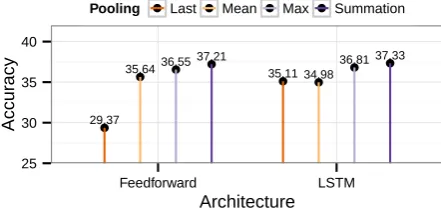
Figure 2: Summation pooling gives the best per-formance in general. The results are shown for the systems using 100-dimensional word vectors and one hidden layer.
ious lexical and syntactic features and extensive feature selection. Tree LSTM achieves inferior accuracy than our best feedforward model. The best configuration of the feedforward model uses 300-dimensional word vectors, one hidden layer, and the summation pooling function to derive ar-gument feature vectors. The model behaves well during training and converges in less than an hour on a CPU.
The sequential LSTM model outperforms the feedforward model when word vectors are not high-dimensional and not trained on a large
cor-● ● ●
● ● ●
● ● ●
29.24 37.85 38.51
28.72 37.21 37.47
35.12 39.56 39.03
25 30 35 40
50 100 300
Embedding Size
Accur
acy
Number of Hidden Layers 0 1 2
Figure 3: Inter-argument interaction can be mod-eled effectively with hidden layers. The results are shown for the feedforward models with summa-tion pooling, but this effect can be observed ro-bustly in all architectures we consider.
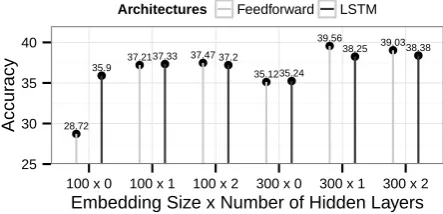
pus (Figure 4). Moving from 50 units to 100 units trained on the same dataset, we do not observe much of a difference in performance in both ar-chitectures, but the sequential LSTM model beats the feedforward model in both settings (Table 3). This suggests that only 50 dimensions are needed for the WSJ corpus. However, the trend reverses when we move to 300-dimensional word vectors trained on a much larger corpus. These results suggest an interaction between the lexical infor-mation encoded by word vectors and the structural information encoded by the model itself.
[image:5.595.312.533.243.351.2] [image:5.595.75.296.408.516.2]●
● ● ● ● ●
● ● ●
● ● ●
28.72 35.9
37.2137.33 37.47 37.2
35.1235.24 39.56
38.25 39.0338.38
25 30 35 40
100 x 0 100 x 1 100 x 2 300 x 0 300 x 1 300 x 2
Embedding Size x Number of Hidden Layers
Accur
acy
[image:6.595.75.297.68.175.2]Architectures Feedforward LSTM
Figure 4: Comparison between feedforward and sequential LSTM when using summation pooling function.
have sufficient data to fit those extra parameters. Summation pooling is effective for both feed-forward and LSTM models (Figure 2). The word vectors we use have been claimed to have some ad-ditive properties (Mikolov et al., 2013b), so sum-mation pooling in this experiment supports this claim. Max pooling is only effective for LSTM, probably because the values in the word vector en-code the abstract features of each word relative to each other. It can be trivially shown that if all of the vectors are multiplied by -1, then the results from max pooling will be totally different, but the word similarities remain the same. The memory cells and the state vectors in the LSTM models transform the original word vectors to work well the max pooling operation, but the feedforward net cannot transform the word vectors to work well with max pooling as it is not allowed to change the word vectors themselves.
4.2 Why does the feedforward model outperform the LSTM models?
Summing up vectors indeed works better than re-current models. We provide further evidence for this claim in Section 5. Sequential and tree LSTM models might work better if we are given larger amount of data. We observe that LSTM mod-els outperform the feedforward model when word vectors are smaller, so it is unlikely that we train the LSTMs incorrectly. It is more likely that we do not have enough annotated data to train a more powerful model such as LSTM. In previous work, LSTMs are applied to tasks with a lot of la-beled data compared to mere 12,930 instances that we have (Vinyals et al., 2015; Chiu and Nichols, 2015; ˙Irsoy and Cardie, 2014). Another explana-tion comes from the fact that the contextual infor-mation encoded in the word vectors can
compen-sate for the lack of structure in the model in this task. Word vectors are already trained to encode the words in their linguistic context especially in-formation from word order.
Our discussion would not be complete without explaining our results in relation to the recursive neural network model proposed by Ji and Eisen-stein (2015). Why do sequential LSTM mod-els outperform recursive neural networks or tree LSTM models? Although this first comes as a sur-prise to us, the results are consistent with recent works that use sequential LSTM to encode syntac-tic information. For example, Vinyals et al. (2015) use sequential LSTM to encode the features for syntactic parse output. Tree LSTM seems to show improvement when there is a need to model long-distance dependency in the data (Tai et al., 2015; Li et al., 2015). Furthermore, the benefits of tree LSTM are not readily apparent for a model that discards the syntactic categories in the intermedi-ate nodes and makes no distinction between heads and their dependents, which are at the core of syn-tactic representations.
Another point of contrast between our work and Ji and Eisenstein’s (2015) is the modeling choice for inter-argument interaction. Our experimen-tal results show that the hidden layers are an im-portant contributor to the performance for all of our models. We choose linear inter-argument in-teraction instead of bilinear inin-teraction, and this decision gives us at least two advantages. Lin-ear interaction allows us to stack up hidden lay-ers without the exponential growth in the number of parameters. Secondly, using linear interaction allows us to use high dimensional word vectors, which we found to be another important compo-nent for the performance. The recursive model by Ji and Eisenstein (2015) is limited to 50 units due to the bilinear layer. Our choice of linear inter-argument interaction and high-dimensional word vectors turns out to be crucial to building a com-petitive neural network model for classifying im-plicit discourse relations.
5 Extending the results across neural architectures, label sets, and languages
our models on non-explicit discourse relation data used in English and Chinese CoNLL 2016 Shared Task.
5.1 English discourse relations
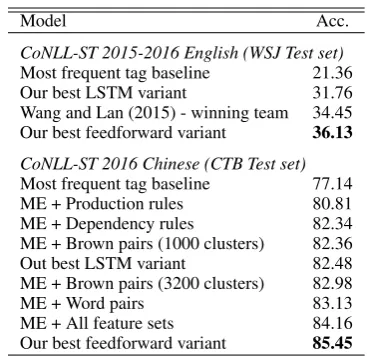
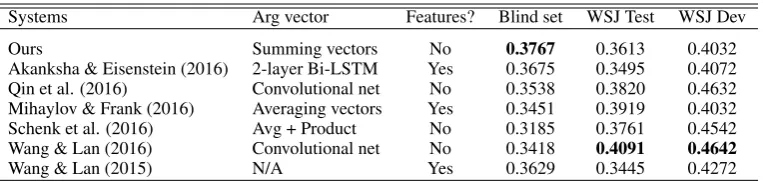
We follow the experimental setting used in CoNLL 2015-2016 Shared Task. To compare our results against previous systems, we compile all of the official system outputs, and make them pub-licly available. The label set is modified by the shared task organizers into 15 different senses in-cluding EntRel as another sense (Xue et al., 2015; Xue et al., 2016). We use the 300-dimensional word vector used in the previous experiment and tune the number of hidden layers and hidden units on the development set. We consider the fol-lowing models: Bidirectional-LSTM (Akanksha and Eisenstein, 2016), two flavors of convolutional networks (Qin et al., 2016; Wang and Lan, 2016), two variations of simple argument pooling (Mi-haylov and Frank, 2016; Schenk et al., 2016), and the best system using surface features alone (Wang and Lan, 2015). The comparison results and brief system descriptions are shown in Table 4.
Our model presents the state-of-the-art system on the blind test set in English. We once again confirm that manual features are not necessary for this task and that our feedforward network outper-forms the best available LSTM and convolutional networks in many settings despite its simplicity. While performing well in-domain, convolutional networks degrade sharply when tested on the blind slightly out-of-domain dataset.
5.2 Chinese discourse relations
We evaluate our model on the Chinese Discourse Treebank (CDTB) because its annotation is the most comparable to the PDTB (Zhou and Xue, 2015). The sense set consists of 10 different senses, which are not organized in a hierarchy, unlike the PDTB. We use the version of the data provided to the CoNLL 2016 Shared Task partic-ipants. This version has 16,946 instances of dis-course relations total in the combined training and development sets. The test set is not yet available at the time of submission, so the system is eval-uated based on the average accuracy over 7-fold cross-validation on the combined set of training and development sets.
To establish baseline comparison, we use Max-Ent models loaded with the feature sets previ-ously shown to be effective for English, namely
Model Acc.
CoNLL-ST 2015-2016 English (WSJ Test set) Most frequent tag baseline 21.36 Our best LSTM variant 31.76 Wang and Lan (2015) - winning team 34.45 Our best feedforward variant 36.13
CoNLL-ST 2016 Chinese (CTB Test set) Most frequent tag baseline 77.14 ME + Production rules 80.81 ME + Dependency rules 82.34 ME + Brown pairs (1000 clusters) 82.36 Out best LSTM variant 82.48 ME + Brown pairs (3200 clusters) 82.98
ME + Word pairs 83.13
ME + All feature sets 84.16 Our best feedforward variant 85.45 Table 5: Our best feedforward variant signifi-cantly outperforms the systems with surface
fea-tures (p <0.05). ME=Maximum Entropy model
CBOW Skipgram
0.78 0.80 0.82 0.84
100 200 300 100 200 300
Dimensionality of word vectors
Accur
acy
[image:7.595.323.507.59.237.2]Number of Hidden Layers 0 1 2
Figure 5: Comparing the accuracies across Chi-nese word vectors for feedforward model.
dependency rule pairs, production rule pairs (Lin et al., 2009), Brown cluster pairs (Rutherford and Xue, 2014), and word pairs (Marcu and Echihabi, 2002). We use information gain criteria to select the best subset of each feature set, which is crucial in feature-based discourse parsing.
Chinese word vectors are induced through
CBOW and Skipgram architecture inword2vec
(Mikolov et al., 2013a) on Chinese Gigaword cor-pus (Graff and Chen, 2005) using default settings. The number of dimensions that we try are 50, 100, 150, 200, 250, and 300. We induce 1,000 and 3,000 Brown clusters on the Gigaword corpus.
[image:7.595.308.528.302.433.2]Systems Arg vector Features? Blind set WSJ Test WSJ Dev
Ours Summing vectors No 0.3767 0.3613 0.4032
Akanksha & Eisenstein (2016) 2-layer Bi-LSTM Yes 0.3675 0.3495 0.4072 Qin et al. (2016) Convolutional net No 0.3538 0.3820 0.4632 Mihaylov & Frank (2016) Averaging vectors Yes 0.3451 0.3919 0.4032 Schenk et al. (2016) Avg + Product No 0.3185 0.3761 0.4542 Wang & Lan (2016) Convolutional net No 0.3418 0.4091 0.4642
[image:8.595.110.492.61.152.2]Wang & Lan (2015) N/A Yes 0.3629 0.3445 0.4272
Table 4: Comparing various systems on the CoNLL 2016 Shared Task standard datasets. Manual fea-tures are no longer needed for a competitive system. While performing well in-domain, convolutional networks degrade sharply when tested on the blind slightly out-of-domain dataset.
sets, and our findings are valid across languages. Our Chinese model outperforms all of the feature sets known to work well in English despite using only word vectors. The choice of neural architec-ture used for inducing Chinese word vectors turns out to be crucial. Chinese word vectors from Skip-gram model perform consistently better than the ones from CBOW model (Figure 5). These two types of word vectors do not show much differ-ence in the English tasks.
6 Related Work
The prevailing approach for this task is to use sur-face features derived from various semantic lexi-cons (Pitler et al., 2009), reducing the number of parameters by mapping raw word tokens in the ar-guments of discourse relations to a limited num-ber of entries in a semantic lexicon such as polar-ity and verb classes. Along the same vein, Brown cluster assignments have also been used as a gen-eral purpose lexicon that requires no human man-ual annotation (Rutherford and Xue, 2014). How-ever, these solutions still suffer from the data spar-sity problem and almost always require extensive feature selection to work well (Park and Cardie, 2012; Lin et al., 2009; Ji and Eisenstein, 2015). The work we report here explores the use of the expressive power of distributed representations to overcome the data sparsity problem found in the traditional feature engineering paradigm.
Neural network modeling has been explored to some extent in the context of this task. Re-cently, Braud and Denis (2015) tested various word vectors as features for implicit discourse re-lation classification and show that distributed fea-tures achieve the same level of accuracy as one-hot representations in some experimental settings. Ji et al. (2015; 2016) advance the state of the art for this task by using recursive and recurrent neural networks. In the work we report here, we
systematically explore the use of different neural network architectures and show that when high-dimensional word vectors are used as input, a simple feed-forward architecture can outperform more sophisticated architectures such as sequen-tial and tree-based LSTM networks, given the small amount of data.
Recurrent neural networks, especially LSTM networks, have changed the paradigm of deriving distributed features from a sentence (Hochreiter and Schmidhuber, 1997), but they have not been much explored in the realm of discourse parsing. LSTM models have been notably used to encode the meaning of source language sentence in neu-ral machine translation (Cho et al., 2014; Devlin et al., 2014) and recently used to encode the meaning of an entire sentence to be used as features (Kiros et al., 2015). Many neural architectures have been explored and evaluated, but there is no single tech-nique that is decidedly better across all tasks. The LSTM-based models such as Kiros et al. (2015) perform well across tasks but do not outperform some other strong neural baselines. Ji et al. (2016) uses a joint discourse language model to improve the performance on the coarse-grained label in the PDTB, but in our case, we would like to deduce how well LSTM fares in fine-grained implicit dis-course relation classification, which is more prac-tical for application.
7 Conclusions and future work
this task. These results hold for different settings and different languages. In addition, we collect and compile the system outputs from all competi-tive systems and make it available for the research community to conduct further analysis. We en-courage that researchers who work on this task to evaluate their systems under the CoNLL Shared Task 2015-2016 scheme to allow for easy compar-ison and progress tracking.
Acknowledgments
The first author was funded by the German Re-search Foundation (DFG) as part of SFB 1102: In-formation Density and Linguistic Encoding
References
Akanksha and Jacob Eisenstein. 2016. Shallow discourse parsing using distributed argument rep-resentations and bayesian optimization. CoRR, abs/1606.04503.
Fr´ed´eric Bastien, Pascal Lamblin, Razvan Pascanu, James Bergstra, Ian J. Goodfellow, Arnaud Berg-eron, Nicolas Bouchard, and Yoshua Bengio. 2012. Theano: new features and speed improvements. Deep Learning and Unsupervised Feature Learning NIPS 2012 Workshop.
Yoshua Bengio. 2012. Practical recommendations for gradient-based training of deep architectures. In Neural Networks: Tricks of the Trade, pages 437– 478. Springer.
James Bergstra, Olivier Breuleux, Fr´ed´eric Bastien, Pascal Lamblin, Razvan Pascanu, Guillaume Des-jardins, Joseph Turian, David Warde-Farley, and Yoshua Bengio. 2010. Theano: a CPU and GPU math expression compiler. In Proceedings of the Python for Scientific Computing Conference (SciPy), June. Oral Presentation.
William Blacoe and Mirella Lapata. 2012. A com-parison of vector-based representations for semantic composition. InProceedings of the 2012 Joint Con-ference on Empirical Methods in Natural Language Processing and Computational Natural Language Learning, pages 546–556. Association for Compu-tational Linguistics.
Chlo´e Braud and Pascal Denis. 2015. Comparing word representations for implicit discourse relation classi-fication. InEmpirical Methods in Natural Language Processing (EMNLP 2015).
Jason P.C. Chiu and Eric Nichols. 2015. Named en-tity recognition with bidirectional lstm-cnns. arXiv preprint arXiv:1511.08308.
Kyunghyun Cho, Bart van Merrienboer, Caglar Gul-cehre, Dzmitry Bahdanau, Fethi Bougares, Holger
Schwenk, and Yoshua Bengio. 2014. Learning phrase representations using rnn encoder–decoder for statistical machine translation. InProceedings of the 2014 Conference on Empirical Methods in Nat-ural Language Processing (EMNLP), pages 1724– 1734, Doha, Qatar, October. Association for Com-putational Linguistics.
Jacob Devlin, Rabih Zbib, Zhongqiang Huang, Thomas Lamar, Richard Schwartz, and John Makhoul. 2014. Fast and robust neural network joint models for sta-tistical machine translation. In Proceedings of the 52nd Annual Meeting of the Association for Compu-tational Linguistics, volume 1, pages 1370–1380.
David Graff and Ke Chen. 2005. Chinese gigaword. LDC Catalog No.: LDC2003T09, ISBN, 1:58563– 58230.
Sepp Hochreiter and J¨urgen Schmidhuber. 1997. Long short-term memory. Neural computation, 9(8):1735–1780.
Ozan ˙Irsoy and Claire Cardie. 2014. Opinion mining with deep recurrent neural networks. InProceedings of the Conference on Empirical Methods in Natural Language Processing, pages 720–728.
Yangfeng Ji and Jacob Eisenstein. 2015. One vector is not enough: Entity-augmented distributed semantics for discourse relations. Transactions of the Associa-tion for ComputaAssocia-tional Linguistics, 3:329–344. Yangfeng Ji, Gholamreza Haffari, and Jacob
Eisen-stein. 2016. A latent variable recurrent neural net-work for discourse relation language models. In Proceedings of the 2016 Conference of the North American Chapter of the Association for Computa-tional Linguistics: Human Language Technologies. Ryan Kiros, Yukun Zhu, Ruslan R. Salakhutdinov,
Richard Zemel, Raquel Urtasun, Antonio Torralba, and Sanja Fidler. 2015. Skip-thought vectors. InAdvances in Neural Information Processing Sys-tems, pages 3276–3284.
Alex Krizhevsky, Ilya Sutskever, and Geoffrey E. Hin-ton. 2012. Imagenet classification with deep con-volutional neural networks. In Advances in neural information processing systems, pages 1097–1105. Alex Lascarides and Nicholas Asher. 2007.
Seg-mented discourse representation theory: Dynamic semantics with discourse structure. In Computing meaning, pages 87–124. Springer.
Quoc V. Le and Tomas Mikolov. 2014. Distributed representations of sentences and documents. arXiv preprint arXiv:1405.4053.
Jiwei Li, Thang Luong, Dan Jurafsky, and Eduard Hovy. 2015. When are tree structures necessary for deep learning of representations? In Proceed-ings of the 2015 Conference on Empirical Methods in Natural Language Processing, pages 2304–2314, Lisbon, Portugal, September. Association for Com-putational Linguistics.
Ziheng Lin, Min-Yen Kan, and Hwee Tou Ng. 2009. Recognizing implicit discourse relations in the penn discourse treebank. InProceedings of the 2009 Con-ference on Empirical Methods in Natural Language Processing: Volume 1-Volume 1, pages 343–351. Association for Computational Linguistics.
William C. Mann and Sandra A. Thompson. 1988. Rhetorical structure theory: Toward a functional the-ory of text organization. Text, 8(3):243–281. Daniel Marcu and Abdessamad Echihabi. 2002. An
unsupervised approach to recognizing discourse re-lations. In Proceedings of the 40th Annual Meet-ing on Association for Computational LMeet-inguistics, pages 368–375. Association for Computational Lin-guistics.
Mitchell P. Marcus, Mary Ann Marcinkiewicz, and Beatrice Santorini. 1993. Building a large anno-tated corpus of english: The penn treebank. Compu-tational linguistics, 19(2):313–330.
Todor Mihaylov and Anette Frank. 2016. Discourse relation sense classification using cross-argument semantic similarity based on word embeddings. In Proceedings of the Twentieth Conference on Compu-tational Natural Language Learning - Shared Task, page 100.
Tomas Mikolov, Kai Chen, Greg Corrado, and Jeffrey Dean. 2013a. Efficient estimation of word represen-tations in vector space.CoRR, abs/1301.3781. Tomas Mikolov, Ilya Sutskever, Kai Chen, Greg S.
Cor-rado, and Jeff Dean. 2013b. Distributed representa-tions of words and phrases and their compositional-ity. InAdvances in Neural Information Processing Systems, pages 3111–3119.
Joonsuk Park and Claire Cardie. 2012. Improving im-plicit discourse relation recognition through feature set optimization. InProceedings of the 13th Annual Meeting of the Special Interest Group on Discourse and Dialogue, pages 108–112. Association for Com-putational Linguistics.
Jeffrey Pennington, Richard Socher, and Christo-pher D. Manning. 2014. Glove: Global vectors for word representation. Proceedings of the Empirical Methods in Natural Language Processing (EMNLP 2014), 12:1532–1543.
Slav Petrov, Leon Barrett, Romain Thibaux, and Dan Klein. 2006. Learning accurate, compact, and interpretable tree annotation. In Proceedings of the 21st International Conference on Computational
Linguistics and the 44th annual meeting of the Asso-ciation for Computational Linguistics, pages 433– 440. Association for Computational Linguistics.
Emily Pitler, Mridhula Raghupathy, Hena Mehta, Ani Nenkova, Alan Lee, and Aravind K Joshi. 2008. Easily identifiable discourse relations. Technical Reports (CIS), page 884.
Emily Pitler, Annie Louis, and Ani Nenkova. 2009. Automatic sense prediction for implicit discourse re-lations in text. InProceedings of the Joint Confer-ence of the 47th Annual Meeting of the ACL and the 4th International Joint Conference on Natural Lan-guage Processing of the AFNLP: Volume 2-Volume 2, pages 683–691. Association for Computational Linguistics.
Rashmi Prasad, Nikhil Dinesh, Alan Lee, Eleni Milt-sakaki, Livio Robaldo, Aravind K. Joshi, and Bon-nie L. Webber. 2008. The penn discourse treebank 2.0. InLREC.
Lianhui Qin, Zhisong Zhang, and Hai Zhao. 2016. Shallow discourse parsing using convolutional neu-ral network. InProceedings of the Twentieth Con-ference on Computational Natural Language Learn-ing - Shared Task, page 70.
Attapol T. Rutherford and Nianwen Xue. 2014. Dis-covering implicit discourse relations through brown cluster pair representation and coreference patterns. In Proceedings of the 14th Conference of the Eu-ropean Chapter of the Association for Computa-tional Linguistics (EACL 2014), Gothenburg, Swe-den, April.
Attapol Rutherford and Nianwen Xue. 2015. Improv-ing the inference of implicit discourse relations via classifying explicit discourse connectives. In Pro-ceedings of the 2015 Conference of the North Amer-ican Chapter of the Association for Computational Linguistics: Human Language Technologies, pages 799–808, Denver, Colorado, May–June. Association for Computational Linguistics.
Niko Schenk, Christian Chiarcos, Kathrin Donandt, Samuel R¨onnqvist, Evgeny A. Stepanov, and Giuseppe Riccardi. 2016. Do we really need all those rich linguistic features? a neural network-based approach to implicit sense labeling. In Pro-ceedings of the Twentieth Conference on Computa-tional Natural Language Learning - Shared Task, page 41.
Oriol Vinyals, Łukasz Kaiser, Terry Koo, Slav Petrov, Ilya Sutskever, and Geoffrey Hinton. 2015. Gram-mar as a foreign language. In C. Cortes, N.D. Lawrence, D.D. Lee, M. Sugiyama, R. Garnett, and R. Garnett, editors,Advances in Neural Information Processing Systems 28, pages 2755–2763. Curran Associates, Inc.
Jianxiang Wang and Man Lan. 2015. A refined end-to-end discourse parser. InProceedings of the Nine-teenth Conference on Computational Natural Lan-guage Learning - Shared Task, pages 17–24, Bei-jing, China, July. Association for Computational Linguistics.
Jianxiang Wang and Man Lan. 2016. Two end-to-end shallow discourse parsers for english and chi-nese in conll-2016 shared task. InProceedings of the Twentieth Conference on Computational Natural Language Learning - Shared Task, page 33. Nianwen Xue, Hwee Tou Ng, Sameer Pradhan, Rashmi
Prasad, Christopher Bryant, and Attapol Ruther-ford. 2015. The conll-2015 shared task on shal-low discourse parsing. InProceedings of the Nine-teenth Conference on Computational Natural Lan-guage Learning - Shared Task, pages 1–16, Beijing, China, July. Association for Computational Linguis-tics.
Nianwen Xue, Hwee Tou Ng, Sameer Pradhan, Bon-nie Webber, Attapol Rutherford, Chuan Wang, and Hongmin Wang. 2016. The conll-2016 shared task on multilingual shallow discourse parsing. In Pro-ceedings of the Twentieth Conference on Computa-tional Natural Language Learning - Shared Task, Berlin, Germany, August. Association for Compu-tational Linguistics.
Yuping Zhou and Nianwen Xue. 2012. Pdtb-style dis-course annotation of chinese text. In Proceedings of the 50th Annual Meeting of the Association for Computational Linguistics: Long Papers-Volume 1, pages 69–77. Association for Computational Lin-guistics.