Improving the IBM Alignment Models Using Variational Bayes
Darcey Riley and Daniel Gildea
Computer Science Dept. University of Rochester Rochester, NY 14627
Abstract
Bayesian approaches have been shown to re-duce the amount of overfitting that occurs when running the EM algorithm, by placing prior probabilities on the model parameters. We apply one such Bayesian technique, vari-ational Bayes, to the IBM models of word alignment for statistical machine translation. We show that using variational Bayes im-proves the performance of the widely used GIZA++ software, as well as improving the overall performance of the Moses machine translation system in terms of BLEU score.
1 Introduction
The IBM Models of word alignment (Brown et al., 1993), along with the Hidden Markov Model (HMM) (Vogel et al., 1996), serve as the starting point for most current state-of-the-art machine trans-lation systems, both phrase-based and syntax-based (Koehn et al., 2007; Chiang, 2005; Galley et al., 2004).
Both the IBM Models and the HMM are trained using the EM algorithm (Dempster et al., 1977). Recently, Bayesian techniques have become widespread in applications of EM to natural lan-guage processing tasks, as a very general method of controlling overfitting. For instance, Johnson (2007) showed the benefits of such techniques when ap-plied to HMMs for unsupervised part of speech tag-ging. In machine translation, Blunsom et al. (2008) and DeNero et al. (2008) use Bayesian techniques to learn bilingual phrase pairs. In this setting, which in-volves finding a segmentation of the input sentences into phrasal units, it is particularly important to con-trol the tendency of EM to choose longer phrases,
which explain the training data well but are unlikely to generalize.
However, most state-of-the-art machine transla-tion systems today are built on the basis of word-level alignments of the type generated by GIZA++ from the IBM Models and the HMM. Overfitting is also a problem in this context, and improving these word alignment systems could be of broad utility in machine translation research.
Moore (2004) discusses details of how EM over-fits the data when training IBM Model 1. He dis-covers that the EM algorithm is particularly suscep-tible to overfitting in the case of rare words, due to the “garbage collection” phenomenon. Suppose a sentence contains an English word e1 that occurs nowhere else in the data, and its French transla-tionf1. Suppose that same sentence also contains a worde2 which occurs frequently in the overall data but whose translation in this sentence,f2, co-occurs with it infrequently. If the translation t(f2|e2) oc-curs with probability0.1, then the sentence will have a higher probability if EM assigns the rare word and its actual translation a probability oft(f1|e1) = 0.5, and assigns the rare word’s translation tof2 a prob-ability oft(f2|e1) = 0.5, than if it assigns a proba-bility of1to the correct translationt(f1|e1). Moore suggests a number of solutions to this issue, includ-ing add-n smoothing and initializing the probabili-ties based on a heuristic rather than choosing uni-form probabilities. When combined, his solutions cause a significant decrease in alignment error rate (AER). More recently, Mermer and Saraclar (2011) have added a Bayesian prior to IBM Model 1 us-ing Gibbs samplus-ing for inference, showus-ing improve-ments in BLEU scores.
In this paper, we describe the results of
rating variational Bayes (VB) into the widely used GIZA++ software for word alignment. We use VB both because it converges more quickly than Gibbs sampling, and because it can be applied in a fairly straightforward manner to all of the models imple-mented by GIZA++. In Section 2, we describe VB in more detail. In Section 3, we present results for VB for the various models, in terms of perplexity of held-out test data, alignment error rate (AER), and the BLEU scores which result from using our ver-sion of GIZA++ in the end-to-end phrase-based ma-chine translation system Moses.
2 Variational Bayes and GIZA++
Beal (2003) gives a detailed derivation of a varia-tional Bayesian algorithm for HMMs. The result is a very slight change to the M step of the original EM algorithm. During the M step of the original al-gorithm, the expected counts collected in the E step are normalized to give the new values of the param-eters:
θxi|y =
E[c(xi|y)]
P
jE[c(xj|y)]
(1)
The variational Bayesian M step performs an inexact normalization, where the resulting parameters will add up to less than one. It does this by passing the expected counts collected in the E step through the function f(v) = exp(ψ(v)), where ψ is the digamma function, andα is the hyperparameter of the Dirichlet prior (Johnson, 2007):
θx
i|y=
f(E[c(xi|y)] +α)
f(P
j(E[c(xj|y)] +α))
(2)
This modified M step can be applied to any model which uses a multinomial distribution; for this rea-son, it works for the IBM Models as well as HMMs, and is thus what we use for GIZA++.
In practice, the digamma function has the effect of subtracting 0.5 from its argument. When α is set to a low value, this results in “anti-smoothing”. For the translation probabilities, because about0.5
is subtracted from the expected counts, small counts corresponding to rare co-occurrences of words will be penalized heavily, while larger counts will not be affected very much. Thus, low values of α cause the algorithm to favor words which co-occur fre-quently and to distrust words that co-occur rarely.
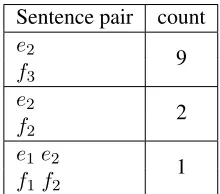
Sentence pair count e2
9 f3
e2
2 f2
e1e2
[image:2.612.370.480.59.156.2]1 f1f2
Table 1: An example of data with rare words.
In this way, VB controls the overfitting that would otherwise occur with rare words. On the other hand, higher values ofαcan be chosen if smoothing is de-sired, for instance in the case of the alignment prob-abilities, which state how likely a word in positioni of the English sentence is to align to a word in po-sitionjof the French sentence. For these probabili-ties, smoothing is important because we do not want to rule out any alignment altogether, no matter how infrequently it occurs in the data.
We implemented VB for the translation probabil-ities as well as for the position alignment probabili-ties of IBM Model 2. We discovered that adding VB for the translation probabilities improved the perfor-mance of the system. However, including VB for the alignment probabilities had relatively little ef-fect, because the alignment table in its original form does some smoothing during normalization by inter-polating the counts with a uniform distribution. Be-cause VB can itself be a form of smoothing, the two versions of the code behave similarly. We did not experiment with VB for the distortion probabilities of the HMM or Models 3 and 4, as these distribu-tions have fewer parameters and are likely to have reliable counts during EM. Thus, in Section 3, we present the results of using VB for the translation probabilities only.
3 Results
First, we ran our modified version of GIZA++ on a simple test case designed to be similar to the exam-ple from Moore (2004) discussed in Section 1. Our test case, shown in Table 1, had three different sen-tence pairs; we included nine instances of the first, two instances of the second, and one of the third.
0.10 0.15 0.20 0.25 0.30 0.35 0.40 0.45 0.50
1e-10 1e-08 1e-06 0.0001 0.01 1
AER
Alpha
AER after Entire Training
[image:3.612.77.300.60.230.2]French (baseline) French (variational Bayes) Chinese (baseline) Chinese (variational Bayes) German (baseline) German (variational Bayes)
Figure 1: Determining the best value ofαfor the transla-tion probabilities. Training data is 10,000 sentence pairs from each language pair. VB is used for Model 1 only. This table shows the AER for different values ofα af-ter training is complete (five iaf-terations each of Models 1, HMM, 3, and 4).
off2, due to the “garbage collection” phenomenon described above. The EM algorithm with VB does not overfit this data and preferse2asf2’s translation. For our experiments with bilingual data, we used three language pairs: French and English, Chi-nese and English, and German and English. We used Canadian Hansard data for French-English, Europarl data for German-English, and newswire data for Chinese-English. For measuring align-ment error rate, we used 447 French-English sen-tences provided by Hermann Ney and Franz Och containing both sure and possible alignments, while for German-English we used 220 sentences pro-vided by Chris Callison-Burch with sure alignments only, and for Chinese-English we used the first 400 sentences of the data provided by Yang Liu, also with sure alignments only. For computing BLEU scores, we used single reference datasets for French-English and German-French-English, and four references for Chinese-English. For minimum error rate train-ing, we used 1000 sentences for French-English, 2000 sentences for German-English, and 1274 sen-tences for Chinese-English. Our test sets con-tained 1000 sentences each for French-English and German-English, and 686 sentences for Chinese-English. For scoring the Viterbi alignments of each system against gold-standard annotated alignments,
400 600 800 1000 1200 1400 1600
5 10 15 20 25
Test Perplexity
Iterations of Model 1 Model 1 Susceptibility to Overfitting
[image:3.612.319.537.63.227.2]French (baseline) French (variational Bayes)
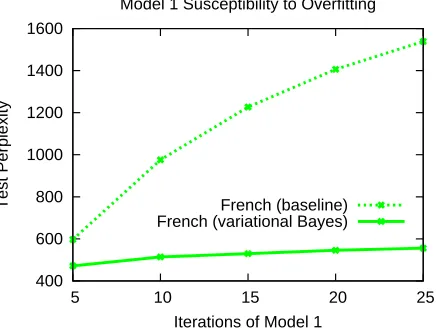
Figure 2: Effect of variational Bayes on overfitting for Model 1. Training data is 10,000 sentence pairs. This table contrasts the test perplexities of Model 1 with vari-ational Bayes and Model 1 without varivari-ational Bayes af-ter different numbers of training iaf-terations. Variational Bayes successfully controls overfitting.
we use the alignment error rate (AER) of Och and Ney (2000), which measures agreement at the level of pairs of words.
We ran our code on ten thousand sentence pairs to determine the best value of α for the transla-tion probabilities t(f|e). For our training, we ran GIZA++ for five iterations each of Model 1, the HMM, Model 3, and Model 4. Variational Bayes was only used for Model 1. Figure 1 shows how VB, and different values ofαin particular, affect the per-formance of GIZA++ in terms of AER. We discover that, after all training is complete, VB improves the performance of the overall system, lowering AER (Figure 1) for all three language pairs. We find that low values ofαcause the most consistent improve-ments, and so we useα= 0for the translation prob-abilities in the remaining experiments. Note that, while a value of α = 0 does not define a proba-bilistically valid Dirichlet prior, it does not cause any practical problems in the update equation for VB.
Figure 2 shows the test perplexity after GIZA++ has been run for twenty-five iterations of Model 1: without VB, the test perplexity increases as training continues, but it remains stable when VB is used. Thus, VB eliminates the need for the early stopping that is often employed with GIZA++.
0.05 0.10 0.15 0.20 0.25 0.30 0.35 0.40 0.45 0.50
10000 30000 50000 70000 90000
AER
Corpus Size
AER for Different Corpus Sizes
[image:4.612.331.522.58.128.2]French (baseline) French (variational Bayes) Chinese (baseline) Chinese (variational Bayes) German (baseline) German (variational Bayes)
Figure 3: Performance of GIZA++ on different amounts of test data. Variational Bayes is used for Model 1 only. Table shows AER after all the training has completed (five iterations each of Models 1, HMM, 3, and 4).
AER
French Chinese German
Baseline 0.14 0.42 0.43
M1 Only 0.12 0.39 0.41
HMM Only 0.14 0.42 0.42
M3 Only 0.14 0.42 0.43
M4 Only 0.14 0.42 0.43
All Models 0.19 0.44 0.45
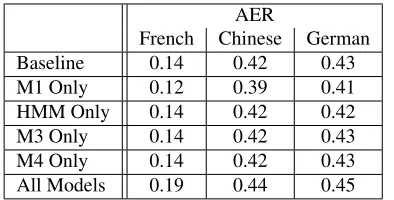
Table 2: Effect of Adding Variational Bayes to Specific Models
[image:4.612.75.298.59.233.2]translation probabilities, we reran the test above (five iterations each of Models 1, HMM, 3, and 4, with VB turned on for Model 1) on different amounts of data. We found that the results for larger data sizes were comparable to the results for ten thousand sentence pairs, both with and without VB (Figure 3).
We then tested whether VB should be used for the later models. In all of these experiments, we ran Models 1, HMM, 3, and 4 for five iterations each, training on the same ten thousand sentence pairs that we used in the previous experiments. In Table 2, we show the performance of the system when no VB is used, when it is used for each of the four models in-dividually, and when it is used for all four models simultaneously. We saw the most overall improve-ment when VB was used only for Model 1; using VB for all four models simultaneously caused the most improvement to the test perplexity, but at the cost of
BLEU Score French Chinese German
Baseline 26.34 21.03 21.14
M1 Only 26.54 21.58 21.73
[image:4.612.90.287.306.406.2]All Models 26.46 22.08 21.96
Table 3: BLEU Scores
the AER.
For the MT experiments, we ran GIZA++ through Moses, training Model 1, the HMM, and Model 4 on 100,000 sentence pairs from each language pair. We ran three experiments, one with VB turned on for all models, one with VB turned on for Model 1 only, and one (the baseline) with VB turned off for all models. When VB was turned on, we ran GIZA++ for five iterations per model as in our earlier tests, but when VB was turned off, we ran GIZA++ for only four iterations per model, having determined that this was the optimal number of iterations for baseline system. VB was used for the translation probabilities only, withαset to0.
As can be seen in Table 3, using VB increases the BLEU score for all three language pairs. For French, the best results were achieved when VB was used for Model 1 only; for Chinese and German, on the other hand, using VB for all models caused the most improvements. For French, the BLEU score increased by 0.20; for German, it increased by 0.82; for Chinese, it increased by 1.05. Overall, VB seems to have the greatest impact on the language pairs that are most difficult to align and translate to begin with.
4 Conclusion
References
Matthew J. Beal. 2003. Variational Algorithms for Ap-proximate Bayesian Inference. Ph.D. thesis, Univer-sity College London.
Phil Blunsom, Trevor Cohn, and Miles Osborne. 2008. Bayesian synchronous grammar induction. InNeural Information Processing Systems (NIPS).
Peter F. Brown, Stephen A. Della Pietra, Vincent J. Della Pietra, and Robert L. Mercer. 1993. The mathematics of statistical machine translation: Parameter estima-tion.Computational Linguistics, 19(2):263–311. David Chiang. 2005. A hierarchical phrase-based model
for statistical machine translation. InProceedings of ACL-05, pages 263–270, Ann Arbor, MI.
A. P. Dempster, N. M. Laird, and D. B. Rubin. 1977. Maximum likelihood from incomplete data via theEM algorithm. Journal of the Royal Statistical Society, 39(1):1–21.
John DeNero, Alexandre Bouchard-Cˆot´e, and Dan Klein. 2008. Sampling alignment structure under a Bayesian translation model. InProceedings of the 2008 Confer-ence on Empirical Methods in Natural Language Pro-cessing, pages 314–323, Honolulu, Hawaii, October. Michel Galley, Mark Hopkins, Kevin Knight, and Daniel
Marcu. 2004. What’s in a translation rule? In Pro-ceedings of NAACL-04, pages 273–280, Boston. Mark Johnson. 2007. Why doesn’t EM find good
HMM POS-taggers? InProceedings of the 2007 Joint Conference on Empirical Methods in Natural guage Processing and Computational Natural Lan-guage Learning (EMNLP-CoNLL), pages 296–305, Prague, Czech Republic, June. Association for Com-putational Linguistics.
Philipp Koehn, Hieu Hoang, Alexandra Birch, Chris Callison-Burch, Marcello Federico, Nicola Bertoldi, Brooke Cowan, Wade Shen, Christine Moran, Richard Zens, Chris Dyer, Ondrej Bojar, Alexandra Con-stantin, and Evan Herbst. 2007. Moses: Open source toolkit for statistical machine translation. In Proceed-ings of ACL, Demonstration Session, pages 177–180. Coskun Mermer and Murat Saraclar. 2011. Bayesian
word alignment for statistical machine translation. In Proceedings of the 49th Annual Meeting of the Associ-ation for ComputAssoci-ational Linguistics (ACL-11), pages 182–187.
Robert C. Moore. 2004. Improving IBM word alignment Model 1. InProceedings of the 42nd Meeting of the Association for Computational Linguistics (ACL’04), Main Volume, pages 518–525, Barcelona, Spain, July. Franz Josef Och and Hermann Ney. 2000. Improved
statistical alignment models. InProceedings of ACL-00, pages 440–447, Hong Kong, October.