Text Simplification as Tree Labeling
Joachim Bingel
Centre for Language Technology University of Copenhagen
Anders Søgaard
Centre for Language Technology University of Copenhagen [email protected]
Abstract
We present a new, structured approach to text simplification using conditional ran-dom fields over top-down traversals of dependency graphs that jointly predicts possible compressions and paraphrases. Our model reaches readability scores com-parable to word-based compression ap-proaches across a range of metrics and hu-man judgements while maintaining more of the important information.
1 Introduction
Sentence-level text simplification is the problem of automatically modifying sentences so that they become easier to read, while maintaining most of the relevant information in them. This can benefit applications as pre-processing for machine trans-lation (Bernth, 1998) and assisting technologies for readers with reduced literacy (Carroll et al., 1999; Watanabe et al., 2009; Rello et al., 2013).
Sentence-level text simplification ignores sen-tence splitting and reordering, and typically fo-cuses on compression (deletion of words) and paraphrasing or lexical substitution (Cohn and Lapata, 2008). We include paraphrasing and lexi-cal substitution here, while previous work in sen-tence simplification has often focused exclusively on deletion. Approaches that address compres-sion and paraphrasing (or more tasks) integrally include (Zhu et al., 2010; Narayan and Gardent, 2014; Mandya et al., 2014).
Simplification beyond deletion is motivated by Pitler’s (2010) observation that abstractive sen-tence summaries written by humans often “include paraphrases or synonyms (‘said’ versus ‘stated’) and use alternative syntactic constructions (‘gave John the book’ versus ‘gave the book to John’).” Such lexical or syntactic alternations may
con-tribute strongly to the readability of a sentence if they replace difficult words with shorter or more familiar ones, in particular for low-literacy readers (Rello et al., 2013). Our joint approach to deletion and paraphrasing works against the limitation that abstractive simplifications “are not capable of be-ing generated by [...] most sentence compression algorithms” (Pitler, 2010).
Furthermore, a central concern in text simplifi-cation is to ensure the grammaticality of the out-put, especially with low-proficiency readers as the target audience. Our approach to this problem is to remove or paraphrase entire syntactic units in the original sentence, thus avoiding to remove phrase heads without removing their arguments or mod-ifiers. Like Filippova and Strube (2008), we rely on dependency structures rather than constituent structures, which promises more robust syntactic analysis and allows us to operate on discontinuous syntactic units.
Contributions We present a sentence simplifi-cation model which is, to the best of our knowl-edge, the first model that uses structured predic-tion over dependency treesandmodels compres-sion and paraphrasing jointly. Our model uses Viterbi decoding rather than scoring of all can-didates and outputs probabilities reflecting model confidence.
2 Data
We use the publicly available Google compres-sion data set,1 which consists of 10,000 English
sentence triples with (1) the original sentence as present in the body of an online news article, (2) a headline based on the original sentence, and (3) a compression that is automatically derived from the original such that it only contains word forms
1http://storage.googleapis.com/
sentencecomp/compressiondata.json
Figure 1: An example simplification tree
present in the original, preserving their order. The following sentence triple exemplifies these differ-ent versions:
(1) In official documents released earlier this month it appears the Queen of England used the wrong name for the Republic of Ireland when writing to president Patrick Hillery.
(2) Queen elizabeth ii used wrong name for Republic
(3) The Queen of England used the wrong name for the Republic of Ireland.
The data is pre-processed with the Stanford CoreNLP tools (Manning et al., 2014), retrieving lemmas, parts-of-speech, named entities and de-pendency trees. We reserve the first 200 sentences from the data set for evaluation, the next 200 for tuning parameters (including the used PPDB ver-sions, see next paragraph), and use the remaining 9,600 sentences for training our model.
Deletion and paraphrase targets As our ap-proach operates on dependency trees, aiming to prune or paraphrase subtrees from the dependency tree of a sentence, we identify deleted or para-phrased subtrees, marking their heads with a cor-responding label. A subtree receives aDeletelabel if none of the words subsumed by this subtree oc-cur in the compressed version of the sentence.
We identify paraphrased subsequences in an original sentence by looking up the subsequence string in the Paraphrase Database (PPDB) (Gan-itkevitch et al., 2013) and testing if one of its pos-sible paraphrases occurs in the headline version of the sentence in question. The Paraphrase Database 1.0 is a set of phrasal and lexical pairs that were automatically acquired from bilingual parallel cor-pora, and thus contain a portion of flawed para-phrase pairs. The database comes in a number of different sizes, where small editions are re-stricted to high-precision paraphrases with rela-tively high paraphrase probabilities. As the two smallest editions of PPDB only yield a very low number of paraphrase targets (less than100in the
entire Google compression data set), we opt to em-ploy a medium-sized version of the resource (size ‘L’) and find a total of 510 phrasal and lexical paraphrases in the corpus.
3 Method
We assume that text simplification is a genera-tive process on syntactic dependency graphs with a paraphrase dictionary. A dependency graph
G = (V, A) is a labeled directed graph in the standard graph-theoretic sense and consists of nodes, V, and arcs, A, such that for sen-tence S = w0w1. . . wn and label set R, V ⊆
{w0, w1, . . . , wn}, and A ⊆ V ×R ×V hold, and if(wi, r, wj) ∈ A then (wi, r0, wj) 6= Afor all r0 6= r. We restrict the dependency graphs
to the class of trees, i.e., for (wi, r, wj) ∈ A, if (wk, r, wj)∈Athenk=i.
The generative process traverses the tree in a top-down fashion, deleting or paraphrasing trees (see Figure 1). Note that elements in sub-trees dominated by a deleted node are automati-cally deleted (analogously for paraphrases).
For each dependency tree G = (V, A) in a training set of T sentences, we derive an in-put sequence of K-dimensional feature vectors
x = x1, . . . , xn and an output sequence of
y = y1, . . . , yn. Our tree-to-string simplification model is a second-order linear-chain conditional random field (CRF)
p(y|x) = Z(1x)Yn i=1
exp{XK
k=1
θkfk(yt, yt−1, xt)}
withyi = Deleteif and only ifxi represents the least upper bound in G covering a deleted span in the training data, andyi = Paraphraseif and only if xi represents the least upper bound in G covering a paraphrased span in the training data. For example, if the entire sentence is deleted, and (w0, r, wi)∈A, thenyi =Delete(butyj =Leave forj6=i).
(or vice versa). However, once an operation is car-ried out on a subtree, none of its dominated nodes are considered in the remainder of the top-down simplification process. Giving preference to op-erations at higher-level syntactic environments in this manner serves as a mechanism to resolve am-biguities in the decision process by taking a wider context into account.
Furthermore, predicting a node to get para-phrased at the right corner of a deleted subtree can potentially influence labeling decisions out-side this subtree as a consequence of the dynamic-program Viterbi decoding. We acknowledge that this is a theoretical drawback of the presented ap-proach, but given that we do not observe any such dependency graphs in our data, we do not expect this to be a serious problem in most cases.
Whenever our model predicts that a subtree be paraphrased, we look up the respective token se-quence in PPDB and replace it with the candi-date paraphrase (if available) that maximises the product of frequency and translation probability according to PPDB.
Features for CRF model We train a second-order CRF model using MarMoT (Mueller et al., 2013), an efficient higher-order CRF implementa-tion. The model computes its observational prob-abilities from features based on properties of the subtree root token (incl. POS, language model probability, NE mention, word difficulty), of the internal structure of the subtree (incl. number of children, depth, length of sequence), and of the external grammatical structure (incl. dependency relation, parent POS, distance from parent, posi-tion in sentence).
4 Evaluation
Baselines In the following experiments, we compare our approach to state-of-the-art ap-proaches to sentence compression and joint com-pression/paraphrasing. For the first of these two categories, we consider the LSTM system de-scribed in Filippova et al. (2015) as well as the results reported therein for the MIRA system (Mc-Donald, 2006). As a joint approach, we consider Reluctant Trimmer (RT), a simplification system that employs synchronous dependency grammars (Mandya et al., 2014). Since the LSTM system re-quires great amounts of training data, which were not available to us, we cannot reproduce its
out-Recall Precision F1
Reluctant Trimmer
tok
ens DeleteParaphrase 54.6001.67 20.2366.67 29.5203.27
Leave 52.27 78.54 54.60 Tree Labeling
subtrees
Delete 43.31 67.54 52.77 Paraphrase 23.85 50.89 32.48 Leave 94.29 84.82 89.30
tok
ens DeleteParaphrase 49.6721.16 77.1651.52 60.4430.00
[image:3.595.309.522.64.260.2]Leave 80.33 50.91 62.32
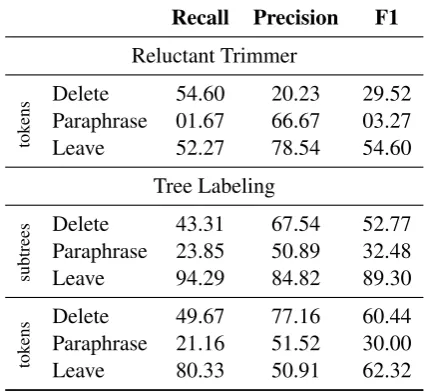
Table 1: Performance on joint deletion and para-phrasing detection for our tree labeling system (evaluating both on entire subtrees and token level) as well as for the RT baseline (tokens only). Note that RT is trained on the (Simple) English Wikipedia, not on the Google compressions, and therefore the results may not be directly compara-ble.
put and therefore limit our comparison of human rankings to the eleven output examples provided in the paper.
F-Scores We first evaluate our tree labeling model (TL) on its ability to predict subtree dele-tion and paraphrasing (i.e. whether a subtree should be paraphrased, independent of the actual replacement). The results for this evaluation setup, as well as word-level performance, are listed in Table 1 and compared to RT. Note that for dele-tion and paraphrasing, our model consistently has higher precision than recall, thus generating more confident simplifications and less ungrammatical output.
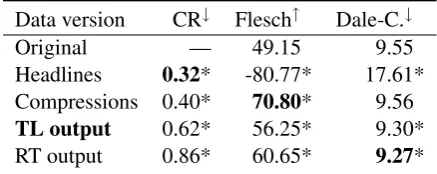
Automated Readability Scores Table 2 reports the compression ratio (CR, percentage of retained words) as well as automated readability scores that our model achieves on the test set and compares it to the output of the RT baseline. Our system man-ages to compress the original texts by more than one third, but the gold simplifications (headlines and compressions) are still considerably shorter.
Our approach improves readability as mea-sured by the Flesch Reading Ease score2 (Flesch,
met-Data version CR↓ Flesch↑ Dale-C.↓
Original — 49.15 9.55 Headlines 0.32* -80.77* 17.61* Compressions 0.40* 70.80* 9.56
TL output 0.62* 56.25* 9.30*
RT output 0.86* 60.65* 9.27*
Table 2: Compression ratios and automatic read-ability scores for the Google compression data set, compared to the system output. Readability is in-dicated by a high Flesh Reading Ease score and a low Dale-Chall score. * indicates differences com-pared to the original sentences that are significant atp <10−3.
System Readability Informativeness
MIRA 4.31 3.55
LSTM 4.51 3.78
TL 4.14 4.01
RT (11) 3.09 4.12
LSTM (11) 4.23 3.42
TL(11) 4.21 4.15
Table 3: Mean readability and informativeness rat-ings for the first 200 sentences in the Google data (upper) and for the 11 sample sentences listed in Filippova et al. (2015) (lower).
1948) and the Dale-Chall formula (Dale and Chall, 1948). The former score measures textual diffi-culty as a function of sentence length and the num-ber of syllables per word, while the latter aims to estimate a US school grade level at which a text can be well understood, based on a vocabulary list. Both metrics deem the output of our system eas-ier to read than the original texts, while the Dale-Chall formula also rates our system better than the gold simplifications.
Human Readability Ratings Following Filip-pova et al. (2015) in their evaluation setup for the sake of comparability, we ask raters to as-sign scores on a one-to-five Likert scale to the first 200 sentences from the Google compression data paired with the output of our system. Each pair is rated by three native or near-native speakers of English.
The raters are asked to evaluate the sentence
ric is due to an over-representation of longer words in head-lines.
[image:4.595.71.290.63.150.2]pairs for readability and informativeness. The former, following Filippova et al. (2015), “cov-ers the grammatical correctness, comprehensibil-ity and fluency of the output.” The latter metric pertains to the relation between the original sen-tence and the system output as it “measures the amount of important content preserved in the com-pression.”
Table 3 compares the performance of our model to the figures reported in Filippova et al. (2015) for their LSTM model and McDonald’s (2006) system (MIRA). For a comparison with the same judges, we repeat the evaluation with the 11 sample out-put compressions listed in Filippova et al. (2015)as well as the respective output from Reluctant Trim-mer; see the lower part of Table 3. The results suggest that, compared to the compression-only LSTMs, our approach yields comparable perfor-mance in terms of readability, while maintaining more of the central information in the original sen-tences. Compared to RT, our system does con-siderably better in terms of readability and retains slightly more of the important information.
5 Related Work
Several approaches to sentence compression have been presented in the last decade. Knight and Marcu (2002) and Turner and Charniak (2005) ap-ply noisy channel models, using language models to control for grammaticality. McDonald (2006) introduces a different approach, discriminatively training a scoring function, informed by syntac-tic features, to score all possible subtrees of a sentence. His work was inspired by Riezler et al. (2003) scoring substrings generated from LFG parses. A third approach to sentence compression is sequence labeling, which has been explored by Elming et al. (2013) using linear-chain CRFs with syntactic features, and more recently by Filippova et al. (2015) and Klerke et al. (2016) using recur-rent neural networks with LSTM cells.
Original Sentence &Simplifications
O OG&E is warning customers about a prepaid debit card scam that is targeting utility customers across the county.
C OG&E is warning customers about a scam.
R OG&E is warning customers about a debit card scam that is targeting utility customers across the country.
T OG&E is warning customersregardinga prepaid debit card scam.
O The husband of murdered Melbourne woman Jill Meagher will return to Ireland later this month “to clear his head” while fighting for parole board changes.
C The husband of murdered woman Jill Meagher will return to Ireland.
R The husband of Melbourne woman Jill Meagher will return to Ireland this month to clear his head fighting for parole board changes.
T The husband of murdered Melbourne woman Jill Meagher will return to Ireland. O A research project has found that taxi drivers often don’t know what the speed limit is. C Taxi drivers don’t know the speed limit is.
R A research project has found that drivers oftendo notknow what the speed limit is.
T A project has found taxi drivers don’t know what the speed limit is.
Table 4: Example output for original sentences (O) as generated by the Reluctant Trimmer baseline (R) and our tree labeling system (T), as well as the headline-generated Google compressions (C).
LSTMs with word embeddings, with no syntactic features. We return to working directly on trees, presenting a tree-to-string model of sentence sim-plification. Our model has interesting similarities to (Riezler et al., 2003), but uses Viterbi decod-ing rather than scordecod-ing of all candidates. Also, it follows Cohn and Lapata (2008) in going be-yond most of these models, modeling compression andparaphrasing.
For lexical simplification, most systems typi-cally use pre-compiled dictionaries (Devlin, 1999; Inui et al., 2003) and select the synonym candidate with the highest frequency. More recently, Baeza-Yates et al. (2015) introduced an algorithm for lex-ical simplification in Spanish that selects the best synonym candidate in a context-sensitive fashion. Cohn and Lapata (2008), Woodsend and Lap-ata (2011) and Mandya et al. (2014) presentjoint approaches to compression and paraphrasing that are based on (quasi-) synchronous grammars, and similarly Zhu et al. (2010) take a syntax-based approach, but employ a probabilistic model of various simplification operations. Napoles et al. (2011) do not use syntactic information, but in-stead employ a character-based metric to compress and paraphrase.
6 Conclusion
We presented a new approach to sentence sim-plification that uses linear-chain conditional
ran-dom fields over dependency graphs to jointly pre-dict compression and paraphrasing of entire syn-tactic units. The objective of our model is to delete or paraphrase entire subtrees in dependency graphs as a strategy to avoid ungrammatical out-put. Our approach makes innovative use of a three-fold parallel monolingual corpus that fea-tures headlines and compressions to learn para-phrases and deletions, respectively. Human eval-uation shows that our approach leads to readabil-ity figures that are comparable to previous state-of-the-art approaches to the more basic sentence compression task, and better than previous work on joint compression and paraphrasing. While our model does rely on syntactic analysis, it only needs a tiny fraction (less than 0.5%) of the train-ing data used by Filippova et al. (2015).
Acknowledgments
This research was partially funded by the ERC Starting Grant LOWLANDS No. 313695, as well as by Trygfonden.
References
Arendse Bernth. 1998. EasyEnglish: Preprocessing for MT. In Proceedings of the Second Interna-tional Workshop on Controlled Language Applica-tions, pages 30–41.
John Carroll, Guido Minnen, Darren Pearce, Yvonne Canning, Siobhan Devlin, and John Tait. 1999. Simplifying text for language-impaired readers. In Proceedings of EACL, volume 99, pages 269–270. James Clarke and Mirella Lapata. 2008. Global
in-ference for sentence compression: An integer linear programming approach. Journal of Artificial Intelli-gence Research, pages 399–429.
Trevor Cohn and Mirella Lapata. 2008. Sentence compression beyond word deletion. InProceedings of the 22nd International Conference on Computa-tional Linguistics-Volume 1, pages 137–144. Asso-ciation for Computational Linguistics.
Trevor Cohn and Mirella Lapata. 2009. Sentence com-pression as tree transduction. Journal of Artificial Intelligence Research, pages 637–674.
Edgar Dale and Jeanne S Chall. 1948. A formula for predicting readability: Instructions. Educational re-search bulletin, pages 37–54.
Siobhan Lucy Devlin. 1999. Simplifying natural lan-guage for aphasic readers. Ph.D. thesis, University of Sunderland.
Jakob Elming, Anders Johannsen, Sigrid Klerke, Emanuele Lapponi, Hector Martinez Alonso, and Anders Søgaard. 2013. Down-stream effects of tree-to-dependency conversions. In HLT-NAACL, pages 617–626.
Katja Filippova and Michael Strube. 2008. Depen-dency tree based sentence compression. In Proceed-ings of the Fifth International Natural Language Generation Conference, pages 25–32. Association for Computational Linguistics.
Katja Filippova, Enrique Alfonseca, Carlos A Col-menares, Lukasz Kaiser, and Oriol Vinyals. 2015. Sentence compression by deletion with lstms. In Proceedings of the 2015 Conference on Empirical Methods in Natural Language Processing, pages 360–368.
Rudolph Flesch. 1948. A new readability yardstick. Journal of applied psychology, 32(3):221.
Juri Ganitkevitch, Benjamin Van Durme, and Chris Callison-Burch. 2013. PPDB: The paraphrase database. In Proceedings of NAACL-HLT, pages 758–764, Atlanta, Georgia, June. Association for Computational Linguistics.
Kentaro Inui, Atsushi Fujita, Tetsuro Takahashi, Ryu Iida, and Tomoya Iwakura. 2003. Text simplifica-tion for reading assistance: a project note. In Pro-ceedings of the second international workshop on Paraphrasing-Volume 16, pages 9–16. Association for Computational Linguistics.
Sigrid Klerke, Yoav Goldberg, and Anders Søgaard. 2016. Improving sentence compression by learning to predict gaze. InProceedings of ACL 2016 (short). Kevin Knight and Daniel Marcu. 2002. Summariza-tion beyond sentence extracSummariza-tion: A probabilistic ap-proach to sentence compression. Artificial Intelli-gence, 139(1):91–107.
Angrosh A. Mandya, Tadashi Nomoto, and Advaith Siddharthan. 2014. Lexico-syntactic text simplifi-cation and compression with typed dependencies. In COLING, pages 1996–2006.
Christopher D. Manning, Mihai Surdeanu, John Bauer, Jenny Finkel, Steven J. Bethard, and David Mc-Closky. 2014. The Stanford CoreNLP natural lan-guage processing toolkit. In Proceedings of 52nd Annual Meeting of the Association for Computa-tional Linguistics: System Demonstrations, pages 55–60.
Ryan T McDonald. 2006. Discriminative sentence compression with soft syntactic evidence. InEACL. Thomas Mueller, Helmut Schmid, and Hinrich Sch¨utze. 2013. Efficient higher-order CRFs for morphological tagging. InProceedings of the 2013 Conference on Empirical Methods in Natural Lan-guage Processing, pages 322–332, Seattle, Wash-ington, USA, October. Association for Computa-tional Linguistics.
Courtney Napoles, Chris Callison-Burch, Juri Ganitke-vitch, and Benjamin Van Durme. 2011. Paraphras-tic sentence compression with a character-based metric: Tightening without deletion. In Proceed-ings of the Workshop on Monolingual Text-To-Text Generation, pages 84–90. Association for Computa-tional Linguistics.
Shashi Narayan and Claire Gardent. 2014. Hybrid simplification using deep semantics and machine translation. Inthe 52nd Annual Meeting of the As-sociation for Computational Linguistics, pages 435– 445.
Tadashi Nomoto. 2007. Discriminative sentence com-pression with conditional random fields. Informa-tion Processing and Management: an InternaInforma-tional Journal, 43(6):1571–1587.
Emily Pitler. 2010. Methods for sentence compres-sion. Technical report, Department of Computer and Information Science, University of Pennsylvania. Luz Rello, Ricardo Baeza-Yates, Laura
Dempere-Marco, and Horacio Saggion. 2013. Frequent words improve readability and short words improve under-standability for people with dyslexia. In Human-Computer Interaction–INTERACT 2013, pages 203– 219. Springer.
InProceedings of the 2003 Conference of the North American Chapter of the Association for Computa-tional Linguistics on Human Language Technology-Volume 1, pages 118–125. Association for Compu-tational Linguistics.
Jenine Turner and Eugene Charniak. 2005. Super-vised and unsuperSuper-vised learning for sentence com-pression. InProceedings of the 43rd Annual Meet-ing on Association for Computational LMeet-inguistics, pages 290–297. Association for Computational Lin-guistics.
Willian Massami Watanabe, Arnaldo Candido Junior, Vin´ıcius Rodriguez Uzˆeda, Renata Pontin de Mat-tos Fortes, Thiago Alexandre Salgueiro Pardo, and Sandra Maria Alu´ısio. 2009. Facilita: reading as-sistance for low-literacy readers. InProceedings of the 27th ACM international conference on Design of communication, pages 29–36. ACM.
Kristian Woodsend and Mirella Lapata. 2011. Learn-ing to simplify sentences with quasi-synchronous grammar and integer programming. InProceedings of the conference on empirical methods in natural language processing, pages 409–420. Association for Computational Linguistics.