2157
Factorising AMR generation through syntax
Kris Cao and Stephen Clark
Computer Laboratory University of Cambridge
United Kingdom
{kc391,sc609}@cam.ac.uk
Abstract
Generating from Abstract Meaning Represen-tation (AMR) is an underspecified problem, as many syntactic decisions are not constrained by the semantic graph. To explicitly account for this underspecification, we break down generating from AMR into two steps: first generate a syntactic structure, and then gen-erate the surface form. We show that decom-posing the generation process this way leads to state-of-the-art single model performance generating from AMR without additional un-labelled data. We also demonstrate that we can generate meaning-preserving syntactic para-phrases of the same AMR graph, as judged by humans.
1 Introduction
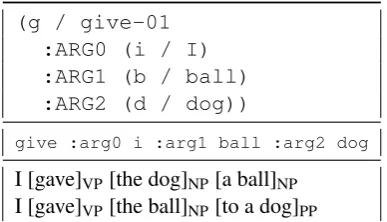
Abstract Meaning Representation (AMR) ( Ba-narescu et al., 2013) is a semantic annotation framework which abstracts away from the surface form of text to capture the core ‘who did what to whom’ structure. As a result, generating from AMR is underspecified (see Figure1for an exam-ple). Single-step approaches to AMR generation (Flanigan et al.,2016;Konstas et al.,2017;Song et al., 2016, 2017) therefore have to decide the syntax and surface form of the AMR realisation in one go. We instead explicitly try and capture this syntactic variation and factor the generation process through a syntactic representation (Walker et al., 2001; Duˇsek and Jurcicek, 2016; Gardent and Perez-Beltrachini,2017;Currey and Heafield, 2018).
First, we generate a delexicalised constituency structure from the AMR graph using a syntax model. Then, we fill out the constituency structure with the semantic content in the AMR graph using a lexicalisation model to generate the final surface form. Breaking down the AMR generation pro-cess this way provides us with several advantages:
we disentangle the variance caused by the choice of syntax from that caused by the choice of words. We can therefore realise the same AMR graph with a variety of syntactic structures by sampling from the syntax model, and deterministically de-coding using the lexicalisation model. We hypoth-esise that this generates better paraphrases of the reference realisation than sampling from a single-step model.
We linearise both the AMR graphs (Konstas et al.,2017) and constituency trees (Vinyals et al., 2015b) to allow us to use sequence-to-sequence models (Sutskever et al., 2014; Bahdanau et al., 2015) for the syntax and lexicalisation models. Further, as the AMR dataset is relatively small, we have issues with data sparsity causing poor param-eter estimation for rarely seen words. We deal with this by anonymizing named entities, and including acopy mechanism(Vinyals et al.,2015a;See et al., 2017;Song et al.,2018) into our decoder, which allows open-vocabulary token generation.
We show that factorising the generation process in this way leads to improvements in AMR genera-tion, setting a new state of the art for single-model AMR generation performance training only on la-belled data. We also verify our diverse generation hypothesis with a human annotation study.
2 Data
(g / give-01 :ARG0 (i / I) :ARG1 (b / ball) :ARG2 (d / dog))
give :arg0 i :arg1 ball :arg2 dog
I [gave]VP[the dog]NP[a ball]NP
I [gave]VP[the ball]NP[to a dog]PP
Figure 1: An example AMR graph, with variable names and verb senses, followed by the input to our system after preprocessing, and finally two sample re-alisations different in syntax.
relations between entities in the text. See Figure 1for an example of an AMR graph, together with sample realisations.
Konstas et al. (2017) outline a set of prepro-cessing procedures for AMR graphs to both ren-der them suitable for sequence-to-sequence learn-ing and to ameliorate data sparsity; we fol-low the same pipeline. We train our mod-els on the two most recent AMR releases. LDC2017T10 has roughly 36k training sentences, while LDC2015E86 is about half this size. Both share dev and test sets, facilitating comparison.
Constituency syntax While there are many syn-tactic annotation formalisms, we use delexicalised Penn treebank-style constituency trees to represent syntax. Constituency trees have the advantage of a well-defined linearization order compared to de-pendency trees. Further, constituency trees may be easier to realise, as they effectively correspond to a bracketing of the surface form.
Unfortunately, AMR annotated data does not come with syntactic annotation. We therefore parse the training and dev splits of both corpora with the Stanford parser (Manning et al.,2014) to provide silver-standard reference parse trees. We then delexicalise the parse trees by trimming the trees of the surface words; after this stage, the leaves of the tree are the preterminal POS tags. Af-ter this, we linearise the delexicalised constituency trees with depth-first traversal, following Vinyals et al.(2015b).
3 Model implementation and training
3.1 Model details
We wish to estimateP(Y, Z|X), the joint proba-bility of a parse Y and surface form Z given an AMR graphX. We model this in two parts, using
the chain rule to decompose the joint distribution. The first model, which we call the syntax model, approximates P(Y|X), the probability of a par-ticular syntactic structure for a meaning represen-tation. The second isP(Z|X, Y), the lexicalisa-tion model. This calculates the probability of a surface realisation given a parse tree and an AMR graph. We implement both as recurrent sequence-to-sequence models.
As we are able to linearise both the AMR graph and the parse tree, we use LSTMs (Hochreiter and Schmidhuber, 1997) both as the encoder and the decoder of our seq2seq models. Given an input se-quenceX1, . . . , Xn, which can either be an AMR graph or a parse tree, we first embed the tokens to obtain a dense vector representation of each to-kenx1, . . . , xn. Then we feed this into a stacked bidirectional LSTM encoder to obtain contextu-alised representations of each input token ci. As far as possible, we share parameters between our two models. Concretely, this means that the syntax model uses the same AMR and parse embeddings, and AMR encoder, as the lexicalisation model. We find that this speeds up model inference, as we only have to encode the AMR sequence once for both models. Further, it regularises the joint model by reducing the number of parameters.
In our decoder, we use the dot-product formula-tion of attenformula-tion (Luong et al.,2015): the attention potentialsaiat timesteptare given by
ai=hTt−1Wattci
whereht−1 is the decoder hidden state at the
pre-vious timestep, andciis the context representation at positionigiven by the encoder. The attention weightwi is then given by a softmax over the at-tention potentials, and the overall context repre-sentationstis given byPwici. The syntax model only attends over the input AMR graph; the lin-earisation model attends over both the input AMR and syntax tree independently, and the resulting context representationst is given by the concate-nation of the AMR context representation and the syntax tree context representation (Libovick´y and Helcl,2017).
We use st to augment the input to the LSTM:
e
yt = Wintanh([yt;st]). Then the LSTM hidden and cell state are updated according to the LSTM equations: ht, ct = LST M(ht−1, ct−1,yet).
[image:2.595.85.279.62.173.2]calcu-lating the logits over the distribution of tokens:
e
ht= tanh(Wout[ht;st]) (1)
p(yt|y<t) = softmax(Weht) (2)
For the syntax model, we further constrain the de-coder to only produce valid parse trees; as we build the parse tree left-to-right according to a depth-first traversal, the permissible actions at any stage are to open a new constituent, produce a ter-minal (i.e. a POS tag), or close the currently open constituent. We implement this constraint by set-ting the logits of all impermissible actions to neg-ative infinity before taking the softmax. We find that this improves both training speed and final model performance, as we imbue the decoder with an intrinsic bias towards producing well-formed parse trees.
3.2 Generation with a copy mechanism
Despite the preprocessing procedures referred to in Section 2, we found that the lexicalisation model still had trouble with out-of-vocabulary words, due to the small size of the training cor-pus. This led to poor vocabulary coverage on the unseen test portions of the dataset. On closer in-spection, many out-of-vocabulary words in the dev split are open-class nouns and verbs, which corre-spond to concept nodes in the AMR graph. We therefore incorporate a copy mechanism (Vinyals et al.,2015a;See et al.,2017) into our lexicalisa-tion model to make use of these alignments.
We implement this by decomposing the word generation probability into a weighted sum of two terms. One is the vocabulary generation term. This models the probability of generating the next token from the model vocabulary, and is calculated in the same way as the base model. The other is a copy term, which calculates the probability of generating the next token by copying a token from the input. This uses the attention distribution over the input tokens calculated in the decoder to decide which input token to copy. The weighting between these two terms is calculated as a function of the current decoder input token, the decoder hidden state, and the AMR and parse context vectors. To sum up, the per-word generation probability in the decoder is given by
p(yt|y<t) = (1−θt)plex(yt|y<t) +θt
X
i:Xi=yt wi
(3) where plex(yt|y<t) is as in Equation 2 andwi is the attention weight on the input token Xi. θ is
the weighting between the generation term and the copy term: this is implemented as a 2-layer MLP.
3.3 Model training procedures
The AMR training corpus, together with the au-tomatically derived parse trees, give us aligned triples of AMR graph, parse tree and realisa-tion. We train our model to minimise the sum of the parse negative log-likelihood from the syntax model and the text negative log-likelihood from the lexicalisation model. We use the ADAM op-timizer (Kingma and Ba,2015) with batch size 40 for 200 epochs. We evaluate model BLEU score on the dev set during training, and whenever this did not increase after 5 epochs, we multiplied the learning rate by 0.8. We select the model with the highest dev BLEU score during training as our fi-nal model.
We apply layer normalization (Ba et al.,2016) to all matrix multiplications inside our network, including in the LSTM cell, and drop out all non-recurrent connections with probability 0.5 ( Srivas-tava et al.,2014). We also drop out recurrent con-nections in both encoder and decoder LSTMs with probability 0.3, tying the mask across timesteps as suggested byGal and Ghahramani(2016). All model hidden states are size 500, and token em-beddings are size 300. Word emem-beddings are ini-tialised with pretrained word2vec embeddings (Mikolov et al., 2013). We replace words with count 1 in the training corpus with the UNK to-ken with probability 0.5, and replace POS tags in the parse tree and AMR concepts with the UNK token with probability 0.1 regardless of count.
Decoding from our model During test time, we would like to estimate
arg max Z
X
Y
P(Z, Y|X) (4)
Model Unlabelled F1 Labelled F1
Text-to-parse 87.5 85.8
AMR-to-parse 60.4 54.8
[image:4.595.83.281.165.215.2]Unconditional 38.5 31.7
Table 1: Parsing scores on LDC2017T10 dev set.
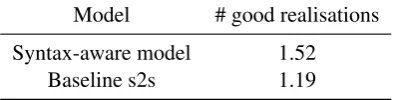
Model # good realisations
Syntax-aware model 1.52
Baseline s2s 1.19
Table 2: Average number of acceptable realisations out of 3. The difference is significant withp <0.001.
items from the beam. In our experiments, we find that considering realisations of the 2 best parses (i.e. settingn= 2above) gives the highest BLEU score on the dev set.
4 Experiment 1: AMR and syntax
We first investigate how much information AMR contains about possible syntactic realisations. We train two seq2seq models of the above architecture to predict the delexicalised constituency tree of an example given either the AMR graph or the text. We then evaluate both models on labelled and un-labelled F1 score on the dev split of the corpus. As neither model is guaranteed to produce trees with the right number of terminals, we first run an insert/delete aligner between the predicted and reference terminals (i.e. POS tags) before calcu-lating span F1s. We also report the results of run-ning our aligner on the most probable parse tree as estimated by an unconditional LSTM as a base-line both to control for our aligner and also to see how much extra signal is in the AMR graph. The results in Table 1 show that predicting a syntac-tic structure from an AMR graph is a much harder task than predicting from the text, but there is in-formation in the AMR graph to improve over a blind baseline.
5 Experiment 2: Generating natural language from AMR
Table 3 shows the results of our model on the AMR generation task. We evaluate using BLEU score (Papineni et al.,2002) against the reference realisations. As a baseline, we train a straight AMR-to-text model with the same architecture as above to control for the extra regularisation in our model compared to previous work. Our results
Model Dev BLEU Test BLEU
Trained on LDC2017T10
Our model 26.1 26.8
Our model + oracle parse 57.5 -Baseline s2s + copy 23.7 23.5
Beck et al.(2018) - 23.3
Trained on LDC2015E86
Our model 23.6 23.5
Our model + oracle parse 53.1
-Konstas et al.(2017) 21.7 22.0
Song et al.(2018) 22.8 23.3
Trained on LDC2015E86 or earlier + additional unlabelled data
Song et al.(2018) - 33.0
Konstas et al.(2017) 33.1 33.8
Pourdamghani et al.(2016) 27.2 26.9
Song et al.(2017) 25.2 25.6
Table 3: BLEU results for generation.
show that adding syntax into the model dramat-ically boosts performance, resulting in state-of-the-art single model performance on both datasets without using external training data.
As an oracle experiment, we also generate from the realisation model conditioned on the ground truth parse. The outstanding result here – BLEU scores in the 50s – demonstrates that being able to predict the gold reference parse tree is a bottleneck in the performance of our model. However, given the inherent difficulty of predicting a single syntax realisation (cf. Section4), we suspect that there is an intrinsic limit to how well generating from an AMR graph can replicate the reference realisation. We further note that we do not use models tai-lored to graph-structured data or character-level features as in Song et al. (2018); Beck et al. (2018), or additional unlabelled data to perform semi-supervised learning (Konstas et al., 2017). We believe that we can improve our results even further if we use these techniques.
6 Experiment 3: Generating varied realisations
Our model explicitly disentangles variation caused by syntax choice from that caused by lexical choice. This means that we can generate diverse realisations of the same AMR graph by sampling from the syntax model and deterministically de-coding from the realisation model. We hypothe-sise that this procedure generates more meaning-preserving realisations than just sampling from a straight AMR-to-text model, which can result in incoherent output (Cao and Clark,2017).
different realisations with our joint model and our baseline model. For our joint model, we first sam-pled 3 parse structures from the syntax model with temperature 0.3. This means we divide the per-timestep logits of the syntax decoder by 0.3; this serves to sharpen the outputs of the syntax model and constrains the sampling process to produce relatively high-probability syntactic structures for the given AMR. Then, we realised each parse de-terministically with the lexicalisation model. For the baseline model, we sample 3 realisations from the decoder with the same temperature. This gave us 100 examples in total.
We then crowdsourced acceptability judgments for each example from 100 annotators: we showed the reference realisation of an AMR graph, to-gether with model realisations, and asked each annotator to mark all the grammatical realisa-tions which have the same meaning as the refer-ence realisation. Each annotator was presented 30 examples selected randomly. Our results in Table 2 show that the joint model can generate more meaning-preserving realisations compared to a syntax-agnostic baseline. This shows the util-ity of separating out syntactic and lexical varia-tion: we model explicitly meaning-preserving in-variances, and can therefore generate better para-phrases.
7 Conclusions and further work
We present an AMR generation model that factors the generation process through a syntactic deci-sion, and show that this leads to improved AMR generation performance. In addition, we show that separating the syntactic decisions from the lexi-calisation decisions allows the model to generate higher quality paraphrases of a given AMR graph. In future work, we would like to integrate a se-mantic parser into our model (Yin et al., 2018). Annotating data with AMR is expensive, and ex-isting AMR treebanks are small. By integrating a component which parses into AMR into our model, we can do semi-supervised learning on plentiful unannotated natural language sentences, and improve our AMR generation performance even further. In addition, we would be able to gen-erate text-to-text paraphrases by parsing into AMR first and then carrying out the paraphrase genera-tion procedure described in this paper (Iyyer et al., 2018). This opens up scope for data augmentation for downstream NLP tasks, such as machine
trans-lation.
Acknowledgements
The authors would like to thank Amandla Mabona and Guy Emerson for fruitful discussions. KC is funded by an EPSRC studentship.
References
Jimmy Lei Ba, Jamie Ryan Kiros, and Geoffrey E Hin-ton. 2016. Layer normalization. arXiv preprint arXiv:1607.06450.
Dzmitry Bahdanau, Kyunghyun Cho, and Yoshua Ben-gio. 2015. Neural machine translation by jointly learning to align and translate.ICLR.
Laura Banarescu, Claire Bonial, Shu Cai, Madalina Georgescu, Kira Griffitt, Ulf Hermjakob, Kevin Knight, Philipp Koehn, Martha Palmer, and Nathan Schneider. 2013. Abstract meaning representation for sembanking. InProceedings of the 7th Linguis-tic Annotation Workshop and Interoperability with Discourse, pages 178–186. Association for Compu-tational Linguistics.
Daniel Beck, Gholamreza Haffari, and Trevor Cohn. 2018. Graph-to-sequence learning using gated graph neural networks. InProceedings of the 56th Annual Meeting of the Association for Computa-tional Linguistics (Volume 1: Long Papers), pages 273–283. Association for Computational Linguis-tics.
Kris Cao and Stephen Clark. 2017. Latent variable di-alogue models and their diversity. InProceedings of the 15th Conference of the European Chapter of the Association for Computational Linguistics: Vol-ume 2, Short Papers, pages 182–187. Association for Computational Linguistics.
Anna Currey and Kenneth Heafield. 2018. Multi-source syntactic neural machine translation. In Pro-ceedings of the 2018 Conference on Empirical Meth-ods in Natural Language Processing, pages 2961– 2966, Brussels, Belgium. Association for Computa-tional Linguistics.
Ondˇrej Duˇsek and Filip Jurcicek. 2016. Sequence-to-sequence generation for spoken dialogue via deep syntax trees and strings. InProceedings of the 54th Annual Meeting of the Association for Computa-tional Linguistics (Volume 2: Short Papers), pages 45–51, Berlin, Germany. Association for Computa-tional Linguistics.
Jeffrey Flanigan, Chris Dyer, Noah A. Smith, and Jaime Carbonell. 2016. Generation from abstract meaning representation using tree transducers. In
pages 731–739, San Diego, California. Association for Computational Linguistics.
Yarin Gal and Zoubin Ghahramani. 2016. A theoret-ically grounded application of dropout in recurrent neural networks. InAdvances in Neural Information Processing Systems 29 (NIPS).
Claire Gardent and Laura Perez-Beltrachini. 2017. A statistical, grammar-based approach to microplan-ning.Computational Linguistics, 43(1):1–30.
Sepp Hochreiter and J¨urgen Schmidhuber. 1997. Long short-term memory. Neural Compututation, 9(8):1735–1780.
Mohit Iyyer, John Wieting, Kevin Gimpel, and Luke Zettlemoyer. 2018. Adversarial example generation with syntactically controlled paraphrase networks. InProceedings of the 2018 Conference of the North American Chapter of the Association for Computa-tional Linguistics: Human Language Technologies, Volume 1 (Long Papers), pages 1875–1885, New Orleans, Louisiana. Association for Computational Linguistics.
Diederik P. Kingma and Jimmy Ba. 2015. Adam: A method for stochastic optimization.ICLR.
Ioannis Konstas, Srinivasan Iyer, Mark Yatskar, Yejin Choi, and Luke Zettlemoyer. 2017. Neural amr: Sequence-to-sequence models for parsing and gen-eration. In Proceedings of the 55th Annual Meet-ing of the Association for Computational LMeet-inguis- Linguis-tics (Volume 1: Long Papers), pages 146–157, Van-couver, Canada. Association for Computational Lin-guistics.
Jindˇrich Libovick´y and Jindˇrich Helcl. 2017. Attention strategies for multi-source sequence-to-sequence learning. InProceedings of the 55th Annual Meet-ing of the Association for Computational LMeet-inguis- Linguis-tics (Volume 2: Short Papers), pages 196–202, Van-couver, Canada. Association for Computational Lin-guistics.
Thang Luong, Hieu Pham, and Christopher D. Man-ning. 2015. Effective approaches to attention-based neural machine translation. InProceedings of the 2015 Conference on Empirical Methods in Natu-ral Language Processing, pages 1412–1421, Lis-bon, Portugal. Association for Computational Lin-guistics.
Christopher D. Manning, Mihai Surdeanu, John Bauer, Jenny Finkel, Steven J. Bethard, and David Mc-Closky. 2014. The Stanford CoreNLP natural lan-guage processing toolkit. InAssociation for Compu-tational Linguistics (ACL) System Demonstrations, pages 55–60.
Tomas Mikolov, Ilya Sutskever, Kai Chen, Greg S Cor-rado, and Jeff Dean. 2013. Distributed representa-tions of words and phrases and their composition-ality. In C. J. C. Burges, L. Bottou, M. Welling,
Z. Ghahramani, and K. Q. Weinberger, editors, Ad-vances in Neural Information Processing Systems 26, pages 3111–3119. Curran Associates, Inc.
Kishore Papineni, Salim Roukos, Todd Ward, and Wei-Jing Zhu. 2002. Bleu: a method for automatic eval-uation of machine translation. In Proceedings of 40th Annual Meeting of the Association for Com-putational Linguistics, pages 311–318, Philadelphia, Pennsylvania, USA. Association for Computational Linguistics.
Nima Pourdamghani, Kevin Knight, and Ulf Her-mjakob. 2016. Generating english from abstract meaning representations. InProceedings of the 9th International Natural Language Generation confer-ence, pages 21–25, Edinburgh, UK. Association for Computational Linguistics.
Abigail See, Peter J. Liu, and Christopher D. Manning. 2017.Get to the point: Summarization with pointer-generator networks. InProceedings of the 55th An-nual Meeting of the Association for Computational Linguistics (Volume 1: Long Papers), pages 1073– 1083. Association for Computational Linguistics.
Linfeng Song, Xiaochang Peng, Yue Zhang, Zhiguo Wang, and Daniel Gildea. 2017. Amr-to-text gener-ation with synchronous node replacement grammar. In Proceedings of the 55th Annual Meeting of the Association for Computational Linguistics (Volume 2: Short Papers), pages 7–13. Association for Com-putational Linguistics.
Linfeng Song, Yue Zhang, Xiaochang Peng, Zhiguo Wang, and Daniel Gildea. 2016. Amr-to-text gener-ation as a traveling salesman problem. In Proceed-ings of the 2016 Conference on Empirical Methods in Natural Language Processing, pages 2084–2089. Association for Computational Linguistics.
Linfeng Song, Yue Zhang, Zhiguo Wang, and Daniel Gildea. 2018. A graph-to-sequence model for amr-to-text generation. In Proceedings of the 56th An-nual Meeting of the Association for Computational Linguistics (Volume 1: Long Papers), pages 1616– 1626. Association for Computational Linguistics.
Nitish Srivastava, Geoffrey Hinton, Alex Krizhevsky, Ilya Sutskever, and Ruslan Salakhutdinov. 2014. Dropout: A simple way to prevent neural networks from overfitting. The Journal of Machine Learning Research, 15(1):1929–1958.
Ilya Sutskever, Oriol Vinyals, and Quoc V Le. 2014. Sequence to sequence learning with neural net-works. In Z. Ghahramani, M. Welling, C. Cortes, N. D. Lawrence, and K. Q. Weinberger, editors, Ad-vances in Neural Information Processing Systems 27, pages 3104–3112. Curran Associates, Inc.
Systems 28, pages 2692–2700. Curran Associates, Inc.
Oriol Vinyals, Łukasz Kaiser, Terry Koo, Slav Petrov, Ilya Sutskever, and Geoffrey Hinton. 2015b. Gram-mar as a foreign language. In C. Cortes, N. D. Lawrence, D. D. Lee, M. Sugiyama, and R. Garnett, editors,Advances in Neural Information Processing Systems 28, pages 2773–2781. Curran Associates, Inc.
Marilyn A. Walker, Owen Rambow, and Monica Ro-gati. 2001. Spot: A trainable sentence planner. In
Second Meeting of the North American Chapter of the Association for Computational Linguistics.