Proceedings of the 2019 Conference on Empirical Methods in Natural Language Processing and the 9th International Joint Conference on Natural Language Processing, pages 5338–5349,
5338
Editing-Based SQL Query Generation for
Cross-Domain Context-Dependent Questions
Rui Zhang† Tao Yu† He Yang Er†
Sungrok Shim† Eric Xue† Xi Victoria Lin¶ Tianze Shi§ Caiming Xiong¶ Richard Socher¶ Dragomir Radev†
†Yale University ¶Salesforce Research §Cornell University
{r.zhang, tao.yu, dragomir.radev}@yale.edu {xilin, cxiong, rsocher}@salesforce.com
Abstract
We focus on the cross-domain context-dependent text-to-SQL generation task. Based on the observation that adjacent natural lan-guage questions are often linguistically de-pendent and their corresponding SQL queries tend to overlap, we utilize the interaction his-tory by editing the previous predicted query to improve the generation quality. Our edit-ing mechanism views SQL as sequences and reuses generation results at the token level in a simple manner. It is flexible to change individual tokens and robust to error prop-agation. Furthermore, to deal with com-plex table structures in different domains, we employ an utterance-table encoder and a table-aware decoder to incorporate the context of the user utterance and the table schema. We evaluate our approach on the SParC dataset and demonstrate the benefit of editing compared with the state-of-the-art baselines which generate SQL from scratch. Our code is available at https://github.com/
ryanzhumich/sparc_atis_pytorch.
1 Introduction
Generating SQL queries from user utterances is an important task to help end users acquire informa-tion from databases. In a real-world applicainforma-tion, users often access information in a multi-turn in-teraction with the system by asking a sequence of related questions. As the interaction proceeds, the user often makes reference to the relevant men-tions in the history or omits previously conveyed information assuming it is known to the system.
Therefore, in the context-dependent scenario, the contextual history is crucial to understand the follow-up questions from users, and the system often needs to reproduce partial sequences gener-ated in previous turns. Recently,Suhr et al.(2018) proposes a context-dependent text-to-SQL model
including an interaction-level encoder and an at-tention mechanism over previous utterances. To reuse what has been generated, they propose to copy complete segments from the previous query. While their model is successful to reason about ex-plicit and imex-plicit references, it does not need to explicitly address different database schemas be-cause the ATIS contains only the flight-booking domain. Furthermore, the model is confined to copy whole segments which are extracted by a rule-based procedure, limiting its capacity to uti-lize the previous query when only one or a few tokens are changed in the segment.
To exploit the correlation between sequentially generated queries and generalize the system to different domains, in this paper, we study an editing-based approach for cross-domain context-dependent text-to-SQL generation task. We pro-pose query generation by editing the query in the previous turn. To this end, we first encode the previous query as a sequence of tokens, and the decoder computes a switch to change it at the to-ken level. This sequence editing mechanism mod-els token-level changes and is thus robust to error propagation. Furthermore, to capture the user ut-terance and the complex database schemas in dif-ferent domains, we use an utterance-table encoder based on BERT to jointly encode the user utter-ance and column headers with co-attention, and adopt a table-aware decoder to perform SQL gen-eration with attentions over both the user utterance and column headers.
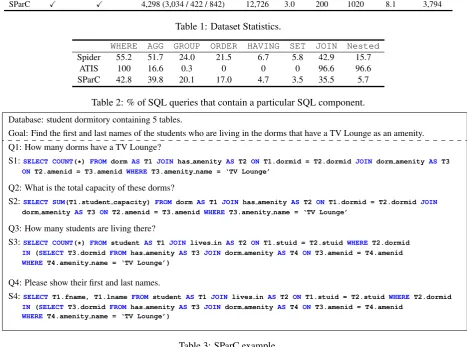
Context Cross-Domain Interaction (train / dev / test) Question Turn Database Table Q. Length Q. Vocab
Spider 7 X 11,840 (8,659 / 1,034 / 2,147) 11,840 1.0 200 1020 13.4 4,818
ATIS X 7 1,658 (1,148 / 380 / 130) 11,653 7.0 1 27 10.2 1,582
[image:2.595.70.538.96.443.2]SParC X X 4,298 (3,034 / 422 / 842) 12,726 3.0 200 1020 8.1 3,794
Table 1: Dataset Statistics.
WHERE AGG GROUP ORDER HAVING SET JOIN Nested Spider 55.2 51.7 24.0 21.5 6.7 5.8 42.9 15.7
ATIS 100 16.6 0.3 0 0 0 96.6 96.6
SParC 42.8 39.8 20.1 17.0 4.7 3.5 35.5 5.7
Table 2: % of SQL queries that contain a particular SQL component.
Database: student dormitory containing 5 tables.
Goal: Find the first and last names of the students who are living in the dorms that have a TV Lounge as an amenity.
Q1: How many dorms have a TV Lounge?
S1:SELECT COUNT(*) FROM dorm AS T1 JOIN has amenity AS T2ON T1.dormid = T2.dormid JOIN dorm amenity AS T3 ON T2.amenid = T3.amenid WHERE T3.amenity name = ‘TV Lounge’
Q2: What is the total capacity of these dorms?
S2:SELECT SUM(T1.student capacity) FROM dorm AS T1JOIN has amenity AST2 ON T1.dormid = T2.dormid JOIN dorm amenity AS T3 ON T2.amenid = T3.amenid WHERE T3.amenity name = ‘TV Lounge’
Q3: How many students are living there?
S3:SELECT COUNT(*) FROM student AS T1JOIN lives in AS T2ON T1.stuid = T2.stuid WHERE T2.dormid IN (SELECT T3.dormid FROM has amenity AS T3 JOIN dorm amenity AS T4 ON T3.amenid = T4.amenid WHERE T4.amenity name = ‘TV Lounge’)
Q4: Please show their first and last names.
S4:SELECT T1.fname, T1.lname FROM student AS T1 JOIN lives in AS T2 ON T1.stuid = T2.stuid WHERE T2.dormid IN (SELECT T3.dormid FROM has amenity AS T3 JOIN dorm amenity AS T4 ON T3.amenid = T4.amenid
WHERE T4.amenity name = ‘TV Lounge’)
Table 3: SParC example.
match accuracy over the previous state-of-the-art. Further analysis shows that our editing approach is more robust to error propagation than copying seg-ments, and the improvement becomes more signif-icant if the basic text-to-SQL generation accuracy (without editing) improves.
2 Cross-Domain Context-Depencent Semantic Parsing
2.1 Datasets
We use SParC 1 (Yu et al., 2019b), a large-scale cross-domain context-dependent semantic parsing dataset with SQL labels, as our main evaluation benchmark. A SParC example is shown in Table 3. We also report performance on ATIS (Hemphill et al.,1990;Dahl et al.,1994a) for direct compar-ison toSuhr et al. (2018). In addition, we evalu-ate the cross-domain context-independent text-to-SQL ability of our model on Spider2 (Yu et al.,
1
https://yale-lily.github.io/sparc 2https://yale-lily.github.io/spider
2018c), which SParC is built on.
We summarize and compare the data statistics in Table 1 and Table2. While the ATIS dataset has been extensively studied, it is limited to a particular domain. By contrast, SParC is both context-dependent and cross-domain. Each inter-action in SParC is constructed using a question in Spider as the interaction goal, where the annota-tor asks inter-related questions to obtain informa-tion that completes the goal. SParC contains in-teractions over 200 databases and it follows the same database split as Spider where each database appears only in one of train, dev and test sets. In summary, SParC introduces new challenges to context-dependent text-to-SQL because it (1) con-tains more complex context dependencies, (2) has greater semantic coverage, and (3) adopts a cross-domain task setting.
2.2 Task Formulation
LetXdenote a natural language utterance andY
Context-What is the customer id of the most recent customer?
What is their name?
SELECT customer_id FROM customers ORDER BY date_became_customer DESC LIMIT 1
LSTM Query Decoder
Interaction Encoder
Utterance Encoder
Utterance Encoder
SELECT customer_name FROM customers ORDER BY date_became_customer DESC LIMIT 1
LSTM Query Decoder
Attention Over Previous Utterances, Column Headers, Previous Query Bi LSTM Query Encoder
Table Encoder
Table: customers customer_id customer_name
Figure 1: Model architecture of editing the previous query with attentions to the user utterances, the table schema, and the previously generated query.
independent semantic parsing considers individ-ual (X, Y) pairs and maps X toY. In context-dependent semantic parsing, we consider an inter-actionI consisting ofnutterance-query pairs in a sequence:
I = [(Xi, Yi)]ni=1
At each turnt, the goal is to generateYtgiven the
current utteranceXtand the interaction history
[(X1, Y1),(X2, Y2), . . . ,(Xt−1, Yt−1)]
Furthermore, in the cross-domain setting, each interaction is grounded to a different database. Therefore, the model is also given the schema of the current database as an input. We consider re-lational databases with multiple tables, and each table contains multiple column headers:
T = [c1, c2, . . . , cl, . . . , cm]
where m is the number of column headers, and eachclconsists of multiple words including its
ta-ble name and column name (§3.1).
3 Methodology
We employ an encoder-decoder architecture with attention mechanisms (Sutskever et al.,2014; Lu-ong et al.,2015) as illustrated in Figure 1. The framework consists of (1) an utterance-table en-coder to explicitly encode the user utterance and table schema at each turn, (2) A turn attention in-corporating the recent history for decoding, (3) a table-aware decoder taking into account the con-text of the utterance, the table schema, and the pre-viously generated query to make editing decisions.
3.1 Utterance-Table Encoder
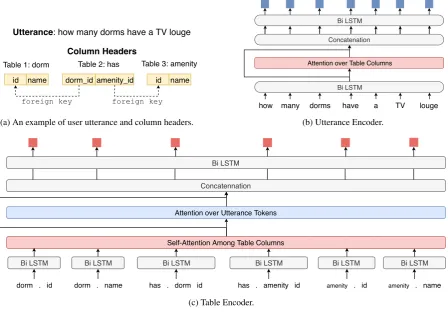
An effective encoder captures the meaning of user utterances, the structure of table schema, and the relationship between the two. To this end, we build an utterance-table encoder with co-attention between the two as illustrated in Figure2.
Figure2bshows the utterance encoder. For the user utterance at each turn, we first use a bi-LSTM to encode utterance tokens. The bi-LSTM hid-den state is fed into a dot-product attention layer (Luong et al., 2015) over the column header em-beddings. For each utterance token embedding, we get an attention weighted average of the col-umn header embeddings to obtain the most rele-vant columns (Dong and Lapata,2018). We then concatenate the bi-LSTM hidden state and the col-umn attention vector, and use a second layer bi-LSTM to generate the utterance token embedding
hE.
Figure 2c shows the table encoder. For each column header, we concatenate its table name and its column name separated by a special dot token (i.e.,table name . column name). Each column header is processed by a bi-LSTM layer. To better capture the internal structure of the table schemas (e.g., foreign key), we then employ a self-attention (Vaswani et al.,2017) among all column headers. We then use an attention layer to cap-ture the relationship between the utterance and the table schema. We concatenate the self-attention vector and the utterance attention vector, and use a second layer bi-LSTM to generate the column header embeddinghC.
Table 1: dorm Table 2: has Table 3: amenity
id name dorm_id amenity_id id name
foreign key foreign key
Column Headers
Utterance: how many dorms have a TV louge
(a) An example of user utterance and column headers.
how
Bi LSTM
many dorms have a TV louge
Attention over Table Columns
Bi LSTM
Concatenation
(b) Utterance Encoder.
Self-Attention Among Table Columns Attention over Utterance Tokens
Bi LSTM Bi LSTM Bi LSTM Bi LSTM Bi LSTM Bi LSTM
dorm . id dorm . name has . dorm id has . amenity id amenity . id amenity . name
Bi LSTM
Concatennation
[image:4.595.77.526.63.376.2](c) Table Encoder.
Figure 2: Utterance-Table Encoder for the example in (a).
Utterance-Table BERT Embedding. We con-sider two options as the input to the first layer bi-LSTM. The first choice is the pretrained word em-bedding. Second, we also consider the contextu-alized word embedding based on BERT (Devlin et al., 2019). To be specific, we follow Hwang et al.(2019) to concatenate the user utterance and all the column headers in a single sequence sepa-rated by the[SEP]token:
[CLS], Xi,[SEP], c1,[SEP], . . . , cm,[SEP]
This sequence is fed into the pretrained BERT model whose hidden states at the last layer is used as the input embedding.
3.2 Interaction Encoder with Turn Attention
To capture the information across different utter-ances, we use an interaction-level encoder (Suhr et al.,2018) on top of the utterance-level encoder. At each turn, we use the hidden state at the last time step from the utterance-level encoder as the utterance encoding. This is the input to a uni-directional LSTM interaction encoder:
hUi =hEi,|X
i|
hIi+1=LSTMI(hUi ,hIi)
The hidden state of this interaction encoder hI
encodes the history as the interaction proceeds. Turn Attention When issuing the current utter-ance, the user may omit or explicitly refer to the previously mentioned information. To this end, we adopt the turn attention mechanism to capture correlation between the current utterance and the utterance(s) at specific turn(s). At the current turn
t, we compute the turn attention by the dot-product attention between the current utterance and pre-vious utterances in the history, and then add the weighted average of previous utterance embed-dings to the current utterance embedding:
si =hUtWturn-atthUi αturn = softmax(s)
cturnt =hUt + t−1
X
i=1
αturni ×hUi
(1)
Thecturnt summarizes the context information and the current user query and will be used as the ini-tial decoder state as described in the following.
3.3 Table-aware Decoder
[image:4.595.352.525.591.661.2]history, the current user utterance, and the table schema.
Denote the decoding step as k, we provide the decoder input as a concatenation of the embedding of SQL query tokenqkand a context vectorck:
hDk+1 =LSTMD([qk;ck],hDk)
where hD is the hidden state of the decoder LSTMD, and the hidden state hD0 is initialized by cturn
t . When the query token is a SQL
key-word,qkis a learned embedding; when it is a
col-umn header, we use the colcol-umn header embedding given by the table-utterance encoder as qk. The
context vectorckis described below.
Context Vector with the Table and User Utter-ance. The context vector consists of attentions to both the table and the user utterance. First, at each step k, the decoder computes the attention between the decoder hidden state and the column header embedding.
sl=hDkWcolumn-atthCl
αcolumn= softmax(s)
ccolumnk =X l
αlcolumn×hCl
(2)
wherelis the index of column headers andhCl is its embedding. Second, it also computes the at-tention between the decoder hidden state and the utterance token embeddings:
si,j=hDkWutterance-atthEi,j
αutterance= softmax(s)
ctokenk =X i,j
αutterancei,j ×hEi,j
(3)
whereiis the turn index,jis the token index, and
hEi,j is the token embedding for thej-th token of
i-th utterance. The context vectorckis a
concate-nation of the two:
ck= [ccolumnk ;ctokenk ]
Output Distribution. In the output layer, our de-coder chooses to generate a SQL keyword (e.g.,
SELECT, WHERE, GROUP BY, ORDER BY) or
[image:5.595.318.515.64.208.2]a column header. This is critical for the cross-domain setting where the table schema changes across different examples. To achieve this, we use separate layers to score SQL keywords and col-umn headers, and finally use the softmax operation
Figure 3: Number of operations at different turns.
to generate the output probability distribution:
ok= tanh([hDk;ck]Wo)
mSQL=okWSQL+bSQL
mcolumn=okWcolumnhC
P(yk) = softmax([mSQL;mcolumn])
(4)
3.4 Query Editing Mechanism
In an interaction with the system, the user of-ten asks a sequence of closely related questions to complete the final query goal. Therefore, the query generated for the current turn often overlaps significantly with the previous ones.
To empirically verify the usefulness of leverag-ing the previous query, we consider the process of generating the current query by applying copy and insert operations to the previous query3. Fig-ure3 shows the SQL query length and the num-ber of copy and insert operations at different turns. As the interaction proceeds, the user question be-comes more complicated as it requires longer SQL query to answer. However, more query tokens overlap with the previous query, and thus the num-ber of new tokens remains small at the third turn and beyond.
Based on this observation, we extend our table-ware decoder with a query editing mechanism. We first encode the previous query using another bi-LSTM, and its hidden states are the query token embeddings hQi,j0 (i.e., the j0-th token of thei-th
query). We then extend the context vector with the attention to the previous query:
ck= [ccolumnk ;ctokenk ;c query k ]
wherecqueryk is produced by an attention to query tokenshQi,j0 in the same form as Equation3.
At each decoding step, we predict a switchpcopy
to decide if we need copy from the previous query or insert a new token.
pcopy=σ(ckWcopy+bcopy)
pinsert= 1−pcopy
(5)
Then, we use a separate layer to score the query tokens at turnt−1, and the output distribution is modified as the following to take into account the editing probability:
Pprev SQL= softmax(okWprev SQLhQt−1)
mSQL=okWSQL+bSQL
mcolumn=okWcolumnhC
PSQLS
column= softmax([mSQL;mcolumn])
P(yk) =pcopy·Pprev SQL(yk∈prev SQL)
+pinsert·PSQLS
column(yk∈SQL
[
column)
(6)
While the copy mechanism has been introduced byGu et al.(2016) andSee et al.(2017), they fo-cus on summarization or response generation ap-plications by copying from the source sentences. By contrast, our focus is on editing the previously generated query while incorporating the context of user utterances and table schemas.
4 Related Work
Semantic parsing is the task of mapping natu-ral language sentences into formal representations. It has been studied for decades including using linguistically-motivated compositional representa-tions, such as logical forms (Zelle and Mooney, 1996; Clarke et al., 2010) and lambda calculus (Zettlemoyer and Collins,2005;Artzi and Zettle-moyer, 2011), and using executable programs, such as SQL queries (Miller et al., 1996; Zhong et al., 2017) and other general-purpose program-ming languages (Yin and Neubig,2017;Iyer et al., 2018). Most of the early studies worked on a few domains and small datasets such as GeoQuery (Zelle and Mooney, 1996) and Overnight (Wang et al.,2015).
Recently, large and cross-domain text-to-SQL datasets such as WikiSQL (Zhong et al.,2017) and Spider (Yu et al.,2018c) have received an increas-ing amount of attention as many data-driven neural approaches achieve promising results (Dong and Lapata,2016;Su and Yan,2017;Iyer et al.,2017; Xu et al., 2017;Finegan-Dollak et al., 2018;Yu
et al.,2018a;Huang et al.,2018;Dong and Lap-ata,2018;Sun et al.,2018;Gur et al.,2018;Guo et al.,2018;Yavuz et al.,2018;Shi et al.,2018). Most of them still focus on context-independent semantic parsing by converting single-turn ques-tions into executable queries.
Relatively less effort has been devoted to context-dependent semantic parsing on datasets including ATIS (Hemphill et al.,1990;Dahl et al., 1994b), SpaceBook (Vlachos and Clark, 2014), SCONE (Long et al.,2016;Guu et al.,2017;Fried et al., 2018; Suhr and Artzi, 2018;Huang et al., 2019), SequentialQA (Iyyer et al., 2017), SParC (Yu et al.,2019b) and CoSQL (Yu et al., 2019a). On ATIS,Miller et al. (1996) maps utterances to semantic frames which are then mapped to SQL queries; Zettlemoyer and Collins (2009) starts with context-independent Combinatory Categorial Grammar (CCG) parsing and then resolves refer-ences to generate lambda-calculus logical forms for sequences of sentences. The most relevant to our work is Suhr et al. (2018), who gener-ate ATIS SQL queries from interactions by in-corporating history with an interaction-level en-coder and copying segments of previously gener-ated queries. Furthermore, SCONE contains three domains using stack- or list-like elements and most queries include a single binary predicate. Se-quentialQA is created by decomposing some com-plicated questions in WikiTableQuestions ( Pasu-pat and Liang,2015). Since both SCONE and Se-quentialQA are annotated with only denotations but not query labels, they don’t include many questions with rich semantic and contextual types. For example, SequentialQA (Iyyer et al.,2017) re-quires that the answer to follow-up questions must be a subset of previous answers, and most of the questions can be answered by simple SQL queries withSELECTandWHEREclauses.
chal-lenges for text-to-SQL systems.
Our work is also related to recently proposed approaches to code generation by editing (Hayati et al., 2018; Yin et al., 2019; Hashimoto et al., 2018). While they follow the framework of gen-erating code by editing the relevant examples re-trieved from training data, we focus on a context-dependent setting where we generate queries from the previous query predicted by the system itself.
5 Experimental Results
5.1 Metrics
On both Spider and SParC, we use the exact set match accuracy between the gold and the pre-dicted queries4. To avoid ordering issues, instead of using simple string matching,Yu et al.(2018c) decompose predicted queries into different SQL clauses such as SELECT, WHERE, GROUP BY,
and ORDER BY and compute scores for each
clause using set matching separately. On SparC, we report two metrics: question match accuracy which is the score average over all questions and interaction match accuracy which is average over all interactions.
5.2 Baselines
SParC.We compare with the two baseline models released byYu et al.(2019b).
(1) Context-dependent Seq2Seq (CD-Seq2Seq): This model is adapted from Suhr et al. (2018). The original model was developed for ATIS and does not take the database schema as input hence cannot generalize well across domains. Yu et al. (2019b) adapt it to perform context-dependent SQL generation in multiple domains by adding a bi-LSTM database schema encoder which takes bag-of-words representations of column headers as input. They also modify the decoder to select between a SQL keyword or a column header.
(2) SyntaxSQL-con: This is adapted from the original context-agnostic SyntaxSQLNet (Yu et al., 2018b) by using bi-LSTMs to encode the interaction history including the utterance and the associated SQL query response. It also employs a column attention mechanism to compute represen-tations of the previous question and SQL query.
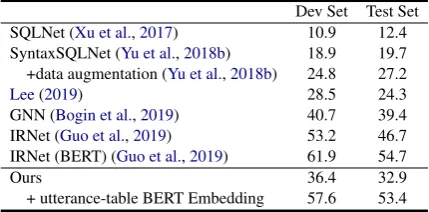
Spider. We compare with the results as re-ported inYu et al.(2018b). Furthermore, we also include recent results from Lee (2019) who pro-pose to use recursive decoding procedure, Bogin
4More details at
https://github.com/taoyds/spider/ tree/master/evaluation_examples
Dev Set Test Set
SQLNet (Xu et al.,2017) 10.9 12.4
SyntaxSQLNet (Yu et al.,2018b) 18.9 19.7 +data augmentation (Yu et al.,2018b) 24.8 27.2
Lee(2019) 28.5 24.3
GNN (Bogin et al.,2019) 40.7 39.4
IRNet (Guo et al.,2019) 53.2 46.7
IRNet (BERT) (Guo et al.,2019) 61.9 54.7
Ours 36.4 32.9
[image:7.595.309.524.63.169.2]+ utterance-table BERT Embedding 57.6 53.4
Table 4: Spider results on dev set and test set.
et al. (2019) introducing graph neural networks for encoding schemas, andGuo et al.(2019) who achieve state-of-the-art performance by using an intermediate representation to bridge natural lan-guage questions and SQL queries.
5.3 Implementation Details
Our model is implemented in PyTorch (Paszke et al.,2017). We use pretrained 300-dimensional GloVe (Pennington et al.,2014) word embedding. All LSTM layers have 300 hidden size, and we use 1 layer for encoder LSTMs, and 2 layers for decoder LSTMs. We use the ADAM optimizer (Kingma and Ba, 2015) to minimize the token-level cross-entropy loss with a batch size of 16. Model parameters are randomly initialized from a uniform distribution U[−0.1,0.1]. The main model has an initial learning rate of 0.001 and it will be multiplied by 0.8 if the validation loss in-creases compared with the previous epoch. When using BERT instead of GloVe, we use the pre-trained small uncased BERT model with 768 hid-den size5, and we fine tune it with a separate con-stant learning rate of 0.00001. The training typi-cally converges in 10 epochs.
5.4 Overall Results
Spider. Table 4 shows the results on Spider dataset. Since each question is standalone, we don’t use interaction-level decoder or query edit-ing. Our method can achieve the performance of 36.4% on dev set and 32.9% on test set, serving as a strong model for the context-independent cross-domain text-to-SQL generation. This demon-strates the effectiveness of our utterance-table en-coder and table-aware deen-coder to handle the se-mantics of user utterances and the complexity of table schemas to generate complex SQL queries in unseen domains.
Furthermore, adding the utterance-table BERT
5
Question Match Interaction Match Dev Test Dev Test SyntaxSQL-con (Yu et al.,2019b) 18.5 20.2 4.3 5.2 CD-Seq2Seq (Yu et al.,2019b)∗ 21.9 23.2 8.1 7.5 + segment copy (w/ predicted query) 21.7 20.3 9.5 8.1 + segment copy (w/ gold query) 27.3 26.7 10.0 8.4 Ours 31.4 – 14.7 –
[image:8.595.85.511.65.232.2]+ query attention and sequence editing (w/ predicted query) 33.0 – 16.4 – + query attention and sequence editing (w/ gold query) 40.6 – 17.3 – Ours + utterance-table BERT Embedding 40.4 – 18.1 – + query attention (w/ predicted query) 42.7 – 21.6 – + query attention and sequence editing (w/ predicted query) 47.2 47.9 29.5 25.3 + query attention and sequence editing (w/ gold query) 53.4 54.5 29.2 25.0
Table 5: SParC results. For our models, we only report test set results of our best model on the dev set. ∗We improve the CD-Seq2Seq performance overYu et al.(2019b) by separating and parsing the column names (e.g., stu fname→student first name) and using the schema-specific output vocabulary during decoding.
Dev Set Test Set
Query Relaxed Strict Query Relaxed Strict FULL (Suhr et al.,2018) 37.5±0.9 63.0±0.7 62.5±0.9 43.6±1.0 69.3±0.8 69.2±0.8
Ours 36.2 60.5 60.0 43.9 68.5 68.1
Table 6: ATIS results on dev set and test set.
embedding gives significant improvement, achiev-ing 57.6% on dev set and 53.4% on test set, which is comparable to the state-of-the-art results from IRNet with BERT. We attribute our BERT model’s high performance to (1) the empirically power-ful text understanding ability of pretrained BERT model and (2) the early interaction between utter-ances and column headers when they are concate-nated in a single sequence as the BERT input.
SParC. Table 5 shows the results on SParC dataset. Similar to Spider, our model with-out previous query as input already with- outper-forms SyntaxSQL-con, achieving 31.4% ques-tion matching accuracy and 14.7% interacques-tion matching accuracy. In addition, compared with CD-Seq2Seq, our model enjoys the benefits of the table-utterance encoder, turn attention, and the joint consideration of utterances and table schemas during the decoding stage. This boosts the performance by 10% question accuracy and 6% interaction accuracy.
Furthermore, we also investigate the effect of copying segment. We use the same segment copy procedure asSuhr et al.(2018): first deterministi-cally extract segments from the previous query and encode each segment using an LSTM, then gener-ate a segment by computing its output probability based on its segment encoding. However, since the segment extraction from Suhr et al. (2018)
is exclusively designed for the ATIS dataset, we implement our own segment extraction proce-dure by extractingSELECT, FROM, GROUP BY, ORDER BYclauses as well as different conditions inWHEREclauses. In this way, 3.9 segments can be extracted per SQL on average. We found that adding segment copying to CD-Seq2Seq gives a slightly lower performance on question matching and a small gain on interaction matching, while using segments extracted from the gold query can have much higher results. This demonstrates that segment copy is vulnerable to error propagation. In addition, it can only copy whole segments hence has difficulty capturing the changes of only one or a few tokens in the query.
To better understand how models perform as the interaction proceeds, Figure4(Left) shows the performance split by turns on the dev set. The questions asked in later turns are more difficult to answer given longer context history. While the baselines have lower performance as the turn num-ber increases, our model still maintains 38%-48% accuracy for turn 2 and 3, and 20% at turn 4 or beyond. Similarly, Figure 4 (Right) shows the performance split by hardness levels with the fre-quency of examples. This also demonstrates our model is more competitive in answering hard and extra hard questions.
[image:8.595.110.491.284.333.2]Figure 4: Performance split by different turns (Left) and hardness levels (Right) on SParC dev set.
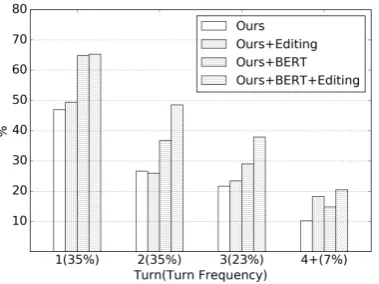
Figure 5: Effect of query editing at different turns on SParC dev set.
on ATIS in Table 6. Our model achieves 36.2% dev and 43.9% test string accuracy, comparable to Suhr et al. (2018). On ATIS, we only apply our editing mechanism and reuse their utterance encoder instead of the BERT utterance-table en-coder, because ATIS is single domain.
5.5 Effect of Query Editing
We further investigate the effect of our query edit-ing mechanism. To this end, we apply editedit-ing from both the gold query and the predicted query on our model with or without the utterance-table BERT embedding. We also perform an ablation study to validate the contribution of query attention and se-quence editing separately.
As shown in Table5, editing the gold query con-sistently improves both question match and inter-action match accuracy. This shows the editing ap-proach is indeed helpful to improve the generation quality when the previous query is the oracle.
Using the predicted query is a more realistic set-ting, and in this case, the model is affected by error propagation due to the incorrect queries produced by itself. For the model without the
utterance-table BERT embedding, using the predicted query only gives around 1.5% improvement. As shown in Figure5, this is because the editing mechanism is more helpful for turn 4 which is a small fraction of all question examples. For the model with the utterance-table BERT embedding, the query gen-eration accuracy at each turn is significantly im-proved, thus reducing the error propagation effect. In this case, the editing approach delivers con-sistent improvements of 7% increase on question matching accuracy and 11% increase on interac-tion matching accuracy. Figure5also shows that query editing with BERT benefits all turns.
Finally, as an ablation study, Table 5 also re-ports the result with only query attention (use pre-dicted query) on the dev set. This improves over our vanilla BERT model without query attention and achieves 42.7% question and 21.6% interac-tion matching accuracy. With query editing, our best model further improves to 47.2% question and 29.5% interaction matching accuracy. This demonstrates the effectiveness of our query atten-tion and query editing separately, both of which are essential to make use of the previous query.
6 Conclusions
In this paper, we propose an editing-based encoder-decoder model to address the problem of context-dependent cross-domain text-to-SQL gen-eration. While being simple, empirical results demonstrate the benefits of our editing mecha-nism. The approach is more robust to error propa-gation than copying segments, and its performance increases when the basic text-to-SQL generation quality (without editing) is better.
Acknowledgements
[image:9.595.89.279.246.388.2]References
Yoav Artzi and Luke Zettlemoyer. 2011. Bootstrap-ping semantic parsers from conversations. In Pro-ceedings of the conference on empirical methods in natural language processing, pages 421–432. Asso-ciation for Computational Linguistics.
Ben Bogin, Matt Gardner, and Jonathan Berant. 2019. Representing schema structure with graph neural networks for text-to-sql parsing. InACL.
James Clarke, Dan Goldwasser, Ming-Wei Chang, and Dan Roth. 2010. Driving semantic parsing from the world’s response. In Proceedings of the four-teenth conference on computational natural lan-guage learning, pages 18–27. Association for Com-putational Linguistics.
Deborah A. Dahl, Madeleine Bates, Michael Brown, William Fisher, Kate Hunicke-Smith, David Pallett, Christine Pao, Alexander Rudnicky, and Elizabeth Shriberg. 1994a. Expanding the scope of the atis task: The atis-3 corpus. InProceedings of the Work-shop on Human Language Technology, HLT ’94, Stroudsburg, PA, USA. Association for Computa-tional Linguistics.
Deborah A Dahl, Madeleine Bates, Michael Brown, William Fisher, Kate Hunicke-Smith, David Pallett, Christine Pao, Alexander Rudnicky, and Elizabeth Shriberg. 1994b. Expanding the scope of the atis task: The atis-3 corpus. InProceedings of the work-shop on Human Language Technology, pages 43–48. Association for Computational Linguistics.
Jacob Devlin, Ming-Wei Chang, Kenton Lee, and Kristina Toutanova. 2019. Bert: Pre-training of deep bidirectional transformers for language understand-ing. InNAACL.
Li Dong and Mirella Lapata. 2016. Language to logi-cal form with neural attention. InProceedings of the 54th Annual Meeting of the Association for Compu-tational Linguistics, ACL 2016, August 7-12, 2016, Berlin, Germany, Volume 1: Long Papers.
Li Dong and Mirella Lapata. 2018. Coarse-to-fine de-coding for neural semantic parsing. In Proceed-ings of the 56th Annual Meeting of the Association for Computational Linguistics (Volume 1: Long Pa-pers).
Catherine Finegan-Dollak, Jonathan K. Kummerfeld, Li Zhang, Karthik Ramanathan, Sesh Sadasivam, Rui Zhang, and Dragomir Radev. 2018. Improv-ing text-to-sql evaluation methodology. In Proceed-ings of the 56th Annual Meeting of the Association for Computational Linguistics (Volume 1: Long Pa-pers).
Daniel Fried, Jacob Andreas, and Dan Klein. 2018. Unified pragmatic models for generating and follow-ing instructions. InProceedings of the 2018 Confer-ence of the North American Chapter of the Associ-ation for ComputAssoci-ational Linguistics: Human Lan-guage Technologies, Volume 1 (Long Papers).
Jiatao Gu, Zhengdong Lu, Hang Li, and Victor O.K. Li. 2016. Incorporating copying mechanism in sequence-to-sequence learning. In Proceedings of the 54th Annual Meeting of the Association for Com-putational Linguistics (Volume 1: Long Papers).
Daya Guo, Yibo Sun, Duyu Tang, Nan Duan, Jian Yin, Hong Chi, James Cao, Peng Chen, and Ming Zhou. 2018. Question generation from sql queries im-proves neural semantic parsing. In Proceedings of the 2018 Conference on Empirical Methods in Nat-ural Language Processing.
Jiaqi Guo, Zecheng Zhan, Yan Gao, Yan Xiao, Jian-Guang Lou, Ting Liu, and Dongmei Zhang. 2019. Towards complex text-to-sql in cross-domain database with intermediate representation. InACL.
Izzeddin Gur, Semih Yavuz, Yu Su, and Xifeng Yan. 2018. Dialsql: Dialogue based structured query generation. InProceedings of the 56th Annual Meet-ing of the Association for Computational LMeet-inguistics (Volume 1: Long Papers).
Kelvin Guu, Panupong Pasupat, Evan Liu, and Percy Liang. 2017. From language to programs: Bridg-ing reinforcement learnBridg-ing and maximum marginal likelihood. InProceedings of the 55th Annual Meet-ing of the Association for Computational LMeet-inguistics (Volume 1: Long Papers).
Tatsunori B Hashimoto, Kelvin Guu, Yonatan Oren, and Percy S Liang. 2018. A retrieve-and-edit frame-work for predicting structured outputs. InAdvances in Neural Information Processing Systems, pages 10052–10062.
Shirley Anugrah Hayati, Raphael Olivier, Pravalika Avvaru, Pengcheng Yin, Anthony Tomasic, and Gra-ham Neubig. 2018. Retrieval-based neural code generation. InEMNLP.
Charles T Hemphill, John J Godfrey, and George R Doddington. 1990. The atis spoken language sys-tems pilot corpus. InSpeech and Natural Language: Proceedings of a Workshop Held at Hidden Valley, Pennsylvania, June 24-27, 1990.
Hsin-Yuan Huang, Eunsol Choi, and Wen-tau Yih. 2019. Flowqa: Grasping flow in history for con-versational machine comprehension. InICLR.
Po-Sen Huang, Chenglong Wang, Rishabh Singh, Wen-tau Yih, and Xiaodong He. 2018. Natural language to structured query generation via meta-learning. InProceedings of the 2018 Conference of the North American Chapter of the Association for Computational Linguistics: Human Language Tech-nologies, Volume 2 (Short Papers).
Srinivasan Iyer, Ioannis Konstas, Alvin Cheung, Jayant Krishnamurthy, and Luke Zettlemoyer. 2017. Learning a neural semantic parser from user feed-back. InProceedings of the 55th Annual Meeting of the Association for Computational Linguistics (Vol-ume 1: Long Papers).
Srinivasan Iyer, Ioannis Konstas, Alvin Cheung, and Luke Zettlemoyer. 2018. Mapping language to code in programmatic context. In Proceedings of the 2018 Conference on Empirical Methods in Natural Language Processing.
Mohit Iyyer, Wen-tau Yih, and Ming-Wei Chang. 2017. Search-based neural structured learning for sequen-tial question answering. InProceedings of the 55th Annual Meeting of the Association for Computa-tional Linguistics (Volume 1: Long Papers).
Diederik P Kingma and Jimmy Ba. 2015. Adam: A method for stochastic optimization. InICLR.
Dongjun Lee. 2019. Recursive and clause-wise decod-ing for complex and cross-domain text-to-sql gener-ation. InCoRR.
Reginald Long, Panupong Pasupat, and Percy Liang. 2016. Simpler context-dependent logical forms via model projections. In Proceedings of the 54th An-nual Meeting of the Association for Computational Linguistics (Volume 1: Long Papers).
Minh-Thang Luong, Hieu Pham, and Christopher D Manning. 2015. Effective approaches to attention-based neural machine translation. InEMNLP.
Scott Miller, David Stallard, Robert Bobrow, and Richard Schwartz. 1996. A fully statistical approach to natural language interfaces. InProceedings of the 34th Annual Meeting of the Association for Compu-tational Linguistics.
Panupong Pasupat and Percy Liang. 2015. Compo-sitional semantic parsing on semi-structured tables. In Proceedings of the 53rd Annual Meeting of the Association for Computational Linguistics and the 7th International Joint Conference on Natural Lan-guage Processing (Volume 1: Long Papers).
Adam Paszke, Sam Gross, Soumith Chintala, Gre-gory Chanan, Edward Yang, Zachary DeVito, Zem-ing Lin, Alban Desmaison, Luca Antiga, and Adam Lerer. 2017. Automatic differentiation in pytorch. InNIPS 2017 Workshop Autodiff.
Jeffrey Pennington, Richard Socher, and Christopher Manning. 2014. Glove: Global vectors for word representation. InProceedings of the 2014 confer-ence on empirical methods in natural language pro-cessing (EMNLP), pages 1532–1543.
Abigail See, Peter J. Liu, and Christopher D. Manning. 2017. Get to the point: Summarization with pointer-generator networks. InProceedings of the 55th An-nual Meeting of the Association for Computational Linguistics (Volume 1: Long Papers).
Tianze Shi, Kedar Tatwawadi, Kaushik Chakrabarti, Yi Mao, Oleksandr Polozov, and Weizhu Chen. 2018. Incsql: Training incremental text-to-sql parsers with non-deterministic oracles. arXiv preprint arXiv:1809.05054.
Yu Su and Xifeng Yan. 2017. Cross-domain seman-tic parsing via paraphrasing. InProceedings of the 2017 Conference on Empirical Methods in Natural Language Processing.
Alane Suhr and Yoav Artzi. 2018. Situated mapping of sequential instructions to actions with single-step reward observation. InProceedings of the 56th An-nual Meeting of the Association for Computational Linguistics (Volume 1: Long Papers).
Alane Suhr, Srinivasan Iyer, and Yoav Artzi. 2018. Learning to map context-dependent sentences to ex-ecutable formal queries. InProceedings of the 2018 Conference of the North American Chapter of the Association for Computational Linguistics: Human Language Technologies, Volume 1 (Long Papers).
Yibo Sun, Duyu Tang, Nan Duan, Jianshu Ji, Guihong Cao, Xiaocheng Feng, Bing Qin, Ting Liu, and Ming Zhou. 2018. Semantic parsing with syntax- and table-aware sql generation. In Proceedings of the 56th Annual Meeting of the Association for Compu-tational Linguistics (Volume 1: Long Papers).
Ilya Sutskever, Oriol Vinyals, and Quoc V Le. 2014. Sequence to sequence learning with neural net-works. InAdvances in neural information process-ing systems, pages 3104–3112.
Ashish Vaswani, Noam Shazeer, Niki Parmar, Jakob Uszkoreit, Llion Jones, Aidan N Gomez, Łukasz Kaiser, and Illia Polosukhin. 2017. Attention is all you need. InAdvances in neural information pro-cessing systems, pages 5998–6008.
Andreas Vlachos and Stephen Clark. 2014. A new cor-pus and imitation learning framework for context-dependent semantic parsing. Transactions of the As-sociation for Computational Linguistics.
Yushi Wang, Jonathan Berant, and Percy Liang. 2015. Building a semantic parser overnight. In Proceed-ings of the 53rd Annual Meeting of the Association for Computational Linguistics and the 7th Interna-tional Joint Conference on Natural Language Pro-cessing (Volume 1: Long Papers).
Xiaojun Xu, Chang Liu, and Dawn Song. 2017. Sqlnet: Generating structured queries from natural language without reinforcement learning. arXiv preprint arXiv:1711.04436.
Pengcheng Yin and Graham Neubig. 2017. A syntactic neural model for general-purpose code generation. In Proceedings of the 55th Annual Meeting of the Association for Computational Linguistics (Volume 1: Long Papers).
Pengcheng Yin, Graham Neubig, Miltiadis Allamanis, Marc Brockschmidt, and Alexander L Gaunt. 2019. Learning to represent edits. InICLR.
Tao Yu, Zifan Li, Zilin Zhang, Rui Zhang, and Dragomir Radev. 2018a. Typesql: Knowledge-based type-aware neural text-to-sql generation. In Proceedings of NAACL. Association for Computa-tional Linguistics.
Tao Yu, Michihiro Yasunaga, Kai Yang, Rui Zhang, Dongxu Wang, Zifan Li, and Dragomir Radev. 2018b. Syntaxsqlnet: Syntax tree networks for com-plex and cross-domain text-to-sql task. In Proceed-ings of the 2018 Conference on Empirical Methods in Natural Language Processing.
Tao Yu, Rui Zhang, He Yang Er, Suyi Li, Eric Xue, Bo Pang, Xi Victoria Lin, Yi Chern Tan, Tianze Shi, Zihan Li, Youxuan Jiang, Michihiro Yasunaga, Sungrok Shim, Tao Chen, Alexander Fabbri, Zifan Li, Luyao Chen, Yuwen Zhang, Shreya Dixit, Vin-cent Zhang, Caiming Xiong, Richard Socher, Wal-ter Lasecki, and Dragomir Radev. 2019a. Cosql: A conversational text-to-sql challenge towards cross-domain natural language interfaces to databases. In Proceedings of the 2019 Conference on Empiri-cal Methods in Natural Language Processing and 9th International Joint Conference on Natural Lan-guage Processing. Association for Computational Linguistics.
Tao Yu, Rui Zhang, Kai Yang, Michihiro Yasunaga, Dongxu Wang, Zifan Li, James Ma, Irene Li, Qingning Yao, Shanelle Roman, Zilin Zhang, and Dragomir Radev. 2018c. Spider: A large-scale human-labeled dataset for complex and cross-domain semantic parsing and text-to-sql task. In Proceedings of the 2018 Conference on Empirical Methods in Natural Language Processing.
Tao Yu, Rui Zhang, Michihiro Yasunaga, Yi Chern Tan, Xi Victoria Lin, Suyi Li, Heyang Er, Irene Li, Bo Pang, Tao Chen, Emily Ji, Shreya Dixit, David Proctor, Sungrok Shim, Jonathan Kraft, Vin-cent Zhang, Caiming Xiong, Richard Socher, and Dragomir Radev. 2019b. Sparc: Cross-domain se-mantic parsing in context. InProceedings of ACL.
John M. Zelle and Raymond J. Mooney. 1996. Learn-ing to parse database queries usLearn-ing inductive logic programming. In AAAI/IAAI, pages 1050–1055, Portland, OR. AAAI Press/MIT Press.
Luke S. Zettlemoyer and Michael Collins. 2005. Learning to map sentences to logical form: Struc-tured classification with probabilistic categorial grammars. UAI.
Luke S Zettlemoyer and Michael Collins. 2009. Learn-ing context-dependent mappLearn-ings from sentences to logical form. In Proceedings of the Joint Confer-ence of the 47th Annual Meeting of the ACL and the 4th International Joint Conference on Natural Lan-guage Processing of the AFNLP: Volume 2-Volume 2, pages 976–984. Association for Computational Linguistics.